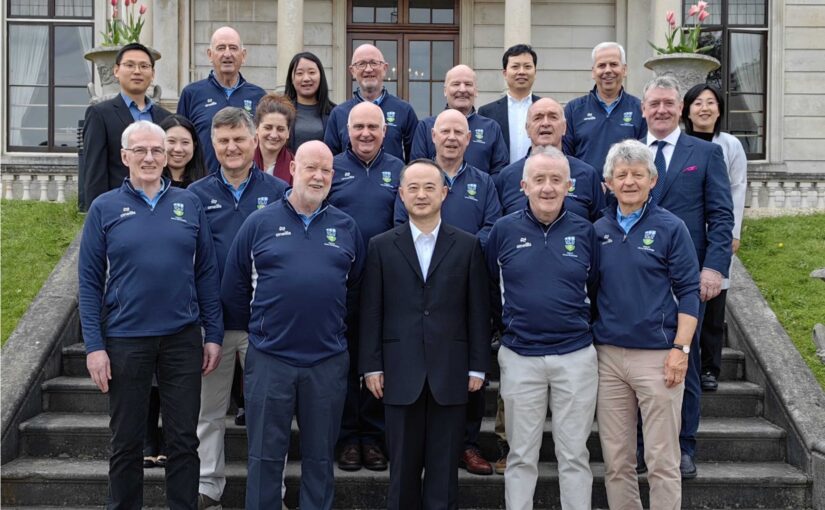
On April 22, 18 former students from University College Dublin (UCD) arrived in Beijing for what for most of them is their first visit to China for half a century. The last time was in September 1976 when they came as members of a 24-strong UCD Soccer Club squad, the first Western football team to play in China since the establishment of the People’s Republic in 1949.
In an interesting article previewing this return visit, Denis Staunton, the newspaper’s Beijing correspondent, writes in the Irish Times:
“Richard Nixon and Henry Kissinger had already initiated the West’s opening to Beijing, which was by then represented at the United Nations, but it was still a highly unusual destination for Irish people.”
Indeed, it was to still be another three years before Ireland and China established diplomatic relations.
Setting out some of the background, Staunton writes: “Paddy Dwyer was an 18-year-old commerce student when he captained the team in China on an expedition that seemed too outlandish when their coach Tony O’Neill proposed it. A medical student known as the Doc, O’Neill worked out the plan, found contacts in China and secured sponsors to help pay for the trip.”
“Certainly, my parents were in disbelief initially. I don’t think anybody believed that it was going to materialise,” Dwyer recalls.
“David Andrews,” Staunton continues, “who was the club’s president and already a Fianna Fáil TD [member of the Irish parliament], described the idea of playing in China as like going on a trip to the moon.”
Their first game was in Shanghai, where they played in front of a crowd of 40,000 people. Dwyer recalls: “We were wearing green Irish jerseys. And I think in retrospect, the Chinese soccer people believed that this was an Irish team. But this was an under-19 UCD team.
“For me, the team that we played against, it was like a provincial team. It would be the equivalent of a Leinster team or a Munster team now in rugby terms. It wasn’t a university side. I think they hammered us 4-1.”
Their trip was to take a dramatic turn. John McGrath, one of the team’s goalkeepers who was a first-year student of history and politics, recalls that a few days after the match in Shanghai, they walked up a hillside to a tea house where they were drinking “a cup of hot water with some tea leaves in it”, when Andrews appeared.
“He came in and said ‘Tá an Cathaoirleach marbh’. And that’s how we found out that Chairman Mao was dead.
“You could see a change in people’s demeanour. When we were walking around the park near that tea room, the Internationale was playing out of the sound boxes in the trees and there were a lot of people crying, older people crying on the benches.”
Staunton writes: “China went into a week of national mourning and the UCD team’s fixtures were cancelled, including a match planned for the Workers’ Stadium in Beijing that had been expected to attract about 100,000 spectators. Instead, they went on trips to various places, among them Mao’s birthplace in the village of Shaoshan in Hunan province.”
Their current return trip to China sees the Irish Embassy host a reception for them in Beijing, before they travel to Shanghai and Changsha, from where they will again visit Mao’s birthplace.
Anticipating the visit, Dwyer said: ““For me, it’s a golden opportunity to see the new China, to see the China of the 21st century. But they’ve afforded me and the rest of these UCD young lads 50 years ago to go back and doing it with 17 or 18 of your mates.”
The Chinese Embassy in Dublin held a reception on April 7 to mark the anniversary and see off the visitors. Addressing the gathering, Ambassador Zhao Xiyuan said:
“Since arriving in Ireland, I have read your journey many times, especially the photographs and stories you have carefully preserved. A group of young Irishmen, traveling without maps or phones and with little shared language, chose to travel halfway around the world with an open spirit. That courage and curiosity left a deep impression on me. Meeting you now feels less like a formal reception and more like a reunion of old friends.
“Of everything I have read, the articles by the late Dr. Tony O’Neill resonate most deeply. To be frank, the China of 1976 was not an easy place to visit; we were a poor nation, and the gap between our reality and the rest of the world was vast. Yet, in Dr. O’Neill’s reporting for the Irish Press, I found not a trace of prejudice or judgment. What I found instead was curiosity, warmth, and a genuine delight in everything that was different and new. Such open-heartedness was admirable then, and in today’s world, it has become exceptionally rare.”
Reviewing China’s achievements over the ensuing half century, Zhao continued:
“The secret weapon behind these achievements has been, and remains, the Five-Year Plan. In 1976, China launched its fifth Plan; last month we adopted the fifteenth. I will leave the details of the plan to be discussed later or leave you to experience it in China yourself. In short, the Plan reflects a nation that is not only growing fast, but also growing thoughtfully, prioritising innovation, the well-being of its people, and global partnership.”
Previewing their itinerary, he noted:
“Your journey then turns west to Changsha, a city that may offer the most striking surprises of all. At Orange Isle, you will stand where Mao Zedong, as a young man of thirty-two, looked out over the horizon and wrote those famous lines:
Brooding over this immensity
I ask, on this boundless land
Who rules over man’s destiny?
[These are lines from Chairman Mao’s 1925 poem Changsha.]
“In Shaoshan, Chairman Mao’s memorial offers a deeper reflection on his life and the profound sacrifices that laid the foundations of the nation.”
In remarks that might be said to combine profundity with informality, the Ambassador noted:
“Speaking of similarities, it is often said China and Ireland share much in common, from our shared history of national liberation, our common drive toward a modern future, to our enthusiasm for a good drink and a cold beer. But standing here with so many footballers, I can’t help but notice one specific similarity.
“Since the summer of 2002, when we both last appeared on the World Cup final stage, China and Ireland have shown an incredible level of selflessness and solidarity. Together, we have maintained a consistent policy for 24 years: gracefully allowing other teams to compete for the trophy while we watch from the sidelines.
“While the recent qualification results were not what we had hoped for, but the story is not over. Both our countries have talented young players and are investing seriously in youth development.”
He concluded: “Like a fine Irish whiskey or a classic Chinese spirit, friendship only grows more refined with time. May your glasses be full, your memories vivid, and this return be the finest chapter yet in a story that is still being written. Sláinte!”
The following articles were originally published on the website of the Chinese Embassy in Dublin.
The Embassy of China in Ireland host a reception to commemorate the 50th Anniversary of UCD Soccer Team’s visit to China
April 8 (Chinese Embassy in Ireland) – On April 7th, the Embassy of China in Ireland hosted a reception to commemorate the 50th anniversary of the UCD Soccer Team’s historic visit to China.
In his remarks, Ambassador Zhao noted that the team’s 1976 visit, as a pioneer of people-to-people exchanges and friendship between China and Ireland, coincided with China’s Fifth Five-Year Plan. Today, as China launches its Fifteenth Five-Year Plan, practical cooperation and cultural exchanges between the two nations have yielded fruitful results across various fields. The Ambassador expressed his belief that the team will fully experience China’s developmental vitality during their commemorative trip later this month, writing a new chapter in the friendship between the two peoples.
The UCD team members enthusiastically shared memories of their visit, expressing what a great honor it was to be the first Western European team to visit China. They look forward to their 50th anniversary commemorative trip at the end of this month and hope to share the story of their two visits to China, spanning half a century, with a wider audience.
Remarks by Ambassador Zhao Xiyuan at the Reception Marking 50th Anniversary of UCD Soccer Team’s visit to China
April 10 (Chinese Embassy in Ireland) – Dear members of the 1976 UCD Soccer Team, Dear friends,
It is a great pleasure to welcome you all today. Since arriving in Ireland, I have read your journey many times, especially the photographs and stories you have carefully preserved. A group of young Irishmen, traveling without maps or phones and with little shared language, chose to travel halfway around the world with an open spirit. That courage and curiosity left a deep impression on me. Meeting you now feels less like a formal reception and more like a reunion of old friends.
Of everything I have read, the articles by the late Dr. Tony O’Neill resonate most deeply. To be frank, the China of 1976 was not an easy place to visit; we were a poor nation, and the gap between our reality and the rest of the world was vast. Yet, in Dr. O’Neill’s reporting for the Irish Press, I found not a trace of prejudice or judgment. What I found instead was curiosity, warmth, and a genuine delight in everything that was different and new. Such open-heartedness was admirable then, and in today’s world, it has become exceptionally rare.
Your record visit met with the threshold of an extraordinary chapter of China. Two years later, China started its reform and opening up and transformed the landscape on a scale rarely seen. Fields became cities, and doors opened where there had been walls. Hundreds of millions were lifted from absolute poverty, discovering new opportunities, new lives, and a more promising future. The video you just watched offers a glimpse of this evolution, and you are about to experience its reality firsthand.
The secret weapon behind these achievements has been, and remains, the Five-Year Plan. In 1976, China launched its fifth Plan; last month we adopted the fifteenth.I will leave the details of the plan to be discussed later, or leave you to experience it in China yourself. In short, the Plan reflects a nation that is not only growing fast, but also growing thoughtfully, prioritizing innovation, the well-being of its people, and global partnership.
China and Ireland did not establish diplomatic relations until three years after your visit. Today, the two countries enjoy a Strategic Partnership for Mutually Beneficial Cooperation. China is now Ireland’s sixth largest trading partner, with bilateral trade in goods and services exceeding 20 billion euros, and Chinese investment in Ireland reaching 12 billion. Following the Taoiseach’s visit earlier this year, academic cooperation has grown to over 150 university partnerships, and 8 pairs of local governments are formally twinned, with Kerry, Louth, and Galway all in active discussions. These are remarkable numbers. But as your story reminds us, the most enduring foundation of any relationship is found in the understanding that grows between people.
50 years on, China-Ireland relationship has evolved alongside you. That is why the journey you are about to take carries a meaning beyond sightseeing.
When you land in Beijing, don’t be surprised if the city feels at once familiar and completely new. The weight of history is still there, in the silence of the Forbidden City and in the ancient Temple of Heaven. But walk a little further, look a little wider, and you will see a metropolis that has remade itself with modern technology. Beijing views its history not as a burden, but as a foundation, a legacy that only adds to its magnificence.
In Shanghai, when you stand at the curve of the Bund and look across the river to Pudong, you will find one of the most dramatic skyline on earth. In 1976, the land on that far bank was largely farmland. And yet, in some historic neighborhoods, you can still catch glimpses of the past, like in the heart of the city, the gardens of Yuyuan remain exactly as they have always been: a place of stillness and poetic care. It is a reminder that in China, while we dream on a grand scale, we never forget to keep a garden at the center of it.
Your journey then turns west to Changsha, a city that may offer the most striking surprises of all. At Orange Isle, you will stand where Mao Zedong, as a young man of thirty-two, looked out over the horizon and wrote those famous lines: “Brooding over this immensity / I ask, on this boundless land / Who rules over man’s destiny?” In Shaoshan, Chairman Mao’s memorial offers a deeper reflection on his life and the profound sacrifices that laid the foundations of the nation.
But when night falls, Changsha reveals a different character and become one of China’s most beloved cities for a night out, full of warmth, noise, extraordinary food, and the kind of generous.
Of course, your itinerary holds far more than I can recount here. To detail every experience would take an entire day, so I shall leave the many fascinating differences between our two nations for you to discover yourselves.
But speaking of similarities, it is often said China and Ireland share much in common, from our shared history of national liberation, our common drive toward a modern future, to our enthusiasm for a good drink and a cold beer. But standing here with so many footballers, I can’t help but notice one specific similarity.
Since the summer of 2002, when we both last appeared on the World Cup final stage, China and Ireland have shown an incredible level of selfless and solidarity. Together, we have maintained a consistent policy for 24 years: gracefully allowing other teams to compete for the trophy while we watch from the sidelines.
While the recent qualification results were not what we had hoped for, but the story is not over. Both our countries have talented young players and are investing seriously in youth development. The hope is alive, and it will find its moment. What those young players need is the wisdom of those who have gone before them. Gentlemen, you know better than most what it takes to step into the unknown. That experience is not something that can be coached from a textbook.
When you first made the journey, you were young men driven by curiosity. Today, Many of you are grandfathers and have retired from your careers. There is a Chinese saying that at your age, a person’s instincts and principles finally move as one. A lifetime of experience brings insights that young people cannot match. I have no doubt that this reunion journey will reveal things to you that were invisible the first time around.
I recently met MEP Barry Andrews, the son of your teammate David Andrews. When I mentioned your return, he recalled watching his father leave for a month to travel to the other side of the world when he was just nine. I share this because I think the most valuable thing you can bring back is not souvenirs, but stories. Share what you saw, what surprised you, what moved you, with your families, your neighbors, your communities. That is how understanding travels, through one person telling another what they found when they crossed the world with an open mind. You did it in 1976, and the ripples are still reaching us today. Do it again, and who knows how far they will travel this time.
Like a fine Irish whiskey or a classic Chinese spirit, friendship only grows more refined with time. May your glasses be full, your memories vivid, and this return be the finest chapter yet in a story that is still being written. Sláinte!