On 20 May, the Trump administration unsealed a federal criminal indictment in Miami against 94-year-old Raúl Castro – former president of Cuba and one of the historic leaders of the Cuban Revolution – along with five other Cuban officials. The indictment, on charges including conspiracy to kill US nationals and the destruction of aircraft, was a calculated political provocation at a moment of maximum US pressure on the island.
China’s response, the following day, was unambiguous: a public rebuke calling on Washington to “stop wielding the big stick of sanctions and judicial measures against Cuba”, and a reaffirmation of Beijing’s firm support for Cuban sovereignty.
In the following article, our co-editor Carlos Martinez situates the indictment in the wider US regime-change campaign, examines China’s diplomatic and material solidarity with Cuba, and traces the six-decade partnership that gives it weight.
On Wednesday 20 May the Trump administration unsealed a federal criminal indictment in Miami against 94-year-old Raúl Castro, former President of Cuba and one of the key historic leaders of the Cuban Revolution, alongside five other Cuban officials. The charges include conspiracy to kill US nationals, four counts of murder, and two counts of destruction of aircraft.
The pretext given is the 1996 downing by Cuban air force MiGs of two aircraft operated by the Miami-based exile group “Brothers to the Rescue”.
The indictment is a transparent political provocation. As the Cuban government made clear in its statement on the subject, “Brothers to the Rescue” was not a humanitarian organisation but a counter-revolutionary terrorist operation founded by long-time CIA-linked Cuban exile José Basulto, which had violated Cuban airspace at least 25 times between 1994 and 1996, despite formal complaints filed by Cuba with the US State Department, the Federal Aviation Administration, and the International Civil Aviation Organisation.
The downing of this terrorist group’s aircraft was nothing more than the defence of Cuban sovereign airspace – an act of self-defence explicitly protected by the United Nations Charter, the 1944 Chicago Convention on International Civil Aviation, and the established principles of air sovereignty and proportionality.
Meanwhile, the hypocrisy is breathtaking. The same US government accusing Cuba of murder has, in recent months, killed nearly 200 people and destroyed 57 vessels in international waters of the Caribbean and the Pacific, on obviously false allegations of drug trafficking. These are, in the precise legal terms used by the Cuban government, “extrajudicial executions” under international law, and murders under US law itself. The accuser is the world’s most prolific extrajudicial killer.
The Castro indictment is not an isolated legal proceeding. It is the latest move in an open campaign of regime change. The Trump administration has tightened the six-decade economic blockade into a full-scale genocidal energy embargo, threatening tariffs against any country selling oil to Cuba and cutting fuel imports by an estimated 90 percent. Blackouts of up to 22 hours a day are the result, with all the disastrous impact on people’s lives that might be expected.
Trump himself has openly stated that the goal is to bring down the Cuban government “by the end of this year”, and asked at the press conference about the indictment whether he was considering a military kidnapping (as carried out against Venezuelan President Nicolás Maduro and First Combatant Cilia Flores), replied only that he “didn’t want to say”. South Carolina senator Lindsey Graham, a highly influential (albeit utterly deranged) figure in the Trump camp, went on record after the start of the US-Israel war on Iran saying that “Cuba’s next”.
China’s response
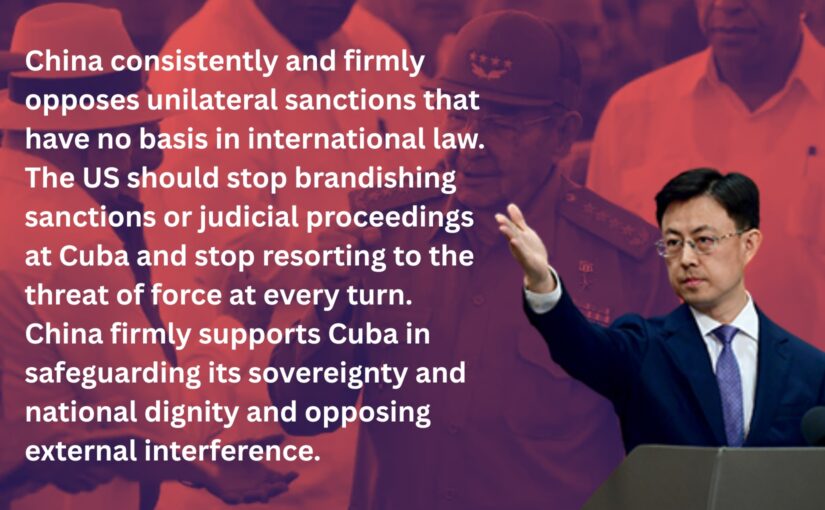
On 21 May, asked by Cuba’s Prensa Latina news agency about the indictment, Chinese foreign ministry spokesperson Guo Jiakun told reporters that Beijing “firmly opposes” illegal unilateral sanctions that lack any basis in international law or authorisation from the UN Security Council, and stands “against abusing judicial means and exerting pressure on Cuba under any pretext by external forces”.
The United States, he continued, “should stop wielding the big stick of sanctions and judicial measures against Cuba, and stop threatening Cuba with force at every turn”. China, he affirmed, “firmly supports Cuba in safeguarding its national sovereignty and national dignity, and opposes external interference”.
To condemn US aggression in such a direct and unequivocal way, in response to a question from a Cuban journalist, in front of the world’s press, is a significant diplomatic statement. It is a direct rebuke of the US government’s illegal and immoral campaign against Cuba, and a clear declaration of solidarity with Cuba’s Revolutionary Government.
This comes just a day after Presidents Xi Jinping and Vladimir Putin called out “treacherous military strikes against other countries, the hypocritical use of negotiations as cover for preparing such strikes, the assassination of leaders of sovereign states, the destabilisation of the domestic political situation in these states and the provocation of regime change, and the brazen kidnapping of national leaders for trial”.
Such strident denunciations of the wars on Iran and Lebanon, the assassination of Sayyid Ali Khamenei, the kidnapping of Nicolás Maduro and Cilia Flores and the indictment of Raúl Castro represent a shift towards a more assertive tone, and send a clear signal that the US’s criminal and imperial conduct will not be tolerated.
A solidarity built over six decades
China-Cuba relations go back many decades. In September 1960, Cuba became the first country in the Western Hemisphere to establish diplomatic relations with the People’s Republic. Fidel Castro always identified strongly with the Chinese Revolution, describing China in 2004 as “the most promising hope and the best example for all Third World countries”.
Visiting China in 1994, Fidel famously said: “If you want to talk about socialism, let us not forget what socialism achieved in China. At one time it was the land of hunger, poverty, disasters. Today there is none of that. Today China can feed, dress, educate, and care for the health of 1.2 billion people. I think China is a socialist country, and Vietnam is a socialist nation as well. And they insist that they have introduced all the necessary reforms in order to motivate national development and to continue seeking the objectives of socialism.”
Xi Jinping has, in turn, called the China-Cuba relationship “an exemplary case of solidarity and cooperation between socialist countries”. Cuba joined the Belt and Road Initiative in 2018 and the Belt and Road Energy Partnership in 2021.
In recent years, that partnership has become a lifeline. China has committed to building 92 solar parks in Cuba by 2028 – with a combined capacity of roughly 2 gigawatts, equivalent to Cuba’s entire current fossil-fuel generation. More than half are already online. Cuba’s solar share of electricity generation has risen from 5.8 percent to over 20 percent in twelve months – in the words of energy analyst Dave Jones, “one of the most rapid solar revolutions” anywhere in the world.
In January 2026, Xi Jinping personally approved $80 million in emergency financial aid for electrical equipment, alongside a donation of 60,000 tons of rice. Beijing has also delivered 10,000 photovoltaic systems for isolated homes, maternity wards and clinics. Chinese Ambassador to Cuba Hua Xin summarises the relationship as one of “firm support under all circumstances”.
The Trump administration’s indictment of Raúl Castro is a calculated provocation, choreographed to threaten and humiliate at a moment of maximum US pressure. It will not succeed. Cuba’s Revolutionary Government has reaffirmed its “unwavering decision to defend the Homeland and its Socialist Revolution”.
China – the world’s largest economy by purchasing power, its largest manufacturer, and the most important member and partner of the Global South – continues to stand squarely behind Cuba and against hegemonism in all its forms.






Are Americans still the good guys? They seem more like the world’s bully and oppressor.