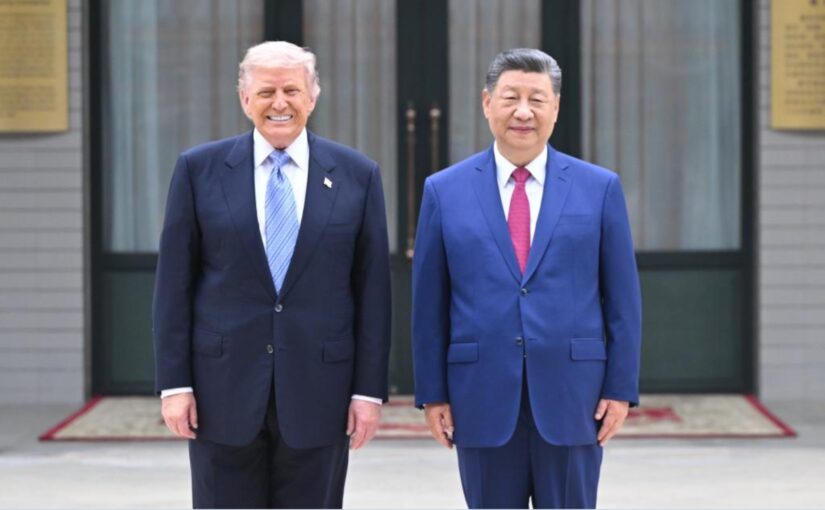
In the following article, our co-editor Carlos Martinez assesses Donald Trump’s 13-15 May state visit to China, arguing that the positive mood music between Trump and Xi Jinping reflects a (slowly) growing understanding in US policy circles that a hawkish anti-China strategy simply is not working. The semiconductor war has accelerated Chinese self-sufficiency rather than slowed it; Trump’s 145 percent tariffs collapsed within days of Beijing tightening rare-earth export controls; and the US-Israeli criminal war on Iran has strengthened, rather than weakened, the multipolar trajectory.
The deeper meaning of this summit is that the US ruling class is having to, very reluctantly, start to come to terms with the world as it actually is. It does not “hold the cards”. As Xi put it at the Great Hall of the People, “the world is big enough to accommodate both countries, and one country’s success is an opportunity for the other.” The Chinese have been consistently saying this for years. The difference now is that, as a growing number of US analysts are admitting that they’re right: win-win cooperation between major powers is possible; what isn’t possible is the indefinite extension of unipolar US hegemony.
NB. An expanded version of this article, including analysis of Vladimir Putin’s visit a few days later, has been published in Beijing Review.
Donald Trump’s 13-15 May state visit to China has produced a raft of headlines that would have been unthinkable a decade ago. “This time, Trump and Xi meet as equals”, declared The Times. The White House spoke of a “constructive relationship of strategic stability”.
A delegation of CEOs – Nvidia’s Jensen Huang (who joined at the last minute), Tesla’s Elon Musk, Apple’s Tim Cook and more – accompanied the president to Beijing, signalling that the decoupling project has, at least for the moment, run its course. Trump publicly defended the right of half a million Chinese students to attend US universities. He called Xi a “great leader” and said “the relationship is a very strong one”. The Times columnist Gerard Baker, who has spent years cheerleading for the China hawks, conceded that “the unipolar moment was fleeting” and that “there are two true superpowers”.
This is a remarkable shift. Trump has cast himself as a China hawk since at least his 2016 campaign. “We can’t continue to allow China to rape our country”, he infamously told a rally in Indiana. He pledged to label China a currency manipulator on day one, accused Beijing of “stealing our jobs” and made tariffs on Chinese goods a centrepiece of his platform. Once in office, he initiated the trade war, banned Huawei from US 5G networks, expelled Chinese journalists, signed bipartisan legislation funnelling weapons to Taiwan, and oversaw the 2017 National Security Strategy that designated China as a “strategic competitor”.
Far from breaking with this approach, the Biden administration deepened it. Trump’s tariffs were retained; the CHIPS and Science Act and the October 2022 export controls escalated the campaign into a full-spectrum technology war; AUKUS, the Quad and an expanding network of bases deepened the longstanding architecture of military encirclement.
Trump’s second term began with the same logic dialled up. “Liberation Day” tariffs pushed effective rates on Chinese goods to over 145 percent. Weapons sales to Taipei hit a billion dollars in a week. Both Trump presidencies, in other words, were meant to represent the same thing: an escalation of the long-standing US campaign of containment, encirclement and disruption against the People’s Republic.
What’s changed is not the strategy but its results.
Biden’s semiconductor war was meant to choke off China’s technological advance. Instead, it has accelerated China’s push for self-sufficiency. DeepSeek and others have shown that Chinese AI is competitive with anything Silicon Valley has to offer, and at a fraction of the cost. BYD outsold Tesla globally in battery-electric vehicles last year by over 600,000 units. China now accounts for roughly 30 percent of world manufacturing output – more than the next nine largest manufacturing countries combined – and installed 54 percent of all new industrial robots in 2024.
Trump’s tariff war backfired even more spectacularly. When tariffs reached 145 percent, Beijing tightened export controls on rare earths, of which it processes over 90 percent of world supply. Within days the US was at the negotiating table. JD Vance had been crowing that “the United States has far more cards than the People’s Republic of China”; in the event, as David Finkelstein observed in the Financial Times, Trump landed in Beijing this week facing a “great wall of confidence” – an assessment in Beijing that China has both “the will and the leverage to successfully push back”.
And the US-Israeli war on Iran, which was meant in part to disrupt the Belt and Road, weaken a key BRICS partner and disrupt Chinese influence in West Asia, has had close to the opposite effect. Iran has been strengthened, its sovereignty intact, and its strategic alignment with China and Russia deepened. Meanwhile China increasingly looks, to the rest of the world, as the grownup in the room. As Finkelstein concedes, “recent US military actions in the Caribbean, Venezuela and especially Iran help Beijing make the case that America is a force for global instability”.
It is in this context that Trump’s comments on Iran during the summit need to be read. Trump claimed that he and Xi “feel very similar” – that the Strait of Hormuz should be open, and that Iran should not have nuclear weapons. However, these are actually longstanding Chinese positions, even if Trump’s phrasing predictably leaves something to be desired in terms of phrasing, nuance and completeness; indeed, they are longstanding Iranian positions. Tehran has consistently maintained that it has no nuclear weapons programme, and a Hormuz blockade has only ever been a defensive, not to say partial, measure. The more intensive, if not overly successful, blockade has of course been imposed by none other than the Trump administration itself in yet another iteration of its utter strategic incoherence.
The core of China’s position, which Trump didn’t mention, is that the conflict “should not have happened in the first place”, that “the use of force is a dead end”, and that what’s needed is a “comprehensive and lasting ceasefire” and a “sustainable security architecture for the region”. Beijing’s Foreign Ministry has been explicit: the war was illegal and must end. Beijing is not signing on to Washington’s framing; Washington is being forced to adapt to Beijing’s. And, its protestations notwithstanding, to reality.
Tellingly, the two sides issued sharply different readouts. The American side stressed cooperation in the Gulf. Xi made clear that Taiwan was “the most important issue in China-US relations”, that ‘Taiwan independence’ and cross-Strait peace are “as irreconcilable as fire and water”, and that mishandling the question would lead to “clashes and even conflicts”.
This is the heart of the matter. Taiwan is an integral part of China. Its separation from the mainland in 1949 was the work of US imperialism, and the One China Principle is recognised in international law by the United Nations and by 181 countries, including the United States. The US arms sales that have turned the island into, in the words of China’s Taiwan Affairs Office, “an ATM for American arms dealers” are designed to pull China into an arms race and lay the groundwork for a future war. No Chinese government could accept this. National reunification is non-negotiable.
The deeper meaning of this summit is that the US ruling class is having to, very reluctantly, start to come to terms with the world as it actually is. It does not “hold the cards”. As Xi put it at the Great Hall of the People, “the world is big enough to accommodate both countries, and one country’s success is an opportunity for the other.” The Chinese have been consistently saying this for years. The difference now is that, as a growing number of US analysts are admitting that they’re right: win-win cooperation between major powers is possible; what isn’t possible is the indefinite extension of unipolar US hegemony.
Decoupling has failed. Containment has failed. The war on Iran has failed. Whether the US can fully internalise this lesson, or whether it will lash out again, remains perhaps the central question of our time.






2 thoughts on “A successful visit to Beijing: is the US ruling class starting to face reality?”