Spanish PM: US tariffs “unjustified, unjust and harmful for everybody”

Spanish Prime Minister Pedro Sánchez recently visited China, becoming the first foreign leader to meet President Xi Jinping since US President Donald Trump dramatically intensified his ‘tariff war’ against the global economy and against China in particular.

Among current Western European leaders Sánchez stands out as being particularly friendly to China and has visited the country three times in the last two years.

Reporting his most recent visit, an article published by the financial news service Bloomberg clearly outlined how the Spanish leader has defied and stood up to US pressure and bullying:

“Earlier this week, US Treasury Secretary Scott Bessent warned the EU against seeking to pivot toward China and away from the US, singling out Sánchez’s push to deepen ties with Beijing. ‘That would be cutting your own throat,’ he said.”

Sánchez, for his part, called the US levies “unjustified, unjust and harmful for everybody.” Speaking at a press conference following his meeting with Xi, he announced that Spain’s head of state, King Felipe VI, will make a state visit to China this year.

Meeting Sánchez on April 11, Xi Jinping pointed out that transformation not seen in a century is accelerating across the world with multiple risks and challenges piling up. Only through solidarity and coordination can countries maintain world peace and stability and promote global development and prosperity. As the international situation gets more complex and volatile, it is increasingly important for China and Spain to develop sound and stable relations. This year marks the 20th anniversary of the comprehensive strategic partnership between China and Spain. China stands ready to work with Spain to build a more strategically resilient and dynamic comprehensive strategic partnership, to better serve the well-being of both peoples, inject impetus into the China-EU relations, and make greater contributions to world peace, stability, and development.

He stressed that the China-Spain friendship is a wise choice made by the two peoples based on traditional friendship, practical needs, and long-term interests. Both sides should continue to consolidate the political foundation of mutual support, trust and respect each other, and support each other on issues concerning core interests and major concerns. China is ready to work with Spain to leverage their mutually beneficial and complementary cooperation advantages, make good use of the economic and technological cooperation mechanisms, tap the potential in areas like new energy, high-tech manufacturing and smart cities, and produce more outcomes of mutually beneficial cooperation.

Xi Jinping pointed out that China always sees in the European Union an important pole in a multipolar world. China is a major country that explicitly supports the unity, development, and growth of the EU. In the current context, it is of great practical significance to strengthen the China-EU partnerships of peace, growth, reform, and civilisation. China and the EU should see each other as partners and embrace open cooperation. There are no winners in tariff wars. Going against the world will only lead to self-isolation. China’s development over the past seven decades is a result of self-reliance and hard work, not favours from others. China does not flinch from any unjust suppression. No matter how the external environment changes, China will remain confident, stay composed, and concentrate on managing its own affairs well.

Sánchez said that over the past 20 years since China and Spain established a comprehensive strategic partnership, the two countries have always respected each other and engaged in friendly cooperation. The relationship has been steadily deepening and growing. Under the leadership of President Xi Jinping, China has achieved remarkable accomplishments in its development and made significant contributions to global prosperity and stability. Spain values its relationship with China and firmly upholds the one-China policy. There are no winners in trade wars. In the face of a complex and challenging global environment, Spain and the EU would like to enhance communication and coordination with China to safeguard international trade order, jointly meet challenges like climate change and poverty alleviation, and preserve the common interests of the international community.

Prior to his China visit, Sánchez had visited Vietnam, the first visit by a Spanish head of government  since the establishment of diplomatic relations between the two countries in 1977.

The Spanish Prime Minister affirmed that Vietnam is one of Spain’s top priority partners in Southeast Asia and agreed on the need to elevate the bilateral ties to a comprehensive strategic partnership.

The following article was originally published on the website of the Chinese Foreign Ministry.

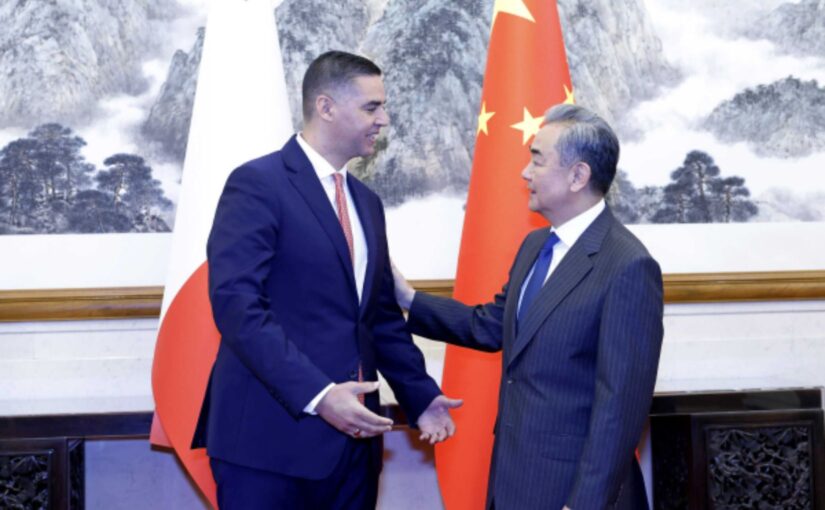
On the morning of April 11, 2025, President Xi Jinping met with visiting Spanish Prime Minister Pedro Sánchez at the Diaoyutai State Guesthouse in Beijing.

Xi Jinping pointed out that transformation not seen in a century is accelerating across the world with multiple risks and challenges piling up. Only through solidarity and coordination can countries maintain world peace and stability, and promote global development and prosperity. As the international situation gets more complex and volatile, it is increasingly important for China and Spain to develop sound and stable relations. This year marks the 20th anniversary of the comprehensive strategic partnership between China and Spain. China stands ready to work with Spain to build a more strategically resilient and dynamic comprehensive strategic partnership, to better serve the well-being of both peoples, inject impetus into the China-EU relations, and make greater contributions to world peace, stability, and development.

Xi Jinping quoted the Chinese proverb “Range far your eye over long vistas.” He stressed that the China-Spain friendship is a wise choice made by the two peoples based on traditional friendship, practical needs, and long-term interests. Both sides should continue to consolidate the political foundation of mutual support, trust and respect each other, and support each other on issues concerning core interests and major concerns, especially in safeguarding sovereignty and territorial integrity. China’s consumption upgrade for 1.4 billion people and industrial transformation potential will provide strong momentum for the world economy. China is ready to work with Spain to leverage their mutually beneficial and complementary cooperation advantages, make good use of the economic and technological cooperation mechanisms, tap the potential in areas like new energy, high-tech manufacturing and smart cities, and produce more outcomes of mutually beneficial cooperation.

Continue reading Spanish PM: US tariffs “unjustified, unjust and harmful for everybody”

China and Cambodia: friendly neighbours and ironclad friends

Following his visit to Malaysia, Chinese President Xi Jinping arrived in Cambodia on the morning of April 17 to begin a state visit a state visit at the invitation of King Norodom Sihamoni, as the final leg of his visit to neighbouring countries in south-east Asia.

King Norodom Sihamoni presided over a grand welcome ceremony at Phnom Penh International Airport, the first of his reign. Xi Jinping made a written statement on arrival, extending his best New Year wishes to the Cambodian government and people on the occasion of the Khmer New Year, that fell that day. He pointed out that the China-Cambodia relationship was forged and carefully nurtured by the elder generation of leaders from both countries. It has withstood the test of the evolving international landscape and remains as solid as a rock.

That afternoon, King Norodom Sihamoni met with Xi at the Royal Palace.

Noting that Cambodia has recently celebrated the 20th anniversary of King Norodom Sihamoni’s enthronement and the Khmer New Year, Xi Jinping said he is delighted to visit the beautiful Cambodia at the invitation of King Norodom Sihamoni, extending his heartfelt New Year greetings to the Cambodian people. Xi Jinping said that Cambodia’s national development is thriving, and he believes that under the blessings of King Norodom Sihamoni, the hardworking and intelligent Cambodian people will surely build an even more prosperous and stronger nation. He stressed that China values its friendship with the Cambodian royal family and spoke highly of the important contributions made by the Cambodian royal family to the cause of China-Cambodia friendship over the years. Under the new circumstances, China and Cambodia should cherish and carry forward the ironclad friendship between the two countries jointly forged by the elder generation of Chinese leaders and King Father Norodom Sihanouk, enrich the China-Cambodia community with a shared future with the features of the new era, serve the development of their respective countries and the well-being of their people, and make greater contributions to building a community with a shared future with neighbouring countries and promoting the building of a community with a shared future for mankind.

Norodom Sihamoni also noted that the friendship between Cambodia and China was forged and cultivated by the elder generation of leaders of the two countries.

He presented the National Order of Independence – Grand Collar to Xi Jinping. He said that President Xi Jinping holds special friendly feelings towards Cambodia and has made outstanding contributions to promoting the development of Cambodia-China relations, adding that Xi Jinping is a great friend of Cambodia.

Xi Jinping said this medal fully demonstrates Cambodia’s high regard for developing China-Cambodia relations and carries the deep friendship of the Cambodian people towards the Chinese people. This honour belongs not only to him personally, but also to all the friendly people who have cultivated and contributed to the friendship between China and Cambodia.

That evening Xi Jinping met with Queen Mother Norodom Monineath Sihanouk.

Xi Jinping extended his best wishes to Norodom Monineath Sihanouk for the Khmer New Year. He noted that King Father Norodom Sihanouk was a symbol of China-Cambodia friendship. Together with the elder generation of Chinese leaders, he personally forged an unbreakable ironclad friendship between China and Cambodia, and we will always remember the historic contributions he made. Noting that Queen Mother Norodom Monineath Sihanouk is a witness and promoter of China-Cambodia friendship, Xi Jinping said she has a special friendship towards the Chinese people, and she well deserves to be awarded the Friendship Medal of the People’s Republic of China. Xi Jinping also said that China, as her second home, welcomes her visit at any time.

Norodom Monineath Sihanouk said President Xi Jinping is the greatest friend of Cambodia, and this visit is a great honour for all the Cambodian people. She is very pleased to see that the China-Cambodia friendship forged by the elder generation of leaders of the two countries has been continuously consolidated and developed. She expressed confidence that the ironclad friendship between the two countries will grow even deeper and more unbreakable.

Continue reading China and Cambodia: friendly neighbours and ironclad friends

General Secretary Tô Lâm: Xi Jinping is a sincere comrade and a close friend of Vietnam

We previously republished the article by Chinese President Xi Jinping published in the Vietnamese newspaper Nhân Dân on April 14, coinciding with his arrival in the country for a state visit. The same day, China’s People’s Daily published an article by To Lam, General Secretary of the Communist Party of Vietnam, welcoming Xi’s visit.

In his article, To Lam noted: “This is Comrade Xi Jinping’s fourth visit to Vietnam since he assumed the responsibility of Party General Secretary and President of China, and also his second visit to Vietnam in the 13th-term National Congress of the Communist Party of Vietnam (CPV) and the 20th-term National Congress of the Communist Party of China (CPC). As the Supreme Leader of the Communist Party of China and the People’s Republic of China who has visited Vietnam the most in history, General Secretary and President Xi Jinping is a sincere comrade and a close friend of Vietnam. The Party, State and people of Vietnam warmly welcome and believe that the visit will definitely be a great success, making a great and important contribution to strongly promoting the tradition of friendship and opening a new era of development in Vietnam-China relations.”

The article continues to note that, in the revolutionary journey that was closely linked from the beginning with countless difficulties, generations of leaders of the two Parties and two countries, directly President Ho Chi Minh and Chairman Mao Zedong, constantly worked hard to cultivate “the close relationship between Vietnam and China, both comrades and brothers”. During many years of revolutionary activities in China, President Ho Chi Minh always received precious sentiments and enthusiastic help from the Chinese communists and people. Under the leadership of President Ho Chi Minh, Vietnamese communists also actively participated in the revolutionary movement in China. The history of standing shoulder to shoulder and sharing joys and sorrows between the revolutionary predecessors of the two countries was a shining example in the revolutionary struggle movement of the world proletariat, laying a solid foundation for the future friendship between Vietnam and China.

On the basis of the reliable relationship between the two Communist Parties, on January 18, 1950, shortly after its establishment, the People’s Republic of China became the first country in the world to officially establish diplomatic relations with the Democratic Republic of Vietnam (now the Socialist Republic of Vietnam). Vietnam was also the first Southeast Asian country to officially establish diplomatic relations with China. This was a brilliant historical milestone, opening a new era for the Vietnam-China friendship. Under the guidance of the two Communist Parties, the people of the two countries gave each other sincere and wholehearted help and support, contributing to the victory and success of the national liberation revolution and the cause of national construction and development in the direction of socialism in each country.

In the overall foreign policy of independence, self-reliance, peace, friendship, cooperation and development, multilateralisation and diversification of foreign relations, the Party and State of Vietnam have always persistently and consistently given top priority to and determined to work with the Party and State of China to develop the Comprehensive Strategic Cooperative Partnership, the Vietnam-China Community with a shared future that carries strategic significance, for the happiness of the people of the two countries, for the cause of peace and progress of all mankind. The Vietnamese people will never forget the great and effective assistance of the Chinese people in historical periods. Vietnam always considers China’s prosperous development as an opportunity for itself and is pleased and appreciates China’s affirmation of prioritising the development of relations with Vietnam in its neighbourhood diplomacy and considers this a strategic choice of both countries.

The two sides have satisfactorily resolved many issues left over from history and agreed to persistently and properly handle and actively resolve disagreements through peaceful measures on the basis of mutual understanding and respect, in accordance with international law. For the relations between the two Parties and two countries to develop well and comprehensively as they are today, the most important lesson is the sincerity, trust and mutual understanding between the two socialist neighbouring countries under the leadership of the Communist Parties, deeply rooted in the tradition of humanity and respect for human relations of the two peoples; the intellectual vision, determination and action of generations of leaders of the two Parties and two countries; and the joint efforts and participation of the political systems and people of the two countries. The Party, State and People of Vietnam respect and appreciate the sentiments, enthusiasm and especially important great contributions of General Secretary and President Xi Jinping to the Vietnam-China relationship over the past many years.

The world is undergoing profound, fundamental changes of an epochal nature, with deep transformations in every aspect under the impact of major shifts in politics, economy, culture, society, and science and technology. The period from now until 2030, with a longer-term vision toward 2045 and even 2050, the mid-point of the 21st century – key milestones tied to the revolutionary causes of the two Parties and the two countries – will be the most crucial period for shaping a new world order. It will open up great opportunities, while also posing significant challenges for nations. For Vietnam, this is a period of important strategic opportunity, a decisive sprint stage to usher in a new era of national development and to fulfill President Ho Chi Minh’s aspiration of “building a peaceful, unified, independent, democratic, and prosperous Vietnam, making a worthy contribution to the revolutionary cause of the world.” For China, this is a pivotal period and a stepping stone in realising its second centenary goal, building the People’s Republic of China into a modern socialist power that is prosperous, strong, democratic, civilised, harmonious, and beautiful.

The following English translation of Comrade To Lam’s article was originally published by Nhân Dân.

JOINING HANDS TO OPEN A NEW ERA OF DEVELOPMENT OF VIETNAM-CHINA FRIENDSHIP

To Lam, General Secretary of the Central Committee of the Communist Party of Vietnam

At the invitation of mine and President Luong Cuong of the Socialist Republic of Vietnam, comrade Xi Jinping, General Secretary of the Central Committee of the Communist Party of China and President of the People’s Republic of China, will pay a state visit to Vietnam from April 14-15, 2025, in the year when the people of the two countries joyfully celebrate the 75th founding anniversary of diplomatic relations between Vietnam and China (January 18, 1950 – 2025) and the Year of Vietnam-China Humanistic Exchange.

This is comrade Xi Jinping’s fourth visit to Vietnam since he assumed the responsibility of Party General Secretary and President of China, and also his second visit to Vietnam in the 13th-term National Congress of the Communist Party of Vietnam (CPV) and the 20th-term National Congress of the Communist Party of China (CPC). As the Supreme Leader of the Communist Party of China and the People’s Republic of China who has visited Vietnam the most in history, General Secretary and President Xi Jinping is a sincere comrade and a close friend of Vietnam. The Party, State and people of Vietnam warmly welcome and believe that the visit will definitely be a great success, making a great and important contribution to strongly promoting the tradition of friendship and opening a new era of development in Vietnam – China relations.

I. Vietnam – China relations: History of close friendship, comprehensive cooperation achievements

Vietnam and China are two close neighbours, connected by mountains and rivers, the people of the two countries have shared many similarities in culture and customs, and together cultivated a long-standing traditional friendship that has lasted for thousands of years.

Continue reading General Secretary Tô Lâm: Xi Jinping is a sincere comrade and a close friend of Vietnam

Xi Jinping: China and Malaysia are good neighbours, good friends and good partners

Following his highly successful visit to Vietnam, Chinese President Xi Jinping arrived in Kuala Lumpur on the evening of April 15 for a state visit to Malaysia at the invitation of the King of Malaysia His Majesty Sultan Ibrahim.

In a written statement on his arrival, Xi Jinping said that, since the establishment of diplomatic relations more than half a century ago, the two countries have adhered to mutual respect, equality and win-win cooperation, setting a model for state-to-state relations. In 2023, the two sides reached an important consensus on building a China-Malaysia community with a shared future.

As major developing countries and members of the Global South, deepening high-level strategic cooperation between China and Malaysia serves the common interests of both countries and is conducive to peace, stability and prosperity in the region and the world at large.

Xi Jinping met with Sultan Ibrahim on the morning of April 16.

The Chinese leader pointed out that China and Malaysia are good neighbours, good friends and good partners who visit each other as often as family. China and Malaysia should continue to deepen political mutual trust and support each other on issues related to their respective core interests and major concerns. The two sides should deepen the synergy of development strategies, draw on each other’s strengths for mutual benefit and win-win results, and jointly pursue modernisation. He called on the two sides to ensure good implementation of major projects such as “Two Countries, Twin Parks” and the East Coast Rail Link, and to speed up efforts to foster cooperation in future industries such as artificial intelligence, digital economy and green economy. China supports Malaysia in its role as the current ASEAN (Association of South East Asian Nations) rotating chair and is ready to work with Malaysia to implement the Global Development Initiative, the Global Security Initiative and the Global Civilisation Initiative, and to promote the Global South’s pursuit of unity-driven collective strength and common development, so as to contribute more certainty and positive energy to the region and the world.

Sultan Ibrahim said that President Xi Jinping’s state visit to Malaysia is a major event in bilateral relations, which fully demonstrates the high level of Malaysia-China relations, adding that his successful visit to China last September is still fresh in his memory. China’s impressive development achievements are attributable to the foresight of President Xi Jinping and the hard work of the Chinese people. Malaysia attaches great importance to its relations with China and will join hands to forge ahead for win-win cooperation and promote the building of a high-level strategic community with a shared future no matter how the international landscape evolves. Malaysia attaches importance to regional economic integration, firmly supports the Belt and Road Initiative, and is willing to strengthen trade and investment cooperation with China, jointly stabilise industrial and supply chains, enhance connectivity and boost educational, people-to-people and cultural exchanges. As the rotating chair of ASEAN and country coordinator for ASEAN-China Dialogue Relations, Malaysia is committed to promoting greater development of ASEAN-China relations and jointly building a peaceful and prosperous future. 

President Xi Jinping held talks with Malaysian Prime Minister Anwar Ibrahim in the afternoon.

He made a three-point proposal on building a high-level strategic China-Malaysia community with a shared future.

  • First, upholding strategic independence and carrying out high-level strategic coordination. Both China and Malaysia are self-reliant nations that oppose external interference. Both countries should continue on the development paths suited to their respective national conditions, resolutely support each other in safeguarding national sovereignty, security and development interests, and hold their future and destiny firmly in their own hands.
  • Second, combining forces for development and setting a benchmark for high-quality development cooperation. China is committed to advancing Chinese modernisation on all fronts through high-quality development. This is highly compatible with Malaysia’s Ekonomi MADANI initiative. The two sides should work together to cultivate and expand cooperation in the digital economy, green economy, blue economy, artificial intelligence and other frontier areas, and strengthen the integrated development of industrial chains, supply chains, value chains, data chains, and talent chains.
  • Third, carrying forward the friendship forged through generations, and deepening inter-civilisational exchanges and mutual learning. The two sides should jointly advance Confucian-Islamic dialogue, and build platforms of civilisational exchanges for both countries and the region. Having signed a mutual visa exemption agreement, the two sides should seize the opportunity to scale up tourism, youth and subnational exchanges, and deepen cooperation in culture, education, sports, film, media, and so on, so as to foster closer people-to-people connection and renew their traditional friendship. China is ready to continue joint research on giant panda conservation with Malaysia.

China supports Malaysia in playing its role as ASEAN Chair and stands ready to sign the China-ASEAN Free Trade Area Upgrade Protocol with regional countries as early as possible. Together, they will reject decoupling, supply disruption, “small yard, high fence” and tariff abuse with openness, inclusiveness, solidarity and cooperation, counter the law of the jungle where the strong prey on the weak with the Asian values of peace, cooperation, openness and inclusiveness, and address instability and uncertainty in the world with the stability and certainty of Asia.

Continue reading Xi Jinping: China and Malaysia are good neighbours, good friends and good partners

China and Vietnam reaffirm their will to jointly strengthen the cause of socialism in the world

Chinese leader Xi Jinping began his first overseas visit of 2025 with a visit to Vietnam as the first leg of a regional tour that also took him to Malaysia and Cambodia.

Xi landed in the Vietnamese capital Hanoi at noon on April 14, for a state visit at the invitation of General Secretary of the Communist Party of Viet Nam (CPV) Central Committee To Lam and President of the Socialist Republic of Viet Nam Luong Cuong. He was greeted on arrival by President Luong Cuong and other senior Vietnamese leaders.

Xi Jinping delivered a written statement on arrival and, on behalf of the Communist Party of China (CPC), the Chinese government, and the Chinese people, extended sincere greetings and best wishes to the brotherly CPV, the Vietnamese government and the Vietnamese people.

The Chinese leader noted that this year marks the 95th anniversary of the founding of the CPV, the 80th anniversary of the founding of Viet Nam, and the 50th anniversary of the liberation of the South. China and Viet Nam are socialist neighbours connected by mountains and rivers, and a community with a shared future that carries strategic significance. During the arduous years of striving for state independence and national liberation, the two countries fought side by side and supported each other, forging a profound friendship. In exploring a socialist path suitable to their respective national conditions, the two countries have learned from each other and advanced hand-in-hand, demonstrating to the world the bright prospects of the socialist system. This year marks the 75th anniversary of the establishment of diplomatic relations between China and Viet Nam and is the China-Viet Nam Year of People-to-People Exchanges. The building of a China-Viet Nam community with a shared future is ushering in new development opportunities. Xi Jinping said he looks forward to taking this visit as an opportunity to have an in-depth exchange of views with Vietnamese leaders and comrades on the overall, strategic, and directional issues concerning the relations between the two parties and countries, as well as on international and regional issues of common interest and concern, and to jointly drawing up a new blueprint for the building of a China-Viet Nam community with a shared future.

Shortly after his arrival, General Secretary of the CPV Central Committee To Lam held a grand welcome ceremony for Xi Jinping. This was followed by talks between the two communist party leaders.

Xi Jinping said that this year marks the 95th anniversary of the founding of the CPV, the 80th anniversary of the founding of the Democratic Republic of Viet Nam (which is now the Socialist Republic of Viet Nam), and the 50th anniversary of the liberation of the South and he extended warm congratulations to the Vietnamese side on behalf of the CPC and the Chinese government. China will support Viet Nam as always in advancing along the socialist path suited to its national conditions, successfully holding the 14th CPV National Congress in 2026, and marching toward the Two Centenary Goals of the CPV and the country.

President Xi noted that this year marks the 75th anniversary of China-Viet Nam diplomatic ties and the China-Viet Nam Year of People-to-People Exchanges. Over the past 75 years, no matter how the international landscape evolved, the two sides had supported each other in the struggle for national independence and liberation, advanced the cause of socialism hand in hand, and forged ahead with modernisation of the two countries, serving as a model of unity and cooperation between socialist countries. Facing a changing and turbulent world, China and Viet Nam staying committed to peaceful development and deepening friendship and cooperation has brought much-needed stability and certainty to the world. Standing on a new historical starting point, the two sides should build on past achievements and join hands to renew their long-standing friendship featuring “camaraderie plus brotherhood.” In line with the overarching goals characterised by “six mores”, namely, stronger political mutual trust, more substantive security cooperation, deeper practical cooperation, more solid popular foundation, closer coordination and collaboration on multilateral affairs, and better management and resolution of differences, the two countries should advance their comprehensive strategic cooperation with high-quality efforts, ensure steady and sustained progress in building the China-Viet Nam community with a shared future, and make new and greater contributions to building a community with a shared future for mankind.

He said that building the China-Viet Nam community with a shared future carries important global significance. The two countries, both following the path of peaceful development and with their over 1.5 billion people marching toward modernisation together will provide an effective safeguard for peace and stability of the region and even the world, and give a strong boost to common development. A single small boat may not survive a ferocious storm; only by working together can we sail steadily and far.


President Xi proposed six measures to deepen the building of the China-Viet Nam community with a shared future:

  • First, elevating strategic mutual trust to a higher level. Leaders of the two Parties and two countries should visit and communicate with each other frequently like family do.
  • Second, building more robust security safeguards. The two sides should designate their “3+3” strategic dialogue on diplomacy, defence and public security as a ministerial-level mechanism to strengthen strategic coordination.
  • Third, expanding higher-quality mutually beneficial cooperation. The two sides should seize the great opportunity of faster formation of new quality productive forces in China and new types of productive forces in Viet Nam to upgrade bilateral practical cooperation. They should work to fully connect their standard-gauge railways, expressways, and smart ports as early as possible, and advance cooperation on AI, IoT and other high technologies.
  • Fourth, making the people-to-people bond more broad-based. The two sides should seize the opportunity of the China-Viet Nam Year of People-to-People Exchanges this year to hold more friendship activities that reach the communities and resonate with the public, and strengthen cooperation in tourism, culture, media, health, etc. The two countries should further tap into revolutionary resources and tell stories of friendship, and China will invite Vietnamese youths to China in the next three years on red study tours. This will help the people of the two countries, especially the younger generation, understand the great sacrifice that led to the founding of the two socialist countries and the great value of their good-neighbourliness, friendship and cooperation.
  • Fifth, carrying out closer multilateral coordination. The two sides should jointly safeguard the outcomes of the victory of the Second World War, firmly defend the UN-centreed international system and the international order based on international law, promote an equal and orderly multipolar world and a universally beneficial and inclusive economic globalisation, and strengthen cooperation within the framework of the Global Development Initiative, the Global Security Initiative and the Global Civilization Initiative.
  • Sixth, engaging in more constructive maritime interactions. The two sides should implement the common understandings reached by the leaders of the two countries, properly handle maritime issues, expand maritime cooperation, make the decision to launch joint development, and work for the early conclusion of the Code of Conduct in the South China Sea.

General Secretary To Lam stated that General Secretary Xi is an outstanding leader of the Chinese people and a great friend of the Vietnamese people. That General Secretary Xi chose Viet Nam as the destination of his first overseas visit this year fully reflects the importance he attaches to Viet Nam-China relations and his support for Viet Nam. This visit will surely become a new milestone in the history of friendly exchanges between the two Parties and two countries and will further advance the building of the China-Viet Nam community with a shared future that carries strategic significance.

Continue reading China and Vietnam reaffirm their will to jointly strengthen the cause of socialism in the world

British Steel crisis leads to wave of anti-China propaganda

The following article by Paul Atkin, originally published in Socialist Economic Bulletin, analyses the response by British politicians and journalists to the announcement by Jingye – the Chinese company that acquired British Steel in 2019 – that it would be closing the blast furnaces at its Scunthorpe plant on account of making losses of £255 million per year. This response has been characterised by thinly-veiled Sinophobia and anti-China propaganda, with British politicians accusing Jingye of attempting to sabotage the country’s steel industry, and demanding that Chinese companies be prevented from future investment in British infrastructure.

Paul contrasts this hysteria with the relatively muted response to a very similar crisis at the Port Talbot steel works in 2024. “Both plants owned by companies based overseas. Both seeking a way out of unprofitable production. Both in negotiation for subsidy from successive governments for outcomes that would lead to massive job losses. Both looking to close aging blast furnaces earlier than originally planned because they have been making significant losses.” However, “Indian based Tata Steel’s ownership of Port Talbot was certainly mentioned in news coverage, but not on the blanket, verging on obsessive scale that British Steel’s Chinese ownership has… After Port Talbot, there has been no denunciation of Indian investment into the UK, nor any calls in the media or Parliament for any ‘urgent review’ into India’s role in the UK, or paranoid accusations … that the attempted closure is part of a dastardly plot to sabotage a strategic British industry”.

The article points out that the narrative on British Steel serves two purposes for the British ruling class. First, it feeds into building popular support for the US-led New Cold War on China. Second, it contributes to the fossil fuel industry’s resistance to meaningful action on climate change, given China’s global leadership in renewable energy and electric transport.

Paul notes that Spain is taking a considerably more far-sighted and progressive approach, “both encouraging inward Chinese investment – like the joint venture between CATL and Stellantis to build a battery factory in northern Spain – and deals signed last year between Spain and Chinese companies Envision and Hygreen Energy to build green hydrogen infrastructure in the country.”

It is crucial that environmental activists in the West do not fall into the Sinophobic trap being laid for them by the Cold War hawks in Washington and London.

The contrast between the way the crises in steel production at Scunthorpe and Port Talbot has been stark. Both plants owned by companies based overseas. Both seeking a way out of unprofitable production. Both in negotiation for subsidy from successive governments for outcomes that would lead to massive job losses. Both looking to close aging blast furnaces earlier than originally planned because they have been making significant losses.

In the case of Port Talbot, this led to a deal to convert to Electric Arc Furnaces to secure sustainable steel production at the site, but with the loss of 2,500 jobs and only 300 retained. This was dependent on a subsidy from the government of £500 million. A similar deal was not clinched at Scunthorpe, as the crisis was brought forward by Trump’s imposition of a 25% tariff on UK manufactured steel – which led to an announcement of imminent closure from the company the following morning. A closure would mean 2,700 jobs lost – on the same scale as Port Talbot.

In Port Talbot, in the absence of a serious just transition process involving the unions, which were excluded from the discussions by the company and the then Tory government, the job losses are being dealt with by the same sort of offers of retraining as have been proposed for the Grangemouth oil refinery in Scotland. In the case of Scunthorpe, also with no just transition process, the government has rightly stepped in to take charge of the plant to keep the blast furnaces running in the short term; which means that the losses previously borne by the company will now be borne by the Exchequer. With the company losing £255 million a year, the governments £2.5 billion steel transformation fund can absorb this in the short term. Workers at Port Talbot have expressed some bitterness that this was not considered for them.

What has been different is the mobilisation of Sinophobia around British Steel’s ownership by a Chinese company, Jingye. Indian based Tata Steel’s ownership of Port Talbot was certainly mentioned in news coverage, but not on the blanket, verging on obsessive scale that British Steel’s Chinese ownership has. Tata’s brinkmanship in negotiations was also mentioned, but they were not accused of “negotiating in bad faith” in the way that Jingye have. Both companies have behaved as you’d expect a capitalist company to behave, though if you read Jingye’s Group Introduction you can see how their operations inside China are turned to more positive social objectives –  from a high wages policy to greening their workplaces – from being based in a country run by a Communist Party, not by their own class. But here, both Tata and Jingye are in it for the money. Their UK operations have only been viable as a tiny loss making fragment of a much larger business, as part of an attempt to implant themselves in a variety of global markets in the hope of profitability in the medium to long term. Steel production at Port Talbot in 2022, for example, was just 10% of Tata’s global production of 35 million tonnes.

After Port Talbot, there have been no denunciation of Indian investment into the UK, nor any calls in the media or Parliament for any “urgent review” into India’s role in the UK, or paranoid accusations made explicitly by Farage but echoed by “senior Labour figures” as well as Tories in the media but not in the recent Saturday debate in Parliament, that the attempted closure in Scunthorpe is part of a dastardly plot by the Chinese government to sabotage a strategic British industry, not a commercial decision in which a company is seeking to cut its losses in all the ways British capitalist company law allows them to; including cancelling orders for the raw materials they’d need to keep running the blast furnaces they want to close. Instead, there has been serious negotiations with the Indian government to set up a trade deal, which was reported last week as “90% done”.

No decoupling there.

The attack on commercial engagement with China fulfills two objectives. One is a straightforward attempt to mobilise popular sentiment in defence of steel workers jobs behind a Cold War sentiment in a wider context in which the Trump administrations policies have shaken up popular faith in deference to the US. An anti Chinese attack distracts from that and pushes people back towards habitual hostilities.

The other opens another front in the resistance to any serious action on climate change that could threaten the profits of the fossil fuel sector. Accusations from the Right have been:

  1. The blast furnaces could have been kept running with locally sourced coking coal from the cancelled Whitehaven mine. This misses the point that the coke from this mine – had it been developed – would have had such a heavy sulphur content that it was too poor quality to be used at Scunthorpe, so this is a consciously mendacious and fundamentally unserious talking point.
  2. High energy prices in the UK are because of “Net Zero”. This, as they know, is the opposite of the truth. The UK has high energy costs because they are tied to the price of gas far more than any other country in the G7. See Figure 1. We should also note that the oft repeated “solution” to this problem from Reform or the Tories is massive investment in nuclear power instead. The problem with this is that the cost per Kilowatt hour of energy generated by nuclear power is higher than gas, which is higher than renewables. See figure 2. So their way forward would actually compound the problem. Paradoxically, their attack on Chinese investment in UK nuclear power development, and the withdrawal of Chinese investment from Sizewell C in Suffolk and Bradwell in Essex, is making the financing of these projects almost impossible. So, in this case, the contradictions of their politics means they will neither have their cake, nor eat it.

These themes came together in a front page broadside from the Times on 15th April directed at Ed Miliband’s recent trip to China aiming to improve relations and develop better sharing of expertise on the climate transition. Miliband’s is the head that the right wing press is keenest to have on its trophy wall of sacked ministers, hence quite limited and inadequate targets being described as “swivel eyed” and “eye watering” in a constant hammering of lead articles from the Sun to the Telegraph and all the low points in between. Attacks on solar panel installations are increasingly taking the form of accusations of “forced labour” in China, which are untrue, but because it is almost universally believed at Westminster, this threatens a reactionary result on the basis of an apparently progressive concern – as China is the source of 80% of the world’s solar panel supply. However, even if the UK sabotages its green transition by impeding imports of Chinese solar panels this will have little effect globally, as China is increasingly exporting them to the Global South.
 See Figure 3  Miliband is nevertheless the most popular government minister among Labour members in Labour List’s survey – in which he has a positive rating of 68, compared to Keir Starmer’s 13 – because he is seen as getting on with something positive and progressive, while Liz Kendall and Rachel Reeves are in negative territory.

The call from Dame Helena Kennedy for “an  urgent security review of all those Chinese companies operating within our infrastructure which could pose a threat to our national interests – and maybe not just confined to China” threatens to compound the damage already done by the UKs removal of Huewei’s investment in the 5G network, ensuring that the version the country has is slower and more expensive, and the financial difficulty set for Nuclear power station projects by the removal of Chinese investment on the basis of “national security” paranoia. Applied more widely, this neatly lines the UK up with Trump’s trade war against China and sets the UK up for a potential trade deal in which US capital is looking hungrily at the NHS, wants to sell chlorinated chicken and other additive saturated and nutrition less food from their agricultural industrial complex and open up a tax and regulation free for all for their abusive big tech companies, while their President is actively sabotaging global progress towards sustainability by doubling down on fossil fuels. China is doing none of these things. A more positive approach is that being taken by the PSOE government in Spain, which is both encouraging inward Chinese investment –  like the joint venture between CATL and Stellantis to build a battery factory in northern Spain and deals signed last year between Spain and Chinese companies Envision and Hygreen Energy to build green hydrogen infrastructure in the country.

Farage, and others on the Right are arguing for nationalisation as a temporary measure just in order for the company to be “sold on” – treating nationalisation as an emergency life support process for private capital -is that there is not exactly a huge queue of companies waiting to buy, and any that did would most likely to be looking at asset stripping. Jingye was the only company interested in 2019, when previous owner Graybull capital gave up on it.

This would also be the government’s preferred approach, because they are nervous of the capital costs involved in making the plant viable. There are three intertwined problems with this.

  1. Attracting a viable private company prepared to put serious money into reviving the plant means attracting overseas capital. Given that more than 50% of global steel production is made by Chinese companies (see figure 4 below) Jonathan Reynolds has changed his tune since the weekend debate in Parliament. That Saturday he was decrying allowing Jingye into UK steel manufacturing as a national security issue, but by mid-week, a few days later, he was prepared to be more pragmatic about it.
  2. Making the plant viable cannot mean investing in new blast furnaces. These would become stranded assets before they had reached the end of their design life. Despite the determined rearguard action from Trump and others, trying to carry on as though the world isn’t changing makes no business sense. In 2024, for example, all new steel plants developed in China were Electric Arc Furnaces, designed to use scrap steel as raw material. As yet, production of virgin steel has been dependent on coking coal, but the first production using (green) hydrogen and electricity looks like coming on stream in Sweden by next year; so if virgin steel production is considered an imperative for the Scunthorpe site, that model will have to be looked at and emulated as a matter of urgency.
  3. New investment in different production on the site – like almost all capital investment – replaces labour with capital. As with Port Talbot, far fewer workers would be needed for EAFs. Reynolds has talked about “a different employment footprint” for the plant; which is one way to put it. So, the issue of how the transition can be made in a way that opens up alternative employment with decent terms and conditions has to be negotiated with the workers themselves through their unions.

What’s needed is a clear industrial plan that consolidates the nationalisation as a precedent for other sectors and builds on the Scunthorpe plant’s strengths in producing, for example, 90% of railway tracks used in the UK, as part of a strategic plan for green transition. This has hitherto been focussed on a transition to Electric Arc Furnaces, but linking the production of green hydrogen to new generation furnaces capable of producing the tougher virgin steel needed for a full range of industrial applications should also be part of the process; because blast furnaces can’t be kept open indefinitely if we are to stop the climate running away out of a safe zone capable of sustaining human civilisation by mid century.

Appendix

UK steel production is the 35th largest in the world, comparable to Sweden, Slovakia, Argentina and the UAE. Its 4 million tonnes in 2024 is just over a tenth of the production of Germany, a twentieth of the United States, a thirty seventh that of India and a 250th that of China. 

The niche, almost token, position of UK based steel manufacturing reflects a wider process in which UK based capital is no longer primarily engaged with manufacture.

The last time the steel industry in the UK was nationalised in 1967 it had 268,500 workers from more than 14 previous UK based privately owned companies with 200 wholly or partly-owned subsidiaries. These companies were considered increasingly unviable because they had failed to invest and modernise, so were increasingly uncompetitive. This is part of a wider story about how the UK capitalist class has transformed itself since the 1960s. While the quantity of manufactured goods has increased since then, the proportion of manufacturing in the economy has shrunk from 30.1% in 1970 to 8.6% in 2024. The service sector  has grown from 56% to more than 80%. UK based capital primarily makes money from selling services, mostly financial, to manufacturing capitalists  at home and abroad. They are spectacularly bad at large scale manufacturing start ups, as the debacle of British Volt  (whose approach of setting themselves up a luxurious executive office suite before they’d secured funding to even build their factory might be described as cashing in on your chickens before you’ve sold any).

What that means is that most of “British Industry” is owned by firms based overseas, so might be better described as “manufacturing that happens to take place in Britain”. Consider the automotive sector. While there are locally based SMEs in the supply chain, all the big manufacturers depend on overseas investment. Nissan, Stellantis, BMW, VW, Geely, Tata (again). As with locally based steel production, firms like Morris, Austin, even Rover, are long gone for the same reasons as BSA – once the world’s biggest motorcycle company – now only builds retro classic designs as a niche luxury product and Guest Keen and Nettlefold had to be nationalised to save its assets.

Xi Jinping: CELAC has remained committed to independence, self-reliance and strength through unity

The ninth summit meeting of Heads of State and Government of the Community of Latin American and Caribbean States (CELAC) was held in Tegucigalpa, the capital of Honduras, the country holding the organisation’s rotating presidency, on April 9, 2025.

Sending greetings to the summit, Chinese President Xi Jinping noted that the world today is undergoing accelerated changes unseen in a century and that the Global South, including China as well as Latin American and Caribbean countries, is growing with a stronger momentum. CELAC has remained committed to independence, self-reliance and strength through unity, playing an important role in safeguarding regional peace and stability, promoting development and cooperation, and advancing regional integration. He sincerely wished the countries and peoples of Latin America and the Caribbean greater achievements on the path to development and revitalisation, so as to make greater contributions to enhancing the solidarity and cooperation of the Global South.

Xi added that this year, China will host the Fourth Ministerial Meeting of the China-CELAC Forum in Beijing, and all CELAC member states are welcome to attend the meeting in China to discuss ways to foster development and promote cooperation and jointly contribute wisdom and strength to addressing global challenges, advancing global governance reform and safeguarding world peace and stability. [Xi’s reference to all member states is significant as, of the 12 states yet to establish diplomatic relations with China and still maintaining so-called “diplomatic relations” with the authorities on Taiwan island, seven are in the region, namely Belize, Guatemala, Haiti, Paraguay, Saint Kitts and Nevis, Saint Lucia, and Saint Vincent and the Grenadines.]

The summit concluded with the adoption of the Declaration of Tegucigalpa, which was signed by 30 of the 33 member states. The right-wing regimes of Argentina and Paraguay refused to sign, reflecting their close alignment with US imperialism, while, for its part, Nicaragua declined to sign, considering it inappropriate that the document did not explicitly defend Cuba and Venezuela or clearly condemn the genocide of the Palestinian people.

Among the key points in the declaration are:

  • Highlighting Latin America and the Caribbean as “a Zone of Peace” adhering to the principles of the UN Charter, international law, democracy, multilateralism, human rights, self-determination of countries, sovereignty, and territorial integrity.
  • Rejecting unilateral coercive measures, contrary to international law, including those of a commercial nature.
  • Congratulating Honduras for its role at the head of CELAC and handing over the rotating presidency to Colombia for the next year.

The full text may be found here.

In speeches at the summit, Brazilian President Luiz Inácio Lula da Silva said: “Latin America and the Caribbean are currently facing one of the most critical moments in their history. We have come a long way to consolidate our ideals of emancipation; we have abolished slavery, and we have overcome military dictatorships. Now, our autonomy is once again at stake. The moment demands that we put our differences aside. Attempts to restore old hegemonies are looming over the region. History teaches us that trade wars have no winners.”

Incoming Chair of CELAC and President of Colombia, Gustavo Petro, called on the member countries to strengthen regional unity in the face of the new US tariff policy, which will hit the region’s exports hard.

President of Cuba, Miguel Díaz-Canel observed: “The gravity of this hour of multiplied threats demands the multiplication of unitary forces. Only unity can save us. Let us not delay any longer the integration dreamed and fought for, since Bolivar until today, by the bravest sons and daughters of Our America.”

And President of Mexico, Claudia Sheinbaum said: “I invite you to convene a Summit for the Economic Well-being of Latin America and the Caribbean to make greater regional integration a reality based on shared prosperity and respect for our sovereignties… Today more than ever is a good time to recognise that Latin America and the Caribbean require unity and solidarity among its governments and peoples, to strengthen greater regional integration, always within the framework of mutual respect and the observance of sovereignty and independence.”

Agência Brasil subsequently reported that May 12-13 were agreed as the dates for the ministerial meeting in China and that President Lula would attend. The agency further reported that Lula will travel on to China after attending the 80th anniversary celebrations of the Soviet Union’s great victory over Nazi Germany at the invitation of Russian President Vladimir Putin, to be held in Moscow on May 9. It added:

“Lula’s trip to China will mark his second official visit during his third term. His first visit occurred in April 2023, followed by a reciprocal state visit from Xi Jinping in November of the same year, after the G20 Summit in Brazil. The two leaders also met again in 2023 at the BRICS Summit in South Africa.”

The following articles were originally published on the website of the Chinese Foreign Ministry and by Peoples Dispatch and Agência Brasil.

Xi Jinping Sends Congratulatory Letter to the 9th Summit of Heads of State and Government of the CELAC

On April 9, 2025, the 9th summit of Heads of State and Government of the Community of Latin American and Caribbean States (CELAC) was held in Honduras, the country holding the rotating presidency. President Xi Jinping sent a congratulatory letter to the summit.

Xi Jinping noted that the world today is undergoing accelerated changes unseen in a century and that the Global South, including China as well as Latin American and Caribbean countries, is growing with a stronger momentum. CELAC has remained committed to independence, self-reliance and strength through unity, playing an important role in safeguarding regional peace and stability, promoting development and cooperation, and advancing regional integration. Xi Jinping sincerely wishes the countries and people of Latin America and the Caribbean greater achievements on the path to development and revitalization, so as to make greater contributions to enhancing the solidarity and cooperation of the Global South.

Xi Jinping stressed that the relations between China and Latin American and Caribbean states (LAC) have withstood the test of changes in the international landscape and entered a new stage marked by equality, mutual benefit, innovation, openness and tangible benefits for the people. The two sides have continuously deepened political mutual trust, expanded practical cooperation, and enhanced people-to-people exchanges, delivering benefits to the people of both sides and setting an example for South-South cooperation. China is willing to work with countries in the region to make new progress in building a China-LAC community with a shared future. This year, China will host the Fourth Ministerial Meeting of the China-CELAC Forum in Beijing, and all CELAC member states are welcome to attend the meeting in China to discuss ways to foster development and promote cooperation, and jointly contribute wisdom and strength to addressing global challenges, advancing global governance reform and safeguarding world peace and stability.


In the face of new geopolitical challenges, CELAC proposes greater unity

After several months of preparation and three days of intense meetings at the highest diplomatic level, the IX Summit of the Community of Latin American and Caribbean States (CELAC), which brings together the 33 countries of the region, concluded in Tegucigalpa, Honduras on April 9.

The high-level meeting concluded with a joint agreement called the Declaration of Tegucigalpa, which was signed by 30 of the 33 member states. Argentina and Paraguay refused to sign the agreement, in line with the foreign policy of the ultra-right-wing Javier Milei and the right-wing Santiago Peña, who reject any attempt at regional unity outside the United States. 

For its part, Nicaragua opposed the signing of the document because it considered it inappropriate that it does not support the defense of Cuba and Venezuela, as well as a clear condemnation of the Palestinian genocide.

The key points of the Declaration of Tegucigalpa

 Among the most important points of the agreement are:

  • Committing to strengthening CELAC as a method for political concentration among member countries.
  • Highlighting Latin America and the Caribbean as “a Zone of Peace” adhering to the principles of the UN Charter, International Law, democracy, multilateralism, human rights, self-determination of countries, sovereignty, and territorial integrity.
  • Rejecting unilateral coercive measures, contrary to international law, including those of a commercial nature.
  • To join efforts toward ensuring that someone from Latin America and the Caribbean becomes the next Secretary General of the UN.
  • Congratulating Honduras for its management at the head of CELAC and hand over the Presidency pro tempore of the organization to Colombia for one year to carry out projects related to “energy (energy transition and interconnection); human mobility; health and health self-sufficiency; environment and climate change; Indigenous peoples and Afro-descendants; science, technology and innovation; connectivity and infrastructure; strengthening of trade and investment; transnational organized crime; education; gender equality; among others.”
  • Supporting Haiti and endorsing the support of each of the countries, according to their capacities to “reestablish an environment of human security” that allows for the normalization ‘“Of the political, economic, and social situation, with a comprehensive development approach.”

The ghost of Trump at the meeting

Undoubtedly, the recent tariff and immigration measures of Donald Trump’s administration marked a good part of the concerns of the presidents, foreign ministers, and prime ministers who attended Tegucigalpa. In a way, CELAC was created to find agreements outside Washington’s direct influence over the region. However, the plurality of political positions, in addition to external political influences in Latin America and the Caribbean, have not allowed the consolidation of a long-term international agenda.

Lula: “Only unity will prevent us from becoming pawns again”

However, despite the differences in political positions that often prevent reaching major agreements, according to the President of Brazil, Luiz Inácio Lula da Silva, the creation of CELAC “Is the most important decision of the region in 500 years… If we remain separated, the Latin American and Caribbean communities run the risk of returning to the condition of a zone of influence in a new division of the globe between superpowers. Latin America and the Caribbean must redefine their place in the emerging global order. We need a structured program of action.”

Lula also indirectly recalled that the unity of the region is imperative at a time when geopolitics is beginning to redefine itself, among other things, due to the decisions of the Trump administration: “Latin America and the Caribbean are currently facing one of the most critical moments in their history. We have come a long way to consolidate our ideals of emancipation; we have abolished slavery, and we have overcome military dictatorships. Now, our autonomy is once again at stake. The moment demands that we put our differences aside. Attempts to restore old hegemonies are looming over the region. History teaches us that trade wars have no winners.”

Petro: “The agenda of solitude has only two names – migration and blockade”

For his part, the President of Colombia, Gustavo Petro, called on the countries to strengthen regional unity in the face of the new US tariff policy, which will hit the region’s exports hard. He also stressed that there are currently two ways of resolving conflicts at the international level: multilateralism (referred to in the final agreement) and “solitude.” 

“Today, there is a certain tendency for us to kill each other and live a century of solitude…This is done to preserve a power that no longer does humanity any good…The agenda of solitude has only two names: migration and blockade. The aid agenda is more complex and difficult, but it is much more interesting for all of us present here, representatives of our nations.”

On Trump’s migration policy and the arrival of Venezuelan migrants to El Salvador, Petro said: “The loneliness agenda proposes to treat the migrant as a criminal. Migrants should not arrive in chains to our land, because if we accept a single migrant in chains, not only do we go back to the time of Torrijos, but we go back to the time when the first boatloads of Africans arrived in chains.”

Díaz-Canel: “Only unity can save us”

For his part, the President of Cuba, Miguel Díaz-Canel, said about the IX Summit of CELAC, “The gravity of this hour of multiplied threats demands the multiplication of unitary forces. Only unity can save us. Let us not delay any longer the integration dreamed and fought for, since Bolivar until today, by the bravest sons and daughters of Our America.”

Sheinbaum calls for an economic summit: “Shared prosperity and sovereignty”

Regarding the urgency of finding economic alternatives in the face of an increasingly complex world, the President of Mexico, Claudia Sheinbaum, called for a meeting to discuss possible joint strategies: “I invite you to CELAC to convene a Summit for the Economic Well-being of Latin America and the Caribbean to make greater regional integration a reality based on shared prosperity and respect for our sovereignties… Today more than ever is a good time to recognize that Latin America and the Caribbean require unity and solidarity among its governments and peoples, to strengthen greater regional integration, always within the framework of mutual respect and the observance of sovereignty and independence.”


Lula to visit China in May for another meeting with Xi Jinping

President Luiz Inácio Lula da Silva will visit China again in May for another meeting with President Xi Jinping. The trip will take place during the China–CELAC Summit, which brings together China and the countries of the Community of Latin American and Caribbean States. The dates—May 12 and 13—were agreed upon during the 9th CELAC Summit, held in Honduras and attended by Lula.

The trip was confirmed by the Planalto presidential palace and is expected to follow the president’s visit to Russia.

At the invitation of President Vladimir Putin, Lula will attend celebrations marking the 80th anniversary of the Soviet Union’s victory over Nazi Germany in World War II. The event—Russia’s most important national holiday—takes place on May 9 and features a grand civic-military parade in Moscow.

International trade

The meeting between Lula and Xi Jinping will occur amid the escalation of the trade war between the United States and China, the world’s two largest economies. The imposition of reciprocal tariffs, initiated by US President Donald Trump, has led to successive stock market turbulence and heightened concerns about a potential global recession.

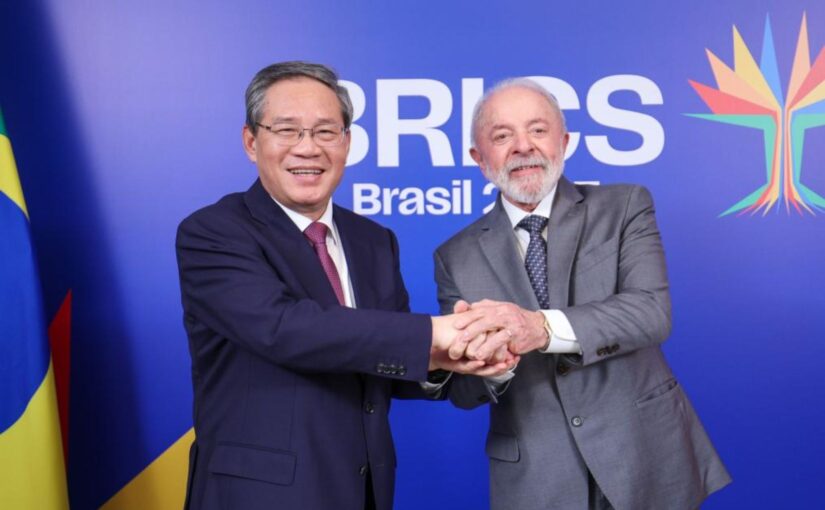
Lula’s trip to China will mark his second official visit during his third term. His first visit occurred in April 2023, followed by a reciprocal state visit from Xi Jinping in November of the same year, after the G20 Summit in Brazil. The two leaders also met again in 2023 at the BRICS Summit in South Africa.

Chinese medical teams have been working in Mozambique for nearly 50 years

Two events on April 14 served to underline the continuing close bonds between China and the countries of southern Africa, forged during the liberation struggle against imperialism, colonialism and white racist minority rule.

Reporting from the capital Maputo, the Xinhua News Agency wrote that the 25th contingent of the Chinese medical team in Mozambique organised a large-scale free clinic at Matola Provincial Hospital, as part of a series of activities commemorating the 50th anniversary of diplomatic relations between China and Mozambique.

The event offered consultations in gynecology, obstetrics, cardiology, urology, pain management, general surgery, orthopedics, spinal surgery, and acupuncture. Medical stations were also set up for blood pressure, glucose, and oxygen saturation checks, as well as for the distribution of basic medicines.

Luisa Panguene, national director of medical assistance at the Ministry of Health, expressed gratitude to the Chinese medical team for promoting health, well-being, and hope for Mozambican citizens.

“On behalf of the Mozambican people, I would like to thank the People’s Republic of China and the Chinese medical mission for their continued support and for the solidarity they have shown throughout these 50 years of brotherhood.”

Ma Litai, leader of the Chinese medical team, said: “We have come here with Chinese expertise, equipment, and medicine to serve the people of Mozambique. Chinese medical teams have been working in Mozambique for nearly 50 years, and we will continue to serve the health needs of the Mozambican people.”

Friendship between China and Mozambique dates to the beginning of the armed liberation struggle against Portuguese colonialism, launched by the Mozambique Liberation Front (FRELIMO) on 25 September 1964, which China, along with the other socialist countries, consistently supported morally and materially. This struggle culminated in the founding of the People’s Republic of Mozambique (now the Republic of Mozambique) on 25 June 1975, with the outstanding Marxist Samora Machel becoming the country’s first President. With a revolutionary friendship already forged in battle, China and Mozambique established diplomatic relations the same day.

Also on April 14, China and Zimbabwe signed two agreements for airport infrastructure maintenance and skills development training in the transport sector in the capital Harare.

At the signing ceremony, Zimbabwean Deputy Minister of Transport and Infrastructural Development Joshua Sacco said: “The signing of the two agreements is a continuation of the long-standing relationship between our two nations dating back to the days of the liberation struggle and it now shows that we are moving on to a stage where we share economic development.”

Ma Xin, Vice Governor of China’s Jiangsu Province, who was leading a provincial delegation, said that with Zimbabwe transitioning towards an industrialised economy, there is heavy demand for infrastructure building and construction, and engineering and construction companies from Jiangsu are more than willing to participate in Zimbabwe’s infrastructure construction development.

Continue reading Chinese medical teams have been working in Mozambique for nearly 50 years

Xi Jinping: China will work with ASEAN countries to combat the undercurrents of geopolitical confrontation

Immediately ahead of his recent state visits to Vietnam, Malaysia and Cambodia, special articles by Chinese President Xi Jinping were published in the major media of the three countries.

Ahead of his visit to Malaysia, Xi reviewed China’s age-old friendship with Malaysia, as well as in more recent times:

“Over 1,300 years ago, Chinese Buddhist monk Yijing of the Tang Dynasty traveled to the Malay Peninsula on his pilgrimage voyage and produced the earliest known written account of the ancient kingdom of Kedah. More than 600 years ago, Chinese navigator and explorer Zheng He of the Ming Dynasty and his fleet called at Malacca during five of his seven historic expeditions. His visits planted seeds of peace and friendship… Some 80 years ago, when the Chinese People’s War of Resistance Against Japanese Aggression reached a critical juncture, the Nanyang Volunteer Drivers and Mechanics from Malaysia braved immense dangers to reach China’s Yunnan Province, and helped keep the Burma Road operational, as it was a vital lifeline of China’s wartime supplies. Today this remarkable story of courage still echoes in the hearts of both peoples… Fifty-one years ago, breaking through the gloom of the Cold War, leaders of China and Malaysia made the decision to establish diplomatic relations, pioneering a groundbreaking new chapter in relations between China and ASEAN (Association of South East Asian Nations) countries. China and Malaysia have since respected each other’s development paths while maintaining strategic independence. We have provided mutual support on issues vital to our respective core interests and on our major concerns, setting an exemplary model for two countries to prosper together through mutually beneficial cooperation.”

Highlighting various areas of such bilateral cooperation, Xi went on to note that China and Malaysia have mutually granted visa exemption to each other’s nationals. The year 2024 saw nearly six million mutual visits between the two countries, which exceeded the pre-COVID level. “Malaysia, truly Asia,” the tourism promotional ad that highlights the unique charm of Malaysia’s culture, history and landscape, has inspired numerous Chinese tourists to visit Malaysia for leisure vacations or sightseeing. More and more Malaysian tourists are traveling to China to appreciate its historical legacy and experience its contemporary vibe. I hope our peoples will visit each other as often as family.

China and Malaysia, Xi continued, are both major developing countries in the Asia-Pacific. We are also emerging market economies and members of the Global South. China welcomes Malaysia as a BRICS partner country. Its inclusion in the organisation aligns with the historic trend of the Global South’s pursuit of solidarity-driven collective advancement and serves the common interests of developing countries. This year marks the 80th anniversary of the victory of the Chinese People’s War of Resistance Against Japanese Aggression and the World Anti-Fascist War, the 80th anniversary of the founding of the UN, and the 70th anniversary of the Bandung Conference. As we honour these milestones, our two countries must strengthen mutual cooperation in international and regional affairs, and champion the Five Principles of Peaceful Coexistence and the Bandung Spirit. We must uphold the UN-centred international system and the international order underpinned by international law, and promote fairer and more equitable global governance. We must uphold the multilateral trading system, keep global industrial and supply chains stable, and maintain an international environment of openness and cooperation. As a community with a shared future, China and Malaysia share the smooth times and the rough, stand united in peace and crisis, and thrive and endure together.

He added: “China fully supports Malaysia in its role as the ASEAN chair for 2025 and looks forward to Malaysia serving as a stronger bridge between the two sides as the country coordinator for China-ASEAN Dialogue Relations. Through its modernisation, China is striving to build itself into a great modern socialist country in all respects and advancing the rejuvenation of the Chinese nation on all fronts. Chinese modernisation follows a path of peaceful development. China will promote global peace, development and shared prosperity with other countries through mutually beneficial cooperation. The Chinese economy is built on a solid foundation, with multiple strengths, high resilience and vast potential for growth. The core conditions supporting its long-term positive growth remain firmly in place, with the underlying upward trend unchanged. China has set its target for economic growth at around five percent for 2025. We will continue to pursue high-quality development, expand high-standard opening up, share development opportunities with other countries, and bring greater stability and certainty to the regional and global economy. Unity brings strength, and cooperation leads to mutual success. China will work with Malaysia and other ASEAN countries to combat the undercurrents of geopolitical and camp-based confrontation, as well as the countercurrents of unilateralism and protectionism, in keeping with the historical trend of peace and development.”

Continue reading Xi Jinping: China will work with ASEAN countries to combat the undercurrents of geopolitical confrontation

Xi Jinping pays state visits to Vietnam, Malaysia and Cambodia

General Secretary of the Communist Party of China (CPC) Central Committee and Chinese President Xi Jinping paid a state visit to Vietnam from April 14 to 15, at the invitation of General Secretary of the Communist Party of Vietnam (CPV) Central Committee To Lam and President of the Socialist Republic of Vietnam Luong Cuong. President Xi also paid state visits to Malaysia and Cambodia from April 15 to 18, at the invitation of King of Malaysia Sultan Ibrahim and King Norodom Sihamoni of Cambodia. He returned to Beijing on the afternoon of April 18.

Prior to the visits, on April 11, the Xinhua News Agency carried three articles reviewing highlights of Xi’s contributions to his country’s friendship with its three neighbours.

Beginning with Vietnam, Xinhua notes that when To Lam made his first visit to China as the leader of the Communist Party of Vietnam in August 2024, he started the trip not in Beijing but in the southern metropolis of Guangzhou – a special arrangement Chinese President Xi Jinping later hailed as “quite meaningful.” It was in Guangzhou, a century earlier, that Ho Chi Minh, the late Vietnamese leader, began his revolutionary activities in China, a period of history Xi described as “a shared red memory” between the two countries’ ruling parties.

Noting that Xi’s trip this time coincides with the 75th anniversary of diplomatic ties between China and Vietnam, two socialist neighbours that have forged an enduring bond as “comrades and brothers.”, Xinhua wrote that, “behind the metaphors lies more than a diplomatic formality. Xi sees the enduring China-Vietnam friendship as a living cause to be carried forward.”

During a state visit to Vietnam in 2017, Xi brought along a special national gift – 19 issues of the People’s Daily, the official newspaper of the CPC Central Committee.

Among the newspapers were 16 yellowed copies carrying news reports on Ho Chi Minh. “These newspapers date back to Chairman Ho’s visit to China in 1955. It took us quite some effort to find them,” Xi explained. One notable edition, dated June 26, 1955, featured a full-column front-page photograph of Ho alongside Mao Zedong, Zhou Enlai and other first-generation CPC leaders. Ho, who founded the Communist Party of Vietnam in Hong Kong and led Vietnam’s liberation, forged close personal ties with CPC leaders during his 12 years of revolutionary activities in China. “He was like a brother for Chairman Mao Zedong, Premier Zhou Enlai and other Chinese leaders,” Xi wrote in a signed article published by the major Vietnamese newspaper Nhân Dân ahead of the visit.

Xi once shared his personal regard for Chairman Ho while speaking with Vietnamese youth. “We call him ‘Uncle Ho’,” Xi said. He noted that in the hearts of the Chinese people of his generation, Chairman Ho is remembered as the best friend of the Chinese people.

Back in 2011, Xi, then Chinese Vice President, visited Ho’s former residence to learn more about his life. Before his departure, Xi left an inscription: “The great man’s spirit shall be honored for millennia, and the China-Vietnam friendship shall endure through the ages.”

Six years later, during the 2017 state visit, Xi once again toured Chairman Ho’s former residence. At a pond near the Ban Sao Nak, the wooden house where Ho once lived and worked, Xi learned to clap his hands before feeding fish, the same practice Ho once used to draw fish closer. While there, reflecting on bilateral ties, Xi said, “We should learn from Chairman Mao, Premier Zhou and Chairman Ho, and carry forward and develop China-Vietnam friendship for the benefit of both our peoples.”

Xinhua’s article on Xi’s friendship with Malaysia recalls that in 2012, Yong June Kong, a Malaysian young man who had studied medicine in China, donated his hematopoietic stem cells to a Chinese boy suffering from leukemia, successfully saving the seven-year-old child and making himself the first foreign stem cell donor in China.

During Xi’s 2013 visit to Malaysia, the president referenced this moving episode to highlight the deep friendship between the Chinese and Malaysian people. “We will also not forget” the story, Xi said with deep emotion.

“This encouragement has strengthened my resolve to stay in China, to continue my medical career in saving lives, to do more blood donations and other charitable activities, and to become a bridge of friendship between China and Malaysia,” Yong said.

As a Malay proverb once quoted by Xi goes: “A friend who understands your tears is much more valuable than a lot of friends who only know your smile.”

Continue reading Xi Jinping pays state visits to Vietnam, Malaysia and Cambodia

Chinese Embassy comments on government takeover of British Steel

Republished below are the remarks by a spokesperson for the Chinese Embassy in London regarding the UK government’s takeover of British Steel.

The spokesperson points to the surge of anti-China propaganda among politicians and in the media following the announcement by Jingye, the Chinese company that owns British Steel, that it would be shutting down the blast furnaces at its Scunthorpe plant. For example, UK business secretary Jonathan Reynolds told Sky News that the British government had in the past been “far too naive” about UK-Chinese trade. Various commentators have resurrected tropes about China using its investments in Britain to conduct espionage or to “disrupt infrastructure for geopolitical leverage”. This sort of anti-China rhetoric is “extremely absurd, reflecting arrogance, ignorance and a twisted mindset”.

The spokesperson notes that the Jingye Group is a private enterprise that works on the basis of normal commercial principles, and that the Chinese government has no control over its operations. Having poured vast amounts of money into British Steel and lost hundreds of millions of pounds in the process – and given negotiations with the UK government over the future of the plant had failed to yield results – Jingye made a commercial decision to shut down the blast furnaces. “British Steel’s plan to close its blast furnaces and build electric arc furnaces is a normal decision, and it is understandable that the company conducted negotiations with the government on investment for the transition.”

The comment notes that, in general, “Chinese companies in the UK have operated in compliance with law and achieved steady progress”. Given the importance of Chinese investment and trade in supporting the Labour government’s stated commitment to economic growth, it seems foolhardy to politicise the issue of Jingye’s operations and create a discriminatory business environment.

This message was reiterated by Chinese Foreign Ministry spokesperson Lin Jian: “We hope that the British government will treat Chinese companies investing and operating in the UK in a fair and just manner, protect their legitimate rights and interests, and refrain from turning economic and trade cooperation into political and security issues lest it should undermine the confidence of Chinese companies in their normal investment and operation in the UK.”

The remarks by the embassy spokesperson also highlight the hypocrisy in fiercely criticising China whilst not offering even the mildest critique of the Trump administration’s unilateral tariff war. “At a time when the US is wielding the tariff stick against all countries, the UK included, and engaging in unilateral and protectionist trade bullying, those British politicians just keep slandering the Chinese government and Chinese enterprises instead of criticising the United States.”

The comments were first published on the website of the Chinese Embassy in the UK.

Question: Recently, there have been various comments in the UK regarding the government’s takeover of British Steel. Several politicians took the opportunity to attack all Chinese companies and the Chinese government. What’s your comment?

Embassy Spokesperson: The anti-China rhetoric of some individual British politicians is extremely absurd, reflecting their arrogance, ignorance and twisted mindset. Regarding the issue of British Steel, I’d like to share a few basic facts.

1. The Jingye Group is a private Chinese enterprise that makes business investments in the UK on the basis of market principles and conducts operation on its own.

2. It is well-known that British Steel had been losing money for many years before its acquisition by Jingye in 2020 and actually went into compulsory liquidation in 2019. After taking over, Jingye put in substantial funding to keep the company afloat to this day. Had it not been for the involvement of this Chinese company, British Steel workers might have already faced the risk of unemployment.

3. It is understood that under the UK government’s net zero strategy, steel companies that use iron ore to make steel must achieve net zero emissions by 2035. To that end, British steel companies including British Steel have all negotiated with the government to find a path to decarbonisation transition. Among them, the Port Talbot Steelworks in Wales closed its blast furnace in July 2024. British Steel’s plan to close its blast furnaces and build electric arc furnaces is a normal decision, and it is understandable that the company conducted negotiations with the government on investment for the transition.

4. Generally speaking, Chinese companies in the UK have operated in compliance with law and achieved steady progress. They have made positive contributions to the local economy. According to statistics available, Chinese companies in the UK have contributed over 115 billion pounds to the UK economy and created nearly 60,000 jobs.

5. At a time when the US is wielding the tariff stick against all countries, the UK included, and engaging in unilateral and protectionist trade bullying, those British politicians just keep slandering the Chinese government and Chinese enterprises instead of criticizing the United States. What on earth are they up to?

6. Any words or deeds that politicise or maliciously hype up business issues will undermine the confidence of Chinese business investors in the UK and damage China-UK economic and trade cooperation. We urge the British government to follow the principles of fairness, impartiality and non-discrimination and to make sure that the legitimate rights and interests of Chinese companies in the UK are protected. At the same time, it is hoped that the British government will continue to engage in consultations and negotiations with Jingye to actively seek a solution acceptable to all parties. We will continue to follow the development of this situation.

China and Vietnam: Building on past achievements and making new advances in pursuit of shared goals

Republished below is President Xi Jinping’s signed article in Nhân Dân, the official newspaper of the Communist Party of Vietnam, published to coincide with his state visit to Vietnam – President Xi’s first overseas trip of 2025, and the first stop on a Southeast Asian tour that also includes Malaysia and Cambodia.

The trip will have been planned for some time, but, as a BBC article notes, “it has taken on heightened significance in the wake of a mounting trade war between the US and China”.

In his article, Xi reiterates the firm political and historical basis for China-Vietnam friendship:

China and Viet Nam are friendly socialist neighbors sharing the same ideals and extensive strategic interests. The profound friendship between the two parties and two peoples, forged decades ago, has grown stronger as we explore a socialist path suited to our respective national conditions and advance our respective modernization drive. Building the China-Viet Nam community with a shared future that carries strategic significance serves the common interests of our two countries and is conducive to peace, stability, development and prosperity of our region and beyond. It conforms with the trend of history. And it is the choice by our peoples.

Citing the famous poetic phrase of Chairman Ho Chi Minh that “the friendship between Viet Nam and China is so profound because we are both comrades and brothers”, Xi states that the bilateral friendship is “inherited from our distinctive revolutionary traditions”.

Pioneers of Chinese and Vietnamese revolutions together explored a path to national salvation and made important contribution to the world’s victory in the struggle against colonialism and imperialism.The historical site of the Vietnamese Revolutionary Youth League in Guangzhou and the site of the office of the League for Independence of Viet Nam in Jingxi, Guangxi Zhuang Autonomous Region bear witness to the revolutionary friendship between China and Viet Nam. Chairman Ho Chi Minh joined and supported the Chinese People’s War of Resistance Against Japanese Aggression in Yan’an, Guilin, Chongqing and Kunming . China sent military and political advisers in support of the Vietnamese people’s War Against French Occupation. The Communist Party of China and the Chinese government and people gave full support for Viet Nam’s just War Against U.S. Aggression to Save the Nation.

Reviewing the progress that has been made in economic cooperation between the two countries in recent decades, Xi notes that China has been Vietnam’s biggest trading partner for over 20 years in a row; that railway connectivity and the smart port development project are being steadily advanced; and that bilateral clean energy projects have boosted Vietnam’s electricity supply and its environmental goals. “Contributing to each other’s success and pursuing common development, China and Viet Nam have set an example of solidarity and cooperation in the Global South.” The article proposes further expansion of trade and in cooperation on railways, 5G, artificial intelligence and green development.

An article in China Daily by researchers at the Vietnam Academy of Social Sciences observes that Chinese investments in Vietnam are “shifting toward high-tech industries such as industrial components, electronics, and automobiles”, thereby “presenting Vietnam with an opportunity to access modern technology and integrate more deeply into the global production chain.”

Xi’s article calls on China and Vietnam to deepen strategic mutual trust and advance the socialist cause; to “explore and enrich together socialist theory and practices, and promote the steady development of the two countries’ socialist cause”.

Addressing the global trade war recently launched by the US, Xi calls for China, Vietnam and the other countries of the region to enhance multilateral collaboration and promote Asia’s prosperity and revitalisation, as part of a fairer, more inclusive vision of globalisation.

China will ensure continuity and stability of its neighborhood diplomacy. We will stay committed to the principle of amity, sincerity, mutual benefit and inclusiveness. We will continue to pursue the policy of forging friendship and partnership with our neighbors. And we will steadily deepen friendly cooperation with them to advance Asia’s modernization…

We should work together with the Global South to uphold the common interests of developing countries. Trade war and tariff war will produce no winner, and protectionism will lead nowhere. Our two countries should resolutely safeguard the multilateral trading system, stable global industrial and supply chains, and an open and cooperative international environment.

The article concludes: “Standing at this new starting point of history, China is ready to work with Viet Nam to build on past achievements, write a new chapter in building the China-Viet Nam community with a shared future, and contribute even more to building a community with a shared future for mankind.”

The article is reposted from Xinhua News Agency.

Late spring is full of vitality. As China and Vietnam celebrate the 75th anniversary of diplomatic relations, I will soon pay a state visit to Vietnam at the invitation of Comrade To Lam, General Secretary of the Central Committee of the Communist Party of Vietnam, and Vietnamese President Comrade Luong Cuong. This will be my fourth visit to this beautiful country since I became General Secretary of the Central Committee of the Communist Party of China and President of the People’s Republic of China. I look forward to renewing friendship with Vietnamese leaders, discussing ways of boosting cooperation, and drawing up a new blueprint for the China-Vietnam community with a shared future in the new era.

China and Vietnam are friendly socialist neighbours sharing the same ideals and extensive strategic interests. The profound friendship between the two parties and two peoples, forged decades ago, has grown stronger as we explore a socialist path suited to our respective national conditions and advance our respective modernization drive. Building the China-Vietnam community with a shared future that carries strategic significance serves the common interests of our two countries and is conducive to peace, stability, development and prosperity in our region and beyond. It conforms with the trend of history. And it is the choice by our peoples.

The China-Vietnam community with a shared future is inherited from our distinctive revolutionary traditions. During modern times, pioneers of Chinese and Vietnamese revolutions together explored a path to national salvation and made important contribution to the Third World’s victory in the struggle against colonialism and imperialism. The historical site of the Vietnamese Revolutionary Youth League in Guangzhou and the site of the office of the League for Independence of Vietnam in Jingxi, Guangxi Zhuang Autonomous Region bear witness to the revolutionary friendship between China and Vietnam. President Ho Chi Minh joined and supported the Chinese People’s War of Resistance Against Japanese Aggression in Yan’an, Guilin, Chongqing and Kunming. China sent military and political advisers in support of the Vietnamese people’s War Against French Occupation. The Communist Party of China and the Chinese government and people gave full support for Vietnam’s just War Against U.S. Aggression to Save the Nation. The well-known line: “The friendship between Vietnam and China is so profound because we are both comrades and brothers,” is etched on our shared revolutionary memory.

The China-Vietnam community with a shared future is based on strong political mutual trust. In recent years, General Secretary Nguyen Phu Trong, General Secretary To Lam and other Vietnamese leaders and I have visited each other many times, steering the course for building a China-Vietnam community with a shared future. Our two parties and two countries have kept close high-level engagement. Mechanisms such as the steering committee for bilateral cooperation, the party-to-party theoretical symposium, the border defence friendship exchange, and the conference on crime control between the two public security ministries are functioning smoothly. High-level mechanisms including the joint committee between the National People’s Congress of China and the National Assembly of Vietnam have been established. The “3+3” strategic dialogue on diplomacy, defence and public security between our two countries has been held successfully. China and Vietnam hold similar positions on many regional and international issues and have engaged in close coordination on them.

The China-Vietnam community with a shared future is rooted in our fruitful cooperation. China and Vietnam have pursued closer cooperation on industrial and supply chains amid a sluggish global economic recovery. China has been Vietnam’s biggest trading partner for over 20 years in a row, with total bilateral trade exceeding 260 billion USD in 2024. More and more quality Vietnamese agricultural products such as durian and coconut are available to Chinese consumers. Railway connectivity and the smart port development project are being steadily advanced. Solar panels, waste-to-energy plants and other bilateral clean energy projects have boosted electricity supply in Vietnam. The Cat Linh-Ha Dong metro line built by a Chinese company makes public transport in Hanoi more convenient. Contributing to each other’s success and pursuing common development, China and Vietnam have set an example of solidarity and cooperation in the Global South.

The China-Vietnam community with a shared future is advanced by close people-to-people exchanges. Over the years, we have seen ever more people-to-people exchanges that foster increasingly closer ties between Chinese and Vietnamese peoples. Chinese tourists made more than 3.7 million visits to Vietnam in 2024. With the official launch of the Detian-Ban Gioc Waterfall Cross-Border Tourism Cooperation Zone and the opening of several cross-border road trip routes, visiting two countries in a single day has become possible. Chinese film and television productions and video games are popular among young Vietnamese, and more people in Vietnam are learning Chinese. Many Vietnamese songs are now on hot search lists on social media in China, and many Chinese diners relish pho and other Vietnamese delicacies.

Today, global, epoch-making and historical changes are unfolding like never before, and the world has entered a new period of turbulent transformation. Despite the headwinds of mounting unilateralism and protectionism, the Chinese economy expanded by five percent in 2024, contributing around 30 percent to the global economy. It remains a key engine of the world economy. China’s new energy sector, artificial intelligence and animated films have come into global spotlight. China will continue to provide more opportunities to the world with its high-standard opening up, and will contribute to the development of all countries with its high-quality development.

Asia represents a new elevation in global cooperation and development. At a new starting point toward revitalisation of the whole region, Asia faces both unprecedented opportunities and challenges. China will ensure continuity and stability of its neighbourhood diplomacy. We will stay committed to the principle of amity, sincerity, mutual benefit and inclusiveness. We will continue to pursue the policy of forging friendship and partnership with our neighbours. And we will steadily deepen friendly cooperation with them to advance Asia’s modernization.

China is going all out to build a great modern socialist country and achieve the rejuvenation of the Chinese nation by pursuing Chinese modernization. Vietnam will usher in a new epoch of national development toward the two goals set for the centenary of the party and the country respectively. China always gives Vietnam high priority in its neighbourhood diplomacy. Our two countries should strengthen our efforts on all fronts to build the China-Vietnam community with a shared future, and contribute more to peace, stability, development and prosperity in Asia and the world at large.

— We should deepen strategic mutual trust and advance the socialist cause. The two sides should act on the guidance of the leaders. The China-Vietnam steering committee for bilateral cooperation should coordinate our interactions more effectively to boost party, government, military, law enforcement and security cooperation; jointly tackle external risks and challenges; and uphold political security. China is ready to enhance exchanges of governance practices with Vietnam, explore and enrich together socialist theory and practices, and promote the steady development of the two countries’ socialist cause.

— We should continue win-win cooperation and deliver more benefit to our two peoples. We should create greater synergy between our development strategies, implement well the cooperation plan between the two governments on synergizing the Belt and Road Initiative and the Two Corridors and One Economic Circle strategy, and build more platforms for economic and technological cooperation. China stands ready to advance cooperation with Vietnam on the three standard-gauge railways in northern Vietnam and the smart port. China welcomes more quality Vietnamese products in the Chinese market and encourages more Chinese enterprises to invest and do business in Vietnam. Our two countries should step up cooperation on industrial and supply chains, and expand cooperation in emerging areas such as 5G, artificial intelligence and green development to create more benefits for the two peoples.

— We should strengthen people-to-people exchanges and forge a closer bond between our peoples. This year is the China-Vietnam Year of People-to-People Exchanges, and we should use this opportunity to promote people-to-people exchanges in diverse forms. China welcomes Vietnamese visitors to travel across China and encourages Chinese tourists to visit scenic sites in Vietnam. Our two countries should carry out more activities that will bring our two peoples together such as the friendly meeting between youth and festive events in border areas. We should further tap into our revolutionary resources and tell stories of friendship that resonate with our two peoples, so as to pass on the baton of China-Vietnam friendship from generation to generation.

— We should enhance multilateral collaboration and promote Asia’s prosperity and revitalization. This year marks the 80th anniversary of the victory in the Chinese People’s War of Resistance Against Japanese Aggression and the World Anti-Fascist War as well as the 80th anniversary of the founding of the United Nations. Our two countries should firmly uphold the UN-centered international system and the international order underpinned by international law. It is important that we pursue the Global Development Initiative, the Global Security Initiative and the Global Civilisation Initiative. It is also important that we promote an equal and orderly multipolar world and a universally beneficial and inclusive economic globalization. We should work together with the Global South to uphold the common interests of developing countries. Trade war and tariff war will produce no winner, and protectionism will lead nowhere. Our two countries should resolutely safeguard the multilateral trading system, stable global industrial and supply chains, and open and cooperative international environment. We should strengthen coordination in mechanisms such as East Asia cooperation and Lancang-Mekong cooperation so as to ensure more stability for a changing and turbulent world and inject more positive energy in it.

— We should properly manage differences and safeguard peace and stability in our region. The successful delimitation of our boundaries on land and in the Beibu Gulf demonstrates that with vision, we are fully capable of properly settling maritime issues through consultation and negotiation. The two sides should implement the common understanding reached between the leaders of the two parties and the two countries. We should make good use of the maritime negotiation mechanism so as to properly manage maritime differences, expand maritime cooperation, and build up conditions for the final resolution of the disputes. We should fully and effectively implement the Declaration on the Conduct of Parties in the South China Sea and actively advance the consultation on a Code of Conduct in the South China Sea. We should be impervious to all interference; bridge differences and expand common ground; and make the South China Sea a sea of peace, friendship and cooperation.

Standing at this new starting point of history, China is ready to work with Vietnam to build on past achievements, write a new chapter in building the China-Vietnam community with a shared future, and contribute even more to building a community with a shared future for mankind. 

China strengthens neighbourhood ties in response to US economic coercion

The following article by Dirk Nimmegeers, which originally appeared on the China Square website, seeks to understand the rationale for the Trump administration’s seemingly bizarre tariff war, noting that it is a component of the US’s long-term strategy of containing China.

The US is using assorted means – persuasive and coercive – to win other countries to its side in its campaign of aggression against China. China meanwhile is “is forming or strengthen coalitions with continents, countries, regions and international organisations”, particularly among its Asian neighbours. “Correct relations, the strengthening of mutual trust and regular contacts between China and those neighbours, and among those same countries, are conducive to peace and prosperity.”

The article provides valuable context for President Xi Jinping’s visit to Vietnam, Malaysia and Cambodia this week.

The article was translated into English from the original Dutch by the author.

Madness?

Most people believe President Trump’s erratic policies will harm the US’s economic interests and alienate its allies. However, it is conceivable that, as Polonius said of Hamlet, ‘though this be madness, yet there is method in’t’. In other words, that there exists a rationale for Trump’s behaviour beyond simple folly and deranged impulsiveness.

In Europe, for instance, the US president has already succeeded in getting his demands for increased financial contributions to NATO accepted by allies. His team has doubled down on distrust of China and has escalated tensions even further than team Biden. In Europe, many influential groups and individuals would rather strike a deal with Washington than cooperate with Beijing.

By means of a global import blackmail, and somewhat later granting a 90-day reprieve to all countries except China, Trump and his ministers and advisers are trying to hit the People’s Republic hard. They want to undermine China’s growth and force China to accept US trade terms. Further, their aim is to punish China for its success in building a modern economy and technology and for its refusal to bow to US rule.

Targeting China and its neighbours

Moreover, Trump and co plan to entice other countries to side with the US against China, and if that fails, to force them to do so. The US elite successfully fought the socialist countries of Europe through an ideological Cold War, imperialist warfare worldwide, fomenting divisions, and a major arms race. Today, in the renewed Cold War, Generation Trump is deploying different tactics against the world’s largest socialist country. In this, financial and economic tactics play an important role.

The Chinese government says it is not seeking a fight with the US, but is ready to take it “to the end” if Washington forces it to do so. This is not grandstanding. The People’s Republic of China has a political leadership that enjoys strong political support from the people and is proving that both with economic growth and technological innovation, it has firmly established its policies and the means to defend them. The Chinese government, under the leadership of the Communist Party, primarily represents the interests of the vast majority of Chinese citizens.

Two-track policy

In doing so, however, it also champions economic globalisation that may benefit all countries. China favours an international system monitored and protected by institutions such as the United Nations, the World Trade Organisation, the International Atomic Energy Agency (IAEA) or the World Health Organisation. China takes initiatives for groupings that offer the countries of the Global South in particular new development opportunities and help them to pursue an independent course. The combination of taking care of domestic interests on the one hand and concern ‘for a shared future for humanity’ on the other is reflected in an economic and a geopolitical programme. Economically, this is called a dual circulation strategy. Geopolitically, China makes the case for its sovereignty and territorial integrity, as well as for multipolarity and peace policy. Driven by President Xi Jinping, Beijing is taking global initiatives such as the Global Development Initiative, the Global Security Initiative and the Global Civilisation Initiative.

To maximise the chances of success, the People’s Republic is forming or strengthen coalitions with continents, countries, regions and international organisations. Preferential countries for this are its Asian neighbours. It is quite obvious why. First of all, there is the importance of their friendship for national defence, but also for the number of people and social strata in China that live and benefit from trade. China no longer depends on imports and exports to the extent that it did at the beginning of the century; nevertheless these sectors remain essential and have a strong input in the domestic debate.

Which neighbouring countries?

China has land borders with no less than 14 states: Vietnam, Laos, Myanmar, Bhutan, Nepal, India, Pakistan, Afghanistan, Tajikistan, Kyrgyzstan, Kazakhstan, Mongolia, Russia and the Democratic People’s Republic of Korea (North Korea). In addition, there are neighbouring countries in Asia from which the People’s Republic is only separated by maritime areas, such as the Philippines, the Republic of Korea (South Korea) and Japan. Some more distant countries such as Cambodia, Thailand, Malaysia, Singapore, Indonesia, Brunei, East Timor also belong to the Southeast Asian neighbourhood region of China.

Correct relations, the strengthening of mutual trust and regular contacts between China and those neighbours, and among those same countries, are conducive to peace and prosperity. That’s why China has resolved most border issues with its neighbouring countries.  In the region, Beijing seeks peaceful agreements between countries with divergent interests in the South China and East China Seas. A roadmap towards peaceful reunification with China’s Taiwan province is also vital for China’s territorial integrity in that context.

Needless to say, peace and prosperity are further served by China’s excellent economic and political relations with the Association of Southeast Asian Nations (ASEAN). The same goes for the Regional Comprehensive Economic Partnership (RCEP), in which China plays a leading role as a co-founding member. Measured by GDP, RCEP is the largest free trade agreement in the world. It unites the 10 countries of ASEAN, as well as Japan, South Korea, Australia and New Zealand, in addition to China itself. Cambodian expert Thong Mengdavid speaks of a “mega-trade pact, covering about 2.3 billion people, which has shown its ability to boost regional economic growth, promote trade liberalisation and foster deeper integration among members”. According to Thong, this is “proof of the power of economic integration. It proves that cooperation, not isolation, leads to prosperity.”

Two visions on international politics

Western views and approaches to global politics are based on ‘prosperity through self-interest and neo-colonialism’ and ‘peace through domination and conflict’. Trump’s Make America Great Again is currently the most extreme example of this. China refuses to submit to it and, within the framework of its socialist project, offers an attractive alternative to it.

Contradictions in neighbouring countries

Many of China’s neighbours experience contradictions between, on the one hand, supporters of closer relations with the People’s Republic and, on the other, supporters of submission to the US or a continued alliance with it. In addition, there is always a current that refuses to make a choice, but is often forced to do so by the course of history. In the Republic of Korea (South Korea), for example, the political world is torn between a Democratic Party that wants rapprochement with China and peace with North Korea, and a party of politicians who believe that the country’s interests are best served by continued obedience to the United States. In Japan, some politicians are more open to the alliance between Washington, Seoul and Tokyo, while others prefer a trilateral with Beijing.

Indian ministers and other policymakers aspire to become a rival to the People’s Republic as an Asian superpower, so they are offering the West their services, and participating in projects like the India – Middle East – Europe Economic Corridor (IMEC). IMEC would like to be a rival to the Belt and Road Initiative (BRI). Hostility with Pakistan, a prominent participant in the BRI, is one of the reasons for this. These Indian nationalists hinder their political opponents who want to go forward on the logical path of peace and progress between two Asian giant civilisations. Vietnam has a political system and economic policies closely akin to China’s, and a history of socialist brotherly relations with the People’s Republic. But even there, there are apparently groups that, for various reasons, seem to advocate accommodation with the United States, the historical imperialist enemy.

To be continued

Understandably, then, Chinese President Xi Jinping wants to ‘strengthen strategic ties with neighbouring countries’. China plans to do this ‘by taking differences into account appropriately and strengthening supply chain ties’. These remarks were made at a central working conference on diplomacy with neighbouring countries held by the CPC in Beijing on Tuesday and Wednesday of last week.

With the following terms China’s foreign ministry announced Xi Jinping’s trip to important neighbouring countries this week. ‘At the invitation of General Secretary of the Central Committee of the Communist Party of Vietnam to Lam and President of the Socialist Republic of Vietnam Luong Cuong, General Secretary of the Central Committee of the Communist Party of China and President of China Xi Jinping will pay a state visit to Vietnam from 14 to 15 April. At the invitation of the King of Malaysia, His Majesty Sultan Ibrahim, and King Norodom Sihamoni of Cambodia, President Xi Jinping will pay a state visit to Malaysia and Cambodia from 15 to 18 April.’

We look forward to learning what opportunities the negotiators agree on for countering MAGA man Trump.

Sources: Xinhua, Min. BuZa China, Friends of Socialist China, Pascalcoppens.com, China Daily, Global Times, Unachina.org, Clingendael.org, South China Morning Post, Asia Times, Morning StarGeopolitical Economy Report

China Daily editorial: the US is not getting ripped off by anybody

We are pleased to republish below a brief editorial in China Daily about the US administration’s hysterical claims that China and other countries are “ripping off” the US via their trade policies. The editorial notes that such claims are being used to justify the US’s unilateral imposition of tariffs, which in turn “provides leverage for the US administration to extract concessions in terms of the real trade war it is waging against China and in reshaping the bilateral relations with the US’s other trade partners in favour of the US by extorting undue concessions”.

The author writes that the US’s trade deficit is not the result of unfair trade practices pursued by other countries, but rather the US’s own economic policies of several decades, pursued in the specific interests of the US capitalist class. What’s more, even if the unilateral tariffs result in more companies investing in manufacturing in the US, this will not create the vast wave of employment being touted by the White House. “The cost of labour in the US means it is more economically viable for machines to do the work than humans.”

In reality, “the US is not getting ripped off by anybody. The problem is the US has been living beyond its means for decades. It consumes more than it produces. It has outsourced its manufacturing and borrowed money in order to have a higher standard of living than it’s entitled to based on its productivity. Rather than being ‘cheated’, the US has been taking a free ride on the globalisation train.” These comments were sufficiently persuasive that they were reported more-or-less neutrally in the Guardian, which is notable given the paper’s usual anti-China stance.

The editorial concludes:

The US should stop whining about itself being a victim in global trade and put an end to its capricious and destructive behaviour. Instead, it should commit itself to working with its trading partners to establish a fair, free and WTO-centred multilateral trading system that is in line with the times.

The US administration has long accused foreign countries of taking advantage of the United States at the expense of domestic jobs and US industries. In US President Donald Trump’s view, the US has received less return value and resources for what it has given the world in terms of the amount of money, trade preferences and other resources. “They’re ripping us off” is his constant refrain.

It is this fabricated premise of a long-standing grievance that has been the launchpad for his administration’s sweeping “Liberation Day” tariffs targeting almost all foreign imports, and which have set up a global trade war and promise to upend the decades-old global trading order.

Though the US leader hit a 90-day pause button on many of the tariffs after his radical power play resulted in US stocks volatility, bond yields surging and recession fears intensifying, his administration’s haughty demolition job on the global trade system is far from over, not least because there is still a 10 percent tariff on virtually all exports to the United States. This provides leverage for the US administration to extract concessions in terms of the real trade war it is waging against China and in reshaping the bilateral relations with the US’ other trade partners in favor of the US by extorting undue concessions.

One of the aims of the US administration is to use the tariffs to close, if not reverse, the trade deficits with nearly all of the US’ trade partners. The preoccupation with trade deficits stems from a warped idea that they are proof that the US has been exploited by other countries. This has also made the US president and his trade advisers wrongly claim that the current rules governing global trade have put the US at a distinct disadvantage.

This is contrary to the belief of mainstream economists that a trade deficit simply means a country is importing more goods and services from a given country than it is exporting to that market, and has nothing to do with the state of a country’s economic health.

While bemoaning surging deficits in the US’ trade of goods with other countries, the US administration has deliberately ignored the fact that the US sells far more services than it buys from other countries, which means the US’ service sector enjoys a trade surplus with almost every trading partner around the world, including those at the center of the ongoing trade war such as China and the European Union. The service sector includes retailers, software, internet and telecom providers, movie studios, as well as health care providers, law firms and accounting agencies. According to the US Commerce Department, the US’ trade surplus in services rose to $293 billion in 2024, up 5 percent from 2023, and 25 percent from 2022.

Trade in services, especially finance, legal, entertainment, and high-tech services, has become a major source of US economic strength. In 2023, US services exports were worth more than $1 trillion, accounting for 13 percent of the global total, and they expanded a further 8 percent last year, according to the World Trade Organization. “Global trade in services … is booming. And there is a clear winner on this front: the United States,” wrote Ngozi Okonjo-Iweala, WTO director-general.

Moreover, Trump’s claim that foreign countries steal US manufacturing jobs through unfair trade practices, and that only sweeping tariffs will help the US reverse the decades-long decline in manufacturing and create related jobs is out of step with historical realities.

This is because service sector jobs have long driven the US economy — the sector employed 57 percent of private sector nonfarm workers in 1939, when the US Labor Department started tracking US employment, and today, service sector businesses account for 84 percent of those jobs.

The modern manufacturing reality suggests that, even if US companies do reshore, the cost of labor in the US means it is more economically viable for machines to do the work than humans.

The US is not getting ripped off by anybody. The problem is the US has been living beyond its means for decades. It consumes more than it produces. It has outsourced its manufacturing and borrowed money in order to have a higher standard of living than it’s entitled to based on its productivity. Rather than being “cheated”, the US has been taking a free ride on the globalization train.

The US should stop whining about itself being a victim in global trade and put an end to its capricious and destructive behavior. Instead, it should commit itself to working with its trading partners to establish a fair, free and WTO-centered multilateral trading system that is in line with the times.

Some aspects of China’s development model

The following article by Shiran Illanperuma, originally published in the Sri Lankan daily newspaper The Island, explores some of the key elements of China’s economic rise, in particular debunking the myth put forward by neoclassical economists that China is “the model par excellence of market liberalisation and the superiority of private sector driven growth”.

Shiran argues that the main competitive advantage of China’s labour force is not its low cost – after all, there are far cheaper labour markets in the world – but the fact that it is well-educated and healthy, and benefits from excellent transport and energy infrastructure. “This, combined with a domestic value chain, is China’s main strength and why economic growth has been combined with rising wages and standards of living.”

Foreign direct investment (FDI) has been leveraged very purposefully in China particularly from the 1990s onwards in order to develop the domestic economy, and to build up the country’s technological capabilities. Meanwhile, “state-owned enterprises (SOEs) are the elephant in the room when it comes to China’s development model”.

Broadly speaking, SOEs in China perform four ‘macroeconomic’ functions. First, they conduct the low-cost production of upstream inputs such as metals, chemicals, and rare earth minerals. Second, they manage essential commodity reserves and intervene in commodity markets to stabilise prices. Third, they engage in countercyclical spending on public works during economic downturns. Fourth, they are deployed to respond during emergencies and external shocks such as the 2008 Sichuan earthquake and the COVID-19 pandemic. The through line in these functions is to keep costs low and smoothen out business and commodity cycles. This is why China has not yet faced a recession comparable to many capitalist economies.

The leading role of the CPC in China’s economic strategy is also crucial:

The Communist Party of China, which has around 100 million members (almost five times the population of Sri Lanka!), has been key to the process of China’s development. The party remains committed to developing Marxist-Leninist philosophy and applying it to the country’s concrete conditions. It retains deep roots in all levels of Chinese society, engaging in consultation during the policymaking process.

As such, China’s remarkable rise cannot be separated from its system of Socialism with Chinese Characteristics.

Shiran Illanperuma is a researcher at Tricontinental: Institute for Social Research and a co-editor of Wenhua Zongheng: A Journal of Contemporary Chinese Thought

China’s rapid development over the last few decades has been the source of much debate among economists. Some claim China as the model par excellence of market liberalisation and the superiority of private sector driven growth. Others equally argue that China’s model is one of planning and state intervention.

On 28 March, I was invited by Nexus Research to deliver a presentation on China’s development model alongside former Ambassador to China Dr. Palitha Kohona. Unfortunately, the contents of this presentation have been misreported in an article in the Island published on 4 April (Dr Kohona: developing countries should covet China model). The article claimed that my presentation touched on “low-cost labour, foreign direct investments, and global trade agreements”. In fact, such simplistic tropes were precisely what I had intended to counter.

China’s development model challenges many of the axioms of neoclassical economics. If low-cost labour were the decisive factor for take-off, then investment should be pouring into much-cheaper labour markets in sub-Saharan Africa. On the contrary, rising wages in China have not led to the outflow of capital one would expect under such a model. This is because the advantage China offers is a healthy and skilled workforce (relative to price) and an infrastructural system that keeps non-wage operating costs (such as transport and energy) low. This, combined with a domestic value chain, is China’s main strength and why economic growth has been combined with rising wages and standards of living.

While foreign direct investment (FDI) has been a huge part of China’s success story, it is possible to overstate their importance. First, FDIs only really took off from the 1990s onwards, yet to begin there would be to ignore the decades of work done to develop the country’s agricultural self-sufficiency, basic industrial system, and institutional structure. Second, what has mattered for China is the quality of FDI, which is determined by government policy. By the standards of the OECD Foreign Direct Investment Regulatory Restrictiveness Index, China remains fairly selective on what FDI is allowed and encouraged. FDI is promoted not as an end in itself but as a means to acquire technology that should be transferred to national champions.

Role of Local Government

A significant portion of my presentation for Nexus Research was on the role of local governments economic policy – something that is often neglected (though there is a growing literature on the subject). China has a fairly decentralised system of governance, a product of its vast size and geography, as well as the institutional changes and experiments in direct democracy during the period of the Cultural Revolution.

Chinese economist Xiaohuan Lan, in his book How China Works (2024), has said that “In China, it is impossible to understand the economy without understanding the government.” While the central government in China formulates indicative plans and the overall goals and trajectory for development, implementation of these plans is delegated to local governments. Local governments have a broad remit to interpret these plans, experiment with implementation, and compete with each other for investment. This leads to a much more dynamic and decentralised development process that encourages grassroots participation.

A comparison between China and India on the share of public employment at different levels of government is very revealing. For China, over 60% of public employment is at the level of local government, with federal and state governments comprising less than 40% of employment. In contrast, less than 20% of Indian public employment is in local government. India, therefore, despite its much-touted linguistic federal system, is far more centralised than China. The weakness of Indian local governments remains a significant barrier for its development.

Continue reading Some aspects of China’s development model

Breaking the silence on Palestinian armed struggle: a call for legal clarity

The following article by Ramzy Baroud and Romana Rubeo, reposted from Palestine Chronicle, addresses the Palestinian people’s right to armed struggle against colonial occupation – recognised under international law but widely ignored by Israel and its supporters.

The authors highlight the significance of the February 2024 testimony at the International Court of Justice (ICJ) by Ma Xinmin, legal advisor to China’s Foreign Ministry, articulating the Chinese position on this conflictive issue, a topic that “even Palestine’s closest allies in the Middle East and Global South dare not touch”.

Palestinian people’s use of force to resist foreign oppression and complete the establishment of an independent state is an inalienable right… The struggle waged by peoples for their liberation, right to self-determination, including armed struggle against colonialism, occupation, aggression, domination against foreign forces should not be considered terror acts.

The article cites Professor Richard Falk, a leading scholar of international law and former UN special rapporteur for Palestine, strongly supporting this position. Addressing the events of 7 October 2023, Falk states: “To the extent that there is real evidence of atrocities accompanying the October 7 attack, those would constitute violations, but the attack itself is something that, in context, appears entirely justifiable and long overdue.”

These points are hugely important in that they affirm the legal and moral legitimacy of Palestinian resistance, and counter the relentless attempts to delegitimise the Palestinian struggle. As such, China’s clearly-stated position is a valuable contribution to the pursuit of Palestinian national rights.

On February 22, 2024, Ma Xinmin, China’s Representative at the International Court of Justice (ICJ), uttered the unexpected.

His testimony, like that of a number of others, was meant to help the International Court of Justice (ICJ) formulate a critical and long-overdue legal opinion on the legal consequences of Israel’s occupation of Palestine. 

Ma Xinmin articulated the Chinese position, which, unlike the American envoy’s testimony, was entirely aligned with international and humanitarian laws.

But he delved into a tabooed subject—one that even Palestine’s closest allies in the Middle East and Global South dared not touch: the right to use armed struggle.

 “Palestinian people’s use of force to resist foreign oppression and complete the establishment of an independent state is an inalienable right,” the Chinese Ambassador said, insisting that “the struggle waged by peoples for their liberation, right to self-determination, including armed struggle against colonialism, occupation, aggression, domination against foreign forces should not be considered terror acts”.

Continue reading Breaking the silence on Palestinian armed struggle: a call for legal clarity

Webinar: The Bandung spirit lives on! Unity against imperialism, and the struggle for a multipolar world

📆 Sunday 27 April 2025, 4pm Britain, 11am US Eastern, 8am US Pacific

Seventy years ago, the Bandung Conference brought together 29 Asian and African countries to discuss the common challenges facing the Third World. The conference was a milestone in the global struggle against colonialism and imperialism, and laid the foundations for the Non-Aligned Movement. This webinar will address the legacy of Bandung, and its relevance to the contemporary world. It will seek to find answers to questions such as:

  • Are the Five Principles of Peaceful Coexistence, adopted at Bandung, still relevant today?
  • How can the Bandung spirit help us to build a global united front against imperialism?
  • What international organisations and movements are carrying forward the Bandung spirit?
  • Are the US and its allies still trying to divide the Global South, as they did during the Cold War?
  • How does China’s rise affect humanity’s trajectory towards multipolarity, sovereignty and socialism?

Confirmed speakers

  • Ben Norton (Founder and editor, Geopolitical Economy Report)
  • Mushahid Hussain (Pakistani senator, Chairman of the China-Pakistan Institute)
  • Tings Chak (Asia Coordinator, Tricontinental Institute)
  • Professor Isaac Saney (Cuba and Black studies specialist, Dalhousie University)
  • Dr Jenny Clegg (Author, China’s Global Strategy: Towards a Multipolar World)
  • Moderator: Professor Radhika Desai (Convenor, International Manifesto Group)

Organisers

This webinar is organised jointly by the International Manifesto Group and Friends of Socialist China.

Book review: People’s China at 75 – The Flag Stays Red

We are pleased to republish this short review of ‘People’s China at 75, the Flag Stays Red’, edited by our co-editors Keith Bennett and Carlos Martinez, which was originally published in the current (Spring 2025) edition of China Eye, the magazine of the Society for Anglo-Chinese Understanding (SACU).

In the editorial, editor Walter Fung also writes: “Keith Bennett and Carlos Martinez’s book, People’s China at 75, the Flag Stays Red, is extremely important as it presents facts from the Chinese point of view of China’s development since the 1949 revolution. Not all histories, even by eminent historians and well qualified scholars present accounts which are without some ‘Western’ bias.”

Further information about SACU, including PDF editions of China Eye, may be found here. The book can be purchased from the Praxis Press website in paperback or digital format.

People’s China at 75, the Flag Stays Red, Edited by Keith Bennett and Carlos Martinez. 152 pages. Praxis Press Glasgow, 2025. 

This is an important book for anybody who wants to understand the People’s Republic of China (PRC) and the Communist Party of China (CPC). Written by several expert authors, the book relates the origins of the CPC and the formation of the PRC and discusses the current position in the world in a clear and concise way. Many references are given at the end of each chapter. The introductory chapter is ‘understanding socialism with Chinese characteristics’, written by the two editors of the book, both of whom are members of SACU.

The aims of Xi Jinping in his programme for a’ New Era;’ are listed and explained. They include: battling against corruption, eliminating extreme poverty and ensuring that those lifted out of poverty do not slip back into poverty, tackling pollution, protecting the environment, safeguarding diversity, being a leader in renewable energy and working against climate change, increasing medical care and insurance and also old age pensions.

Steps will be taken to strengthen the Party and ensuring that it serves the people. In addition, support will be given to support other socialist countries. A strategic goal will be building a world community of a shared future for humanity.  

Other chapters include; building socialism with Chinese characteristics, standing up and opposing hegemony and China’s socialist democracy. Jenny Clegg, a SACU Vice-President relates China’s transition to socialism during the years 1949-56. Despite many challengers and mistakes much was achieved in providing basic necessities of life such as food, clothing and rural medicine through the efforts of barefoot doctors. Advances were made in agricultural techniques and life expectancy was significantly increased.  

BRICS laying the groundwork for a more balanced global financial system

In the following article, which was originally published in China Daily, Endalkachew Sime, a former Minister of Planning and Development in Ethiopia, who is currently studying for his PhD at Peking University, provides a balanced overview of the trend towards de-dollarisation and the role played by the BRICS+ cooperation mechanism.

He notes that it has emerged as a pivotal actor in this regard, adding: “This strategic shift seeks to reduce dependence on the US dollar in international trade, investments and monetary reserves.” But “far from being an antagonistic move against the United States, it represents a pragmatic effort by the BRICS nations to assert financial autonomy and protect their economies from external shocks.” The New Development Bank, established by the BRICS nations in 2015, represents a concrete institutional response to dollar dominance and China’s trade with such major partners as Russia and South Africa have seen significant shifts away from the ‘greenback’.

BRICS nations have also developed alternative payment systems to bypass traditional US-dominated infrastructure. China’s Cross-Border Interbank Payment System and Russia’s System for Transfer of Financial Messages offer alternatives to SWIFT, while India’s rupee-based trade settlement mechanism challenges the US dollar’s dominance in regional trade. These systems enhance financial sovereignty by providing secure, independent channels for international transactions.

Moreover, by diversifying their foreign exchange reserves into alternative currencies and assets – such as the euro, yen and gold – BRICS countries aim to enhance financial stability. Gold reserves have seen particularly dramatic increases.

Sime notes that: “Developing economies face significant risks when their financial systems are closely tied to the US dollar. Changes in US interest rates, quantitative easing, or other monetary policies can trigger capital flows, currency volatility, and economic instability in dollar-dependent economies. By reducing dollar dependence, Global South nations can insulate themselves from these external shocks and maintain greater control over their domestic economic policies. US sanctions have become a powerful tool of economic coercion, particularly against countries such as Russia, Iran and Venezuela. De-dollarisation efforts provide a mechanism for these nations to conduct international trade and finance outside the reach of US sanctions.”

He adds that the current global financial architecture disproportionately benefits developed economies, particularly the US. By creating alternative financial institutions and mechanisms, BRICS nations contribute to a more multipolar system where multiple currencies and financial architectures coexist. This evolution could lead to greater fairness and representation for developing economies in global financial governance.

However, he goes on to warn: “Despite these advances, challenges remain in establishing a fully integrated BRICS financial architecture. The heterogeneity of economic structures, political priorities, and developmental stages among member countries complicates coordination. Furthermore, the US dollar retains its dominance in global finance, and transitioning to alternative systems requires significant investment and institutional development.”

Nevertheless, he concludes: “By creating alternative financial institutions and instruments, BRICS nations are laying the groundwork for a more balanced global financial system. This shift could potentially reduce the effectiveness of the US’ politically motivated unilateral sanctions, enhance financial sovereignty for developing economies, and promote greater stability in international monetary relations… De-dollarisation represents not a threat to the global economic system but an opportunity to create a more resilient and equitable architecture that respects the sovereign economic interests of all nations. For the Global South, this movement is fundamentally about protecting domestic economies from external shocks, asserting financial autonomy, and participating in a more multipolar world order.”

The “BRICS Plus” grouping — Brazil, Russia, India, China, South Africa, Egypt, Ethiopia, Saudi Arabia, Iran, the United Arab Emirates and Indonesia — has emerged as a pivotal actor in the global movement toward de-dollarization. This strategic shift seeks to reduce dependence on the US dollar in international trade, investments and monetary reserves. Far from being an antagonistic move against the United States, it represents a pragmatic effort by the BRICS nations to assert financial autonomy and protect their economies from external shocks.

The US dollar accounted for about 58 percent of global foreign currency reserves and 88 percent of the daily foreign exchange market turnover as of 2023. However, this dominance creates vulnerabilities for countries whose economies are closely tied to its performance.

The New Development Bank, established in 2015 with an initial capital of $50 billion, represents a concrete institutional response to the dollar dominance. By 2023, the NDB had approved over $30 billion in funding for infrastructure and sustainable development projects across BRICS nations, with approximately 30 percent of these funds disbursed in nondollar currencies. Further, the Contingent Reserve Arrangement, a $100 billion financial safety net established in 2014, provides liquidity support in nondollar currencies during financial crises. This mechanism helps BRICS nations mitigate the risks associated with dollar volatility and potential capital flight.

Bilateral trade settlements have seen significant shifts away from the dollar. For instance, the share of the US dollar in Russia-China bilateral trade settlement plummeted from nearly 90 percent in 2015 to 46 percent in the first half of 2020, while the use of local currencies in India-Russia bilateral trade surged from 6 percent to 30 percent between 2014 and 2019. Similarly, the renminbi’s usage in South African trade grew by 65 percent in 2016 alone. These changes reflect a deliberate strategy to reduce exposure to dollar fluctuations and enhance trade stability.

Continue reading BRICS laying the groundwork for a more balanced global financial system

CODEPINK peace group subjected to McCarthyite lies

On 25 March 2025, at a US Senate Intelligence Committee hearing on global threats, CODEPINK activist Tighe Barry stood up and called on the US government to stop funding Israel’s genocide in Gaza. Fanatical China hawk Senator Tom Cotton responded by labelling Barry as a “CODEPINK lunatic that was funded by the Communist Party of China”. Retired Colonel Ann Wright stood up and shouted “I’m a retired Army Colonel and former diplomat. I work with CODEPINK and it is not funded by Communist China.”

Both activists were ejected from the room and arrested. Cotton meanwhile proceeded with his McCarthyite diatribe: “The fact that Communist China funds CODEPINK, which interrupts a hearing about Israel illustrates Director Gabbard’s point that China, Russia, Iran and North Korea are working together in greater concert than they ever had before.”

The purpose of this narrative is to portray any opposition to US hegemonism and imperialism as being funded and fomented by foreign powers – just as in the 1950s and 60s, working class, progressive and anti-war activists were portrayed as Soviet agents.

We republish below an article about the incident by Ann Wright from CovertAction magazine, and a petition by CODEPINK, Senator Cotton: Stop Lying about Peace Activists!, which we encourage people to sign.

Senate Intelligence Committee Hearing Turns Ugly with McCarthy-Style Lies About CODEPINK: Women for Peace

On March 25, at the U.S. Senate Intelligence Committee hearing on global threats with the five heads of intelligence agencies of the U.S. government, Senator Tom Cotton, accused on national TV a group I have worked with for over 20 years, CODEPINK: Women for Peace, of being funded by the Communist Party of China.

During the hearing CODEPINK activist Tighe Barry stood up following the presentation of the Director of National Security Tulsi Gabbard’s lengthy statement about global threats to U.S. national security and yelled “Stop Funding Israel.”

This was because neither Intelligence Committee Chair Tom Cotton and Vice Chair Mark Warner had mentioned Israel in their opening statement nor had Gabbard mentioned the Israeli genocide of Palestinians in Gaza in her statement either.

Continue reading CODEPINK peace group subjected to McCarthyite lies