Celebrating 75 years of Chinese Socialism – New York City – Assembly of Peace and Solidarity

📆 Sunday 29 September 2024, 10am-6pm US Eastern

📍The Malcolm X & Dr. Betty Shabazz Memorial and Educational Center, 3940 Broadway New York, NY 10032 United States


October 1, 2024 will mark the 75th anniversary of the founding of the People’s Republic of China, when Mao Zedong declared that “the Chinese people have stood up”.

Friends of Socialist China is initiating two events to mark this historic occasion, in London on Saturday, September 28 and in New York City on Sunday, September 29.

These events will highlight the extraordinary achievements of Chinese socialism over the past 75 years and bring people together to counter the rising tide of anti-China propaganda and the U.S.-led New Cold War.

Discussions will include the ongoing processes of poverty alleviation and modernisation; China’s role in the struggle against climate catastrophe; China’s contribution to Marxist thought; the significance of the recent meeting of all the Palestinian organizations in China and more.

The New York City event is jointly organized by Friends of Socialist China and Workers World Party in coordination with Black Agenda Report, Freedom Road Socialist Organization, Qiao Collective and the International Manifesto Group. It will take place on Sunday, September 29 from 10am to 6pm, at the Malcolm X and Dr. Betty Shabazz Memorial and Educational Center, 165th and Broadway in Harlem, New York

Guests can attend in-person (seating is limited) or virtually. 

Registration required for online and in-person participation via Eventbrite.

Confirmed speakers include:

  • Gerald Horne – Author and historian
  • Danny Haiphong – Journalist, Co-founder of Friends of Socialist China
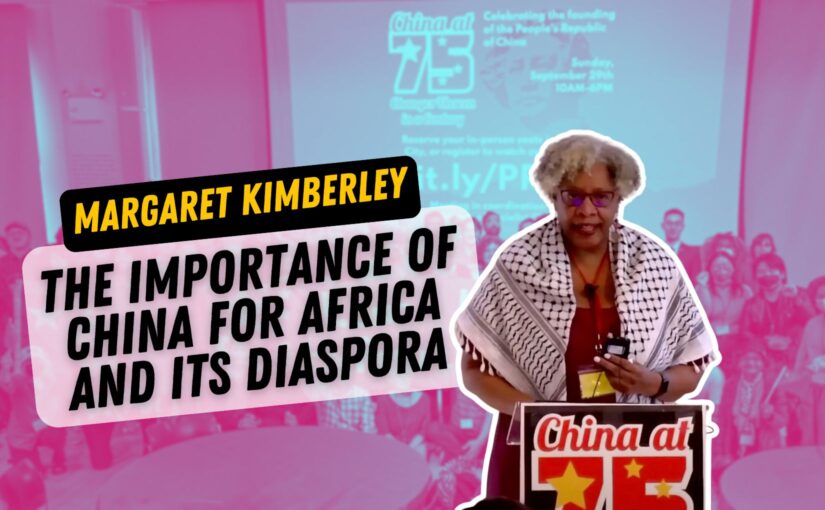
  • Margaret Kimberly – Executive Editor – Black Agenda Report
  • Larry Holmes – First Secretary – Workers World Party
  • Mick Kelly – Political Secretary – Freedom Road Socialist Organization
  • Lee Siu Hin – Director – China / U.S. Solidarity Network
  • Omowale Clay – International Secretariat – December 12th Movement
  • Ken Hammond – Party for Socialism and Liberation, author of multiple books on China
  • Radhika Desai – Coordinator – International Manifesto Group
  • Michael Wong – Vice Pres. of Veterans For Peace and VFP China Working Group
  • KJ Noh – Journalist, analyst of the geopolitics of the Asia-Pacific region
  • Sara Flounders – International Action Center, Friends of Socialist China
  • Dee Knight – author and peace activist

Representatives will also participate from:

  • Communist Party USA International Department
  • US Peace Council
  • Black Alliance for Peace
  • Qiao Collective
  • Struggle / La Lucha
  • Iskra Publishers

Liu Jianchao leads delegation to South Africa

Liu Jianchao, Minister of the International Department of the Communist Party of China (CPC) Central Committee (IDCPC), led a party delegation to South Africa at the end of July and the beginning of August. It was the first stop on a tour of a number of countries in Africa and Latin America.

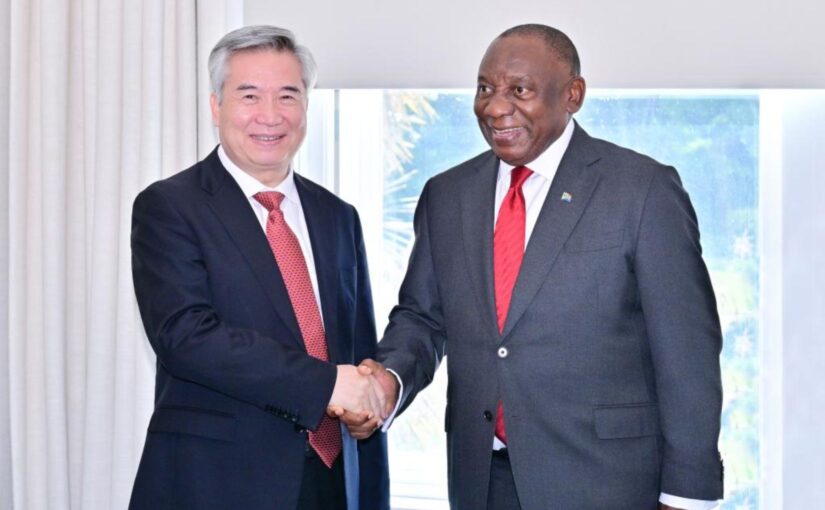
On August 1, Minister Liu met with Cyril Ramaphosa, President of the African National Congress (ANC) of South Africa and of the Republic of South Africa.  Welcoming Liu and his delegation, Ramaphosa said that the CPC delegation’s visit to South Africa at this time (following the recent election and the formation of a government of national unity) demonstrates the Chinese side’s firm support for the ANC and South Africa. He said that he maintains close exchanges with President Xi Jinping and has forged a close friendship, of which he is proud. President Xi Jinping has visited South Africa many times, promoting bilateral relations for continuous improvement and upgrading, which has deeply moved and inspired the South African side. The South African government will keep its policies toward China unchanged and will continue to be committed to promoting the development of a comprehensive strategic partnership. South Africa firmly adheres to the one-China principle and thanks the Chinese side for its long-term valuable support and assistance.

Ramaphosa added that the leadership of the CPC is what has allowed China to realise today’s development achievements and the CPC’s achievements have also inspired the ANC. Since its establishment, the ANC has been fighting for South Africa’s national independence and development. Despite setbacks, it will not give up easily, nor will it shirk its responsibility to lead the country’s development and revitalisation. Calling the CPC a reliable friend and close comrade of the ANC, he said the ANC cherishes its sincere friendship with the CPC. 

Liu said, the Chinese side congratulates the ANC on its victory in the general election again and President Cyril Ramaphosa on his successful re-election. He voiced confidence that under the strong leadership of President Cyril Ramaphosa and the ANC, the government of national unity will closely unite the people and help South Africa make new development achievements. (In the election, the ANC secured 40.2% of the vote, almost twice that of its nearest rival – and now coalition partner – the Democratic Alliance [DA], which secured 21.8%.) 

China and South Africa, Liu continued, are both important members of the Global South and emerging economies. The Chinese side is willing to strengthen coordination and cooperation with South Africa on multilateral affairs, promote the construction of a more just and reasonable international political and economic order, and safeguard the common interests of the vast number of developing countries.

He added that the CPC and the ANC have a long-standing friendship. The Chinese side firmly believes that as a mature political party that has stood the test of the changing circumstances, the ANC will carry forward its fine traditions, firmly grasp the correct development direction of South Africa, and promote China-South Africa relations for robust development.

The previous day, Liu had met with ANC Secretary-General Fikile Mbalula. Liu said, the Chinese side congratulates the ANC on its leadership in forming a government of national unity, which proves that the ANC is a mature century-old party with political wisdom and believes that the ANC will unite and lead the South African people to achieve new achievements in national development.

On August 1, he met with Ronald Lamola, Member of the National Executive Committee of the ANC and South African Minister of International Relations and Cooperation. Lamola said that South Africa is grateful to the Chinese side for providing valuable support in its struggle for national independence and construction. He expressed the hope to expand mutually beneficial cooperation with the Chinese side in areas such as trade and investment. He added that the the foreign policy of the new South African government will not change, and that South Africa will continue to firmly adhere to the one-China principle and steadfastly support China’s positions on issues concerning its core interests. South Africa highly appreciates China’s significant role in promoting the improvement of relations between Saudi Arabia and Iran as well as facilitating the reconciliation of Palestinian factions. He expressed the hope to strengthen coordination with the Chinese side within the BRICS cooperation mechanism and the G-20. South Africa looks forward to participating in the 2024 FOCAC (Forum on China Africa Cooperation) Summit in Beijing, this coming September, believing that it will help African countries advance the African Union’s Agenda 2063 and promote greater development in Africa-China relations.

On July 31, Liu met with Solly Afrika Mapaila, General Secretary of the South African Communist Party (SACP). He congratulated the SACP on its 103rd anniversary, which fell in February. He said that the CPC and the SACP are both Marxist parties, share the same ideals and beliefs, always understand and support each other, and are time-tested good comrades and good brothers.

Mapaila said, the SACP cherishes its friendly relations with the CPC, and thanks the Chinese side for its long-term valuable assistance to South Africa’s economic and social development and the improvement of people’s livelihood, as well as its strong support for the SACP, the African National Congress and other progressive forces in South Africa.

On August 3, Liu also met with the parliamentary leaders of some of the political parties which are participating in the new government of national unity.  He met with Mzwanele Nyhontso, President of the Pan Africanist Congress (PAC) of Azania and Minister of Land Reform and Rural Development; Mogamad Ganief Ebrahim Hendricks, President of the Al Jama-ah and Deputy Minister of Social Development; Brett Herron, Secretary-General of the GOOD Party; and Thandi Nontenja, National Treasurer of the United Democratic Movement (UDM).

Liu said, China and South Africa enjoy a time-honoured friendship. As early as in the struggle against imperialism, colonialism and racism, the two peoples have supported each other and forged a profound friendship. 

The South African party leaders thanked the Chinese side for its long-term and valuable support to the economic and social development of South Africa and expressed their hope to strengthen exchanges with the CPC and learn from its experience in party building and state governance in order to facilitate South Africa’s development and advance South Africa-China relations. 

For their part, Nyhontso said, the PAC has a long history of interacting with China, with many of its leaders and members having trained in China. He hoped to learn from China’s experience in areas such as land reform and rural development to help South Africa solve its prominent problems. [China consistently supported the PAC as one of the country’s national liberation movements during the struggle against apartheid, maintaining a close relationship for a long time.]

Hendricks fondly recalled his experience of interacting with the Chinese side and appreciated China’s great achievements in poverty alleviation. Calling the strong leadership of the CPC the key to China’s success, he said he would like to learn from the Chinese side’s experience.

Herron said, South Africa can benefit from China’s rapid economic and social development and hoped that the two countries will strengthen practical cooperation in various fields, closely coordinate and cooperate in BRICS and other multilateral mechanisms and promote a more just and equitable international order.

Nontenja said, as South Africa is undergoing special changes in its political landscape, the UDM is willing to play a role in the country’s development and hopes to strengthen exchanges with the CPC on national and party construction.  

On August 2, Liu and his delegation also held discussions with representatives from South Africa’s media and think tanks.

Following its visit to South Africa, the CPC delegation proceeded to Uruguay.

The following articles were originally published on the website of the IDCPC.

Cyril Ramaphosa, President of ANC and President of South Africa Meets with Liu Jianchao

Johannesburg, August 1st (IDCPC) — Cyril Ramaphosa, President of African National Congress (ANC) and President of South Africa, met here today with Liu Jianchao, Minister of the International Department of the CPC Central Committee.

Ramaphosa welcomed Liu and the CPC delegation. He said, the CPC delegation’s visit to South Africa, which is experiencing a special moment now, demonstrates the Chinese side’s firm support for the ANC and South Africa. I maintain close exchanges with President Xi Jinping and have forged a close friendship, which I am proud of. President Xi Jinping has visited South Africa many times, promoting bilateral relations for continuous improvement and upgrading, which has deeply moved and inspired the South African side. The South African government will keep its policies toward China unchanged, and will continue to be committed to promoting the development of a comprehensive strategic partnership between South Africa and China. South Africa firmly adheres to the one-China principle and thanks the Chinese side for its long-term valuable support and assistance. 

Ramaphosa said, the leadership of the CPC is what allowed China to realize today’s development achievements, and the CPC’s achievements have also inspired the ANC. Since its establishment, the ANC has been fighting for South Africa’s national independence and development. Despite setbacks, it will not give up easily, nor will it shirk its responsibility to lead the country’s development and revitalization. Calling the CPC a reliable friend and close comrade of the ANC, he said the ANC cherishes its sincere friendship with the CPC and hopes to further strengthen exchanges between the two Parties at all levels and strengthen experience exchanges in national construction and party building.

Liu said, the Chinese side congratulates the ANC on its victory in the general election again and President Cyril Ramaphosa on his successful re-election. Liu voiced confidence that under the strong leadership of President Cyril Ramaphosa and the ANC, the government of national unity will closely unite the people and help South Africa make new development achievements. In August last year, President Xi Jinping successfully visited South Africa and reached important consensus with President Cyril Ramaphosa, charting the course for the further development of relations between the two countries. The Chinese side is willing to work with the South African side to implement the consensus reached by the top leaders of the two Parties and countries, deepen political mutual trust, expand practical cooperation in various fields, firmly support each other on issues involving each other’s core interests, and promote China-South Africa comprehensive strategic partnership for new and greater development. China and South Africa are both important members of the Global South and emerging economies. The Chinese side is willing to strengthen coordination and cooperation with South Africa on multilateral affairs, promote the construction of a more just and reasonable international political and economic order, and safeguard the common interests of the vast number of developing countries. 

Liu said, the CPC and the ANC have a long-standing friendship. The Chinese side firmly believes that as a mature political party that has stood the test of the changing circumstances, the ANC will carry forward its fine traditions, firmly grasp the correct development direction of South Africa, and promote China-South Africa relations for robust development. The Chinese side is willing to strengthen institutionalized exchanges with the ANC as always, deepen exchanges and mutual learning of experience in party building and state governance, enhance its own governing capacity, and promote China-South Africa relations to a new level.


Liu Jianchao Meets with Fikile Mbalula, Secretary-General of African National Congress (ANC) of South Africa

Pretoria, July 31st (IDCPC) — Liu Jianchao, Minister of the International Department of the CPC Central Committee, met here today with Fikile Mbalula, Secretary-General of African National Congress (ANC) of South Africa.

Liu said, the Chinese side congratulates the ANC on its leadership in forming a government of national unity, which proves that the ANC is a mature century-old party with political wisdom, and believes that the ANC will unite and lead the South African people to achieve new achievements in national development. Under the new circumstances, the CPC is willing to work with the ANC to implement the important consensus reached by the top leaders of the two Parties and two countries, maintain high-level strategic communication and political mutual trust, continue to firmly support each other on issues involving respective core interests, deepen exchanges and mutual learning of experience in state governance and administration, and bring China-South Africa comprehensive strategic partnership to a new level. The Chinese side is willing to, together with the South African side, strengthen coordination and cooperation within multilateral frameworks such as the BRICS cooperation mechanism and the Group of 20, promote common development of the Global South countries, and jointly safeguard international fairness and justice. 

Mbalula said, the ANC and the CPC have a long-standing friendship, and the relationship between the two Parties is an important foundation for the relationship between South Africa and China. The ANC congratulated the CPC on the successful holding of the third plenary session of the 20th CPC Central Committee. Mbalula introduced relevant situation of the South African general election of 2024, and said that the ANC will hold a National Executive Committee meeting to thoroughly summarize the experience and lessons. Calling China a reliable friend of South Africa, the ANC thanks the Chinese side for the long-term valuable support and assistance to South Africa. The South African government’s long-term commitment to the one-China principle will not change, and its friendly policy toward China will not change. Under the new situation, the ANC is willing to continue to strengthen high-level exchanges with the CPC, and learn experience in governing the Party and the country from the CPC, so as to overcome the current challenges, achieve self-reform, and lead the country to develop better. 

Lindiwe Zulu, Member of the ANC National Executive Committee, Nokuthula Nqaba, Secretary General of ANC Women’s League and others, were present.


Liu Jianchao Meets with Ronald Lamola, Member of the ANC’s National Executive Committee, South African Minister of International Relations and Cooperation

Pretoria, August 1st (IDCPC) — Liu Jianchao, Minister of the International Department of the CPC Central Committee, met here today with Ronald Lamola, Member of the National Executive Committee of the African National Congress (ANC) and South African Minister of International Relations and Cooperation.

Liu stated that Chinese President Xi Jinping and South African President Cyril Ramaphosa have provided important strategic guidance for the development of bilateral relations, ushering in a “golden era” of building a high-level China-South Africa community with a shared future. The Chinese side is willing to work with the South African side to implement the important consensus reached by the two heads of state. Focusing on the implementation of the “Nine Programs” of the Forum on China-Africa Cooperation (FOCAC) and the 10 Years Strategic Programme on Cooperation between the People’s Republic of China and the Republic of South Africa (2020-2029), both sides need to strengthen the deep alignment of development strategies, consolidate cooperation in advantageous areas, cultivate new growth drivers for cooperation, achieve mutual benefits, win-win results and common development, and continuously benefit the people of both countries. 

Liu said, both China and South Africa are influential developing countries and emerging market nations. The Chinese side supports the South African side in playing a greater role in international and regional affairs and is willing to continue to work with the South African side under multilateral mechanisms such as the BRICS cooperation mechanism and the Group of 20, practice true multilateralism, strengthen the Global South countries’ representation and voice in the global governance system, and safeguard the common interests of developing countries. The new meeting of the FOCAC will be held in Beijing. The Chinese side is willing to work with African countries, including South Africa, to achieve more win-win outcomes in China-Africa cooperation.

Lamola stated, Chinese President Xi Jinping’s successful visit to South Africa last year injected strong impetus into the future development of bilateral relations. South Africa is grateful to the Chinese side for providing valuable support in its struggle for national independence and construction. He expressed the hope to expand mutually beneficial cooperation with the Chinese side in areas such as trade and investment. The South African side also hoped that the Chinese side can help it address prominent issues in its development process, advance industrialization, and promote the development of the comprehensive strategic partnership between South Africa and China. He said the foreign policy of the new South African government will not change and that South Africa will continue to firmly adhere to the one-China principle, steadfastly support China’s positions on issues concerning China’s core interests related to the Taiwan question, Hong Kong, Xinjiang, and Xizang. South Africa highly appreciates China’s significant role in promoting the improvement of relations between Saudi Arabia and Iran, and facilitating the reconciliation of Palestinian factions. He expressed the hope to strengthen coordination with the Chinese side within BRICS and the Group of 20. South Africa looks forward to participating in the 2024 FOCAC Summit in Beijing, believing that the summit will help African countries advance the African Union’s Agenda 2063 and promote greater development in Africa-China relations. 

Both sides exchanged views on international and regional issues such as the Ukraine crisis and the Palestinian-Israeli conflict.


Liu Jianchao Meets with Solly Afrika Mapaila, General Secretary of the South African Communist Party

Pretoria, July 31st (IDCPC) — Liu Jianchao, Minister of the International Department of the CPC Central Committee, met here today with Solly Afrika Mapaila, General Secretary of the South African Communist Party (SACP).

Liu congratulated the SACP on its 103rd anniversary. He said that the CPC and the SACP are both Marxist parties, share the same ideals and beliefs, always understand and support each other, and are time-tested good comrades and good brothers. Under the new situation, the CPC is willing to work with the SACP to implement the important consensus reached by President Xi Jinping and President Cyril Ramaphosa, continue to deepen strategic communication, strengthen experience exchanges on issues such as party building, promote practical cooperation in various fields, better promote the construction of respective countries, and bring more benefits to the people of the two countries. 

Mapaila said, the SACP cherishes its friendly relations with the CPC, and thanks the Chinese side for its long-term valuable assistance to South Africa’s economic, social development and improvement of people’s livelihood, as well as the strong support for the SACP, the African National Congress and other progressive forces in South Africa. Under the new situation of the formation of a government of national unity in South Africa, the SACP hopes to strengthen exchanges with the CPC, deepen experience exchanges in state governance and administration, and promote South Africa-China relations for greater development. Mapaila also introduced the situation of the South African general election of 2024 and the current political situation in conjunction with the process of South Africa’s national democratic revolution. 

Joyce Moloi-Moropa, SACP National Treasurer, Cde Thulas Nxesi, SACP Deputy National Chairperson, Jenny Schreiner, Member of SACP Political Bureau and others, were present.


Liu Jianchao Meets with Party Leaders in the National Assembly of South Africa

Cape Town, August 3rd (IDCPC) — Liu Jianchao, Minister of the International Department of the CPC Central Committee (IDCPC), met here today with the leaders of some parties in the National Assembly of South Africa. Mzwanele Nyhontso, President of the Pan Africanist Congress (PAC) of Azania and Minister of Land Reform and Rural Development, Mogamad Ganief Ebrahim Hendricks, President of the Al Jama-ah and Deputy Minister of Social Development, Brett Herron, Secretary-General of the GOOD Party, and Thandi Nontenja, National Treasurer of the United Democratic Movement (UDM), attended the meeting.

Liu said, China and South Africa enjoy a time-honored friendship. As early as in the struggle against imperialism, colonialism and racism, the two peoples have supported each other and forged a profound friendship. Since the establishment of diplomatic relations 26 years ago, the two sides have upheld sincerity and friendship with bilateral relations continuously reaching new heights. Under the strategic guidance of President Xi Jinping and President Cyril Ramaphosa, China-South Africa relations have entered a “golden era”. The Chinese side is willing to work with the South African side to implement the important consensus reached by the two heads of state, firmly support each other on issues that bear on our respective core interests and are of major concern to us, expand practical cooperation in various fields, and continuously enrich the connotation of the China-South Africa comprehensive strategic partnership.  

Liu said, relations between political parties are a vital part of state-to-state relations. The CPC is willing to strengthen communication and exchanges with the political parties in the National Assembly of South Africa, exchange views on important issues of common concern, enhance mutual understanding, further gather the forces of China-South Africa friendship, and push China-South Africa relations to a new height to bring more benefits to the two peoples. Liu also introduced the major experience of China’s economic and social development and the main features of Chinese modernization.  

The party leaders thanked the Chinese side for its long-term and valuable support to the economic and social development of South Africa, and expressed their hope to strengthen exchanges with the CPC and learn from the CPC’s experience in party building and state governance to facilitate South Africa’s development and advance South Africa-China relations.  

Nyhontso said, the PAC has a long history with interacting with China, with many of its leaders and members trained in China. He hoped to learn from China’s experience in areas such as land reform and rural development to help South Africa solve its prominent problems. Hendricks fondly recalled his experience of interacting with the Chinese side and appreciated China’s great achievements in poverty alleviation. Calling the strong leadership of the CPC the key to China’s success, he said he would like to learn from the Chinese side’s experience. Herron said, South Africa can benefit from China’s rapid economic and social development, and hoped that the two countries will strengthen practical cooperation in various fields, closely coordinate and cooperate in BRICS and other multilateral mechanisms, and promote a more just and equitable international order. Nontenja said, as South Africa is undergoing special changes in its political landscape, the UDM is willing to play a role in the country’s development, hoping to strengthen exchanges with the CPC on national and party construction. 

China supports Iran in safeguarding its sovereignty, security and national dignity

China has declared that it supports Iran in safeguarding its sovereignty, security and national dignity in accordance with the law, supports its efforts to safeguard regional peace and stability, and is willing to maintain close communication with the country.

This important statement came in an August 11 telephone conversation between Chinese Foreign Minister Wang Yi and Acting Iranian Foreign Minister Ali Bagheri Kani. It followed the assassination by Israel on July 31 in Tehran of Ismail Haniyeh, who chaired the Political Bureau of the Islamic Resistance Movement Hamas. Haniyeh was in the Iranian capital to attend the inauguration of President Masoud Pezeshkian.

Wang Yi reiterated that China firmly opposes and strongly condemns the assassination, believing that it gravely violates the basic norms governing international relations, seriously infringes on Iran’s sovereignty, security and dignity, directly undermines the Gaza ceasefire negotiation process, and shocks regional peace and stability.

China stands ready to work with the new Iranian government to continue to firmly support each other on issues concerning their respective core interests, steadily advance practical cooperation in various fields, unswervingly promote the sound development of bilateral relations, and constantly add new content to the China-Iran comprehensive strategic partnership.

Iran is welcome to actively participate in the events hosted by China as the rotating chair of the Shanghai Cooperation Organisation (SCO) and China is also willing to strengthen cooperation with Iran within the framework of the BRICS mechanism, further increase the voice and influence of the Global South, and promote more just and reasonable development of international governance, Wang said.

Analysing the significance of the Chinese stance, the online publication, The Palestine Chronicle quoted its Chief Editor, Dr. Ramzy Baroud, as saying:

“The official Chinese position did not include such phrases as ‘using restraint’, or ‘avoiding further escalation’. In itself, this is very important.”

Baroud added, “also considering the guarded nature of Chinese foreign policy, it would not be expected that the Chinese openly declare that Iran has the right to attack Israel or Israeli interests as a form of retaliation for Israel’s infringement on its sovereignty through the assassination of the Palestinian leader.

“A careful reading of the statement of Foreign Minister Wang Yi, however, suggests that China is willing to accommodate, in fact, support an Iranian retaliation against Israel since such retaliation can be considered part of Iran’s ‘safeguarding its sovereignty, security and national dignity.’”

“This development”, Baroud continued, “indicates two things: One, that Iran is succeeding in garnering enough international support for its forthcoming response to the Israeli assassination of Haniyeh; two, that China is inching closer to the pro-resistance camp in the Middle East, a position that would surely frustrate Washington’s designs in the region.”

Earlier, on August 11, Wang Yi also held separate telephone talks with Egyptian Foreign Minister Badr Abdelatty and Jordanian Foreign Minister Ayman Safadi.

In his talk with his Egyptian counterpart, Wang said the assassination of Ismail Haniyeh has pushed the regional situation into a more dangerous height, adding that China resolutely opposes and strongly condemns such assassination acts that violate the basic principles of the UN Charter, infringe on Iran’s sovereignty and dignity, severely undermine efforts to promote peace, and make a ceasefire in Gaza increasingly unattainable, adding that that double standards should not be applied to the crisis in Gaza.

He also pointed out that China will continue to stand on the side of international justice, strengthen solidarity with Arab countries, and work with all parties to avoid further escalation and deterioration of the situation.

Speaking with Jordanian Foreign Minister Safadi, Wang pointed that the key to avoiding the deterioration and escalation of the situation is to achieve a full and permanent ceasefire in Gaza as soon as possible and the international community should raise a more consistent voice on this issue and form a joint force.

The following articles were originally published by the Xinhua News Agency.

Chinese FM holds phone talks with Iranian counterpart on bilateral ties, Mideast situation

BEIJING, Aug. 11 (Xinhua) — Chinese Foreign Minister Wang Yi on Sunday held phone talks with Acting Iranian Foreign Minister Ali Bagheri Kani at request, focusing on bilateral relations and the situation in the Middle East.

Noting that Iran is a country with important influence in the region and a comprehensive strategic partner of China, Wang, also a member of the Political Bureau of the Communist Party of China Central Committee, said that China has always promoted its relations with Iran from a strategic and long-term perspective.

Continue reading China supports Iran in safeguarding its sovereignty, security and national dignity

China strongly condemns “heinous” Israeli air strike on school in Gaza

China has once more spoken out at the United Nations against Israeli aggression and in support of justice for the Palestinians.

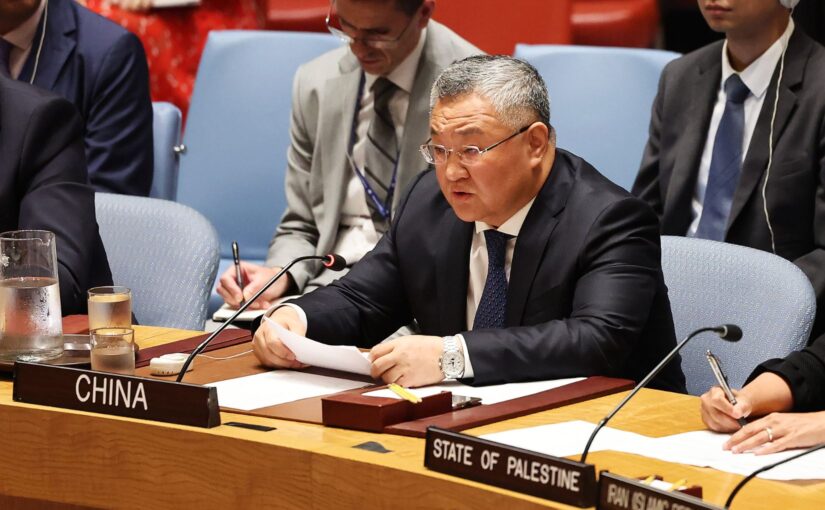
Speaking at a Security Council briefing called at the request of Algeria on August 13, Ambassador Fu Cong said that:

Israel’s air strike on the Tabeen school in Gaza last week claimed around 100 innocent civilian lives. China strongly condemns this attack. Civilians and the civilian infrastructure must not be the target of military operations. This is a red line under the international humanitarian law. Attacking schools where a large number of civilians are seeking shelter again and again is a heinous act. Over the past ten months, millions of people in Gaza have seen their homes destroyed and their loved ones separated. They have been forced to move from place to place in search of a corner of peace, only to be met with indiscriminate bombardment and deaths that could befall them at any moment. As we speak, nowhere is safe in Gaza.

Underlining once again the pressing need for an immediate and durable ceasefire, Fu noted: “Two months ago, when pushing for Security Council Resolution 2735, the US claimed that Israel had accepted a ceasefire agreement. But the reality is quite the opposite. Instead of credible signs of Israel’s commitment to a ceasefire, what we see is ever-expanding military operations and ever-increasing civilian casualties.”

Pointing out that the humanitarian situation in Gaza continues to worsen, with hunger and disease spreading rapidly, the Chinese Ambassador continued: “Recently, a high-ranking Israeli politician described it as just and moral to starve two million people in Gaza. Such appalling remarks are totally unacceptable.” He added that: “We are gravely concerned about the incidents of sexual abuse by Israeli soldiers against Palestinian detainees. We call for investigations and accountability.”

We print below the full text of Ambassador Fu Cong’s remarks. They were originally published on the website of China’s Permanent Mission to the UN.

President, 

I thank Algeria for requesting this meeting, and thank Under-Secretary-General Rosemary DiCarlo and Director Lisa Doughten for their briefings.

Israel’s air strike on the Tabeen school in Gaza last week claimed around 100 innocent civilian lives. China strongly condemns this attack. Civilians and the civilian infrastructure must not be the target of military operations. This is a red line under the international humanitarian law. Attacking schools where a large number of civilians are seeking shelter again and again is a heinous act. Over the past ten months, millions of people in Gaza have seen their homes destroyed and their loved ones separated. They have been forced to move from place to place in search of a corner of peace, only to be met with indiscriminate bombardment and deaths that could befall them at any moment. As we speak, nowhere is safe in Gaza. In Khan Yunis, a place once declared a so-called safe zone by Israel, people there have been forced to flee in the face of new bombing rains. The desperate people of Gaza want to know where is the end of the war and where is the hope for survival.

An immediate and durable ceasefire is what the people of Gaza yearn for. It is also the overwhelming consensus of the international community. Two months ago, when pushing for Security Council Resolution 2735, the US claimed that Israel had accepted a ceasefire agreement. But the reality is quite the opposite. Instead of credible signs of Israel’s commitment to a ceasefire, what we see is ever-expanding military operations and ever-increasing civilian casualties. The US, as the largest supplier of weapons, has enough influence over Israel. We hope that the US will take sincere and responsible actions to push Israel to stop its military operations in Gaza as soon as possible and to stop slaughtering civilians.

President,

The humanitarian disaster in Gaza has continued to worsen. Hunger and disease are spreading rapidly. Recently, a high ranking Israeli politician described it as just and moral to starve two million people in Gaza. Such appalling remarks are totally unacceptable. Hunger must not be weaponized. Humanitarian issues must not be politicized. Civilian lives must not be trivialized as bargaining chips. China urges Israel to fulfill its international humanitarian law obligations by opening all border crossings and guaranteeing rapid and safe access for humanitarian supplies at scale. The World Health Organization is conducting a polio vaccination program for children in Gaza, which is crucial for stemming the spread of infectious diseases and protecting children’s health. Israel is obliged to protect the safety and freedom of movement of the medical workers involved.

Continue reading China strongly condemns “heinous” Israeli air strike on school in Gaza

NATO, nukes and a New Cold War

We are pleased to republish below a series of three articles by Kenny Coyle analysing the new Labour government’s foreign policy, in particular the “progressive realism” espoused by Foreign Secretary David Lammy.

This putatively “clear-eyed approach to international relations” shares a great deal with the pro-Washington, pro-NATO, hawkish foreign policy of recent Conservative governments. Kenny notes that Prime Minister Keir Starmer has pledged to commit 2.5 percent of GDP to military spending, and Lammy’s critique of his Tory predecessor at the Foreign Office is largely focused on the need for a more aggressive stance against China, Russia and Syria.

Lammy praises Ernest Bevin, Labour foreign secretary from 1945 to 1951, for “bringing us the Nato alliance that is still the bedrock of our security” and “fighting for a nuclear bomb as he put it with the Union Jack on top”. Meanwhile, Lammy’s most coherent policy in relation to the Global South is to develop deeper relations with India. As Kenny points out, “clearly this is part of Western efforts to woo India away from its close relations with Russia and to maintain a level of mistrust between Delhi and Beijing”.

Labour is proposing to intensify Britain’s involvement in the US-led campaign of China encirclement. Lammy makes clear his support for the AUKUS nuclear pact, demanding that it be considered “as a floor, not a ceiling” for the UK’s military posture in the Pacific. He also calls for deepening Britain’s military coordination with Japan, South Korea and the Philippines, with the obvious aim of contributing to the US’s island chain strategy against China.

Meanwhile there seem to be shifts occurring in Labour’s position with regard to Taiwan Province, including the establishment of Labour Friends of Taiwan in March 2023 and a recent Labour Party delegation to the island led by Lord Leong. Kenny writes: “The danger is that a current or future British government will abandon [its] One China positions and lean toward the ‘One China, One Taiwan’ policy that is gaining ground in Washington. The emergence of a generously funded Taiwan lobby within the Labour Party and at an all-party level needs to be further exposed.”

The series concludes:

Whoever enters the White House, the cosmetic modifications on offer from Starmer and Lammy commit Britain to a dangerous path in the Asia-Pacific, particularly the under-the-radar military agreements with Japan, South Korea and the Philippines. The left needs to ensure that the arguments against ‘progressive realism’ reach deep into the labour and peace movements.

The articles were originally published in the Morning Star in August 2024.

A new window on the world?

August 2 (Morning Star) — The guiding philosophy of Sir Keir Starmer’s foreign policy has been described by Foreign Secretary David Lammy as “a clear-eyed approach to international relations: progressive realism.”

In a series of speeches, interviews, articles and pamphlets over the past year or so, Lammy has elaborated this apparently innovative outlook in British foreign policy.

The most substantial of these were an article for the influential US journal Foreign Affairs in May, The Case for Progressive Realism, Why Britain Must Chart a New Global Course later republished in The Guardian, and a 2023 pamphlet for the Fabian Society, Britain Reconnected A Foreign Policy for Security and Prosperity at Home.

“Progressive Realism” is designed to meet the challenge of a whole range of global issues, including, AI, climate change, international economic supply-chains and development.

However, since Sir Keir Starmer has pledged to commit 2.5 per cent of GDP to military spending and to conduct a thorough security and defence review, it’s essential to analyse the military and diplomatic aspects of what this new Labour government stands for on the international scene.

Continue reading NATO, nukes and a New Cold War

Germany’s Left Party delegation visits China

A delegation from Germany’s Left Party (Die Linke) visited China in late July, headed by co-chairman of the party Martin Schirdewan.

In an important round of engagements on July 22, the delegation met with Li Hongzhong, Vice Chairman of the National People’s Congress (NPC) Standing Committee, who is also a member of the Political Bureau of the Communist Party of China (CPC) Central Committee.

Li said that China is ready to work with Germany to take the 10th anniversary of the establishment of the all-round strategic partnership between the two countries as an opportunity to strengthen exchanges between political parties and legislatures, promote mutually beneficial cooperation and push forward China-Germany and China-EU relations.

In his meeting with the German delegation, Liu Jianchao, Minister of the International Department of the CPC Central Committee (IDCPC), said that in April this year, President Xi Jinping had in-depth exchanges with visiting German Chancellor Olaf Scholz, charting the course for the future development of bilateral relations. The Chinese side is willing to strengthen communication and dialogue with the German side, promote practical cooperation in various fields, and push China-Germany relations for steady and sustained development.  Liu also briefed on the just concluded third plenary session of the 20th CPC Central Committee.  

Schirdewan thanked the Chinese side for inviting the delegation of Germany’s Left Party to visit China. He said he gained a better understanding of China’s economic and social development, especially the Chinese modernisation, through this visit, and congratulated the Chinese side on its great achievements in poverty alleviation. The Left Party paid close attention to the third plenary session of the 20th CPC Central Committee. It appreciated the CPC’s determination, showcased at the plenary session, to narrow the gap between the rich and the poor and achieve common prosperity. The Left Party is willing to strengthen exchanges with the CPC and promote the development of Germany-China and EU-China relations.  

The delegation also held additional talks with IDCPC Assistant Minister Ma Hui, who said that the CPC attaches importance to its traditional friendly relations with Germany’s Left Party and is willing to, together with the Left Party, strengthen personnel and concept exchanges, promote mutually beneficial cooperation between China and Germany, jointly oppose bloc confrontation and Cold War mentality, and work together to meet global challenges.  

The following articles were originally published by the Xinhua News Agency and on the website of the IDCPC.

Senior Chinese legislator meets co-chairman of German Left Party

BEIJING, July 22 (Xinhua) — Li Hongzhong, vice chairman of the National People’s Congress Standing Committee, met with co-chairman of the German Left Party Martin Schirdewan in Beijing on Monday.

Li, also a member of the Political Bureau of the Communist Party of China (CPC) Central Committee, said that China is ready to work with Germany to take the 10th anniversary of the establishment of the all-round strategic partnership between the two countries as an opportunity to strengthen exchanges between political parties and legislatures, promote mutually beneficial cooperation and push forward China-Germany and China-EU relations.

Continue reading Germany’s Left Party delegation visits China

US economists ‘expose’ China’s economy

In the following article for Fighting Words, Chris Fry unpicks and debunks a recent Axios piece about how China’s economy is supposedly failing.

According to the Axios article, it is a serious problem that “household income growth is outpacing that of spending”, with per capita disposable income rising by 5.4 percent in the first half of 2024. Chris comments: “In the US, 60% of the workers live paycheck to paycheck, putting them and their families at risk in case of an unforeseen crisis. Yet bourgeois economists seem to believe that it is a bad thing for Chinese families to be able to sock some of their income away for emergencies.” Meanwhile, “banks in China, unlike in the US, are publicly owned, so the savings are used to fund the country’s development instead of stock buybacks and cryptocurrency manipulation.”

Another major ‘problem’ is that prices in China are barely rising. “To the well-heeled economists at Axios, it’s a bad thing that the inflation rate in China is a fraction of 1%, while in the U.S. workers now face an inflation rate of some 4%, with prices remaining sky high after previous climbs of over 9% for essential items like food and gas.”

Chris goes on to contrast China’s merciless war on poverty with the alarming rise in poverty, inequality and homelessness in the US. And yet, “whoever wins the next election, the billionaire class and their minions from both parties in Washington will no doubt blame the unfolding crisis here on the People’s Republic of China”.

The article concludes with a powerful call to take inspiration from, and show solidarity with, Chinese socialism:

The high prices that we face for food and gas, the lack of affordable housing, the sky-high prices for education, health care and childcare, the collapse of the infrastructure, the catastrophic effects of global warming, the monstrous prison system, the billions wasted on the war industry, none of these are the fault of the Chinese working class or their Communist Party. The blame lies entirely with the tiny parasitic ruling class of billionaires right here at home.

We must explain to our class here that the extraordinary development by China provides us a beacon of hope. It tells us that the struggle here to empower the workers and oppressed communities, to wrest the ownership and control of the productive apparatus from the billionaires, to use scientific planning to direct both the production and distribution of goods and services instead of Wall Street’s drive for massive profits, all this can offer real benefits for ourselves and our families and for the planet as a whole.

Bourgeois economists, ever ready to proclaim the impending demise of the socialist economic model in the People’s Republic of China (PRC), find every opportunity to throw shade on China’s economic system.

At the same time, they devote their energy to proclaim the supposed superiority of the capitalist economies in the imperialist world, in Europe and the U.S.

And sometimes they have to stretch all logic and common sense to make their billionaire masters and the workers and oppressed here believe in the eternal superiority of U.S. imperialist hegemony over the social and economic system of China, even as the Pentagon scrambles to prepare their war on the PRC.

Continue reading US economists ‘expose’ China’s economy

Karol Cariola: Chile attaches great importance to comprehensive strategic partnership with China

Friendly and cooperative relations between China and Chile were underlined and reinforced with a July visit by Karol Cariola Oliva, Speaker of the Chilean Chamber of Deputies.

In a series of exchanges on July 19, Cariola met with Zhao Leji, Chairman of China’s National People’s Congress (NPC) Standing Committee. He noted that Chile was the first South American country to establish diplomatic ties with the New China [shortly after the election of socialist President Salvador Allende], and China-Chile relations have set a good example of solidarity and cooperation between developing countries.

Cariola said that the Chile-China friendship is based on common values, and that both countries are committed to upholding international law and supporting multilateralism and free trade. She said that Chile upholds the one-China principle firmly, and that political parties and all sectors of society in Chile are highly consistent in their development of relations with China.

 Next year will mark the 55th anniversary of the establishment of diplomatic relations between the two countries. The Chamber of Deputies of Chile is willing to strengthen friendly exchange with the NPC of China, share legislative experience, enhance the friendship between the two peoples constantly, and promote bilateral cooperation in such varied fields as the Belt and Road Initiative (BRI), the economy, culture, and science and technology.

In her meeting with Wang Huning, Chairman of the National Committee of the Chinese People’s Political Consultative Conference (CPPCC), Cariola said Chile attaches great importance to developing a comprehensive strategic partnership with China, and Chile abides by the one-China principle, admires China’s development achievements, and is willing to learn from China’s successful development experience.

A former student leader, and a leading member of the Communist Party of Chile, Cariola is also the General Secretary of the Communist Youth of Chile, which lent extra significance to her meeting with Liu Jianchao, Minister of the International Department of the CPC Central Committee (IDCPC).

Liu said that the CPC is ready to strengthen exchanges and mutual learning of experience in party building and state governance, promote the construction of their respective parties, along with national development, and push forward the China-Chile comprehensive strategic partnership for sustainable and stable development.

Referring to the  third plenary session of the 20th CPC Central Committee, which had concluded in Beijing the previous day, Liu said the  Chinese side is willing to introduce the contents of the plenary session to Chilean political parties in detail, share experience, and support each other in the process of realising the modernisation and development of their respective countries, and unswervingly serve as each other’s comprehensive strategic partner based on equal treatment, mutual benefit and win-win results.

The following articles were originally published by the Xinhua News Agency and on the website of the IDCPC.

China’s top legislator holds talks with speaker of Chilean Chamber of Deputies

BEIJING, July 19 (Xinhua) — Zhao Leji, China’s top legislator, held talks with Karol Cariola Oliva, speaker of the Chilean Chamber of Deputies, on Friday in Beijing.

Zhao, chairman of China’s National People’s Congress (NPC) Standing Committee, said that China has always regarded Chile as an important cooperative partner in Latin America and the Asia-Pacific region, and is willing to work with Chile to implement the important consensus reached by the two heads of state, continue their traditional friendship, upgrade their level of cooperation, and continuously enrich the connotations of the China-Chile comprehensive strategic partnership.

Noting that Chile was the first South American country to establish diplomatic ties with the New China, Zhao said that over the past half century and more, China-Chile relations have maintained sound, steady growth regardless of changes in the international situation, setting a good example of solidarity and cooperation between developing countries.

Continue reading Karol Cariola: Chile attaches great importance to comprehensive strategic partnership with China

Brixton plaque remembers China pioneer

A pioneering photographer, now considered a founder of photojournalism, was honoured with the unveiling of a blue plaque at his former home in the south London district of Brixton on Thursday August 8. London’s blue plaques scheme, run by English Heritage, celebrates the links between notable figures of the past and the buildings in which they lived and worked.

John Thomson, who was born in Edinburgh in 1837 and who died in London in 1921 and is buried in Streatham Cemetery, was known for some of the first photographs of China, Cambodia and Thailand to reach a British audience, as well as for photos of the poorest sections of the working class in Victorian London, before finally winning recognition from ‘high society’ and royalty.

In April 1862, Thomson left Edinburgh for Singapore, beginning a ten-year period of travelling in East and South Asia. After visiting Ceylon (as Sri Lanka was then known) and India in October-November 1864 to document the destruction caused by a cyclone, he travelled to Thailand (then known as Siam), taking photographs of the monarch and members of the royal court and government.

Inspired by accounts of the rediscovery of the ruins of the city of Angkor, which was at the heart of a magnificent Khmer civilisation that flourished from the ninth century onwards, Thomson set off on his first major photographic expeditions and, despite nearly dying of malaria, took the first known photographs of the Angkor Wat Temple, which today takes the central place on the Cambodian flag. As in Siam, he also took photos of the Cambodian royal family.

Following a brief return to Britain, he settled in Hong Kong in 1868, using it as a base to explore and photograph China extensively over the next three years, including Fujian province, Guangzhou, Beiijing, Shanghai, the Great Wall and deep into central China. He published many of his photographs under the title, ‘Illustrations of China and Its People’.

His other important publication was ‘Street Life in London’. According to the BBC, it “recorded some of the impoverished characters living on the fringes of late nineteenth century society in London. His photographs include Hookey Alf of Whitechapel, who wore a hook in place of the arm he lost in an industrial accident and hung around the streets of east London looking for casual labour… His photojournalism, deliberately intended to prick the consciences of the Victorian middle classes, included a poignant picture of a destitute woman in Covent Garden, taken in 1877 and entitled ‘The Crawlers’.”

What the BBC did not report was that, far from merely intending to prick middle class consciences, each of the 36 photos was accompanied by text written by Adolphe Smith Headingley, a Marxist revolutionary and member of the First International. Half-French and a participant in the Paris Commune, Smith narrowly escaped execution when the Commune was crushed and was also instrumental in popularising the singing of the Red Flag in the British Labour movement.

Speaking at the unveiling of Thomson’s plaque, Jamie Carstairs, senior digitisation officer with Bristol University’s library services, who originally made the nomination, said that Thompson was an exceptionally gifted and versatile photographer with “a rare combination of a keen intellectual curiosity, perceptive observational skills, and visual virtuosity.”

‘Illustrations of China and its People’, consisting of 200 photographs and descriptions, was published in 1874. It earned him the nickname “China Thomson”. He is nowadays acclaimed as one of the best foreign photographers ever to set foot in China, Carstairs noted.

 “Thomson’s photography introduced the Victorian public to what it could not see – far away Asia – and to what it did not necessarily want to see – London’s poorest people. John Thomson is a model photographer. Talented, hardworking, innovative, effective, generous, humane. His respect and empathy for the people he photographed made for compassionate and moving portraiture, especially of women.”

Carstairs was followed by Betty Yao MBE, a Chinese community activist, who co-founded the Pan-Asian Women’s Association (PAWA UK) and is the Managing Director of Credential International Arts Management. The rediscovery of Thomson’s work on China is largely thanks to 15 years of tireless work by Betty, who curated the touring exhibition, ‘Through the Lens of John Thomson’, which has now been viewed by over a million visitors throughout Britain, Ireland, China, Europe and North America. Betty has also chaired the John Thomson Commemoration Group, which completed the restoration of his gravestone at south London’s Streatham cemetery in 2019.

She told the gathering of her first encounter with Thomson’s work: “Instantly, I fell in love with his images of China, especially the many, many photographs of women.”

Mayor of Lambeth, and Labour Councillor for Brixton North, John-Paul Ennis said: “I’d like to thank everybody involved in helping to bring this blue plaque to fruition. Blue plaques create the opportunity to sow seeds in people’s minds. To see that great people have lived or worked in your community can have a huge impact on you.”

Thomson’s great-granddaughter, Caroline Thomas said: “As Londoners by upbringing, the work [‘Street Life in London’] resonates greatly, despite being produced over a century ago. It’s sad to think that some of the themes still prevail today. We’re especially proud of the fact that Thomson and Smith chose as their subjects ordinary people and those on the edge of society…  It is this humanity that we would like to honour.”

In 2020, a heritage plaque was unveiled on the Edinburgh building where Thomson was born. 

The below article was originally published on The Brixton Blog. We also embed an interview with Betty Yao, recorded in 2018, to coincide with her exhibition showing at the Brunei Gallery at SOAS University of London.

Continue reading Brixton plaque remembers China pioneer

Remy Herrera: the foundations of China’s economy clearly distinguish it from capitalism

The following text is the English translation of an interview with Rémy Herrera, a research analyst at the National Center for Scientific Research (CNRS) at the Sorbonne in Paris. The interview was carried out by Tang Xiaofu for the Observers’ Network, Beijing, and was recently posted in Workers World. While covering similar ground to the interview we published in June 2024, it contains a number of additional insights and is well worth reading in full.

In the interview, Herrera firmly rejects the characterisation of China by David Harvey and others of “a neoliberalism with Chinese characteristics”, and points to the foundations that clearly distinguish China’s system from capitalism:

1) The persistence of powerful and modernized planning; 2) a form of political democracy, obviously perfectible, but making collective choices possible; 3) extensive public services, conditioning political, social and economic citizenship; 4) ownership of land and natural resources that remains in the public domain; 5) diversified forms of ownership, adequate to the socialization of productive forces and boosting economic activity; 6) a general policy which consists of increasing labor remuneration more quickly compared to other types of income; 7) a desire for social justice displayed by public authorities in the face of rising social inequalities since 1978; 8) the priority given to the preservation of the environment, the protection of nature being now considered inseparable from social progress; 9) a conception of economic relations between States based on a win-win principle; and 10) political relations between States based on the search for peace and more balanced exchanges between peoples.

Herrera goes on to discuss the unique role of the state-owned enterprises in China’s economy, in particular that “the compass that guides them is not the enrichment of private shareholders, but the priorities given to productive investment and the service provided to their customers”.

The public sector “still represents a large part of industrial assets (in construction, steelmaking, basic materials, semi-finished products, etc.) and almost all of them in strategic areas for the country’s, like infrastructure in energy, transport, telecommunications, and of course armaments — in addition to the banking and financial sectors.” As such, public ownership sits at the heart of – and is able to guide – China’s development strategy.

The planning system “is the place where collective choices are developed and decided, as expressions of a general will. It is the authentic space where a nation chooses a common destiny and the means for a sovereign people to become its own master, in all areas of its existence: way of life, ways of consuming, housing and occupying or developing the national territory, precise definition of the relationships maintained by human beings with their environment and nature.”

Herrera also addresses the US’s trade war, launched by Trump and continued by Biden, assessing that the “problem” from the US’s point of view is that the unequal relationship between the US (an imperialist country) and China (a developing country) is becoming less unequal – “there is an erosion of the advantage of the United States in the exchange”. The trade war “was an attempt by the administration led by President Trump to curb the slow, continuous erosion of the advantage of the United States, observed for decades in trade with its emerging rival, China.”

The interview concludes with an appeal to move beyond a moribund imperialism. “We must dismantle the logic of crisis and war driven by high finance by imposing democratic control on it, and therefore think about alternatives to capitalism. The defense of peace and the reactivation of the socialist project are today’s priorities. In this context, China has a fundamental role to play in these transformations.”

I. How the West interprets China

Tang Xiaofu: 1) You have visited China multiple times, but now many scholars are trying to distort Socialism with Chinese Characteristics into State Capitalism. What’s your view towards State Capitalism? And what’s the difference between State Capitalism and Socialism with Chinese Characteristics?

Rémy Herrera: The speeches of many current leaders of the Communist Party of China (CPC) suggest that China would still be in the “first phase of socialism,” that is to say, in a stage considered essential for developing the productive forces and which would take a long time to reach its goal. According to them, the historical goal sought would indeed remain that of developed socialism — even if, it is true, the contours of the latter are far from being clearly and precisely defined. However, in Western countries, many researchers claim that these official political declarations claiming the persistence of socialism in China are only a facade, or the cover-up of a hidden form of capitalism, and that socialism is really dead and buried in China. I do not share the opinion of these Western researchers. On the contrary, I think that these statements by Chinese leaders deserve to be taken seriously.

Moreover, even within the debates among Western Marxists, a clear majority of them affirm that the Chinese economy would henceforth be purely and simply capitalist. This is the case of certain well-known Marxists, such as David Harvey, who believes he has seen, since the 1978 reforms, “a neoliberalism with Chinese characteristics” where a particular type of capitalist market economy has incorporated more and more neoliberal devices operated in the framework of very authoritarian centralized control. This is also the case of Leo Panitch, for example, who analyzes the contemporary integration of China into the circuits of the world economy as the duplication by China of the role of “capitalist complement” formerly held by Japan, as a support that China would provide to the United States through capital flows allowing the latter to maintain its global hegemony, and as the trend towards the liberalization of financial markets in China leading to the dismantling of instruments of control of capital movements and undermining at the same time the bases of the power of the CPC. I do not agree with these researchers either. I defend the idea that today, the Chinese system still contains key elements of socialism, and the interpretation I give of its nature is compatible with socialism.

Thus, I read the Chinese political-economic system as a market socialism, or socialism with a market, based on some pillars which still distinguish it quite clearly from capitalism. I will cite, among these foundations: 1) the persistence of powerful and modernized planning; 2) a form of political democracy, obviously perfectible, but making collective choices possible; 3) extensive public services, conditioning political, social and economic citizenship; 4) ownership of land and natural resources that remains in the public domain; 5) diversified forms of ownership, adequate to the socialization of productive forces and boosting economic activity; 6) a general policy which consists of increasing labor remuneration more quickly compared to other types of income; 7) a desire for social justice displayed by public authorities in the face of rising social inequalities since 1978; 8) the priority given to the preservation of the environment, the protection of nature being now considered inseparable from social progress; 9) a conception of economic relations between States based on a win-win principle; and 10) political relations between States based on the search for peace and more balanced exchanges between peoples. Socialism “with Chinese characteristics” is not very far from this reading grid.

Continue reading Remy Herrera: the foundations of China’s economy clearly distinguish it from capitalism

Wang Yi: China, India should properly handle differences, develop mutually beneficial cooperation

During his July visit to Laos, where he attended a number of international meetings held under the aegis of ASEAN (the Association of South East Asian Nations), Chinese Foreign Minister Wang Yi also held a number of bilateral meetings with his counterparts. Among the potentially most significant, on July 25, was that with Indian External Affairs Minister Subrahmanyam Jaishankar.

At the meeting, Wang said that, in the face of the current complex international situation and severe global challenges, China and India, as two major developing countries and two major emerging economies living next to each other, should strengthen dialogue and communication, and enhance mutual understanding and trust. They should also work for the improvement, steady and sustainable development of China-India relations with a sense of surmounting differences and frictions.

Wang noted that the two countries’ relationship has an important impact that goes beyond the bilateral scope. An improved relationship should reflect the strategic structure of China and India as two major emerging developing countries. The political wisdom of China and India as two ancient civilisations should be reflected in handling their differences, and the unity and cooperation of countries in the Global South should be reflected in their addressing global challenges. He stressed that the return to the right track of China-India relations not only serves the interests of both sides – it is also the common expectation of countries in the Global South.

Jaishankar said that India and China are the two most populous countries, two major emerging economies and two ancient civilisations with a long history. To maintain the stable and predictable development of bilateral relations fully conforms to the interests of both sides and is of special significance to safeguarding regional peace and promoting multipolarity.

The two sides agreed to work together to maintain peace in the border areas and to push for new progress in consultation on border affairs. They also agreed to strengthen communication within a number of international bodies, among them BRICS and the Shanghai Cooperation Organisation, including to safeguard the legitimate rights and interests of developing countries.

The following article was originally published by the Xinhua News Agency.

VIENTIANE, July 25 (Xinhua) — Chinese Foreign Minister Wang Yi met with Indian External Affairs Minister Subrahmanyam Jaishankar here on Thursday, saying the two countries should properly handle differences, and develop mutually beneficial cooperation.

Wang, also a member of the Political Bureau of the Communist Party of China Central Committee, said in the face of the current complex international situation and severe global challenges, China and India, as two major developing countries and two major emerging economies living next to each other, should strengthen dialogue and communication, enhance mutual understanding and trust.

The two sides should work for the improvement, steady and sustainable development of China-India relations with a sense of surmounting differences and frictions, Wang said, adding that the bilateral relationship has an important impact that goes beyond the bilateral scope.

The improvement of bilateral relations should reflect the strategic structure of China and India as two major emerging developing countries, Wang said. The political wisdom of China and India as two ancient civilizations should be reflected in handling their differences, and the unity and cooperation of countries in the Global South should be reflected in addressing global challenges, he added.

It is hoped that the two sides will meet each other halfway, actively explore the right way for the two neighboring major countries to get along, and guide all sectors to build a positive understanding of each other, Wang said.

Wang stressed that the return to the right track of China-India relations serves the interests of both sides and is also the common expectation of countries in the Global South.

Jaishankar said that India and China are the two most populous countries, two major emerging economies and two ancient civilizations with a long history. To maintain the stable and predictable development of bilateral relations fully conforms to the interests of both sides and is of special significance to safeguarding regional peace and promoting multipolarity.

India and China have widely intertwined interests and are also facing the shadow brought by the border situation, but the Indian side is willing to find a solution to differences with a historical vision, strategic thinking and an open attitude and bring bilateral relations back to the positive and constructive track, he said.

The two sides agreed to work together to maintain peace in the border areas and push for new progress in the consultation on border affairs.

The two sides said that they will strengthen communication within the East Asia Cooperation Platform, the Shanghai Cooperation Organization, the Group of Twenty, BRICS and other frameworks, jointly practice multilateralism, and safeguard the legitimate rights and interests of developing countries.

Daniel Ortega: China is bringing progress and benefit to the peoples of the world

On July 15, Nicaraguan President Daniel Ortega and Vice President Rosario Murillo attended a special ceremony in the capital Managua to hand over a fleet of Chinese buses produced by the Yutong company to the city’s transport cooperatives.

“Today,” Ortega declared, “we are delivering these buses so that they contribute to the transportation of families, of children going to school, of young people going to school, going to university; of workers, women, doctors, teachers, of all sectors of Nicaraguan society, who use collective transport.”

A special day had been chosen: “Today, July 15th, is the day our Brother Julio Buitrago, a young man, fell in combat. Julio was in college but went on to combat with the Sandinista Front, and the feat, the heroism, of Julio, who fell in combat 55 years ago today, on July 15th 1969, is well known. He was alone! He was surrounded by 300 National Guard, trained by the Yankees, they brought small tanks, they brought airplanes, and he resisted until his last cartridge… And in tribute to Julio we make this handover on this day, in tribute to Julio who represents Nicaragua’s youth, giving their lives for Nicaragua, fighting for Nicaragua.”

Ortega took the occasion to outline in some detail the long history of solidarity between the Nicaraguan and Chinese revolutions. Referring to a speech just delivered by China’s Ambassador to Nicaragua, he continued: “Our relations with China are historic. Ambassador Chen Xi recalled the years of the triumph of China’s revolution, and they will be commemorating now 75 and us 45. What does this mean? That it took 30 years for the triumph of the Sandinista revolution to follow on, and before the triumph of the Nicaraguan revolution was the triumph of the Cuban revolution, which was immediately intertwined with the People’s Republic of China, when the great Chairman Mao Zedong was at the head of the People’s Republic of China.

“When we were fighting, from the 1960s onwards, against the tyranny of Somoza, we maintained links with the leaders of the Chinese party; compañeras and compañeros of the Sandinista Front traveled there, to China, in those years. And naturally we were inspired by the Chinese revolution, a revolution that had an impact on the world, with such an immense territory and with a division in the country, and the ability that the Chinese leadership, headed by Mao, displayed in uniting that great nation, where there were a great many differences between the provinces. They had to be united, and he united them.

“Then the Chinese revolution came to grow, it came to advance, facing counter-revolutions, and later the Chinese people’s revolution managed to take a great leap forward, such that now, with President Xi Jinping, much wider doors are opening for humanity.”

China, Ortega said, “has been fulfilling its principles, which are revolutionary principles, they are the principles of the Chinese Communist Party, with which we have always maintained relations. Tomás [Tomás Borge, a co-founder and central leader of the Sandinista National Liberation Front, FSLN] was there, in China, in various seminars held there in China in which leaders of the revolutionary parties of Central America took part. Victor Tirado [another historic Sandinista Commandante] had also been there before.

“And China today, is really serving as a compass, pointing the way which other nations share as well, that Planet Earth cannot continue to live under the boot of empires which accumulate wealth at the expense of developing peoples, crushing them, invading them, murdering them. This has to change, and it will surely have to change, because every day we find more countries defending these positions.”

Having praised the cultural performances at the celebration from indigenous and Afro-descendant peoples on his country’s Caribbean coast, Ortega referred to the next tranche of 1,000 buses that will be delivered from China, saying that, “we guarantee some buses for the Caribbean coast, so that they reach Bluefields and reach Bilwi, so that they reach the Mines Region; that is, that the embrace of solidarity from the Chinese people reaches the Miskito peoples, the Ramas, the Afro-descendant population, the Mayagna, the Garifuna. May this embrace of solidarity from the Chinese people reach all these communities, because now the highways are there, and the highways are still advancing. So, there should be no problem now for these buses to circulate on the Caribbean coast.”

He went on to recall his own state visit to China in 1986, where, “we managed to meet as the brothers and sisters that we are.” However, “in the 1990s the neoliberal politicians imposed by the Gringos came along, and the first thing they did was break off relations with the People’s Republic of China.”

After the struggle against three consecutive neoliberal governments, “we returned to government, always in communication with the People’s Republic of China, looking for the moment when we could normalise relations again. We have been united in our struggles, in the battles that the Chinese people have been waging to improve their conditions, to strengthen themselves in all fields, to stand in solidarity with the peoples of Asia, Africa, Latin America, with the peoples of the world.”

Four days after this speech, on July 19, Nicaragua celebrated the 45th anniversary of the victory of the Sandinista people’s revolution. Tens of thousands of Nicaraguans were joined by government delegations from numerous countries, including Algeria, Angola, Belarus, Burkina Faso, China, Cote d’Ivoire, Cuba, Ghana, Honduras, Iran, Kuwait, South Ossetia, Palestine, Qatar, Russia, South Africa, United Arab Emirates, Venezuela, Vietnam and Zimbabwe, along with solidarity delegations from numerous other countries, to hear President Ortega make another important speech. A special guest was the legendary Palestinian revolutionary Leila Khaled.

Having referred to the historic and decisive support rendered by the Soviet Union in the first period of building a new society in Nicaragua, and to Russia’s current struggle against the revival of Nazism in Ukraine, Ortega continued:

“And there is another nation with which we have also had historical relations, the People’s Republic of China, which has been bringing progress, benefits and development to the world’s peoples who were colonised and who became independent, but who were then subjugated under the boot of the interests of the powers that had colonised them, leaving those peoples in poverty, with people in misery, people going hungry, people in illiteracy, with infant mortality, in Africa, in Asia. And the People’s Republic of China has been developing a policy bringing benefits to developing countries, without setting any conditions.

“So now the great powers grouped in NATO already have an incipient war which is in the phase of them preparing their own peoples for what they call a threat; that Russia and China are a threat, but then, too, there are the BRICS, where there is India, and they say they too are a threat. That is to say, everything that is a coming together of nations, of countries, where sovereignty is respected, where they reach agreements to achieve better conditions for their peoples, they see as a threat, because the imperialists are used to occupying by force, and then dominating and murdering; and then pointing accusing fingers at us.”

The following articles were originally published by Tortilla con Sal.

Continue reading Daniel Ortega: China is bringing progress and benefit to the peoples of the world

Chinese modernisation rejects short-termism, stresses sustainability

The Xinhua News Agency recently carried a short interview with our co-editor Keith Bennett on the question of Chinese modernisation, which he said, has as its aim that all people can lead a dignified and meaningful life based on common prosperity.

Keith added that Western countries have seen great economic development over a long period but the gap between the rich and the poor not only persists but even gets worse. Moreover, all sorts of social problems proliferate and eventually become a drag on economic development as well.

On the other hand, Chinese modernisation has taken a different path, which replaces this vicious circle with a virtuous circle and is therefore of great significance to the world. Moreover, China’s foreign policy is an integral aspect of China’s commitment to global stability and development.

“China’s foreign policy of peace is completely connected to and in harmony with its modernisation drive at home as well as with its contributions to the modernisation of other countries.”

The following article was originally published by Xinhua.

LONDON, July 25 (Xinhua) — Chinese modernization rejects short-termism and stresses sustainability, a British expert has said recently.

In an interview with Xinhua, Keith Bennett, an international relations consultant based in London, said that comprehensive and holistic are among the distinctive features of Chinese modernization. “It does not just concern itself with one or other aspect, nor does it see them in isolation from one another but rather as part of an integrated and interconnected whole.”

“This reflects the fact that Chinese modernization rejects short-termism, stresses sustainability,” he said.

On top of that, Chinese modernization is “scientific” and above all “people centered,” Bennett said.

“The aim of Chinese-style modernization is that all people can lead a dignified and meaningful life based on common prosperity,” he added.

The British expert also drew a comparison between Chinese and Western-style modernization approaches.

In his view, Western countries have seen great economic development over a long period but the gap between the rich and the poor not only persists but even gets worse. Moreover, all sorts of social problems proliferate and eventually become a drag on economic development as well.

On the other hand, Chinese modernization has taken a different path, which replaces this vicious circle with a virtuous circle and is therefore of great significance to the world.

He also noted that in China’s case, development and peace are not mutually exclusive; but rather, they are complementary and interdependent.

“China long ago identified development and peace as two key issues of our times. And they are intimately connected. Without peace there can be no development,” he stressed, adding that the tragic conflicts in various parts of the world illustrate this too clearly. “Likewise, successful development helps to eliminate at least one of the main root causes of conflict,” he noted.

Bennett views China’s foreign policy of peace as an integral aspect of China’s commitment to global stability and development.

“China’s foreign policy of peace is completely connected to and in harmony with its modernization drive at home as well as with its contributions to the modernization of other countries,” he said.

So that is why the China-proposed initiatives including the Belt and Road Initiative, the Global Development Initiative, the Global Security Initiative and the Global Civilization Initiative, form an integrated whole, which together lay the foundations to help realize a community with a shared future for mankind, said the expert.

On China’s significant role in the global economy, Bennett said, “China has been the main engine of global economic growth for decades.”

China’s significant contributions as “a major external investor, a major recipient of foreign direct investment, a huge market with the world’s largest middle-income group, and the major trading partner of the majority of the world’s nations” make it a key player in the global economy, he said.

Given the above-mentioned factors, he stressed that China’s efforts in building a high-standard socialist market economy, supporting all-round innovation, and persisting in opening up can have far-reaching effects, which will “help bring stability to the global economy and generate opportunities for businesses and economies worldwide, while providing a valuable point of reference for other countries that wish to develop their economies and realize modernization.”

China shines at the Olympics, but there are some who “don’t want that”

The article below analyses the Western media response to China’s successes in the Olympic Games, in particular the persistent attempts to discredit China’s achievements and to portray the country as a systematic violator of doping regulations.

The author points out that this negative portrayal of Chinese athletes reflects two underlying dynamics. Firstly, an inability to accept that countries of the Global South can, along with their economic emergence, establish the infrastructure necessary to compete at the highest level in sports. Secondly, it reflects a broader hostility towards China, itself a manifestation of an escalating US-led New Cold War.

When it comes to attacking China, racism and war preparation go hand in hand. A campaign is underway against the People’s Republic of China in which lies and distortions of the truth in many areas breed hostility and fear of the country, its leaders and even its people.

This article originally appeared in the Belgian website China Square, and has been translated into English by the author, Friends of Socialist China advisory group member Dirk Nimmegeers.

The people and the media in China are excited about Team China’s outstanding results at the Olympics, though without ignoring the victories of other athletes or looking down on them. Those pushing for war totally dislike this.

Last Sunday, 21-year-old Zheng Qinwen defeated her opponent in the singles tennis final. She made history in Chinese tennis, winning the first gold medal for a Chinese and even for an Asian athlete in that event. Earlier, on Thursday, in the final of the men’s 100-metre freestyle swimming, Pan Zhanle had won and broken his own world record with an astonishing time of 46.40 seconds. Pan is a member of the foursome that won the 4×100-metre medley relay on Sunday.

Exceptional sports performances provoke mixed reactions: admiration, amazement, but sometimes also suspicion. Cyclist Tadej Pogacar, who achieved a spectacular double and more this cycling season, had to deal with doubts from certain quarters. However, the positive usually prevails.

The Positive

Swimming champion Pan Zhanle experienced both positive and negative reactions. His closest sporting rivals, Kyle Chalmers, the Australian silver medal winner, and a previous world record holder, Romanian Popovici, warmly congratulated him. They predicted that swimmers would go even faster as long as they keep working hard and in the right way. Pan has indeed done that and so, after a somewhat hesitant start as a 16-year-old, he managed to make a steep ascent and reach the absolute top just days before he turned 20. Pau Gasol, member of the International Olympic Committee’s (IOC) Athletes’ Commission, and until recently an Olympic athlete himself, stressed that in the “many World Anti-Doping Agency (WADA) doping tests that all Chinese swimmers had to undergo, absolutely nothing was found”. At a press conference Gasol also made clear that “he thought those tests that cause a lot of stress and turn athletes’ lives upside down were excessive” and that “he was not sure whether the measure [of testing Chinese swimmers two or three times more than others] is right or not”. IOC spokesman Mark Adams also confirmed that the Chinese swimming team was “the most tested team” at the Paris Olympics. Since January, the team has undergone more than 600 tests.

Continue reading China shines at the Olympics, but there are some who “don’t want that”

State intervention an indispensable factor in China’s economic success

The following article by Michael Roberts reviews and summarises a new book by Brazilian Marxist economists Adalmir Antonio Marquetti, Alessandro Miebach and Henrique Morrone, entitled Unequal Development and Capitalism: Catching Up and Falling Behind in the Global Economy.

The central focus of the book is measuring the progress of Global South countries in catching up with the imperialist countries in terms of economic development. Roberts summarises the authors’ key finding as follows: “The ‘follower’ countries (the Global South) will generally have higher profit rates than the ‘leader’ countries (the imperialist Global North) because their capital-labour ratio (in Marxist terminology, the organic composition of capital) is lower.” However, “as these countries try to industrialise, the capital-labour ratio will rise and so will the productivity of labour.” As a result, “capital productivity will tend to decline and this eventually will slow the rise in labour productivity.”

Consequently, “many Global South countries will never ‘bridge the gap’ on labour productivity and thus on living standards because the profitability of capital in the Global South will quickly dissipate compared to the Global North”.

How to overcome this contradiction where increased productivity of labour leads to a falling rate of profit, thereby decelerating development? The book’s authors write: “This issue is observed in many middle-income trap countries. In these cases, state intervention becomes essential, expanding investment even as the profit rate declines, as in China.” To which Roberts comments: “Exactly. China’s success in catching up, which so frightens US imperialism now, is down to state-led investment overcoming the impact of falling profitability on capital investment.”

China has “a model of development based on dominant public ownership of finance and strategic sectors and a national plan for investment and growth”. As a result, “only China is closing the gap on per capita GDP with the imperialist bloc”. This chimes with Samir Amin’s observation that “China is the only authentically emergent country”.

Brazilian Marxist economists Adalmir Antonio Marquetti, Alessandro Miebach and Henrique Morrone have produced an important and insightful book on global capitalist development, with an innovative new way of measuring the progress for the majority of humanity in the so-called Global South in ‘catching up’ on living standards with the ‘Global North’.

In this book Marquetti et al argue that unequal development has been a defining characteristic of capitalism. “Throughout history, countries and regions have exhibited differences in labor productivity growth – a key determinant in poverty reduction and development – and although some nations may catch up with the productivity levels or well-being of developed economies at times, others fall behind.”

They propose a model of economic development based on technical change, profit rate and capital accumulation, on the one hand, and institutional change, on the other.  Together these two factors should be combined to explain the dynamics of catching up or falling behind.

They base their development model on what Duncan Foley called the ‘Marx-bias’ and what Paul Krugman has called ‘capital bias’; namely that in capitalist accumulation there will be a rise in the organic composition of capital (rising mechanization compared to labour input) leading to an increase in the productivity of labour, but also a tendency for the profitability of accumulated capital to fall.

Continue reading State intervention an indispensable factor in China’s economic success

China a credible peace broker in Palestine

In the following article for Middle East Monitor, Ramzy Baroud, editor-in-chief of the Palestine Chronicle, discusses the historic signing of a unity agreement between 14 Palestinian political parties in Beijing and the implications it has for China’s role as a peacemaker in the Middle East.

Ramzy notes that China has long been a supporter of the Palestinian cause, and has been involved in various peace initiatives in the region, including its four-point proposal on the Palestine-Israel conflict, put forward by Foreign Minister Wang Yi in May 2021. This proposal was not immediately successful, but in the intervening period there have been two significant developments: first, “China’s success in ending a seven-year rift between Saudi Arabia and Iran re-introduced Beijing as a powerful new mediator”; and second, “US-dominated western diplomacy is breaking apart” and the US has lost all credibility as a mediator.

Meanwhile, China has been a loud and consistent voice in the international community condemning Israel’s onslaught on Gaza. China has proven itself to be “committed to the rights of the Palestinian people and their historic struggle for freedom and justice”.

China’s efforts towards a lasting peace and justice in the Middle East have been widely welcomed by regional states and by the Palestinian people themselves. “China is now officially a peace broker in Palestine and, for most Palestinians, a credible one at that”.

In the video embedded below the article, Ramzy discusses these issues in greater detail on the Palestine Deep Dive show.

Chinese diplomacy has done it again.

By hosting a historic signing of a unity agreement between 14 Palestinian political parties in Beijing on 23 July, China has, once more, shown its ability to play a global role as a peace broker.

For years, China has attempted to play a role in Middle East politics, particularly in the region’s most enduring crisis, the Israeli Occupation of Palestine.

In 2021, China announced its four-point plan, aimed at “comprehensively, fairly and permanently” resolving the Palestinian question.

Whether the plan itself was workable or not, it mattered little, as neither the Israeli government nor the Palestinian Authority were prepared to ditch Washington, which has dominated Middle East diplomacy for decades.

Continue reading China a credible peace broker in Palestine

Xi Jinping congratulates To Lam on his election as General Secretary of the Communist Party of Vietnam

On August 3, the Central Committee of the Communist Party of Vietnam unanimously elected State President To Lam as its General Secretary following the recent death of General Secretary Nguyen Phu Trong.

The same day, his Chinese counterpart Xi Jinping sent a warm congratulatory message to To Lam, in which he reiterated that, “China and Vietnam are socialist neighbours linked by mountains and rivers… I am ready to join Comrade General Secretary To Lam in leading the building of an increasingly substantial and in-depth China-Vietnam community with a shared future, jointly promoting the traditional friendship, consolidating political trust, deepening strategic exchanges, boosting substantive cooperation, bringing more happiness to the peoples of the two countries, and actively contributing to the cause of peace and progress of humanity.”

The text of the message was published by the Vietnamese newspaper Nhân Dân and is reprinted below. In its initial reports, Nhân Dân also highlighted the messages from the leaders of Laos, Cambodia, the Democratic People’s Republic of Korea, Russia, Cuba, Venezuela and Nicaragua, among others.

General Secretary of the Communist Party of China (CPC) and Chinese President Xi Jinping has sent congratulations to State President To Lam on his election as General Secretary of the Communist Party of Vietnam (CPV)’s Central Committee.

The message reads:

“I am very delighted to learn that you have been elected to the position of General Secretary of the Central Committee of the CPV. On behalf of the Central Committee of the Communist Party of China and in my own name, I would like to extend my warm congratulations to you.

“Over the recent years, the CPV has thoroughly implemented the spirit of the 13th National Party Congress’s Resolution, focusing on promoting the Party building, and reaping new achievements in boosting the building of socialism and the renewal and open-door cause.

“We believe that, under the steadfast leadership of the CPV Central Committee, the entire Party and people of Vietnam will successfully realise the objectives and tasks set forth by the CPV’s 13th National Congress, steadily promoting the preparations for the 14th National Congress, and continuously moving towards the “two 100-year goals” of the Party and the country’s founding.

“China and Vietnam are socialist neighbours linked by mountains and rivers. Last December, I paid a state visit to Vietnam, during which both sides announced the building of a China-Vietnam Community with a shared future that carries strategic significance, opening a new journey and a new chapter in the relationship between the two Parties and the two countries. I am ready to join Comrade General Secretary To Lam in leading the building of an increasingly substantial and in-depth China-Vietnam Community with a shared future, jointly promoting the traditional friendship, consolidating political trust, deepening strategic exchanges, boosting substantive cooperation, bringing more happiness to the peoples of the two countries, and actively contributing to the cause of peace and progress of the mankind.

“Wish you new achievements in your noble position”.

Timor-Leste President: If China can help our people, then China is my hero

At the invitation of President Xi Jinping, Dr. José Ramos-Horta, the President of the Democratic Republic of Timor-Leste, paid a state visit to China from July 28-31.

It was Ramos-Horta’s first visit to China since he took office in 2022, but he has visited China many times in the past, the first occasion being in early 1976, as part of a delegation from the Revolutionary Front for an Independent East Timor (FRETILIN). With the collapse of Portuguese colonialism, Timor-Leste had declared its independence on November 28, 1975. However, Indonesia invaded and occupied the newly independent country just nine days later. Ramos-Horta had left the country three days before the invasion to present its case to the United Nations and remained in exile for 24 years, leading the work to gain international support and solidarity for Timor’s liberation struggle, which finally triumphed over overwhelming odds.

In a July 2006 article, the right-wing US thinktank Jamestown noted:

“When the Frente Revolucionária de Timor-Leste Independente (FRETILIN) Party declared outright independence from Portugal in November 1975, the PRC [People’s Republic of China] supported the declaration…  Following Indonesia’s annexation of East Timor, the PRC acted as FRETILIN’s primary patron. China argued East Timor’s case at the UN, provided financial support to its government in exile in Mozambique and was prepared to furnish anti-Indonesian guerilla fighters with sufficient military equipment to arm a light division of approximately 8,000 troops… At the stroke of midnight on May 20, 2002, East Timor became fully independent after three years under UN tutelage. The PRC became the first country to formally establish diplomatic relations with the world’s newest country.”

Meeting his Timorese counterpart on July 29, Xi Jinping said that President Ramos-Horta is the founding father of Timor-Leste and the founder of China-Timor-Leste friendship. China and Timor-Leste enjoy a long-standing traditional friendship, with China being the first country to recognise Timor-Leste’s independence and establish diplomatic ties with Timor-Leste.

He added that China firmly supports Timor-Leste’s efforts to safeguard national unity and social stability and stands ready to deepen strategic coordination and cooperation with Timor-Leste in an all-round way, safeguard the sovereignty and security interests of the two countries, and move toward the general direction of building a community with a shared future. He also called on both countries to take the signing of the Belt and Road cooperation plan as an opportunity to synergise their development strategies, share experience and technology in water conservancy construction, water-saving irrigation, disaster prevention and reduction, implement agricultural cooperation such as in rice cultivation, advance cooperation in terms of fisheries and poverty reduction, and help Timor-Leste develop its economy independently and in diversified ways, and continued:

“We should jointly promote the development of the Global South, carry out multilateral cooperation at a higher level, carry forward the spirit of the Five Principles of Peaceful Coexistence, strengthen coordination and cooperation in the United Nations, the World Trade Organisation and other multilateral platforms, jointly advocate an equal and orderly multipolar world and an economic globalisation that benefits all, and promote the building of a community with a shared future for humanity.”

Ramos-Horta said that he has visited China many times since 1976 and witnessed with his own eyes the earth-shaking changes that have taken place in China. He added that under the leadership of President Xi, China has eliminated absolute poverty, which is a miracle of humanity.

He added that in the face of profound changes in the international situation, China has firmly upheld multilateralism, and proposed the Belt and Road Initiative and a series of other important global initiatives. China has also facilitated reconciliation between Saudi Arabia and Iran, as well as among Palestinian factions, making significant contributions to regional and global peace and development, thereby demonstrating China’s role and influence as a peaceful and responsible major country in today’s world.

He also thanked China for its long-term valuable support for Timor-Leste’s economic and social development and his country’s response to the COVID-19 pandemic, adding that Timor-Leste hopes to further consolidate and develop the comprehensive strategic partnership with China, and strengthen cooperation in food security, infrastructure construction and other fields.

Timor-Leste firmly adheres to the one-China principle, believes that Taiwan is an inalienable part of the Chinese territory, opposes “Taiwan independence” and interference by external forces, and supports all efforts by China to safeguard national sovereignty and territorial integrity.

After the talks, the two heads of state witnessed the signing of the Belt and Road cooperation plan and multiple bilateral cooperation documents in the fields of agriculture, green development, digital economy and air transport. They also issued a joint statement on strengthening their comprehensive strategic partnership.

The previous day, Ramos-Horta had met with Chinese Premier Li Qiang. Li said that that since the establishment of diplomatic ties 22 years ago, no matter how the international landscape has evolved, China and Timor-Leste have always understood and supported each other, deepened political mutual trust and achieved fruitful results in practical cooperation. China is willing to work with Timor-Leste to further carry forward their traditional friendship, strengthen mutually beneficial cooperation and achieve more results to better benefit the two peoples.

Ramos-Horta also met with Zhao Leji, Chairman of the National People’s Congress (NPC) Standing Committee on July 29. 

In their joint statement, both nations shared the view that since the establishment of diplomatic relations between China and Timor-Leste 22 years ago, the two countries have acted with mutual respect and treated each other as equals, with the friendship continuing to deepen, and set a fine example of unity and cooperation between countries of different sizes.

Timor-Leste extended warm congratulations on the 75th anniversary of the founding of the People’s Republic of China, and the great success of convening the Third Plenary Session of the 20th Central Committee of the Communist Party of China. Timor-Leste commends the impressive achievements China made in the First Decade of the New Era and believes that Chinese modernisation presents a new paradigm, which broadens paths and options for developing countries to achieve modernisation. Timor-Leste trusts that the Communist Party of China will lead all Chinese people of all ethnic groups in a concerted effort to realise the Second Centenary Goal of building a great modern socialist country in all aspects, and to advance the rejuvenation of the Chinese nation on all fronts through a Chinese path to modernisation.

Continue reading Timor-Leste President: If China can help our people, then China is my hero

Wang Yi to Blinken: the US should return to a rational and pragmatic China policy

On July 27, Chinese Foreign Minister Wang Yi met in Vientiane with US Secretary of State Antony Blinken at the latter’s request. The two men were both attending various international meetings held under the auspices of the Association of South East Asian Nations (ASEAN) in the Laotian capital. Laos currently holds the rotating chair of ASEAN.

China’s official report of the meeting clearly indicates the grave situation in which the two countries’ bilateral relationship continues to finds itself.

Wang Yi said that in the past three months, the diplomatic, financial, law enforcement, and climate teams of the two governments and the two militaries have maintained communication, and people-to-people exchanges have been on the rise. However, he continued, it must be pointed out that the US has not stopped, but rather doubled down on its containment and suppression of China. The risks facing China-US relations are still building and the challenges are rising.

He added that China’s policy towards the United States is consistent, and the US side should earnestly implement the commitments made by President Biden (at his meeting with Chinese President Xi Jinping in California in November 2023) and return to a rational and pragmatic China policy. The US, Wang Yi pointed out, holds a wrong perception of China, always seeing China with its own hegemonic mindset.

The Chinese Foreign Minister added that Taiwan is part of China, and it never has been and never will be a country. “Taiwan independence” and cross-Strait peace are as irreconcilable as fire and water. “We will keep reducing the space for ‘Taiwan independence’ and work toward the goal of complete reunification.”

Wang Yi also said that China’s position on the Ukraine issue is fair and transparent. The US should stop abusing unilateral sanctions and long-arm jurisdiction. China rejects false accusations and will not succumb to pressure or blackmail. China will take resolute and robust measures to protect its major interests and legitimate rights.

From Laos, Blinken went on to visit Vietnam, Japan, the Philippines, Singapore and Mongolia, his main purpose being to try to rig up anti-China alliances, attempt to encircle China and thereby prepare for and heighten the risk of a catastrophic war. While this found expression in the conclusion of new military agreements with Japan and the Philippines, Vietnam, Mongolia and Singapore displayed no interest in disturbing their friendly and mutually beneficial relations with China or in being drawn into US schemes.

The following article was originally published on the website of the Chinese Foreign Ministry.

On July 27, 2024 local time, Member of the Political Bureau of the CPC Central Committee and Minister of Foreign Affairs Wang Yi met with U.S. Secretary of State Antony Blinken in Vientiane at the latter’s request. The two sides exchanged views on current China-U.S. relations, and agreed to maintain communication at all levels and further implement the important common understandings reached by their Presidents at the San Francisco meeting.

Wang Yi said that in the past three months, the diplomatic, financial, law enforcement, and climate teams of the two governments and the two militaries have maintained communication, and people-to-people exchanges have been on the rise. However it must be pointed out that the U.S. has not stopped, but rather doubled down on its containment and suppression of China. The risks facing China-U.S. relations are still building, and the challenges rising. The relationship remains at a critical juncture of deescalation and stabilization. We need to continue to recalibrate the direction, manage risks, properly address differences, remove interference, and advance cooperation.

Wang Yi said that China’s U.S. policy is consistent, and adheres to the principles of mutual respect, peaceful coexistence and win-win cooperation. The U.S. side should earnestly implement the commitments made by President Biden, and return to a rational and pragmatic China policy. The two sides need to work together for a stable, healthy, and sustainable China-U.S. relationship.

Wang Yi pointed out that the U.S. side holds a wrong perception of China, always seeing China with its own hegemonic mindset. China is not the United States, nor does China want to become like the United States. China does not pursue hegemony, or practice power politics. China has the best record on peace and security among all major countries. The third Plenary Session of the 20th CPC Central Committee adopted a major resolution on further deepening reform comprehensively to advance Chinese modernization. We will stay committed to our founding aspiration, and focus on seeking happiness for the Chinese people, and rejuvenation for the Chinese nation. China will stay on the path of peaceful development, and promote the building of a community with a shared future for mankind. It is hoped that the U.S. side will better understand the CPC as well as China’s present and future through this resolution.

Wang Yi said that Taiwan is part of China, and it never has been and never will be a country. “Taiwan independence” and cross-Strait peace are as irreconcilable as fire and water. Each time “Taiwan independence” forces make provocation, we will definitely take countermeasures. We will keep reducing the space for “Taiwan independence” and work toward the goal of complete reunification.

Wang Yi reiterated the ins and outs of the Ren’ai Jiao (Reef) issue. Now that China has agreed on a provisional arrangement with the Philippines on managing the situation, the Philippine side should honor its commitment, and not ship construction materials any more. The U.S. side should not take any more action to fan the flames, stir up trouble, or undermine maritime stability.

Wang Yi said that China’s position on the Ukraine issue is fair and transparent, and China will continue to encourage and promote peace talks. The U.S. side should stop abusing unilateral sanctions and long-arm jurisdiction. China rejects false accusations, and will not succumb to pressure or blackmail. China will take resolute and robust measures to protect its major interests and legitimate rights.

Blinken said that the United States is strongly committed to stabilizing U.S.-China relations and continues to follow the one-China policy. The U.S. side looks forward to keeping in regular communication with the Chinese side and continuing the cooperation in such areas as counternarcotics and artificial intelligence. The U.S. would like to manage differences between the two sides and avoid misunderstanding and miscalculation.

The two sides also exchanged views on the situation concerning Gaza and the Korean Peninsula, and the question of Myanmar, among other matters.

China using AI in support of peace, progress and human rights

On 7 July 2024, the Chinese Permanent Mission to the United Nations office at Geneva, along with several other international organisations, held an event on the theme of “science and technology enabling human rights protection” at the Palais des Nations in Geneva. Nearly a hundred experts from around the world attended.

Ali Al-Assam, representing Friends of Socialist China, contributed to the event at the invitation of the Chinese Association for International Understanding (CAFIU). In his presentation, Ali highlighted the potential benefits and risks of artificial intelligence (AI) for human rights protection, and the importance of international cooperation in the field of AI development. He also introduced China’s practices and approaches in the field of AI development and regulation, and drew attention to the Global AI Governance Initiative proposed by China, which seeks to foster international collaboration on AI development, to ensure that AI technologies respect and promote human rights, and to leverage AI to address global challenges.

Embedded below is a video of Ali’s speech, followed by the detailed notes of his presentation.

The event was reported in the China News Service website.

Thank you for inviting me to this meeting dealing with such a key topic: how to make AI work for the people

I am Ali Al-Assam, member of Friends of Socialist China, and also founder of the tech cooperative NewsSocial, that is engaged now in extensive use of AI for community wealth building and Inter-cooperation for the cooperative movement.

AI and Human Rights: A Double-Edged Sword

Promises of AI

• Generative AI is part of the fourth industrial revolution, synthetic biology mobility and energy
• AI is used in B2B and B2C, fuelling huge demand for wafers and connectivity.
• AI is not like other breaking-ground technology such as the steam engine revolution. It is rather a meta-technology that is driving many other technological revolutions and will change modes of production in fundamental ways.
• Artificial general intelligence (AGI) is the point at which an AI can perform all human cognitive skills better than the smartest humans.
• The human brain is said to contain around 100 billion neurons with 100 trillion connections between them. China’s Alibaba announced that they have reached 30 trillion connections in their AI system, so things are developing very quickly.
• AI has the potential to create new economies and lift millions out of poverty by driving innovation and efficiency. It offers solutions to some of society’s most challenging problems, such as advancements in healthcare and education.
• It can help people, organizations and countries to deliberate in a rational manner and solve problems peacefully. It is capable of rational thoughts.

Risks of AI

• However, AI can also pose risks to human rights, such as enabling aggression and war – one clear example is what’s happening in Gaza, where the Israelis are using AI-powered systems to enable their genocide.
• Ethical concerns include privacy issues and the lack of transparency and accountability in AI systems.
• Expanding the gap between the rich and the poor.
• The main danger of AI is that it is being driven by uncontrolled interests of financial capital in Western countries where extreme wealth for the few is the norm.

China’s Approach

• China is actively developing AI technologies to drive economic growth and societal benefits. According to China’s State Council dated 6 April, ‘China aims to become the world’s major AI innovation center by 2030, with the scale of its AI core industry exceeding 1 trillion yuan (about 140.9 billion U.S. dollars), and the scale of related industries exceeding 10 trillion yuan.”
• In China, these emerging technologies are subjected to far more regulation than in the West.
• According to the MacroPolo thinktank, nearly half of the world’s top AI researchers come from China, up from about 33 percent three years ago, while only around 18 percent come from US.
• The government supports AI innovation through comprehensive policies and strategic frameworks.
• China has also established ethical guidelines to ensure responsible AI development and usage.
• Initiated the Global AI Governance Initiative was announced last year by President Xi Jinping with a view to fostering international collaboration on AI development and promote inclusivity in AI.

Global AI Initiative – AI for the People

• On October 18 2023, the Global AI Governance Initiative was announced at the opening ceremony of the third Belt and Road Forum for International Cooperation. The proposal put forward an open, fair and efficient approach to the development, security and governance of AI, intending to harness the transformative technologies for the benefit of humanity.

Objectives

• The Global AI Governance Initiative aims to foster international collaboration on AI development.
• It seeks to ensure that AI technologies respect and promote human rights.
• The initiative addresses global challenges by leveraging AI innovation.

Implementation

• Implementation involves multilateral agreements and partnerships among various countries.
• Ethical AI standards and regulations are established to guide AI development.
• The initiative promotes inclusive AI development to avoid biases and discrimination.

Conclusion

• Embrace and implement ethical guidelines and international cooperation in AI development.
• Focus on inclusive AI practices to ensure benefits reach all sectors of society.
• Promote the responsible use of AI technologies to uphold and advance human rights.
• Perhaps cooperate to build multi-lingual Humanity Generative AI engine used a global resource for aid with problem solving and peaceful path for humanity development.