Why so many young Asian-Americans stand with Palestine

In the following article, which we reprint from Yes! Media, Cathi Choi reports how during this year’s Asian American Pacific Islander (AAPI) Heritage Month, which is celebrated in the United States each May, students across the country are shutting down college campuses as part of a growing mass movement in support of a free Palestine.

She notes that, according to a November 2023 GenForward survey, younger Asian Americans are the demographic group most likely to sympathise with Palestinians and to believe that the United States is too supportive of Israel. The legacy of US wars waged throughout Asia has historically shaped generations of solidarity-building between Asian Americans and all peoples facing the brunt of US militarism. And as the US continues to fund Israel, militarise the Pacific, and exacerbate tensions with China, young Asian Americans have a particular role to play in challenging the ever-growing US war machine. 

In a recent interview, Ji Hye Choi, a young organiser with Marianas for Palestine, shared that as a Korean woman born and raised on the US territory of Guam, her ancestral legacy and upbringing have shown her how communities across time and space have organised to resist colonisation, capitalist-driven militarism and US forever wars. 

She said sceptics dismiss her because of her young age, but she is nevertheless determined to stand in solidarity with Palestinians based on a shared understanding of “the global fight for resistance and liberation.”

Cathi describes Ji Hye as “continuing a tradition that I have been proud to be a part of through my own work mobilising hundreds of intergenerational activists across the country to end the Korean War.

“While the term ‘Asian American’ has been rightfully critiqued, the origins of Asian America are rooted in an internationalist, anti-war ethos. As Karen Ishizuka describes in ‘Serve the People: Making Asian America in the Long Sixties’, [published by Verso], it was ‘no accident’ that Asian America was born during the peak of organising against the Vietnam War, when Asian Americans highlighted the connection between racism and militarism in Vietnam – a perspective they felt the mainstream anti-war movement ignored.

“Past Asian American organisers also applied a class lens to their organising, demanding divestment from militarism and reinvestment in working-class communities at home. This class-based analysis is even more critical today as Asian Americans have the largest income gap of any racial group.”

She also cites the pioneering work of the Combahee River Collective, a “radical black feminist, socialist, anti-imperialist collective of women.” 

According to Cathi, “With zero accountability, the US military continues its costly ramp-up for a war against China as it prepares for the Rim of Pacific Exercise (RIMPAC)… carried out in the Pacific biennially in coordination with 25 other countries (including Israel, South Korea, and the Philippines).

“In April, Biden also approved a controversial bill after it was passed by Congress, reauthorising the Foreign Intelligence Surveillance Act (FISA).  A coalition of leading Asian American organiations opposed this renewal because FISA has been used to ‘justify mass spying, racial profiling, and discrimination of innocent people,’ with harsh consequences for both Asian Americans and pro-Palestinian protestors.”

Cathi Choi is the director of policy and organising for Women Cross DMZ, and co-coordinator of Korea Peace Now! Grassroots Network. 

Yes! Media describes itself as a nonprofit, independent publisher of solutions journalism.

As we mark Asian American Pacific Islander (AAPI) Heritage Month, students across the country are shutting down college campuses and spurring mass movement for a free Palestine. 

Younger generations are significantly more pro-Palestine than their elders, and according to a November 2023 GenForward survey, younger Asian Americans are the demographic group most likely to sympathize with Palestinians and to believe that the United States is too supportive of Israel. The legacy of U.S. wars waged throughout Asia has historically shaped generations of solidarity-building between Asian Americans and all peoples facing the brunt of U.S. militarism. And as the U.S. continues to fund Israelmilitarize the Pacific, and exacerbate tensions with China, young Asian Americans have a particular role to play in challenging the ever-growing U.S. war machine. 

In a recent interview, Ji Hye Choi, a young organizer with Mariånas for Palestine, shared that as a Korean woman born and raised on the U.S. territory of Guam, her ancestral legacy and upbringing have shown her how communities across time and space have organized to resist colonizationcapitalist-driven militarism, and U.S. forever wars.

Ji Hye said skeptics dismiss her because of her young age, but she is nevertheless determined to stand in solidarity with Palestinians based on a shared understanding of “the global fight for resistance and liberation.” As I listened, I was deeply struck by her clarity and deep sense of purpose, both tied to her ancestral inheritance. 

Through her work to build solidarity with Palestinians, Ji Hye is one of many young Asian Americans working to resist U.S. militarism and war. She is continuing a tradition that I have been proud to be a part of through my own work mobilizing hundreds of intergenerational activists across the country to end the Korean War.

While the term “Asian American” has been rightfully critiqued, the origins of Asian America are rooted in an internationalist, anti-war ethos. As Karen Ishizuka describes in Serve the People: Making Asian America in the Long Sixties, it was “no accident” that Asian America was born during the peak of organizing against the Vietnam War, when Asian Americans highlighted the connection between racism and militarism in Vietnam—a perspective they felt the mainstream anti-war movement ignored. U.S. militarism and imperialism continue to fuel anti-Asian violence today.

Past Asian American organizers also applied a class lens to their organizing, demanding divestment from militarism and reinvestment in working-class communities at home. This class-based analysis is even more critical today as Asian Americans have the largest income gap of any racial group. Much of this economic disparity can be tied to the legacies of U.S. wars and militarism in Asian Americans’ countries of origin.

We stand on our predecessors’ tall shoulders and those of preeminent feminists like Margo Okazawa-Rey, a founding member of International Network of Women Against Militarism and the historic Combahee River Collective, a “radical black feminist, socialist, anti-imperialist collective of women.” As a “transnational feminist, U.S.-based African-American and Japanese woman,” Okazawa-Rey has long led movements in challenging militarism and radically rethinking possibilities for intersectional activism in the Asia Pacific and beyond.

Like Okazawa-Rey, our predecessors applied intersectional lenses to their activism. We must learn from them as we advocate for long-term change in all arenas of policymaking by building out a “robust ecosystem” of movements and community power, as urged by veteran movement leaders Ahmad Abuznaid of U.S. Campaign for Palestinian Rights, Deepa Iyer of Building Movement Project, and Darakshan Raja of Muslims for Just Futures.

In particular, we must wrest power out of the hands of war profiteers and weapons manufacturers and reclaim the halls of legislative power from corporate interests. U.S. military spending has reached new heights; in April, Biden signed into law a $95 billion military spending package after it was approved by Congress, with $26 billion allotted to Israel and $8 billion to the Asia Pacific. As the U.S. continues to fund Israel, it also expands its military presence in the Asia Pacific in preparation for a potential war with China. 

More than half of U.S. national discretionary spending already goes toward the Pentagon, which has failed every single audit ever mandated by Congress, leaving billions unaccounted for. With zero accountability, the U.S. military continues its costly ramp-up for a war against China as it prepares for the Rim of Pacific Exercise (RIMPAC)—highly destructive war drills carried out in the Pacific biennially in coordination with 25 other countries (including Israel, South Korea, and the Philippines). While RIMPAC rages on, U.S. communities lack affordable health carehousing, and education, and are underprepared to deal with the devastating effects of the climate crisis.  

In April, Biden also approved a controversial bill after it was passed by Congress, reauthorizing the Foreign Intelligence Surveillance Act (FISA). A coalition of leading Asian American organizations opposed this renewal because FISA has been used to “justify mass spying, racial profiling, and discrimination of innocent people,” with harsh consequences for both Asian Americans and pro-Palestinian protestors

We must continue learning from our collective pasts as we organize during this increasingly precarious time. Our elders have taught us that an identity grouping is only as meaningful as its capacity to be transformative for all peoples. Okazawa-Rey has explained that the Combahee River Collective’s “identity politics” were not exclusionary, but about galvanizing collective power to organize against all systems of oppression. 

If we are to continue making meaning out of “Asian America” this AAPI Heritage Month, we must root ourselves in intersectional principles, draw threads across global and local struggles, and forge new paths toward a world free from U.S. militarism and forever wars.

Roosevelt Skerrit: China-Dominica relations have become a model of south-south cooperation

Roosevelt Skerrit, Prime Minister of the Commonwealth of Dominica, visited China from March 23-29. During his visit he gave an interview to Wang Guan for the CGTN series Leaders Talk. 

Skerrit, who has visited China 12 times in the 20 years since the two countries established diplomatic relations shortly after he became Prime Minister, describes the country as a true and reliable friend in difficult times.

His meeting with President Xi Jinping had been the highlight of his current visit. They had reached a consensus on bilateral and multilateral issues, especially the need to take stronger measures to tackle the threats posed by climate change and to build stronger resilience in this regard. 

Skerrit acclaims the Chinese leader’s work for global peace and prosperity, in a way that will allow every country to prosper. China’s example in this regard should be emulated by the developed countries.

The Dominican Prime Minister agreed with President Xi’s observation that China-Dominica relations have become a model of south-south cooperation. He noted that although Dominica is a very small country, Xi always treats him as an equal. 

Dominica fully supports the one China principle, which it regards as a tenet of international law, and will support and play its part in the peaceful reunification of China. 

Expanding on China’s friendship in difficult times, Skerrit said that whenever Dominica faces difficulties, China comes to its aid without even having to be asked. As a small Caribbean island country, Dominica is highly susceptible to natural disasters, such as Hurricane Erika in 2015 and Hurricane Maria in 2017, which destroyed or damaged some 90% of buildings on the island, and climate change is truly an existential threat for small island states in particular, whether in the Caribbean or the South Pacific. Dominica is seeking to harness its own resources, such as geothermal and hydro, with the aim to achieve 100% renewable energy usage by 2030.

China had played a major role in reconstruction following the hurricanes, for example, completing the reconstruction of the West Coast Road, which links the capital Roseau with the second city of Portsmouth, in 2020, despite the challenges posed by COVID. Other key aid projects of China are the Dominica-China Friendship Hospital along with the building of six schools. The Friendship Hospital is described by Skerrit as the most modern one to be found in the Caribbean and he singles out its cardiology unit as a key example of a facility that ensures that Dominicans can now receive specialist treatment without needing to travel abroad.

In agricultural technology, China is helping Dominica to contribute to regional food security through the development of seedlings that are more resilient to pests and to the vagaries of the climate.

As for his impressions of the changes in China that he has been able to witness in 12 visits over two decades, Skerrit simply describes them as magical, citing in particular achievements in technology, infrastructure, education and the promotion of common prosperity.

Skerrit also commends China’s promotion of dialogue in dealing with international issues as well as its rejection of unilateral sanctions, especially the United States’ unfair and unjust sanctions on Cuba. He rejects the misconceptions harboured by the United States and some European powers regarding China’s engagement with the countries of the Caribbean and Latin America. This engagement is focused on economic development and social advancement and China’s support and cooperation come with no conditions. Loans extended to the Caribbean and Latin America by China have the lowest interest rates, sometimes being fixed at zero.

The full interview with Prime Minister Skerrit is embedded below.

Keith Bennett: Understanding Socialism with Chinese Characteristics

The Brighton Morning Star Readers and Supporters organised a meeting on the theme, China and the Struggle for Peace on March 24.

The invited speakers were our co-editors Carlos Martinez and Keith Bennett.

In his presentation, Carlos explained the thinking behind China’s foreign policy, showing how it is based on the principles of peace, development and win-win cooperation, and explained how this approach is rooted in China’s history and ideology, and is consistent with the country’s overall strategic goals. 

The text of Carlos’s presentation can be read here.  

Following this, Keith presented a broad overview of China’s socialist development, contextualising it in the overall history of the exercise of state power by the working class and its allies and the original road taken by the Chinese communists led by Mao Zedong, which represents a major contribution to the theory and practice of revolution. 

He prefaced his contribution by noting that the Morning Star carries the words, “For Peace and Socialism” on its masthead every day, highlighting the fact that the struggles for peace and for socialism are inextricably intertwined. 

A lively discussion and Q&A followed the presentations, which was continued informally in one of Brighton’s excellent local pubs.

We reprint below the text of Keith’s remarks.

The Communist Manifesto, the foundational text of scientific socialism, is still considerably short of 200 years old.

The working class and its allies have now held state power, and engaged in a serious project of socialist nation building, somewhere continuously for just under 107 years.

The Chinese working class, together with the peasantry and representatives of all patriotic sections of Chinese society, have held state power for just coming up to 75 years, with some two decades of running revolutionary base areas before that.

Since the October Revolution of 1917, serious attempts, with varying degrees of success, have been made to establish and build socialism in Europe, Asia, the Caribbean, South America and Africa.

Therefore, on the one hand we can say that humanity has acquired a certain degree of experience and lessons, both positive and negative, regarding the struggle to establish and build socialism.

But more fundamentally, we can say that, in the long course of human history, socialism remains a very new and fledgling system.

This is not to say that there is nothing to learn and draw from. Xi Jinping’s point that socialism with Chinese characteristics offers a new reference point and option for those countries that wish to rapidly develop their economies while maintaining their independence acquires ever greater validity practically with each passing day.

And communists everywhere still draw on the historical experience of the USSR, its monumental achievements, as well as its mistakes, that contributed to its ultimate demise, as well as the experience of every historical and contemporary attempt to build socialism.

But despite the fact that we do not start from a completely blank page, the most fundamental lesson we can draw so far from the historical and ongoing attempts to build socialism, I would argue, is that there is no ready-made blueprint or master plan, no straight road, and certainly no ‘one size fits all’ formula that can be downloaded and implemented at any time and in any place.

Moreover, for most of their political lives (arguably less so towards the end) Marx and Engels envisaged socialism replacing highly developed and advanced capitalism.

So far, this has not happened anywhere.

One could of course argue, like some ultra leftists and dogmatists, that this somehow invalidates the whole experience of actually existing socialism.

Or one can appreciate that this conditions the context in which countries and peoples move towards socialism, that every country will approach socialism in its own way, and that, not least, the character and duration of the transition period may vary enormously.

What’s highly relevant to those countries in which socialism has actually triumphed, theorised by Lenin as ‘breaking the chain at its weakest link’, is the fact that attempts to build socialism have all occurred in a world that is still largely dominated by capitalism and imperialism.

Moreover, every preceding class that rose to political power did so in the wake of and in the context of their rising economic power. In the case of the proletariat, it is almost the exact opposite.

All this helps explain why Stalin, in his Foundations of Leninism, explains that, even after it has taken power, for a time, the proletariat remains weaker than the bourgeoisie.

This is some of the context in which we must start to look at the trajectory of the Chinese revolution.

Although China has the world’s longest continuous civilisation and was the world’s biggest economy for most of the last two millennia, since the British launched the first Opium War in 1839, the country was reduced to a semi-colonial, semi-feudal society. Not for nothing is the ensuing period known by the Chinese as the ‘century of humiliation’, marked by unequal treaties, foreign aggression, most devastatingly that by Japan in the 1930s and 1940s, and by wars of aggression and resistance, civil wars and ultimately a victorious revolution.

Whether when the Communist Party of China was founded in 1921, or the People’s Republic of China was proclaimed in 1949, China was one of the poorest and most wretched societies on earth. Illiteracy was as high as life expectancy was low.

So, how did the Chinese revolution succeed?

Continue reading Keith Bennett: Understanding Socialism with Chinese Characteristics

China: Israel must immediately cease its military operation in Rafah

China has demanded that Israel immediately cease its military offensive in Gaza’s Rafah city.

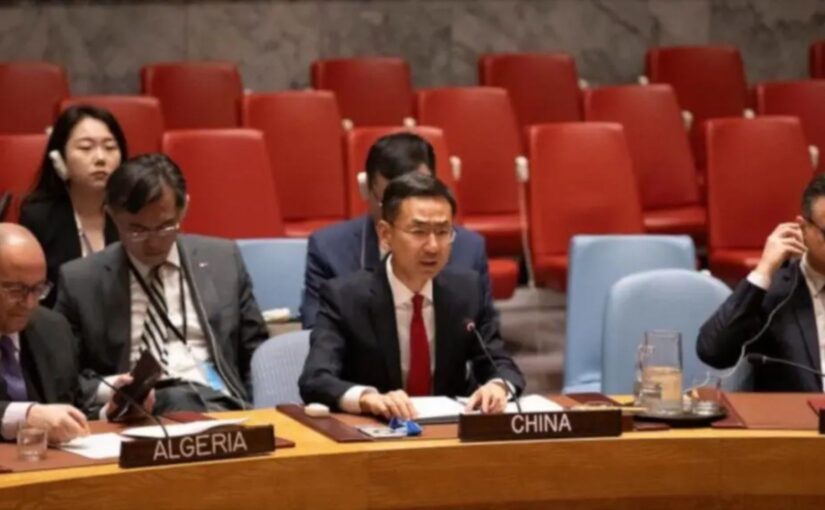
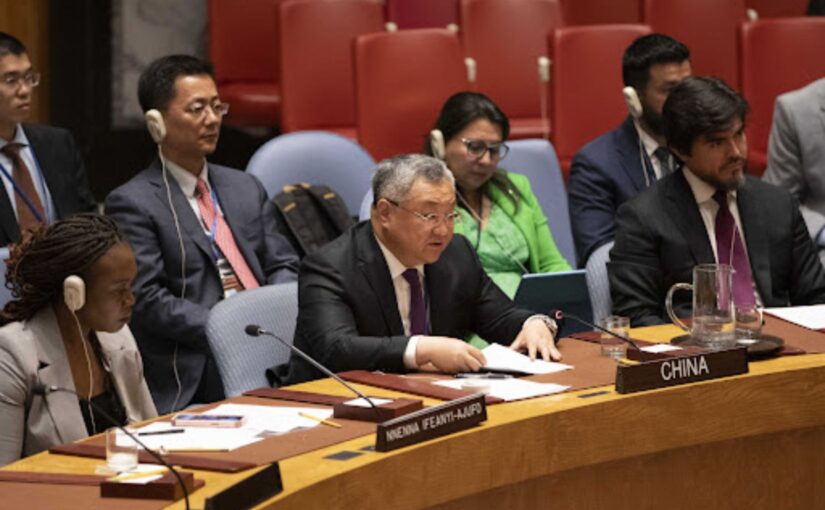
Speaking at the United Nations on May 20, Fu Cong, China’s Permanent Representative to the world body, told the Security Council that, “facing strong opposition from the international community, Israel is still pushing ahead with its large-scale offensive on Rafah, once again driving hundreds of thousands of Gazans into displacement. 

“Nothing can justify the perpetuation of conflict. The collective punishment of civilians does not create conditions conducive to the rescue of hostages. Israel must immediately cease its military operation in Rafah.”

The current humanitarian disaster in Gaza is inconceivable, Fu added. The occupation of the Rafah border crossing has seriously hindered access to humanitarian aid and humanitarian workers and UN personnel are confronted with multiple obstacles and even risks to their lives, which is unacceptable,

Clearly alluding to such cynical gimmicks as the US ‘floating pier’ and dangerous and ineffective air drops, Fu said that land routes are crucial for humanitarian delivery and have no substitute, further noting that Israel should effectively comply with its obligations under international law and international humanitarian law by immediately opening up all land crossings and ensuring the supply of food, medicine, fuel, and other necessities. Gaza is an inalienable part of Palestine, the Chinese envoy affirmed, adding that any proposal on post-war governance of Gaza should respect the will of the Palestinian people

May 15 marked the 76th anniversary of the Nakba, the massive exodus of Palestinians that occurred in 1948 following the establishment of the state of Israel. For decades, generations of Palestinians have made arduous struggles for their legitimate rights, he added.

Meanwhile, on May 22, Chinese foreign ministry spokesperson Wang Wenbin, responding to the news that Ireland, Spain and Norway were officially recognising the State of Palestine, said that “China always firmly supports the just cause of the Palestinian people in restoring their legitimate national rights, supports the two-State solution and is one of the first countries to recognise the State of Palestine.”

The following articles were originally published by the Xinhua News Agency.

Chinese envoy says Israel must cease Rafah offensive

UNITED NATIONS, May 20 (Xinhua) — A Chinese envoy said Monday that Israel must immediately cease its military offensive in Rafah city in the Gaza Strip.

Facing strong opposition from the international community, Israel is still pushing ahead with its large-scale offensive on Rafah, once again driving hundreds of thousands of Gazans into displacement, said Fu Cong, China’s permanent representative to the United Nations, expressing China’s grave concern about and strong opposition to the operation.

“Nothing can justify the perpetuation of conflict. The collective punishment of civilians does not create conditions conducive to the rescue of hostages. Israel must immediately cease its military operation in Rafah,” he told the UN Security Council.

China supports further Security Council actions to ensure the implementation of its Resolution 2728, which demands a humanitarian cease-fire, Fu said, adding China also hopes that the United States, as the country with major influence on Israel, can uphold impartiality and effectively facilitate a cease-fire and cessation of hostilities.

The current humanitarian disaster in Gaza is inconceivable. The occupation of the Rafah border crossing has seriously hindered access to humanitarian aid, as humanitarian supplies from Jordan to Gaza have been blocked and sabotaged, and humanitarian workers and UN personnel are confronted with multiple obstacles and even risks to their lives, which is unacceptable, said Fu.

Land routes are crucial for humanitarian delivery and have no substitute, he said, noting Israel should effectively comply with its obligations under international law and international humanitarian law by immediately opening up all land crossings and ensuring the supply of food, medicine, fuel, and other necessities.

Noting the two-state solution is the only viable way to resolve the Palestinian-Israeli issue, Fu said China supports the establishment of an independent state of Palestine and its early admission as a full member of the United Nations.

Gaza is an inalienable part of Palestine, the Chinese envoy said, adding any proposal on post-war governance of Gaza should respect the will of the Palestinian people, should respect the legitimate concerns of the countries in the region, and should not deviate from the general direction of the two-state solution.

May 15 marked the 76th anniversary of Nakba, the massive exodus of Palestinians that occurred in 1948 following the establishment of the state of Israel, Fu noted. For decades, generations of Palestinians have made arduous struggles for their legitimate rights, he added.

China will continue to work tirelessly together with the international community to promote an immediate cease-fire in Gaza, alleviate the humanitarian disaster, and implement the two-state solution, so that Nakba will forever be the past, and Palestine and Israel can live side by side in peace, and the Middle East can enjoy lasting peace and stability, Fu said.


China firmly supports Palestinian people restoring their legitimate national rights

BEIJING, May 22 (Xinhua) — China always firmly supports the just cause of the Palestinian people in restoring their legitimate national rights, and will continue to work with the international community to play a constructive role in promoting a comprehensive, just and lasting settlement of the Palestinian question, Chinese foreign ministry spokesperson Wang Wenbin said Wednesday.

Wang made the remarks at a daily press briefing in response to the news that Spain and Ireland said they are going to recognize the Palestinian State.

China always firmly supports the just cause of the Palestinian people in restoring their legitimate national rights, supports the two-State solution and is one of the first countries to recognize the State of Palestine. China’s stance on the Palestinian-Israeli conflict is consistent, Wang noted.

“We believe the immediate priority is to implement UNSC Resolution 2728, realize ceasefire at once, end the unprecedented humanitarian crisis in Gaza and return to the right track of seeking a political settlement of the Palestinian question on the basis of the two-State solution as soon as possible,” Wang said.

China will continue to work with the international community to play a constructive role in ending the Palestinian-Israeli conflict as early as possible and promoting a comprehensive, just and lasting settlement of the Palestinian question, the spokesperson added.

Shanghai Cooperation Organisation Foreign Ministers’ meeting promotes regional cooperation

A meeting of the Council of Foreign Ministers of the Shanghai Cooperation Organisation (SCO) was held in Astana, the capital city of Kazakhstan, on May 20-21.

The meeting was preparatory to the Astana SCO Summit, which is scheduled to be held on July 3-4. 

Presiding over the meeting, Murat Nurtleu, Kazakh Deputy Prime Minister and Foreign Minister, welcomed participants and called for a moment of silence to honour Iranian President Ebrahim Raisi, Foreign Minister Hossein Amirabdollahian, and others who died in the helicopter crash on May 19.

The meeting agreed to enhance cooperation in ensuring regional security and combating terrorism, extremism, separatism, drug trafficking, and cybercrime, among other areas. A special focus was placed on the organisation’s growth, with Belarus expected to complete all necessary procedures for admission to full membership at the July summit.

Addressing the ministers, Kazakh President Kassym-Jomart Tokayev expressed his deep condolences to the people and leadership of Iran following the tragic death of President Ebrahim Raisi and Foreign Minister Amir-Abdollahian. He also acknowledged the participation of Iranian representatives despite their nation’s difficult time and welcomed Belarus to its first Foreign Ministers’ Council in Astana.

Amid global strategic uncertainty, Tokayev stressed the importance of an integrated approach that considers all parties’ interests and the constant search for compromises. He voiced his belief that the time has come to collectively promote the ideals and values of peaceful and harmonious development for the sake of all humanity.

Addressing the situation in Afghanistan, he stressed the need to prevent a humanitarian crisis and create conditions for long-term stabilisation. He reiterated the importance of Kazakhstan’s initiative to establish the United Nations’ Regional Centre for Sustainable Development Goals for Central Asia and Afghanistan in Almaty.

In his speech to the meeting, Chinese Foreign Minister Wang Yi said that SCO member countries have been important partners for China in high-level opening-up and high-quality development.

Valuing the SCO’s role, Wang said the Shanghai Spirit, which features mutual trust, mutual benefit, equality, consultation, respect for diverse civilisations and pursuit of common development, has become the fundamental principle of the SCO’s continuous growth and a banner for promoting new types of international relations.

He put forward four suggestions during the meeting: to maintain strategic autonomy and strengthen unity and cooperation; to share security responsibilities and lift cooperation to higher levels; to pursue inclusive and win-win cooperation and empower joint development; and to embrace openness and inclusiveness and deepen exchanges and mutual learning.

China is willing to work with SCO partners to actively advocate for a multipolar world with equality and order and inclusive economic globalisation, and to promote the building of a community with a shared future for humanity, he added.

In a meeting with the Kazakh President on May 20, Tokayev asked Wang to convey his sincere greetings to President Xi Jinping, noting that China’s international status continues to rise and its role in the world is increasingly significant. The country is making greater contributions to global peace and stability, and the international community is paying more attention to China’s voice. He looked forward to the Chinese President’s state visit in July. 

He also highly evaluated Kazakh-Chinese relations within the framework of international organisations, including the United Nations (UN), Shanghai Cooperation Organisation (SCO), and the Conference on Interaction and Confidence Building Measures in Asia (CICA).

“Kazakhstan has been and remains a reliable partner of China. We are doing everything possible to implement the agreements that were reached earlier. We are working together and advancing our relationship into the future,” he added.

Wang responded that China would continue to firmly support Kazakhstan in safeguarding its independence, sovereignty and territorial integrity, support President Tokayev’s series of development strategies and important measures, and resolutely oppose any external forces interfering in Kazakhstan’s internal affairs.

During the country’s historical process of building a New Kazakhstan, China is willing to be a reliable and long-term partner, supporting the diversification of Kazakhstan’s economic development and promoting cooperation in emerging industries such as e-commerce, new energy and artificial intelligence.

The same day, Wang Yi met with Deputy Prime Minister and Minister of Foreign Affairs Murat Nurtleu, with the two men jointly meeting the press following their talks.

Wang said that, as Kazakhstan recently suffered from severe floods, China is willing to continue providing as much help as possible to assist in the reconstruction work.

He further noted that both sides spoke highly of the fruitful outcomes of their cooperation. According to Chinese statistics, bilateral trade reached 41 billion US dollars last year, achieving the target set by the two heads of state seven years ahead of schedule. To date, 26 out of the 45 capacity cooperation projects have been completed, in such sectors as mining and metals, energy resources, machinery manufacturing, building materials, chemicals and infrastructure construction. Cooperation in oil and gas and in nuclear energy is also accelerating.

Both sides praised the success of the China-Central Asia Summit in Xi’an, held in May 2023, which has ushered in a new phase of enhanced cooperation between China and Central Asia.

The Chinese side is eager to work alongside the Central Asian nations to strengthen and optimise the China-Central Asia cooperation mechanism, aiming to build a stable, prosperous, harmonious, and interconnected Central Asia, thereby injecting strong vitality into the building of a China-Central Asia community of shared future, Wang said.

Both sides will work to advance the Global Development Initiative, Global Security Initiative, and Global Civilisation Initiative, unequivocally oppose unilateralism and hegemonic behaviours, and promote the development of global governance towards a more just and reasonable direction.

Continue reading Shanghai Cooperation Organisation Foreign Ministers’ meeting promotes regional cooperation

Xi Jinping: China and Arab countries witnessing mutual trust and vibrant practical cooperation

Chinese President Xi Jinping has said that the Arab countries are playing an increasingly important role in strengthening solidarity and cooperation for the Global South and in upholding their common interests.

His statement came in a congratulatory message to King of Bahrain Hamad bin Isa Al Khalifa, the rotating chairperson of the Council of Heads of the League of Arab States, on the convening of the 33rd Arab League Summit in Bahrain. He also said that China is ready to work with Arab countries to build a China-Arab community with a shared future at a higher level.

Xi stressed that the current China-Arab ties are in the best period in history. He said that in December 2022, he attended the first China-Arab States Summit with leaders of Arab states in Saudi Arabia, drew up a comprehensive blueprint for the development of China-Arab relations, and agreed to make all-out efforts to build a China-Arab community with a shared future for the new era.

At the end of May, the 10th ministerial meeting of the China-Arab States Cooperation Forum will be held in Beijing, Xi noted, expressing his hope that the two sides will take the meeting as an opportunity to further deepen cooperation in various fields, so as to better benefit the two peoples.

The following article was originally published by the Xinhua News Agency.

China is ready to work with Arab countries to build a China-Arab community with a shared future at a higher level, Chinese President Xi Jinping said Thursday.

Xi made the remarks in a congratulatory message to King of Bahrain Hamad bin Isa Al Khalifa, the rotating chairperson of the Council of Heads of the League of Arab States, over the convening of the 33rd Arab League Summit in Bahrain.

Xi noted that the Arab League has long been committed to pushing for unity and self strengthening in the Arab world, and promoting peace, stability and development in the Middle East.

In recent years, facing changes in the world, the times and history, Arab countries have adhered to independence, promoted development and revitalization, upheld fairness and justice, and safeguarded regional peace and stability, Xi said, adding that Arab countries are playing an increasingly important role in strengthening solidarity and cooperation for the “Global South” and in upholding their common interests.

Xi stressed that the current China-Arab ties are in the best period in history. He said that in December 2022, he attended the first China-Arab States Summit with leaders of Arab states, drew up a comprehensive blueprint for the development of China-Arab relations, and agreed to make all-out efforts to build a China-Arab community with a shared future for the new era.

For more than a year, China and Arab countries have witnessed deepening political mutual trust, vibrant practical cooperation, as well as rich cultural and people-to-people exchanges, Xi said, adding that their cooperation in various fields has yielded fruitful outcomes.

Looking to the future, China is ready to work with Arab countries to continue carrying forward the spirit of the China-Arab friendship, build a China-Arab community with a shared future at a higher level, and contribute to the building of a community with a shared future for mankind, he said.

At the end of this month, the 10th ministerial meeting of the China-Arab States Cooperation Forum will be held in Beijing, Xi said, expressing his hope that the two sides will take the 10th ministerial meeting as an opportunity to further deepen cooperation in various fields, so as to better benefit the two peoples.

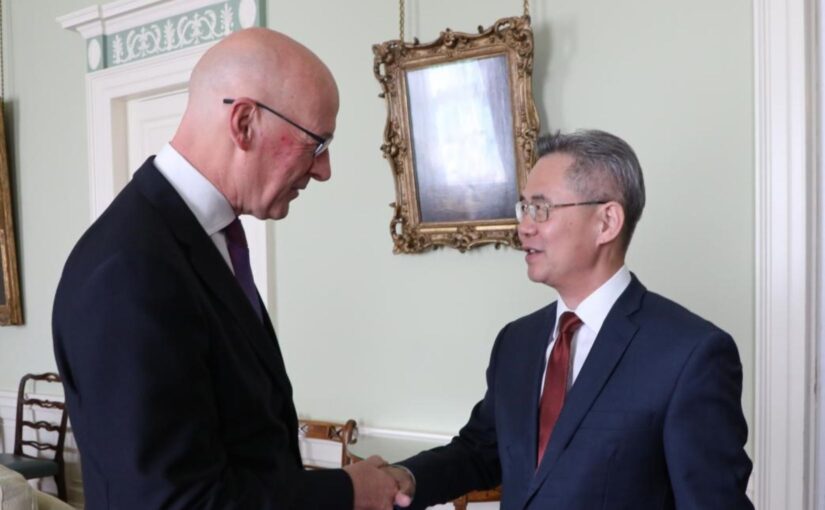
Fruitful visit to Northern Ireland by Ambassador Zheng Zeguang

Chinese Ambassador to the United Kingdom Zheng Zeguang paid the second visit of his tenure to Northern Ireland at the beginning of May, meeting with First Minister Michelle O’Neill and Deputy First Minister Emma Little-Pengelly on May 1. 

O’Neill is a leading member of Sinn Féin and the first nationalist and republican to serve as First Minister. Emma Little-Pengelly belongs to Northern Ireland’s second largest party, the Democratic Unionist Party (DUP). 

According to the Chinese Embassy in London, the two sides had an in-depth exchange of views on further developing the friendship and cooperation between China and Northern Ireland.

Ambassador Zheng congratulated the two major political parties in Northern Ireland on successfully forming a new Northern Ireland Executive and introduced China’s economic and social development.

China’s economy grew by 5.2% last year and expanded by 5.3% in the first quarter of this year. Facts show that the fundamentals of China’s economy stay unchanged and will not change in the future. This will continue to provide more opportunities for practical cooperation in various fields between China and Northern Ireland.

He noted that local cooperation is an important foundation for state-to-state relations. China appreciates Northern Ireland’s long-standing commitment to exchanges and cooperation with China. Collaboration between the two sides in fields such as business, trade, education, culture, and tourism have yielded fruitful outcomes.

Northern Ireland enjoys excellent natural conditions and great potentials for development. China encourages Chinese businesses, students, and tourists to invest, study, and travel in Northern Ireland and welcomes more Northern Ireland investment, quality products and students in China.

First Minister Michelle O’Neill and Deputy First Minister Emma Little-Pengelly welcomed Ambassador Zheng on his second visit to Northern Ireland. They said that the Northern Ireland government attaches importance to developing its relationship with China.

In recent years, Northern Ireland and China had close cooperation in business, trade, education, agriculture, and tourism, bringing tangible benefits to both sides. Northern Ireland welcomes more Chinese investments, supports broader education collaboration between universities in Northern Ireland and China, welcomes Chinese students and tourists to study and vacation in Northern Ireland, and hopes to strengthen personnel exchanges and deepen mutually beneficial cooperation with China.

The same day, Ambassador Zheng Zeguang attended and addressed the first China-UK/Northern Ireland Education Cooperation Forum held at Ulster University in Belfast at invitation and delivered a keynote speech titled “Openness and cooperation is the right way forward.”

Over the 75 years since the founding of New China, he said, great accomplishments have been achieved in education. China has put in place the world’s largest education system, with more than 510,000 education institutions of different types at all levels, 293 million university, secondary and primary school students, and more than 18.8 million full-time teachers. The popularity of China’s basic education at different stages has reached or exceeded the OECD [a grouping of mostly developed countries] average and China is now upgrading its higher education to achieve greater quality. Education advancement has in turn accelerated technological innovation. By the end of 2023, China owned close to five million valid invention patents, ranking first in the world.

In recent years, however, there have been constant noises from some politicians in the West, using “national security” as an excuse to push for “decoupling” of economies, severing of industrial and supply chains, and creation of “small yards with high fences”, while pointing fingers at China and obstructing exchanges and collaboration. This must be firmly rejected. Facts have and will continue to prove that China-UK educational collaboration is mutually beneficial and has broad prospects.

Dr Colin Davidson, Chancellor of Ulster University, said that his university is proud of its extensive collaboration with universities such as Hubei Normal University and the National Academy of Chinese Theatre Arts. It is committed to building a sustainable future for the world and will continue to work with its Chinese partners to deepen cooperation in culture, education and scientific research towards shared goals.

The following articles were originally published on the website of the Chinese Embassy in London.

Ambassador Zheng Zeguang meets with First Minister Michelle O’Neill and Deputy First Minister Emma Little-Pengelly of Northern Ireland

May 3 (Chinese Embassy in the UK) — On 1 May 2024, during his visit to Northern Ireland, H.E. Ambassador Zheng Zeguang met with  First Minister Michelle O’Neill and Deputy First Minister Emma Little-Pengelly of Northern Ireland.

The two sides had an in-depth exchange of views on further developing the friendship and cooperation between China and Northern Ireland.

Ambassador Zheng congratulated the two major political parties in Northern Ireland on successfully forming a new  Northern Ireland Executive, and introduced China’s economic and social development.

Ambassador Zheng said that China,  committed to modernisation through a Chinese path, is striving for high-quality development, faster growth of new quality productive forces, greater domestic demand, and opening up at a higher level.

China’s economy grew by 5.2% last year and expanded by 5.3% in the first quarter of this year. Facts show that the fundamentals of China’s economy stay unchanged and will not change in the future. This will continue to provide more opportunities for practical cooperation in various fields between China and Northern Ireland.

Ambassador Zheng noted that local cooperation is an important foundation for state-to-state relations. China appreciates Northern Ireland’s long-standing commitment to exchanges and cooperation with China. Collaboration between the two sides in fields such as business, trade, education, culture, and tourism have yielded fruitful outcomes.

Northern Ireland enjoys excellent natural conditions and great potentials for development. China encourages Chinese businesses, students, and tourists to invest, study, and travel in Northern Ireland and welcomes more Northern Ireland investment, quality products and students in China.

First Minister Michelle O’Neill and Deputy First Minister Emma Little-Pengelly  welcomed Ambassador Zheng on his second visit to Northern Ireland.  They said that the Northern Ireland government attaches importance to developing its relationship with China.

In recent years, Northern Ireland and China had close cooperation in business, trade, education, agriculture, and tourism, bringing tangible benefits to both sides. Northern Ireland welcomes more Chinese investments, supports broader  education collaboration between universities in Northern Ireland and China, welcomes Chinese students and tourists to study and vacation in Northern Ireland, and hopes to strengthen personnel exchanges and deepen mutually beneficial cooperation with China.

They wish the China-UK/Northern Ireland Education Cooperation Forum to be held on the day full success.

The meeting was also attended by Chinese Consul General in Belfast Zhang Meifang, and Counsellor for Political Affairs Kong Xiangwen.


Ambassador Zheng Zeguang attended the first China-UK/Northern Ireland Education Cooperation Forum and delivered a keynote speech

May 4 (Chinese Embassy in the UK) — On 1 May 2024, H.E. Ambassador Zheng Zeguang attended and addressed the first China-UK/Northern Ireland Education Cooperation Forum held at Ulster University in Belfast at invitation and delivered a keynote speech titled “Openness and cooperation is the right way forward”. 

Ambassador Zheng commended Ulster University for itsstrong sense of openness and fully recognised its fruitful cooperation with Hubei Normal University, the National Academy of Chinese Theatre Arts and other Chinese institutions.

Ambassador Zheng pointed out thatitis China’s long-standing tradition to value education and respect teachers, and that education has always been a priority for the Chinese government. Over the 75 years since the founding of New China, great accomplishments have been achievedon education. China has put in place the world’s largest education system, with more than 510,000 education institutions of different types at all levels, 293 million university, secondary and primary school students, and more than 18.8 million full-time teachers. The popularity of China’s basic education at different stages has reached or exceeded the OECD average, and China is now upgrading its higher education to greater quality. Education advancement has in turn accelerated technological innovation. By the end of 2023, China owned close to 5 million valid invention patents, ranking first in the world. China’s total input in R&D and investment in the high-tech sector has been growing at double-digit rates for several years running. China now has around 400,000 high-tech enterprises and ranks second globally in the number of unicorn companies.

Ambassador Zheng pointed out that China is taking concrete steps to promote high-quality development and accelerate the creation of new-quality productive forces. In this process, China is further prioritising education, science and technology, and talent cultivation. China remains committed to openness and international exchanges in education. China has carried out educational exchanges with more than 180 countries, signed agreements on mutual recognition of qualifications and academic degrees with 58 countries and regions. 85 countries have incorporated Chinese language teaching into their national education curricula, and more than 30 million people outside of China are studying the language.

Ambassador Zheng pointed out that the world today is undergoing deep transformation and increasing volatility, humanity is facing multiple common challenges, and a new round of industrial and technological revolution is unfolding at pace. Now more than ever, countries need to enhance education cooperation, work together to cultivate more talent with a global vision, and find solutions to common challenges. In recent years, however, there have been constant noises against it from some politicians in the West, using “national security” as an excuse to push for “decoupling” of economies, severing of industrial and supply chains, and creation of small yards with high fences, while pointing fingers at China and obstructing exchanges and collaboration. This must be firmly rejected. Facts have and will continue to prove that China-UK educational collaboration is mutually beneficial and has broad prospects. China is committed to a steady and mutually beneficial China-UK relationship on the basis of mutual respect and equality. It is hoped that people from all walks of life in both countries will not be swayed by noises or disturbed by obstructions, and will continue to promote mutual learning and mutually beneficial collaboration between the two countries. The Chinese Embassy and Consulates in the UK will, as always, provide support and facilitation for UK’s educational exchanges and collaboration with China.

Dr Colin Davidson, Chancellor of Ulster University, said that Ulster is proud of its extensive collaboration with universities such as Hubei Normal University and the National Academy of Chinese Theatre Arts. It is committed to building a sustainable future for the world and will continue to work with its Chinese partners to deepen cooperation in culture, education and scientific research towards shared goals.

Speaker of the Northern Ireland Assembly Mr Edwin Poots, Consul General of China in Belfast Ms Zhang Meifang, and President of Hubei Normal University Professor Lei Rujin also delivered remarks. The event was attended by around 200 people, including Deputy Lieutenant of the County Borough of Belfast Professor Alastair Adair, and Minister Counsellor for EducationMs Zhang Jin,Minister Counsellor for Press and Public Affairs Mr Bi Haibo, and Political CounsellorMr Kong Xiangwen at the Chinese Embassy, as well as representatives from cities and counties and headteachers from primary and secondary schools in Northern Ireland. Chinese and British students presentedfantastic cultural and artistic programmes with ethnic characteristics.

During the Forum, Ambassador Zheng and Chancellor Davidson witnessed the signing of an agreement between Hubei Normal University and Ulster University to establish a Centre for Education, Culture and Language Exchange andjointly unveiled the plagued of the Centre.

China proves that not only is a new world possible but it has already arrived

In this article for the Morning Star, Roger McKenzie draws on his experiences on the recent Friends of Socialist China delegation, which combined visits to historical sites with discussions on contemporary Chinese politics, as well as providing an opportunity to witness the Chinese modernisation process in action.

Roger notes “the lengths the Chinese were taking to celebrate their revolutionary history at the same time as looking for ways to be at the cutting edge of modernisation”. This highlights the Chinese communists’ insistence on remaining true to the original aspiration and founding mission. After all, the founders of the CPC “had a dream of a better and fairer society based on Marxist principles” – a dream that still guides the Party today.

The article concludes that those of us in the West can learn a great deal – and take inspiration – from the Chinese example.

“China proves to me that not only is a new world possible but it has already arrived — if we choose to look and if we dare to win.”

The CPC was formed in July 1921 on a red boat in Nanhu Lake in Jiaxing, Zhejiang province. It was the start of a century-plus journey from widespread poverty and political weakness to China becoming, according to many experts, the largest economy in the world.
 
China is a country high on ambition. The sort of ambition that would not have been possible without the bravery to set up the CPC under threat of imprisonment or death.

After many visits to China, my comrade and friend Keith Bennett, a co-founder of Friends of Socialist China (FSC), was visiting the Red Boat for the first time.
 
Bennett said: “I think what’s very impressive is how the history of the founding of the CPC is remembered and respected and it’s been passed onto the younger generations. We’ve been here today and we’ve seen lots of middle school students and younger school students all taking a great interest in it.”
 
Another comrade and co-founder of FSC, Carlos Martinez, agreed with Bennett’s analysis adding that he was impressed by the “inspiration that Chinese communists took from the Russian October Revolution and obviously from Marx and Engels.”
 
He added: “So when they talk about being true to their foundations, their roots and founding mission this includes the whole legacy of our global movement.”
 
I couldn’t help but notice the pride that people of all ages were taking in the history of the founding of the CPC. I witnessed the lengths the Chinese were taking to celebrate their revolutionary history at the same time as looking for ways to be at the cutting edge of modernisation.
 
The CPC seemed to have no difficulty in combining seemingly contradictory positions, whether it’s combining the old with the new or the market with socialism. For China, the key priority seems to be making sure that the people are put first.
 
In my view, one of the keys of Marxism is not to reduce it to an immovable dogma. For me — and I do not doubt that someone will see fit to correct me — it is a scientific tool that can be used to analyse the material circumstances confronting us and to use it to develop policies that put people rather than profits first.
 
The fact that the CPC has its hands on the levers of the market and is able to divert resources where they are most needed rather than into the pockets of greedy capitalists, makes all the difference.
 
Housing is often seen as one of the measures of how well an economy is serving its people. As I write this from Jiaxing I have yet to see a single homeless person on the street.
 
What I have seen is a diversity of housing provisions including a high-tech development called the Luli Future Community where quality housing, with fitness and children’s facilities, are available at a good price.
 
Some of the cost is subsidised by the central government — particularly for young people and public service workers such as doctors.
 
The brand new Party-Masses Service Centre in Jiaxing, which opened in 2021, is a hub for training, exhibitions, NGOs and the provision of mental health services.
 
Martinez said: “FSC Delegates to China were amazed to learn that you can register for counselling and get an appointment booked for the next day — free of charge.”
 
On one wall in the centre I saw “Only with peace of mind can the people and the country be safe,” which seemed a good summary of the work being carried out.
 
Whatever I say here “haters are always gonna hate.” I’m also not arrogant enough to believe that anything I say makes the slightest bit of difference.
 
But I can only say what I see and what I am seeing is a country brimming with confidence and full of ambition.
 
I’m also seeing a nation that refuses to be diverted from its upward course after generations of poverty and humiliation.
 
The Chinese seem prepared to think big and to continue to confound the racist stereotypes of China as a backward nation.
 
Any person with the slightest knowledge of history will know just how totally wrong that is.
 
China is thinking hard about what the future can look like and not waiting for it to shape them but, instead, taking steps to lead the way.
 
I visited the Yangtze River Delta Science and Technology Centre where they have gathered some of the finest thinkers in architecture, health, industry and communications, to name but a few, to carry out research and to advise the government.
 
China is thinking big but not just for itself. It is prepared to share its knowledge with other countries in a spirit of win-win and mutual respect.
 
The incredibly popular but much-maligned Belt and Road Initiative is a prime example of this. The BRI is based on greater policy co-ordination with partners, connecting facilities, trade, financial integration and, importantly, building people-to-people bonds.
 
Far removed from the zero game US model of you’re either with us or against us. The US model is yesterday’s news. The global South, where most people on the planet live, has had enough and has already moved on.
 
Despite the goading and the sanctions led by the US, China is refusing to play a game that nobody wins. Instead, it is creating a new game with its global South partners.

Shifting the focus away from the old colonial powers to the people — billions of people. Along the way it won’t be perfect — tell me what is?
 
But we have to break with the idea that the old colonial rulers can sit at their table, divide up the world and tell everyone else what to do. Those days are gone forever. The US and its posse just need to understand this.
 
The only questions that really matter are how will the old world respond? Will they do what they know best and resort to violence and financial sanctions? This seems to be their response so far.
 
Alternatively, for those of us interested in building a new world, what might it look like? What more do we need to do to breathe life into that newborn?
 
What I have seen so far in China convinces me that socialism works. Those pioneers on the Red Boat had a dream of a better and fairer society based on Marxist principles.
 
I am not advocating copying China but we can apply the scientific methods of Marxism-Leninism to our own circumstances in the same way that the CPC has with its socialism with Chinese characteristics for the new era.
 
Some onlookers say China has abandoned Marxism. I don’t agree for the reasons I’ve already stated. Many have never been there but profess to know better than the people of China.

Clearly not everyone in the country of 1.4 billion people agrees entirely with the road being travelled.
 
I’m told there is a healthy debate within the nearly 100 million members of the CPC but it is clear to me that President Xi Jinping is providing clear direction and outstanding leadership.

Building a revolution against the stream is hard graft but it continues apace in China.
 
China is still red and will continue to attract partners interested in a different way, which may or may not be socialism. China proves to me that not only is a new world possible but it has already arrived — if we choose to look and if we dare to win.

Joint Statement between the People’s Republic of China and the Russian Federation

Following talks between Chinese President Xi Jinping and his Russian counterpart Vladimir Putin in Beijing on May 16, the first day of the Russian President’s state visit to China, the two countries adopted and signed a joint statement.

Divided into ten sections and running to nearly 8,500 words, the statement reflects the high degree of synergy between the two major developing countries and comprehensively deals with the full spectrum of bilateral relations, foreign policy issues and key questions facing humanity.

It begins by noting that, in 2024, China and Russia solemnly celebrate the 75th anniversary of the establishment of diplomatic relations between the two countries. Over the past 75 years, China-Russia relations have gone through an extraordinary course of development. The Soviet Union was the first country in the world to recognize and establish diplomatic relations with the People’s Republic of China. After the dissolution of the Soviet Union, the People’s Republic of China recognized the Russian Federation as the legal successor of the Soviet Union and reiterated its willingness to develop China-Russia relations on the basis of equality, mutual respect and mutually beneficial cooperation.

Under the unremitting efforts of both sides, China-Russia relations follow the national interests of the two countries, uphold the spirit of good-neighbourliness and friendship forever, and maintain healthy and stable development.

They pointed out that the current China-Russia relations transcend the military and political alliance model of the Cold War era and are characterized by non-alignment, non-confrontation and not targeting third parties. 

And they stressed that the development of the China-Russia comprehensive strategic partnership of coordination for a new era is in line with the fundamental interests of the two countries and their peoples, and is not a matter of expediency, nor is it affected by a single incident, and has strong endogenous power and independent value.

Russia reaffirmed its adherence to the one-China principle, recognized that Taiwan is an inalienable part of the People’s Republic of China, opposed any form of “Taiwan independence”, and firmly supported China’s measures to safeguard national sovereignty and territorial integrity and achieve national reunification. China supports Russia’s efforts to maintain its own security and stability, development and prosperity, sovereignty, and territorial integrity, and opposes external forces’ interference in Russia’s internal affairs.

The two sides pointed out that the world’s major changes are accelerating, and the status and strength of emerging powers in the “Global South” are constantly increasing and the acceleration of world multipolarisation is becoming more and more obvious. Countries that adhere to hegemonism and power politics go against this trend and attempt to replace and subvert the universally recognized international order based on international law with a “rules-based order”.

The two sides believe that all countries have the right to independently choose their development model and political, economic, and social systems according to their own national conditions and the will of the people and oppose interference in the internal affairs of sovereign states, oppose unilateral sanctions and “long-arm jurisdiction” without a basis in international law or authorization by the UN Security Council, and oppose drawing lines based on ideology. They point out that neo-colonialism and hegemonism completely run counter to the current trend of the times, and call for equal dialogue, the development of partnerships, and the promotion of exchanges and mutual learning between civilizations.

China and Russia will continue to firmly defend the results of the victory of the Second World War and the post-war world order enshrined in the Charter of the United Nations, and oppose the negation, distortion, and falsification of the history of World War II.  They plan to solemnly celebrate the 80th anniversary of the victory of the Chinese People’s War of Resistance Against Japanese Aggression and the Soviet Union’s Patriotic War in 2025 and jointly promote a correct view of the history of World War II.

The two sides will further deepen military mutual trust and cooperation, expand the scale of joint exercises and training activities, regularly organize joint maritime and air patrols, strengthen coordination and cooperation under bilateral and multilateral frameworks, and continuously improve the ability and level of the two sides to jointly respond to risks and challenges.

They believe that, in accordance with the basic principle of sovereign equality of states in international law, international obligations regarding the immunity of states and their property (including sovereign reserves) must be strictly observed. The two sides condemn attempts to confiscate foreign assets and property, and stress that the victim state has the right to take countermeasures in accordance with international law.

This refers particularly to the multiple measures taken, and under consideration, by the imperialist powers against Russia. However, they are also threatened against China and have been deployed against a range of other countries, including Afghanistan, Venezuela, Iran, the DPRK and Equatorial Guinea, among others.

Having surveyed bilateral economic relations in detail, the statement also refers to some of their international ramifications.

Continue reading Joint Statement between the People’s Republic of China and the Russian Federation

Venezuelan President Maduro meets with CPC delegation

A delegation of the Communist Party of China, headed by Vice Minister of the International Department (IDCPC) Chen Zhou, recently visited Venezuela, meeting with President Nicolás Maduro on May 8. The Venezuelan head of state was joined by First Lady Cilia Flores and a number of senior officials. 

During the meeting, Maduro expressed his intention to continue strengthening the joint work between the CPC and the United Socialist Party of Venezuela (PSUV), and to continue to exchange historical experiences and knowledge to mutual benefit.

The Venezuelan president emphasised that Venezuela and China “have the challenge of building a new world.” As a part of this, a Venezuelan delegation recently paid a working visit to Beijing to agree on new and deeper relations with the Communist Party of China as well as with the country’s National People’s Congress (NPC).

In addition, it is proposed to incorporate study of Xi Jinping Thought on Socialism with Chinese Characteristics for a New Era into the PSUV’s training programs.

The Chinese ambassador in Caracas, Lan Hu, also expressed his satisfaction with the achievements and progress made between the two nations. “We are here to implement the strategic and important consensus between you [Nicolás Maduro] and your counterpart President Xi Jinping,” he said, “to serve our people, to benefit socio-economic development, to promote the right path to the future, aligned to the reality of both countries, and also to jointly build a new world, a multipolar world and a world of common future for humanity.”

The below article was originally published in Spanish by Ultimas Noticias. This English language translation was published in Orinoco Tribune.

The president of Venezuela, Nicolás Maduro, held a meeting with a delegation of the Central Committee of the Communist Party of China (CPC), led by the vice minister of the International Department of the party, Chen Zhou.

In the meeting, reported by a Venezuelan presidency press release this Wednesday, May 8, the Venezuelan head of state was accompanied by First Lady Cilia Flores; Deputy Nicolás Maduro Guerra; the vice minister for Latin America of the Ministry of Foreign Affairs of Venezuela, Rander Peña; and the vice minister for Asia, the Middle East, and Oceania, Tatiana Pugh.

On the Chinese side, Zhou was accompanied by the ambassador of the People’s Republic of China, Lan Hu; the Discipline Inspector of the CPC Central Committee Feng Jicai; the deputy director general for Latin America and the Caribbean, Wang Nan; and the head of the Andean Community Section of the International Department of the CPC Central Committee, Zhou Xiangmeng.

During the meeting, the Venezuelan leader expressed his intention to continue strengthening the joint work between the CPC and the United Socialist Party of Venezuela (PSUV), and to continue to exchange historical experiences and knowledge to mutual benefit.

President Maduro highlighted the fact that the CPC collects the historical synthesis of the Chinese people, and the PSUV, for its part, has maintained over the course of the 21st century the history of struggle of the Venezuelan people.

Venezuela and China have the challenge of building the new world

The Venezuelan president emphasized the fact that Venezuela and China “have the challenge of building a new world.” As a part of this, a Venezuelan delegation recrntly held a work agenda in Beijing to agree on new deep relations with the Communist Party of China and with the National Assembly of China.

The deputy to the Venezuelan National Assembly and president of the China-Venezuela Parliamentary Friendship Group, Nicolás Maduro Guerra, accompanied this delegation, highlighting in his report that China has human beings as its core, and it is their humanist and caring philosophy that allowed them to lift over 800 million Chinese citizens out of poverty.

“We are united by the human vision of development,” Maduro Guerra stated during his participation in the presidential program Con Maduro+ on Monday, May 6. “We are united by the flags of shared humanity, because in the end humanity is on this planet, and President Xi Jinping has expressed his humanity in our community of common destiny.”

In addition, the proposal arose to study the thought of Chinese leader Xi Jinping, also known as Socialism with Chinese Characteristics for a New Era, to be incorporated into the PSUV training programs.

The Chinese ambassador in Caracas, Lan Hu, also expressed his satisfaction with the achievements and progress made between the nations. “We are here to implement the strategic and important consensus between you [Nicolás Maduro] and your counterpart President Xi Jinping,” he said, “to serve our people, to benefit socio-economic development, to promote the right path to the future, aligned to the reality of both countries, and also to jointly build a new world, a multipolar world and a world of common destiny for humanity.”

Three US wars threaten World War Three: $95 billion targets Palestine, Iran, Russia and China

The following article by Sara Flounders, originally published in Workers World, discusses the 95 billion dollar “supplemental aid” bill passed by Congress and signed by President Joe Biden on 24 April 2024. Of the $95 billion, $61 billion is allocated to Ukraine, $26 billion to Israel and $8 billion to Taiwan and the Pacific region. Sara writes that the package constitutes “a declaration of war on the world … an ominous and highly publicised military escalation on three fronts.” She continues:

In an era when uncontested US economic, productive and technological hegemony has decisively deteriorated, the only way that US corporate power can assert its dominance is in the military destruction of its rivals. Instigating wars and imposing sanctions are desperate efforts to destroy the emerging poles of development, cooperation and trade in West Asia, Russia and China that are outside of US control.

Sara observes that, as the bill was being signed, US Secretary of State Antony Blinken was in China – “not to promote diplomacy, but to make threats”. Blinken was demanding that China support the US’s unilateral and illegal sanctions against Russia, while back in Washington funds were being assigned to support Taiwanese separatism and stir up tensions in the Taiwan Strait. The hypocrisy is mind-boggling.

The article concludes:

The bill finances a drive toward World War III on three fronts: the U.S.-Israeli genocidal war aimed at Palestine, the US-NATO proxy war against Russia in Ukraine, and preparation for a US-led war in the Pacific against People’s China and the Democratic People’s Republic of (North) Korea.

The powerful global movement that has taken bold steps to stop Israeli genocide will be stronger as it grows to understand that this whole imperialist system is its enemy.

Anyone who thinks that the U.S. policy of continued arming and fully supporting the Israeli genocide is an accident or a mistake need only look at the $95 billion “supplemental aid” bill just passed by Congress and signed by President Joe Biden on April 24.

The same group of war criminals in Washington who back genocide in Gaza also support the NATO-provoked proxy war in Ukraine and maneuvers in the Pacific that threaten war against China.

The U.S. “supplemental” military aid package is a declaration of war on the world. It is an ominous and highly publicized military escalation on three fronts.

In an era when uncontested U.S. economic, productive and technological hegemony has decisively deteriorated, the only way that U.S. corporate power can assert its dominance is in the military destruction of its rivals. Instigating wars and imposing sanctions are desperate efforts to destroy the emerging poles of development, cooperation and trade in West Asia, Russia and China that are outside of U.S. control.

U.S. accelerates aid to Israel 

The $26 billion in additional aid to Israel, part of the supplement package, is a public statement of complete support for genocide in Gaza. It confirms U.S. determination to escalate the brutal aggression.

Moreover, it is sending a threat of escalating war to Iran, Lebanon, Yemen and the vast majority of the people of the world who support the Palestinian people’s justified resistance to colonial occupation.

This $26 billion is in addition to Washington’s $4 billion a year allotment to Israel, which has already been committed through 2028, and the over 100 military aid transfers to Israel that are intentionally kept out of the accounting process.

Since World War II, the U.S. has provided more foreign aid to Israel than to any other country. In 2022, 99.7% of those funds went to the Israeli military.

The huge infusion of aid to Israel confirms the decision by U.S. corporate powers to prop up Washington’s primary strategic ally in West Asia. This has been the goal behind the billions of dollars allocated to the apartheid state over decades.

Despite receiving enormous funds and creating massive destruction, Zionist forces have failed to defeat the unified Palestinian Resistance. This is a political blow to Israel and a humiliating setback to U.S. imperialism’s position in the entire region.

For this reason, Israel and some U.S. policy strategists are seeking to widen the war by bombing Iran, Syria, Lebanon and Yemen.

Israeli Prime Minister Benjamin Netanyahu welcomed the billions of dollars in U.S. assistance, writing on X (formerly Twitter) that it “demonstrates strong bipartisan support for Israel and defends Western civilization.” He immediately announced plans to proceed with a major military operation in Rafah.

Funds for humanitarian assistance are supposedly included in the bill. Yet its language stipulates that financial allocations for the United Nations Relief and Works Agency for Palestine Refugees are prohibited. UNRWA is a lifeline for nearly two million people in Gaza and for Palestinians in the West Bank, Jordan, Syria and Lebanon. Without this U.N. agency’s help, there is no way to provide food aid, teachers or medical care.

Continue reading Three US wars threaten World War Three: $95 billion targets Palestine, Iran, Russia and China

Xi expresses condolences over Iranian President Raisi’s death

Chinese President Xi Jinping has expressed his condolences to Iran’s First Vice President Mohammad Mokhber following the tragic death of Iranian President Ebrahim Raisi in a helicopter crash.

On behalf of the Chinese government and the people of China, Xi expressed deep condolences and extended sincere sympathies to Mokhber, the family of President Raisi, and the Iranian government and people.

Xi said that since President Raisi took office, he made important contributions to maintaining Iran’s security and stability and promoting national development and prosperity. He added that Raisi also made positive efforts to consolidate and deepen the China-Iran comprehensive strategic partnership.

Raisi’s tragic death is a great loss to the Iranian people, and the Chinese people also lost a good friend, Xi said.

Meanwhile, speaking in the capital Astana, whilst on a visit to Kazakhstan, Chinese Foreign Minister Wang Yi also expressed deep condolences over the deaths of Iranian President Ebrahim Raisi and Foreign Minister Hossein Amir-Abdollahian during a joint press briefing with Kazakhstan’s Deputy Prime Minister and Foreign Minister Murat Nurtleu.

Wang noted that Raisi and Amir-Abdollahian have made significant contributions to developing China-Iran relations and to promoting regional friendly cooperation.

China, he said, has actively assisted in the search and rescue efforts following the disaster and is ready to continue providing any necessary support to Iran.

Earlier, before the crashed helicopter was discovered, a spokesperson for the Chinese Foreign Ministry also said that China would provide all necessary support and assistance for Iran’s rescue efforts.

The following articles were originally published by the Xinhua News Agency.

Xi expresses condolences over Iranian President Raisi’s death

BEIJING, May 20 (Xinhua) — Chinese President Xi Jinping on Monday sent a message of condolence to Iran’s First Vice President Mohammad Mokhber following the unfortunate death of Iranian President Ebrahim Raisi in a helicopter accident.

On behalf of the Chinese government and the people of China, Xi expressed deep condolences and extended sincere sympathies to Mokhber, the family of President Raisi, and the Iranian government and people.

Xi said that since President Raisi took office, he made important contributions to maintaining Iran’s security and stability and promoting national development and prosperity. He added that Raisi also made positive efforts to consolidate and deepen the China-Iran comprehensive strategic partnership.

Raisi’s tragic death is a great loss to the Iranian people, and the Chinese people also lost a good friend, Xi said.

The Chinese government and Chinese people cherish the traditional friendship between China and Iran, Xi said, noting that with the joint efforts of both sides, the China-Iran comprehensive strategic partnership will continue to consolidate and develop. 


Chinese FM expresses deep condolences over deaths of Iranian president, FM

ASTANA, May 20 (Xinhua) — Chinese Foreign Minister Wang Yi on Monday expressed deep condolences over the deaths of Iranian President Ebrahim Raisi and Foreign Minister Hossein Amir-Abdollahian during a joint press briefing with Kazakhstan’s Deputy Prime Minister and Foreign Minister Murat Nurtleu in Astana.

Wang, also a member of the Political Bureau of the Communist Party of China Central Committee, said that China is deeply saddened by Iran’s official confirmation that Raisi and Amir-Abdollahian lost their lives in a recent helicopter accident.

Wang expressed deep condolences and extended sincere sympathies to the families of the deceased, the Iranian government and the people of Iran.

He noted that Raisi and Amir-Abdollahian have made significant contributions to developing China-Iran relations and promoting regional friendly cooperation.

China has actively assisted in the search and rescue efforts following the accident and is ready to continue providing any necessary support to Iran, Wang said, adding that he believes that the Iranian government and people will get through this difficult time.

Putin in China: A new world is taking shape before our eyes and becoming multipolar

Russian President Vladimir Putin paid a state visit to China from May 16-17 at the invitation of President Xi Jinping. It was Putin’s first foreign trip since he began his fifth term as Russian President and the 43rd meeting between the two leaders.

In their talks, the two sides made a comprehensive review of the successful experience in developing the China-Russia relationship and had an in-depth exchange of views on their relationship as well as major international and regional issues of mutual interest, charting the course forward for their cooperation across the board.

Xi stressed that this year marks the 75th anniversary of diplomatic relations between China and Russia. In the past three quarters of a century, the China-Russia relationship has grown stronger amidst wind and rain and stood the test of a changing international landscape. It has become a fine example for major countries and neighbouring countries to treat each other with respect and candour and pursue amity and mutual benefit.

The most important conclusion drawn from the 75-year history of China-Russia relations is that two neighbouring major countries must always promote the Five Principles of Peaceful Coexistence, respect each other on an equal footing, trust each other, accommodate each other’s concerns, and truly provide mutual assistance for the development and revitalisation of both sides, Xi noted, adding that this is not only the correct way for China and Russia to get along, but also the direction that major-country relations should strive for in the 21st century.

Putin expressed his pleasure to visit China again after he was sworn in as Russian president for a new term. Noting that President Xi also paid a state visit to Russia in March last year, shortly after his re-election as Chinese president, Putin said that it is a friendly tradition between the two countries, which demonstrates that both sides attach high importance to enhancing the Russia-China comprehensive strategic partnership of coordination for the new era.

The development of Russia-China ties is not out of expediency or targeted at any third party, Putin said, adding that it benefits international strategic stability.

After the talks, Xi and Putin signed and issued the Joint Statement of the People’s Republic of China and the Russian Federation on Deepening the Comprehensive Strategic Partnership of Coordination for the New Era in the Context of the 75th Anniversary of China-Russia Diplomatic Relations and witnessed the signing of a number of bilateral cooperation documents.

They also made statements to the press.

Xi Jinping said China and Russia have served as a role model by showing others the ways of building state-to-state ties of a new kind and working together as two major neighbouring powers.

“Our commitment to the following five principles has made all of this possible.

“The first principle involves demonstrating mutual respect and firm commitment to supporting each other on matters dealing with the core interests of both sides. Our two countries are committed to acting in the spirit of non-alignment with any blocs, rejecting confrontation and refraining from targeting any third countries while demonstrating our steadfast commitment to confidence building measures on political matters, respecting the development trajectories we choose for ourselves and firmly supporting each other as we strive for shared prosperity and revival. 

“The second principle consists of promoting a win-win approach to shaping a new architecture of mutually beneficial cooperation. We must support networks promoting fundamental research, unleash our cooperation potential in high-technology sectors, step up our cooperation on border crossings, transport and logistics, and ensure the stable operation of global manufacturing and supply chains.

“The third principle deals with maintaining our centuries-old friendly ties and passing on this friendship from one generation to another. People from average Chinese families read Pushkin’s and Tolstoy’s books, while traditional Chinese culture, including the Beijing Opera and Taichi, have been very popular among Russians.

“The fourth point is that we must act in the spirit of strategic cooperation to set various visions of global governance on the right track. China and Russia have been firmly advocating a UN-centred system of international relations and an international order based on international law.

 “We express our firm commitment to working together in the context of Russia’s BRICS chairmanship this year and when China assumes the SCO [Shanghai Cooperation Organisation] presidency in the second half of the year by forging a comprehensive, closely-knit, result-driven and inclusive high-level partnership for uniting the Global South and making it stronger.

“The fifth principle deals with promoting a political settlement for hotspots in the interest of truth and justice. Today’s world is still plagued by Cold War mentality. Aspirations to securing a unilateral hegemony, bloc-based confrontation and power politics pose a direct threat to peace and security for all countries around the world. President Putin and I discussed the need to achieve an immediate settlement in the Israeli-Palestinian conflict and to resolve the Palestinian issue based on the two-state solution and in keeping with the UN resolution.”

For his part, Vladimir Putin said: “I would like to emphasise that this state visit takes place in the year of the 75th anniversary of our diplomatic relations. Our country was the first to recognise the People’s Republic of China on October 2, 1949, the day after its declaration. We also provided substantial assistance to it at the initial stage of the development of its political system, state institutions and the economy.

Turning to current economic issues, he added: “The enhancement of trade and investment ties [has been] greatly aided by the coordinated measures implemented to shift payments between our countries into national currencies. Currently, the ruble and yuan comprise over 90 percent of Russian-Chinese commercial transactions, with this proportion steadily increasing. This trend signifies that our mutual trade and investment are securely protected from the influence of third countries and adverse developments on global currency markets.

He also remarked that: “Our talks have reaffirmed that Russia and China have similar or identical views on many international and regional issues. Both countries have an independent and sovereign foreign policy. We are working together to create a fairer and more democratic multipolar world order based on the central role of the UN and its Security Council, international law, cultural and civilisational diversity, as well as a calibrated balance of interests of all members of the international community. Acting from these positions, Russia and China are fruitfully working together in BRICS, where Russia is holding the chairmanship this year, and in the Shanghai Cooperation Organisation, the chairmanship of which China will take over in July. Of course, our countries are resolved to continue working to align the integration processes underway within the framework of the EAEU [Eurasian Economic Union] with China’s Belt and Road Initiative, with a view to ultimately creating a Greater Eurasian Partnership.”

The two leaders also held a personal meeting, in which President Xi noted that, having lasted three quarters of a century, China-Russia relations have grown from strength to strength despite the ups and downs. and have stood the test of changing international landscape. Over the years, he and President Putin have met more than 40 times and stayed in close communication, providing strategic guidance that has ensured the sound, steady and smooth development of the relationship. The China-Russia relationship today is hard-earned, and the two sides need to cherish and nurture it. 

Steady development of China-Russia relations is not only in the fundamental interests of the two countries and the two peoples, but also conducive to peace, stability and prosperity of the region and the world at large. On the new journey, China is ready to work with Russia to stay each other’s good neighbour, good friend and good partner that trust each other, continue to consolidate the lasting friendship between the two peoples, and jointly pursue respective national development and revitalisation and uphold fairness and justice in the world.

Premier Li Qiang also met with the Russian leader.  

Li said that in recent years, under the strategic guidance of the two heads of state, China and Russia have been developing bilateral relations on the basis of non-alliance, non-confrontation and not targeting any third party. He added that their practical cooperation in various fields has been steadily promoted, people-to-people and sub-national exchanges have flourished, and public support for friendly relations between the two countries has been increasingly consolidated, setting an example of peaceful coexistence and win-win cooperation between major countries.

Noting that this year marks the 75th anniversary of China-Russia diplomatic ties, Li said China is willing to work with Russia to follow the strategic guidance of the two heads of state, consolidate and carry forward their long-standing friendship, deepen cooperation in various fields, promote the common development of China and Russia, better benefit the two peoples, and contribute to the building of a community with a shared future for humanity.

He added that China is ready to work with Russia to further synergy and deepen cooperation between the Belt and Road Initiative and the Eurasian Economic Union, promote regional integration, enhance trade liberalisation and facilitation, and deepen cooperation in such areas as economy, trade, energy and connectivity.

The two sides should take the China-Russia Years of Culture as an opportunity to further promote cooperation in the fields of cultural tourism, sports, youth, medical and health care, and continuously enhance mutual understanding and friendship between the two peoples.

Noting that Russia-China relations have reached the highest level, Putin said Russia is willing to work with China to take the celebration of the 75th anniversary of the establishment of bilateral diplomatic ties as an opportunity to further strengthen cooperation in such fields as economy, trade, energy, agriculture and infrastructure construction, make the Russia-China Years of Culture a success, deepen people-to-people and cultural exchanges, and push the Russia-China comprehensive strategic partnership of coordination for the new era to a new level. 

That evening the two presidents attended the opening ceremony of the China-Russia Years of Culture and a special concert celebrating the 75th anniversary of China-Russia diplomatic ties.

Xi said that: “Last year, President Putin and I agreed to make 2024 and 2025 the China-Russia Years of Culture. The two sides officially launched this cultural event today.” He added that the two countries will hold a series of cultural exchange programs to further release the potential of bilateral cultural cooperation and jointly open up a new future of China-Russia cultural exchanges.

The second day of President Putin’s visit was spent in Harbin, the capital of China’s northeast Heilongjiang Province and a city with deep historical connections to Russia since the nineteenth century.

Accompanied by Chinese Vice President Han Zheng, Putin attended the opening ceremony of the 8th China-Russia Expo in the city. 

In his congratulatory letter, which was read by Han Zheng, Xi said that with the joint efforts of the two countries, China-Russia relations have made solid progress step by step and delivered tangible cooperation outcomes to the benefit of the two peoples.

Stressing that after years of cultivation and development, the China-Russia Expo has become an important platform for promoting bilateral economic and trade cooperation, he added that it is hoped that all sectors of the two countries will make full use of the opportunity presented by the current China-Russia Expo to deepen exchanges and share opportunities, jointly contribute to the mutually beneficial cooperation between China and Russia, and inject new impetus into the development of the China-Russia comprehensive strategic partnership of coordination for a new era.

Noting that Russia cherishes the tradition of friendly cooperation with China, Putin expressed the hope that the two sides will tap the potential and actively leverage the role of the expo to push for new progress in bilateral cooperation in such fields as economy, trade, investment, energy, industry, high and new technology, cross-border transportation, tourism, agriculture and local affairs, to bring more benefits to the two peoples.

After the opening ceremony, Han met with Putin.

Han said China-Russia cooperation has enjoyed a sound momentum in recent years.

The Belt and Road Initiative has been further aligned with the Eurasian Economic Union, and a number of major projects have been smoothly advanced, adding that the China-Russia Expo was a beautiful “business card” of bilateral economic and trade cooperation. It is believed that with the joint efforts of the two sides, bilateral cooperation will surely achieve more results, benefit the two peoples and contribute to world development and progress.

For his part, Putin called on the two sides to closely coordinate and cooperate, strengthen practical cooperation in various fields, further promote local cooperation between Russia’s far east and China’s northeast region, and push for better development of bilateral relations.

Putin also visited the Harbin Institute of Technology, where he delivered a speech to Chinese and Russian students and faculty members, noting how the institute had originally been established by Russian professionals as a Russian-Chinese technical college to train personnel for the Chinese Eastern Railway.

Whilst in Harbin, President Putin also laid flowers at the monument to the Soviet Red Army soldiers who gave their lives in the liberation of northeast China from Japanese militarism and visited the Russian Orthodox Church of the Intercession

In a press conference concluding his visit, Putin answered a large number of questions from the international media and stated:

“Of course, it is necessary to strengthen the emerging multipolar world. There is absolutely no doubt that a new world is taking shape before our eyes and becoming multipolar. I believe all the people are aware of this. It is important that those who are trying to maintain their monopoly on making decisions on all issues globally should realise this (I believe that they do realise it perfectly well). Understanding this, they should do everything possible to facilitate this natural process. I repeat, this process should be peaceful and conflict-free, with the opinions of all parties to the international process fully considered. All of us should seek compromises while making the difficult decisions that lie ahead.”

Meanwhile, coinciding with the state visit, a memorial plaque commemorating the former head of the Soviet expert group to China Ivan Vasilievich Arkhipov was unveiled in the Russian city of Kaluga, southwest of Moscow, on May 15.

The ceremony was attended by representatives from China and Russia as well as Arkhipov’s descendants.

At the ceremony, Minister Counsellor of the Chinese Embassy in Moscow Liu Qinghua noted that Arkhipov significantly contributed to helping New China revitalise its national economy and achieve the goals of the first Five-Year Plan, adding that he made unremitting efforts to consolidate and continue the friendship between the two peoples.

Arkhipov, who died in 1998, led the work of the former Soviet expert group to China in the 1950s. He received multiple awards from both countries for his contribution to their bilateral ties. He always remained highly respected in China, even when the Soviet Union and China became estranged on the state level and official relations were hostile.

The following articles were originally published by the Xinhua News Agency and on the websites of the Russian Presidency and the Chinese Foreign Ministry.

Continue reading Putin in China: A new world is taking shape before our eyes and becoming multipolar

China decries historical injustice against the Palestinian People

May 15 marked the 76th anniversary of the Nakba, the catastrophe that saw the destruction of the historic Palestinian homeland and the uprooting and ethnic cleansing of the indigenous population at the hands of Zionist colonisers in 1948.

At the Chinese Foreign Ministry’s regular press conference that day, spokesperson Wang Wenbin said that:

“Seventy-six years on, the historical injustice suffered by the Palestinian people, far from being redressed, has further worsened. Today’s Gaza Strip is left in ruins and rubble. Those wounded and ill cannot receive timely treatment, those hungry cannot obtain necessities, and those escaping from the disaster have nowhere to go.

“People cannot help but ask, for how long will the humanitarian catastrophe in Gaza drag on and when will the Palestinian people be able to see an end to their suffering?”

Reporting Wang’s remarks, the Palestine Chronicle further recapped China’s recent expressions of support for the struggle of the Palestinian people, including repeated calls for a permanent ceasefire in Gaza, support for Palestine’s full membership in the United Nations, and affirming, at the International Court of Justice (ICJ), the legality of the Palestinian armed struggle against occupation. In this regard, it recalled Chinese official Ma Xinmin’s statement to the ICJ that:

“The struggle waged by peoples for their liberation and right to self-determination, including armed struggle against colonialism, occupation and aggression, should not be considered terror acts.”

The following article was originally published by Palestine Chronicle.

Chinese Foreign Ministry Spokesperson Wang Wenbin said during a press conference on Wednesday that the “historical injustice” of the Nakba “has further worsened”.

Wenbin’s remarks were made during his regular press conference on May 15, which marked the 76th anniversary of the Nakba, the Catastrophe, the destruction of the Palestinian homeland – historic Palestine – and the mass ethnic cleansing of the Palestinian population in 1948. 

“Seventy-six years on, the historical injustice suffered by the Palestinian people, far from being redressed, has further worsened,” Wenbin said.

“Today’s Gaza Strip is left in ruins and rubble. Those wounded and ill cannot receive timely treatment, those hungry cannot obtain basic necessities, and those escaping from the disaster have nowhere to go,” the Chinese official added.

“People cannot help but ask, for how long will the humanitarian catastrophe in Gaza drag on and when will the Palestinian people be able to see an end to their suffering?”

Wenbin also reiterated that “China firmly opposes the expansion of the fighting to Rafah and opposes collective punishment on the people in Gaza.”

He also said that China continues to “support the establishment of an independent State of Palestine that enjoys full sovereignty based on the 1967 border and with east Jerusalem as its capital.”

Calls for Ceasefire

China has repeatedly called for a permanent ceasefire in Gaza and affirmed its support for full membership of Palestine in the United Nations. 

During a press conference on the sidelines of the second session of the National Council in Beijing last March, the Chinese minister said that “the failure to end this humanitarian disaster today, in the 21st century, is a tragedy for humanity and disgrace for civilization,”

“Nothing justifies the protraction of the conflict or the killing of the civilian population,” he added.

Wang Yi also affirmed his country’s strong support for the “just cause of the Palestinian people to restore their legitimate national rights”.

He stressed that China “will continue to work with the international community to restore peace, save lives, and uphold justice” adding that China supports “Palestine’s bid to become a full member state of the United Nations.”

Right to Armed Struggle

On February 21, China sharply criticized the United States for vetoing a United Nations Security Council resolution calling for an immediate ceasefire in Gaza.

Beijing said the move effectively gave a “green light to the continued slaughter” of Palestinians.

One day later, addressing the International Court of Justice, the Chinese representative said the Palestinians’ use of armed struggle to gain independence from foreign and colonial rule is “legitimate” and “well-founded” in international law.

“In pursuit of the right to self-determination, Palestinian people’s use of force to resist foreign oppression and complete the establishment of an independent state is (an) inalienable right well founded in international law,” Ma Xinmin told the ICJ in The Hague.

Citing resolutions by the UN General Assembly, Beijing’s envoy to the top world court said that people struggling for self-determination could use “all available means, including armed struggle.”

“The struggle waged by peoples for their liberation, right to self-determination, including armed struggle against colonialism, occupation, aggression, domination against foreign forces should not be considered terror acts,” Ma stated in his address to the ICJ, citing international conventions.

Genocide Continues

Currently on trial before the International Court of Justice for genocide against Palestinians, Israel has been waging a devastating war on Gaza since October 7. 

According to Gaza’s Ministry of Health, 35,233 Palestinians have been killed, and 79,141.

Moreover, at least 11,000 people are unaccounted for, presumed dead under the rubble of their homes throughout the Strip. 

Palestinian and international organizations say that the majority of those killed and wounded are women and children.

The Israeli war has resulted in an acute famine, mostly in northern Gaza, resulting in the death of many Palestinians, mostly children.

The Israeli aggression has also resulted in the forceful displacement of nearly two million people from all over the Gaza Strip, with the vast majority of the displaced forced into the densely crowded southern city of Rafah near the border with Egypt – in what has become Palestine’s largest mass exodus since the 1948 Nakba. 

Israel says that 1,200 soldiers and civilians were killed during the Al-Aqsa Flood Operation on October 7. Israeli media published reports suggesting that many Israelis were killed on that day by ‘friendly fire’.

Minister Liu Jianchao meets with SWAPO delegation

The historic ties between the Communist Party of China (CPC) and the SWAPO (South West African People’s Organisation) Party of Namibia were reaffirmed with a recent visit by a SWAPO delegation led by  Sophia Shaningwa, Secretary General of the party.

Meeting Liu Jianchao on May 14, the Minister of the CPC International Department (IDCPC) said that China and Namibia fought side by side during Namibia’s struggle for national independence and forged a profound friendship. (China consistently supported the armed struggle led by SWAPO against apartheid colonialism and imperialism from the early days, with Sam Nujoma, the father of the Namibian nation, forging a revolutionary friendship with successive generations of Chinese leaders from Mao Zedong and Zhou Enlai onwards.)

Liu added that the CPC and SWAPO are both political parties that work tirelessly for the interests of the people. The close ties between the two parties are an important cornerstone for the inheritance and development of relations.

Shaningwa said that Namibia-China friendship was jointly created by leaders from the older generations of the two countries and has grown stronger over time. SWAPO regards the CPC as a close comrade and a true friend. It hopes to learn experience in party building and state governance from the CPC, enhance high-level exchanges between the two parties, strengthen cooperation in cadre training and other fields, and promote the relations between the two parties and the two countries.  

The following article was originally published on the website of the IDCPC.

Beijing, May 14th—Liu Jianchao, Minister of the International Department of the CPC Central Committee (IDCPC), met here today with a delegation led by Sophia Shaningwa, Secretary General of the SWAPO Party of Namibia.  

Liu said, China and Namibia fought side by side during Namibia’s struggle for national independence and forged a profound friendship. Since the establishment of diplomatic relations, the two countries have continuously strengthened political mutual trust and achieved fruitful results in cooperation in various fields. The Chinese side is willing to work with the Namibian side, under the leadership of the two heads of state, to inherit China-Namibia friendship, deepen political mutual trust, strengthen practical cooperation in various fields, and better benefit the two countries and the two peoples.  

Liu said, the CPC and the SWAPO Party are both political parties that work tirelessly for the interests of the people. The close ties between the two Parties are an important cornerstone for the inheritance and development of relations. The CPC is willing to strengthen high-level exchanges with the SWAPO Party, deepen mutual learning of experience in state governance and administration, support each other in safeguarding the sovereignty, security, and development interests of the two countries, promote exchanges and cooperation between youth and women’s organizations affiliated to the two Parties, and push China-Namibia comprehensive strategic cooperative partnership for constant development.  

Shaningwa said, Namibia-China friendship was jointly created by leaders from the older generations of the two countries and has grown stronger over time. The Namibian side thanks the Chinese side for its selfless assistance in agriculture, infrastructure construction and other aspects, and hopes to comprehensively strengthen cooperation with the Chinese side in all areas. The SWAPO Party regards the CPC as a close comrade and a true friend. It hopes to learn experience in party building and state governance from the CPC, enhance high-level exchanges between the two Parties, strengthen cooperation in cadre training and other fields, and promote the relations between the two parties and the two countries for greater development.  

Li Mingxiang, Vice-minister of the IDCPC, was present. 

Video: Black Liberation and People’s China – Rediscovering a History of Transcontinental Solidarity

Friends of Socialist China, in conjunction with the International Manifesto Group, organised a well-attended webinar on Saturday May 11 on the theme of Black Liberation and People’s China – Rediscovering a History of Transcontinental Solidarity.

The webinar marked the 65th anniversary of the historic visit to China by Dr. W.E.B. Du Bois, where, together with his wife Shirley Graham Du Bois, the great scholar and revolutionary celebrated his 91st birthday on February 23rd, 1959.

Focusing specifically on transcontinental solidarity between the Chinese revolution and the African-American freedom struggle, the webinar noted that this revolutionary history neither begins nor ends with Dr. Du Bois. It embraces Langston Hughes and Paul Robeson from the 1930s; Robert F. and Mabel Williams and Malcolm X in the 1960s; the Black Panther Party in the 1960s and 1970s; and many others, joined by Chinese leaders, including Mao Zedong and Zhou Enlai, as well as Chinese American communists and progressives and returned overseas Chinese.

The event was moderated by our co-editor Keith Bennett and featured a distinguished panel of speakers as follows:

  • Professor Gerald Horne, John J. and Rebecca Moores Chair of History and African American Studies, University of Houston, USA; 
  • Dr. Charisse Burden-Stelly, Associate Professor of African American Studies, Wayne State University, USA; 
  • Dr. Gao Yunxiang, Professor of History, Toronto Metropolitan University, Canada; 
  • Dr. Zifeng Liu, Post Doctoral Scholar, Africana Research Center, Pennsylvania State University, USA; 
  • Margaret Kimberley, Executive Editor and Senior Columnist, Black Agenda Report; and
  • Qiao Collective, a diaspora Chinese media collective challenging US aggression against China

The video of this interesting and important webinar is embedded below, followed by the individual contributions.

Black Liberation and People’s China: Rediscovering a History of Transcontinental Solidarity
Keith Bennett
Gerald Horne
Gao Yunxiang
Charisse Burden-Stelly
Zifeng Liu
Charles Xu
Margaret Kimberley

Putin: Russia-China relations have reached the highest level ever

Following his decisive victory in the presidential election, held March 15-17, Vladimir Putin was sworn in on May 7 to serve his fifth term as President of the Russian Federation. On May 16-17, he paid a state visit to the People’s Republic of China, his first foreign visit since his inauguration.

On the day prior to his visit, the Xinhua News Agency released an extensive written interview with the Russian leader. In highlighting the various reasons for his choice of destination, Putin wrote:

“I have emphasised on many occasions that our peoples are bound by a long and strong tradition of friendship and cooperation. That is one of the most important pillars of bilateral relations. During World War II, Soviet and Chinese soldiers stood up together against Japanese militarism. We remember and value the contribution of the Chinese people to the common victory. It was China that held back major forces of Japanese militarists, making it possible for the Soviet Union to focus on defeating Nazism in Europe. And, of course, we are grateful to our Chinese friends for their careful attitude to war memorials, to the memory of Soviet citizens who had fought for the liberation of China and supported the revolutionary struggle of the Chinese people, their righteous fight against the invaders. Today, Russia-China relations have reached the highest level ever, and despite the difficult global situation continue to get stronger.

“This year is special for our countries. October 1 marks the 75th anniversary of the establishment of the People’s Republic of China. The country is approaching this significant historical date with outstanding achievements, which we welcome as old, reliable and time-tested friends. The USSR was the first to recognise the PRC on the second day of its existence. So in early October, we will also celebrate the 75th anniversary of the establishment of diplomatic relations.”

Clearly alluding to the bitter dispute that later divided the Soviet Union and China, Putin noted:

“Over the three quarters of a century, our countries have travelled a long and at times difficult way. We have learnt well the lessons of the history of our relationship at different stages of their development… It is important that Russia-China ties as they are today, are free from the influence of either ideology or political trends. Their multidimensional development is an informed strategic choice based on the wide convergence of core national interests, profound mutual trust, strong public support and sincere friendship between the peoples of the two countries… In a broader sense, we are working to contribute to the development and prosperity of Russia and China by enhancing equal, mutually beneficial economic and humanitarian cooperation, and strengthen foreign policy coordination in the interests of building a just multipolar world order.”

Turning to trade and economic cooperation, Xinhua, in its question, noted that last year, the target set by the two heads of state of a US$200 billion trade turnover had been achieved ahead of schedule, to which Putin responded:

“Trade and economic relations between our countries are developing at a fast pace, showing strong immunity to external challenges and crises… More than 90% of settlements between our companies are made in national currencies. So it would be more accurate to say that bilateral trade currently totals about 20 trillion rubles, or nearly 1.6 trillion yuan.”

On the question of cultural ties, having spoken about Russia’s long-standing interest in Chinese culture, Putin added:

“I know that people in China are also keen to get acquainted with Russian literature, art and traditions. Our eminent theatre groups and musicians regularly perform in China, museums organise their exhibitions, and Russian films are run in cinemas. We are most willing to introduce our Chinese friends to the historical, artistic and cultural heritage of multi-ethnic Russia in all its diversity.

“As for my personal attitude to Chinese culture, I would like to emphasise that I am always eager to discover China’s unique and authentic traditions, especially during my visits to the PRC. I know quite a bit about your martial arts, including Wushu, which is very popular in our country. [Putin himself is a renowned practitioner of judo.] I also have respect for Chinese philosophy. My family members are also interested in China, and some of them are learning Chinese.”

Russia holds this year’s rotating chair of the BRICS cooperation mechanism and this is also the first year of “greater BRICS cooperation”. In this regard, President Putin said: “Full-scale work is underway on all three main pillars of cooperation – politics and security, the economy and finance, culture and people-to-people contacts. One of the main goals of the Russian Chairmanship is undoubtedly the seamless integration of the BRICS new members…  I would like to particularly stress that cooperation within BRICS relies on the principles of mutual respect, equality, openness and consensus. That is why countries of the Global South and East, which see BRICS as a platform for their voices to be certainly heard and taken into account, find our association so attractive.”

Reflecting on the successful development and growing attraction of both BRICS and the Shanghai Cooperation Organisation (SCO), and how this relates to the bilateral relationship, Putin ridiculed western rhetoric regarding the so-called ‘rules based international order’, noting: “Our countries have similar or coinciding positions on key issues on the international agenda. We advocate for the primacy of international law, equal, indivisible, comprehensive and sustainable security at both the global and regional level with the UN’s central coordinating role. We also reject Western attempts to impose an order based on lies and hypocrisy, on some mythical rules of no one knows whose making.”

He commented at length on the Ukraine crisis, expressing support for China’s peace initiative, stating:

“We commend China’s approaches to resolving the crisis in Ukraine. Beijing is well aware of its root causes and global geopolitical significance, which is reflected in its 12-point plan entitled ‘China’s Position on the Political Settlement of the Ukraine Crisis’ published in February 2023. The ideas and proposals contained in the document show the genuine desire of our Chinese friends to help stabilise the situation…

“Beijing proposes practicable and constructive steps to achieve peace by refraining from pursuing vested interests and constant escalation of tensions, minimising the negative impact of the conflict on the global economy and the stability of global value chains. The steps build on the idea that we need to forego the ‘Cold War mentality’ and ensure indivisible security and respect for international law and the UN Charter in their entirety and interrelation. They could therefore lay the groundwork for a political and diplomatic process that would take into account Russia’s security concerns and contribute to achieving a long-term and sustainable peace.

“Unfortunately, neither Ukraine nor its Western patrons support these initiatives. They are not ready to engage in an equal, honest and open dialogue based on mutual respect and consideration of each other’s interests. They are reluctant to discuss the underlying causes, the very origins of the global crisis, which has manifested itself, inter alia, in the dramatic situation around Ukraine. Why? Because today’s global shocks have been provoked precisely by their policies in the previous years and decades.

“Instead, Western elites are stubbornly working to ‘punish’ Russia, isolate and weaken it, supplying the Kiev authorities with money and arms. They have imposed almost 16,000 unilateral illegitimate sanctions against our country. They are threatening to dismember our country. They are illegally trying to appropriate our foreign assets. They are turning a blind eye to the resurgence of Nazism and to Ukraine-sponsored terrorist attacks in our territory.

“We are seeking a comprehensive, sustainable and just settlement of this conflict through peaceful means. We are open to a dialogue on Ukraine, but such negotiations must take into account the interests of all countries involved in the conflict, including ours. They must also involve a substantive discussion on global stability and security guarantees for Russia’s opponents and, naturally, for Russia itself. Needless to say, these must be reliable guarantees. That is where the main problem is, since we are dealing with states whose ruling circles seek to substitute the world order based on international law with an ‘order based on certain rules,’ which they keep talking about but which no one has ever seen, no one has agreed to, and which, apparently, tend to change depending on the current political situation and interests of those who invent these rules.

“Russia stands ready for negotiations; moreover, we had engaged in such negotiations. On April 15, 2022, in Istanbul, together with the Ukrainian delegation, we drafted a peace agreement, taking into account the demands of the Ukrainian side, including those on future security guarantees for Ukraine. Moreover, the head of the Ukrainian delegation initialled the main provisions of the draft document. Our Western partners tried to convince us that in order to finalise and sign the agreement, it was necessary to provide conditions. The main point was that Russian troops be withdrawn away from Kiev, the capital of Ukraine. And so we did. But instead of signing the peace agreement, the Ukrainian side suddenly announced the cessation of negotiations. Later on, Ukrainian officials stated that they had done so, inter alia, because their Western allies had recommended that they continue hostilities and apply joint efforts to achieve Russia’s strategic defeat. We have never refused to negotiate.”

We reproduce below the full text of President Putin’s interview. It was originally published by the Xinhua News Agency.

Continue reading Putin: Russia-China relations have reached the highest level ever

China continues to strengthen its relations with socialist Cuba in practical ways

China is continuing to strengthen its relations with socialist Cuba in practical ways. 

On April 8, Radio Havana reported that: “The advance of a rice donation and the completion, with Chinese help, of the deepest oil well ever drilled in Cuba, illustrated in recent weeks the scope and relevance of cooperation between the two countries.”

The Cuban oil industry, it added, had reported the completion of the 8,477-meter well with the assistance of the Chinese company Gran Muralla.

The Chinese donation of rice, to help alleviate current food shortages on the island, was complemented by steps to increase cooperation in the fields of agri-food, biotechnology, transportation, and communications industries.

Meanwhile, Air China is to resume direct flights to Cuba from May 17. The flights were suspended during the COVID-19 pandemic.

Following Air China’s move, on May 4, the Cuban government announced that Chinese citizens would no longer require a visa to visit Cuba. The Chinese travel platform Ctrip reported that online searches for travel to Cuba surged by 40 percent within half an hour of the announcement.

It has also been announced that China will be the guest country of honour at the 2025 Cuban Tourism Festival.

Song Wei, a professor with the School of International Relations and Diplomacy at Beijing Foreign Studies University, told the Global Times that the resumption of direct flights will facilitate stronger connections between Cuba and the rest of the world, enhance its trade relations, and contribute to consolidating its development basis. It also helps mitigate the impact of the decades-long US embargo and enhances Cuba’s external economic ties in opposition to hegemony and unilateral sanctions.

She added that how to free themselves from the economic hegemony of the US and to seek more development partnerships are particularly important questions for Latin American countries, which is also the reason why Latin America attaches great importance to developing relations with China.

The following articles were first published by Radio Havana and Global Times.

China’s helping hand

The advance of a rice donation and the completion, with Chinese help, of the deepest oil well ever drilled in Cuba, illustrated in recent weeks the scope and relevance of cooperation between the two countries.

The Cuban oil industry reported with satisfaction the completion of the 8,477-meter well with the assistance of the Chinese company Gran Muralla.

More recent was the visit to Havana of Luo Zhaohui, president of China’s International Cooperation Agency for Development, when a donation of rice was made and memorandums of understanding were signed in the agri-food, biotechnology, transportation and communications industries.

The stay of the illustrious visitor was described by the host government as significant and a reflection of the consensus reached by the presidents of both countries, Xi Jinping and Miguel Díaz-Canel, who have met several times.

The most recent agreements and other previous ones are part of the course of relations that stand out for their special nuance.

China understands and cooperates with Cuba in pressing circumstances for the latter, due to the tightening of the U.S. blockade and the inclusion of the Caribbean country in a list that Washington unilaterally points out as sponsors of terrorism.

Now, if Beijing’s gestures and actions towards Havana are relevant and comprehensive, so are the prospects for exchanges.

Continue reading China continues to strengthen its relations with socialist Cuba in practical ways

Arnold August: slanders about Tibet/Xizang are designed to discredit Chinese socialism

The following interview with Montreal-based author, journalist and lecturer Arnold August describes Arnold’s 2023 visit to Southwest China’s Xizang Autonomous Region (Tibet) and Qinghai.

Arnold discusses his visit to a boarding school in the Hainan Tibetan Autonomous Prefecture in Qinghai, where he toured the school, met with teachers and pupils, and asked a wide range of questions. Referencing the assorted lurid claims about how China is using boarding schools in order to “sinicise” Tibet, Arnold notes that the reality is quite different; indeed major efforts are made to preserve and promote Tibetan culture and language.

But why would Western forces want to spread slanders about boarding schools?

In brief, it is to discredit Chinese socialism. People in the West are increasingly looking for an alternative to capitalism. China does not present itself as a model. But China’s earth-shattering modernization and its cultural progress – in the broad sense of a civilized, peaceful, collective society, as opposed to the American individualistic jungle – is increasingly attractive. Hence the inevitable spoiler: “What about the boarding schools in Tibet?”

Arnold further notes that absolute poverty was eliminated in Xizang in 2019, observing: “While this is an amazing achievement in the rest of China, given the harsh social-economic Tibetan conditions, it is nothing short of a miracle.” He describes the situation prevailing before the emancipation of serfs in Tibet in 1959, when 95 percent of the population were slaves and serfs, had no land of their own and were considered the property of the serf owners.

The interview was first published in Global Times.

Over the past decades, Southwest China’s Xizang Autonomous Region has experienced a period of unprecedented development. This year marks the 65th anniversary of Serfs’ Emancipation Day, a day to commemorate the emancipation of more than one million serfs in Xizang in 1959. Xizang, once plagued by poverty and backwardness, is now embarking on a new journey of modernization. This huge change astonished Canadian author and journalist Arnold August (August), who visited Xizang and neighboring Qinghai Province last year.

He shared with Global Times (GT) reporter Xia Wenxin his experiences during his field trip to this region as well as his thoughts on its development.


GT: You visited Xizang and Qinghai in the second half of last year. Can you share with us what you saw in these regions? What aspect of their development impressed you the most?

August:
 Our visit to a boarding school in Gonghe county in the largely Tibetan-speaking Hainan Tibetan Autonomous Prefecture in Qinghai Province

 provided us with an eyewitness account to counter the allegations to which you refer. There are so many positive and enlightening features of this school that people in Western countries should know about.

Based on transparent and open-ended questions and answers during the tour of the classrooms (education is free), the dormitories (modern and well-equipped), the sports fields, the cafeteria (great health manual), the state-of-the-art multimedia rooms and classrooms, the exercise facilities for both the teachers and students, and much more, the veil of “mystery” surrounding boarding schools was completely torn apart.

 I asked our hosts about the dormitories. The very term “boarding school” in North America rightly conjures up images of colonial genocide against indigenous peoples. But the answer was: “Normally, students sleep in the dormitories during the week. It’s convenient for their studies, in terms of time, and if they have any questions, they can just go and ask their teachers. Most students go home for the weekend. However, if they want to stay in school on the weekends, it’s okay – they can stay if they want to.”In response to the sub-question about why Western forces want to create these lies about boarding schools, in brief, it is to discredit Chinese socialism. People in the West are increasingly looking for an alternative to capitalism. China does not present itself as a model. But China’s earth-shattering modernization and its cultural progress – in the broad sense of a civilized, peaceful, collective society, as opposed to the American individualistic jungle – is increasingly attractive. Hence the inevitable spoiler: “What about the boarding schools in Tibet?”

 We counter what we call “whataboutism” by turning the tables on the skeptics, by asking “what about” the universally recognized facts of the Canadian and American states’ responsibility in the actual genocide of the first peoples in the boarding schools? And side by side, we present the facts about China, based on firsthand evidence by visitors and analysts.

GT: There is a view that Xizang is a microcosm of China’s achievements in construction and development and an all-encompassing window into Chinese modernization. Do you agree with this? How does the development of Xizang reflect the characteristics of Chinese modernization?

August:
 Yes, this view is supported by our visits to several such sites as examples of Chinese achievements. But let’s focus on one, the National Innovation Base, which is a long bus ride from Lhasa. It was built by the local government in 2017. Its basic purpose is to give post-university young people the opportunity to build their own businesses or, in the words of the hosts there, to build their own dreams. They are provided with free office space for a period of three years. Water, electricity and housing fees are covered by the government. They told us that “the young people just need to bring their computers and start working here. Everyone has access to the site’s online platform to sell their products.”

This center is not only an example of China’s achievements in construction and development and a comprehensive window on Chinese modernization, but it is also an example of socialism with Chinese characteristics. In short, this innovative path seeks to avoid the extremes of full public ownership of the means of production and a planned economy. How does it do this? It does this by redefining the relationship between state ownership and individual effort with the goal, as our hosts told us, of “realizing dreams.” Thus, while all the conditions for individual success are created, the individual is also socialized. It is thus an example of the balance between state and market, a sine qua non for further Chinese modernization.

Continue reading Arnold August: slanders about Tibet/Xizang are designed to discredit Chinese socialism

China and Cuba working to strengthen mutually beneficial cooperation and promote socialist development

Liu Jianchao, Minister of the International Department of the Communist Party of China (IDCPC), met with Ludmila Alamo, Deputy Chief of the Ideological Department of the Communist Party of Cuba, on April 23, during her visit to China.

Alamo said the Cuban side sincerely thanks China for its strong support and selfless help to overcome economic and social challenges and promote the cause of socialism in Cuba over the years. The Communist Party of Cuba cherishes its friendly relations with the CPC and is willing to increase high-level exchanges between the two Parties, strengthen exchanges and cooperation in ideological and other fields, and create a favourable environment of public opinion for promoting the socialist causes of both countries.

The following report was originally published on the IDCPC website.

Liu Jianchao, Minister of the International Department of the CPC Central Committee, met here today with Ludmila Alamo, Deputy Chief of the Ideological Department of the Communist Party of Cuba.

Liu said, in recent years, General Secretary Xi Jinping and First Secretary Miguel Mario Díaz-Canel Bermúdez have maintained close communication, injecting strong impetus into the development of China-Cuba relations in the new era. The Chinese side is ready to work with the Cuban side to implement the important consensus reached by the top leaders of the two Parties and countries, strengthen mutually beneficial cooperation in various fields and promote the development of respective socialist causes. The CPC is willing to deepen institutionalized exchanges and cooperation with the Communist Party of Cuba, strengthen mutual learning on party building and state governance, and contribute to jointly building a China-Cuba community with a shared future in the new era.  

Alamo said, the Cuban side sincerely thanks China for its strong support and selfless help to overcome economic and social challenges and promote the cause of socialism in Cuba over the years. The Cuban side firmly upholds the one-China principle, supports China’s great cause of national reunification and opposes external interference in China’s internal affairs. The Communist Party of Cuba cherishes its friendly relations with the CPC and is willing to increase high-level exchanges between the two Parties, strengthen exchanges and cooperation in ideological and other fields, and create a favorable environment of public opinion for promoting the socialist causes of both countries.