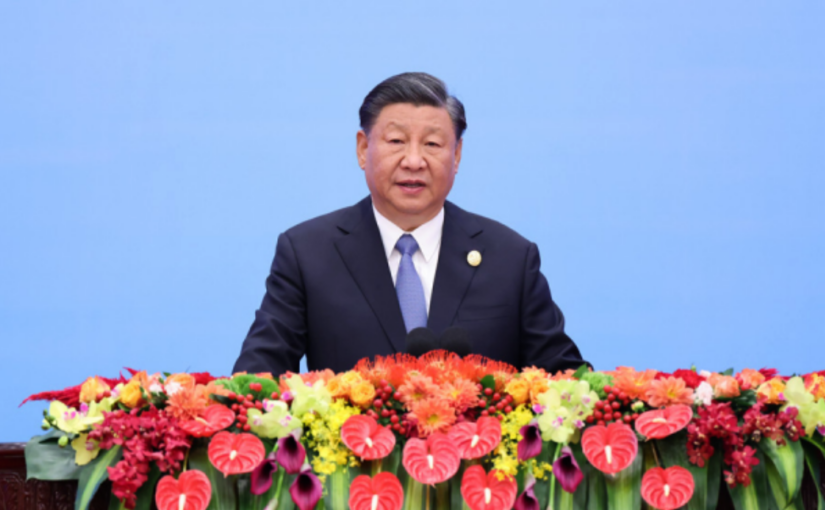
PFLP leader: we highly appreciate China’s constant support for the just cause of the Palestinian people

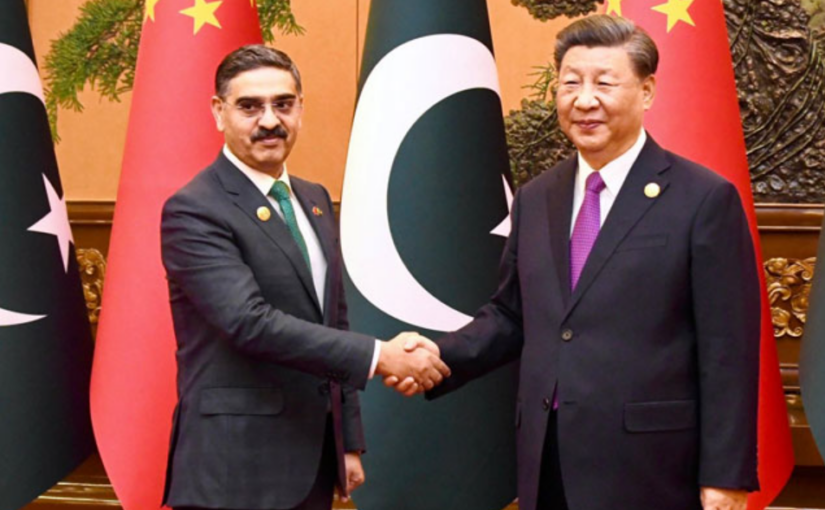
The fourth China-Arab States Political Parties Dialogue was jointly organised by the International Department of the Communist Party of China (IDCPC) together with the Central Party School and the party committee of the Ningxia Hui Autonomous Region on July 13 in Yinchuan, the capital city of Ningxia Hui. It was attended by the leaders of 67 political parties and organisations from 19 Arab countries.

Mahmoud Abbas, Chairman of the Fatah party and President of Palestine, sent a written speech to the gathering, in which he said that the Palestinian side thanked the Chinese side for its long-term commitment to resolving the Palestinian issue in a peaceful and just manner, and highly appreciated President Xi Jinping’s three proposals for this purpose. The Palestinian side firmly supports the one-China principle, resolutely opposes external forces’ interference in China’s internal affairs, and opposes the politicization of human rights issues. Fatah, he said, is willing to strengthen exchanges and cooperation with the CPC so as to strengthen communication and cooperation, and to promote the further development of Palestine-China relations as well as Arab States-China relations.

A significant intervention was made in the dialogue by the Popular Front for the Liberation of Palestine (PFLP). In his speech, its Deputy Secretary-General, Jamil Mazhar affirmed the Popular Front’s support for China and its sovereignty and territorial integrity, including with regard to Taiwan, and called for the adoption of joint policies and decisions that would limit the US domination of oil prices, and open huge projects in the fields of energy, as well as the establishment of a global cooperation network for dialogue between Arab and Chinese civilizations.

Mazhar called for China to strengthen its role in pressing for the implementation of resolutions to establish fair international legitimacy for the Palestinian people, in addition to presenting proposals to strengthen the special relationship between the Popular Front and the Communist Party of China.

He conveyed greetings to the CPC from the Palestinian people and from the leadership of the PFLP, in particular from its Secretary-General Ahmed Sa’adat. Comrade Sa’adat has spent much of his life in prison and is presently serving a 30-year sentence handed down by an Israeli military court in 2008. He was placed in solitary confinement in 2010, which was only lifted when he and other PFLP prisoners ended a 21-day hunger strike on 17 October 2011.

Comrade Mazhar further stressed that China is a springboard for important global transformations that put an end to US imperialist hegemony and its savage policies in the world, expressing the Front’s pride in the historical China-Palestine relations, which reflect the depth and strength of relations that unite the two peoples, and which have witnessed a great acceleration in recent years in all fields, highly appreciating China’s constant support for the just causes of the Palestinian people in their struggle to restore their legitimate national rights.

He expressed great confidence that China and its leadership will continue to support the struggle of the Palestinian people for statehood, stressing the Front’s keenness to develop relations with the CPC in all fields.

The previous month, on June 7, the China Daily carried an article by another Palestinian resistance leader. Ahmad Majdalani, Secretary-General of the Palestinian Popular Struggle Front and Executive Committee member of the Palestine Liberation Organization (PLO), wrote that, “Palestinians have a strategic interest in the growing role and power of China as a friendly state,” adding:

“We Palestinians welcome the Global Civilization Initiative, as it is based on mutual respect, mutual benefit, equality and development of all countries. Fair and just resolution of global and regional issues has been hindered under the United States-led world order. The Global Civilization Initiative, on the other hand, is a visionary initiative that aligns with Palestinian aspirations and could help the Palestinian president to convene an international peace conference.

“The initiative creates an ideal opportunity in the year that marks the 35th anniversary of the establishment of diplomatic relations between Palestine and China to work toward achieving tangible results, in order to realize better benefits for the peoples of both countries and expand cooperation in various fields. Sino-Palestinian constructive cooperation has been progressing well, giving us enough reasons to be optimistic about the possibility of further deepening pragmatic cooperation.”

The leader of the Popular Struggle Front added:

“We expect China to continue supporting the just Palestinian cause, and hope that China will spare no efforts in helping seek serious negotiations in an attempt to resolve the Palestinian issue. And as Palestinians, we must seize this historic moment to strengthen relations with China as a strategic partner and true friend. Palestine also needs to increase practical engagement in the Belt and Road Initiative and the Global Civilization Initiative while playing an important role in shaping humanity’s shared destiny.

“China has begun its journey to build a modern socialist country, which would achieve the goals of developing Arab-Chinese projects and launching strategic partnerships between China and Arab countries, representing a successful model of solidarity, cooperation and mutual benefit.”

The following articles originally appeared on the websites of the IDCPC, the PFLP and China Daily. The article from the PFLP was machine translated from Arabic and lightly edited by us.

Fourth China-Arab States Political Parties Dialogue Held

On July 13th, the fourth China-Arab States Political Parties Dialogue, which was co-organized by the International Department of the CPC Central Committee (IDCPC), the Party School of the Communist Party of China (CPC) Central Committee (National Academy of Governance), the CPC Committee of Ningxia Hui Autonomous Region, was held in Yinchuan. The dialogue was themed on “China-Arab States civilization exchanges: from the ancient Silk Road to the community with a shared destiny in the new era”. Liu Jianchao, Minister of the IDCPC, Xie Chuntao, Vice President of the Party School of the CPC Central Committee (National Academy of Governance) responsible for routine work, and Liang Yanshun, Secretary of the CPC Committee of Ningxia Hui Autonomous Region were present. Mahmoud Abbas, Chairman of Fatah and President of Palestine sent a written speech to the dialogue. The event’s attendees included political leaders of 67 political parties and organizations from 19 Arab countries and leaders, such as Fatima Habib, leader of the Equity Party and Vice President of the National Assembly of Mauritania, Hassan Benomar, Member of the Political Bureau of the National Rally of Independents (RNI) and Deputy Speaker of the House of Representatives of Morocco, Saleban Daher Bile, National Secretary of the People’s Rally for Progress(RPP), Secretary-General of the National Assembly of Djibouti, and representatives of think tanks and media.

Continue reading PFLP leader: we highly appreciate China’s constant support for the just cause of the Palestinian people

What we defend, what Wall Street wants to destroy

The following article by Sara Flounders unpicks US Treasury Secretary Janet Yellen’s recent demands that China “shift to a market-oriented system”, drop its putative “coercive actions against American firms”, and participate in the US’s unilateral and unenforceable sanctions against Russia.

Sara points out that the US is in no position to complain about China’s subsidies to state-owned enterprises, given that “every capitalist economy, including that of the US, subsidizes key industries”; some of those who suffered ruinous poverty as a result of the 2008 financial crisis may remember the trillions of dollars of subsidies that bailed out the banks rather than the poor. Meanwhile calls for China to end “barriers to market access for foreign firms” ring decidedly hollow in the light of hundreds of US trade barriers and sanctions on China.

China’s use of “non-market policies” is not in itself the source of the US’s escalating hostility. “Most frustrating to the imperialists is that the socialist development of the economy is guided by the 90-million member, popularly supported Communist Party of China. There is a party cell in every workplace, school and neighborhood. This is what US politicians and corporate investors consider a ‘dictatorship,’ restricting their freedom. On the other hand, unelected billionaires making all decisions are proof of ‘democracy.'”

Sara observes that China’s socialist strategy has brought about “the largest and most rapid improvement in material conditions in modern history”. Furthermore, via its Belt and Road Initiative and other programs, China is enabling the emergence of a truly multipolar order – a serious threat to the US-led imperialist system. The article concludes that Chinese socialism is creating important gains for the global working class, and should be defended and supported. “It is in the interests of workers here to defend China and condemn the onerous demands of US imperialism.”

The article was first carried in Workers World.

What is the material basis of the growing hostility on every level of the U.S. ruling class toward China?

No great struggle is based on the personalities or aspirations of individuals. At the root is a very concrete, material basis that drives the conflict. Otherwise, meetings, discussions and diplomacy would succeed. These techniques can paper over differences – but not fundamentally resolve them.

Secretary of the Treasury Janet Yellen’s talk on June 7 to a group of U.S. businesspeople at the American Chamber of Commerce in China exposed how well these U.S. corporate heads understand the basic, irreconcilable difference. They are deeply frustrated about their inability to maintain their dominant global position, as well as by China’s non-compliance with their self-proclaimed “rules-based order.” (tinyurl.com/2s45jh53)

Yellen is a top capitalist economist. She is a former Chair of the Federal Reserve and headed the White House Council of Economic Advisors. Yellen has taught economics at Harvard, Yale and the London School of Economics. Her words carry weight and reflect the thinking of imperialist think tanks, strategists, politicians and businesspeople. 

Yellen’s talk in China was similar to a longer presentation she gave at the Johns Hopkins School of Advanced International Studies on April 20, published in preparation for her announced trip to China. It sharply defined the Biden administration’s demands on China. 

Continue reading What we defend, what Wall Street wants to destroy

Solomon Islands PM: establishing relations with China one of the best decisions in our history

In this episode of the CGTN series Leaders Talk, Zou Yun interviews the Prime Minister of Solomon Islands Manasseh Sogavare at the start of his second official visit to China in July. Sogavare came to China nearly four years after his previous visit, which marked the establishment of diplomatic relations between the two countries. This time, he officially opened his country’s embassy in Beijing and the two countries formally established a Comprehensive Strategic Partnership of Mutual Respect and Common Development in the New Era. When asked how he felt to be visiting China again, he simply says: “It’s good to be back home.”

Solomon Islands finally won independence from British colonial rule in 1978, but Sogavare repeatedly describes the decades between the proclamation of independence and the establishment of diplomatic relations with China as ones of “wandering in the wilderness”. This strikingly biblical phrase doubtlessly reflects his own Seventh Day Adventist faith, as well as the deep religious sentiments of the Solomon Islands people as a whole, and therefore, in turn, his deep attachment to the China relationship, which, despite being just under four years old, has been on the fast track to become a model of solidarity, cooperation and joint development between large and small countries and between developing countries. For Sogavare, the establishment of diplomatic relations was one of the best decisions made in his country’s history and he praises the attitude he ascribes to President Xi Jinping that, “no country is too small; no one comes too late.”

In the very short history of diplomatic relations between his country and China, Sogavare asserts that the achievements have been huge, not least China’s provision of the national stadium, where Solomon Islands will host the Pacific Games this year. He expresses himself vehemently with regard to those countries who have criticised his relations with China, saying that, “we are a sovereign state and who we have diplomatic relations with and who we develop cooperation with is no one’s business.” He dismisses the theory of a ‘Chinese debt trap’ as “nonsense”, saying that some countries are afraid that they are losing their grip over the small island states.

Establishing relations with China was the best decision because his country is struggling for development. Decades after independence, Solomon Islands is still aid dependent and the country is still poor, despite its immense resources and potential, including in forestry, marine resources, minerals and tourist attractions. Unless his country realigned itself to open up to the opportunities provided by China, he feared it would remain poor forever. Asked about his impressions of President Xi Jinping, he singles out his leadership in lifting the Chinese people out of poverty. This does not simply happen by chance and is something that other countries should emulate.

As the leader of a Pacific Island country, and home to some of the world’s greatest diversity of corals and coral reef species, Sogavare expressed serious and grave concern with regard to both the Japanese plan to release contaminated water from the Fukushima nuclear reactor into the ocean and the AUKUS agreement between Australia, the UK and the US that will see the introduction of nuclear powered submarines into the South Pacific. The South Pacific countries had jointly sent the Prime Minister of Cook Islands to Japan to convey their concern. 

Regarding the AUKUS agreement, he explained that the first he had heard of this was on the media – the countries concerned had not even had the courtesy to inform Solomon Islands. This is despite the fact that both Australia and Solomon Islands are signatories to the 1986 South Pacific Nuclear Free Zone Treaty, also known as the Treaty of Rarotonga. The South Pacific, he says, is very clear on its nuclear free policy, citing the impact of the nuclear tests on Moruroa (a part of Polynesia still under French colonial rule) and the continued suffering of the people there.

Finally, Prime Minister Sogavare speaks of his personal admiration for the Chinese martial arts icon Bruce Lee. Himself a Second Dan (black belt) in the Japanese Shotokan school of karate, it was Bruce Lee who inspired him to take up the martial arts seriously and the Prime Minister recalls how meaningful it was for him to visit Lee’s Hong Kong home in 1997.

The full interview with Prime Minister Manasseh Sogavare is embedded below.

The East is Still Red: a valuable defense of socialism in China

We’re pleased to reproduce below J Sykes’ review of The East is Still Red, originally published in FightBack News. Sykes considers the book to be “a valuable and important defense of socialism in the People’s Republic of China”, addressing an urgent need for people to better understand contemporary China, particularly in the light of an escalating US-led hybrid war against it.

Sykes has also recently published a useful book, The Revolutionary Science of Marxism-Leninism, about which you can find more information here.

The East is Still Red can be purchased in paperback and digital formats from Praxis Press.

The new book, The East is Still Red: Chinese Socialism in the 21st Century, by Carlos Martinez and published by Praxis Press, is a valuable and important defense of socialism in the People’s Republic of China today. As the U.S. ramps up propaganda and aggression against China, this book addresses an important need, for everyone who wants a better world, to understand and defend China.

The book begins by acknowledging that there is a great deal of ignorance and confusion, especially in the imperialist countries, about China. Martinez writes, “Even among socialists and communists, there are misconceptions and important gaps in understanding.” He addresses these issues head on.

The first chapter focuses on the continuities of the revolution in China, from the founding of the Communist Party of China (CPC) in 1921 until today. Martinez gives an overview of the history of the Chinese revolution and defends that legacy of Mao Zedong, while giving a balanced account of Mao’s more controversial initiatives, such as the Great Leap Forward and the Cultural Revolution.

For example, while acknowledging that the turmoil and disruption of the Cultural Revolution significantly impeded China’s development, he also points out that it “had a more directly useful outcome” in terms of preventing the “ideological decay that was taking place in the Soviet Union.” According to Martinez it “set the parameters of how far Reform and Opening Up could go” and “laid the groundwork for Deng Xiaoping’s Four Cardinal Principles, which the CPC continues to observe today: 1) We must keep to the socialist road; 2) We must uphold the people’s democratic dictatorship; 3) We must uphold the leadership of the Communist Party; 4) We must uphold Marxism-Leninism and Mao Zedong Thought.

Furthermore, he explains that the movement to send young intellectuals down to the countryside during the Cultural Revolution “was a crucial factor in the development of a new generation of young intellectuals with a close understanding of the needs of the peasantry and the situation in the countryside.” It is noteworthy that Chinese President Xi Jinping was himself sent to the countryside as part of this movement.

Looking at the post-1978 Reform and Opening Up period initiated by Deng Xiaoping, Martinez recognizes that many see this period as “a turning point in the wrong direction.” Martinez argues against this view. Instead, Martinez notes, “Deng Xiaoping’s strong belief was that, unless the government delivered on a significant improvement in people’s standard of living, the entire socialist project would lose its legitimacy and therefore be in peril.”

Continue reading The East is Still Red: a valuable defense of socialism in China

President Tebboune: China is Algeria’s most important friend and partner

The President of the People’s Democratic Republic of Algeria, Abdelmadjid Tebboune, paid a state visit to China from July 17-21, 2023, at the invitation of his Chinese counterpart, Xi Jinping. 

This was Tebboune’s first visit to China since he assumed the Presidency in 2019. However, China’s contacts with the ruling National Liberation Front (FLN) date back to the 1950s, when the Algerian people were engaged in a bitter war of national liberation against French colonialism. China was the first non-Arab country to recognise Algeria’s independence and to establish diplomatic relations with the fledgling Algerian republic. In 2014, Algeria became the first Arab country to establish a comprehensive strategic partnership with China.

Meeting his Algerian counterpart on July 18, Xi Jinping noted that this year marks the 65th anniversary of diplomatic relations between China and Algeria. Xi said that, 65 years ago, China and Algeria were brought together by the common cause of opposing imperialism and colonialism and seeking national independence and liberation. Since then, the two countries have helped each other through thick and thin and rendered mutual understanding and support to one another. They have been true friends and natural partners in the pursuit of common development and national rejuvenation. He thanked Algeria for its unequivocal support for China’s just position on issues related to Taiwan, Xinjiang and human rights, and reaffirmed that China firmly supports Algeria in safeguarding its national sovereignty, independence and territorial integrity, supports Algeria in following a development path that fits its national reality, and opposes external interference in Algeria’s internal affairs.

Xi added that this year marks the 60th anniversary of China sending its first medical team to Algeria. (And China’s first medical team to any foreign country.) Over the last six decades, 3,522 Chinese medical workers have been sent to Algeria, treating over 27 million people and delivering over 2.07 million babies. “This is a monument to the China-Algeria friendship,” Xi said.

President Tebboune said that China is the most important friend and partner of Algeria. He thanked China for giving Algeria valuable support of various sorts over the years, saying Algeria firmly supports China’s position on issues concerning its core interests such as Taiwan and Xinjiang. He added that Algeria supports the Global Development Initiative, the Global Security Initiative, and the Global Civilization Initiative proposed by China. He expressed readiness for Algeria to take an active part in Belt and Road cooperation and to deepen the Algeria-China comprehensive strategic partnership, which will give a boost to economic and social development in Algeria.

Following their talks, the two heads of state issued a joint statement, in which they recalled the profound traditional friendly relations between the two countries and pointed out that this visit coincides with the 65th anniversary of their establishment of diplomatic relations and is of great significance.

Having discussed the need to further enhance political and security cooperation and that in diversified economic fields, as well as in such areas as culture, sports, tourism and journalism, the two heads of state said they would like to take the celebration of the 60th anniversary of China’s dispatch of the first foreign medical team to Algeria as an opportunity to strengthen cooperation in the field of health between the two countries.

With the summit of the BRICS grouping, presently comprising Brazil, Russia, India, China and South Africa, due to be held in South Africa in August, and with more than 40 countries having reportedly expressed an interest in joining, the Algerian side once again informed the Chinese side of the measures taken by them to apply for BRICS membership. China welcomes the positive willingness of Algeria to join the BRICS countries and supports its efforts to achieve this goal. The Algerian side appreciates China’s position and its expression of willingness to support Algeria at all stages of this process.

China, the statement said, supports Algeria in playing an important and constructive role in international and regional affairs, and appreciates the initiatives and ideas put forward by Algeria and its positive efforts to promote a just and lasting settlement of the Middle East issue. The two sides stressed that the question of Palestine should be resolved in accordance with international law and relevant United Nations resolutions, ensuring the right of the Palestinian people to establish a fully sovereign and independent Palestinian state based on the 1967 borders, with East Jerusalem as its capital. China appreciates President Tebboune’s positive efforts to achieve Palestinian unity and intra-Palestinian reconciliation, as well as the Algiers Declaration issued in that regard. The Algerian side appreciates President Xi Jinping’s many initiatives on the settlement of the Palestinian issue, especially the recent three-point proposal; it appreciates China’s long-standing firm support for the just cause of the Palestinian people to restore their legitimate national rights and supports all Palestinian factions in strengthening unity and achieving internal reconciliation through consultation and dialogue.

The two sides agreed that on the basis of respecting the sovereignty, independence and territorial integrity of regional countries and through dialogue and consultation, they should promote the political and peaceful settlement of hotspot issues and other crises in the Arab region, such as in Syria, Libya, Yemen and Sudan, stressed their opposition to external interference, support for jointly cracking down on extremist terrorist organizations in their territories, supported the efforts of Lebanon, Somalia and Sudan to achieve security, stability, development and prosperity and counter-terrorism, and supported the efforts of the United Nations and the League of Arab States towards those ends. China stresses its support for Arab countries in resolving regional security issues through solidarity and cooperation. Algeria also expressed its appreciation for China’s efforts to achieve reconciliation between Saudi Arabia and Iran.

Algeria also appreciated China’s firm support for African countries in achieving national independence, following a development path suited to their own national conditions, and supporting Africa’s efforts in integration and joint self-improvement. It believes that China’s cooperation with Africa has always been at the forefront of international cooperation with the continent, and the results of China-Africa cooperation have improved the conditions for Africa’s economic and social development and brought tangible benefits to the people of both sides.

China appreciates the important role played by the Algerian side in supporting stability, development, security and peace in Africa, actively promoting the peaceful settlement of the crises in Libya, Mali, the Sahel and the Sahara region, and appreciates the fact that, as the coordinator of the African Union for preventing and combating terrorism and violent extremist activities, it has long been committed to combating this dangerous public enemy in Africa and has actively worked to share its successful experience in counter-terrorism.

The statement says that on the question of Western Sahara, the two sides stressed their support for efforts to reach a just and lasting solution within the framework of international law, in particular the relevant United Nations resolutions, so as to guarantee the self-determination of the people of Western Sahara under arrangements consistent with the purposes and principles of the Charter of the United Nations, and for the efforts of the UN to that end. This constitutes a clear and significant statement of China’s support for the right of the Sahrawi people to self-determination.

Regarding the situation in Ukraine, the two sides called for resolving differences peacefully through dialogue and negotiation; called for abiding by universally recognised international law and the purposes and principles of the Charter of the United Nations. The security of one country should not be at the expense of the security of other countries, and the legitimate security concerns of all countries should be valued and properly addressed. They oppose coercive measures such as unilateral sanctions, violating international law and harming the livelihood of relevant countries. Possible humanitarian impacts should be mitigated and every effort should be made to avoid escalation and to achieve a peaceful settlement of the crisis.

President Tebboune invited President Xi Jinping to visit Algeria, for which Xi expressed his gratitude, and the date of the visit will be agreed by both sides.

The following day, President Tebboune held separate meetings with Chinese Premier Li Qiang and Chairman of the National People’s Congress Standing Committee Zhao Leji.

Li Qiang said that China and Algeria should expand cooperation in emerging areas such as information technology, digital economy, new energy vehicles, and space satellites and set an example for high-tech cooperation among developing countries. China supports Algeria in playing a more significant role in international and regional affairs and stands ready to work with Algeria to practice genuine multilateralism and oppose unilateralism, hegemony, and bullying to safeguard the common interests of China, Algeria, and other developing countries. 

Zhao Leji congratulated Algeria on its election as a non-permanent member of the UN Security Council for 2024-2025, and expressed a readiness to work with Algeria to build an open world economy and promote a more just and equitable global governance system.

Noting that Algeria and China have always firmly supported each other, Tebboune said that Algeria admires the great achievements made by the Chinese people through long-term hard work, and is willing to learn from China’s experience and deepen cooperation in various fields to bring better benefits to the two peoples.

In an interview with the Xinhua News Agency, coinciding with the start of Tebboune’s visit, Smail Debeche, President of the Algeria-China Friendship Association, said the “historical and political ties between the two nations serve as a foundation for strategic convergence” and expressed the hope that their bilateral relations can be a model for Africa and the Arab world.

Debeche, who is also a professor of political sciences and international relations at the University of Algiers 3, a Central Committee member of the National Liberation Front (FLN), a leader of the Algerian Committee for Solidarity with the People of Western Sahara, and an Advisory Group member of Friends of Socialist China, added that over the past 65 years since the establishment of diplomatic relations, China and Algeria have firmly supported each other on issues related to their core interests and major concerns. The two countries have maintained a consistent stance on international and regional hotspot issues and engaged in mutually beneficial cooperation in various fields, becoming strategic partners that walk hand in hand. Referring to the 60th anniversary of China’s dispatch of medical teams to Algeria, he added:

“At that time, Algeria emerged from a brutal war and urgently needed medical assistance. The Chinese medical teams brought hope and timely assistance. Chinese doctors treated patients and trained local doctors. Medical cooperation between the two countries has become an example of China-Algeria cooperation.”

The following articles originally appeared on the websites of the Xinhua News Agency and the Chinese Foreign Ministry. The Joint Statement was published by the Foreign Ministry in Chinese. It has been machine translated and edited by us for clarity and accuracy.

Xi holds talks with Algerian president

Xinhua, 18 July 2023

Chinese President Xi Jinping on Tuesday held talks with Algerian President Abdelmadjid Tebboune, who is on a state visit to China, at the Great Hall of the People.

Noting that this year marks the 65th anniversary of diplomatic relations between China and Algeria, Xi said 65 years ago, China and Algeria were brought together by the common cause of opposing imperialism and colonialism and seeking national independence and liberation.

Since then, the two countries have helped each other through thick and thin and rendered mutual understanding and support to each other, and the two countries have been true friends and natural partners in the pursuit of common development and national rejuvenation, Xi said.

Continue reading President Tebboune: China is Algeria’s most important friend and partner

Report back from a delegation to China

The following is a report by Carlos Martinez on a delegation to China, organised by the CPC’s International Department, that Friends of Socialist China was invited to join. Carlos’s report describes the intensive program of activities that the delegation participated in, as well as detailing some of the discussions and observations on China’s path to modernisation, common prosperity, whole process people’s democracy, rights of migrant workers, and the nature and trajectory of Chinese socialism.

The Third Communist Party Leaders Delegation of North American, Oceanian and Nordic Countries visited China from 24 June to 4 July, at the invitation of the International Department of the Central Committee of the Communist Party of China (IDCPC).

Friends of Socialist China were invited to join this delegation, along with the Communist Party of Australia, the Communist Party of Britain, the Communist Party of Ireland, the Communist Party of Finland, the Communist Party (Sweden), the Communist Party of Norway, the Communist Party USA, the Communist Party of Canada (including Le Parti communiste du Québec), the Communist Party of Denmark, the New Communist Party of Britain, and the Communist Party of Great Britain (Marxist-Leninist). We were represented by co-editors Keith Bennett and Carlos Martinez and advisory group member Francisco Domínguez.

The intensive and incredibly well-organised program included meetings with academics, ‘red tourism’, visits to communities and enterprises, cultural activities, and discussions with the IDCPC, the Communist Youth League of China, the All-China Federation of Trade Unions and the Party School of the CPC Central Committee.

The first destination was Guangzhou (capital city of Guangdong Province in southern China), and the first activity was a presentation and Q&A session at the Guangdong Academy of Social Sciences, introduced by its President, Wang Tinghui, and led by Professor Deng Zhiping.

Deng Zhiping gave an overview of China’s approach to modernisation – characterised by common prosperity for all, harmony between humanity and nature, material and cultural-ethical advancement, and peaceful development – and described the leading role played by Guangdong in this process. Historically Guangdong has always been an area associated with trade; indeed it was the starting point of the Maritime Silk Road, connecting China, South and Southeast Asia, Arabia, East Africa and Europe. In the recent era, Reform and opening up started with the establishment of four Special Economic Zones (SEZs), three of which were in Guangdong Province. Today Guangdong’s GDP ranks alongside Italy and Türkiye, and surpassed South Korea in 2021. Its per capita GDP now exceeds 15,000 USD, indicating that it has been able to jump out of the ‘middle-income trap’.

Guangdong’s average life expectancy is now 79.3, and all the province’s social and economic indicators are steadily improving. Enrolment rate in higher education is 58 percent, up from 28 percent in 2010. More than 158 million residents are covered by social security, and inequality is trending downwards. With the focus on rural regeneration, the urban-rural income ratio has narrowed from 2.7 a decade ago to 2.4 today.

Guangzhou has long been a trailblazer in green development, and in recent years there has been a strong emphasis on building a “green and beautiful Guangdong” – pursuing high-quality development which is green and open, based on innovation and sharing. Professor Deng emphasised that “the colour of our further modernisation is green”. Economic activity in the province is increasingly oriented towards renewable energy and electric vehicles, and major efforts are underway to improve public transport and protect biodiversity.

Continue reading Report back from a delegation to China

Nicaraguan presidential adviser visits Beijing, strengthening ties

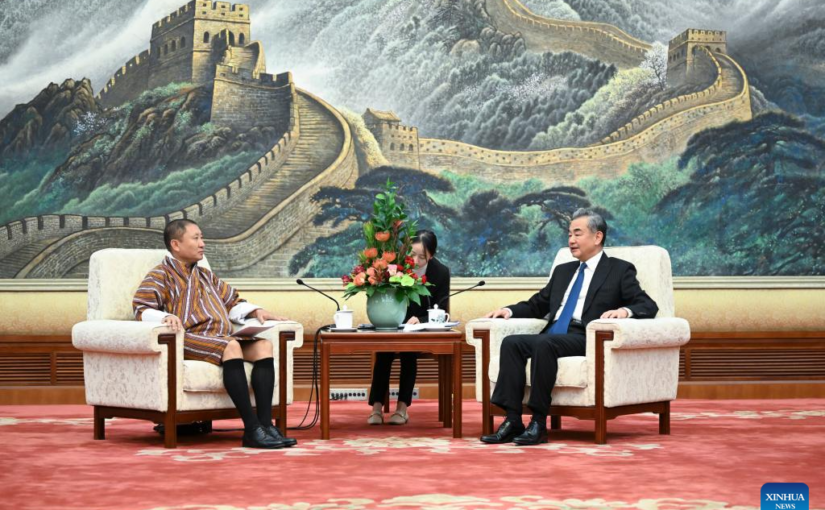
The steadily strengthening ties between China and Nicaragua were highlighted by a further visit to Beijing by presidential adviser Laureano Ortega Murillo in July.

Ortega attended the first high-level conference of the Forum on Global Action for Shared Development, which attracted senior representation from throughout Africa, Asia and Latin America, including the Foreign Ministers of Burundi, Gabon, Uganda and Laos.

Meeting Ortega on July 11, China’s most senior foreign affairs official Wang Yi said that his country always views China-Nicaragua relations from a strategic and long-term perspective, regards Nicaragua as a trustworthy partner, will firmly support Nicaragua in defending its independence and national sanctity, and will firmly support Nicaragua in independently choosing a development path in line with its national conditions.

China, he added, is willing to upgrade the strategic level of bilateral relations with Nicaragua, promote the implementation of the free trade agreement, strengthen coordination in the multilateral field, and take a clear-cut stand against all hegemonism and power politics.

The following report on the meeting between Laureano Ortega and Wang Yi was originally carried by the Xinhua News Agency. We also reprint the full text of the statement for the First High-Level Conference of the Forum on Global Action for Shared Development from the same source.

Senior Chinese diplomat meets with presidential adviser of Nicaragua

Wang Yi, director of the Office of the Foreign Affairs Commission of the Communist Party of China (CPC) Central Committee, met with Laureano Ortega Murillo, presidential adviser of Nicaragua, in Beijing on Tuesday.

Wang, also a member of the Political Bureau of the CPC Central Committee, welcomed Laureano to China to attend the first high-level conference of the Forum on Global Action for Shared Development, saying that in the process of promoting the Global Development Initiative, China can become Nicaragua’s closest partner and play an important role in Nicaragua’s development and improvement of people’s livelihood.

Since the resumption of diplomatic relations between China and Nicaragua, cooperation in various fields has achieved fruitful results. China always views China-Nicaragua relations from a strategic and long-term perspective, regards Nicaragua as a trustworthy partner, will firmly support Nicaragua in defending its independence and national sanctity, and firmly support Nicaragua in independently choosing a development path in line with its national conditions, Wang said.

Continue reading Nicaraguan presidential adviser visits Beijing, strengthening ties

China and Solomon Islands establish comprehensive strategic partnership

Solomon Islands Prime Minister Manasseh Sogavare began a highly successful visit to China on July 9 2023. Meeting with President Xi Jinping the following day, the two sides jointly announced the official establishment of a comprehensive strategic partnership featuring mutual respect and common development for a new era.

President Xi noted that China and Solomon Islands are trustworthy friends and dependable partners to each other. He said that since the two countries established diplomatic relations, their friendly cooperation has become a pacesetter for the relations between China and other island countries in the Pacific in spite of a relatively late start. He said their cooperation is a paradigm of unity, cooperation and common development for countries of different sizes, and for developing countries. He further stressed that China greatly appreciates Solomon Islands’ firm adherence to the one-China principle, supports Solomon Islands in safeguarding its national sovereignty, security and development interests, and supports the development path that the country itself has chosen.

“China is supporting more Chinese enterprises to invest and do business in Solomon Islands, and will continue to provide economic and technical assistance to the country without any political strings attached,” Xi said, adding that China supports Solomon Islands in hosting the 17th Pacific Games.

China fully respects the cultural traditions of Pacific island countries, and adheres to harmony in diversity and shared beauty of diverse cultures and also understands that island countries in the Pacific face severe challenges caused by climate change, and stands ready to strengthen exchanges and cooperation with them in such areas as meteorological services, disaster prevention and mitigation, and clean energy to help them implement the United Nations 2030 Agenda for Sustainable Development, Xi said.

Noting that the decision to establish diplomatic relations with China was a correct choice, Sogavare said fruitful outcomes have been achieved in bilateral ties and China has become Solomon Islands’ largest infrastructure partner and a reliable development partner.

After the meeting, the two sides released the Joint Statement on Establishing a Comprehensive Strategic Partnership Featuring Mutual Respect and Common Development for a New Era Between the People’s Republic of China and Solomon Islands.

Meeting with his host, Premier Li Qiang on the same day, Sogavare said that Solomon Islands attaches great importance to relations with China, appreciates China’s active assistance for the economic and social development of Solomon Islands and other island countries in the Pacific, and supports the Belt and Road Initiative, the Global Development Initiative, the Global Security Initiative and the Global Civilization Initiative proposed by China.

Li noted that China is willing to share development opportunities with Solomon Islands, synergize development strategies further, and expand cooperation on trade and investment, infrastructure construction, agriculture, tourism, forestry and fisheries, information and communication, and energy and mineral resources.

According to the Joint Statement, “The two sides agreed that since the establishment of diplomatic ties four years ago, China-Solomon Islands relations have developed rapidly and remained at the forefront of relations between China and Pacific Island countries, becoming an example of unity, cooperation, mutual support and mutual benefit between developing countries.”

They added that they “agreed that all countries, regardless of size, strength and wealth, are equals, and that their sovereignty and territorial integrity must be respected. The Chinese side reaffirmed its staunch support for Solomon Islands’ nation building process and to choose a development path suited to its national conditions and in upholding its sovereignty, security and development interests. The Solomon Islands side reaffirmed that it is resolutely committed to the one-China principle, that the government of the People’s Republic of China is the sole legal government representing the whole of China and Taiwan is an inalienable part of China’s territory.”

In one of the most internationally noted aspects of China/Solomon Islands cooperation, the two countries agreed to enhance cooperation on law enforcement and security matters. “The Chinese side will continue to provide support and help to Solomon Islands as needed in strengthening Solomon Islands’ police law enforcement capacity. The two sides agreed to step up protection of the safety and lawful rights and interests of each other’s nationals and institutions in their countries.”

China’s assistance to Solomon Islands in this regard has been a particular focus of imperialist ire, with allegations that it infringes on the island nation’s sovereignty and independence. In fact, what really concerns the imperialist and colonialist powers is how this cooperation with China is precisely what is enabling Solomon Islands to assert and enhance its independence. Australia, which sees itself as the United States’ “deputy sheriff” in the South Pacific, has hitherto asserted its right to intervene, in a ‘policing’ capacity under an unequal 2017 security treaty, which Prime Minister Sogavare, secure in his friendly relationship with China, called to be reviewed in June.

The joint statement further said that the two sides are “committed to working with all sides to promote peace, development and stability in the Pacific Islands region, and firmly uphold the international nuclear non-proliferation regime with the Treaty on the Non-Proliferation of Nuclear Weapons as the cornerstone and the South Pacific Nuclear Free Zone Treaty.” In a clear rebuke to Japan and to the AUKUS military alliance of Australia, Britain and the United States, it added that they “urge relevant countries to fulfill their international obligations and prudently handle issues such as the discharge of nuclear contaminated water and cooperation on nuclear submarine.”

In conclusion, “Prime Minister Sogavare expressed heartfelt appreciation to the Chinese side for the generous hospitality accorded to him during his visit, and extended an invitation to the Chinese leaders to visit Solomon Islands at an early date.”

Sogavare was elected as Prime Minister of Solomon Islands for a fourth time in April 2019 and established diplomatic relations with China in September that year. Since then his government has been subjected to tremendous pressure, both overt and covert, from the United States, Australia and other imperialist powers, but far from retreating, he has actively consolidated and developed the friendly relationship with China, proving himself to be a leader of courage, principle and integrity. This is already providing tangible benefits to his country. Chinese telecoms giant Huawei is building a cellular network whilst a Chinese state company is to redevelop the port in the capital Honiara.

Analyzing the visit, Niu Li, executive director of the Pacific Research Center at Beijing Foreign Studies University, told the Chinese newspaper Global Times that from establishing diplomatic ties with China in 2019 to signing the security pact in 2022, then to Sogavare’s current visit, “the Solomon Islands has shown its determination to defend its national sovereignty and is striving to get rid of being controlled regardless of the pressure from the US and its allies like Australia.”

The Chinese scholar added that the reaffirmation of strategic cooperation between China and Solomon Islands will encourage other Pacific Island countries to cooperate with China. “The China-Solomon Islands cooperation will serve as a model for other Pacific Island countries, which have come under long-standing bullying and control of the US-led Western powers, to defend their national sovereignty and autonomy.”

During his visit, Sogavare also officially opened the Solomon Islands embassy in Beijing, alongside China’s top diplomat, Wang Yi.

The following reports were originally published by the Xinhua News Agency and Global Times.

Xi meets Sogavare, urging enhanced China-Solomon Islands cooperation

Xinhua, 11 July 2023

BEIJING, July 10 (Xinhua) — Chinese President Xi Jinping met with visiting Prime Minister of Solomon Islands Manasseh Sogavare in Beijing on Monday afternoon.

The two sides jointly announced the official establishment of a comprehensive strategic partnership featuring mutual respect and common development for a new era.

Continue reading China and Solomon Islands establish comprehensive strategic partnership

Biden keeps lying about the US “not trying to surround” China

In the following brief article, Caitlin Johnstone unpicks President Biden’s recent claim that the US’s military escalation in the Pacific is not about surrounding China but about “maintaining stability in the Indian Ocean and in the South China Sea.” Caitlin points out the obvious: that Biden is lying. The US’s 313 military bases in East Asia, its initiation of AUKUS, its transfer of nuclear-capable bombers to Indonesia, its provocations in Taiwan and more all form part of a broader project of encircling and containing China. Frankly, “only a drooling idiot would believe the world’s most powerful empire is militarily surrounding its top geopolitical rival as an act of defence.”

Caitlin observes that the Chinese leadership understands these dynamics very well and is under no illusions as to the US’s intentions. When Biden says that the US is not trying to contain China and that the US is engaged in acts of defence, the purpose is to dupe the public in the West and generate support for an incredibly reckless military strategy that offers nothing of value to ordinary people.

The author concludes by advising readers to ignore the words of US officials and instead focus on their actions. “Ignore what officials say about wanting peace and not trying to surround China and supporting the One China policy etc. Just watch all the US war machinery that’s being rapidly added to that region.”

President Biden had a recent interview with CNN’s Fareed Zakaria during which he defended his controversial decision to send cluster munitions to Ukraine and suggested that the US can continually support Ukraine the way it supports Israel rather than adding it to the NATO alliance.

About halfway through the interview Biden said something about China that’s worth flagging, because the claim he makes is self-evidently false, and it’s not the first time he’s made it.

Describing the conversations he’s been having with China’s President Xi Jinping, Biden said the following:

“We’re going to put together the Quad which is India, Australia, the United States and Japan. I got a call from him [Xi] on that. He said why are you doing that. I said we’re not doing that to surround you, we’re doing that to maintain stability in the Indian Ocean and in the South China Sea. Because we believe the rules of the road about what constitutes international air space, international space and the water should be maintained.”

Continue reading Biden keeps lying about the US “not trying to surround” China

High-level delegation of Brazil’s Workers’ Party visits China

A high-level delegation of Brazil’s Workers’ Party (PT), led by its General Secretary, Henrique Fontana, visited China in June.

Meeting the delegation on June 13, Liu Jianchao, Minister of the International Department of the Communist Party of China’s Central Committee (IDCPC), noted that their visit followed that in April by Brazil’s President Luiz Inácio Lula da Silva, who, together with his Chinese counterpart, Xi Jinping, had  jointly made plans for the development of China-Brazil relations in the new era. Liu said he hoped that both sides will take this visit as an opportunity to further implement the important consensus reached by the two heads of state, deepen exchanges between the ruling parties, enhance political mutual trust, and exchange experience in state governance and administration. 

Liu added that China’s efforts  in promoting the process of the country’s modernization will not only help the Chinese people achieve common prosperity, but will also bring more development opportunities to countries around the world, including Brazil. The Chinese side supports the Brazilian side in playing a greater role on the international stage.

Fontana said that his visit, following that of President Lula, fully shows that the PT attaches high importance to developing relations with the CPC. Next year will be the 40th anniversary of the establishment of relations between the two Parties. The Brazilian side hopes to see inter-party exchanges play a greater role in deepening relations between the two countries and friendship between the two peoples. The PT admires the huge success of the CPC in promoting domestic development with a people-centered approach and responding to international challenges. His party believes that China’s successful development model provides important references for the vast number of developing countries. He further applauded the Chinese side’s important role in promoting the political settlement of the Ukraine issue, and said his party is willing to strengthen cooperation with the Chinese side under the framework of the United Nations, the Group of 20, and the BRICS, oppose the new Cold War mentality, champion multilateralism, and together build a multipolar and prosperous world.

The following report was originally published on the IDCPC website.

Beijing, June 13th—Liu Jianchao, Minister of the International Department of the CPC Central Committee (IDCPC), met here today with a delegation of senior officials of the Workers’ Party of Brazil (PT) led by Henrique Fontana, General Secretary of PT.

Liu said, not long ago, President Xi Jinping and visiting Brazilian President Luiz Inacio Lula da Silva jointly made plans for China-Brazil relations in the new era, charting the course for the development of bilateral relations. We welcome the visit of a high-level delegation of PT, and appreciate PT’s commitment to actively promoting cooperation between the two countries. We hope both sides will take this visit as an opportunity to further implement the important consensus reached by the two heads of state, deepen exchanges between the ruling parties, and enhance political mutual trust and experience exchange in state governance and administration, and push cooperation between counterpart departments of the two Parties, think tanks and media. We firmly support each other’s core interests and support each other in choosing a development path that suits respective national conditions. We stand ready to jointly implement the Global Development Initiative, the Global Security Initiative and the Global Civilization Initiative, and continuously push China-Brazil comprehensive strategic partnership for new development.

Continue reading High-level delegation of Brazil’s Workers’ Party visits China

How China became the world’s industrial superpower – and why the US is desperate to stop it

In this detailed and informative video explainer on Geopolitical Economy Report, Ben Norton discusses China’s extraordinary rise and the economic dynamics of the New Cold War.

Ben notes that in 1950, China represented just 5 percent of global GDP. In purchasing power parity (PPP) terms, it currently represents 19 percent of global GDP, compared to 15 percent for the US. No other country in history has undergone such a dramatic transformation in so short a period. Ben makes the critically important point that this progress is the result of socialist, not capitalist, economics. He notes that in China’s socialist market economy, the commanding heights, including finance, infrastructure, transport and energy, are run by the state, and that the state continues to guide the economy overall, via five-year plans and multiple other mechanisms. China’s strategy has succeeded in transforming an overwhelmingly agrarian country into a leading industrial power, thereby creating the resources needed to develop more advanced socialism.

China’s rapid industrialization has led to it becoming the world’s largest manufacturer, and a leading innovator in advanced industry. This has some important – and contradictory – consequences for the West. Firstly, the West – and particularly the US – has been deindustrializing while China has been industrializing, and it now finds itself in a position where it is unable to outcompete China in terms of industrial innovation. This leads the US towards notions of ‘decoupling’ and trying to engage in various forms of economic coercion to suppress China’s rise. Secondly, however, China has become the global manufacturing center, and its high levels of productivity and innovation make it integral to multiple crucial value chains. As such, Western companies tend to be unwilling to ‘decouple’ or divest from China.

These competing needs are fomenting divisions within the Western ruling classes and are leading to decidedly incoherent foreign policy in Washington, London and elsewhere. The US is intent on preventing China from continuing to develop and becoming the world’s foremost economy, and yet the US’s financialized capitalism lacks the means to compete with (or indeed decouple from) China.

China-Barbados relations constantly deepening and growing

Prime Minister of Barbados Mia Amor Mottley paid an official visit to China in late June. 

Meeting with Xi Jinping on June 27, the Chinese President pointed out that Barbados is the first country in the eastern Caribbean to establish diplomatic relations with China, and also a good friend and good partner of China in the region. Though separated by vast oceans, China and Barbados share similar goals and have moved forward hand in hand, with bilateral relations constantly deepening and growing. China welcomes Barbados to board the “express train” of China’s development, and to work with China to build a closer China-Barbados community with a shared future.

President Xi went on to note that China, as always, supports Barbados in safeguarding its national sovereignty and independence, and independently choosing its own development path. China and Barbados are both developing countries, sharing much in common in the field of development, and enjoy great potential for cooperation. The two sides should expand practical cooperation and take the Belt and Road cooperation as an opportunity to expand cooperation in such fields as infrastructure construction, digital economy, climate change, new energy, agriculture, medical care and health.  

Xi Jinping said that, facing profound world changes unseen in a century, developing countries should strengthen solidarity and cooperation, practice true multilateralism, oppose the Cold War mentality and bloc confrontation, uphold the basic norms governing international relations, safeguard international fairness and justice, and promote the building of a community with a shared future for humanity. China fully understands the aspirations of Barbados and other small island developing states in the field of climate change, and is ready to continue strengthening South-South cooperation on climate change and to provide assistance and support to developing countries, including Barbados. China attaches importance to its relations with the Caribbean from a strategic height and a long-term perspective, and will continue to provide assistance to the best of its ability for the economic and social development of the region.

Mia Amor Mottley said that she was deeply impressed by the solidarity and friendship she witnessed between Barbados and China during the visit. She thanked China for its valuable assistance for Barbados’ response to the COVID-19 pandemic and for its economic and social development. She said the Chinese government has made great achievements in eliminating poverty and benefiting the people, and these achievements are admired around the world.  Barbados firmly supports the one-China principle, highly recognizes China’s philosophies, and is ready to learn from China’s experience and actively participate in the implementation of the Global Development Initiative, the Global Security Initiative, and the Global Civilization Initiative. Barbados hopes to strengthen cooperation with China in such fields as climate response, water resources, addressing the digital divide, and health care. Barbados is committed to multilateralism, opposes “decoupling and severing industrial and supply chains”, and is ready to continue promoting the development of relations between the Caribbean and China.

Two days previously, on June 25, the Barbados Prime Minister met her Chinese counterpart, Premier Li Qiang, who said that Barbados is a good friend and partner of China in the Caribbean region. Under the new circumstances, China is ready to work with Barbados to further enhance strategic mutual trust, deepen bilateral cooperation in various fields, and build China-Barbados relations into a model of solidarity and win-win cooperation between developing countries. For her part, Mottley said that Barbados attaches great importance to its relations with China, and both countries are committed to improving people’s lives and promoting sustainable development. Barbados thanked China for sending medical teams and providing strong support for its fight against COVID-19.

Mottley has been the Leader of the Barbados Labour Party (BLP) since 2008. She was first elected as Prime Minister in May 2018, when she led the BLP to win all 30 seats in the country’s parliament, for the first time in Barbadian history, taking 72.8% of the vote, the highest ever scored by any party in the country. In the 2022 general election, the BLP again secured all 30 parliamentary seats. On November 30 3021, Mottley led her country to renounce the British monarchy and become a fully independent republic, a trend that is gaining wider support throughout the Caribbean.

The following articles were originally carried on the website of the Chinese Foreign Ministry.
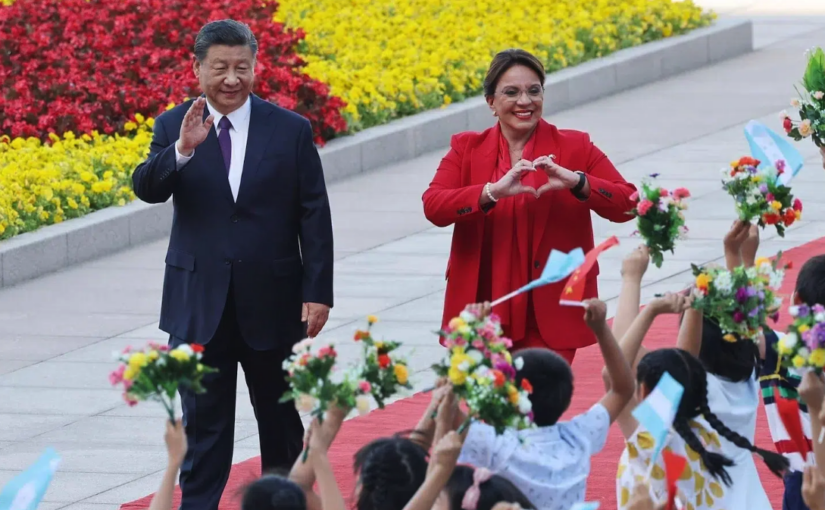
Xi Jinping Meets with Prime Minister of Barbados Mia Amor Mottley

On the afternoon of June 27, 2023, President Xi Jinping met at the Great Hall of the People with Prime Minister of Barbados Mia Amor Mottley who is on an official visit to China.

Xi Jinping pointed out that Barbados is the first country in the eastern Caribbean to establish diplomatic relations with China, and also a good friend and good partner of China in the region. Though separated by vast oceans, China and Barbados share similar goals and have move forward hand in hand, with bilateral relations constantly deepening and growing. China is promoting Chinese modernization with high-quality development, which will bring new opportunities for Barbados’ development and China-Barbados cooperation. China welcomes Barbados to board the “express train” of China’s development, and to work with China to build a closer China-Barbados community with a shared future.

Continue reading China-Barbados relations constantly deepening and growing

Kerry must understand – the climate crisis lives in a developmental context

In the following article, submitted to us by Keith Lamb, the author argues that the current China visit by John Kerry, the US Special Presidential Envoy for Climate, provides an opportunity for the two countries to cooperate in an area that is vital for the future, indeed the survival, of humanity. However, he notes that approaching this issue in isolation is not feasible in the long-term. The fight against climate catastrophe has to be combined with that for development as well as against war and for peace. The Global Development Initiative (GDI), proposed by President Xi Jinping, provides just such a holistic template and approach and is already reflected in numerous agreements between China and other countries of the Global South.

“How can we achieve our global climate goals without having Beijing working with us? We can’t, it’s that simple! There’s no way any one country can solve this crisis and particularly if we’re large emitting nations.” This was the answer of US climate envoy John Kerry being interviewed on MSNBC. He went on to claim that China and the US had agreed to separate climate, which affects us all, from the many other bilateral Sino-US issues.

This sensible recognition that there is a wider commonality binding humanity together is a welcome change from the hegemonic “America first” and faux human-rights rhetoric too often emanating from US circles. When it comes to climate and cooperation with China, Kerry went on to say that, “it’s not a question of the US giving away something, by cooperating we all gain something.”

This pragmatic win-win attitude should serve the diplomatic and well-mannered Kerry well on his current July 16-19 trip to Beijing, where he will discuss the climate crisis and hopefully promote a successful COP28 climate change conference, due to be held in the United Arab Emirates (UAE). Coming after the recent visit by US Treasury Secretary Janet Yellen, it may also serve to thaw Sino-US tensions.

However, for real climate cooperation, which seeks the salvation of our planet and humanity, the many Sino-US tensions to which Kerry alludes cannot be bracketed off indefinitely. These tensions include the trade war, sanctions, interference in China’s domestic affairs, not least regarding Xinjiang, Hong Kong and Taiwan, and the US’ military containment of China.

To illustrate this point, climate talks have been suspended in the past, due to Nancy Pelosi’s visit to Taiwan. The weather balloon debacle led to Secretary of State Antony Blinken canceling his Beijing visit. The pushing of China’s red lines, the threatening of China’s integrity, and the China threat hysteria all push the world closer to the possibility of environmental annihilation, as the US plays a fool’s game of ‘chicken’, risking nuclear catastrophe.

Even without this dire outcome, according to Brown University, the US military is responsible for twice the amount of greenhouse emissions as all the cars in the US. War causes incalculable damage to the environment due to factors such as fuel infrastructure destruction and the use of depleted uranium.[1] In Ukraine, we have seen how the destruction of energy infrastructure has led to renewed use of coal and the purchasing of expensive and environmentally damaging US fracked gas by Europe.

Continue reading Kerry must understand – the climate crisis lives in a developmental context

Liu Jianchao meets with Irish leaders

Liu Jianchao, Minister of the International Department of the Communist Party of China (IDCPC), led a delegation of his department to visit Britain, Ireland and Italy in the second half of June. His meetings in Ireland included with Fine Gael Senator Jerry Buttimer, Cathaoirleach of Seanad Éireann (the presiding officer of the Senate, the upper house of the Oireachtas, or Irish parliament), Bertie Ahern, former leader of Fianna Fáil, former Taoiseach (Prime Minister) of Ireland, and Co-chair of the InterAction Council, and Eamon Ryan, Leader of the Green Party and Minister for Transport, as well as Minister for the Environment, Climate and Communications of Ireland.

Senator Buttimer said that both Ireland and China have splendid culture and art. The two countries enjoy close cooperation in areas including economy, trade, science, education, and agriculture, as well as robust people-to-people and cultural exchanges and exchanges at local levels. The friendship between Ireland and China is deeply rooted in the hearts of the two peoples. Ireland, he said, speaks highly of China’s important efforts and achievements in helping the development of Africa and other developing countries.

Bertie Ahern congratulated China on its great achievements in economic and social development and in successfully lifting hundreds of millions of people out of poverty, and expressed full confidence in China’s development prospects. He said, both Ireland and China cherish respective excellent traditional culture, and attach importance to education, innovation and development.

Minister Liu responded that since the establishment of diplomatic relations, China-Ireland relations have always maintained healthy and stable development. Despite different history, culture and social system of the two sides, they have both adhered to mutual respect, tolerated differences, continuously consolidated mutual trust, constantly expanded consensus, and carried out exchanges and cooperation on the basis of equality and mutual benefit. The CPC, he added, is willing to strengthen inter-party exchanges and cooperation with all political parties of Ireland, exchange experience in state governance and administration, push economic and trade cooperation, and enhance non-governmental friendship.

Meeting Minister Ryan from the Green Party, Liu said that Ireland is one of the countries in the world that loves green development the most. And the Green Party of Ireland has actively contributed to the cause of domestic and global green development. Pursuing harmonious co-existence between people and nature and striving for sustainable development has become the important consensus between China and Ireland. He added that the Chinese side is willing to, together with the Irish side, adhere to mutual understanding and mutual respect, deepen cooperation in areas such as renewable energy, clean development, energy conservation, environmental protection, and addressing climate change, so as to promote the development of a China-Ireland strategic partnership for mutually beneficial cooperation.

Ryan said that he had visited China in 1987, 2010 and 2023, and was deeply impressed by China’s development achievements. China is a major energy producer and consumer, as well as a major producer of clean energy technology and equipment. The Green Party of Ireland appreciates the concept of ‘lucid waters and lush mountains are invaluable assets’, put forward by President Xi Jinping, he noted.

The following reports were first published on the website of the IDCPC.

Jerry Buttimer, Cathaoirleach of Seanad Éireann of Ireland Meets with Liu Jianchao

Dublin, June 23rd—Jerry Buttimer, Cathaoirleach of Seanad Éireann of Ireland, met here today with Liu Jianchao, Minister of the International Department of the CPC Central Committee.

Buttimer welcomed Liu on behalf of the Oireachtas. He said, both Ireland and China have splendid culture and art. The two countries enjoy close cooperation in areas including economy, trade, science, education, and agriculture, as well as robust people-to-people and cultural exchanges and exchanges at local levels. The friendship between Ireland and China is deeply rooted in the hearts of the two peoples. The Oireachtas attaches great importance to developing relations with China and adheres to the one-China principle. Ireland speaks highly of China’s important efforts and achievements in helping the development of Africa and other developing countries. He expressed the willingness to strengthen dialogue and communication with the Chinese side, deepen exchanges and cooperation in various fields such as parliament and political parties, and promote mutually beneficial cooperation between Ireland and China for greater development.

Continue reading Liu Jianchao meets with Irish leaders

Is the East still red? Interview with Carlos Martinez on Black Agenda Radio

In late June 2023, Margaret Kimberley hosted Friends of Socialist China co-editor Carlos Martinez on Black Agenda Radio to talk about Carlos’s recently-released book, The East is Still Red: Chinese Socialism in the 21st Century.

The two discuss a number of topics, including the rationale for the book’s name; the issue of whether or not China is a socialist country; the reasons behind China’s phenomenal economic rise; the escalating New Cold War; China’s foreign policy; and more.

Richard D Wolff: The fatal contradictions of China-bashing

This short essay by Marxist economist Richard D Wolff assesses the frenzied China-bashing that the US political and media mainstream is currently engaged in. Wolff observes that the wave of sinophobic propaganda is designed to “provide convenient cover” for US attempts to militarily intimidate and economically strangle China.

Additionally, scapegoating China provides a convenient way for the US ruling class to deflect criticism of a vicious neoliberal capitalism that has working people experiencing a chronic decline in living standards. “Scapegoating China joins with scapegoating immigrants, BIPOCs, and many of the other usual targets. The broader decline of the U.S. empire and capitalist economic system confronts the nation with the stark question: whose standard of living will bear the burden of the impact of this decline?” As long as China can be blamed for all problems, the US government can continue with its program of austerity, deregulation and inflation.

The author points out that antagonizing, and decoupling from, China could prove to be highly detrimental to the US economy. He calls on people to “see through the contradictions of China-bashing to prevent war, seek mutual accommodation, and thereby rebuild a new version of the joint prosperity that existed before Trump and Biden.”

This article was originally published in Asia Times.

The contradictions of China-bashing in the United States begin with how often it is flat-out untrue.

The Wall Street Journal reports that the “Chinese spy” balloon that President Joe Biden shot down with immense patriotic fanfare in February did not in fact transmit pictures or anything else to China.

White House economists have been trying to excuse persistent US inflation saying it is a global problem and inflation is worse elsewhere in the world. China’s inflation rate is 0.7% year on year.

Financial media outlets stress how China’s GDP growth rate is lower than it used to be. China now estimates that its 2023 GDP growth will be 5-5.5%. Estimates for the US GDP growth rate in 2023, meanwhile, vacillate around 1-2%.

China-bashing has intensified into denial and self-delusion – it is akin to pretending that the United States did not lose wars in Vietnam, Afghanistan, Iraq and more.

The BRICS coalition (China and its allies) now has a significantly larger global economic footprint (higher total GDP) than the Group of Seven (the United States and its allies).

China is outgrowing the rest of the world in research and development expenditures.

The American empire (like its foundation, American capitalism) is not the dominating global force it once was right after World War II. The empire and the economy have shrunk in size, power and influence considerably since then. And they continue to do so.

Putting that genie back into the bottle is a battle against history that the United States is not likely to win.

Continue reading Richard D Wolff: The fatal contradictions of China-bashing

A community of shared future is the only viable option for humanity

The Third Dialogue on Exchanges and Mutual Learning Among Civilizations and the First World Conference of Sinologists was held in Beijing on July 3-4. Held under the auspices of the International Department of the CPC Central Committee, it was hosted by the Chinese Association for International Understanding (CAFIU) and organised by the China National Archives of Publications and Culture and Beijing Language and Culture University.

Chinese Vice President Han Zheng attended and addressed the opening session, where he also read a letter of greetings sent by President Xi Jinping. In his letter, President Xi said that in the long course of human history, various nations have created civilizations with their own characteristics and symbols, and equal exchanges and mutual learning among different civilizations will provide strong spiritual guidance for humanity to solve the problems of the times and achieve common development. He also stressed that China is willing to work with all parties to advocate the universal values of peace, development, fairness, justice, democracy and freedom, and to implement the Global Civilization Initiative.

Other speakers in the opening session – in person or via video link – included former Spanish socialist Prime Minister José Luis Rodríguez Zapatero and party and state leaders from the Central African Republic, Mauritania and Malaysia.

Friends of Socialist China Co-editors Keith Bennett, Carlos Martinez and Danny Haiphong participated in the conference. On the second day, Danny chaired a parallel session, which included speakers from China, Kazakhstan, Bangladesh, Cuba, Thailand, Mongolia and South Africa.

Keith spoke at another parallel session, alongside speakers from China, Ireland, Russia, Kenya, Mauritius, USA, Cameroon, Indonesia, Malaysia, Türkiye and Iran.

The closing session included video addresses by Bertie Ahern, former Taoiseach (Prime Minister) of Ireland and former leader of the Fianna Fáil party, and Erik Solheim, former Under-Secretary-General of the United Nations.

We reprint below Keith’s speech to the conference. An article version has been published in China Today.

Dear Comrades and Friends

It is a great honor for me to be invited to contribute some thoughts to this Third Dialogue on Exchanges and Mutual Learning among Civilizations. Thank you for your invitation.

Humanity has a history of civilization dating back millennia.  Civilizations arose and developed on different continents and at different times. But they prospered and innovated through mutual exchanges and mutual learning. The ancient Silk Road, which began in China, is one of the greatest examples of this.

Through such routes, Roman remains have been found in China and Chinese silk and coins were to be found in the markets of Ancient Rome. Admiral Zheng He introduced the products of Chinese civilization from South East Asia to East Africa while merchants and traders from the Middle East found their way to China, becoming in time part of the great, diverse but united family of the Chinese nation.

Of course, previous history, since primitive communism gave way to class society, is by no means devoid of conflict, but it was, above all, the rise of capitalism and modern imperialism, which, from 1492 especially, fundamentally disrupted humanity’s inter-civilizational relationships.

Continue reading A community of shared future is the only viable option for humanity

Guo Yezhou meets with Communist Party leaders delegation

The Third Communist Party Leaders Delegation of North American, Oceanian and Nordic Countries visited China from June 24-July 4 at the invitation of the International Department of the Central Committee of the Communist Party of China (IDCPC).

Friends of Socialist China were invited to join this delegation, and our delegates were co-editors Keith Bennett and Carlos Martinez and advisory group member Francisco Domínguez. The delegation was led by Robert Griffiths, General Secretary of the Communist Party of Britain (CPB). The other parties represented were:

  • Communist Party of Australia
  • Communist Party of Ireland
  • Communist Party of Finland
  • Communist Party (Sweden)
  • Communist Party of Norway
  • Communist Party USA
  • Communist Party of Canada (including Le Parti communiste du Québec)
  • Communist Party of Denmark
  • New Communist Party of Britain
  • Communist Party of Great Britain (Marxist-Leninist)

The delegation enjoyed a rich and varied programme in Guangzhou, Guiyang, Zunyi and Beijing. On June 30, it met with IDCPC Vice Minister Guo Yezhou in Beijng, who expressed the CPC’s willingness to deepen exchanges and cooperation and jointly open up a better future for humanity, together with all the parties represented. The below report of the meeting with Comrade Guo was originally published on the IDCPC website.

Friends of Socialist China once again expresses its warmest thanks and appreciation to our comrades in the IDCPC for their kind invitation and wonderful arrangements. We will be carrying further reports on the visit.

Guo Yezhou, Vice-minister of the International Department of the CPC Central Committee (IDCPC), met here today with the 3rd Communist Party Leaders Delegation of North American, Oceanian and Nordic Countries led by Robert Griffiths, General Secretary of the Communist Party of Britain.

Guo said, at present, the central task of the CPC is uniting and leading the people of all ethnic groups of China to build a modern socialist country in an all-round way, achieve the second centenary goal, and advance rejuvenation of the Chinese nation on all fronts through a Chinese path to modernization. On the new journey, we are willing to, together with Marxist political parties in North American, Oceanian and Nordic Countries, deepen exchanges and cooperation, and jointly open up a better future for mankind.

Griffiths said he was very happy to visit China at the invitation of the IDCPC. During the visit, he further deepened understanding of the CPC, and witnessed China’s new development and progress. He said, the CPC made outstanding contributions to world peace, security, development, and prosperity. The Marxist political parties in North American, Oceanian and Nordic Countries are willing to strengthen exchanges with the CPC to jointly safeguard world peace and stability.

Review: ‘The East is Still Red’ highly readable and well-researched

In this book review in the Morning Star, Ben Chacko sums up – and strongly recommends – Carlos Martinez’s new book The East is Still Red. Ben writes that “understanding China could hardly be more important for today’s left”, and yet a Neither Washington Nor Beijing position is startlingly common among Western leftists. Ben opines that such a position “is untenable in a context where the US is unambiguously the aggressor in the new cold war while China’s rise is widely welcomed in the global South”, and considers that The East is Still Red provides a powerful counter-narrative.

The book can be purchased directly (in paperback and electronic formats) from Praxis Press.

China looms large in today’s world. Its economy is predicted to exceed the US’s in size within the decade; by purchasing power parity, it is already larger.

It is racing ahead too in diplomacy and trade: it has now replaced the US as the country with the most diplomatic missions overseas, and is the biggest trading partner of a majority of countries globally.

This very success — China’s status as the United States’ only acknowledged “peer competitor”— could be the reason China is now routinely depicted as a menace.

Britain’s BBC dutifully takes up scares over weather balloons and breathless reports on Chinese aircraft or ships’ “aggressive” conduct in encounters with US counterparts — which for some reason always take place just off the Chinese, not the American coast.

Projects like the Belt & Road Initiative, which overtook the World Bank as the biggest development finance lender in 2019, are seen as evidence of a sinister new imperialism.

Understanding China could hardly be more important for today’s left.

The “China threat” is a key justification for a major plank of British state policy: huge increases in arms spending and the first “east of Suez” military deployments in many decades.

This could mean World War III: a serving US general predicts that happening the year after next.

Armageddon could result from current China policy in other ways: sanctions and economic “decoupling” are cutting us off from the world leader in renewable technology and undermining scientific co-operation on global warming or pandemics.

Socialists need to know how we respond to these challenges. Carlos Martinez’s new book The East is Still Red is an excellent guide.

Whether China is socialist, as its ruling Communist Party argues, is a divisive topic but with an eye on history Martinez draws out the consistencies in the country’s course since 1949.

Chapter 1, No Great Wall, looks at how the “reform and opening up” period begun by Deng Xiaoping from 1978 built on achievements of the Mao years, without underrating the huge policy differences that did occur, or whitewashing either era. Later, in Will China Suffer the Same Fate as the Soviet Union, Martinez contrasts the two and points both to underlying strengths in China’s model and the lessons its party leadership has learned from the Soviet collapse.

Many are familiar with impressive headline figures such as China lifting 800 million people out of poverty — but Western accounts tend to imply this is the undirected result of introducing “the market,” though capitalist market economies such as India or Brazil cannot point to similar achievements. Martinez delves into the details and looks at the targets, the plans, the actual measures taken to deliver the greatest improvement in human welfare in recorded history.

For a Western left audience, key chapters are those on how China is making progress towards “ecological civilisation” — and why a “plague on both your houses” position dubbed Neither Washington Nor Beijing is untenable in a context where the US is unambiguously the aggressor in the new cold war while China’s rise is widely welcomed in the global South.

Later, he adopts Noam Chomsky’s famous phrase “manufacturing consent” while looking at the media’s coverage of China and how issues are distorted to build support for our own ruling class’s hostility to it: essential reading here is a demolition of the wild claims made about alleged abuses in Xinjiang and their less than objective origins.

Developed from articles written on different aspects of China and its revolution — many originally published in the Morning Star — this is a highly readable narrative that doesn’t presuppose detailed knowledge of Chinese history or politics.

The thematic character means many chapters work well on their own, and will make it a handy reference point for anyone wanting to brush up on specifics like the anti-poverty campaigns or China and climate change. It’s extensively referenced, and welcome in quoting more Chinese than foreign sources on the country.

Highly recommended.

Renewable energy development is less important than stopping Chinese industry!

In this brief but incisive blog post, Canadian anti-imperialist writer Justin Podur unpacks the contradictory remarks made by US Treasury Secretary Janet Yellen during her visit to Beijing, complaining about China’s use of state subsidies in certain parts of its economy. As Justin points out, “if the market system is the best and most efficient, why would Yellen complain about China using state subsidies or protections and interfering in it? Wouldn’t that just allow the US to use the market to win the game?” And why would they want China to adopt measures that would – according to free-market fundamentalism – accelerate its rise?

The reality is that the US wants Beijing to adopt an economic strategy that “would actually destroy the basis of China’s growth and ensure its subordination to the US.” One side-effect of this is that it would cause a major disruption to the solar energy industry, in which China is dominant (Justin notes that China holds 80 percent of photovoltaic patents worldwide). As such, “the imperialist anxiety to stop the rise of Chinese industry conflicts with the green priority for a transition to renewables.” But in this battle of priorities between hegemonism and the environment, the US is siding with hegemonism. An important reminder that the struggle against the New Cold War is also a struggle to keep the planet habitable.

Janet Yellen went to China and warned them there would be consequences if they didn’t adopt a market economy. There’s so many admissions in this little statement that shouldn’t go unnoticed. If the market system is the best and most efficient, as its proponents claim, why would Yellen complain about China using state subsidies or protections and interfering in it? Wouldn’t that just allow the US to use the market to win the game? If the market is the “cheat code”, as the gamers say, then how could China “cheat” by using non-market mechanisms? The flip side of the coin is also there. If the US, as its officials repeatedly cry, is desperate to stop the rise of China, why would they advise China to take steps (like market reforms) that should, according to market theory, only accelerate China’s rise? Perhaps it is because Yellen knows market reforms would actually destroy the basis of China’s growth and ensure its subordination to the US.

I want to talk about one of these Chinese industries that has grown up under state subsidy and protection that is – again according to Western environmentalists – very important in the struggle against climate change: photovoltaics (solar panels) and other renewable energy technologies.

There’s this video from a youtube channel called Tech Teller that outlines some details about the rise of China’s PV industry. The news hook for the video was the arrest of a Chinese PV executive, Pu Yonghua of Jiangsu Green Power New Energy, in Germany. It looked like Germany was going to pull a Canada (with the kidnapping of Meng Wanzhou of Huawei) and get into a pointless years-long conflict at US urging. But it looks like Pu Yonghua was released a few days later.

Tech teller’s video provides some “startling figures” about China’s dominance in PV:

  • of 150,000 PV patents worldwide, Chinese companies hold 120,000 of them.
  • The top ten PV companies in the world are all Chinese.
  • Chinese PV has a market share of 60% in the US and peaked at 95% in the EU. EU’s domestic PV capacity accounted for 3% of market share there.
  • 200 countries are customers of Chinese PV products.

The EU’s attempt to raise its renewable energy use to reduce its dependence on Russian gas is ultimately a plan to transfer its dependence on Russia — to China.

China’s PV industry is so far ahead that the US and EU industries are going to have a lot of difficulty catching up. This despite, as the video tells, depraved and repeated attempts to stop China from developing by both the US and EU.

There are problems with PV, as environmentalists like Stan Cox have noted, including the mining footprint of rare earths and the use of fossil fuels in their production. But there is a Green consensus on the need to get off of fossil fuels and PV technology will be key to get there. The imperialist anxiety to stop the rise of Chinese industry conflicts with Green the green priority for a transition to renewables. It is another case of Western imperialism vs the environment. If you believe climate change is an existential issue for the species like nuclear war, you could use Chomsky’s phrase and consider it a choice between Hegemony or Survival.

Which do you think the US will choose?