The following article by Morning Star editor Ben Chacko describes the reality of China’s pursuit of ecological civilisation, witnessed during a recent trip to the southwestern province of Yunnan, and contrasts it with the West’s hypocrisy: talking up the need for climate mitigation and adaptation whilst predictably sacrificing environmental regulation for economic growth.
Ben notes that China’s environmental record is contested: once the subject of widespread criticism for the pollution and greenhouse gas emissions connected with its rapid industrialisation, it has over the last 15 years made sustainability a central goal, lowering growth targets and embedding ecological protection in its five-year plans. The slogan “clear waters and green mountains are as valuable as mountains of silver and gold” is now a guiding principle across the country.
Ben writes that, at Erhai Lake in Dali, a major clean-up project begun in 2018 has restored biodiversity and water quality through state-led coordination — something, he argues, that would be impossible under Britain’s privatised water system. Similarly, conservation initiatives like the Yangtze Finless Porpoise Research Centre and a 10-year fishing ban have reversed biodiversity decline along China’s largest river.
The article also highlights the integration of ecological awareness with social policy: cooperatives in Yunnan’s nut industry and flower farming partnerships with Shanghai institutions have increased incomes while protecting local ecosystems.
Ben contrasts China’s progress — cleaner cities, renewable energy, efficient public transport, flourishing greenery — with Britain’s deterioration in infrastructure and environment. His conclusion is that China’s ecological civilisation is not mere rhetoric but a genuine effort to demonstrate that economic development and environmental protection can advance together in a rational, publicly coordinated economy.
This article was first published in the Morning Star on 9 October 2025.
Sustainable development is one of the world’s biggest challenges — can we raise living standards while protecting the environment and reducing emissions?
In Britain as in the United States, the answer increasingly appears to be “no” — with environmental regulation sacrificed in the name of growth.
China’s environmental record is contested: some paint it as a global villain, with the world’s highest carbon emissions (a point often used on the right to argue that there is no point in Western countries addressing climate change) while others point to its world-leader status in developing green technology including wind and solar power, electric vehicles and emission-reducing high-speed rail as a form of mass transit.
A common accusation after China began “reform and opening up” in 1978 was that the country pursued industrialisation and urbanisation without regard for nature, causing serious environmental degradation and pollution.
The Xi Jinping governments from 2011 announced a changed approach, lowering growth targets and shifting the emphasis of five-year plans to sustainability, which involved social factors (strengthening the welfare state, reducing inequality and eliminating absolute poverty) but also a greater focus on protecting the environment.
This concept took formal shape with 2018’s announcement that China was building an “ecological civilisation” and Xi’s declaration that “clear waters and green mountains are as valuable as mountains of silver and gold” was something we saw posted on billboards and heard on the lips of local leaders throughout the Morning Star’s trip to the country’s south-western Yunnan province this month.
Is it rhetoric or is it real? Our experience suggested China continues to face huge challenges, but is — as in most policy fields — more innovative and more ambitious than Western governments.
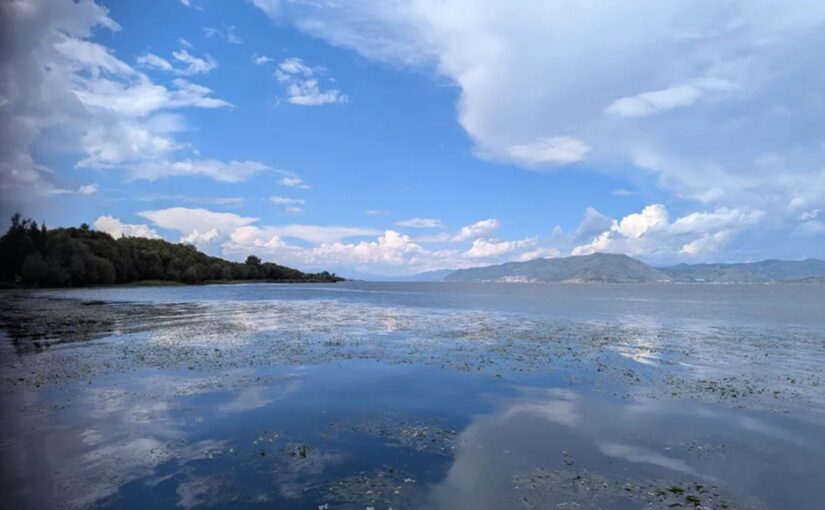
An example of the attempt to meet these challenges is the “ecological corridor” laid around Erhai, a lake 25 by five miles in area, bordered both by the sizeable city of Dali at one end and by farmland. Scientists were increasingly worried by the water quality in what remains an important source of drinking water for the local population, with multiple outbreaks of blue-green algae recorded by 2013.
A clean-up project launched in 2018 has been very successful: the lake has recorded significant biomass increases in aquatic plants, fish and birds, the water is now clean enough to drink, and the lakeshore tree-lined pathways are a pleasant space where we saw families walking, children playing in the water and young couples posing for wedding photos.
The trees were festooned with the webs of thousands of golden orb-weaving spiders, indicating a healthy insect population, while we saw white egrets nesting in others on the lake, pointing to a ready supply of fish and frogs. The lake is still fished by people, but seasonally and under strict regulation.
Professor Wang Xinze of Shanghai Jiaotong University told the Morning Star that the main source of pollution has been identified as agricultural runoff (a severe problem for many of Britain’s rivers).
The 2018 project, launched in line with the new national “ecological civilisation” policy and underlined by a site visit by President Xi, cleared an 80-mile ecological corridor around the lake, laid 20 miles of pipelines to divert farm waste to 20 treatment plants and established 559 hectares of wetland habitat.
The approach involved trial and error (incentivising farmers to relocate further from the lake was not particularly successful, he told us) and consultation with experts from several European countries; “but their advice was not always practical. One proposal was to lower the water level by two metres; but we need the water to drink. A big part of the challenge for China, given its population, is how to conserve and reuse water,” Wang explained.
The entire project — which, given it is just seven years old, has had remarkable results — depended on public co-ordination and control of resources, and it is difficult to imagine England’s privatised water companies delivering such a clean-up. My reference to water in England being privately owned, often by foreign companies, was met with incredulity not just by our Chinese interlocutors but by journalists from other countries in our group.
Environmental protection was a key theme of our visit a couple of days later to the Yangtze Finless Porpoise Research and Learning Centre in Nanjing, too. The world’s only freshwater porpoise was critically endangered by the time the Chinese government included specific measures aimed at saving it in the 13th five-year plan, which ended in 2020; the following year’s 10-year moratorium on fishing in China’s biggest river has also contributed to a modest increase in numbers.
The turnaround in Chinese policy has come too late for some animals: our guide Yiwei spoke sadly of the fate of the huge Chinese paddlefish, one of the world’s biggest freshwater fish, which died out by the early 2000s, and the Yangtze river dolphin or baiji, which is now deemed functionally extinct (some may remain but not a viable breeding population).
But the turnaround has come, and earlier, as we had enjoyed iced teas and coffees looking out over the giant river Shen Zhengrong, the head of our Nanjing hosts Xinhua Daily’s international department, told us she often came to this spot to watch for finless porpoises with her husband.
Our site visits were designed to explain the Chinese concept of “people-centred development” to an international audience and preserving the natural environment is part of that, but most had other focuses.
At Lincang in Yunnan our introduction to the macadamia and walnut industry saw local workers (including 75-year-old Model Worker Bi Jiafu) detail the role of co-operatives in providing villages with agricultural equipment and training, and of the overarching association formed by co-operatives and villages which buys and sells the produce of the individual farms, ensuring price stability and financing a national and international marketing strategy.
In Xiangyun, our visit to the Shen’er floral industrial park showcased one of the policies that enabled China to eliminate absolute poverty over the last decade, the mandated pairing of institutions in wealthy parts of the country with poor areas.
Here, Shanghai’s Jingdong was partnered with the local village to grow flowers on a large scale, raising farmers’ income by renting their land and employing them as well as issuing them shares in the resulting enterprise, which is now thriving.
But both initiatives were environmentally conscious: in Lincang, despite the massive expansion of the nut industry to the point that it produces a third of the macadamia nuts in the world, the local area covered by forest has actually increased.
The Xiangyun flower park used fine-mesh nets to protect the flowers from pests, saying they tried to avoid pesticides as they wanted an organic process. At both sites, the abundance of spiders, something the reader will have noticed I pay attention to, suggested healthy local ecosystems.
A contrast to Rachel Reeves, who decried concern for “bats and newts” as a barrier to solving the housing crisis, or Keir Starmer, who sneered at an environmental impact assessment that had limited the size of a housing development in a report which mentioned, among other issues, rare spiders.
Their mockery of ecological considerations served to push deregulation of the construction industry, something Britain has already had far too much of. China’s experience shows we should aim higher than trading off living standards against nature: it is possible, in a rationalised economy, to improve both.
And that is what has happened in China. I lived in China for three years, from 2007-10, and before last month’s visit I had not been back since then. I loved my time in China, but nobody would have said then it was a clean country: the cities were often filthy and discarded plastic was everywhere — I recall seeing waterways clogged with it, and plastic bags wafting past on the evening breeze being a regular sight.
I had heard, from friends who had visited China more recently, praise for how clean its cities were: and can now vouch for the fact that the ones I visited are cleaner and far better maintained than most British urban spaces.
Kunming, Lincang, Dali and Nanjing were not just clean but beautiful: flower boxes line the roads, trees are everywhere and many arterial roads were flanked with spectacular topiary: hedge elephants in Yunnan, dolphins and finless porpoises in Nanjing. Colourful murals cover walls, street infrastructure and the undersides of bridges.
I was interviewed by various Chinese media organisations while there. One reporter asked me what was different about China after an absence of 15 years. Besides its new cleanliness and urban beauty, I pointed to smoother motorways, far faster trains (we peaked at 216mph), and robots in the hotels.
How different the answer would be if asked about Britain. Almost nobody would say Britain’s environment, living standards or infrastructure have improved over the last 15 years: most would describe deterioration in every important aspect of public life.
It is clear that China is getting things right that Britain is getting wrong. The “ecological civilisation” announced in 2018 is not just rhetoric: and the issues it addresses are relevant to everyone on the planet.
My personal enthusiasm for spiders was noticed by our hosts, since I was periodically missing having fallen behind trying to photograph them. But I was taken aback when they decided to make use of it — informing me one day they had invited an entomologist from Dali University and would like to film us discussing the local ecology for a TV channel.It was great to chat to Professor Li, who mentioned a colleague had published a book about the spiders of Yunnan (like most Chinese provinces, it is a big place — slightly larger than Germany, with a population roughly that of Spain). Later that evening, the phone in my hotel room rang: someone had come from the university with a copy of the book for me, with a personal dedication inside by the author.A small example of the friendliness and generosity we were shown on all sides in China, even in passing encounters.