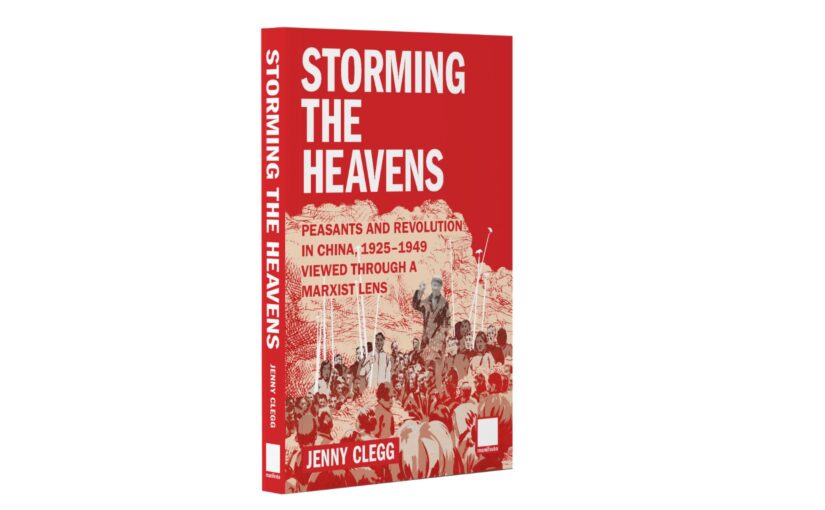
We are pleased to announce the release of a new book by Jenny Clegg.
Storming the Heavens: Peasants and Revolution in China, 1925-1949 – viewed through a Marxist lens brings into focus the central role of peasant mass power in China’s revolutionary transformation. Engaging with debates in peasant studies, on China’s historical transformation, as well as within the Communist movement, it delves into both objective and subjective aspects of the peasant struggle.
In critiquing reformist-orientated perspectives of mainstream Western Sinology, the discussion draws on the neglected works of Chinese Marxists, Chen Hanseng and Chen Boda, to reveal how a system of monopoly rent exacerbated land hunger impacting both poor and middle peasants, making radical land reform the central issue for the revolution. It goes on to explore how the Asiatic features of Chinese feudalism shaped landlord power to complicate peasant organisation at local levels.
Going on to address questions of peasant agency and CPC leadership, traditional rebellion and modern proletarian revolution, the work considers case studies from the field of Chinese peasant studies together with Party documents. Following the zig-zag revolutionary process, it sees how Party and peasant were brought together in a dynamic relationship of mutual learning within a context of change.
Mao’s methods of rural work, Party building and mass organisation are shown as meaningful in meeting the practical challenges of agrarian transformation. Applying a distinctive class analysis, the book shows how the CPC found ways to tackle the resilience of feudal power, handling the contradictions both among the peasants and between the agrarian and national movements to unite the revolutionary forces in reaching towards a socialist future.
About the author
Jenny Clegg is a China specialist. She first visited China in 1971 and has followed its development and international role ever since. She was awarded a PhD by the University of Manchester for her thesis on peasants and revolution in China in 1989, and subsequently became a Senior Lecturer in Afro-Asian Studies and Asia Pacific Studies at universities in the North of England. She continues to research and write about China from a Marxist perspective. She is a member of the Friends of Socialist China advisory panel.
Endorsements
Storming the Heavens is a major accomplishment. It combines detailed historical analysis of China’s agrarian social relations, prior to 1949 and beyond, with a keen sense of theory, integrating Western and Chinese sources, Marxist and non-Marxist alike, into a vibrant picture of struggle and transformation. The CPC’s programs and practices are given detailed, and often admiring, attention, while still being carefully dissected with an eye to errors, misjudgments and shortcomings. The complexities of national vs. agrarian movements, relations between poor and middle peasants, navigation of stages in social and political development, differences in class structure between north and south, and much more — all of this unfolds in a story that is both remarkably specific and deeply universal in its implications. All in all, a fine addition to our knowledge of modern China.
David Laibman, Professor Emeritus, Economics, City University of New York, Editor Emeritus, Science & Society
This monograph is a systematic study by a British Marxist economist of the situation in rural China during the Republican period. It presents an insightful analysis of the new democratic revolution in the countryside of China centred on the agrarian revolution led by Mao Zedong. This book is very important for any Chinese scholar who wishes to learn about the perspectives of research from experts outside China, and is extremely useful in all capitalist countries, especially those in the South, for understanding how to develop the countryside and truly safeguard the interests of the peasants through reforms, as well as for understanding the theories of Marxism-Leninism and its sinicization.
Cheng Enfu, Member of the the Chinese Academy of Social Sciences, President of the World Association for Political Economy
For those who wish to understand the origins of the Chinese revolution, this book is an essential guide to negotiating the complex terrain of the agrarian class structure in pre-revolutionary China; the Marxist and alternative analyses of this structure; and the debates which underlay the eventual formulation by the CPC of the strategy that led to victory over both the Japanese and the Kuomintang. As well as discussion of the theoretical contribution of Mao Zedong to Marxism, as this guided CPC strategy….the book covers a range of debates over an extensive area of discourse.
Utsa Patnaik, Professor Emerita at the Centre for Economic Studies and Planning, Jawaharlal Nehru University, in New Delhi, India.
Jenny Clegg’s Storming the Heavens offers a brilliantly enlightening Marxist understanding of socialist China. Based on years of research it is focused on the dynamic and transforming relationship between the Communist Party of China and China’s diverse peasant communities. Like the studies made by Lenin of Russia’s peasantry, or Connolly’s of Ireland’s, both very different, it enables us to understand the specifically national characteristics of the party’s Marxist practice. It is essential reading for anyone wanting to understand China’s role in the world today.
John Foster, Emeritus Professor of Social Sciences, University of the West of Scotland
Contents
Introduction
Part 1 Landlord monopoly and peasant land hunger – the distinct characteristics of China’s agrarian structure
- Introduction
- Chapter 1: Land Ownership, Rent and the Condition of the Peasantry
- Chapter 2: Landlordism and Commerce
- Chapter 3: Landlord, State and Village – the Articulation of Economic and Political Power in Chinese Feudalism
- Chapter 4: The Impact of Imperialism
Part 2 From stagnation to crisis: economic and political dimensions of agrarian China’s decline
- Introduction
- Chapter 5: Market and Technological Constraints and the Problem of Monopoly Rent
- Chapter 6: Huang and the Involuting Peasant Economy of North China – Between Lenin and Chayanov
- Chapter 7: The Role of the State – for the Common Good or Legitimising Landlord Power?
- Chapter 8: The Tenacity of Chinese Feudalism
- Chapter 9: Peasant Rebellions and Why They Failed
- Chapter 10: The Failure of Reforms
- Chapter 11: The Convoluted Trajectory to Revolution
Part 3 China’s revolutionary experience from United Front to land revolution (1924-1937) and the evolution of Mao’s strategy
- Introduction
- Chapter 12: Peasants and Revolution – from Lenin to Mao
- Chapter 13: China’s First Revolution and the CPC-KMT United Front (1924-1927)
- Chapter 14: From the Towns to the Countryside – Rethinking Revolutionary Strategy
- Chapter 15: The Land Revolution, Soviet Power and the Dynamics of Peasant Class Struggle
- Chapter 16: Mao and the Sinification of Marxism – Class Analysis and the Mass Line
- Chapter 17: From Agrarian to National Revolution
Part 4 China’s revolutionary experience from Second United Front to land revolution (1937-1949) and the implementation of Mao’s strategy
- Introduction
- Chapter 18: The Anti-Japanese War and the United Front (1937–1945) – the Challenges of Party Building
- Chapter 19: Building the New Democratic State
- Chapter 20: The Return to Land Revolution (1946-48) – from Moderate to Radical Land Policies
- Chapter 21: The Return to Land Revolution (1946-48) – Mao’s methods refined
Part 5 Peasants, revolution and the CPC
- Introduction
- Chapter 22: From Traditional Rebellion to Modern Revolution
- Chapter 23: Peasants as Free Trade Familialists – Thaxton’s Contribution
- Chapter 24: What Difference did CPC Leadership Make?
Conclusion