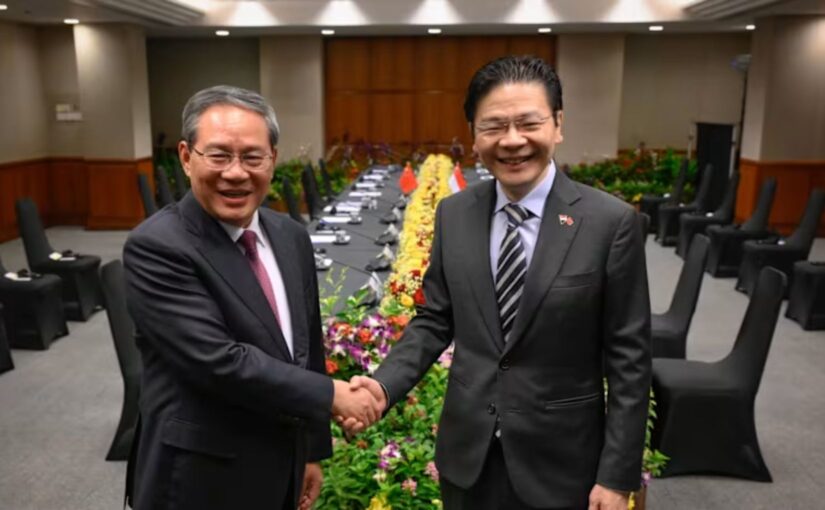
From October 25-26, Chinese Premier Li Qiang paid an official visit to Singapore at the invitation of Prime Minister Lawrence Wong.
Then, from October 27-28, at the invitation of Prime Minister Anwar Ibrahim of Malaysia, the current rotating chair of the Association of South East Asian Nations (ASEAN), he attended the 28th China-ASEAN Summit, the 28th ASEAN Plus Three Summit, the 20th East Asia Summit and the fifth Regional Comprehensive Economic Partnership (RCEP) Leaders’ Meeting in the Malaysian capital Kuala Lumpur.
Prior to the China-ASEAN Summit, Li and Anwar witnessed the signing of the CAFTA [China ASEAN Free Trade Agreement] 3.0 Upgrade Protocol.
Beyond tariff cuts and smoother trade, the upgraded document expands cooperation into nine areas, namely digital economy, green economy, supply chain connectivity, standards and technical regulations with conformity assessment procedures, sanitary and phytosanitary measures, customs procedures and trade facilitation, competition and consumer protection, small and medium-sized enterprises (SMEs), and economic and technical cooperation.
Following the signing of the protocol, both sides will carry out their respective domestic ratification procedures to facilitate the protocol’s early entry into force and implementation.
The original agreement, signed in 2002, was fully implemented in 2010, and upgraded to CAFTA 2.0 in 2015. The newly upgraded CAFTA 3.0 shows China’s and ASEAN’s solemn commitment to multilateralism and free trade, as well as their firm resolve to jointly build an open, inclusive, and rules-based regional integrated market and a resilient regional industrial and supply chain system that delivers mutual benefits, the Chinese Ministry of Commerce said.
The upgrade also gives SMEs wider and smoother access to the grand Chinese and ASEAN markets. “Local SMEs can now connect directly with regional markets through digital platforms – true ‘local creation, regional expansion,'” said Tan Kar Hing, deputy chairman of Malaysia’s Centre of Regional Strategic Studies.
Industries such as food, agricultural products, tourism, logistics, and digital e-commerce will be among the first to benefit from the upgrade, said Suwat Techawatanawana, executive vice president of the leading Thai bank Kasikornbank.
Speaking at the 20th East Asia Summit, Premier Li said: “Twenty years ago, the EAS was inaugurated in Kuala Lumpur. Upon reading the declaration of the first summit, we can easily discern the EAS purpose: strengthening cooperation in the spirit of equality and partnership, observing the UN Charter and other norms of international law, ensuring the effective functioning of multilateral systems, and improving people’s well-being. The constructive role of the EAS on the whole in promoting the steady and rapid development of our region over the past two decades is mainly attributable to the implementation of this founding mission.”
He added: “We should continuously build extensive consensus. Absent common understanding on some very basics, countries would hardly make good progress in their communication, consultations or business exchanges. History tells us that some common values that humanity has fostered over millennia, such as mutual respect, equality, fairness and justice, underpin both people-to-people and state-to-state interactions. To address the global transformation unseen in a century, we need to have a clearheaded and sensible judgment about the trajectory of the future. Among many others, the trend toward economic globalisation and multipolarity is irreversible, and the world must not slip back to the law of the jungle where the strong prey on the weak. Only when we embrace these basic understandings that are consistent with the common values of humanity and the trend of history, can we make the right decision at this critical juncture and move ahead in the right direction.
“Our region is home to a large number of developing countries. Growing the economy and improving people’s lives is a priority for us, and overcoming the impact of protectionism and strengthening internal growth momentum is a pressing issue we face… The more volatile the world becomes, the more imperative it is for us to uphold the authority of international law. We should all observe rules. In particular, we should jointly safeguard the UN-centred international system, support ASEAN centrality in the regional architecture, and promote cooperation in our region. At the same time, we should also actively promote reform and build a more just and equitable global governance system so as to better safeguard the interests of all.
“As a saying goes, when you are clear about the direction to go, you can surely reach your destination, no matter how far away it is. China is ready to work in concert and pursue practical cooperation with all parties to promote peace, development and prosperity both in our region and across the world.”
Speaking at the 28th ASEAN Plus Three [China, Republic of Korea {ROK} and Japan] Summit, Li said:
“I want to thank Prime Minister Anwar and our host Malaysia for the thoughtful arrangements made for this Summit. I also congratulate Timor-Leste for officially joining the ASEAN family.
“Over the past year, ASEAN Plus Three cooperation has kept a sound momentum on the whole, demonstrating the resilience and vibrancy of the East Asian economy. Meanwhile, given the complex changes in international economic and trade structure, especially the disruptions from high tariffs, we have a deep feeling that East Asia is faced with mounting difficulties and challenges in its economy and growing instability and uncertainty in its development.”
He went on to note: “Over the past decades, the commitment to openness and cooperation has enabled us to transcend social system and other differences and realise mutually complementary specialisation and collaboration on the basis of our respective endowments and the law of economics. The commitment to openness and cooperation has enabled us to guard against attempts at turning economic and trade issues into political and security hurdles, manage and resolve differences through communication and dialogue, and minimise disruptions to economic development. The commitment to openness and cooperation has enabled us to steadily increase connectivity, fully unleash the vitality of the regional market, and create and share development opportunities together.
“Looking ahead, the centre of gravity of the world economy is shifting toward Asia, and the epicentre of the Asian economy is in East Asia. The East Asian miracles are not behind us, but ahead of us as an unfolding reality. China stands ready to work with all parties to seek greater synergy of development strategies, uphold openness and cooperation, take more concrete actions, and jointly renew the glory of East Asia’s development.”
He put forward three ideas:
- We should foster an environment conducive to regional development. The peace and stability that East Asia enjoys has not come easily and must be safeguarded with our utmost efforts. We should properly resolve differences through dialogue and negotiation, oppose external interference, and avoid creating tensions or conflicts.
- We should deepen collaboration on industrial and supply chains. Few regions in the world can match East Asia’s comprehensive strengths across the chains, spanning design and R&D, material processing, smart manufacturing, and all the way to market sales. What’s more, each economy is in a unique position within the chains, making our industries highly complementary and our interests neatly aligned. We should better leverage our respective strengths, further promote synergy and cooperation, and steadily improve the level of our specialisation and collaboration, thereby making the flow of production factors more efficient.
- We should jointly cultivate new drivers of development. Seizing opportunities from the latest round of technological revolution and industrial transformation – particularly in fields like AI, robotics, and biomedicine that are seeing an explosive surge of innovations — the 10+3 countries should intensify support for sci-tech innovation and collaborative research.
Addressing the 28th China-ASEAN Summit, the Chinese Premier said that: “This year marks the 80th anniversary of the victory of the World Anti-Fascist War. In September, China held a series of solemn commemorative events, and many ASEAN leaders joined us in Beijing to honour that arduous yet heroic chapter of history. During that war, China and Southeast Asian nations, undeterred by tyranny, rose up in resistance, stood by one another, and fought shoulder to shoulder till we achieved independence and liberation. In the ensuing decades, we continued to stand side by side to promote common development. We inspired one another and pulled together to deliver rapid economic growth… China and ASEAN countries are good neighbours and good brothers, standing close and connected, in kinship and in mutual support. As long as we stay united and independent, we will generate immense strength. No difficulty is too great for us to surmount.”
Saying that, “we must pay attention to the new developments on the international landscape,” he continued: “Unilateralism and protectionism are buffeting the international economic and trade order, external interference in our region is on the rise, and many countries are slapped with unwarranted high tariffs. Development today faces greater risks and challenges. In the face of power politics and economic bullying, we will gain nothing from disunity and confrontation and will only end up divided and conquered by external forces. The more challenging the situation, the more resolute we should be in maintaining unity and self-reliance. We must defend our legitimate rights and interests through mutual support and coordinated action and promote steady and sound economic growth by leveraging our complementary strengths and deepening our cooperation. China is ready to work with ASEAN countries to build greater synergy, remove external disturbances, address risks and challenges together, and create a brighter future for all of us.”
He again put forward three suggestions:
- We should further consolidate strategic mutual trust. China and ASEAN countries share similar values, and equality and harmonious coexistence are our common pursuit. We should strengthen strategic communication and properly handle differences to ensure that trust remains the defining theme of our relations.
- We should promote deeper convergence of interests. We should take the China-ASEAN Free Trade Area 3.0 Upgrade Protocol as an opportunity to accelerate trade and investment liberalisation and facilitation and strengthen industrial integration and interconnection. China will continue to replenish the China-ASEAN cooperation fund to support practical cooperation between the two sides. China is ready to work with ASEAN countries to establish a China-ASEAN digital academy, a platform for AI cooperation, and a centre for maritime development and technological cooperation, and deepen cooperation in transportation, digital economy, green economy, disaster prevention and mitigation, climate change and other areas, with a view to making the pie of mutually beneficial cooperation bigger and better.
- We should forge stronger people-to-people bonds. We should further expand the breadth and depth of people-to-people exchanges. China will work with ASEAN to hold a successful closing ceremony of the China-ASEAN Year of People-to-People Exchanges, and designate 2026 as the China-ASEAN Year on the Fifth Anniversary of the Comprehensive Strategic Partnership.
The following articles were originally published by the Xinhua News Agency.
China, ASEAN sign FTA upgrade to turbocharge high-level collaboration
KUALA LUMPUR, Oct. 28 (Xinhua) — Chinese Premier Li Qiang said here on Tuesday that the newly signed China-ASEAN Free Trade Area (CAFTA) 3.0 upgrade heralds a new opportunity to expand and enhance bilateral economic and trade cooperation.
Li made the remarks at the 28th China-ASEAN Summit held in Kuala Lumpur on Tuesday morning. Before the summit, Li and Malaysian Prime Minister Anwar Ibrahim witnessed the signing of the CAFTA 3.0 Upgrade Protocol.
At the signing ceremony, against the backdrop of the national flags of China and the member states of the Association of Southeast Asian Nations (ASEAN), Chinese Commerce Minister Wang Wentao and Malaysian Minister of Investment, Trade and Industry Tengku Zafrul Abdul Aziz inked their respective documents flanked by Premier Li and Prime Minister Anwar. Then the Malaysian minister presented the document to ASEAN Secretary-General Kao Kim Hourn.
Beyond tariff cuts and smoother trade, the upgraded document expands cooperation into nine areas, namely digital economy, green economy, supply chain connectivity, standards and technical regulations with conformity assessment procedures, sanitary and phytosanitary measures, customs procedures and trade facilitation, competition and consumer protection, small and medium-sized enterprises (SMEs), and economic and technical cooperation.
Following the signing of the protocol, both sides will carry out their respective domestic ratification procedures to facilitate the protocol’s early entry into force and implementation, the Chinese Ministry of Commerce said.
The original agreement, signed in 2002, was fully implemented in 2010, and upgraded to CAFTA 2.0 in 2015. The newly upgraded CAFTA 3.0 shows China’s and ASEAN’s solemn commitment to multilateralism and free trade, as well as their firm resolve to jointly build an open, inclusive, and rules-based regional integrated market and a resilient regional industrial and supply chain system that delivers mutual benefits, the ministry said.
CAFTA 3.0 will inject more confidence and momentum into regional and global economic growth, the ministry noted.
Sun Xiao, secretary-general of the China Chamber of International Commerce, said CAFTA 3.0 is not a simple expansion from the existing framework, but a high-level free trade agreement with an inclusive, modern, comprehensive and mutually beneficial nature.
“It is not just an expansion of economic cooperation, but also a key step towards helping the region to walk away from the reliance on low-end manufacturing and achieve high-quality development,” he said.
The upgrade also gives SMEs wider and smoother access to the grand Chinese and ASEAN markets. “Local SMEs can now connect directly with regional markets through digital platforms — true ‘local creation, regional expansion,'” said Tan Kar Hing, deputy chairman of Malaysia’s Center of Regional Strategic Studies.
Industries such as food, agricultural products, tourism, logistics, and digital e-commerce will be among the first to benefit from the upgrade, said Suwat Techawatanawana, executive vice president of the leading Thai bank Kasikornbank.
“The CAFTA 3.0 will serve as a strong starting point for developing the digital economy, e-commerce, the green economy and sustainability, ultimately fostering connectivity among SMEs across participating countries,” Suwat said.
Yeah Kim Leng, a professor of economics at Malaysia’s Sunway University, called the signing “a timely upgrade not only to shield the region from global economic fragmentation and rising uncertainties, but a natural consequence of advancing inclusive development at the regional level.”
Giving more details about CAFTA 3.0 cooperation, Premier Li announced at the later 28th China-ASEAN Summit that China will inject more capital into the China-ASEAN Cooperation Fund, establish the China-ASEAN Digital Academy, build a cooperation platform on artificial intelligence, and set up a center for maritime development and technology cooperation. He further said that the two sides can also strengthen cooperation in transportation, digital economy, green economy, disaster prevention and mitigation, as well as climate change.
Li said China stands ready to strengthen the alignment of development strategies with ASEAN countries and effectively implement the Plan of Action to Implement the ASEAN-China Comprehensive Strategic Partnership (2026-2030), further cementing the all-round framework of China-ASEAN collaboration.
In his remarks, Li also touched on other issues, including a call for accelerating the consultation on the Code of Conduct in the South China Sea and striving for its early conclusion.
He urged China and ASEAN countries to join forces more strongly, fend off external disruptions, and stand up for their legitimate rights and interests through mutual reliance and coordinated actions amid new changes in the current international landscape.
Full text: Address by Chinese Premier Li Qiang at the 20th East Asia Summit
KUALA LUMPUR, Oct. 27 (Xinhua) — Chinese Premier Li Qiang on Monday delivered a speech at the 20th East Asia Summit.
The following is the full text of the speech:
Address by H.E. Li Qiang
Premier of the State Council of the People’s Republic of China
At the 20th East Asia Summit
Malaysia, October 27, 2025
Honorable Prime Minister Dato’ Seri Anwar Ibrahim,
Colleagues,
It gives me great pleasure to attend the 20th East Asia Summit (EAS) in Kuala Lumpur. I would like to thank Prime Minister Anwar and the Malaysian government for the meticulous arrangements.
Twenty years ago, the EAS was inaugurated in Kuala Lumpur. Upon reading the declaration of the first summit, we can easily discern the EAS purpose: strengthening cooperation in the spirit of equality and partnership, observing the U.N. Charter and other norms of international law, ensuring the effective functioning of multilateral systems, and improving people’s well-being. The constructive role of the EAS on the whole in promoting the steady and rapid development of our region over the past two decades is mainly attributable to the implementation of this founding mission.
At present, the international landscape continues to undergo profound changes. The world is in a new period of turbulence and transformation, with new risks and challenges facing peace and development. Against that background, President Xi Jinping has formally put forward the Global Governance Initiative (GGI) to address changes in the world and tackle pressing problems, highlighting the imperative of adhering to sovereign equality, abiding by international rule of law, practicing multilateralism, advocating the people-centered approach and focusing on taking real actions. This is very relevant in today’s world, and is fully consistent with the EAS founding mission. China will work with all parties to ensure that this mission is observed, and take vigorous actions to promote the GGI to boost peace and development of our region.
We should continuously build extensive consensus. Absent common understanding on some very basics, countries would hardly make good progress in their communication, consultations or business exchanges. History tells us that some common values that humanity has fostered over millennia, such as mutual respect, equality, fairness and justice, underpin both people-to-people and state-to-state interactions. To address the global transformation unseen in a century, we need to have a clearheaded and sensible judgment about the trajectory of the future. Among many others, the trend toward economic globalization and multipolarity is irreversible, and the world must not slip back to the law of the jungle where the strong prey on the weak. Only when we embrace these basic understandings that are consistent with the common values of humanity and the trend of history, can we make the right decision at this critical juncture and move ahead in the right direction.
We should focus on solving prominent issues. In recent years, protectionism of various forms has undermined international economic and trade cooperation and inflicted greater losses on developing countries. Our region is home to a large number of developing countries. Growing the economy and improving people’s lives is a priority for us, and overcoming the impact of protectionism and strengthening internal growth momentum is a pressing issue we face. This means we should more firmly uphold the free trade regime, create a high-standard regional free trade network, and vigorously and effectively advance regional integration. We should also do more together to improve people’s well-being and achieve inclusive development for all.
We should reform and improve the system of norms. The world today faces increasing chaos and turbulence, which has exerted a major impact on our region. An important cause of this is the erosion of the system of international norms. The more volatile the world becomes, the more imperative it is for us to uphold the authority of international law. We should all observe rules. In particular, we should jointly safeguard the U.N.-centered international system, support ASEAN centrality in the regional architecture, and promote cooperation in our region. At the same time, we should also actively promote reform and build a more just and equitable global governance system so as to better safeguard the interests of all.
As a saying goes, when you are clear about the direction to go, you can surely reach your destination, no matter how far away it is. China is ready to work in concert and pursue practical cooperation with all parties to promote peace, development and prosperity both in our region and across the world.
Thank you!
Full text: Remarks by Chinese Premier Li Qiang at the 28th ASEAN Plus Three Summit
KUALA LUMPUR, Oct. 27 (Xinhua) — Chinese Premier Li Qiang on Monday delivered a speech at the 28th ASEAN Plus Three Summit.
The following is the full text of the speech:
Remarks by H.E. Li Qiang
Premier of the State Council of the People’s Republic of China
At the 28th ASEAN Plus Three Summit
Malaysia, October 27, 2025
Honorable Prime Minister Dato’ Seri Anwar Ibrahim,
Colleagues,
It gives me great pleasure to attend today’s meeting. I want to thank Prime Minister Anwar and our host Malaysia for the thoughtful arrangements made for this Summit. I also congratulate Timor-Leste for officially joining the ASEAN family.
Over the past year, ASEAN Plus Three cooperation has kept a sound momentum on the whole, demonstrating the resilience and vibrancy of the East Asian economy. Meanwhile, given the complex changes in international economic and trade structure, especially the disruptions from high tariffs, we have a deep feeling that East Asia is faced with mounting difficulties and challenges in its economy and growing instability and uncertainty in its development.
In many Asian countries, we share a similar saying: The past informs the future. In other words, we can draw wisdom and strength from historical experience to meet the current difficulties. Over the past decades, East Asia has been the world’s fastest growing region. Since the 1950s, East Asian countries have actively explored paths toward modernization. From Japan’s high-speed growth, to the takeoffs of the Four Asian Tigers and the Tiger Cub Economies, and to the rapid development of China since the start of reform and opening up, East Asia has created many economic miracles and witnessed the rise of many modern metropolises, bringing about epoch-making changes to the outlook of our societies. These landmarks in our development still inspire us, and make us proud even today.
Indeed, times are changing, and we East Asian countries have found ourselves in development stages very different from the past. Today we cannot possibly relive our success stories of yesterday, but by reviewing the past, we can find enlightenment and inspiration for the future. As we reflect deeply upon the reasons for East Asian miracles, I believe that one phrase would come to the minds of many: openness and cooperation. Over the past decades, the commitment to openness and cooperation has enabled us to transcend social system and other differences, and realize mutually complementary specialization and collaboration on the basis of our respective endowments and the law of economics. The commitment to openness and cooperation has enabled us to guard against attempts at turning economic and trade issues into political and security hurdles, manage and resolve differences through communication and dialogue, and minimize disruptions to economic development. The commitment to openness and cooperation has enabled us to steadily increase connectivity, fully unleash the vitality of the regional market, and create and share development opportunities together. It is fair to say that openness and cooperation is a valuable experience we gained and refined through hard work. It must be cherished and upheld continually as the distinctive strength and competitive edge of the East Asian economy.
Looking ahead, the center of gravity of the world economy is shifting toward Asia, and the epicenter of the Asian economy is in East Asia. The East Asian miracles are not behind us, but ahead of us as an unfolding reality. China stands ready to work with all parties to seek greater synergy of development strategies, uphold openness and cooperation, take more concrete actions, and jointly renew the glory of East Asia’s development.
Colleagues,
ASEAN and China, Japan and the ROK have close economic ties. This region enjoys a vast market, full-fledged and well-developed industrial systems, abundant funding, advanced technologies, and rich demographic and talent dividends. China supports the theme of “Inclusivity and Sustainability” put forward by Malaysia, and stands ready to work with all parties to continue unleashing economic potential and broadening development space through closer and more efficient openness and cooperation.
First, we should foster an environment conducive to regional development. The international landscape has been changing and fluid, and conflicts and confrontation keep flaring up. This has had severe impacts on global development. The peace and stability that East Asia enjoys has not come easily, and must be safeguarded with our utmost efforts. We should properly resolve differences through dialogue and negotiation, oppose external interference, and avoid creating tensions or conflicts. At the same time, we should jointly uphold free trade and the multilateral trading system, oppose all forms of protectionism, and further advance the process of regional economic integration.
Second, we should deepen collaboration on industrial and supply chains. Few regions in the world can match East Asia’s comprehensive strengths across the chains, spanning design and R&D, material processing, smart manufacturing, and all the way to market sales. What’s more, each economy is in a unique position within the chains, making our industries highly complementary and our interests neatly aligned. We should better leverage our respective strengths, further promote synergy and cooperation, and steadily improve the level of our specialization and collaboration, thereby making the flow of production factors more efficient. China welcomes the adoption of the Statement on Strengthening Regional Economic and Financial Cooperation, and stands ready to carry it out with all parties, and step up practical cooperation in finance, trade, food security and other areas, so as to create more cooperation highlights and growth engines, and foster greater development momentum for our region from within.
Third, we should jointly cultivate new drivers of development. Seizing opportunities from the latest round of technological revolution and industrial transformation — particularly in fields like AI, robotics, and biomedicine that are seeing an explosive surge of innovations — the 10+3 countries should intensify support for sci-tech innovation and collaborative research. We need to enhance our capacity for generating “zero-to-one” breakthroughs and efficiently scaling them into “one-to-N” successes, making innovation a powerful driver of our development. China will continue advancing cooperation with all parties in areas like the digital economy, electric vehicles, and clean energy, joining hands to seize opportunities for development.
With the concerted efforts of the 10+3 countries, I am confident that we will create a brighter future for East Asia and make greater contributions to lasting peace, prosperity and stability of the world.
Thank you.
Full text: Remarks by Chinese Premier Li Qiang at the 28th China-ASEAN Summit
KUALA LUMPUR, Oct. 28 (Xinhua) — Chinese Premier Li Qiang on Tuesday delivered a speech at the 28th China-ASEAN Summit.
The following is the full text of the speech:
Remarks by H.E. Li Qiang
Premier of the State Council
Of the People’s Republic of China
At the 28th China-ASEAN Summit
Malaysia, October 28, 2025
Honorable Prime Minister Dato’ Seri Anwar Ibrahim,
Colleagues,
It is my great pleasure to join you in Kuala Lumpur. I wish to thank Prime Minister Anwar Ibrahim and the Malaysian government for their thoughtful arrangements.
This year marks the 80th anniversary of the victory of the World Anti-Fascist War. In September, China held a series of solemn commemorative events, and many ASEAN leaders joined us in Beijing to honor that arduous yet heroic chapter of history. During that war, China and Southeast Asian nations, undeterred by tyranny, rose up in resistance, stood by one another, and fought shoulder to shoulder till we achieved independence and liberation. In the ensuing decades, we continued to stand side by side to promote common development. We inspired one another and pulled together to deliver rapid economic growth. We supported one another and coalesced amid hardships to overcome major challenges like financial crises, tsunamis, and the COVID-19 pandemic. As President Xi Jinping noted during his visit to Southeast Asia in April, “Unity brings strength, and cooperation leads to mutual success.” China and ASEAN countries are good neighbors and good brothers, standing close and connected, in kinship and in mutual support. As long as we stay united and independent, we will generate immense strength. No difficulty is too great for us to surmount.
Today, we look back with delight on a year of fresh progress in China-ASEAN joint endeavors. Across all areas our cooperation is flourishing. Trade has been growing steadily. The “ASEAN Visa” has brought our peoples even closer. And we have just witnessed the signing of the China-ASEAN Free Trade Area 3.0 Upgrade Protocol, heralding a new opportunity to expand and enhance our economic and trade cooperation. At the same time, we must pay attention to the new developments on the international landscape. Unilateralism and protectionism are buffeting the international economic and trade order, external interference in our region is on the rise, and many countries are slapped with unwarranted high tariffs. Development today faces greater risks and challenges. In the face of power politics and economic bullying, we will gain nothing from disunity and confrontation, and will only end up divided and conquered by external forces. The more challenging the situation, the more resolute we should be in maintaining unity and self-reliance. We must defend our legitimate rights and interests through mutual support and coordinated action, and promote steady and sound economic growth by leveraging our complementary strengths and deepening our cooperation. China is ready to work with ASEAN countries to build greater synergy, remove external disturbances, address risks and challenges together, and create a brighter future for all of us.
Colleagues,
Last May, the ASEAN Summit adopted the ASEAN Community Vision 2045. China stands ready to work with ASEAN countries to strengthen the alignment of development strategies, deliver on the Plan of Action to Implement the ASEAN-China Comprehensive Strategic Partnership (2026-2030), continue advancing the building of an even closer China-ASEAN community with a shared future, and keep writing new chapters of China-ASEAN unity for strength.
First, we should further consolidate strategic mutual trust. China and ASEAN countries share similar values, and equality and harmonious coexistence are our common pursuit. We should strengthen strategic communication and properly handle differences to ensure that trust remains the defining theme of our relations. China will continue to support ASEAN in playing an active role and promoting the peaceful settlement of disputes between Cambodia and Thailand in the ASEAN way. We need to speed up consultations on the COC and strive for its early conclusion to better maintain peace and stability in the South China Sea.
Second, we should promote deeper convergence of interests. We should take the China-ASEAN Free Trade Area 3.0 Upgrade Protocol as an opportunity to accelerate trade and investment liberalization and facilitation, and strengthen industrial integration and interconnection. China will continue to replenish the China-ASEAN cooperation fund to support practical cooperation between the two sides. China is ready to work with ASEAN countries to establish a China-ASEAN digital academy, a platform for AI cooperation, and a center for maritime development and technological cooperation, and deepen cooperation in transportation, digital economy, green economy, disaster prevention and mitigation, climate change and other areas, with a view to making the pie of mutually beneficial cooperation bigger and better.
Third, we should forge stronger people-to-people bonds. We should further expand the breadth and depth of people-to-people exchanges. China will work with ASEAN to hold a successful closing ceremony of the China-ASEAN Year of People-to-People Exchanges, and designate 2026 as the China-ASEAN Year on the Fifth Anniversary of the Comprehensive Strategic Partnership. We will speed up the establishment of meeting mechanisms of tourism and education ministers of China and ASEAN countries, and make good use of the China-ASEAN Network of Academies on Governance and Public Administration and Think Tanks to enhance our mutual understanding and friendship.
Looking forward, China will always be ASEAN’s good friend based on mutual trust and good partner for shared development. Let us reaffirm our commitment to unity for strength, march forward together with faster steps, promote the sustained and steady development of China-ASEAN cooperation, and make greater contributions to peace and development of the region and beyond.
Thank You.