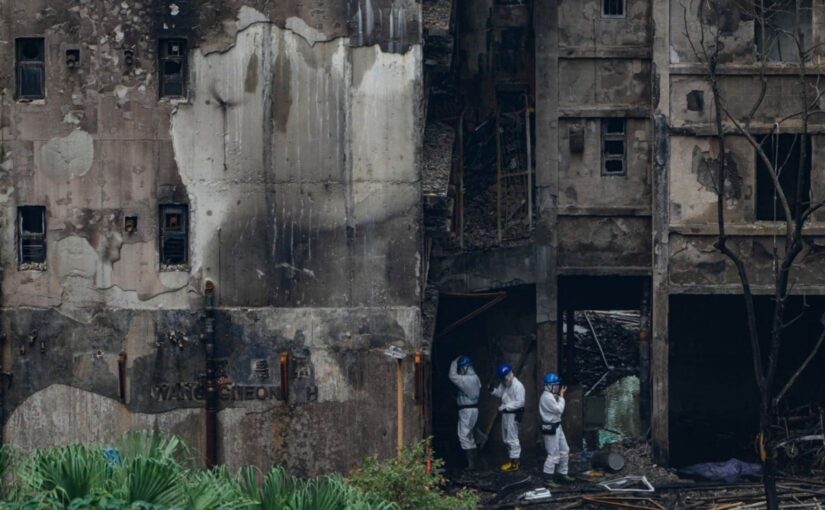
In the following article, which was originally published in the South China Morning Post, and is reprinted with the kind permission of the author, Alex Lo decries the cynical response of sections of the western media and others to the terrible fire in Wang Fuk Court, Tai Po, Hong Kong, which broke out on November 26 and which claimed the lives of 160 people.
Alex writes: “As sure as night follows day, you can always count on the big Western media outlets to politicise anything bad that happens in Hong Kong or on the mainland.”
Reinforcing his point, he goes on to note: “Even as the bodies were still being recovered and identified, these Western ‘experts’ already seemed to know what had happened. Are they so all-knowing or just reprehensibly presumptuous?
“Here are some headlines: ‘Deadly Fire Highlights Hong Kong’s Predicament’ (with the standfirst, ‘The tragedy confirmed to many locals that the city’s freedoms have vanished’), ‘The killer Hong Kong fire shows how freedom is an even greater loss than you’d think’, ‘Deadly Hong Kong fire is a test of Beijing’s rule in the city’.”
To this, Alex responds:
“In handling the aftermath of such a deadly fire, there is always room for improvement, and not every demand can be met immediately.
“But the victims were immediately taken care of, including 294 of their pets rescued from the fire. The living allowance for every affected household has been doubled from HK$50,000 (US$6,410) to HK$100,000.
“HK$2.8 billion in donations have already [some 10 days after the tragedy] been raised from the government and private sources. Temporary housing is being provided. The needs of affected residents are being addressed in the short and medium term. The government has promised a long-term housing settlement, meaning each household is likely to be allocated a flat somewhere in the end.”
In contrast to the pervasive and appalling lack of mental health care provision in the UK health service, on December 5, RTHK (Radio Television Hong Kong) reported that Hong Kong Chief Executive John Lee Ka-chiu called for efforts to step up mental health support for people affected by the deadly blaze, saying the whole of Hong Kong is emanating grief and sadness in the aftermath of the tragedy.
“I have requested for mental health support work to be carried out… to assist victims of the fire as well as others who were affected, including students, teachers and those living nearby,” Lee said as he inspected services offered by a government mental health support hotline and frontline staff at a community centre.
“It is necessary to sort out feelings of being uneasy and anxious. While we commemorate the deceased, we also hope to help those alive to overcome hard times.”
Executive councillor and chairman of the Advisory Committee on Mental Health, Lam Ching-choi, said one way to strengthen support is to match bereaved families with counselling organisations, doctors and clinical psychologists to “accompany them through the toughest times”.
“Members of the public, especially nearby residents… may face post-traumatic stress disorder. We will discuss our response measures and ways to strengthen training and service,” Lam said.
With many drawing comparisons with the Grenfell Tower fire tragedy in West London, of 14 June 2017, Alex writes:
“Can democracy in Western countries offer comparably quick and comprehensive settlement and solutions? People should study how the US has handled its recurrent deadly hurricane crises or how the British government addressed the deadly Grenfell fire in London in 2017.
“Some have compared the Wang Fuk Court fire with the Grenfell blaze, which claimed 72 lives, noting similarities such as both being subsidised housing, substandard material being used, and ignored complaints from residents. However, one American pundit has argued that the difference is that the British government launched a major public inquiry. ‘But unlike Grenfell,’ he wrote, ‘where intense media scrutiny and a major public inquiry followed, such independent investigations are no longer possible in Hong Kong.’
“Oh really? Britain’s then prime minister, Theresa May, announced an official inquiry on June 29 after the fire started on June 14, a time lag of more than two weeks. Hong Kong Chief Executive John Lee Ka-chiu ordered the establishment of an independent review committee, to be chaired by a judge, on Tuesday, within a week of the tragedy.”
And whilst such inquiries in the UK, once they are eventually conceded, are invariably interminably dragged out, Lee insisted that work to uncover the truth should be completed as soon as possible in order for reforms to happen and to plug existing loopholes. For example:
- The Chilcot Inquiry into the 2001 Iraq War was announced in 2009, held hearings until 2011, and issued its report in 2016. No one was held to account.
- A report into police conduct at the time of the Hillsborough Football Stadium disaster of April 15, 1989, which claimed the lives of 97 people, was finally published on December 2, 2025. No one has been legally held to account.
- As yet, despite a lengthy inquiry, no one has been prosecuted for the Post Office scandal that, between 1999-2015, saw more than 900 sub-postmasters wrongfully convicted of theft, fraud and false accounting and led to at least thirteen suicides.
- From the 1970s to the early 1990s, tens of thousands of NHS patients were infected with hepatitis B, hepatitis C and HIV as a result of receiving contaminated blood or blood products. A public inquiry was finally announced in July 2017. It reported in May 2024. To date there have been no prosecutions.
In stark contrast to this sorry litany, less than 24 hours after the Tai Po blaze broke out, Hong Kong police arrested and detained three men in charge of a construction company on charges of manslaughter.
The next day, Hong Kong’s Independent Commission Against Corruption (ICAC) arrested eight people. RTHK reported:
“The ICAC earlier opened an investigation into the fire at the Tai Po residential complex, which was under a large-scale renovation.
“It said the group of seven men and one woman arrested were aged between 40 and 63 and included ‘four individuals from the consulting firm of the grand renovation project of Wang Fuk Court, namely two directors and two project managers responsible for supervising the project’.
“The others arrested included three scaffolding subcontractors and a middleman. ICAC investigators also seized work documents and bank records from 13 premises.”
In contrast to Hong Kong, where company bosses were arrested on manslaughter charges the next day, in the case of Grenfell, just like the examples cited above, eight-and-a-half years later, not a single person has been brought to justice.
At the time of the public inquiry, more than three years ago, local community campaign group, Grenfell United, led by survivors and bereaved families, wrote:
“For nearly five years, we’ve remained dignified. We’ve campaigned for justice for our 72 who no longer have a voice. We’ve campaigned to ensure another Grenfell never happens again… We’ve waited too long. The Grenfell Public Inquiry has uncovered millions of documents, the evidence is staring us in the face, yet no action. There cannot be a two-tiered justice system. We need to see criminal charges for those responsible.”
Their case is also poignantly set out in this brief video.
As sure as night follows day, you can always count on the big Western media outlets to politicise anything bad that happens in Hong Kong or on the mainland. So with the horrific Tai Po fire, you can be sure those platforms will go to town with that approach.
The real cause of the fatal fire? Well, of course, it’s all about democracy and freedom, or rather the lack of their Western versions in China.
The same old “democracy” explains everything, which turns every ignorant foreign commentator into an expert. If you are disgusted by their sheer moral indecency, you are probably not alone.
Even as the bodies were still being recovered and identified, these Western “experts” already seemed to know what had happened. Are they so all-knowing or just reprehensibly presumptuous?
Here are some headlines: “Deadly Fire Highlights Hong Kong’s Predicament” (with the standfirst, “The tragedy confirmed to many locals that the city’s freedoms have vanished”), “The killer Hong Kong fire shows how freedom is an even greater loss than you’d think”, “Deadly Hong Kong fire is a test of Beijing’s rule in the city”.
In handling the aftermath of such a deadly fire, there is always room for improvement, and not every demand can be met immediately.
But the victims were immediately taken care of, including 294 of their pets rescued from the fire. The living allowance for every affected household has been doubled from HK$50,000 (US$6,410) to HK$100,000.
HK$2.8 billion in donations have already been raised from the government and private sources. Temporary housing is being provided. The needs of affected residents are being addressed in the short and medium term. The government has promised a long-term housing settlement, meaning each household is likely to be allocated a flat somewhere in the end.
Can democracy in Western countries offer comparably quick and comprehensive settlement and solutions? People should study how the US has handled its recurrent deadly hurricane crises or how the British government addressed the deadly Grenfell fire in London in 2017.
Some have compared the Wang Fuk Court fire with the Grenfell blaze, which claimed 72 lives, noting similarities such as both being subsidised housing, substandard material being used, and ignored complaints from residents. However, one American pundit has argued that the difference is that the British government launched a major public inquiry. “But unlike Grenfell,” he wrote, “where intense media scrutiny and a major public inquiry followed, such independent investigations are no longer possible in Hong Kong.”
Oh really? Britain’s then prime minister, Theresa May, announced an official inquiry on June 29 after the fire started on June 14, a time lag of more than two weeks. Hong Kong Chief Executive John Lee Ka-chiu ordered the establishment of an independent review committee, to be chaired by a judge, on Tuesday, within a week of the tragedy.
Yes, there have been crowd control measures, and the monitoring and arrests of people suspected of committing fraud or of hate-mongering by spreading malicious rumours and conspiracy theories.
Don’t they do that in Western democracies? People have been arrested and jailed in Britain and the United States for much less.
While covering the aftermath in Tai Po, a colleague witnessed some so-called volunteers handing out masks to mourners while falsely claiming that cyanide and other poisonous substances were being emitted from the charred buildings. Many people went on to put on masks.
Rumours and scams are on the rise. That’s to be expected when there is so much money involved. Malicious individuals have been seen carrying cards warning people from the mainland to stay away and not to try to steal donations for the victims.
That the police have made arrests or detained some for questioning has been immediately seized on by some foreign media outlets as evidence of a government cover-up.
The local press has been much more responsible and circumspect. This again has been interpreted in some quarters as a sign of political censorship.
After the Grenfell tragedy, rumours swirled. The BBC and other responsible news outlets took pains to verify their reports, checking with the government and other official sources. That’s just journalistic professionalism, which aims to report the facts. Sadly, many Western news media platforms seem incapable of not politicising any bad news coming out of China.
Hong Kong is far from perfect. As the city responds to this terrible tragedy, more mistakes may be made along the way. But we are more than capable of taking care of our own without being badmouthed by ill-wishers.