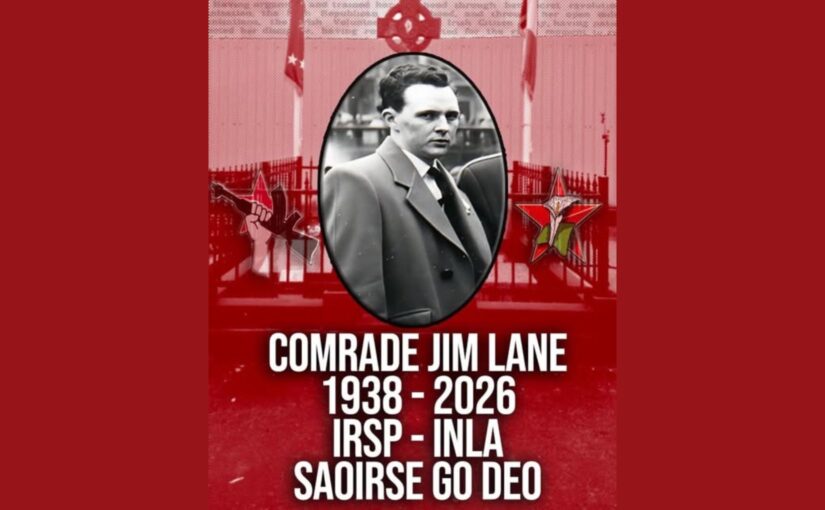
The struggle for national liberation and socialism in Ireland lost one of its great figures on February 16, 2026, with the passing of James Anthony Lane, universally known as Jim Lane, at the age of 88.
Born in Cork in 1938, Jim joined the Irish Republican Army (IRA), Sinn Féin and the Cork Volunteers’ Pipe Band in 1954. A key area of his early political work was in the city’s unemployed workers movement. He was an active participant in Operation Harvest, the 1956-62 IRA ‘border campaign’, being one of the first volunteers to be sent north to participate in the armed struggle.
Following the end of the border campaign, Jim was one of those who became disillusioned with the political evolution of the republican movement in that period. He became a leading figure in the Irish Revolutionary Forces and subsequently in Saor Éire. He was also instrumental in establishing the Cork Vietnamese Freedom Association in the 1960s, which became known in particular for demonstrating against the presence of a US warship in Cork Harbour, in defiance of Ireland’s supposed neutrality.
Jim was both an uncompromising Irish republican as well as an uncompromising Marxist. In the most bitter and difficult days of McCarthyite anti-communism and clerical reaction, he openly espoused his communist views and actively distributed the Marxist classics, the portraits of Marx, Engels, Lenin, Stalin and Mao Zedong, and literature from socialist countries.
When the major split occurred in the international communist movement, Jim sided with the Communist Party of China and was a leading participant in attempts to form a Marxist-Leninist party in Ireland. When a key section of the anti-revisionist movement in Ireland adopted the anti-communist, pro-imperialist ‘two nations theory’, claiming that protestants in the north of Ireland constituted a separate nation distinct from the Irish people as a whole, Jim helped form the Cork Communist Organisation, which subsequently became the Cork Workers’ Club. The club’s Historic Reprints series played a key role in rediscovering and popularising some of the most important works of James Connolly, Jim Larkin and other Irish republican socialist classics. Their bookshop also distributed literature from socialist China and Albania.
With the revival of the armed liberation struggle in Ireland’s six occupied counties in the north east, when Derry’s Bogside came under siege, in what became known as the Battle of the Bogside, in 1969, Jim and his comrades brought arms and assistance, to the beleaguered nationalist community, working closely with the IRA, organisational and political differences notwithstanding.
Jim played a leading role in the H-Block Committees, both in Cork and nationally during the 1980-81 hunger strikes. He joined the Irish Republican Socialist Party (IRSP), which had been founded by Seamus Costello (1939-1977), who had also been an ardent supporter of the Chinese revolution since the 1950s.
Jim was elected National Chairperson of the IRSP in 1983 and at its conference the following year, the party “adopted the teachings of Marx, Engels and Lenin as providing the basis for its socialist principles.”
Jim wrote at the time:
“In our deliberations we were greatly influenced by James Connolly’s advice to, ‘emulate our fathers and like the true men of [17] ’98, place ourselves in line with the most advanced thought of our age, drawing inspiration and hope from the spectacle presented by the worldwide revolt of the workers.’ In his time, James Connolly, credited Karl Marx as representing such advanced thought, when he said of him that he was, ‘the ablest exponent of socialism the world has seen, and the founder of that school of thought which embraces all the militant socialist parties of the world.’ Like Connolly, the IRSP accepts the valued contribution to revolutionary thought made by Marx and Engels, the great architects of scientific socialism. But in placing ourselves ‘in line with the most advanced thought of our age’, the age of imperialism; the highest stage of capitalism, we were inexorably led beyond Marx and Engels, to Lenin. Leninism we consider to be Marxism in the era of imperialism and proletarian revolution. His contribution was so vast that it comprised an entire phase of the development of socialist ideas. His analysis of imperialism; his work on national liberation and democratic movements opposed to imperialism; his development of the Marxist theory of proletarian dictatorship; and not least his creation of the new type revolutionary party, enriched Marxism.
“In embracing the teachings of Marx, Engels and Lenin, we are placing ourselves in line with the most advanced thought of our age and as a consequence are in line with the revolutionary tradition passed on by James Connolly.”
The previous year, following his election as Chairperson, Jim was asked in an interview how he would like to see the IRSP develop over the coming year and replied:
“I would like to see greater emphasis on political education within the party. We must research, study and discuss, so as to further develop the necessary revolutionary theory which is required to bring to fruition national liberation and socialism in Ireland. Without revolutionary theory, all our efforts will be in vain. Most of our members have come to a commitment to revolutionary activity out of their experience, be it the naked oppression of British imperialist forces, or the violence of unemployment and bad conditions – North and South. We have never lacked for battlers against oppression. But we would do well to take heed of James Connolly’s observation, ‘The Irish are not philosophers as a rule, they proceed too rapidly from thought to action.’ It is not sufficient to fight courageously for a cause, it is also necessary to have clarity about the objective for which we strive, otherwise the fruits of our struggle could slip to counter revolutionaries. If we fight for socialism today, we don’t want sell-out tomorrow. Yet it could easily happen. Personally, I believe that only a party based on Marxist-Leninist principles can achieve socialism in Ireland.”
He was then asked: “What do you say to those who say that all nationalism is reactionary in today’s world,” and replied:
“I believe the nationalism of the oppressed people of British Occupied Ireland is positively progressive because it unites them in struggle against the main enemy – British imperialism. There are occasions of course when nationalism is reactionary. Nationalism fostered by imperialist powers like Britain and the USA is definitely reactionary, because it obscures the class struggle and unites people in the service of imperialism. There is no black and white situation. To say that all nationalism is reactionary is as stupid as to say that all nationalism is progressive. I believe that all that helps the British imperialists and harms the oppressed people is reactionary and all that helps the people and harms the British imperialists is progressive.”
Here Jim closely follows the proposition advanced by Mao Zedong in The Role of the Chinese Communist Party in the National War:
“Can a Communist, who is an internationalist, at the same time be a patriot? We hold that he not only can be but also must be. The specific content of patriotism is determined by historical conditions. There is the ‘patriotism’ of the Japanese aggressors and of Hitler, and there is our patriotism. Communists must resolutely oppose the ‘patriotism’ of the Japanese aggressors and of Hitler. The Communists of Japan and Germany are defeatists with regard to the wars being waged by their countries. To bring about the defeat of the Japanese aggressors and of Hitler by every possible means is in the interests of the Japanese and the German people, and the more complete the defeat the better…. For the wars launched by the Japanese aggressors and Hitler are harming the people at home as well as the people of the world. China’s case, however, is different, because she is the victim of aggression. Chinese Communists must therefore combine patriotism with internationalism. We are at once internationalists and patriots, and our slogan is, ‘Fight to defend the motherland against the aggressors.’ For us defeatism is a crime and to strive for victory in the War of Resistance is an inescapable duty. For only by fighting in defence of the motherland can we defeat the aggressors and achieve national liberation. And only by achieving national liberation will it be possible for the proletariat and other working people to achieve their own emancipation. The victory of China and the defeat of the invading imperialists will help the people of other countries. Thus, in wars of national liberation patriotism is applied internationalism.”
Jim’s funeral was held in Cork on February 20. In the eulogy delivered at his graveside on behalf of the IRSP, it was stated that:
“Jim was a giant and a legend in the struggle for national liberation and socialism since the 1950s and it is an honour to be delivering this oration for such a hero and that is what Jim was to this generation of republican socialists. He had a remarkable political journey, never ever wavering from his core belief in republican socialism…
“Jim’s republican pedigree is well documented and has been well remembered here and in recent days. His active republican life has been talked of constantly since the sad news of his passing has hit the republican socialist movement and the wider republican family in general.
“Jim was a man we can all be proud of. Every Irish republican, socialist, and communist, we can all look to Jim and his legacy of struggle, and honour a life fully lived of revolutionary conviction.
“He stands as a giant of the Fenian tradition, having served the IRA throughout its twilight years, and then stepping up as more than willing and able to fight Ireland’s fight when things got hot and dangerous too. Jim was not found wanting during the years of the border campaign, and neither was he absent during the fiery rebirth of republican militarism in the period after 1969.
“Furthermore, something sets Jim apart for those of us who look at our history with a keen and honest eye, in trying to understand what the material driving force of Irish history has been… This is where Jim steps into his own.
“Jim gave leadership in his home city of Cork, helping to found groups such as the Irish Revolutionary Forces, in pushing the republican movement towards advanced positions of socialist thought… Jim believed that only a party based on Marxist-Leninist principles could achieve socialism in Ireland.
“Jim was a strong believer that with the correct political education within the party, with study and discussions, that we could develop the necessary revolutionary theory required to bring to fruition national liberation and socialism in Ireland.
“He armed the working-class people in the occupied six counties with the ideological tools to free ourselves from British imperialism and capitalist exploitation.
“He fully recognised that the fight for the emancipation of the Irish working class was one and the same as that struggle for Irish national freedom.
“This is something keenly present in the phrase ‘National Liberation’, a term that Jim knew aligned with working class anti-imperialist movements all over the world throughout the twentieth century.
“It’s this radical, pointed and ultimately accurate view, shared with his contemporaries in the early days of the IRSM [Irish Republican Socialist Movement], that there is no freedom, no national sovereignty, nor no genuine anti-imperialist movement that doesn’t aim for that total freedom which is encompassed by the term ‘National Liberation’.
“It’s the liberation of the masses, free of the yoke of capitalist domination and imperialism that he fought for. He fought for it in Cork… and he fought for it on the streets of Derry and Belfast.
“As we seek to fight on now, today, as we stand with our ever battered and exploited communities, we will remember Jim Lane.
“Exactly as Jim fought before us, we’ll fight as well. If we can amount to a mere fraction of the honour and integrity with which Jim served as a working-class warrior, our revolutionary struggle will go on. Standing firmly with the working class and the communities that Jim himself so fiercely defended.
“Friends and comrades, as we leave Jim’s final resting place as I mentioned before we leave a giant of the struggle for national liberation and socialism. We salute you Jim Lane and you will always have a special place in our hearts.
“Rest in power comrade; let the fight go on.”
A statement from Anti Imperialist Action Ireland said:
“Anti Imperialist Action Ireland, and the wider Revolutionary Irish Socialist Republican Movement extends our deepest revolutionary solidarity and sympathies to the family, friends and comrades of the Irish Socialist Republican, Veteran of the Border Campaign 1956-1962, and IRA and INLA [Irish National Liberation Army] Volunteer Jim Lane, from Cork’s North Inner City…
“Jim trained for participation in the IRA’s Operation Harvest and was part of one of the first detachments of Volunteers to cross the border to recommence the war against the British occupation of Ireland in December 1956.
“Deeply opposed to the running down of the revolutionary struggle after the Border Campaign, Jim and comrades in Cork formed the Irish Revolutionary Forces, an explicitly socialist republican organisation and promoted the continuation of the revolutionary armed struggle for national liberation and socialism.
“A committed Marxist-Leninist, through the 1960s, Jim was increasingly inspired by the teachings of Chairman Mao, which he viewed as the advanced stage of scientific socialism, and the Maoist people’s wars across South Asia, which he saw as providing lessons relevant to the prosecution of a successful revolution in Ireland. He was a founding member of the Cork-Vietnam Freedom Association which actively opposed the presence of US and NATO War Ships in Cork Harbour.
“In 1968, Jim and the IRF founded Saor Éire (Cork) as a new vehicle to promote revolutionary Irish socialist republicanism and the national liberation struggle. In 1969, with the outbreak of the current phase of the war against the British occupation, Jim and members of the IRF/Saor Éire were once again on active service in the occupied six counties, aiding in the defence of nationalist and republican communities, notably during the Battle of the Bogside and working closely with fellow Cork man, Daithí Ó Conaill and the reorganised Irish Republican Army.
“Jim played a national role in supporting the IRA and INLA POWs in the late 1970s and throughout the 1980 and 1981 hunger strikes, acting as the Chairperson of the Cork Branch of the National H-Block/Armagh Committees…
“It was during this period that Jim joined the IRSM, and by 1983 was elected as Chairperson of the IRSP, also serving on the Army Council of the INLA at a time when it was playing a leading role in the war against the British occupation and championing political education within the movement. Jim played a key role in the IRSP formally adopting Marxism-Leninism at its 1984 Ard Fheis.”
In his later years, “Jim remained an uncompromising Irish Socialist Republican who believed in the necessity of revolutionary struggle and though no longer politically aligned, he remained active in community campaigns including the mass anti water tax campaign, pro-Palestinian solidarity and also the commemorations of the 100th anniversary of the 1916 Rising in 2016. Jim was also a regular attendee at Republican commemorations and particularly at the funerals of his comrades, and fellow veterans of the Border Campaign.
“With the passing of Volunteer Jim Lane, we have lost a giant of our struggle for national liberation and socialism in Ireland and a fountain of knowledge and understanding of Ireland’s revolutionary republican struggle. Today’s generation of revolutionary socialist republicans are enriched by the conversations and advice from time spent with Jim, and the next generation of revolutionaries would do well to study his large volume of revolutionary writings dating back to the 1950s.”