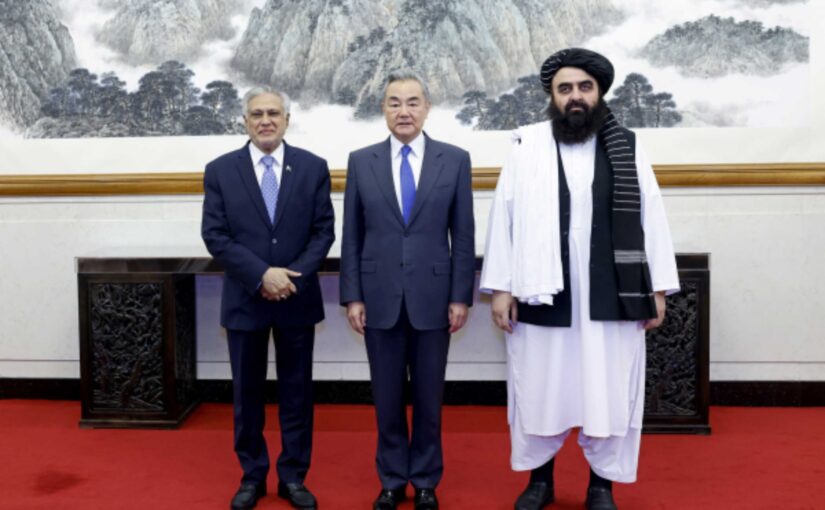
A considerable period of rising tension between Pakistan and Afghanistan erupted into open and ongoing conflict on February 21. As a friendly neighbour to both countries China is actively working for the restoration of peace.
Accordingly, on March 10, Chinese Foreign Minister Wang Yi held a phone conversation with Pakistani Deputy Prime Minister and Foreign Minister Mohammad Ishaq Dar at the latter’s request.
Given the overall situation, primary emphasis was given to the US-Israeli war of aggression against Iran, launched on February 28.
Wang Yi said that as all-weather strategic cooperative partners, China and Pakistan share a fine tradition of communication and coordination on major international and regional issues. Both countries have promptly expressed their firm stance on the situation in Iran, demonstrating a responsible attitude and commitment to the purposes and principles of the UN Charter. The outbreak of this war lacks justification and legitimacy, and its continuation will only result in more unnecessary casualties. The key to preventing further escalation lies in the United States and Israel ceasing military operations.
The Chinese side appreciates Pakistan’s mediation efforts to de-escalate regional tensions and stands ready to maintain multilateral and bilateral coordination and cooperation with Pakistan, support Pakistan in continuing to play a constructive role, and jointly work toward the early restoration of peace and stability in the region.
Turning to the situation in Afghanistan, Wang Yi said that the special envoy on Afghan Affairs of the Ministry of Foreign Affairs of China is currently shuttling between Afghanistan and Pakistan to promote peace talks. The pressing priority is to prevent the escalation of the conflict and return to the negotiating table at an early date. The Chinese side firmly supports Pakistan in its counterterrorism efforts and hopes that Pakistan will continue to make the utmost efforts to ensure the safety of Chinese personnel, projects, and institutions in Pakistan.
This was followed by Wang Yi’s call with Afghan Foreign Minister Mawlawi Amir Khan Muttaqi on March 13, again at the latter’s request.
This conversation foregrounded the conflict between Kabul and Islamabad and Mawlawi Amir Khan Muttaqi appreciated China’s active efforts to mediate in the border conflict between Afghanistan and Pakistan, stating that the Afghan people, having suffered greatly from war, cherish the opportunities for peace and development. Afghanistan aspires to be a source of regional peace rather than instability. The Afghan side reiterates that its territory will not be used to attack neighbouring countries, expresses no desire for military confrontation with other nations, and looks forward to mutual trust and friendly coexistence among neighbors. The Afghan side believes that dialogue and consultation are the only way to resolve issues and expects China, as a major country and friendly neighbour, to play an even greater role.
Wang Yi stated that the more turbulent the external environment becomes, the more regional countries should strengthen unity and cooperation to overcome difficulties together, forging a path of cooperative and common security. Afghanistan and Pakistan are inseparable brothers and neighbours that cannot be moved away from each other. Any issues between the two countries can only be resolved through dialogue and consultation. The use of force will only complicate the situation, exacerbate contradictions, benefit neither side, and threaten regional peace and stability. China has always maintained an objective and fair stance on the Afghanistan-Pakistan conflict, and the special envoy on Afghan Affairs of the Ministry of Foreign Affairs of China is currently shuttling between Afghanistan and Pakistan to mediate, urging both sides to remain calm and exercise restraint, engage in face-to-face exchanges as soon as possible, achieve a ceasefire at the earliest opportunity, and resolve contradictions and differences through dialogue.
The two sides also had an exchange of views on the Iran situation. Wang Yi reiterated China’s principled position, stating that China stands ready to work with the international community, including Afghanistan, to continue playing a constructive role in striving for peace.
Meanwhile, on March 16, the United Nations Security Council unanimously adopted a resolution extending the mandate of the United Nations Assistance Mission in Afghanistan (UNAMA) for three months.
In an explanation of his country’s vote following the resolution’s adoption, Chinese Ambassador to the UN Fu Cong set out China’s comprehensive and principled position on the issue of Afghanistan emphasisng the following points:
- The Resolution reaffirms firm support for UNAMA’s work, emphasises the critical importance of UNAMA and other UN agencies continuing to carry out their mandates in Afghanistan, and calls for ensuring the safety, security, and freedom of movement of the United Nations and its personnel throughout Afghanistan. We call on the Afghan Government to lift the ban on Afghan female staff entering UN premises as soon as possible and to provide the necessary facilitation for UN agencies to carry out their mandates in Afghanistan.
- The Resolution reiterates deep concerns over the economic and humanitarian situation in Afghanistan, emphasising the need to strengthen humanitarian assistance and support Afghanistan’s development needs. We call on traditional donors, particularly those countries that bear historical responsibility toward Afghanistan, to resume and increase their aid to Afghanistan as soon as possible. The Resolution specifically notes the need to help Afghanistan restore its banking and financial systems and ensure that the assets of Afghanistan’s Central Bank are used for the benefit of the Afghan people. We call on relevant countries to unfreeze and return the assets of Afghanistan’s Central Bank, and we hope that UNAMA will play a greater role in this regard.
- The Resolution expresses serious concerns over the increasing erosion of the fundamental rights of women and girls in Afghanistan and calls for the reversal of relevant restrictive policies to ensure that women enjoy equal rights in education, healthcare, employment, public life, and other areas. We hope that the Afghan government will act in the fundamental interests of its people and enable Afghan women and girls to truly become beneficiaries, builders, and contributors to the country’s development and revitalisation.
- The Resolution emphasises that terrorist organisations operating in Afghanistan remain a threat to international peace and security, and that Afghan territory must not be used to shelter or support any form of terrorist activities. We urge the Afghan government to take more resolute and forceful measures in accordance with Council resolutions to combat all terrorist forces.
- The Resolution also expresses serious concerns over the continued civilian casualties caused by explosive ordnance in Afghanistan and calls on the international community to provide greater support for the Mine Action Programme in Afghanistan.
The Pakistan-Afghanistan conflict further deteriorated on March 16, with Afghanistan accusing Pakistan of killing 400 people in an air strike on an addiction treatment hospital in Kabul.
At the Chinese Foreign Ministry’s March 17 Beijing press conference, spokesperson Lin Jian said that China hopes that both Afghanistan and Pakistan will remain calm and exercise restraint, engage in face-to-face talks at the earliest date, and achieve a ceasefire as soon as possible.
Asked by the AFP news agency for China’s comment and whether China is still playing a mediating role between the two countries, Lin replied:
“Afghanistan and Pakistan are and will always be each other’s neighbour. Issues between the two countries can only be resolved through dialogue and negotiation. China hopes that both sides will remain calm and exercise restraint, engage face to face as soon as possible, achieve a ceasefire at the earliest opportunity, and resolve differences and disputes through dialogue. China has urged the two countries to ensure the safety and security of Chinese personnel, projects and institutions there, and will continue to play a constructive role in easing tensions and facilitating the improvement of relations between the two sides via its own channels.”
The following articles were originally published on the websites of the Chinese Foreign Ministry and China’s Permanent Mission to the UN.
Wang Yi Has a Phone Call with Pakistani Deputy Prime Minister and Foreign Minister Mohammad Ishaq Dar
March 12 (MFA) – On March 10, 2026, Member of the Political Bureau of the CPC Central Committee and Foreign Minister Wang Yi had a phone call with Pakistani Deputy Prime Minister and Foreign Minister Mohammad Ishaq Dar at the latter’s request.
Mohammad Ishaq Dar briefed Wang Yi on Pakistan’s position regarding the situation in Iran, urging all parties to exercise restraint and resolve the current crisis through peaceful negotiations. Pakistan appreciates China’s efforts to de-escalate the situation and stands ready to enhance coordination and cooperation with China on platforms such as the United Nations to jointly explore effective ways to achieve peace.
Wang Yi said that as all-weather strategic cooperative partners, China and Pakistan share a fine tradition of communication and coordination on major international and regional issues. Both countries have promptly expressed their firm stance on the situation in Iran, demonstrating a responsible attitude and commitment to the purposes and principles of the UN Charter. The outbreak of this war lacks justification and legitimacy, and its continuation will only result in more unnecessary casualties. The key to preventing further escalation lies in the United States and Israel ceasing military operations. At the same time, China does not approve of attacks on Gulf countries and condemns all attacks on civil facilities and innocent civilians. The Chinese side appreciates Pakistan’s mediation efforts to de-escalate regional tensions and stands ready to maintain multilateral and bilateral coordination and cooperation with Pakistan, support Pakistan in continuing to play a constructive role, and jointly work toward the early restoration of peace and stability in the region.
The two sides also exchanged views on the border conflict between Pakistan and Afghanistan. Wang Yi said that the special envoy on Afghan Affairs of the Ministry of Foreign Affairs of China is currently shuttling between Afghanistan and Pakistan to promote peace talks. The pressing priority is to prevent the escalation of the conflict and return to the negotiating table at an early date. The Chinese side firmly supports Pakistan in its counterterrorism efforts and hopes that Pakistan will continue to make the utmost efforts to ensure the safety of Chinese personnel, projects, and institutions in Pakistan. Mohammad Ishaq Dar expressed appreciation for China’s mediation efforts and stressed that Pakistan attaches great importance to and will make every effort to ensure the safety of Chinese institutions and personnel.
Wang Yi Has a Phone Call with Afghan Foreign Minister Mawlawi Amir Khan Muttaqi
March 13 (MFA) – On March 13, 2026, Member of the Political Bureau of the CPC Central Committee and Foreign Minister Wang Yi had a phone call with Afghan Foreign Minister Mawlawi Amir Khan Muttaqi at the latter’s request.
Mawlawi Amir Khan Muttaqi appreciated China’s active efforts to mediate in the border conflict between Afghanistan and Pakistan, stating that the Afghan people, having suffered greatly from war, cherish the opportunities for peace and development. Afghanistan aspires to be a source of regional peace rather than instability. The Afghan side reiterates that its territory will not be used to attack neighboring countries, expresses no desire for military confrontation with other nations, and looks forward to mutual trust and friendly coexistence among neighbors. The Afghan side believes that dialogue and consultation are the only way to resolve issues and expects China, as a major country and friendly neighbor, to play an even greater role.
Wang Yi stated that the more turbulent the external environment becomes, the more regional countries should strengthen unity and cooperation to overcome difficulties together, forging a path of cooperative and common security. Afghanistan and Pakistan are inseparable brothers and neighbors that cannot be moved away from each other. Any issues between the two countries can only be resolved through dialogue and consultation. The use of force will only complicate the situation, exacerbate contradictions, benefit neither side, and threaten regional peace and stability. China has always maintained an objective and fair stance on the Afghanistan-Pakistan conflict, and the special envoy on Afghan Affairs of the Ministry of Foreign Affairs of China is currently shuttling between Afghanistan and Pakistan to mediate, urging both sides to remain calm and exercise restraint, engage in face-to-face exchanges as soon as possible, achieve a ceasefire at the earliest opportunity, and resolve contradictions and differences through dialogue. China stands ready to continue making active efforts to facilitate reconciliation and ease tensions between Afghanistan and Pakistan.
The two sides also had an exchange of views on the Iran situation. Wang Yi reiterated China’s principled position, stating that China stands ready to work with the international community, including Afghanistan, to continue playing a constructive role in striving for peace.
Explanation of Vote by Ambassador Fu Cong on the UN Security Council Draft Resolution Extending the Mandate of UNAMA
March 16 (MFA) – President,
The Security Council has just unanimously adopted the resolution extending the mandate of UNAMA for three months. As the penholder of the Resolution, China thanks Council members for their support and cooperation.
At present, Afghanistan faces multiple challenges. It is imperative that the Afghan Government and the international community maintain communication, work in the same direction, gradually address each other’s legitimate concerns, and help Afghanistan achieve lasting stability, development, and prosperity. UNAMA plays an indispensable role in this regard. China commends the efforts made by UNAMA and supports it in better fulfilling its mandate. In light of the Resolution, I would like to highlight the following points.
First, the Resolution reaffirms firm support for UNAMA’s work, emphasizes the critical importance of UNAMA and other UN agencies continuing to carry out their mandates in Afghanistan, and calls for ensuring the safety, security, and freedom of movement of the United Nations and its personnel throughout Afghanistan. We call on the Afghan Government to lift the ban on Afghan female staff entering UN premises as soon as possible and to provide the necessary facilitation for UN agencies to carry out their mandates in Afghanistan. The Resolution also requests the Secretary-General, in consultation with Security Council members, to appoint a new Special Representative in a timely manner. China looks forward to the appointment receiving broad support from all parties, including the Afghan government, thereby injecting new momentum into international cooperation on Afghanistan.
Second, the Resolution reiterates deep concerns over the economic and humanitarian situation in Afghanistan, emphasizing the need to strengthen humanitarian assistance and support Afghanistan’s development needs. We call on traditional donors, particularly those countries that bear historical responsibility toward Afghanistan, to resume and increase their aid to Afghanistan as soon as possible. The Resolution specifically notes the need to help Afghanistan restore its banking and financial systems and ensure that the assets of Afghanistan’s Central Bank are used for the benefit of the Afghan people. We call on relevant countries to unfreeze and return the assets of Afghanistan’s Central Bank, and we hope that UNAMA will play a greater role in this regard.
Third, the Resolution expresses serious concerns over the increasing erosion of the fundamental rights of women and girls in Afghanistan, and calls for the reversal of relevant restrictive policies to ensure that women enjoy equal rights in education, health-care, employment, public life, and other areas. We hope that the Afghan government will act in the fundamental interests of its people, and enable Afghan women and girls to truly become beneficiaries, builders, and contributors to the country’s development and revitalization, thereby creating favorable conditions for Afghanistan’s further integration into the international community.
Fourth, the Resolution emphasis that terrorist organizations operating in Afghanistan remain a threat to international peace and security, and that Afghan territory must not be used to shelter or support any form of terrorist activities. We urge the Afghan government to take more resolute and forceful measures in accordance with Council resolutions to combat all terrorist forces, including ISIL-K, Al-Qaida, the ETIM, the TTP, and the BLA. The Resolution also expresses serious concerns over the continued civilian casualties caused by explosive ordnance in Afghanistan, and calls on the international community to provide greater support for Mine Action Programme in Afghanistan.
President,
Although the Security Council this time did not, as is customary, extend UNAMA’s mandate by one year, this by no means implies any wavering in its support for UNAMA and the Afghan people. Considering the desire of some Council member to make appropriate adjustments of UNAMA’s mandate, the Council has decided to extend the mandate by 3 months to ensure sufficient time for serious discussions and the adoption of a responsible decision. China is willing to listen extensively to the views of all parties on this matter over the next 3 months, and to promote consensus and agreements among Council members. At the same time, I would like to emphasize that the goal of adjusting the mandate is to strengthen, not weaken the role of UNAMA, so as to better advance a political solution to the Afghanistan issue, and help Afghanistan achieve stability and development. China stands ready to work with all parties to make active efforts towards this end.
Thank you, President.






2 thoughts on “China working to restore peace between Pakistan and Afghanistan”