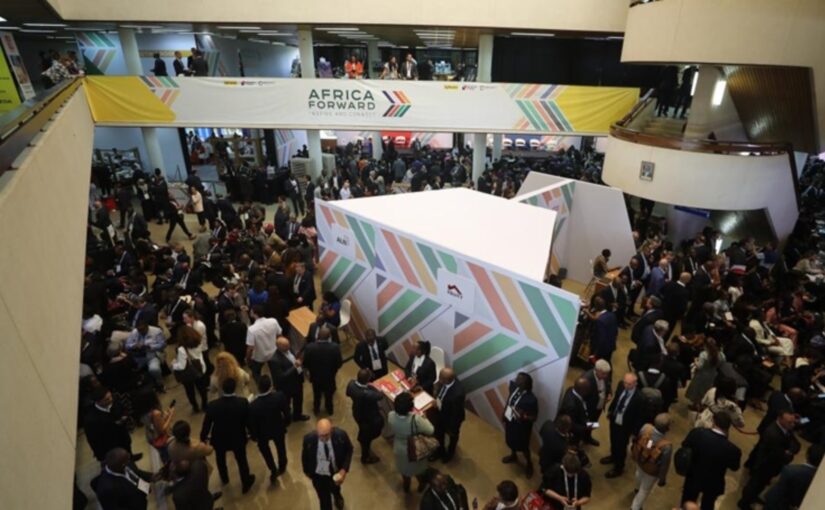
At the Africa Forward Summit in Nairobi on 12 May, French President Emmanuel Macron accused China of operating with a “predatory logic” across Africa. Carlos Martinez’s article below subjects that claim to the scrutiny it deserves – and finds that the phrase describes France’s own relationship with the continent rather more accurately than China’s.
The article sets out what China’s engagement with Africa actually looks like: a record $348 billion in bilateral trade in 2025; thousands of kilometres of railways, roads and power infrastructure; sixty years of medical teams; more university scholarships for African students than all leading Western governments combined; and, most recently, unconditional zero-tariff access to the Chinese market for all 53 African countries with diplomatic ties to Beijing – the structural trade arrangement that Africa has sought from the West for decades and never received.
France’s record, by contrast, involves the CFA franc (a colonial-era monetary arrangement that continues to route African foreign exchange reserves through the French Treasury), at least sixteen military interventions between 1960 and 1991, coups, extractive multinationals, and the systematic underdevelopment of economies it claims to be partnering.
Macron’s real purpose, Carlos argues, is not to help Africa but to suppress the South-South cooperation that is gradually dismantling the neocolonial order France built.
The summit’s true character was made plain by what happened outside the venue. As Macron received a red carpet welcome from President Ruto, Kenyan security forces arrested international delegates attending the parallel Pan-African Summit Against Imperialism – a counter-summit of revolutionary and anti-imperialist movements from across the continent and beyond. A statement by the Black Alliance for Peace observes that this outrageous action “further demonstrates the growing panic and hypocrisy within imperialist and comprador circles”. Friends of Socialist China expresses its unflinching solidarity with those that have been arrested.
Speaking at the Africa Forward Summit in Nairobi on Tuesday 12 May, French President Emmanuel Macron accused China of operating with a “predatory logic” across Africa and of “creating dependencies” by insisting that processing of critical minerals and rare earths takes place on Chinese soil. He presented Europe, by contrast, as a partner offering “equal footing” and “co-investment”.
It takes a particular kind of audacity to make these remarks on a continent that France has systematically plundered for the best part of two centuries.
Some context: France has in recent years suffered a humiliating strategic retreat from its former West African strongholds. Progressive governments in Mali, Burkina Faso and Niger have expelled French troops, torn up the military and diplomatic arrangements that underpinned Françafrique, and looked elsewhere for security cooperation. France’s response has been, in part, to pivot to East Africa, co-hosting the Africa Forward Summit in Kenya in what amounts to an admission that its traditional grip on the continent is slipping. Even The Times notes that the summit represents an attempt by France “to rebuild its influence after a humiliating retreat”.
It turns out that “rebuilding French influence” involves manufacturing a new bogeyman in the form of China.
What does China’s actual engagement with Africa look like?
China has been Africa’s largest trading partner for many years, with bilateral trade reaching a record $348 billion in 2025. Virtually every African country counts China as its most significant trade relationship. Chinese state banks have financed thousands of kilometres of railways, roads, ports and power generation capacity — 40 percent of Chinese loans to Africa have gone towards electricity generation and transmission, addressing a crisis in which over 600 million Africans have no reliable access to power.
West Africa’s first light rail opened in Lagos in 2023, built by China. The Ethiopia-Djibouti electric railway – Africa’s first fully electrified cross-border rail line – was built with Chinese finance and expertise. The new Africa CDC (Centre for Disease Control and Prevention) headquarters in Addis Ababa, which anchors the continent’s public health infrastructure, was also a Chinese-aided project. Chinese medical teams have been present in Africa for over sixty years, and China now offers more university scholarships to African students than all the leading Western governments combined.
Tariff-free access
The most recent development is China’s new zero-tariff policy. As of May 1, China has granted full, unconditional zero-tariff access to its market of 1.4 billion people for all 53 African countries with which it maintains diplomatic relations (that is, all African states other than Eswatini), with no conditions, political strings, or demand for reciprocal action. Producers of Kenyan coffee and South African wine, for example, now have tariff-free access to the world’s largest consumer market. This is a structural trade arrangement of the kind that Africa has been requesting from the West for decades, but China is the first major economy to deliver it. It is a concrete example of the “equal footing” that Macron claims to offer, but which France has never actually offered.
French neocolonialism
None of this bears the slightest resemblance to “predatory logic”. That phrase, however, describes France’s relationship with Africa rather precisely.
We can begin with the CFA franc – the colonial-era currency still used across 14 African countries, initially pegged to the French franc and now to the euro, which requires member states to deposit a significant share of their foreign exchange reserves into a French Treasury account. This is a monetary arrangement designed not for the benefit of African economies but as a mechanism of ongoing French control. As protesters across Francophone Africa have pointed out for years, the CFA franc is the most potent surviving symbol of Françafrique – the network of political, military and economic ties through which France maintained a de facto empire long after formal independence.
Then there is the military dimension. France intervened militarily in at least 16 African countries between 1960 and 1991. It backed coups in Gabon, Mali and the Republic of the Congo in the 1960s alone. French multinationals took over uranium mines in Niger (fuelling France’s nuclear power plants while leaving local communities with the environmental consequences), oil refineries in Gabon, and plantations across Cameroon. Vincent Bolloré — the ultraconservative billionaire whose fortune was built substantially on African transport infrastructure — used the profits from his neocolonial operations to finance France’s far-right media ecosystem. The Jacobin article from which that detail comes sums up the arrangement succinctly: “Extractive industries destroy landscapes and livelihoods, pushing millions to find new ways to sustain themselves and their communities” – and then France shuts its borders to the people its policies have displaced.
“No one has done more to benefit Africa than the Chinese”
China has done none of this. China has not backed coups, not maintained private armies, not extracted resources through colonial-era monetary arrangements, not killed independence leaders, not built a network of political clients sustained by corruption. It has built infrastructure, transferred technology, provided medical assistance, trained students and agreed commercial deals on terms that African governments and populations have overwhelmingly welcomed. As the Senegalese-American musician Akon has put it: “No one has done more to benefit Africa than the Chinese”.
When Macron accuses China of “predatory logic”, he is engaged in a form of projection so transparent it would be funny if it weren’t so cynical. The purpose of such rhetoric is not to help Africa but to suppress the South-South cooperation that is gradually freeing the continent from the very dependencies France helped to create.
Africa is not fooled. That is precisely why France is no longer welcome in so many of the countries where it once held sway, and why it finds itself staging summits in Nairobi, desperately seeking a rebranding that no amount of rhetoric about “equal footing” can deliver.






2 thoughts on “Macron’s China-bashing in Africa: a case of projection”