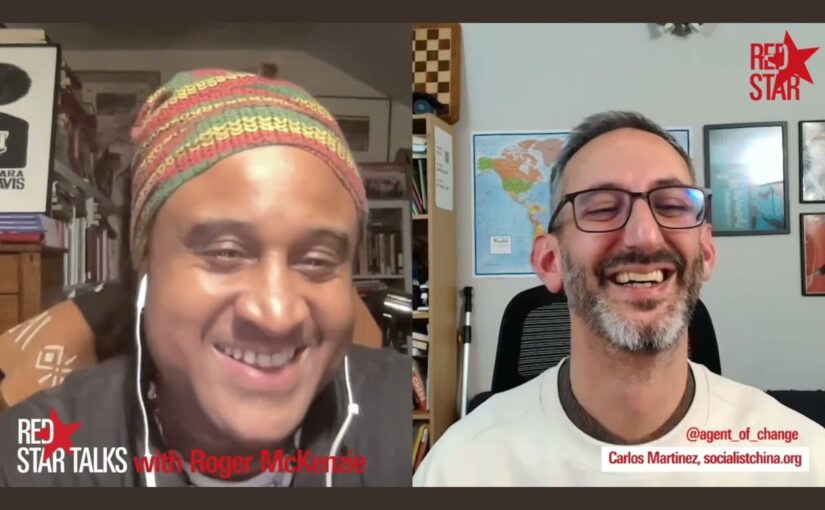
In the video embedded below, Friends of Socialist China co-editor Carlos Martinez joins Roger McKenzie for a detailed exploration of China’s foreign policy, its domestic progress, and the geopolitical strategies shaping the 21st century. The two discuss the importance of understanding China’s rise, the global shift towards multipolarity, and the need for solidarity against imperialist pressures.
Some of the key ideas put forward include:
• China’s foreign policy rests on the Five Principles of Peaceful Coexistence, first formulated by Zhou Enlai in 1954 and adopted at the Bandung Conference the following year. These principles – mutual respect for sovereignty, non-aggression, non-interference, equality and mutual benefit, and peaceful coexistence – elevate what Lenin conceived as a tactical necessity into a principled theoretical framework. The core insight is that countries with fundamentally different social systems can and must coexist, and that all non-imperialist countries share a common interest in opposing domination and pursuing their own development paths. Today these principles find expression in China’s vision of a community with a shared future for humanity, underpinned by the Belt and Road Initiative, BRICS (which now surpasses the G7 in GDP, population and landmass), the SCO, and the G77. Multipolarity – a negotiated international order in which no single power can impose its will – is not only urgently needed to address existential challenges like climate change and nuclear war, but is, as Samir Amin argued, the necessary framework for the possible overcoming of capitalism itself.
• The United States is not accepting this shift passively. Brzezinski identified the nightmare scenario decades ago: a grand coalition of China, Russia and Iran. US responses have included proxy war against Russia in Ukraine, military encirclement of China through AUKUS and Pacific buildups, unconditional support for Israel, tariff wars, semiconductor controls, the kidnapping of president Maduro, the suffocation of Cuba, the reassertion of the Monroe Doctrine, and now open war on Iran. The US is losing economic and technological primacy but retains overwhelming military power, and the danger is precisely that of a declining empire reaching for military solutions.
• The war on Iran must be understood in this context. It is not about nuclear weapons – nobody believes that. It is not about women’s rights – women’s rights are improving in Iran and deteriorating in the West. It is a criminal attack, carried out by presidential decree without reference to international law or domestic legal process, against a sovereign state that supports Palestinian resistance, maintains public ownership of its energy resources, and is a key node in the multipolar project – a crucial link in the Belt and Road, a member of BRICS and the Shanghai Cooperation Organisation, and an important energy partner for China. The attack is simultaneously an attempt to seize control of energy flows, to develop strategic chokepoints that could be used against China in a hot war, and to destroy the axis of resistance across West Asia. It is the empire striking back.
• China is supporting Iran to the best of its abilities – diplomatically, economically, and with military cooperation – but does not have the capacity to project military power into the region. Nonetheless, Iran is a fiercely independent country with formidable military capabilities. The US and Israel will not achieve their objectives: they will not install a puppet regime, will not destroy the Palestinian resistance, and will not seize Iran’s strategic position.
• The task for progressive forces in the West is to oppose the war on Iran, oppose the New Cold War on China and the propaganda war that sustains it, and build the broadest possible united front against imperialism, racism and neoliberalism. We are not the vanguard – that role belongs to the socialist countries and the peoples under direct attack. But everyone has a part to play, and we must do what we can to build solidarity and make war untenable for the imperialists.