While the world’s attention has been focused on Washington’s wars of aggression in the West Asia, the Trump administration has been quietly advancing a parallel offensive in Latin America – one whose real target, as Oscar Rotundo makes clear in this incisive analysis (originally published in English on the website Internationalist 360), is China.
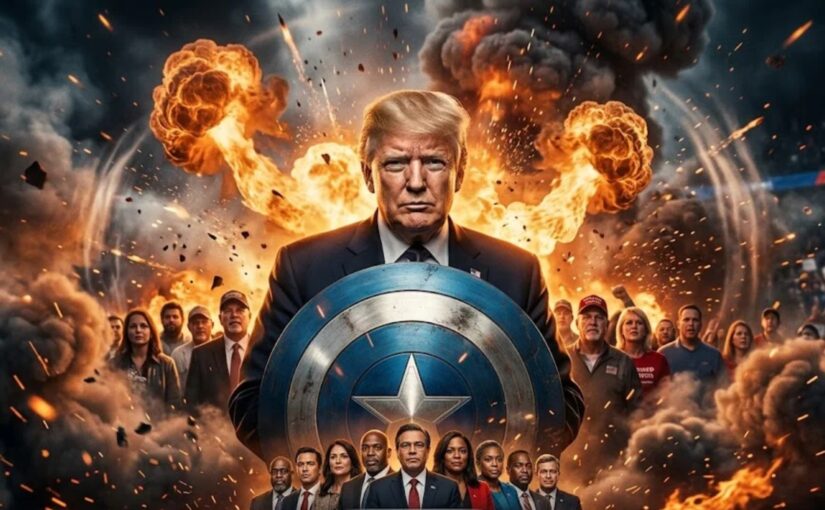
The “Shield of the Americas” summit, hosted by Secretary of State Marco Rubio and Kristi Noem at Trump’s Doral golf resort in Miami, brought together twelve compliant Latin American governments and committed them to a Washington-monitored protocol covering security, economic and digital cooperation. As Rotundo shows, this is nothing new: the US has long used regional proxies to advance its interests while making others pay the bill. What’s relatively new is the explicit anti-China dimension.
Every country invited to Miami has significant economic ties with China – ties that are, in most cases, irreplaceable. China is the largest trading partner of Chile; it is Bolivia’s largest creditor; a key investor in Ecuador; and a key destination for much of the region’s commodity exports. The Chancay megaport in Peru, Chinese EVs and green energy investment are all in Washington’s crosshairs.
But as Rotundo argues, the US has nothing comparable to offer. It brings no investment, no infrastructure, no technology transfer – only threats, sanctions and hegemonism. China, by contrast, “builds quality infrastructure and incorporates cutting-edge technology” without demanding political submission.
“The train of the future,” Rotundo concludes, “has left Trump stranded.”
The so-called “Shield of the Americas,” which includes Argentina, Bolivia, Chile, Costa Rica, the Dominican Republic, Ecuador, El Salvador, Guyana, Honduras, Panama, Paraguay, and Trinidad and Tobago , met at a golf club in Doral, Miami, and was hosted by Secretary of State Marco Rubio and Kristi Noem, former Secretary of Homeland Security, who will now serve as special envoy for the “Shield of the Americas.”
The idea behind this meeting is to commit those present to a regional control protocol in security, economy, and digital cooperation, monitored from Washington.
Just as the United States once turned to private contractors such as DynCorp International (now part of Amentum), a US security and aviation contractor for the Pentagon and the State Department, who operated in “Plan Colombia,” it is now turning to the military forces of these countries to act as police officers under its command.
Sending migrants to prisons in El Salvador or Guantanamo in Cuba, the kidnapping of the sitting constitutional president Nicolás Maduro and the deputy Cilia Flores in Caracas, Venezuela, the threats of invasion or overthrow of the legitimate government of Cuba, the constant extortion against Mexico, are all part of the same package to which the cohort of lackeys is added.
The United States, with the same zeal with which it bombs boats under the pretext of drug trafficking, taking the lives of people who cannot be held responsible for any crime; under this cloak of suspicion, it intends to implement a regional security policy with military forces paid for by each State to multiply the protection of its interests in the region.
What is hidden beneath that shield
Supposedly a shield protects, but not always. We could say that the TIAR (Inter-American Treaty of Reciprocal Assistance) – a mutual defense pact signed in 1947 by countries of America, under the principle that an armed attack against a member state is considered an attack against all, obliging cooperation – was also a shield promoted by the northern hegemon, which, when it came to intervening and discouraging the aggression of an extra-continental force like Great Britain, which since 1833 has illegitimately occupied the Falkland Islands, a territory belonging to Argentina, a member country, did the opposite and joined the aggression by logistically supporting the colonialist force.
Under this shield, “friendly” countries agree to hand over natural resources and sovereignty over these and over the territories where interoceanic passages are located, so that the United States can exercise control over the movement of goods and military resources that can be moved from one place to another, as Donald Trump has just proposed regarding the Strait of Hormuz, which he is “considering taking control of,” a strategic maritime passage through which 20% of the world’s crude oil and also significant quantities of liquefied natural gas (LNG) circulate.
Also, as seen in Ecuador with the presence of Erik Prince, founder of the private military company Blackwater, who in 2025 collaborated with the government of Daniel Noboa to combat organized crime and drug trafficking, participating in operations in Guayaquil and in the training of security forces, it would not be surprising if contractors of this nature were to occupy the ground and the operation of this purported fight against Narcoterrorism, under the auspices of this “strategic protection” in the associated countries.
But the fundamental aspect of this strategic partnership is that the United States “on the one hand involves you in the problem and at the same time sells you the solution,” summoning you to fight against drug trafficking, of which it is the main recipient and which it cannot defeat in its own country, and making you pledge your natural resources to pay for the protection and technology that it will use to combat it in your country.
It sounds like the old argument used for the implementation of “Plan Colombia” and that has not contributed at all to solving the problem of drug trafficking to the United States.
The “Shield of the Americas” is the consolidation of the backyard theory, in which there is no room for investments from China, Russia, and Iran, and even less for the construction of spaces that call for multipolarity or multilateralism and open conditions of well-being for the “Global South”.
The United States is concerned about the development in the region of companies from emerging nations that have become powers and that today have a variety of innovations and technological advantages to offer with which it cannot compete.
He is concerned about the mega-port of Chancay in Peru and the development and consolidation of Brazil alongside the BRICS. He knows that he has no way to reach Asia because the most important technological pool in the world is located there, along with the largest global population, and that China’s presence in the region has deep roots since it is not based on offering security services and extractive exploitation. China builds quality infrastructure and incorporates cutting-edge technology for agricultural, transportation, communications, urban and scientific development solutions, which the bully to the north cannot offer.
Our region has much to offer Asian countries, but also human potential and fertile ground to join the qualitative development offered by those countries, and this challenges the anachronistic approach of the MAGA, because this is not the United States of the 1960s; it is a crude and decadent caricature expressed in a corrupt and vicious political class whose most notable exponent is the current occupant of the White House, who in his senility, concocts a future of conquest that only finds a place in his mythomania.
The entourage that follows him for a handful of dollars knows deep down that the social and economic problems that accompany the growth of drug trafficking can be solved with education and economic growth, generating jobs and well-being for the population. They know that violence and repression lead to backwardness and decline, but they can’t help but listen to the violent mantra of the powerful, either because it seduces them or because they are inept at solving society’s problems with their own people.
Donald Trump tells them, “The only way to defeat these enemies is to unleash the power of our armies”… “We have to use our military. You have to use your armies” and concludes, “A great change is coming soon to Cuba,” “you are practically at the end of the road.”
But it doesn’t end there; he then unleashes his fury against Mexico, which he calls the “epicenter of cartel violence,” where drug lords “orchestrate much of the bloodshed and chaos in this hemisphere,” concluding, “The cartels control Mexico” and “We cannot allow that. Too close to us. Too close to you.”
Never before has so much hypocrisy been expressed with such impunity. It is not the drug problem that worries Trump and his cronies, it is the ambition for power that keeps them awake at night and their deep fear of losing it and having to face the consequences of the atrocities they commit.
The obsession with China
Trump is targeting infrastructure projects, military cooperation, and investment in industries by China in the region.
He pressured Panama to withdraw from China’s Belt and Road Initiative and to review the concession granted to Hong Kong-related companies that operated the Panama Canal services, under threat of invasion.
Then it militarily occupied the Caribbean Sea to block and sanction the traffic of hydrocarbons leaving Venezuela, taking into account that China was the largest buyer of Venezuelan crude before the attack and kidnapping of the Venezuelan president.
But the ramifications of the Chinese presence put its partners at a crossroads that could cost them dearly.
Argentina: The Argentine economic structure is highly complementary to that of Beijing.
Bolivia: China is its largest creditor and a central player in lithium, infrastructure and energy projects.
Chile: China is the largest buyer of Chilean exports.
Costa Rica: Maintains ties with China, but these have slowed to levels seen between 2007 and 2022.
Ecuador: China is key to the Ecuadorian economy and breaking that relationship would be very detrimental.
El Salvador: China financed the National Library and the National Stadium.
Honduras: Recognizes China since 2023 and this relationship is beneficial for the Asian country.
Panama: China warned of “high political prices” after the cancellation of port contracts.
Paraguay: China continues to supply a third of its imports.
Dominican Republic: Maintains relations with China since 2018 and recently signed economic cooperation agreements with Beijing.
Trinidad and Tobago: They have a need for Chinese investment for their economy that cannot be met by US aid.
Beyond political posturing and speculative compromises, China’s influence in the Americas generates tension and becomes a complex challenge to resolve because China is an irreplaceable commercial and financial engine that transcends the bravado of “you’re either with me or against me.” And no matter how much Trump tries to mask the problems of backwardness and inequality in the region (of which the United States is no stranger) with police-state strategies to bring under his wing those upstarts who seek to imitate him, reality will continue to demonstrate that the organization of the people triumphs over time and that the train of the future has left him stranded, along with his decadent henchmen.