Reflections on Western and Chinese Approaches to Operate Local Government

The following article by Douglas Rooney, originally published on Li Jingjing’s China Up Close blog, contrasts Western and Chinese approaches to local governance through two key examples. In Britain, the author’s hometown faces the closure of its local Partnership Centre, a community hub, due to funding cuts. Despite the decision being framed as a local choice, the community council lacks the resources to keep it running, effectively outsourcing blame for austerity to local residents. This reflects a broader trend in Western localism, where decentralisation is championed as empowering communities but often leaves them under-resourced.

In contrast, Douglas highlights China’s 12345 Hotline – the Beijing headquarters of which was included in the itinerary of the Friends of Socialist China delegation to China in April 2024 – as a model of effective local governance. Established in 1987, the hotline allows citizens to report issues directly to the government, from minor nuisances to significant problems. With millions of calls annually and a 97 percent satisfaction rate, it provides a streamlined way for residents to communicate with authorities. The hotline, alongside other mechanisms like WeChat groups and focus groups, integrates local concerns into a centralised decision-making process, ensuring problems are addressed without overburdening local communities.

The article argues that while Western localism often devolves responsibility without adequate support, China’s approach emphasises collaboration and problem-solving. Chinese local governance is part of a broader system of whole-process people’s democracy, in which citizens are actively consulted and solutions are pursued collectively.

Douglas concludes:

While Western politics is often about parceling out responsibility (and blame) for a problem, Chinese politics is about trying to find a solution to a problem. The 12345 Hotline is probably the most representative example of this solution-orientated approach to local governance. And judging by the positive response of Chinese citizens, it is an approach to local governance that resonates with everyday people.

Douglas Rooney is a Scottish Christian Socialist, currently working in Beijing.

In my hometown, my mum serves on the local community council (the lowest tier of representative government in the UK). Community councils are usually given a minuscule budget by the larger county or city government to spend on projects in their community: host a local gala, re-paint the park benches, maintain a local news board – that sort of thing. In my hometown, these duties also include managing the local Partnership Centre. This is a large building in the center of the town where you can find the local library, a community cafe, and a dance hall – basically a one-stop shop for community activities.

At the start of this winter the community council got bad news – the county government is no longer going to cover the running costs of the Partnership Centre. However, the county hasn’t made a decision to close the Partnership Centre. Instead, they have told the community council that it is their decision if they want to keep the Centre running after the county pulls funding in the summer.

But this isn’t much of a choice: without help from the county, the local community council will have to find an extra £8000 a month for upkeep costs. In the working-class town where I grew up, it is inconceivable the community will find this kind of money. Next year, the Partnership Centre will close because the government has slashed local budgets, but, on paper at least, the decision will have been made by the local community, and this will probably be enough to ensure the lion’s share of the blame is laid at the feet of the community council.

I was thinking about this story recently when I attended the Beijing Forum on Swift Response to Public Complaints. This Forum was primarily to discuss the progress made on the 12345 Hotline (more on this later), but experts from North America and Europe were also in attendance to share their thoughts on local governance.

The key concepts put forward by Western contributors were those of a responsible citizenry and localism. We heard about how difficult it was for central or municipal government in the West to coordinate with local communities: for example, about how, during the pandemic, New York City government initially found it difficult to establish adequate local testing centres because the municipal government simply didn’t have a good idea of where in the local community had the capacity to host them.

Continue reading Reflections on Western and Chinese Approaches to Operate Local Government

Trump’s war on China in Latin America

In the following article, Steve Ellner provides a detailed analysis of Donald Trump’s Latin America policy as he embarks on his second presidential term, arguing that its bellicosity is closely related to US imperialism’s increased hostility to China.

According to Ellner: “US President Donald Trump’s threats to take over the Panama Canal, convert Canada into the 51st state and purchase Greenland may not be as ludicrous as they seemed. The proposals, albeit unachievable, lay the groundwork for a more ‘rational’ strategy of targeting China (not so much Russia) and singling out real adversaries (as opposed to Canada and Panama), which include Cuba and Venezuela, with Bolivia not far behind.”

Arguing that much of Trump’s analysis is drawn from the right-wing Heritage Foundation, he draws attention to the think tank’s James Carafano’s advocacy of a “rejuvenation of the Monroe Doctrine”.

Trump’s choice of anti-Cuba zealot Marco Rubio as secretary of state reinforces the perception that the Trump administration’s foreign policy will pay special attention to Latin America and that Latin American policy will prioritise two enemies: China and the continent’s leftist governments. Carafano calls the strategy ‘a pivot to Latin America.’

He notes that the threat to Panama is a reminder that currents on the right and within the Republican Party still denounce the “canal giveaway.” Ronald Reagan warned against it in his attempt to secure the Republican presidential nomination in 1976 and again raised the issue in his successful bid for the presidency four years later.

Drawing attention to what he considers a certain difference in approach from that taken by the US Democratic Party, he observes that, “the McCarthyite new right targets the more leftist Pink Tide leaders such as those of Venezuela and Cuba, but it is not letting moderate ones such as Lula off the hook. Rubio calls Brazil’s Lula a ‘far-left leader,’ while Musk has expressed certainty that he will not be reelected in 2026. Some analysts have raised the possibility that Trump will slap the Lula government with tariffs and sanctions to support the return to power of Jair Bolsonaro and the Brazilian far right.”

Trump’s real target in all three threats [against Panama, Canada and Greenland] was China… Trump made his case for the annexation of the Panama Canal, Canada and Greenland (a gateway to the Arctic) by arguing for the need to block China’s growing presence in the hemisphere…

In the 21st century, China’s investment in and trade with Latin America have increased exponentially. China has now surpassed the US as South America’s top trading partner. Some economists predict that the net value of trade, which in 2022 was valued at $450 billion, will exceed $700 billion by 2035.

When it comes to Washington’s anti-China rhetoric, competition with the US on the economic front receives less attention than it merits. If ever the ‘it’s the economy stupid’ [a phrase made famous by Bill Clinton] statement was apropos, it is in the case of China’s challenge to US hegemony.

The Heritage Foundation’s 38,000-word ‘Plan for Countering China,’ enumerates an endless number of non-economic threats [supposedly] posed by China. Many of the threats put the spotlight on Latin America due to its proximity. For example: ‘China’s role in global drug trafficking, exploiting instability in the US and Latin America caused by illegal migration… The US government should close loopholes in immigration law and policy that China is exploiting.’

Surveying the role played by the Latin American right in this situation, he notes that former Brazilian President Bolsonaro and current Argentine President Milei employed extreme anti-China rhetoric in opposition, only to adopt a more pragmatic approach in office.

“All this indicates that the Trump administration will probably face resistance to its anti-China campaign in Latin America from an unexpected source, namely local business interests.”

This article contains some formulations and opinions with which the editors of this website are not fully in agreement. However, we reproduce it for its detailed factual presentation, interesting analysis and clear anti-imperialist standpoint. It was originally published by Links, an Australian publication which describes itself as an international journal of socialist renewal.  A slightly abridged version was first published in Jacobin.

Steve Ellner is an Associate Managing Editor of Latin American Perspectives and a retired professor at the Universidad de Oriente in Venezuela, where he lived for over 40 years.

US President Donald Trump’s threats to take over the Panama Canal, convert Canada into the 51st state and purchase Greenland may not be as ludicrous as they seemed. The proposals, albeit unachievable, lay the groundwork for a more “rational” strategy of targeting China (not so much Russia) and singling out real adversaries (as opposed to Canada and Panama), which include Cuba and Venezuela, with Bolivia not far behind. The strategy is what James Carafano of the Heritage Foundation calls the “Rejuvenation of the Monroe Doctrine,” which, after all, in its day encompassed Canada and Greenland in addition to Latin America.

Trump’s choice of anti-Cuba zealot Marco Rubio as secretary of state reinforces the perception that the Trump administration’s foreign policy will pay special attention to Latin America and that Latin American policy will prioritise two enemies: China and the continent’s leftist governments. Carafano calls the strategy “a pivot to Latin America.”

Political analyst Juan Gabriel Tokatlian writing in Americas Quarterly was more specific. After citing Trump’s plans for military action against Mexico, Cuba and Venezuela in his first administration, Tokatlian reasons “a second Trump White House may well lack some of the more rational voices that averted more rash actions the first time around.”

Continue reading Trump’s war on China in Latin America

The US’s campaign of China containment is destined to fail

The following text is based on a speech given by Danny Haiphong at a hybrid public meeting (live in Portland and online via Zoom) on the theme of defending Socialist China.

Danny addresses the various questions circulating currently about what the Trump administration’s approach to China will be, noting that, some tactical differences notwithstanding, the two mainstream US political parties are united in their pursuit of a strategy aimed at containing China, encircling it, and suppressing its rise. “The overall trend of aggression toward China remains on an upward trajectory regardless of the duopoly party in the oval office.”

Danny notes that the escalating New Cold War on China is not having the desired effect, and that there is a serious possibility of the US ruling class resorting to direct military aggression. “US sanctions have failed. US militarization has failed. The US under Trump truly does not know how to approach China. It is certain however that the aggression will ramp up again.”

Given that the US and China are both nuclear powers, and that the US (unlike China) does not have a no-first-use policy, and has used nuclear weapons, and consistently engages in nuclear bullying, there is a significant danger of nuclear war. That threat must motivate a systematic response of solidarity from progressive forces around the world.

As long as the United States remains the capitalist empire that it is, we can expect it to continue pursuing China containment. That means we are all going to have to be ready to oppose these anti-China narratives, to expose people to the real China, and to build people-to-people ties and the necessary solidarity to ensure that we roll back this war machine once and for all.

We in the US tend to be captive to narrative and spin, to personality and hubris. The cult of individualism is powerful. Class consciousness and organization in the US, not so much. In this context we find ourselves pulled into the vortex of obsessing over Trump. And indeed, Trump puts on a show. Hundreds of executive orders and endless political theater acts have many Americans’ heads spinning.

Is Trump a “peacemaker”? Will he End the War in Ukraine? Is a Golden Age in America coming? These are all the wrong questions. The question of China teaches us this.

Why? Because the US empire is just that, an empire, and it’s ruled by a class of capitalist elites who see China as a threat.

Continue reading The US’s campaign of China containment is destined to fail

China: Gaza belongs to Palestinians and is an inseparable part of Palestinian territory

As the world continues to react to Donald Trump’s illegal and genocidal threats to seize control of the Gaza Strip and to forcibly expel the Palestinian population, the Arab diplomatic corps in China met on February 7 with Vice Foreign Minister Chen Xiaodong at their request. Chen has considerable experience and expertise in Middle Eastern affairs. Among his previous responsibilities, he served as the Director-General of the Foreign Ministry’s Department of West Asian and North African Affairs, as well as Ambassador to Iraq and as a diplomat in Saudi Arabia, Jordan and Egypt.

Chen Xiaodong said that Gaza belongs to Palestinians and is an inseparable part of Palestinian territory. Any arrangements concerning the future of Gaza must respect the will of the Palestinian people, and any post-conflict governance plan for Gaza must follow the principle of “the Palestinians governing Palestine”. President Xi Jinping has repeatedly stressed that China supports the just position of Palestine. China always firmly supports the legitimate national rights of the Palestinian people.

The diplomatic envoys of Arab states to China said that Gaza has been the territory of the Palestinian people since ancient times, and the Arab countries firmly oppose the policy of “cleaning out” Gaza, which seriously violates international law and international humanitarian law and also violates relevant resolutions of the United Nations. The Arab side appreciates China’s consistent and just position on the Palestinian question and expects China to continue to play a constructive role in safeguarding international fairness and justice and supporting Palestine’s legitimate national rights.

The following article originally appeared on the website of the Chinese Foreign Ministry.

On February 7, 2025, Vice Foreign Minister Chen Xiaodong had a group meeting with diplomatic envoys of Arab states to China at the latter’s request. The two sides had an exchange of views on the Palestinian question.

Chen Xiaodong said that Gaza belongs to Palestinians and is an inseparable part of Palestinian territory. Any arrangements concerning the future of Gaza must respect the will of the Palestinian people, and any post-conflict governance plan for Gaza must follow the principle of “the Palestinians governing Palestine”. President Xi Jinping has repeatedly stressed that China supports the just position of Palestine. China always firmly supports the legitimate national rights of the Palestinian people, supports the effective jurisdiction of the Palestinian National Authority over all Palestinian territories including Gaza and the West Bank, and supports the two-State solution as the fundamental way out to work for an early and just political settlement of the Palestinian question. In other words, China firmly supports the establishment of an independent State of Palestine that enjoys full sovereignty based on the 1967 borders and with East Jerusalem as its capital. China is ready to continue to maintain close communication and coordination with Arab states on the Palestinian question.

The diplomatic envoys of Arab states to China said that Gaza has been the territory of the Palestinian people since ancient times, and the Arab countries firmly oppose the policy of “cleaning out” Gaza, which seriously violates international law and international humanitarian law and also violates relevant resolutions of the United Nations. The legitimate rights of the Palestinian people are not to be deprived of, and the fairness and justice of the international community brook no infringement. The Arab side appreciates China’s consistent and just position on the Palestinian question and expects China to continue to play a constructive role in safeguarding international fairness and justice and supporting Palestine’s legitimate national rights.

Chinese solidarity in Panama’s long struggle for sovereignty against US imperialism

Following threats by the Trump administration to illegally seize the Panama Canal, Panama’s right wing government, following a visit by Secretary of State Marco Rubio, has partially acceded to US pressure by deciding to withdraw from its participation in China’s Belt and Road Initiative (BRI).

In a prompt reaction, on February 7, Chinese Assistant Foreign Minister Zhao Zhiyuan summoned Miguel Humberto Lecaro Barcenas, Panama’s ambassador to China, to lodge solemn representations over Panama’s decision, to which the Chinese side expressed deep regret.

More than 150 countries actively participate in the BRI, with achievements benefiting the people of various nations, including Panama, Zhao said. “Any attempts to reverse course on the BRI and go against the expectations of the Chinese and Panamanian peoples do not align with the vital interests of Panama.”

China respects Panama’s sovereignty and territorial integrity, and advocates for equality among countries of all sizes, mutual respect, and credibility in commitments, Zhao stressed. China firmly opposes the United States wantonly undermining China-Panama relations and discrediting and undermining cooperation under the BRI through pressure and threats.

Lecaro said that Panama values its relationship with China and will promptly report to its government.

That same day, at a regular Foreign Ministry press conference, spokesperson Lin Jian said that China firmly opposes the United States’ actions to smear and sabotage Belt and Road cooperation through pressure and coercion and deeply regrets that Panama will not renew the Memorandum of Understanding on BRI cooperation with China.

China supports Panama’s sovereignty over the Panama Canal and is committed to upholding the Canal’s status as a permanently neutral international waterway, he added. China has never participated in managing or operating the Canal, and never ever has China interfered. The accusation that China has control over the Canal is totally groundless. “The world is not blind to the truth as to who is keeping the Canal neutral and thriving and who keeps threatening to ‘take back’ the Canal.”

It is highly unlikely that this concession by Panama will have the effect of appeasing the Trump administration. If anything, it is likely to further turn the screws on the small Central American country.

In an article published by People’s Dispatch, and also republished by the Morning Star, Tings Chak noted that: “Trump’s rhetoric fits neatly into his vocal expansionist and imperialist ambitions, from annexing Greenland and Canada to ‘taking back’ the Panama Canal, which itself was a product of US interventionism and imperialist interest in the region.”

Tings adds: “Panamanian sovereignty over the Canal Zone became the centre of decades of struggle, coming to a head in January 1964, when students attempted to raise a Panamanian flag there in protest of US imperialism. They were met with brutal repression, and several students were wounded and killed. It wasn’t until the leadership of Omar Torrijo that Panama was finally able to gain its control over the Canal Zone, solidified in the Torrijos-Carter treaties in 1977. As an important victory for Panama’s national sovereignty, the treaties stated that the US would relinquish control of the area in 1979, with the transference of control completed by 1999 – now once again being threatened again by the provocations of Trump’s administration.”

Responding to the events of January 1964, a wave of solidarity swept socialist China, with up to 20 million people taking part in militant anti-imperialist protests. In his statement of support, issued on January 12, 1964, Chairman Mao Zedong declared:

The heroic struggle now being waged by the people of Panama against US aggression and in defence of their national sovereignty is a great patriotic struggle. The Chinese people stand firmly on the side of the Panamanian people and fully support their just action in opposing the US aggressors and seeking to regain sovereignty over the Panama Canal Zone.

US imperialism is the most ferocious enemy of the people of the entire world.

It has not only committed the grave crime of aggression against the Panamanian people, and painstakingly and stubbornly plotted against socialist Cuba, but has continuously been plundering and oppressing the people of the Latin American countries and suppressing the national-democratic revolutionary struggles there.

Significantly, and fully in keeping with his consistent analytical framework when assessing international questions, Mao’s brief survey of the global struggle against US imperialism at the time, also stressed:

Even toward its allies in Western Europe, North America and Oceania, US imperialism is pursuing a policy of the law of the jungle, trying hard to trample them underfoot.

Mao’s statement also formed the centrepiece of a pamphlet published by China’s Foreign Languages Press, whose contents also included the texts of messages from Chinese leaders Liu Shaoqi, Zhou Enlai and Zhu De to their Panamanian counterparts. It should be noted that such messages were sent in the spirit of internationalism and without regard to the fact that Panama had yet to establish diplomatic relations with China. China consistently maintained its principled stand in support of Panama’s anti-imperialist struggle for sovereignty, through all its twists and turns, although bilateral diplomatic relations were not established until 2017.

The following articles are republished from the Xinhua News Agency, People’s Dispatch and the Marxist Internet Archive (MIA).

China lodges solemn representations to Panama over withdrawal from BRI cooperation with China

BEIJING, Feb. 8 (Xinhua) — Assistant Foreign Minister Zhao Zhiyuan on Friday summoned Miguel Humberto Lecaro Barcenas, Panama’s ambassador to China, to lodge solemn representations over Panama’s decision to not renew the Memorandum of Understanding on cooperation with China on the Belt and Road Initiative (BRI).

Panama recently announced the termination of the Memorandum of Understanding on the BRI, to which the Chinese side expressed deep regret, Zhao said.

Under the framework of the BRI, pragmatic cooperation between China and Panama has rapidly developed across various sectors and achieved a series of fruitful results, bringing tangible benefits to Panama and its people, Zhao noted.

More than 150 countries actively participate in the BRI, with achievements benefiting the people of various nations, including Panama, Zhao said. “Any attempts to reverse course on the BRI and go against the expectations of the Chinese and Panamanian peoples do not align with the vital interests of Panama.”

China respects Panama’s sovereignty and territorial integrity, and advocates for equality among countries of all sizes, mutual respect, and credibility in commitments, Zhao stressed.

Continue reading Chinese solidarity in Panama’s long struggle for sovereignty against US imperialism

Xi exchanges congratulations with Colombian president over 45th anniversary of ties

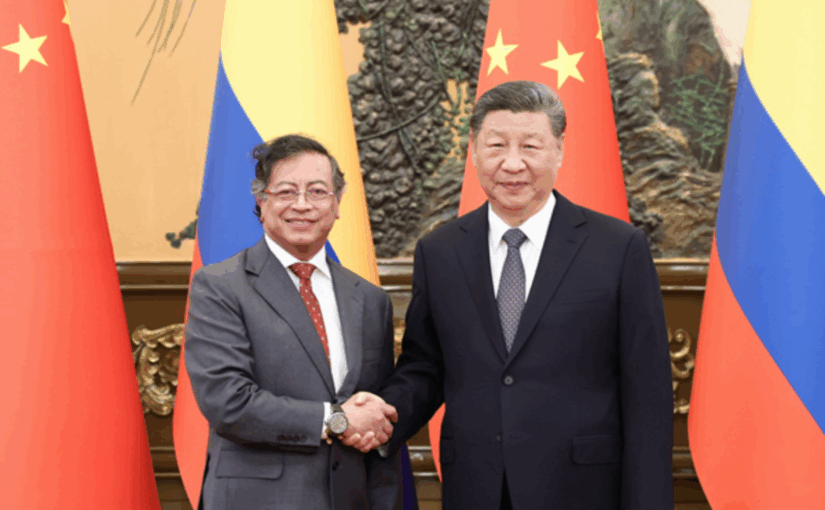
China and Colombia have underlined the dynamic nature of their friendship and cooperation at a time when the progressive South American government is facing crude interference and brutal threats from the Trump administration in the United States.

On February 7, Chinese President Xi Jinping and Colombian President Gustavo Francisco Petro Urrego exchanged messages greeting the 45th anniversary of the establishment of their bilateral diplomatic relations.

Xi said that since then, both sides have been pushing for the steady development of bilateral ties based on the principles of equality and mutual respect. He further noted that in October 2023, Petro paid a successful state visit to China, during which the two heads of state had a fruitful meeting and jointly announced the establishment of a strategic partnership between the two countries, guiding China-Colombia relations into a new era.

Colombia is an important country in Latin America and will assume the rotating presidency of the Community of Latin American and Caribbean States (CELAC) this year, he added, and said that he attaches great importance to developing China-Colombia relations, and is willing to work with Petro to deepen the strategic partnership between the two countries in efforts to jointly build a China-Latin America and the Caribbean community with a shared future.

President Petro noted that he paid a state visit to China after taking office, and bilateral ties have been steadily strengthened with the continuous increase of trade and investment. Colombia is willing to work with China to jointly advance the global agenda of mutual concern, including world peace, energy transition and tackling climate change.

Earlier, on January 28, Hong Kong’s South China Morning Post reported that China’s Ambassador to Colombia, Zhu Jingyang told the El Tiempo newspaper that relations between China and Colombia were “at the best moment” since they established diplomatic ties. He added that Colombia and China “are global cultural powers” and that the differences between the two countries “far from creating obstacles, bring us closer and enrich us.”

Coincidentally the Ambassador’s comments were published at the same time as a public row broke out between President Petro and Trump. Colombia denied permission for two US military aircraft, each carrying some 80 Colombian migrant workers, victims of Trump’s racist pogroms that currently threaten millions of workers and their families in the US. With the type of performative cruelty that is among his trademarks, Trump has taken to deporting workers bound and shackled aboard military aircraft.

Petro said he would accept deported migrants again once the US established protocols for their dignified treatment. Trump said on his Truth Social account that by refusing to accept the flights, the “socialist president of Colombia” had put US “national security and public safety” at risk. He announced 25 per cent tariffs on all Colombian imports, including coffee; Colombia is among the leading exporters of the bean to the US.

After a furious riposte from Petro on the social media platform X, the United States acceded to Colombia’s demand for the humane treatment of deportees.

The following article was originally published by the Xinhua News Agency.

BEIJING, Feb. 7 (Xinhua) — Chinese President Xi Jinping on Friday exchanged congratulations with Colombian President Gustavo Francisco Petro Urrego over the 45th anniversary of bilateral diplomatic ties.

Since China and Colombia established diplomatic relations 45 years ago, both sides have been pushing for the steady development of bilateral ties based on the principles of equality and mutual respect, said Xi.

Xi noted that in October 2023, Petro paid a successful state visit to China, during which the two heads of state had a fruitful meeting, and jointly announced the establishment of a strategic partnership between the two countries, guiding China-Colombia relations into a new era.

Colombia is an important country in Latin America and will assume the rotating presidency of the Community of Latin American and Caribbean States this year, said Xi.

Xi also said he attaches great importance to developing China-Colombia relations, and is willing to work with Petro to deepen the strategic partnership between the two countries in efforts to jointly build a China-Latin America and the Caribbean community with a shared future.

In his message, Petro said the development of bilateral relations has witnessed fruitful results since the two sides established diplomatic ties, delivering benefits to the two peoples.

Frequent high-level visits have strongly boosted bilateral cooperation in various fields, and fostered a deeper bond between the two peoples, he said.

The Colombian president also noted that he paid a state visit to China after taking office, and bilateral ties have been steadily strengthened with the continuous increase of trade and investment.

Colombia is willing to work with China to jointly advance the global agenda of mutual concern, including world peace, energy transition and tackling climate change, he added. 

Xi Jinping holds talks with Pakistani President Asif Ali Zardari

President of Pakistan Asif Ali Zardari paid a state visit to China from February 4-8, 2025, at the invitation of President Xi Jinping. During his stay in China, he also attended the Opening Ceremony of the Ninth Asian Winter Games in Harbin.

Presidents Xi and Zardari held talks on the afternoon of February 5.

Xi Jinping pointed out that China and Pakistan are ironclad friends and all-weather strategic cooperative partners. The enduring traditional friendship between China and Pakistan, forged by the elder generation of leaders of the two countries, is the invaluable treasure of the two countries and two peoples. In recent years, the two countries have provided firm political support for each other, maintained close high-level exchanges, and deeply advanced the development of the China-Pakistan Economic Corridor (CPEC) and cooperation in various fields, setting a good example of state-to-state relations. China is ready to work hand in hand with Pakistan on each other’s path to modernization and to speed up efforts to build an even closer China-Pakistan community with a shared future in the new era, bring more benefits to the two peoples, and make greater contributions to regional peace, stability and prosperity.

 Xi Jinping stressed that China always views its relations with Pakistan from a strategic perspective, maintains a high degree of stability and continuity in its friendly policy toward Pakistan, and is committed to a friendly policy toward all Pakistani people. China will, as always, firmly support Pakistan in safeguarding its sovereignty, independence and territorial integrity, countering terrorism, and following a development path suited to its national conditions.

Noting that next year marks the 75th anniversary of the establishment of diplomatic relations between China and Pakistan, the Chinese leader called on the two sides to deepen exchange and cooperation on culture, education and the media, so as to pass on the China-Pakistan friendship from generation to generation. China appreciates Pakistan’s active support for the three global initiatives and its participation in relevant cooperation, and is ready to work with Pakistan to uphold the Five Principles of Peaceful Coexistence, resist unilateralism and hegemonic practices, strengthen multilateral coordination, and safeguard the common interests of developing countries.

Asif Ali Zardari said that Pakistan and China are close neighbours and all-weather good friends and partners. The friendship between Pakistan and China has weathered changing circumstances, and the hearts of the two peoples have always remained closely connected. Pakistan will stand steadfastly with China no matter how the situation changes. The Pakistani side appreciates China’s selfless assistance for Pakistan’s economic and social development. Pakistan is willing to learn from China’s successful experience and advance the high-quality development of the CPEC and cooperation in various fields, so as to help the country realise its industrialisation and modernisation. Under the wise leadership of President Xi Jinping, China has played an ever-growing leadership role in international affairs and has become an increasingly important force for safeguarding world peace, stability and prosperity. Pakistan is willing to work closely with China to uphold multilateralism, safeguard free trade, and promote the common interests of the two countries and the vast number of developing countries.

On February 6, Zardari met with Chinese Premier Li Qiang. 

Li said that China stands ready to work with Pakistan to implement the important consensus reached by the two heads of state, maintain close high-level exchanges, continue to carry forward the traditional friendship, firmly support each other on issues concerning core interests and major concerns, push forward the all-weather strategic cooperative partnership between China and Pakistan, and make the building of a China-Pakistan community with a shared future more beneficial to the two peoples.

He also noted that China is ready to forge synergy between the development strategies of the two countries, jointly promote high-quality Belt and Road cooperation, advance the construction of the China-Pakistan Economic Corridor, push forward construction of major projects concerning roads, railways and ports in an orderly manner, deepen cooperation in terms of agriculture, mining, new energy information technology and artificial intelligence, expand sub-national cooperation and people-to-people exchanges, and better promote the common development of the two countries.

Zardari said that Pakistan and China have always supported and helped each other in the changing international situation, adding that mutual trust and friendship between the two countries have been passed down from generation to generation. Pakistan cherishes the bilateral friendship with China and is ready to join hands to further deepen exchanges and cooperation in trade, investment and other fields, and to achieve common prosperity.

Zaradari also met with Zhao Leji, Chairman of the National People’s Congress (NPC) Standing Committee, on February 5.

China and Pakistan issued a comprehensive 24-point joint statement on the occasion of Zardari’s state visit.

The two sides agreed that the China-Pakistan All-Weather Strategic Cooperative Partnership is a choice by history and by the people and enjoys broad support from all walks of life in both countries. Having withstood the test of changing international circumstances, the enduring partnership and iron-clad friendship between China and Pakistan transcends geopolitical interests and is an important positive factor for regional peace, stability and development.

The two sides noted that while the transformation not seen in a century is accelerating, the China-Pakistan relationship remains of strategic significance, and any attempt to disrupt or undermine it is bound to fail. The Chinese side reiterated that the China-Pakistan relationship is a priority in its foreign relations and of special significance in China’s foreign policy. The Pakistani side underscored that the Pakistan-China relationship is the cornerstone of its foreign policy.

The Pakistani side spoke highly of the great development achievements made by Chinese people under the guidance of the Communist Party of China and expressed firm support for the Chinese side in advancing the great cause of building a great modern socialist country in all respects and realising the rejuvenation of the Chinese nation through Chinese modernisation.

The two sides reiterated their commitment to combating terrorism in all its forms and manifestations with a zero-tolerance attitude and agreed to further strengthen bilateral and multilateral cooperation on counter-terrorism. The Pakistani side will continue to make all efforts to investigate into the terrorist attacks involving Chinese personnel and bring the perpetrators to justice.

The two sides welcomed the official inauguration of the new Gwadar International Airport, reaffirmed their commitment to promoting the comprehensive development and operation of the Gwadar Port to further leverage its role as a multimodal logistics hub to boost local economic growth through industrial development. Recognising the significance of the Gwadar Port, both sides agreed to optimally utilise its potential as a key hub of connectivity and trade.

The two sides emphasised that the China-Pakistan cooperation opens to all regions in Pakistan and aims to benefit all Pakistani people. They agreed to continue to carry out cooperation on people’s livelihood in areas such as healthcare, agriculture, education, climate response, and disaster prevention and alleviation, and to deliver more ‘small and beautiful’ projects beneficial for the people.

Continue reading Xi Jinping holds talks with Pakistani President Asif Ali Zardari

China opposes forced displacement of the people of Gaza

China has promptly joined the widespread international condemnation of US President Trump’s threats to expel the Palestinian people from Gaza and take control of the territory.

At the foreign ministry press conference on February 6, spokesperson Guo Jiakun said that Gaza belongs to the Palestinian people. It is an inalienable part of the territory of Palestine, not a bargaining chip for political games, still less a prey of the strong.

“China firmly supports the legitimate national rights of the Palestinian people, believes that ‘the Palestinians governing Palestine’ is an important principle that must be upheld in the post-conflict governance of Gaza, and opposes the forced displacement of the people of Gaza.”

The following article was originally published by the Xinhua News Agency.

BEIJING, Feb. 6 (Xinhua) — Gaza is an inalienable part of the territory of Palestine, and China opposes the forced displacement of the people of Gaza, a Chinese foreign ministry spokesperson said on Thursday.

Spokesperson Guo Jiakun made the remarks at a regular press briefing when asked to comment on U.S. President Donald Trump’s proposal to “clear out” and take over Gaza.

Guo said that Gaza belongs to the Palestinian people. It is an inalienable part of the territory of Palestine, not a bargaining chip for political games, still less a prey of the strong.

The war has already left Gaza in devastation and suffering. The international community, major countries in particular, should join hands to make Gaza better, rather than worse, by providing humanitarian assistance and helping with its reconstruction, he said.

“China firmly supports the legitimate national rights of the Palestinian people, believes that ‘the Palestinians governing Palestine’ is an important principle that must be upheld in the post-conflict governance of Gaza, and opposes the forced displacement of the people of Gaza,” he said.

China stands ready to work with the rest of the world for the realization of the two-state solution as the fundamental way forward, and for an early, just political settlement of the Palestinian question, namely, the establishment of an independent State of Palestine that enjoys full sovereignty based on the 1967 border and with east Jerusalem as its capital, Guo added. 

From Xizang to Appalachia and Altadena: A tale of opposite disaster responses

In the following article, originally published in Struggle/La Lucha, Sharon Black compares and contrasts responses to recent natural disasters in China and the United States.

When Hurricane Helene struck, entire villages in Appalachia were wiped out. And of the 230 victims the hurricane claimed, 105 lived in North Carolina.

“More than four months after Hurricane Helene struck, many residents in western North Carolina remain essentially homeless. They are temporarily housed in hotels and face eviction during a freezing winter. More than 1,600 families lost access to Transitional Sheltering Assistance because FEMA [the Federal Emergency Management Agency] was unable to contact them digitally.”

In California, fires raged for nearly a month and the danger of landslides remains. Health consequences in the region have not yet been fully measured, especially for young children, infants, and older people, whose lungs are more at risk of disease from inhaling poisonous air. The Los Angeles-based Harriet Tubman Center for Social Justice has called on the government to convert military production from bombs and guns to manufacturing air purifiers and personal protective equipment (PPE).

While Trump demagogically attacked Los Angeles’s Black Mayor, Karen Bass, he did not condemn price-gouging landlords, multi-million–dollar insurance companies, or profit-hungry utility companies such as Southern California Edison. Residents in Altadena, where 75% of African Americans living there own their homes, have charged the company with negligence and greed.

While such disasters swept the USA, a 6.8 -magnitude earthquake struck a remote region of China’s Xizang Autonomous Region (generally known as Tibet). The contrast in the response was stark.

China’s President Xi Jinping ordered all-out rescue efforts to save lives. He called for top priority to be given to treating the injured, meeting the basic needs of those affected, and speeding post-disaster recovery.

The earthquake struck at 9 a.m. Village representatives from the local government and the Communist Party of China immediately alerted the central government and went door to door to begin rescue efforts – even before specialised teams arrived. Military aircraft from the Western Theatre Command took off early that day to set up a command station in Dingri County. Disaster teams, medical personnel, and supplies – including members of the People’s Liberation Army  – were already on their way. Sharon notes:

“What’s remarkable is that these efforts took place at high altitudes, in freezing temperatures, and with limited daylight. Pictures show Chinese rescue teams using drones to light up the area and working around the clock.”

She notes the similarity in response on the part of working people in both countries, concluding:

From China to Los Angeles and Appalachia, ordinary people have shown an incredible capacity for sacrifice and altruism and the ability to work together. Such cooperation and solidarity are key to human survival. What is missing in Los Angeles, North Carolina, and the United States as a whole is a system that matches our natural ability to cooperate, protect one another, and act heroically when needed – a system that puts people’s needs before profits. China’s President Xi Jinping summed it up best: ‘Saving lives is the most important thing.’ It should always come before capitalist profits and imperialist war.

President Donald Trump recently visited two U.S. climate disaster sites — Asheville, North Carolina, and Los Angeles. In addition to racist rants against immigrants and DEI (diversity, equity, and inclusion) hires, he also targeted the Federal Emergency Management Agency (FEMA).

Trump said his goal was to shut down the already underfunded agency and pass the problem of disaster relief to the states and local politicians to avoid federal responsibility.

Western North Carolina, particularly Buncombe County, suffered the worst damage and loss of life from Hurricane Helene. Entire villages in Appalachia were wiped out, and 105 of the 230 Helene victims lived in North Carolina. Some residents went weeks without water or power.

People in Appalachia remain cold and homeless

More than four months after Hurricane Helene struck, many residents in western North Carolina remain essentially homeless. They are temporarily housed in hotels and face eviction during a freezing winter. More than 1,600 families lost access to Transitional Sheltering Assistance because FEMA was unable to contact them digitally.

Continue reading From Xizang to Appalachia and Altadena: A tale of opposite disaster responses

Portland event answers questions and debunks propaganda about People’s China

On Sunday 26 January, the Friends of Socialist China US commmittee held a hybrid public meeting (live in Portland and online via Zoom) on the theme of defending Socialist China. The event brought together speakers from a range of different organisations and backgrounds, covering several important themes related to Chinese socialism and the struggle against imperialism and war.

We republish below a report of the event that appeared in Workers World. Beneath the report, we embed the video of the full event as well as the individual contributions.

The Friends of Socialist China – U.S. Chapter, a coalition of anti-imperialist forces, held an incisive hybrid event on Jan. 26, to clarify the international role and domestic policies of the People’s Republic of China (PRC) — to dispel the myriad of misconceptions that pervade the West due to the onslaught of false propaganda that we are forced to consume on a daily basis.

The event was held in person before a packed audience at the Portland, Oregon Central Library.  More than 600 people registered for the Zoom webinar hosted by the United National Antiwar Coalition (UNAC). Others watched by FaceBook stream and hundreds more are viewing the program on UNAC and Friends of Socialist China YouTube channels. 

The analysis of the seven presentations, each taking up a different topic, was striking in its breadth and depth. Especially notable was the vast number of established facts about modern China that would have been news even to someone familiar with the political, economic and social organization of the PRC. Some of those facts follow.

Material conditions in People’s China 

During the tenure of Mao Zedong as Chairman of the Communist Party of China (CPC), life expectancy in China grew by one year, every year.  The PRC went from practically the poorest country on Earth to solving the basic problems of feeding, clothing, housing, educating (the vast majority were made literate) and caring for the health of their nearly quarter of the world’s population; the role and social position of women were dramatically improved.

The PRC had about 19% of the world’s gross domestic product (GDP) in 2024, while the U.S. GDP declined to about 14%. From industries like automobiles and ship-building (about 50 times the capacity of the United States) to steel and green technologies, the PRC is leaving the United States behind.

The PRC is one of only four formerly colonized countries or regions to achieve “developed” status. It accomplished this without slavery, without colonization, without war and without invading foreign countries.

China has the longest post-retirement life expectancy — between 18 to 28 years. Blue=collar women workers can retire at age 50 and men at 55. Others retire between the ages of 60 and 63.

Some 70% of Chinese millennials own their own homes. This is twice the rate of the U.S. Between 90% and 96% of Chinese households own their own homes, usually without any debt.

Continue reading Portland event answers questions and debunks propaganda about People’s China

Remembering Cha Cha Jiménez

A historic leader of the multinational US proletariat, and student of Mao Zedong, José Jiménez, popularly known as Cha Cha, passed away in Chicago on January 10, 2025. He was 75 according to the Freedom Road Socialist Organisation (FRSO) and 76 according to the New York Times.

Jiménez was the Chairman of the Young Lords Organisation, a youth organisation of the Puerto Rican national minority in the United States, who took up revolutionary organising and the study of Marxism-Leninism and who supported and forged links with socialist China.

Extending condolences to his family, friends and comrades, FRSO wrote:

All those who knew him appreciated Jiménez’s determination and his ability to motivate others to action, all the while teaching about the need for revolution and socialism. A revolutionary to the end, he often quoted Mao Zedong on the united front strategy, ‘Unite the many to defeat the few!’

The Young Lords Organisation was founded… in 1968 in the Lincoln Park neighbourhood of Chicago. Puerto Ricans and other working people were being forced out of the now wealthy neighbourhood by big financiers and real estate firms working with Mayor Richard Daley’s Democrat political machine.

At that time, Jiménez turned a street gang into one of the most successful political movements of its day, resisting community displacement and opposing the US war in Vietnam. Their militant tactics attracted masses of people to protest for better housing, education, childcare and health care in Chicago. The Young Lords spread to New York and many other cities, inspiring Puerto Rican people who were forced to move from the island by US domination and exploitation.

FRSO’s article, published on January 17, also details how the Young Lords under Jiménez’s leadership, forged links with and learned from the Black Panther Party, especially Fred Hampton, as well as a number of other organisations, particularly the Brown Berets, who were fighting for Chicano self-determination, and the Young Patriots, a youth group of poor whites from Appalachia. Together they formed the original Rainbow Coalition.

A July 2019 interview with Jiménez’s conducted by FRSO’s Fight Back News! is full of fascinating and important details of those times, which remain rich in lessons for revolutionary and progressive struggles in the United States and elsewhere. Towards the end he manages to conflate two of Mao Zedong’s most famous and important sayings into a single short sentence:

“We must be clear on who are our enemies and who are our friends so that we can unite with the many to defeat the few.”

And added: “Ours is not about individuals but a people’s struggle led by the common folk. Ours is a protracted struggle that will take years and we must prepare ourselves for the long run via structured community programs specific to the revolution. We stand for Puerto Rico, all Latin American nations and oppressed nations of the world, against colonialisms and for self-determination and neighbourhood empowerment.”

The New York Times published a detailed obituary of Jiménez on January 22, which even quoted from the FRSO interview.

We reprint below the obituary from FRSO as well as their 2019 interview.

Among various books on the subject, The Young Lords – A Radical History by Johanna Fernández, published by the University of North Carolina Press, is a sympathetic but critical history.

The Young Lords Speak: From the Streets of Chicago to Revolutionary Organization – Edited by Jacqueline Lazú and with a foreword by José Jiménez, written just before his passing, is due to be published by Haymarket in August.

The Young Lords: A Reader is another title that allows its members to speak in their own voice as does Palante: Young Lords Party.

FRSO: Remembering Cha Cha Jiménez

The Freedom Road Socialist Organization shares its condolences with the family, friends and comrades of Jose “Cha Cha” Jimenez, chairman of the Young Lords Organization. He died on January 10, 2025, at the age of 75 in Chicago.

All those who knew him appreciated Jimenez’s determination and his ability to motivate others to action, all the while teaching about the need for revolution and socialism. A revolutionary to the end, he often quoted Mao Tse Tung on the united front strategy, “Unite the many to defeat the few!”

Continue reading Remembering Cha Cha Jiménez

Webinar: DeepSeek and the challenge to US technological hegemony

📆 Sunday 16 February 2025, 4pm Britain, 11am US Eastern, 8am US Pacific

In January, the Chinese tech startup DeepSeek stunned the world with the release of its R1 artificial intelligence model, which outperforms its major US-based competitors, at a fraction of the cost of development, requiring orders of magnitude less energy, and not relying on the latest and greatest semiconductors. The model is fully open source, and has been made available for free worldwide.

The release of DeepSeek R1 led to an unprecedented drop in share price for several US tech giants, most notably chip-maker Nvidia, which has been attracting enormous investment on the premise that the future of AI relies on faster and better semiconductors.

Just a few weeks earlier, the Chinese mobile app RedNote (Xiaohongshu / Little Red Book) unexpectedly gained a substantial user base in the US in the days running up to the Biden administration’s TikTok ban (which has since been suspended by Trump). The sudden appearance of millions of US users on RedNote led to an unprecedented cultural exchange between particularly young people in China and the US – in spite of the best efforts of the US government to prevent such exchanges.

In this rapidly-changing technology landscape, our webinar addresses questions such as:

  • Is the release of DeepSeek’s R1 model a “Sputnik moment”, as it has been described?
  • Are we witnessing the decline of US technological hegemony?
  • Why has DeepSeek had such a profound impact on the US tech market?
  • Has Biden’s “chip war” with China been a failure?
  • Can AI be a public good, or is it destined simply to generate profits for Big Tech?
  • Is China’s socialist market economy outperforming Western neoliberalism?
  • In what way is China’s approach to AI different to that of the US?
  • What is China’s Global AI Initiative?
  • How are Chinese technologies such as RedNote and DeepSeek impacting perceptions of China?

Confirmed speakers

  • Ben Norton (China-based broadcaster and geopolitical analyst)
  • Li Jingjing (Journalist and broadcaster, CGTN)
  • KJ Noh (Journalist, political analyst and peace activist)
  • Michael Roberts (Marxist economist and blogger)
  • Alan Freeman (Economist, co-director of the Geopolitical Economy Research Group)
  • Gary Wilson (Author, War and Lenin in the 21st Century)
  • Ali Al-Assam (Managing Director of the NewsSocial Cooperative)
  • Radhika Desai (Convenor, International Manifesto Group)

This event is co-organised by Friends of Socialist China and the International Manifesto Group.

Socialist education: what can we learn from the Chinese example?

We are pleased to republish this article by Logan Williams, which was originally published by the Morning Star. It provides a broad overview of educational policies and attainments in the different phases of the long Chinese revolution and points to the need for the education sector in Britain to engage with the Chinese experience.

Noting that the British government has launched a Curriculum and Assessment Review, Logan argues that it is “vital that educators and trade unionists across Britain seek to examine and apply lessons from alternative forms of education across the globe for post-Covid British education – most notably through an examination of progressive forms of education, such as the Chinese approach.”

Having briefly reviewed early Chinese attempts at modernisation, he states that the first genuine attempts at pursuing mass education in China emerged in the rural soviets set up by the Communist Party of China (CPC) under the leadership of Mao Zedong in Jiangxi in the early 1930s. Priorities included three key focuses for education namely “the right of all workers, peasants and other working people to education; the introduction of free schools for all children to be embarked upon immediately; educational establishments to be run by the people with support from the party.”

The success of such policies was recorded by the progressive American writer and journalist Edgar Snow when he visited the liberated areas in Yan’an in 1936, but despite these successes, “there were immense problems still to overcome in the liberated regions with 95 per cent of the population still illiterate, no pre-existing school buildings, virtually no books and very few teaching materials. But the experiences gained in the liberated areas would prove vital in the shaping of China’s new education system following the establishment of the People’s Republic of China in 1949.”

The early years of the People’s Republic saw a massive expansion of schooling and alongside this, there was simultaneously a mass literacy campaign in the factories and the fields with lessons taking place in lunch breaks or in evening classes. These efforts worked together to achieve the colossal task of reducing illiteracy to below 10 per cent in many areas by 1958.

As the People’s Republic of China entered the second phase of its development, known as “reform and opening up” from the end of 1978, the gains made for Chinese education under Mao’s leadership were expanded and deepened during the leadership of Deng Xiaoping and Jiang Zemin.

Following the massive achievements in the reform period, not least the targeted pursuit of progress in key STEM subjects, which laid the groundwork for the new era of Chinese development in the 21st century, it is now possible to see the fruits of China’s policies, with the country supporting the world’s largest education sector with 270 million students enrolled in 514,000 educational institutions.

Moreover, the national student nutrition programme has supported 37 million students across rural China to access education through the provision of high-quality meals daily. Under the leadership of Xi Jinping, China has also focused on tackling the growing mental health crisis faced by students through the successful passage of the ‘double reduction’ policy which looks to restrict the amount of homework and additional tutoring that has hitherto burdened students.

Logan concludes that it is therefore logical for British educators, progressives, socialists and trade unionists to seek to learn lessons from the Chinese education system, considering its role in defeating illiteracy and its vital contribution to the transformation of China’s economy into the industrial and scientific powerhouse it is today.

Throughout the Covid-19 pandemic, the issue of education within Britain came to the forefront of the British consciousness from the issue of examinations and assessment to lockdown learning and the role of education as a vital tool to overcome child poverty as highlighted by the work of the National Education Union, among others.

The emergence of these issues has led the British government to launch the Curriculum and Assessment Review to explore the reforms needed to begin to solve the problems rooted deeply within the British education system.

It is therefore vital that educators and trade unionists across Britain seek to examine and apply lessons from alternative forms of education across the globe for post-Covid British education — most notably through an examination of progressive forms of education, such as the Chinese approach, if we are to forge an education system ready to face the challenges on the horizon.

Continue reading Socialist education: what can we learn from the Chinese example?

Panama: Trump’s testing ground for his new Monroe Doctrine

In the opinion piece below, Yuan Sha, a special commentator on current affairs for CGTN, reports on Donald Trump’s outlandish threat to “take back” the Panama Canal. She notes that the threat “reveals Trump’s hidden agenda to resurrect the infamous Monroe Doctrine” and that, “eying the geostrategic importance of the canal, Trump wants to renege on the agreements and regain US control of the canal”.

Trump and his cronies have justified their increasingly aggressive comments by claiming that China is “operating the canal” and that this compromises US national security. While China is the second largest user of the canal, Yuan Sha points out that “China does not participate in the management and operation of the canal and has never interfered in its affairs”.

Wielding the threat to “take back” the canal – that is, to invade a sovereign country – is a clear violation of international law. Unfortunately it seems this threat has already extracted a concession from the Panamanian government, which has announced its intention to withdraw from the Belt and Road Initiative.

As the author notes, “Trump’s bullying rhetoric on Panama has sent shockwaves across the world, revealing the administration’s penchant to revive the Monroe Doctrine which once provided the pretext for prolonged U.S. military, diplomatic and economic interventions. This is bound to cause more tensions in the region and beyond, eventually disrupting the international order.”

Since returning to the White House, U.S. President Donald Trump has repeatedly threatened to “take back” the Panama Canal, alleging – falsely – that it is operated by China. The outlandish threat actually reveals Trump’s hidden agenda to resurrect the infamous Monroe Doctrine, articulated in 1823 to curb Europe’s expansion and promote America’s commercial and security interests, as a pathway to achieve the “Golden Age of America.”

As the new U.S. Secretary of State Marco Rubio begins his first official trip abroad to Central America, including a stop in Panama, there is worldwide concern about Trump’s end goal, what coercive tactics he might use, and whether he would succeed in bullying the region into giving him what he wants. These questions are critical in assessing the nature of Trump 2.0 foreign policy and its challenges to the international order.

Trump’s outlandish claims

The Panama Canal is a key strategic waterway in Central America linking the Pacific and Atlantic oceans. Up to 14,000 ships pass through the canal each year, accounting for around five percent of global maritime trade.

The U.S. used to control the canal from the early 20th century until the end of 1999, after which it handed over control of the canal to the Panama government in accordance with the treaties signed between the Carter administration and Panama in the 1970s. But now, eying the geostrategic importance of the canal, Trump wants to renege on the agreements and regain U.S. control of the canal. 

To justify this, he has lambasted the canal being “foolishly given to Panama,” accusing Panama of charging U.S. ships “exorbitant” fees to use the waterway. He is also falsely claiming that China is “operating the canal,” and cites national security as the necessity for an American takeover.

Trump’s assertion to “take back” the Panama Canal is effectively an infringement on Panama’s sovereignty and goes against international law. Panama has owned and administered the canal since 1999. Panamanian President Jose Raul Mulino has rejected Trump’s claim as “nonsense,” saying the canal “was not a gift” from the U.S.

Trump’s claim about China is also outright disinformation. China undoubtedly is the second largest user of the canal, following the U.S., and a major investor in infrastructure in Panama as Panama is the first Latin American country to join the Belt and Road Initiative. But as the Panama government and China’s Ministry of Foreign Affairs have clarified, China does not participate in the management and operation of the canal and has never interfered in its affairs.

Trump’s outlandish claims actually reflect his heightened concern over China’s growing investment in Panama. As the Trump 2.0 administration is ready to escalate the “great power competition” with China around the globe, the Panama Canal, not surprisingly, has become a new flashpoint.

What could Trump do?

The question is how serious Trump’s bombastic rhetoric to regain control of the canal is and what he might do to achieve that end.

Trump has hinted at taking it back by force. He could cite the 1977 Neutrality Treaty with Panama which stipulates that the U.S. shall remain permanently neutral, but it reserves the right to defend any threat to the canal’s neutrality by using military force. This outright threat to use military force is regarded as bluff to exact concessions from Panama.

Trump is also likely to use tariffs as a coercive tool. He might repeat the successful maneuver in pressuring Colombia to accept the flights carrying Colombians deported from the U.S. by threatening to impose 25 percent tariff. Trump’s goal is to force the Panama government to curb its engagements with China as well as regain U.S. control over Panama.

Trump has the support of the Republican-controlled Congress. Republican senators recently introduced a resolution, calling on the government of Panama to cut its political and economic ties with China and Chinese businesses. Republican representatives have also introduced a bill in the House to authorize the president to enter into negotiations to acquire the canal from Panama. These legislative moves will further empower Trump’s brazen actions on this matter.

Trump’s new Monroe Doctrine

Trump’s bullying rhetoric on Panama has sent shockwaves across the world, revealing the administration’s penchant to revive the Monroe Doctrine which once provided the pretext for prolonged U.S. military, diplomatic and economic interventions.

In fact, Trump wanted to resuscitate the doctrine in his first administration itself. In September 2018, he declared in the United Nations General Assembly, “It has been the formal policy of our country since President Monroe that we reject the interference of foreign nations in this hemisphere and in our own affairs.” He also expressed his admiration for President Theodore Roosevelt, who seized the Panama Canal and added the famous “Roosevelt Corollary” to the Monroe Doctrine, stating that the U.S. had the right to intervene in Latin American domestic affairs.

The Trump 2.0 administration seems to be all out to revive this doctrine, along with the bluster to force Denmark to sell Greenland to the U.S., make Canada the 51st state of the U.S., and change the name of the Gulf of Mexico to the “Gulf of America.” Trump has also made startling proclamations in his inaugural address such as the U.S. needs to “expand our territory” and “carry our flag into new and beautiful horizons.” He has made no secret of his intention to reinstate U.S. control over the Western Hemisphere.

However, the Monroe Doctrine is dead and anachronistic and Trump’s bullying has already triggered pushbacks. Panama has made a formal complaint to the United Nations, emphasizing that the UN Charter precludes “the threat or use of force” against territorial integrity. Denmark, Canada and Mexico have also rejected Trump’s outrageous claims.

But it is disconcerting that with a unified Congress, a loyal cabinet and the strong Make America Great Again movement, as well as the obsession with competition with China, Trump might face little constraint in practicing an expansionist foreign policy agenda. This is bound to cause more tensions in the region and beyond, eventually disrupting the international order.

China and Vietnam marching together on the journey of socialist modernisation

The Communist Party of Vietnam (CPV) recently celebrated its 95th founding anniversary. Founded as the Communist Party of Indochina (CPI) on February 3, 1930 in Hong Kong, the CPI may also be considered as the root of the ruling Lao People’s Revolutionary Party (LPRP) and Cambodian People’s Party (CPP).

Greeting the anniversary, the Central Committee of the Communist Party of China (CPC) wrote to its Vietnamese counterpart that: “In the past 95 years, the CPV has united and led the Vietnamese people in successfully realising national unification and liberation with remarkable achievements in the cause of the country’s socialist construction and transformation.

“The CPC and the CPV share a long-standing revolutionary friendship and amicable partnership. Under the personal guidance and careful nurturing of the leaders of previous generations including Mao Zedong and Ho Chi Minh, the two peoples have supported each other in revolutionary struggles, marching together in socialist construction, in the drive of reform and opening up and on the journey of socialist modernisation.

“The CPC is willing to work with the CPV to implement the important consensus reached by the top leaders of the two parties, uphold the 16-word guideline of ‘long-term stability, future orientation, good-neighbourly friendship and comprehensive cooperation’ and the spirit of ‘good neighbours, good friends, good comrades and good partners,’… and push for more progress in building a China-Vietnam community with a shared future to bring greater benefits to both peoples and contribute further to the cause of peace and progress for humanity.”

At time of writing, the CPV newspaper Nhân Dân is continuing to publish a series of articles highlighting the greetings received from fraternal and friendly parties on the anniversary. The first such article was devoted to those parties with which the CPV maintains historic special relations and, besides that from the CPC, reported greetings from the Central Committee of the LPRP, President of the CPP Hun Sen, First Secretary of the Communist Party of Cuba and President of Cuba Miguel Díaz-Canel Bermúdez and Leader of the Cuban Revolution General Raúl Castro Ruz, and General Secretary of the Workers’ Party of Korea Kim Jong Un.

The message from the LPRP Central Committee underlined that over the past 95 years, the CPV, founded and led by President Ho Chi Minh, with its sound, skilful and creative policies has led the Vietnamese people to many glorious victories in the struggle for national liberation and reunification.

“We firmly believe that by upholding its glorious revolutionary tradition and building upon these great and comprehensive achievements, the Party, State, and people of Vietnam will continue to reap new and even greater successes in implementing the Resolution of the 13th National Congress of the CPV and preparing for the upcoming Party congresses at all levels, leading to the successful organisation of the 14th National Congress of the CPV, ” the message read.

On this occasion, the LPRP would like to express its profound gratitude for the Party, State, and people of Vietnam for their invaluable, effective, and timely support for the revolutionary cause of Laos over the years. The Party, State, and people of Laos will continue to stand side by side with the Party, State, and people of Vietnam to do their utmost to preserve and promote the rare and cherished relationship for the common interests of both nations, contributing to peace, stability, cooperation, and development in the region and the world.

The message from the Cuban leaders reaffirmed Cuba’s commitment to deepening the friendship, solidarity and cooperation between the two nations, based on the legacy of Commander-in-Chief Fidel Castro Ruz, the historic leader of the Cuban Revolution, and beloved President Ho Chi Minh.

Kim Jong Un wrote that he was delighted to see that under the leadership of the CPV, the Vietnamese people have made remarkable progress in developing a prosperous and strong nation. He expressed his belief that the traditional friendship between the two Parties will continue to grow in the common struggle to safeguard and preserve the socialist cause.

Nhân Dân also reported that Belarus President Aleksandr Lukashenko wrote that the CPV members are always examples of true patriots who have pioneered in the political and socio-economic development of the fatherland to build a strong sovereign country. Today, the CPV is continuing the cause of socialism building and promoting Vietnam’s role and prestige in the region and the world. He added that Belarus and Vietnam have been faithful friends and responsible partners whose relationship is based on the principle of mutual respect and assistance.

At a meeting of Sri Lankan political parties in the capital Colombo, Deputy Minister of Foreign Affairs and Foreign Employment Arun Hemachandra, on behalf of the People’s Liberation Front (Janatha Vimukthi Peramuna – JVP), highlighted Vietnam’s development achievements under the CPV’s leadership in recent years. He emphasised that the CPV’s steadfast and sound leadership is a crucial factor in the struggle for national liberation and reunification of Vietnam, as well as in its current economic development and poverty reduction efforts.

Continue reading China and Vietnam marching together on the journey of socialist modernisation

President Dissanayake: Learning from China’s development model is essential for Sri Lanka

Anura Kumara Dissanayake, (popularly known as AKD), who was elected President of Sri Lanka in September 2024, and whose party, the National People’s Power (NPP), whose main component is the Janatha Vimukthi Peramuna (JVP or People’s Liberation Front), Sri Lanka’s largest Marxist party, and of which AKD is also the leader, and who then went on to win a supermajority in November 2024 parliamentary elections, paid a state visit to China from January 14-17 at the invitation of his Chinese counterpart Xi Jinping.

During his visit, Sri Lanka’s head of state gave a customarily wide-ranging interview to He Yanke for the CGTN program Leaders Talk.

Asked about his talks with President Xi Jinping, which had been held earlier that day, President Dissanayake said that Xi had emphasised  that China’s achievements today are not just the result of the last two decades but also the outcome of the blood, toil, sweat and hard work of the Chinese people. This had made a deep impression on him.

On the relations between China and Sri Lanka, he said that whenever China draws up plans or programs, it always puts the people first. Similarly, the current Sri Lankan government is committed to the principle of serving the people in everything it does. As a result, the friendship between China and Sri Lanka, which has deep historical roots stretching back 1,000 years, will now enter a new stage.

China’s victory over poverty, the Sri Lankan leader continued, is inseparable from President Xi’s unwavering conviction and decisive leadership. He is a leader who always puts the people first, genuinely works for their welfare, spares no effort in safeguarding their interests and remains deeply connected to them.

Noting that his first visit to China was in 2004, when he served as Sri Lanka’s Minister of Agriculture, Dissanayake noted that China had made extraordinary achievements in the ensuing two decades. Asked what he had drawn from his visit to the Museum on the history of the Communist Party of China (CPC), he said that behind all China’s achievements lies a history of relentless struggle, unwavering belief and refusal to give up. These lessons are applicable to the development of all countries.

Sri Lanka also wished to learn and benefit from China’s technological expertise and related investment in the field of renewable energy, where it had become the global leader.

Likewise, China’s pivotal role in the global fight against poverty was setting an extraordinary example for countries and peoples worldwide. Sri Lanka will research and learn from this example and he wishes to personally visit China’s rural areas to see their development first hand.

Starting from the famous rubber-rice pact of 1952, today China is Sri Lanka’s most trusted economic partner. One of the first countries to sign up to the Belt and Road Initiative (BRI), it has become very important to Sri Lanka’s economic development, with increasing and diversifying exports to China and developing large scale industrial parks to complement the existing major infrastructure projects high on the agenda.

Studying and learning from China’s development model, he stressed, was essential for Sri Lanka. A key lesson is that every country must find its own way to modernisation and adopt a development model suited to its own conditions, rather than blindly copying the development experiences of others.

Regarding the well-known initiatives put forward by Xi Jinping, Dissanayake said that the Global Development Initiative means that the benefits of human progress and development can reach every individual; the Global Security Initiative offers inclusiveness and universal benefits; and the Global Civilisation Initiative respects and integrates unique civilisations and cultures, and the shared values of all countries.

Asked about how his government is facing challenges and implementing change, the Sri Lankan leader first noted that his government had been formed when the national economy was in tatters and the country had been forced to declare bankruptcy. Therefore, its immediate priorities were to pull out of the crisis, ensure economic stability and drive forward development through well structured planning and decisive action.

The political system also needs major reforms, with the entrenched issues of corruption and waste needing to be addressed.

CGTN’s full interview with President Dissanayake is embedded below.

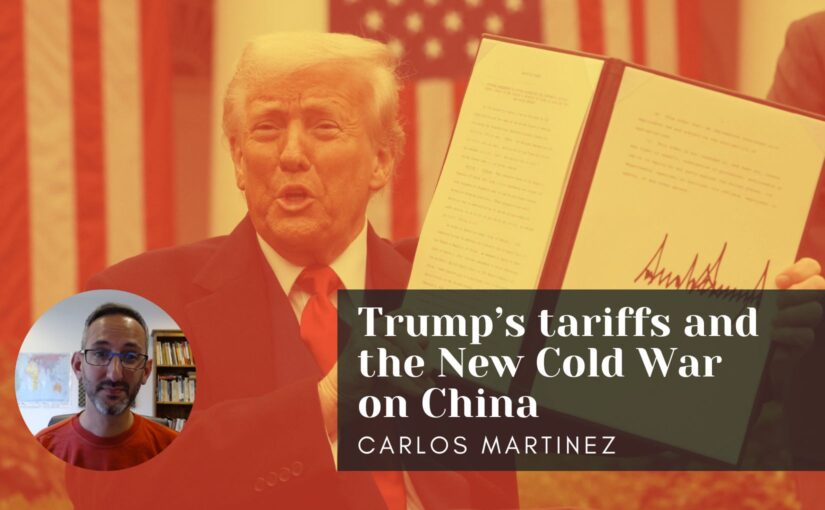
Trump, tariffs and the working class

The two articles below address the tariffs recently announced by the US against China, Canada and Mexico.

The first article, written by Friends of Socialist China advisory group member and International Manifesto Group convenor Radhika Desai, republished from CGTN, points to the cynical economic motives for these tariffs: to rob from the poor to pay the rich. Since the cost of tariffs is passed on to consumers, they constitute a stealth tax on ordinary Americans, and will help make up for the loss of revenue resulting from the Trump regime’s tax cuts for the super-rich.

The cost of the tariffs will be paid by ordinary US consumers. And they will pay in order that the richest US taxpayers can enjoy greater tax cuts, which is the key reason why Trump needs the tariff revenues.

Tariffs will also drive up inflation, further impacting living conditions of the working class.

The putative aim of the tariffs is to bolster US manufacturing. However, “for US capital, given its decades-long reluctance to invest productively at home, it’s going to take a lot more than tariffs. US capital needs to be turned away from the unproductive, predatory and speculative financial ventures in which it is engaged and towards serious productive investment.”

The second article, republished from Workers World, details the likely negative impact of the tariffs on the US economy, and denounces the Trump administration’s threats against the BRICS countries.

Attacks against BRICS are detrimental to workers in G7 countries… BRICS countries are displaying self-sufficiency and independence from Western imperialism and settler colonialism. Relations between China and Russia have also strengthened because of BRICS. Many countries in the Global South have less of a need to trade with the U.S. than they did in previous decades, and therefore they have more leverage to maintain sovereignty.

The article concludes:

Trump’s promotion of tariffs is harmful to workers all over the globe. Imperialist protectionism and isolationism are an obstacle to working-class unity, and they should be opposed. International solidarity is necessary in resisting anti-worker tariffs and defeating the racist, xenophobic “America First” agenda. Workers and oppressed peoples of the world, unite!

Trump’s empty tariff brinkmanship

After days of keeping the world guessing whether he would commit to such a disastrous course, U.S. President Donald Trump has started his trade wars against his country’s three most important trade partners, Canada, Mexico and China.

In announcing the tariffs on exports from these countries, Trump was self-contradictory, claiming they were a negotiating tool designed to deal with U.S. trade deficits, and then that they were not. Their true extent remains unclear: From the apparently blanket tariffs of 25 percent on Canada and Mexico and 10 percent on China, he has already reduced tariffs on oil, natural gas and electricity from Canada to 10 percent, and uncertainty prevails over exactly which goods they will hit, how, and by how much.

The Financial Times called it “a trade war on steroids” while the Washington Post declared it “the dumbest trade war in history.” Many others said these sky-high tariffs could not be expected to last forever.

So, as the world tightens its seatbelt for a bumpy ride through the Trump quadrennial, let’s parse the real wheat from the rhetorical chaff so we can better anticipate the course of the trade wars Trump has started. The key is that Trump’s tariffs are incoherent in conception and applied for the wrong reasons.

Trump is certainly using them as negotiating tools. He claims they are superior to sanctions, which scare other countries from the dollar system he wishes to save. Exactly how adding the weaponization of trade to the weaponization of the dollar is going to help the U.S. is anyone’s guess.

Continue reading Trump, tariffs and the working class

Is DeepSeek China’s Sputnik moment?

In the article below, reprinted from People’s World, CJ Atkins examines the geopolitical significance of the success of China’s DeepSeek R1 model, which has been taking the world by storm in recent weeks, and which was responsible for chip manufacturer Nvidia suffering the biggest ever fall in share price in a single day.

Atkins notes that the Biden administration’s export ban on the most sophisticated microchips has clearly backfired. “The export bans simply spurred Chinese developers to get creative, pushing them to come up with cheaper and more efficient ways of using the older chips they already had access to. They discovered means to train and operate AI models using less memory and less computing power. This resulted in a model that was cheaper to build and less damaging for the planet to operate than those developed by the U.S. tech monopolies.”

Importantly, DeepSeek’s developers made their model open source, allowing anyone to use it for free. “That means they showed their work for the world to see and adapt for further development. Other scientists and coders can build on DeepSeek-R1 to create their own AI models.” The article cites Liang Wenfeng, the founder of DeepSeek, as saying that “our starting point is not the opportunity to make a quick profit, but rather to reach the technical frontier and drive the development of the entire ecosystem”.

The stunning success of DeepSeek’s model highlights the fact that China is now a major player in the global tech industry, and is increasingly setting the pace in terms of innovation. This is testament to the effectiveness of China’s economic model, and calls to mind Deng Xiaoping’s 1984 comment that “the superiority of the socialist system is demonstrated, in the final analysis, by faster and greater development of those forces than under the capitalist system”.

Atkins warns that the DeepSeek phenomenon will likely trigger a deepening of the US’s trade war against China, along with an expansion of its campaign of containment and encirclement. “We can expect a ramping up of military tensions over the long term. The weapons dealers and neocon warhawks will seize the moment to beat the drums of a real war against China. There will be a tightening of U.S. imperialism’s military encirclement of China, and a propaganda onslaught warning of the ‘China threat’ will wash over the American people. Anti-Asian racism will figure prominently, just as it did during the pandemic.”

The article concludes by noting that China’s consistent call is for peaceful coexistence and international cooperation between countries with different social systems. The US and China could and should be working together to push science and technology forward in the service of humanity, but the US ruling class cannot be expected to pursue such a path in the absence of mass pressure. “The tech monopolists will do anything to protect their own profits and power, even if it means keeping the world divided and holding back shared progress.”

In 1978, just months before China initiated the reform and opening up of its economy, Communist Party leader Deng Xiaoping told a meeting of researchers:

“Our science and technology have made enormous progress since the founding of New China…. But we must be clear-sighted and recognize that there is still an enormous gap between our level and that of the most advanced countries and that our scientific and technical forces are still too meager.”

If he were alive to witness the events of the last few days, would Deng be shocked?

The release of the DeepSeek-R1 chatbot, a Chinese-developed large language model (LLM), threw the global artificial intelligence industry into chaos and wiped a trillion dollars off the values of some of the biggest tech corporations on the New York Stock Exchange—overnight.

Is this China’s “Sputnik moment,” comparable in historic significance to the Soviet Union’s inauguration of the space age with the launch of the first artificial satellite in 1957?

Back then, U.S. capitalism made the mistake of assuming that blockading the socialist half of the world via trade walls and embargoes would keep it technologically backward forever. The same error is being made again with China.

No chips for China

Export bans on the most sophisticated microchips that power advanced AI applications, along with chip-making equipment and software, were imposed by the Biden administration in 2022, using “national security” as a justification.

With Trump campaigning last year to go even further, Biden toughened his restrictions in December. The graphics processing units (GPUs) that are the go-to for training AIs like ChatGPT and DeepSeek were put on an export blacklist, forbidden from being shipped to China or companies in third countries that do business with the People’s Republic.

But the U.S.’ economic aggression now appears to have backfired. The export bans simply spurred Chinese developers to get creative, pushing them to come up with cheaper and more efficient ways of using the older chips they already had access to.

They discovered means to train and operate AI models using less memory and less computing power. This resulted in a model that was cheaper to build and less damaging for the planet to operate than those developed by the U.S. tech monopolies.

Continue reading Is DeepSeek China’s Sputnik moment?

Sino-British Concert: East-West Dialogue, Spring Sequence of New Sounds

On February 2, 2025 the ‘Sino-British Concert: East-West Dialogue, Spring Sequence of New Sounds’ was held at London’s Royal Academy of Music. David Peat, Secretary of Friends of Socialist China (FoSC) Britain Committee, attended the event on invitation. The following is his report.

On Sunday 2nd February, visitors to London’s central Shaftesbury Avenue and surrounding streets were able to take part in Chinese New Year (CNY) celebrations. The breadth of China’s historic culture and modern development were all displayed: exuberant traditional ‘Lion Dances’ took place next to China’s cutting-edge high-tech electric BYD vehicles. People could purchase good fortune souvenirs, and enjoy street snacks and the sounds of firecrackers, all along the temporarily pedestrianised thoroughfare. Each year London’s main Chinese New Year celebration, which expanded beyond the bounds of Chinatown proper since the mayoralty of Ken Livingstone, can be enjoyed by both tourists and residents of the capital city. With the recent viral success of the Xiaohongshu [Red Note] app, western users have been able to witness the amazing CNY celebrations that take place all over China, so no doubt some attendees were keen to enjoy that closer to home.

To the west of Chinatown proper, another event was held, which was a stunning display of musical skill and proof that artistic cultures – and cultures in general – benefit from sharing traditions and influence across borders. This event was the Sino-British Concert: East-West Dialogue, Spring Sequence of New Sounds, hosted by the Sino-British Ensemble, the Society for Anglo-Chinese Understanding (SACU), and the UK Beijing Arts Centre.

In attendance at the event was Chinese Ambassador Zheng Zeguang and his wife Counsellor Hua Mei, along with Minister Zhao Fei. Among others present were representatives of organisations that have sought to build connections and understanding between China and the UK, including Special Guest Michael David Wood, historian and SACU President, who is especially known for his book and BBC documentary on China’s iconic Tang dynasty poet Du Fu. Prior to the performances, Professor Wood gave a brief talk outlining the history of musical exchanges between the west and the east and highlighted the ongoing potential for artistic collaboration to build bridges between nations and peoples.

This sold-out event was held in the beautiful Duke’s Hall of the Royal Academy of Music. The program was expansive and diverse, with more than 80 musicians performing 10 ‘dialogues’, in which one piece of music from the western tradition and one from the eastern were performed alternately, or even directly in conversation with one another. The Sino-British orchestra features musicians from China, the UK, India, Germany, Italy, Romania and other countries, and also foregrounded pieces and musical styles from China’s ethnic minority musical traditions.

Chinese President Xi Jinping has highlighted how China in its history has long cherished the notion of “harmony without uniformity.” In a speech at UNESCO headquarters in 2015 titled ‘Exchanges and Mutual Learning Make Civilizations Richer and More Colorful’, President Xi quoted Yan Zi, prime minister of the State of Qi during the Spring and Autumn Period (770-476 BC), who is recorded as observing: “Only by combining the texture, length, rhythm, mood, tone, pitch and style adequately and executing them properly can you produce an excellent melody… Who can tolerate the same tone played again and again with one instrument?”[1] This observation matches the purpose of the concert: appreciating the new connections and possibilities that can be created when diverse musical traditions and peoples are brought into contact. As the enormous interest in apps like RedNote has shown, people in both East and West are intensely curious to make connections with one another, and the results are ‘win-win’ when they do. Events like the Sino-British concert are a wonderful way to establish and strengthen these sorts of links.

For those interested in similar events in future, check SACU’s website at Home – Society for Anglo-Chinese Understanding (SACU)


[1] Xi Jinping, The Governance of China Vol 1, pp. 283 – 289.

China and Nicaragua share experiences and concepts in fighting against imperialism, colonialism and hegemony

The strong fraternal relations between the Communist Party of China (CPC) and the Sandinista National Liberation Front (FSLN) of Nicaragua were underlined in a January 13 meeting in Beijing between Liu Jianchao, Minister of the International Department of the CPC Central Committee (IDCPC), and a delegation led by Fidel Antonio Moreno Briones, Secretary General of the Managua Mayor’s Office and Organisation Secretary of the FSLN.

Liu said, under the strategic guidance and personal promotion of President Xi Jinping and President Daniel Ortega, China and Nicaragua have seen strong development in bilateral relations, and officially established a strategic partnership in 2023, continuously releasing the dividends of the resumption of diplomatic relations. He said, despite different scales, the CPC and the FSLN have always treated each other as equals and respected each other. The two parties have similar experiences and shared concepts in fighting against imperialism, colonialism and hegemony.

Moreno said, since the resumption of diplomatic relations between the two countries fruitful results have been achieved in practical cooperation in various fields, bringing tangible benefits to the Nicaraguan people. The delivery and operation of buses produced in China have boosted the development of Nicaragua’s public transportation system. Nicaragua is willing to continue to strengthen practical cooperation with China in economy, trade, transportation, humanities and other fields. The CPC, a century-old party, has led the Chinese people to make great achievements in poverty alleviation, environmental protection and economic development, providing important inspiration and reference for the FSLN.

Earlier, on January 8, Ma Hui, Vice-Minister of the IDCPC met with a delegation led by Enrique Santiago, Secretary General of the Communist Party of Spain (PCE).

Ma spoke positively of the relations between the two parties and countries, saying that the CPC is willing to deepen traditional friendship with the PCE, strengthen exchanges and mutual learning on state and party governance, enhance political mutual trust between China and Spain and deepen pragmatic cooperation between the two countries through inter-party channels, and promote mutual understanding between the two peoples.

Santiago said, the PCE appreciates the economic and social achievements made by the Chinese people under the leadership of the CPC and is willing to further strengthen inter-party exchanges and cooperation with the CPC, continuously deepen China-Spain comprehensive strategic partnership and jointly contribute to world peace and stability.

The following articles were originally published on the website of the IDCPC.

Liu Jianchao Meets with a Delegation of the Sandinista National Liberation Front (FSLN) of Nicaragua

Beijing, January 13th (IDCPC) — Liu Jianchao, Minister of the International Department of the CPC Central Committee (IDCPC), met here today with a delegation led by Fidel Antonio Moreno Briones, Secretary General of the Managua Mayor’s Office and Organization Secretary of the Sandinista National Liberation Front (FSLN) of Nicaragua.

Continue reading China and Nicaragua share experiences and concepts in fighting against imperialism, colonialism and hegemony