Xi Jinping extends May Day greetings to China’s working people

As China celebrated the May Day holiday, marking International Workers’ Day, Chinese leader Xi Jinping extended his greetings and best wishes to the country’s working people.

In his message, Xi called on working people to actively participate in advancing Chinese modernisation with high-quality development and work tirelessly to promote the building of a strong country and the rejuvenation of the Chinese nation on all fronts. He also asked party committees and government bodies at all levels to earnestly realise, safeguard and develop the legitimate rights and interests of workers.

Also, in a significant development, President Xi replied to a letter from Serbian workers at the HBIS Smederevo Steel Plant. Xi said that during his previous state visit to Serbia in 2016, he met with the workers there face-to-face and deeply felt their support for the mutually beneficial cooperation between China and Serbia, and their high expectations for a bright future of the steel plant.

He continued:

“It is a great pleasure to learn that the steel plant has turned losses into gains quickly after the investment of a Chinese-funded enterprise, with the jobs of more than 5,000 employees guaranteed and thousands of families enjoying a peaceful and happy life.

“The development of the plant cannot be achieved without the dedication and hard work of the workers, who have been working diligently for the quick growth of the steel plant and have written a new chapter for the iron-clad friendship between China and Serbia. I give you ‘the thumbs up.’”

Thirty representatives of the HBIS Smederevo Steel Plant workers wrote a letter to Xi, expounding on the latest development of the plant and its important contribution to improving local people’s wellbeing. They also thanked him for showing care for and facilitating the project. In a recent interview with the CGTN Leaders Talk series, Serbian President Aleksandar Vučić also recalled Xi’s 2016 visit to the steel plant and his care for the project.

Xi’s reply was dated April 29 but released on May Day. The Chinese President is scheduled to make another state visit to Serbia next week, as the second leg of a European visit that will also take him to France and Hungary. His visit to Serbia will coincide with the 25th anniversary of US-led NATO’s bombing of the Chinese Embassy in Belgrade, which claimed the lives of three Chinese citizens and wounded others.

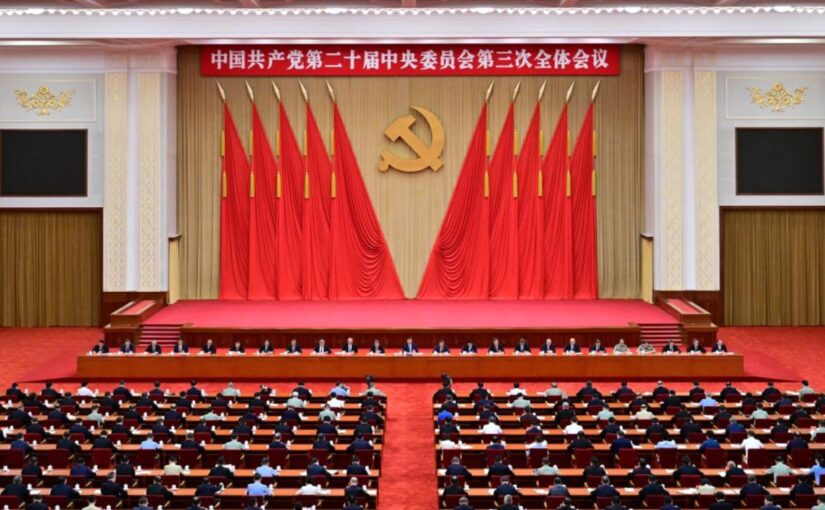
Also on May 1st, an article by Xi Jinping on mobilising China’s hundreds of millions of workers to vigorously take part in the great cause of building a strong country and national rejuvenation was published in this year’s ninth issue of Qiushi, the main theoretical journal of the Communist Party of China (CPC).

According to the article, since the 18th CPC National Congress, the working class has been playing a backbone role in the development of the cause of the Party and the country under the leadership of the CPC Central Committee. The Chinese workers’ movement has made historic achievements, and the work of trade unions has made comprehensive progress.

The article says Chinese workers have taken on significant challenges and shouldered responsibilities in such major work as economic development, scientific and technological innovation, poverty alleviation, rural revitalisation, epidemic prevention and control, and disaster relief.

Trade unions should earnestly safeguard the rights of workers and strive to solve practical problems concerning their vital interests, in particular for workers in new forms of employment.

Besides, Party committees at all levels should strengthen leadership over trade unions and their work, and government bodies at all levels should help trade unions solve workers’ difficulties and problems.

The following articles were originally published by the Xinhua News Agency and on the www.cpcnews.cn website. The latter, which is the full text of the Qiushi article, comprising the main part of General Secretary Xi Jinping’s speech on October 23, 2023, when he spoke with the members of the new leadership team of the All-China Federation of Trade Unions (ACFTU), was published in Chinese and has been machine translated.


Xi extends greetings to working people nationwide ahead of Int’l Workers’ Day

BEIJING, April 30 (Xinhua) — Chinese President Xi Jinping on Tuesday extended festive greetings and best wishes to the country’s working people ahead of International Workers’ Day, which falls on May 1.

Xi, also general secretary of the Communist Party of China (CPC) Central Committee and chairman of the Central Military Commission, sent the greetings on behalf of the CPC Central Committee.

This year marks the 75th anniversary of the founding of the People’s Republic of China and a crucial year to fulfill the goals and tasks set in the 14th Five-Year Plan, Xi said, praising the important contributions made by the working people to the cause of the Party and the country.

Xi called on working people to actively participate in advancing Chinese modernization with high-quality development, and work tirelessly to promote the building of a strong country and the rejuvenation of the Chinese nation on all fronts.

Xi asked Party committees and governments at all levels to earnestly realize, safeguard and develop the legitimate rights and interests of workers, and encourage working people to realize dreams through their work. 


Xi replies to letter from Serbian steelworkers

BEIJING, May 1 (Xinhua) — Chinese President Xi Jinping has replied to a letter from Serbian workers in HBIS Smederevo Steel Plant.

In a letter dated Monday, Xi encouraged them to make new contributions to the China-Serbia friendship.

Xi said that during his state visit to Serbia in 2016, he met with the workers face-to-face at the Smederevo Steel Plant and deeply felt their support for the mutually beneficial cooperation between China and Serbia, and their high expectations for a bright future of the steel plant.

From their letter, Xi said he learned that with the joint efforts of the management teams of both sides and the workers themselves, the steel plant has taken on a new look, providing strong support for the development of Smederevo City.

It is a great pleasure to learn that the steel plant has turned losses into gains quickly after the investment of a Chinese-funded enterprise, with the jobs of more than 5,000 employees guaranteed, and thousands of families enjoying a peaceful and happy life, said the Chinese president.

The development of the plant, he said, cannot be achieved without the dedication and hard work of the workers, who have been working diligently for the quick growth of the steel plant and have written a new chapter for the iron-clad friendship between China and Serbia.

I give you “the thumbs up,” Xi said.

The sound development of the plant is a striking epitome of high-quality Belt and Road cooperation between China and Serbia as well as a paradigm of their mutually beneficial cooperation, he said, adding that the steelworkers are participants, witnesses, contributors to and beneficiaries of China-Serbia friendly cooperation.

“I hope you will continue to do your own jobs wholeheartedly and dedicate yourself enthusiastically to the operation and development of the plant, so as to make new and greater contributions to the socio-economic development of Serbia and the consolidation of the China-Serbia friendship,” Xi said.

Thirty representatives of Serbian workers in HBIS Smederevo Steel Plant wrote a letter to Xi, expounding on the latest development of the plant and its important contribution to improving local people’s wellbeing. They also thanked Xi for showing care for and facilitating the project.


Xi’s article on mobilizing workers to participate in building a strong country, national rejuvenation to be published

BEIJING, April 30 (Xinhua) — An article by Xi Jinping, general secretary of the Communist Party of China (CPC) Central Committee, on mobilizing the country’s hundreds of millions of workers to vigorously take part in the great cause of building a strong country and national rejuvenation will be published on Wednesday.

The article by Xi, also Chinese president and chairman of the Central Military Commission, will be published in this year’s ninth issue of the Qiushi Journal, a flagship magazine of the CPC Central Committee.

Since the 18th CPC National Congress, the working class has been playing a backbone role in the development of the cause of the Party and the country under the leadership of the CPC Central Committee. The Chinese workers’ movement has made historic achievements, and the work of trade unions has made comprehensive progress, according to the article.

The article says Chinese workers have taken on significant challenges and shouldered responsibilities in major work such as economic development, scientific and technological innovation, poverty alleviation, rural revitalization, epidemic prevention and control, and disaster relief.

On the work of trade unions, the article stresses the importance of adhering to the overall leadership of the Party over trade unions, and not wavering or deviating from it at any time or under any circumstances.

Efforts must be made to encourage workers to actively take part in the great cause of building China into a strong country and national rejuvenation on all fronts, the article says, noting that it is necessary to promote the spirit of model workers, the working spirit and craftsmanship.

Trade unions should earnestly safeguard the rights of workers and strive to solve practical problems concerning their vital interests, in particular for workers in new forms of employment, according to the article.

Besides, Party committees at all levels should strengthen leadership over trade unions and their work, and governments at all levels should help trade unions solve workers’ difficulties and problems, the article says.


Organize and mobilize hundreds of millions of workers to actively participate in the great cause of building a strong country and national rejuvenation

Xi Jinping

Since the 18th National Congress of the Communist Party of China, under the strong leadership of the CPC Central Committee, China’s working class has played a major role in the development of the cause of the Party and the country. In the past five years, the broad masses of workers have worked with the party and struggled with the party, and have shown the style of the times in major work such as economic construction, scientific and technological innovation, poverty alleviation, rural revitalization, epidemic prevention and control, emergency rescue and disaster relief.

The All-China Federation of Trade Unions and trade unions at all levels have strengthened the ideological and political guidance of employees, promoted the construction and reform of the ranks of industrial workers, protected the rights and interests of workers, maintained political security in the labor field, deepened the reform of the trade union system, and continuously enhanced the political, advanced and mass nature. The CPC Central Committee has fully affirmed the major contributions made by the working class and the new achievements made in the work of the trade unions.

With regard to the work of trade unions in the coming period, the congress made arrangements. Here, I would like to emphasize a few more points.

First, uphold the party’s overall leadership over trade unions. China’s labor movement has developed under the leadership of the party, and trade unions are mass organizations of the working class under the leadership of the party. We must uphold the party’s overall leadership over trade unions, and we must not waver or deviate from them at any time and under any circumstances. Upholding the party’s leadership is not abstract and vague, and cannot be reduced to a mere formality, but must be comprehensively and effectively implemented in the entire process and in all aspects of trade union work. In particular, in establishing trade unions in new economic organizations, new social organizations, and new employment groups, it is necessary to take a clear-cut stand and uphold the party’s leadership from the very beginning. It is necessary to resolutely safeguard the authority of the Party Central Committee and its centralized and unified leadership, always maintain a high degree of unity with the Party Central Committee in ideology, politics, and action, and ensure the correct direction of trade union work. It is necessary to unremittingly use the ideology of socialism with Chinese characteristics in the new era to forge the soul, continue to promote the theoretical arming to go deeper and more practical, and constantly enhance the ideological consciousness and action consciousness of learning and practicing the party’s innovative theories. It is necessary to keep in mind the “great power of the country”, find out the combination point, entry point and focus point of the trade union work and the central task of the party, promote the implementation of the decisions and arrangements of the party Central Committee in the trade union system, and better play the role of trade unions. It is necessary to strengthen ideological and political guidance, do a good job in the ideological and political work of the workers, educate and guide the broad masses of workers to unswervingly listen to the party and follow the party, and ensure that the working class is always the most solid and reliable class foundation of our party.

Second, organize and mobilize hundreds of millions of workers to forge ahead on a new journey and make contributions to a new era. There are thousands of points in the work of trade unions, and the most fundamental one is to unite the broad masses of workers and workers closely around the party and unite and struggle for the realization of the party’s central tasks. It is necessary to adhere to the fundamental principle of wholeheartedly relying on the working class, fully mobilize the enthusiasm, initiative, and creativity of the broad masses of workers and workers, and actively plunge into the great cause of comprehensively promoting the building of a strong country and the rejuvenation of the nation. It is necessary to focus on implementing the new development concept, building a new development pattern, and promoting high-quality development, carry out various forms of labor and skill competitions extensively and in-depth, stimulate the labor enthusiasm and creative potential of the majority of employees, and give full play to the role of the main force in all walks of life and fields. It is necessary to vigorously carry forward the spirit of model workers, the spirit of labor and the spirit of craftsmen, give full play to the exemplary and leading role of model workers and craftsmen, and encourage the majority of employees to achieve their dreams in hard work, honest work and creative labor. It is necessary to focus on the in-depth implementation of the strategy of rejuvenating the country through science and education, the strategy of strengthening the country with talents, and the strategy of innovation-driven development, deepen the reform of the construction of the contingent of industrial workers, accelerate the construction of an army of knowledge-based, skilled, and innovative industrial workers, and train and bring up more craftsmen and high-skilled personnel of major countries.

Third, do a good job of rights protection services with heart and affection. Chinese modernization is the modernization of common prosperity for all people. The working class and the broad masses of laborers are the main creators of social wealth, and the more obvious and substantive progress in promoting the common prosperity of all the people should first be embodied in the hundreds of millions of laborers. As representatives and defenders of the interests of workers, trade unions should conscientiously perform their basic duties of rights protection services, strive to solve practical problems related to the vital interests of the masses of workers, and pay special attention to safeguarding the legitimate rights and interests of workers in new forms of employment. It is necessary to strengthen the democratic management of enterprises and institutions, smooth the channels for the expression of employees’ demands, guide employees to express their interests in a rational and orderly manner in accordance with the law, protect their own rights and interests, and promote the construction of harmonious labor relations.

Trade unions are the homes of workers, and trade union cadres are the “mother’s family” of workers. It is necessary to continue to deepen the reform and construction of trade unions, firmly establish a clear orientation of grasping the grassroots in a big way, consolidate the foundation of the grassroots level, stimulate the vitality of the grassroots level, and continuously enhance the leadership, organization, and service capacity of the grassroots trade unions. It is necessary to improve the existing organizational foundation, continue to promote the establishment and membership of new economic organizations, new social organizations, and new employment groups, and expand the coverage of trade union organizations. It is necessary to innovate the way of working and strive to provide accurate and intimate services for the masses of workers. Trade union cadres should practice the party’s mass line, conduct in-depth investigation and research, keep abreast of what employees are thinking, thinking and expecting, constantly enhance their ability to serve employees, and sincerely speak and do things for employees. As the leading organ of trade unions at all levels, the All-China Federation of Trade Unions should take the lead in strengthening self-building, be a benchmark and set an example, and become a model political organ that reassures the party and satisfies the people.

Party committees (leading party groups) at all levels should strengthen their leadership over trade unions and trade union work, properly select and strengthen trade union leadership groups, show warm concern for and set strict demands on trade union cadres, and attach importance to the training and use of trade union cadres. It is necessary to pay attention to giving play to the role of trade union organizations, promptly study the important problems encountered by the masses of workers and trade unions, and support trade unions in carrying out their work in a creative manner. Governments at all levels should give full play to the role of the joint conference between the government and the trade unions, and actively help the trade unions resolve the practical difficulties and problems of the masses of workers.

This is the main part of General Secretary Xi Jinping’s speech on October 23, 2023, when he spoke with the members of the new leadership team of the All-China Federation of Trade Unions.

China, Tanzania celebrate 60 years of diplomatic relations

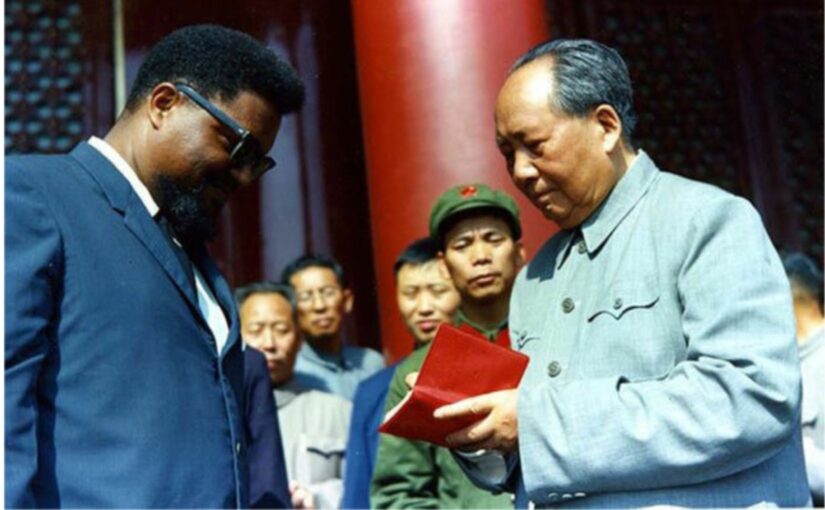
China and Tanzania have celebrated the 60th anniversary of their establishment of diplomatic relations. Tanzania has always enjoyed particularly close and friendly relations with China, which were forged by Chairman Mao Zedong, Premier Zhou Enlai and President Julius Nyerere.

Marking the 60th anniversary, on April 26, President Xi Jinping exchanged messages with his Tanzanian counterpart Samia Suluhu Hassan.

Noting that the traditional friendship between China and Tanzania was forged by the elder generations of leaders of the two countries, Xi said that in recent years, political mutual trust between the two countries has been continuously consolidated, and cooperation in various fields has yielded fruitful results, which has become a model of South-South cooperation.

For her part, Hassan said over the past 60 years since the establishment of bilateral diplomatic relations, the two countries have continuously deepened solidarity, friendship and sincere cooperation, adding that both sides respect each other’s sovereignty and territorial integrity, as well as support each other in bilateral and multilateral affairs. Tanzania, she added, admires China’s epoch-making achievements in economic and social development.

Earlier, on April 15, the two countries held a joint celebration of the anniversary in the former Tanzanian capital of Dar es Salaam. 

Speaking there, Chinese Ambassador to Tanzania Chen Mingjian said that in the 1960s, when national liberation movements were in full swing in Africa, China stood firmly with Tanzania and other African countries and forged a profound friendship with them.

The following articles were originally published by the Xinhua News Agency.

Xi exchanges congratulations with Tanzanian president over 60th anniversary of ties

BEIJING, April 26 (Xinhua) — Chinese President Xi Jinping on Friday exchanged congratulations with Tanzanian President Samia Suluhu Hassan over the 60th anniversary of bilateral diplomatic ties.

In his message, Xi pointed out that the traditional friendship between China and Tanzania was forged by the elder generations of leaders of the two countries.

Over the past 60 years since its establishment, the bilateral relationship has withstood the test of international vicissitudes and grown stronger, he added.

In recent years, political mutual trust between the two countries has been continuously consolidated, and cooperation in various fields has yielded fruitful results, which has become a model of South-South cooperation, Xi noted.

Standing at a new historical starting point, Xi said he is ready to work with Hassan to renew bilateral traditional friendship, turn the shared dream of developing and rejuvenating their two countries, as well as the magnificent chapter of bilateral Belt and Road cooperation a reality, continue to enrich the connotation of the comprehensive strategic cooperative partnership between the two countries, and make greater contributions to building a high-level China-Africa community with a shared future.

For her part, Hassan said over the past 60 years since the establishment of bilateral diplomatic relations, the two countries have continuously deepened solidarity, friendship and sincere cooperation, adding that both sides respect each other’s sovereignty and territorial integrity, as well as support each other in bilateral and multilateral affairs.

Tanzania admires China’s epoch-making achievements in economic and social development, deeply appreciates China’s support in the field of development, and will unswervingly support major initiatives such as the Belt and Road Initiative and the Global Development Initiative, so as to strengthen the comprehensive strategic cooperative partnership between the two countries, she said.


China, Tanzania celebrate 60 years of diplomatic relations

DAR ES SALAAM, April 15 (Xinhua) — China and Tanzania held a reception in the Tanzanian port city of Dar es Salaam on Monday to celebrate the 60th anniversary of the establishment of diplomatic relations between the two countries.

The celebrations, braced by Tanzanian Minister for Foreign Affairs and East African Cooperation January Makamba and Chinese Ambassador to Tanzania Chen Mingjian, were also attended by overseas Chinese in Tanzania and Tanzanian government officials.

The reception was highlighted by a photo exhibition, jointly organized by the Chinese embassy and Xinhua News Agency, depicting the practical cooperation between the two countries over the past 60 years.

Makamba said the friendship between the two countries has withstood the test of time and the relationship is much stronger today.

Chen said the past 60 years have marked a period of solidarity and unity between China and Tanzania, characterized by sincere cooperation, common development and shared ideas, as well as mutual support.

She said in the 1960s, when national liberation movements were in full swing in Africa, China stood firmly with Tanzania and other African countries and forged a profound friendship with them.

On April 26, 1964, the People’s Republic of China and the United Republic of Tanzania formally established diplomatic relations. 

Vice Foreign Minister Chen Xiaodong attends South Africa’s Freedom Day reception

Chinese Vice Foreign Minister Chen Xiaodong joined the South African Embassy in Beijing on April 26 to celebrate Freedom Day, the 30th anniversary of South Africa’s first democratic elections which marked a formal end to the racist apartheid regime.

Addressing the reception, Chen, who until his recent appointment as Vice Foreign Minister was serving as China’s Ambassador to South Africa, expressed congratulations on the 30th anniversary of the founding of South Africa and spoke highly of South Africa’s development achievements and contribution to world prosperity and stability. The Chinese side stands ready to work together with the South African side to jointly create a better future for China-South Africa and China-Africa relations, he said.

South African Ambassador to China Siyabonga Cyprian Cwele thanked the Communist Party of China and the Chinese people for their important contributions to bilateral relations and highly appreciated President Xi Jinping’s successful visit to South Africa again in August last year.

The following article was originally published on the website of the Chinese Foreign Ministry.

On April 26, 2024, Vice Foreign Minister Chen Xiaodong, upon invitation, attended and addressed the Freedom Day reception hosted by the Embassy of South Africa in China.

Chen Xiaodong expressed congratulations on the 30th anniversary of the founding of South Africa and spoke highly of South Africa’s development achievements and contribution to world prosperity and stability. He said that in recent years, under the strategic guidance of President Xi Jinping and President Matamela Cyril Ramaphosa, bilateral relations have achieved leapfrog development, starting a new era of building a high-level China-South Africa community with a shared future. In September this year, the Forum on China-Africa Cooperation will be held in Beijing. The Chinese side stands ready to work together with the South African side to jointly create a better future for China-South Africa and China-Africa relations.

South African Ambassador to China Siyabonga Cyprian Cwele thanked the Communist Party of China and the Chinese people for their important contributions to bilateral relations and highly appreciated President Xi Jinping’s successful visit to South Africa again in August last year. He said that South Africa-China cooperation in various fields has great potential and that the South African side stands ready to work with the Chinese side to strengthen political, economic, people-to-people and cultural exchanges between the two countries and achieve greater development of the South Africa-China comprehensive strategic partnership.

China hosts dialogue between Palestinian factions

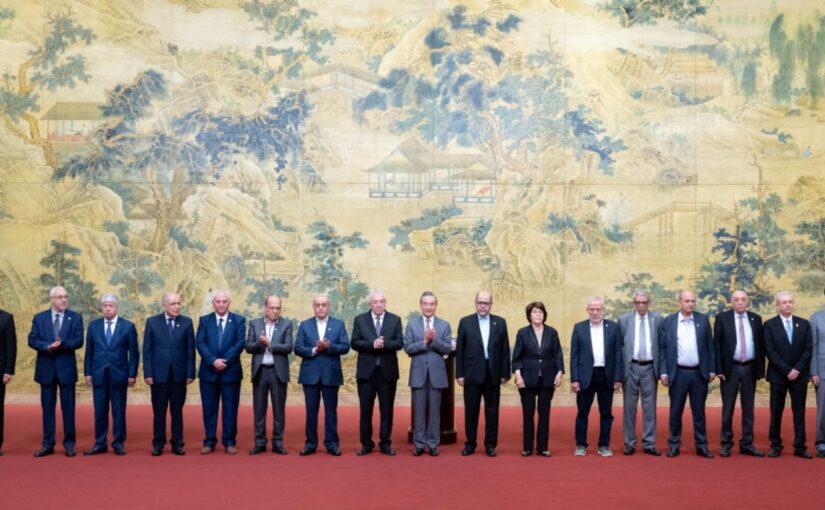
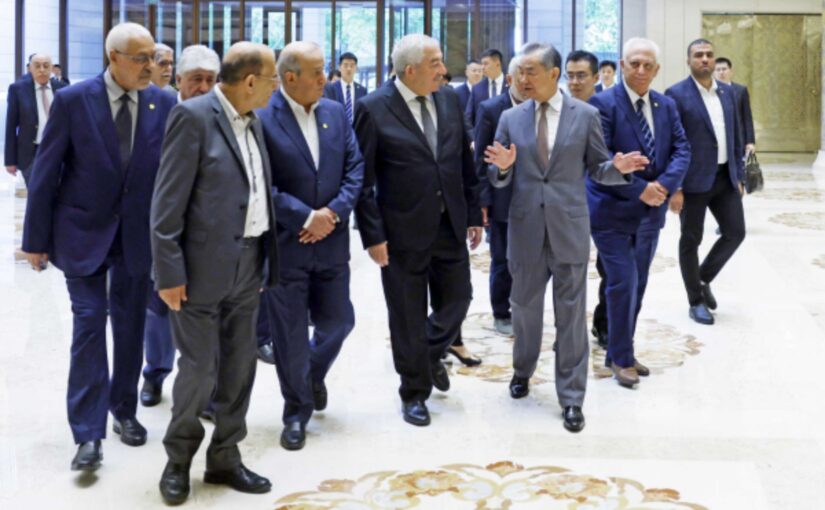
As part of its support for the just struggle of the Palestinian people, and to encourage and facilitate unity in the ranks of the Palestinian liberation movement, China hosted talks between Fatah and the Islamic Resistance Movement Hamas in Beijing on April 26.

Little news has been published with regards to the talks. However, on the same day, in response to a media question, Chinese Foreign Ministry spokesperson, Wang Wenbin, at the ministry’s regular press conference, noted that China supports all Palestinian factions in achieving reconciliation and increasing solidarity through dialogue and consultation.

At the April 30 press conference, spokesperson Lin Jian added:

“At the invitation of the Chinese side, representatives of the Palestinian National Liberation Movement (Fatah) and the Palestinian Islamic Resistance Movement (Hamas) recently came to Beijing to have in-depth and candid dialogue on promoting Palestinian reconciliation. The two sides fully expressed their political will of realising reconciliation through dialogue and consultation, had discussions on many specific issues, and made encouraging progress. They agreed to continue this dialogue process so as to achieve Palestinian solidarity and unity at an early date. They highly appreciated China’s firm support for the just cause of the Palestinian people in restoring their legitimate national rights, thanked the Chinese side for its efforts to help strengthen Palestinian internal unity, and reached agreement on ideas for future dialogue.”

Also on April 26, China’s top diplomat, Foreign Minister Wang Yi gave a written interview to the Qatar-based Al Jazeera Media Network.

Wang stated that the protracted conflict in Gaza has become a humanitarian catastrophe that should not have happened, adding that it has gone far beyond the bottom line of modern civilisation. The overriding priority is to realise a ceasefire as soon as possible:

“Even one more day of delay would mean further violation of human conscience and more erosion of the cornerstone of justice.”

Regarding the UN Security Council calling for a ceasefire, he noted that “the resolution is legally binding, and should be enforced effectively to achieve an unconditional and lasting ceasefire right away.”

The foreign minister went on to say that unimpeded humanitarian assistance must be ensured at all times, describing this as a “pressing moral obligation.” China has firmly opposed forced transfer of Palestinian civilians and collective punishment against people in Gaza since the beginning of the conflict and continuously provided humanitarian assistance to Gaza.

The historical injustice done to the Palestinian people must be redressed in a timely fashion, he said, adding that this is the right way to address the root cause of the conflict in Gaza. The Gaza calamity shows once again that the perpetual denial of the legitimate national rights of the Palestinian people is the root cause of the Palestinian question, and it is also the core issue of the Middle East question. 

In a highly significant passage, he added:

“China will continue to strengthen solidarity and cooperation with Middle East countries and the whole international community to firmly support the just cause of the Palestinian people in restoring their legitimate national rights; firmly support internal reconciliation among different factions of Palestine through dialogue; firmly support Palestine’s full membership in the United Nations at an early date; and firmly support establishing the independent State of Palestine and realising ‘the Palestinians governing Palestine.’ (Emphasis in Foreign Ministry original.)

Wang Yi also addressed a number of other major international issues.

Regarding the conflict in Ukraine, he again said that it is imperative to address both symptoms and root causes. Alluding to the steady encroachment of US-led NATO on Russia, he said: “To uproot the crisis, we must dive deeper into the question of security. Pursuing unilateral or absolute security by willfully compressing the security space of others will inevitably tip the balance of power in the region and give rise to conflicts.”

On Taiwan, he reiterated China’s long-standing and consistent position that: “We will strive for peaceful reunification with the utmost effort and greatest sincerity. In the meantime, our bottom line is also clear: we will absolutely not allow anyone to separate Taiwan from China in any way.”

He went on to note that “some countries are giving ‘Taiwan independence’ separatist elements more and more weapons behind the scenes, in stark contrast to their calls for peace and stability of the Strait. These moves will only increase the risk of conflict and confrontation, and seriously undermine peace and stability in the Strait and the region as a whole. China will not sit on its hands [in the face of] external disruptions… As President Xi Jinping has stressed, complete reunification of our motherland is the shared aspiration of the people, the trend of the times and a historical inevitability, and no force can stop it. China will ultimately achieve complete reunification, and Taiwan is bound to return to the embrace of the motherland.”

Turning to prospects for relations between China and the United States, he said that despite the agreements reached between the two heads of state at their meeting in San Francisco last November, “the United States still sticks to its misperception of China and presses ahead with its misguided policy to contain China. It has recently continued to woo its so-called allies in an attempt to provoke tensions at sea in the region and build networks to contain China at a faster pace. It has kept ratcheting up its unilateral sanctions and gone all out to constrain China’s development of science and technology. The United States should not view the world through the lens of Cold War and zero-sum mentality, and it should not say one thing but do another. The people of the world have clear eyes, and even more so for the Middle East people who can see easily who is on the right side of history and justice.”

The following articles were originally published by the Xinhua News Agency and on the website of the Chinese Foreign Ministry.

Continue reading China hosts dialogue between Palestinian factions

China’s ‘12345’ government service hotline – serving the people

The first exclusive Friends of Socialist China delegation took place from 14 to 24 April 2024. The delegation’s first site visit was to the was to the Beijing headquarters of the ‘12345’ government service hotline, where 1,500 employees – mostly CPC members – work in shifts over 24 hours to provide a single point of access for any and all problems and queries – for example, rubbish being left on the street, heating not working, older people not receiving food deliveries. In the article below, Morning Star international editor Roger McKenzie – one of the delegates – notes that some people even called the hotline “because they were concerned about the unequal distribution of bamboo shoots to the world-famous pandas at the zoo.”

Roger writes: “All calls are answered within 15 seconds and a guarantee is given that your concern, question or complaint, will be addressed within seven days. Calls are passed on to local authorities as appropriate to deal with the issue. Anyone who calls will get a call back to tell them what has been done and be given the opportunity to confirm whether the issues have been resolved to their satisfaction.”

The 12345 service, which has been rolled out across China, is tremendously popular with its users. Its efficiency connecting problems to solutions is aided by extensive use of artificial intelligence.

The article compares the 12345 hotline with the near-impossibility of contacting public services in Britain. “Sometimes we just need a bit of advice but get the runaround and passed to people whose main job appears to be not to add unnecessarily to their already hefty workload. A workload increasing by the year as they do the job that used to be done by two or three others before the cutbacks.”

The 12345 hotline is a great example of the Chinese government’s commitment to serving the people and demonstrates the practical application of the CPC’s founding ethos in a modern setting.

This article was first published in the Morning Star on 23 April 2024.

Public service cuts are sweeping across Britain. Essential services are being cut to the bone and, in many areas, have disappeared altogether.

A number of councils, including the largest, Birmingham, have even had to declare bankruptcy.

In Britain, if there is no budget to meet the people’s needs then the services have to go.

Meanwhile, in China, responding to the needs of the people rather than the needs of the budget is the priority.

Some people will read what I have just said and shout: “That it’s just Chinese propaganda!” Not so. Unlike many of those quick to disparage “socialism with Chinese characteristics” as some kind of sloganising nonsense, I have bothered to go and see it for myself.

As many of you will know, I worked for many years in the leadership of the country’s largest public services union. Even though I left the organisation, I am still interested in how public services are delivered, and make a point on any working visit to investigate this for myself.

One thing that I have always been interested in is how public service organisations respond to requests or complaints about their services.

Many of us have been hanging on the telephone for a public service either waiting for someone to answer or left in that hell-hole of canned, plastic, easy-listening music otherwise known as “the queue.” We are often left frustrated and wondering whether to complain about the service or lack thereof.

Sometimes we just need a bit of advice but get the runaround and passed to people whose main job appears to be not to add unnecessarily to their already hefty workload. A workload increasing by the year as they do the job that used to be done by two or three others before the cutbacks.

The Chinese dealt with all of these problems by setting up the 12345 helpline in 1987. The helpline is a phone and online system that anyone in China, including visitors, can use to ask questions or make complaints.

Businesses can also use the helpline to get advice on things such as relocation, name changes, etc. In fact it seems to me you can use the hotline to ask about pretty much anything.

At the 12345 centre, one of our Friends of Socialist China delegation was asked to call the number and ask a question.

Francisco Dominguez said he was at our hotel and needed to get a taxi to take him into central Beijing.

The operator patiently advised him what to do. The call was logged and went into a system that would follow any trends.

Dominguez said: “The response was very quick although they were surprised by the request.

“They spoke in English which was helpful. Within seconds they got back with a number and an alternative to call.”

He added: “It was a very efficient service.”

It was clear that most calls were about far more serious things than the need for a taxi.

Calls covered issues ranging from rubbish collection, getting a lift fitted or repaired and enquiries about official papers.

Some people did call in because they were concerned about the unequal distribution of bamboo shoots to the world-famous pandas at the zoo.

All calls are answered within 15 seconds and a guarantee is given that your concern, question or complaint, will be addressed within seven days. Calls are passed on to local authorities as appropriate to deal with the issue.

Anyone who calls will get a call back to tell them what has been done and be given the opportunity to confirm whether the issues have been resolved to their satisfaction.

Around 1,500 staff work in shifts over 24 hours. The numbers on duty can be varied to take into account predicted hotspots such as major sporting events.

All members of staff are part of the nearly 100 million members of the Communist Party of China — putting the party at the service of the people in a very practical way. Each call is recorded and keywords are used to help identify trends which are fed through to national and local authorities to address.

Delegation member Russel Harland is a public service worker in Surrey. He said: “When I saw the hotline in action I was overwhelmed because I’ve worked in a similar job for a number of years to give advice on social care among other issues but also as someone who has worked for the Alzheimer’s society as a dementia adviser.

“We saw something in action which was about resolving issues by getting to the crux of the problems that people were having.

“The intention was to solve these issues rather than avoid them but also to carry out an evaluation so the issues don’t happen again.”

Harland said public service workers in Britain were overwhelmed by endless budget cuts and said he couldn’t help thinking as a public servant, “How can we get our politicians and planners to start looking more closely at schemes like this?”

Rashida Islam, a delegation member from Halifax, said: “I was particularly struck by 12345’s dedication to serving people and was also very interested by how this platform is used to shape some of the nation’s policies.”

Co-founder of the Black Liberation Alliance Fiona Sim said: “I was really impressed with how the people are being connected with the government and the Communist Party.

“I just had to think about all the elderly people, disabled people people who are vulnerable and might not have been able to reach out for help or reach out for support in any other ways.

“So I feel the 12345 hotline really provides a crucial lifeline to the world not just for material needs but also for emotional and psychological wellbeing.”

There is little doubt that this nationwide service available to the 1.4 billion population and anyone who visits is about being people-centred rather than budget-centred.

It is also about making sure that the CPC does not lose sight of its mission to put itself at the service of the people.

This fits entirely with the view of Chinese revolutionary Qu Qubai who said in 1927 that the theory of revolution can never be divorced from the practice of revolution and that the “work of applying Marxism to China’s national conditions cannot be delayed for a day.”

Applied today this must mean making sure that the people have the best possible services in place to enable them to get by every day. The 12345 hotline is an important and very popular part of building the Chinese revolution.

Taiwan: An Anti-Imperialist Resource

Qiao Collective, a diaspora Chinese media collective challenging US aggression against China, published in February of this year an “Anti-Imperialist Resource” on the topic of China’s Taiwan province, the island’s history and its place in contemporary and 20th-century geopolitics. The resource contains a useful introduction, which is reprinted below, alongside a detailed timeline, and links to contemporary “left pro-unification” articles, summaries of economic issues, statistical analysis of public opinion, and other resources to aid understanding. This resource is the latest in a series of reading lists on topics related to contemporary China, and particularly ‘hot button’ issues frequently weaponised against China in Western media. The full list can be accessed here.

Below, Friends of Socialist China reprints the resource’s introduction, and encourages readers to explore and utilise the extensive collection of materials to gain a full understanding of the complexities of cross-straits relations, and the winding road of China’s path of reunification, which is an essential element of its projects of national rejuvenation and overcoming the legacy of colonialist and imperialist interference.

The historical context provided here is particularly useful while the current administration of Taiwan province is engaging in various forms of historical obscurantism: whitewashing the crimes of the period of Japanese occupation, while at the same time hiding the reality of the period of the Nationalist KMT’s “white terror” and military dictatorship, with martial law lasting until 1987. The introduction notes that “proponents of Taiwan independence rely on an overlapping revisionist toolkit that elides the historical context of unresolved civil war.” The full resources also importantly highlight that pro-reunification voices and organisations continue to exist on Taiwan province (despite concerted violent suppression campaigns), and that when the population are surveyed, ‘independence’ is not the preferred option for the majority. 

The introduction stresses that a proper understanding of historical context, and awareness of arguments of contemporary pro-reunification activists, can help readers unpick the frequent use of “left” language, such as that of ‘settler-colonialism’, employed by liberal advocates of independence to obscure the reality of Taiwan’s position in the intrigues of imperialism. As the CPC has asserted on many occasions, reunification will be a benefit to Chinese on both sides of the straits, stating in a recent white paper on the topic: “The future of Taiwan lies in China’s reunification, and the wellbeing of the people in Taiwan hinges on the rejuvenation of the Chinese nation, an endeavor that bears on the future and destiny of the people on both sides.” 

The collection of materials “serves as a starting point for understanding China’s aspirations for national reunification and Taiwan’s overdetermined status as an ‘unsinkable aircraft carrier’ for Western ideological, economic, and military power in Asia and the Pacific.”

Introduction

In the Western imagination, Taiwan exists as little more than a staging ground for ideological war with the People’s Republic of China—a crossroads of democracy versus authoritarianism, Western values versus Chinese backwardness, and free market capitalism versus closed-door communism. Yet for centuries, the island of Taiwan has played a rich and pivotal role in broader Chinese history. Located just one hundred miles from the mainland’s southeastern coast, Taiwan was linked to the mainland through migration, trade, language and culture long before European and Japanese colonizers seized on its strategic location as a launchpad for economic and military forays against China at large. Today, this history continues as U.S. imperialism positions Taiwan as an ideological and military base for its new Cold War against China.

Taiwan’s separation from the Chinese mainland began in 1895, when the Qing government was forced to cede Taiwan to Japan after its defeat in the First Sino-Japanese War. While Japan’s surrender at the end of World War II legally restored Chinese sovereignty over Taiwan, the Chinese civil war and the global Cold War once again rendered Taiwan an instrument for imperial ambitions against China. For the ascendant postwar United States, the 1949 establishment of the PRC under the Communist Party of China marked the “loss of China”—a blow that was partially recouped by propping up the fleeing Chiang Kai-shek government in Taiwan as “Free China.” In 1950, as the U.S. waged war to prevent the socialist unification of Korea, President Harry Truman dispatched the U.S. Navy’s Seventh Fleet to the Taiwan Strait to similarly foreclose the possibility of a unified socialist China. The legacy of that militarized division remains today, as the U.S. enforces the separation of Taiwan from the PRC through multibillion-dollar arms sales, menacing war games, and a concerted propaganda drive which together undermine the possibility of peaceful reunification. This bipartisan campaign of hybrid warfare has intensified over the last fifteen years, following China’s rise as a major power, the corresponding U.S. Pivot to Asia, and the era of “decoupling” pursued by both the Trump and Biden administrations. As the U.S. military declares the Pacific its primary theater of war, successive U.S. administrations have marshaled enormous economic, military, and ideological resources to build up Taiwan as a focal point for this new Cold War. This program violates the letter of the one-China principle and the spirit of the United States’ own “one-China policy,” which together have formed the basis for bilateral relations since 1979. Furthermore, they neglect the centuries-long shared history of Taiwan and its people with their neighbors across the strait.

Just as Western colonialism was once justified as a “civilizing mission,” U.S. imperial designs on Taiwan and China at large march under the banner of promoting “democracy” and defending the international “rules-based order.” The U.S. claim to be acting in defense of Taiwan’s “vibrant democracy” from Chinese authoritarianism is particularly ahistorical, given that the United States is responsible for propping up the Kuomintang (KMT) military dictatorship under Chiang and his successors for almost forty years. Meanwhile, despite grandiose language about U.S. global leadership, the reality is that the majority of the world understands cross-strait relations to be an internal matter for China. Only eleven UN member states maintain formal diplomatic relations with Taiwan (as the Republic of China), and no country recognizes Taiwan as an independent nation. This fact is unsurprising; UN recognition of the PRC as the legitimate representative of China came on the wings of overwhelming support from the Third World. Having experienced the genocidal violence and economic exploitation inherent to the Western imperial system, the Global South, like China itself, adheres to the tenets of sovereignty and non-interference. 

Though ideologically diverse, proponents of Taiwan independence rely on an overlapping revisionist toolkit that elides the historical context of unresolved civil war shaping the cross-strait relationship. Instead, China’s aspirations for national unity are cast in terms of imperialism and expansionism. The era of KMT martial law is counterfactually invoked as precedent for authoritarian Chinese encroachment, obscuring the historical KMT-CPC rivalry and the role of the U.S. in supporting the military dictatorship. Meanwhile, the history of Japanese colonialism has been systematically revised to present a relatively “benign” rule that forms the bedrock for a non-Chinese local identity. Claims that Taiwan’s democracy has “voted out” reunification as a political pathway omit the crucial context that the island’s most vocal left-wing supporters of unification were systematically purged, jailed, and murdered under Japanese colonialism and KMT rule. Efforts to co-opt Taiwan’s yuánzhùmín, or indigenous peoples, into the project of Taiwan independence rely on a similar level of obfuscation; despite the separatist camp’s appropriation of decolonial rhetoric, yuánzhùmín have historically been apathetic towards the pro-independence Democratic Progressive Party (DPP). And in spite of attempts to stake Taiwan separatism to a schema of ethnic difference, official demographics list 95% of Taiwan’s population as being Han Chinese, the majority ethnic group of the Chinese mainland.

While those on the left may be (rightfully) skeptical of elite rhetoric of freedom and democracy, this rhetoric of Chinese imperialism, settler colonialism, and ethnic chauvinism may be harder to parse for those unfamiliar with Taiwan’s history. Yet, whether it is couched in the moralizing language of classic Cold Warriors or self-styled leftists, Taiwan independence ultimately serves the material interests of Western imperialism. Like the European and Japanese imperialists that colonized Taiwan for access to Chinese trade from the 17th through the 20th century, the United States transparently envisions the island as an outpost for efforts to contain China militarily and decouple from it economically. More than 70 years since U.S. military leader Douglas MacArthur described Taiwan as an “unsinkable aircraft carrier” in the nation’s Cold War against China, Taiwan remains a crude asset for U.S. military realpolitik. It is the linchpin of the so-called first island chain that links the 400 U.S. military bases spread across Asia and the Pacific and, crucially, home to Taiwan Semiconductor Manufacturing Company, the world’s largest advanced semiconductor chip manufacturer. Lofty narratives of Taiwan independence thus ultimately fuel consent for militarization, intervention, and war while marginalizing anti-imperialist voices for diplomacy and peace. They also disguise the true intent of retaining Taiwan as a neocolonial outpost of Western empire to undermine China’s sovereign economic development. There is no “independence” in becoming a U.S. client regime entrapped in a capitalist world order. It would set a precedent for any country, large or small, that challenges U.S. hegemony to be balkanized with impunity. For the left to support such an outcome would be self-sabotage on an epic scale, regardless of the titanic politico-economic shifts on both sides of the strait since the Chinese Revolution of 1949.

The modern-day context around cross-strait relations is complex and evolving, and the lives of Chinese people on both sides of the Taiwan strait have been negatively affected by centuries of imperialism. We recognize that there is no perfect, clear-cut path to development after colonization and civil war, but insist on China’s right to defend its sovereign project of socialist construction. Cross-strait relations should be debated and resolved on Chinese terms and in Chinese dialogues only. They should not be used as crude ammunition in the U.S.-led geopolitical assault on China.

This syllabus includes a condensed timeline of Taiwan’s history to provide historical context to contemporary discussions about China, as well as a list of resources that highlight key aspects of cross-strait relations and history. It is not intended to be comprehensive in scope, for Taiwan’s place in Chinese history extends far beyond the recent centuries of Western and Japanese imperialism in Asia. Nor is it intended to offer simple answers to questions about mainland China and Taiwan. It aims only to be a starting point for critical inquiry, and we urge readers to seek a diversity of sources and form their own opinions. A more detailed understanding requires further study into Taiwan’s history, cross-strait relations, Chinese politics, and ongoing geopolitical developments.

The full resource can be accessed here.

China and Global Development: podcast interview with Carlos Martinez

In the video embedded below, Carlos Martinez, co-editor of Friends of Socialist China, speaks to Jason Smith on the latter’s “The Bridge” podcast about a range of topics concerning China.

The two discuss the rationale for the formation of Friends of Socialist China; China’s achievements in poverty alleviation, environmental protection, and the fight against Covid-19; the nature of China’s political system; the slanders in the Western media about human rights in Xinjiang; the Belt and Road Initiative; China’s role promoting development in the Global South; the accusations around “debt trap diplomacy”; and the prospects for improving relations between China and the West.

The Bridge podcast can be found on Apple Podcasts, Spotify and YouTube.

Asian ‘Nato’ encircles China

Writing in the Morning Star, Fiona Edwards provides a useful and detailed analysis of recent developments in the US-led campaign of China encirclement.

Fiona describes a number of alarming steps taken by the US in the month of April: the announcement of a proposal for Japan to join AUKUS; a trilateral agreement between the US, Japan and the Philippines; and the first joint naval and air drills between the US, Australia, Japan and the Philippines in the South China Sea. Fiona observes that “these new initiatives aim to bolster the US’s already substantial military encirclement of China, threatening to destabilise the region and lay the foundations for a US-led hot war against China.”

The US has appointed itself “the world’s policeman”, and uses this role to justify its increasing militarisation of the South China Sea, claiming a responsibility to preserve freedom of navigation. One small detail is that there is not a single case of China having impeded freedom of navigation. Meanwhile, as Fiona points out, “the South China Sea is 12,000 kilometres away from the US … Beijing is not conducting naval exercises off the coast of California and has no military bases surrounding the US.”

Recent foreign policy shifts by the Philippines and Japan are particularly dangerous. As the article points out, the previous Filipino administration pursued a policy of neutrality which served to facilitate win-win cooperation between the Philippines and China and contributed to the cause of peace in the region. Meanwhile, “the plan to invite Japan into Aukus threatens to escalate Japanese militarism and encourage Japan to move even further away from its post-War World II pacifist constitution.”

The article correctly concludes: “The US’s increasing militarisation of the Asia-Pacific is a key component of Washington’s global war drive. It should be vigorously opposed by all those who want to stop the US dragging everyone into another world war.”

Major new announcements this month indicate that the US is intent on escalating its military interference in the Asia-Pacific and the seas around China.

The first announcement by the defence ministers of the US, Britain and Australia on the April 8 2024, revealed that the Aukus military alliance is seeking to expand with plans to invite Japan into the anti-China pact.

This was followed by another announcement, three days later, at a summit in Washington between the US President Joe Biden, Prime Minister of Japan Fumio Kishida and the President of the Philippines Ferdinand Marcos Jnr, where a new trilateral agreement between the countries was unveiled, including plans to conduct joint naval exercises in the South China Sea this year.

Days before this announcement, on April 7, the first joint naval and air drills between the US, Australia, Japan and the Philippines took place in the South China Sea.

These new initiatives aim to bolster the US’s already substantial military encirclement of China, threatening to destabilise the region and lay the foundations for a US-led hot war against China.

Continue reading Asian ‘Nato’ encircles China

Friends of Socialist China delegation returns from China

The first exclusive Friends of Socialist China (FoSC) delegation has just returned from a 10-day visit to the People’s Republic of China.

Invited by the China NGO Network for International Exchanges (CNIE), which works under the direction of the International Department of the Central Committee of the Communist Party of China (IDCPC), 14 comrades (11 from Britain, two from the United States and one from Ireland) visited Beijing, Hangzhou and Jiaxing (Zhejiang province), and Changchun and Siping (Jilin province) from April 14-24. Our packed program featured visits to public service and community facilities, historic revolutionary sites and museums, political, scientific, cultural, industrial, and agricultural organisations, exhibition centres and cooperatives, and famous scenic spots among others.

Bilateral meetings, lectures and roundtable discussions with our hosts, as well as at three party schools and two university departments of Marxism, along with other organisations, enabled us to explore a wide range of issues, including the contribution of Xi Jinping Thought to contemporary Marxism, the development of socialism with Chinese characteristics and whole process people’s democracy, latest developments in theoretical study and publishing  on issues of socialism and capitalism in China and the west, the early development and spread of Marxism in China, China’s distinctive modernisation, the building of an ecological civilisation, the opportunities and challenges posed by AI (Artificial Intelligence), and other topics.

All members of the delegation learned a great deal and came away with a deeper understanding of China’s revolutionary past, present and future, along with a renewed commitment both to building friendship with socialist China as well as to applying what we have learned to all of our political work in the struggle against imperialism, for the rights of working people and for the development of the socialist movement in our countries.

We take this opportunity to once again warmly thank our comrades at CNIE and all the organisations and institutions, and Chinese people from many walks of life, for their meticulous arrangements and kind hospitality every step of the way. It was an unforgettable experience.

We will be publishing further articles on the visit in the coming weeks.

69 years on, the Bandung Spirit remains alive in the Global South

The following article, originally published in Xinhua on 21 April 2024 to coincide with Chinese Foreign Minister Wang Yi’s visit to Indonesia, explores the fascinating history of the historic Asian-African Conference, held in Bandung in 1955, and the significance of the Bandung Spirit for the world today.

The Bandung Conference marked “the first time that the countries of the Global South united to oppose imperialism and colonialism in defense of their sovereign rights and a more equitable world.” The significance of this united front against imperialism resonated across the world, including with the great African-American freedom fighter Malcolm X, who said in his Message to the Grassroots that the attendees of the conference “began to recognise who their enemy was” and formed a common front against colonialism and imperialism on this basis.

At Bandung all the nations came together. Their were dark nations from Africa and Asia. Some of them were Buddhists. Some of them were Muslim. Some of them were Christians. Some of them were Confucianists; some were atheists. Despite their religious differences, they came together. Some were communists; some were socialists; some were capitalists. Despite their economic and political differences, they came together.

Opening the conference, Indonesian President Sukarno stated:

Wherever, whenever and however it appears, colonialism is an evil thing, and it must be eradicated from the earth. I hope our conference will give evidence of the fact that we Asian and African leaders understand that Asia and Africa can prosper only when they are united, and that even the safety of the world at large cannot be safeguarded without a united Asia-Africa.

The article notes that Chinese Premier Zhou Enlai played a key role in the conference, proposing the Five Principles of Peaceful Coexistence, which became “a crucial component of the Bandung Spirit and were later accepted by the vast majority of countries worldwide as the basic norms of international relations and the basic principles of international law.”

The Bandung Spirit remains as relevant as ever, in a world where the imperialist powers are still seeking to preserve their hegemony and suppress the development of the Global South. The article cites a 2015 speech by President Xi Jinping, Carry Forward the Bandung Spirit for Win-win Cooperation as follows:

We must carry forward the Bandung Spirit by enriching it with new elements consistent with changing times, by pushing for a new type of international relations featuring win-win cooperation, by promoting a more just and equitable international order and system.

The Bandung Spirit continues to inform China’s foreign policy and its approach to the united front against imperialism and for development. The article concludes:

Today, almost seven decades after the conference, the Bandung Spirit carries on, inspiring countries in the Global South to embark on a new path of common development through win-win cooperation under the framework of the Belt and Road Initiative and other platforms.

“Few cities in history have won so many hearts and minds as Bandung,” the late Honorary President of the People’s Republic of China, Soong Ching Ling, commented on the Indonesian city.

The historic Asian-African Conference, also known as the Bandung Conference, was held in the city on April 18, 1955. It marked the first time that the countries of the Global South united to oppose imperialism and colonialism in defense of their sovereign rights and a more equitable world.

Continue reading 69 years on, the Bandung Spirit remains alive in the Global South

US anti-war conference builds unity against the hybrid war on China

The following article by Joe Lombardo, first published in Workers World, reports on the recent United National Antiwar Coalition held in St. Paul, Minnesota, on April 5, 6 and 7. The conference brought together a wide range of progressive and anti-imperialist forces, including Black Alliance for Peace, the US Palestinian Community Network, Veterans For Peace, CODEPINK, US Peace Council, Freedom Road Socialist Organization, Workers World Party, Alliance for Global Justice, Party of Communists-USA, Struggle La Lucha and more.

The various trends at the conference were united around support for Palestinian resistance against occupation, opposition to the genocide in Gaza, opposition to NATO, and opposition to the New Cold War on China. The article notes:

The impending U.S. war against China and how to oppose it was the focus of a major conference plenary, as well as a follow-up workshop where buzzing discussion provided participants with details of the bristling U.S. armada that now threatens China. Bruce Gagnon described the scale of U.S. space weapons blanketing the skies. Mike Wong, former national vice president of Veterans For Peace, gave a close-up view of the true stories in Hong Kong and Xinjiang, while Lee Siu Hin raised the importance of eyewitness delegations and video images to counter official U.S. propaganda’s false pictures of “genocide” and repression — hiding the true role of the CIA in both places.

Along with calling for an end to US aid to Israel and the abolition of the trillion-dollar US war budget, the conference demanded the dismantling of the US’s 800-plus overseas military bases and the unilateral elimination of its nuclear arsenal.

Over 400 antiwar, anti-imperialist and Palestine solidarity activists convened in St. Paul, Minnesota, on April 5, 6 and 7, in the first major conference of the U.S. antiwar movement since before the COVID-19 pandemic. Geographical representation ranged from Maine and New York to California and the Pacific Northwest, and from Minnesota to New Orleans and Florida, as well as Canada. There were international representatives from a number of countries.

More than 50 national and local groups participated — most notably the Black Alliance for Peace, the U.S. Palestinian Community Network, American Muslims for Palestine, Veterans For Peace, CODEPINK, U.S. Peace Council, Green Party Action Committee, BAYAN USA, International League for Peoples’ Struggle, Bolivarian Circle, Just Peace Advocates from Canada, Sanctions Kill Campaign, Task Force on the Americas, China-U.S. Solidarity Network, Freedom Road Socialist Organization, Workers World Party, Alliance for Global Justice, Socialist Action, Party of Communists-USA, Struggle La Lucha and Movement Against War and Occupation.

Conference hosts included Minneapolis-based Women Against Military Madness, local antiwar committees, Twin Cities Students for a Democratic Society and Students for Justice in Palestine. There were community-based groups from around the country including the Bethlehem Neighbors for Peace, Bronx Anti-War Coalition, Virginia Defenders, New Orleans Stop Helping Israel’s Ports, antiwar committees from Dallas and Denver and others.

Ajamu Baraka of Black Alliance for Peace and UNAC’s National Coordinator Joe Lombardo opened the conference, and the Twin City Free Palestine Coalition provided the opening panel, recapping lessons from months of struggle. At sundown Friday, the Twin Cities Free Palestine Coalition hosted a fast-breaking for Ramadan, followed by a Palestinian drum performance.

United for Palestine

The Palestine issue and Palestinian delegations inspired a high level of spirited unity against the U.S.-backed Israeli genocide in Gaza. At its founding 15 years ago, UNAC came together as an antiwar coalition determined to include support for Palestine and united on the demand to “End All U.S. Aid to Israel.”

The Palestinian resistance struggle was a key focus throughout the conference, generating shared determination and strong unity. Other major issues included “No to NATO,” opposition to the U.S. hybrid war against China and resistance to racist U.S. government attacks on migrants and people of color.

Greetings and receptions from the United Nations Ambassador Lautaro Sandino of Nicaragua and Dr. Sidi M. Omar, Ambassador of the Polisario Front of Western Sahara, were highlights of the conference. Ambassador Sandino told participants that the Nicaraguan government has filed a charge against Germany in the International Court of Justice for providing weapons to Israel.

Mnar Adley, founding editor of MintPress News, gave an extremely moving account of her family’s experience living in Jerusalem/Al-Quds during the Israeli crackdown against the Second Intifada of the 1990s. Conference participants also heard a greeting from Olga Sanabria Davila, representing the struggle to  decolonize Puerto Rico, while William Camacaro of the Alliance for Global Justice raised accelerating U.S. interventions in Latin America and the significance of the return of diplomat Alex Saab to Venezuela after torturous imprisonment by the U.S.

A video message from the Union of Political Emigrants, speaking from Ukraine about popular resistance to U.S.-backed fascism, along with Jeff Makler and Tom Baker from Socialist Action, addressed the danger of an expanding NATO war in Ukraine.

Stop the U.S. war against China

The impending U.S. war against China and how to oppose it was the focus of a major conference plenary, as well as a follow-up workshop where buzzing discussion provided participants with details of the bristling U.S. armada that now threatens China. Bruce Gagnon described the scale of U.S. space weapons blanketing the skies. Mike Wong, former national vice president of Veterans For Peace, gave a close-up view of the true stories in Hong Kong and Xinjiang, while Lee Siu Hin raised the importance of eyewitness delegations and video images to counter official U.S. propaganda’s false pictures of “genocide” and repression — hiding the true role of the CIA in both places.

K.J. Noh, noted Korean researcher and analyst, provided valuable details of ongoing U.S. war plans against China and the ominous threats by U.S. generals of war with China by 2025. Dee Knight, an author and GI resister during the Vietnam War, raised a proposal to build large-scale support for the right of active duty U.S. soldiers and sailors to say no to being sitting ducks and cannon fodder in extremely dangerous U.S. war moves against China.

Sara Flounders of Workers World Party posed the setbacks and defeats confronting U.S. imperialism — Afghanistan, Syria, Ukraine and the global turning point of resistance in Gaza driving U.S. imperialism toward war with China — a desperate attempt to reassert its fading global economic position by military means.

Defending our movement, confronting repression

A key part of the conference program was fighting repression across the U.S. Mick Kelly opened the session by recounting the unity built by the Antiwar 23 against FBI frame-up charges. The panel focused on the “Uhuru Three,” leaders of the African People’s Socialist Party, who are being prosecuted for opposing the U.S. proxy war against Russia; and Efia Nwangaza on the campaigns to Stop Kop Cities.

Roger Harris described the international campaign to gain the return of diplomat Alex Saab to Venezuela. Colleen Rowley focused on the mobilization for Julian Assange, while Tom Burke described the continuing campaign to free Colombian Simon Trinidad, currently held in a U.S. prison. Mel Underbakke described the two decades focused on the hundreds of FBI frame-ups of Muslims to justify the so-called U.S. War on Terror.

The conference took months in planning, with over 60 sponsoring organizations, all of which experienced a major surge in street actions in the past six months, since the Palestinian resistance forces broke out of military encirclement in Gaza last October 7.

Action Plans

Major action plans discussed in workshops and approved at the conference included:

  • Support for May 1/May Day actions as Workers Day to Defend Palestinian Resistance,
  • Major national protests at NATO’s 75th Anniversary Summit July 6-7 in Washington, D.C.
  • Mobilization against the Republican National Convention July 15-18 in Milwaukee and the Democratic National Convention Aug 19-22 in Chicago.
  • A call to oppose the “RIMPAC” naval war games in the Pacific in July, sponsored by ILPS and BAYAN.

The conference called for ending all U.S. aid to Israel, opposing all U.S. wars, abolition of the trillion-dollar U.S. war budget, shutting down the 800-plus U.S. military bases around the world and elimination of nuclear weapons worldwide starting with the U.S. arsenal.

There were 16 workshops during the conference, providing ample time for participants to discuss and make proposals. Focus topics included Palestine organizing across the U.S.; the ominous U.S. Pivot to Asia; tactics in bringing anti-imperialist issues into community, workplace and school settings; tactics in movement building; building Zones of Peace in the Americas; challenging U.S. sanctions and hybrid warfare; imperialism out of Africa; and connecting climate change and climate justice to war.

In the final plenary, a full range of resolutions and action plans were developed that reflected the cohesion and level of unity at the conference. Margaret Kimberley, senior editor of Black Agenda Report, gave the concluding talk to a resounding ovation.

Year of DPRK-China Friendship strengthens mutual support and cooperation for the socialist cause

The Friendship Year, marking the 75th anniversary of the establishment of diplomatic relations between China and the Democratic People’s Republic of Korea (DPRK), was formally inaugurated with an April 11-13 visit to the Korean capital Pyongyang by a Chinese party and government delegation led by Zhao Leji, Member of the Standing Committee of the Political Bureau of the Communist Party of China (CPC) Central Committee and Chairman of the Standing Committee of the National People’s Congress (NPC). 

Zhao Leji met with DPRK top leader Kim Jong Un, General Secretary of the Workers’ Party of Korea (WPK) and President of the State Affairs of the DPRK, towards the end of his visit.

Zhao extended to Kim the kind regards and good wishes of General Secretary of the CPC Central Committee Xi Jinping.

This year marks the 75th anniversary of the establishment of diplomatic ties between China and the DPRK, and the journey of the past 75 years epitomised good neighbourliness and friendship as the two countries stood side by side, fighting together and sharing a common destiny and common development, he said.

Zhao pointed out that the China-DPRK friendship, established and cultivated meticulously by the elder generations of revolutionists of both parties and both countries, has withstood various tests of the changing international situation and is an invaluable asset of the two countries.

The CPC and the Chinese government have always treated the China-DPRK relations from a strategic height and long-term perspective, and it is China’s unwavering policy to maintain, consolidate and develop the China-DPRK traditional friendly and cooperative relations.

Kim Jong Un extended his warm congratulations over the development achievements that China has made in the pursuit of its socialist cause under the strong leadership of General Secretary Xi and the CPC. He stressed that the DPRK-China relations have boasted a profound historical tradition, having withstood various tests and been passed on from generation to generation.

It is the unwavering policy of the WPK and the DPRK government to consolidate and develop the traditional friendly and cooperative relations between the two countries. The relationship is continuously developing to new and higher stages in line with the demands of the new era.

The Korean Central News Agency (KCNA) added that Kim Jong Un affirmed that it is his consistent stand and the invariable and steadfast policy of the WPK and the government of the DPRK to develop the long-standing DPRK-China friendship decade after decade and century after century, expressing his expectation that the common will of the two parties and the two countries to dynamically promote the socialist cause and provide their peoples with substantial well-being by steadily carrying forward and developing these durable traditions of friendship would lead to responsible progress and successful fruition of the Year of DPRK-China Friendship.

Offering sincere congratulations to the Chinese party, government and people for registering remarkable successes in the struggle for implementing the tasks set forth at the 20th National Congress of the CPC, he expressed his hope that the fraternal Chinese people would make a more brilliant step forward in carrying out the historic task of building a modern and powerful socialist country this year marking the 75th founding anniversary of the PRC under the guidance of General Secretary Xi Jinping.

Following the talks, at a luncheon he hosted, Kim Jong Un proposed a toast to the eternal development of socialism in the two countries, longevity, and good health of General Secretary Xi Jinping and to the successful DPRK visit of the party and government delegation of the PRC led by Zhao Leji.

On April 11, in talks with his DPRK counterpart Choe Ryong Hae, Member of the Presidium of the Political Bureau of the WPK Central Committee and Chairman of the Standing Committee of the DPRK’s Supreme People’s Assembly, Zhao said that the China-DPRK traditional friendship was established and cultivated meticulously by the elder generations of leaders of both parties and both countries.

General Secretary of the CPC Central Committee Xi Jinping has repeatedly said that the CPC and the Chinese government attach great importance to the traditional friendly and cooperative relations between the two countries, and that it is China’s unwavering strategy to maintain, consolidate and develop bilateral relations.

China is ready to work with the DPRK to implement the important consensus reached by the top leaders of both parties and both countries and take the “China-DPRK Friendship Year” as an opportunity to intensify high-level exchanges, deepen mutually beneficial cooperation, promote people-to-people exchanges and strengthen strategic coordination, so as to further promote and advance China-DPRK relations to continue to move forward.

Choe said the blood-cemented friendship between the two countries has a long history and profound foundation and is the common precious heritage and wealth of the two countries.

The opening ceremony for the China-DPRK Friendship Year was held on April 12. In his speech, Zhao Leji said that it has always been the steadfast strategic policy of the CPC and the Chinese government to safeguard, solidify and develop China-DPRK traditional friendly cooperation. 

Continue reading Year of DPRK-China Friendship strengthens mutual support and cooperation for the socialist cause

Developing Whole-Process People’s Democracy and ensuring the people run the country

The following article, which we reprint from the English language July/August 2023 edition of Qiushi, the theoretical journal of the Communist Party of China (CPC), outlines how, since the CPC’s 18th National Congress in 2012, President Xi Jinping has put forward a key concept of whole-process people’s democracy. This concept has further enriched Marxist democratic theory and represents a historic achievement and landmark in the development of democracy in China in the new era.

This, the article states, has not only advanced China’s socialist democracy, but also offered Chinese insights and solutions for other countries as they explore and develop paths of democracy suited to their own conditions.

The article notes that: “President Xi has also creatively put forward a framework for judging whether a country is democratic or not: ‘The key factor in deciding whether a country is democratic or not is whether the people truly run the country. We must evaluate whether the people have the right to vote, and more importantly, the right to participate; what promises they are given during elections, and more importantly, how many of these promises are delivered after elections; what kind of political procedures and rules are set through state systems and laws, and more importantly, whether these systems and laws are truly enforced; and whether the rules and procedures for the exercise of power are democratic, and more importantly, whether the exercise of power is genuinely subject to public oversight and checks.’”

It further explains that:

President Xi has summarised the CPC’s adherence to and development of people’s democracy in five basic points.

First, people’s democracy is the life of socialism; without democracy, there would be no socialism, socialist modernisation, or national rejuvenation.

Second, the running of the country by the people is the essence and heart of socialist democracy. The very purpose of developing socialist democracy is to give full expression to the will of the people, protect their rights and interests, spark their creativity, and provide a system of institutions to ensure that it is they who run the country.

Third, the Chinese socialist path of political advancement is the right path, as it conforms to China’s national conditions and guarantees the position of the people as the masters of the country. It is the logical outcome of history, theory, and practice based on the endeavours of the Chinese people in modern times. It is a requisite for maintaining the nature of the Party and fulfilling its fundamental purpose.

Fourth, China’s socialist democracy takes two important forms: one in which the people exercise their rights by means of elections and voting, and another in which people from all walks of life are consulted extensively in order to reach the widest possible consensus on matters of common concern before major decisions are made. Together these make up the institutional features and strengths of China’s socialist democracy.

Fifth, the key to developing China’s socialist democracy is to fully leverage its features and strengths. As we continue to advance socialist democracy with well-defined institutions, standards, and procedures, we can provide better institutional safeguards for our Party and country’s prosperity and long-term stability.

These five basic points systematically encapsulate the essence of socialist democracy. They enrich and expand the political, theoretical, and practical significance of socialist democracy and set the goals, direction, and approach for developing whole-process people’s democracy.

Since the 18th National Congress of the Communist Party of China (CPC) held in 2012, President Xi Jinping has comprehensively reviewed achievements and experiences in building China’s socialist democracy, deepened understanding of the laws governing the development of democracy, and put forward a key concept of whole-process people’s democracy. This concept has further enriched Marxist democratic theory and represents a historic achievement and landmark in the development of democracy in China in the new era.

I. President Xi Jinping’s original theoretical achievement in the area of socialist democracy

Whole-process people’s democracy is a new form of political advancement developed by the people under the leadership of the Party. Its essence is the principle of the people running the country. In November 2019, during his visit to Hongqiao Subdistrict in Shanghai, President Xi first proposed that “people’s democracy is whole-process democracy.” In July 2021, at the ceremony marking the CPC’s centenary, he declared that the Party would “practice a people-centered philosophy of development and promote whole-process people’s democracy.” In October 2021, at a central conference on work related to people’s congresses, President Xi provided a comprehensive and systematic elucidation of whole-process people’s democracy. In November 2021, the Sixth Plenary Session of the 19th CPC Central Committee adopted the third resolution concerning the Party’s history, which listed “developing whole-process people’s democracy” as an important element of Xi Jinping Thought on Socialism with Chinese Characteristics for a New Era. At its 20th National Congress in October 2022, the Party set forth overarching plans for “developing whole-process people’s democracy and ensuring the people run the country.”

The efforts to propose, implement, and develop whole-process people’s democracy have clearly illustrated the CPC’s firm commitment to the position of people’s democracy and the principle of the people running the country and provided sound guidance for promoting socialist political advancement in the new era. Furthermore, they have offered Chinese insights and solutions for other countries as they explore and develop paths of democracy suited to their own conditions.

President Xi has repeatedly emphasized that there are eight criteria to evaluate whether a country’s political system is democratic and effective, specifically, “We must observe whether the succession of its leaders is orderly and law-based, whether the people can participate in the management of state, social, economic, and cultural affairs in accordance with the law, whether the public can express their needs through open channels, whether all sectors of society can effectively participate in the country’s political affairs, whether the country’s decision-making can be conducted in a rational and democratic manner, whether people of all fields can join state leadership and administrative systems by way of fair competition, whether the governing party can lead state affairs in accordance with the Constitution and the law, and whether the exercise of power is subject to effective checks and oversight.”

President Xi has also creatively put forward a framework for judging whether a country is democratic or not: “The key factor in deciding whether a country is democratic or not is whether the people truly run the country. We must evaluate whether the people have the right to vote, and more importantly, the right to participate; what promises they are given during elections, and more importantly, how many of these promises are delivered after elections; what kind of political procedures and rules are set through state systems and laws, and more importantly, whether these systems and laws are truly enforced; and whether the rules and procedures for the exercise of power are democratic, and more importantly, whether the exercise of power is genuinely subject to public oversight and checks.”

Continue reading Developing Whole-Process People’s Democracy and ensuring the people run the country

Serbian President completely rejects suggestions of Chinese ‘debt trap diplomacy’

In this episode of the CGTN series Leaders Talk, Serbian President Aleksandar Vučić speaks to Wang Guan about the special friendship that links the two countries. Chinese people often refer to Serbia as their “iron clad brother”.

Vučić recalls that China has been the most supportive country to Serbia in difficult times, mentioning, in particular, the fight against Covid-19. Other countries talked about solidarity yet hoarded vaccines, incubators, and other medical equipment. But China came to the aid of Serbia and of countries around the world. In 2020, President Vučić touched the hearts of many people in China when he went to the airport to personally receive the medical relief supplies from China and kissed first the Serbian and then the Chinese flag.

He also recalled how his intercession with President Xi Jinping during the Chinese leader’s state visit in 2016 had saved the country’s Smederevo steel mill and also spoke about the 2022 inauguration of the Belgrade to Novi Sad (Serbia’s second largest city) link of the Serbia-Hungary high-speed railway.

Vučić completely rejects suggestions of Chinese ‘debt trap diplomacy’. He was presented with such allegations in Brussels but countered that Serbia had taken many loans from China, but the country’s public debt to GDP ratio was some 51-52% whereas the average in the Eurozone is 92% and, in some cases, it is over 100%.

Additionally, the Free Trade Agreement (FTA) that Serbia signed with China last October will bring many benefits to his country, both in facilitating exports and making imports cheaper.

Recalling the NATO bombing of the then Yugoslavia 25 years ago, which also claimed the lives of Chinese citizens, the Serbian President notes that NATO’s actions were illegal and criminal – there was no resolution or authorisation from the United Nations Security Council. Territorial integrity is important to both China and Serbia and his position on Taiwan is very straightforward: Taiwan is China. It is up to China when and how it achieves reunification. Whatever China does in this regard will be supported by Serbia.

Reflecting on President Xi Jinping, Vučić says that you can see the depth of his thoughts, and his love for his country, from the simple but profound way in which he deploys Chinese proverbs in his writings.

The full video of President Vučić’s interview is embedded below.

China’s modernisation of a huge population: an unprecedented challenge

In the following article, an abridged version of which was published in Chinese in People’s Daily on 31 March 2024, Carlos Martinez addresses the unprecedented scale of China’s modernisation process.

Other countries have achieved modernisation, but never on the scale of China. Furthermore, the process of modernisation in North America, Western Europe and Japan was built to a significant degree on colonialism, imperialism and the oppression of the nations of the Global South.

The article asks: How can we explain China’s successes? Answering that, “above all, they are a function of China’s political system, its revolutionary history, and the leadership of the CPC” – or as Xi Jinping has put it: “Our greatest strength lies in our socialist system, which enables us to pool resources in a major mission. This is the key to our success.”

Carlos continues:

The overall trajectory of China’s economy and the top-level allocation of resources is determined by the government – led by the CPC – rather than being in the hands of a small group of people who own and deploy capital. The interests of the people always come first. This is the ‘secret ingredient’ that allows China to blaze a trail towards modernisation in a country with a huge population.

China’s successful modernisation will double the proportion of the global population living in high-income countries and will, in the words of President Xi Jinping, “completely change the international landscape and have a far-reaching impact on humanity.”

In his speech of February 2023 entitled Chinese modernisation is a sure path to building a great country and rejuvenating the nation, Comrade Xi Jinping observed that “Chinese modernisation is unprecedented in human history in terms of both scale and difficulty.”

Other countries have achieved modernisation, but never on the scale of China. Furthermore, the process of modernisation in North America, Western Europe and Japan was built to a significant degree on colonialism, imperialism and the oppression of the nations of the Global South.

The most important precursors of the West’s modernisation are colonialism, slavery and genocide: the conquest of the Americas, the settlement of Australia, the transatlantic slave trade, the colonisation of India, the rape of Africa, the Opium Wars, the theft of Hong Kong, and more. Meanwhile, Japan’s rapid rise was facilitated first by its brutal expansionist project in East Asia, and then through its adaptation to and integration with the US-led imperialist system in the post-World War 2 era.

Such a path to modernisation is not available to China, and anyway the Chinese people would never walk down that path. China’s commitment to peaceful development is well established, and is enshrined in the country’s constitution. As Foreign Minister Wang Yi has stated firmly: “On how to accomplish this modernisation of the largest scale in human history, China has given an unequivocal and steadfast answer: to unswervingly follow the path of peaceful development.”

Thus there are no precedents for the task that China has set itself. By 2035, China aims to reach a per-capita GDP on a par with that of the mid-level developed countries such as Spain or the Czech Republic; to join the ranks of the world’s most innovative countries in the realm of science and technology; to become a global leader in education, public health, culture and sport; to guarantee equitable access to basic public services; and to ensuring modern standards of living in rural areas. Furthermore, all this should be achieved whilst steadily lowering greenhouse gas emissions and protecting biodiversity, so as to restore a healthy balance between humans and the natural environment.

To achieve modernisation in a country with such an enormous country will be an incredible achievement, particularly since one of the requirements of China’s modernisation is that it should feature common prosperity; it is the modernisation of the Chinese people as a whole, not only the wealthier sections of society.

Even in a small country such as Singapore, with its population of 5.5 million, solving the problems of employment, healthcare, education, housing, childcare and elderly care is complex and difficult. China’s population is 250 times larger, and the level of complexity and difficulty is almost infinitely greater.

Impressive progress

China is still a developing country and there remains a long road to travel before the journey of modernisation can be considered complete. Nonetheless China has already made historic progress in that direction.

Life expectancy has more than doubled since the founding of the People’s Republic of China in 1949, and indeed has now surpassed that of the United States. China has achieved near-universal literacy. Everybody has access to education and healthcare. The social and economic position of women has improved beyond recognition. In purchasing power parity (PPP) terms, China is the world’s largest economy.

In late 2020, the Chinese government announced that its goal of eliminating extreme poverty by 2021 (the centenary of the founding of the Communist Party of China) had been met. To eradicate extreme poverty in a developing country of 1.4 billion people – which at the time of the founding of the People’s Republic of China in 1949 was one of the poorest countries in the world, characterised by widespread malnutrition, illiteracy, foreign domination and technological backwardness – is without doubt “the greatest anti-poverty achievement in history”, in the words of UN Secretary General Antonio Guterres.

As a result of the extraordinary efforts of the Chinese government and people, the long-held dream of eliminating extreme poverty has been achieved. In addition to having a guaranteed income level, every single person enjoys sufficient access to food, clothing, housing, clean water, modern energy, education and healthcare. No other developing country, and no other enormous country, has achieved this feat.

With the extensive infrastructure construction programs of the last two decades, China’s development has become more balanced. In the 1980s, Deng Xiaoping introduced a policy of “letting some people and some regions get rich first, in order to drive and help the backward regions.” The Eastern and Southern regions, benefitting from their coastal location, ports and access to investment, did indeed “get rich first”. But Deng also specified that “it is an obligation for the advanced regions to help the backward regions”, and recent years have witnessed the massive expansion of modern infrastructure to the Western and Central regions, following the example and benefitting from the experience of the advanced regions.

With absolute poverty eliminated, China is taking important steps towards reducing inequality and tackling relative poverty, improving per capita GDP, revitalising rural areas, and reducing inequality between regions and groups. It is time for “making the cake bigger and better and sharing it fairly”, as Foreign Ministry spokesperson Wang Wenbin has said.

This progress stands in stark contrast to the advanced capitalist countries, where neoliberal economic theory has dominated for the last four decades, and where people are experiencing an alarming rise in poverty and inequality. Rather than pursuing common prosperity, the US and its allies are drifting towards mass destitution.

China is transitioning away from high-speed growth to high-quality development based on innovation. Already China has become a global leader in telecommunications, renewable energy, artificial intelligence, nanotechnology and more. And in spite of the US’s attempts to suppress its development, China is on the cusp of being a major power in semiconductor technology.

Education is another important component of modernisation, and China has made significant strides forward in this area. Every single child receives nine years of compulsory, free education. The high school (15-18) enrolment rate now exceeds 90 percent, and the higher education enrolment rate stands at 60 percent (in Britain it is 35 percent).

The secret ingredient: socialism

How can we explain China’s successes? Above all, they are a function of China’s political system, its revolutionary history, and the leadership of the CPC.

At a meeting of the Chinese Academy of Sciences in 2016, Xi Jinping made this point very succinctly: “Our greatest strength lies in our socialist system, which enables us to pool resources in a major mission. This is the key to our success.”

Or as Deng Xiaoping famously commented in 1984: “the superiority of the socialist system is demonstrated, in the final analysis, by faster and greater development of the productive forces than under the capitalist system.”

It’s instructive to look at the example of India – the only other country with a population size similar to that of China. There are some important historical similarities between the two. India won its independence in 1947, and China won its liberation in 1949. At that time, both countries were in a parlous state, their populations enduring pervasive poverty and backwardness, ground down by centuries of feudal oppression and colonial occupation and interference.

India has made commendable progress, and yet its record of development falls way behind China’s. Its life expectancy is several years below the global average, whereas China’s is several years above the global average. Millions of children in India still don’t go to school, and its adult literacy rate is 76 percent. Hundreds of millions don’t have access to clean water or electricity. Tens of millions live in slums.

Not having had a revolution, political power in India continues to be monopolised by landlords and big capitalists. China’s political system, in which power is exercised by and on behalf of the masses, allows enormous resources to be consolidated for projects that serve the interests of the people. As such, China is able to effectively solve the problems that face all countries, particularly developing countries.

The overall trajectory of China’s economy and the top-level allocation of resources is determined by the government – led by the CPC – rather than being in the hands of a small group of people who own and deploy capital. The interests of the people always come first. This is the ‘secret ingredient’ that allows China to blaze a trail towards modernisation in a country with a huge population.

A major contribution to the world

Chinese economist Justin Yifu Lin has pointed out that, with China’s successful modernisation, “the global population of high-income nations will double, rising from 15.8 percent to 33.8 percent.” Modernisation has thus far been dominated by a small group of imperialist countries, with a combined population of 1.2 billion. China’s successful modernisation, in the words of President Xi Jinping, “will completely change the international landscape and have a far-reaching impact on humanity.”

China’s development will set an example for other countries of the Global South, and will finally put an end to the myth that there’s an equals sign between modernisation and westernisation. China will continue to share the fruits of its modernisation, via mechanisms such as the Belt and Road Initiative and the Global Development Initiative, and as such it will provide development impetus for the whole world. China’s modernisation will be a major, historic contribution to global development.

Rosa Luxemburg Foundation chair calls for further development of Germany-China relations

Heinz Bierbaum, Chair of the Executive Board of the Rosa Luxemburg Foundation and former President of the Party of the European Left, recently visited China. The Rosa Luxemburg Foundation is the think tank associated with Germany’s Die Linke (Left Party).

In his meeting with Bierbaum on March 26, Zhao Shitong, Assistant Minister of the  Communist Party of China’s International Department (IDCPC), said that the CPC attaches importance to the traditional friendly relations with Germany’s Left Party and is willing to continue deepening personnel and ideological exchanges between the two parties with the support of the Rosa Luxemburg Foundation.  

Bierbaum said that the Rosa Luxemburg Foundation is willing to actively build a dialogue platform, promote exchanges between Die Linke and the CPC, and contribute to the development of Germany-China relations.  

The below article was originally published on the website of the IDCPC.

Beijing, March 26th—Zhao Shitong, Assistant-minister of the International Department of the CPC Central Committee, met here today on the morning with Heinz Bierbaum, Chair of the Executive Board of the Rosa Luxemburg Foundation and former President of the Party of the European Left.  

Zhao said, amidst the complex and changing world situation, China and Germany should strengthen dialogue and cooperation, achieve win-win cooperation, benefit the people of both countries, and make due contributions to addressing global challenges. The CPC attaches importance to the traditional friendly relations with the German left-wing party and is willing to continue deepening personnel exchanges and ideological exchanges between the two Parties with the support of the Rosa Luxemburg Foundation.  

Bierbaum said, Germany and China should enhance exchanges and cooperation in various fields such as politics and economy, jointly promote international cooperation and world stability. The Rosa Luxemburg Foundation of Germany is willing to actively build a dialogue platform, promote exchanges between the German left-wing party and the CPC, and contribute to the development of Germany-China relations. 

Eritrean President Isaias Afwerki meets with Ambassador Xue Bing

Eritrean President Isaias Afwerki met with Ambassador Xue Bing, Special Envoy of the People’s Republic of China to the Horn of Africa, in the Eritrean capital Asmara on April 7. Their discussion centred on the progress in Eritrea-China strategic ties, as well as regional and international issues of mutual concern.

President Isaias announced Eritrea’s participation in the forthcoming Forum on China-Africa Cooperation (FOCAC) Summit, to be held in Beijing this September. He also condemned the acts of indiscriminate killing and devastation perpetrated by Israel in Gaza.

Ambassador Xue Bing, who previously visited Eritrea in December 2023, expressed China’s appreciation for Eritrea’s independence and its principled, non-aligned foreign policy. He emphasised Eritrea’s vital role in promoting peace and stability in the Horn of Africa region and expressed his expectation for the two countries to strengthen their historical and strategic ties and to collaborate against hegemony and domination.

The friendly relations between China and Eritrea have a long history, dating back to the Eritrean people’s protracted war for independence. These relations were in turn significantly boosted by President Isaias’s state visit to China in May last year.

The following article was originally published by Shabait, the official website of Eritrea’s Ministry of Information.

President Isaias Afwerki met with Ambassador Xue Bing, Special Envoy of the People’s Republic of China to the Horn of Africa, at the Denden Guest House this morning. The discussion centered on the progress in Eritrea-China strategic ties, as well as regional and international issues of mutual importance.

Regarding peace and stability, President Isaias emphasized the importance of bilateral and regional forums and mechanisms in achieving tangible results. He highlighted the dividends accruing to both sides and confirmed Eritrea’s readiness for expanded cooperation. Additionally, he announced Eritrea’s participation in the forthcoming Forum on China-Africa Cooperation (FOCAC) Summit in Beijing in September.

President Isaias underscored the significance of regional peace, particularly in the Horn of Africa, Red Sea, Nile Basin, and Arabian Gulf. He condemned acts of indiscriminate killings and devastation perpetrated by Israel in Gaza.

Ambassador Xue Bing expressed China’s appreciation for Eritrea’s independence and its principled, non-aligned foreign policy. He emphasized Eritrea’s vital role in promoting peace and stability in the Horn of Africa region.

Ambassador Xue Bing, who previously visited Eritrea in December 2023, expressed his expectation for the two countries to strengthen their historical and strategic ties and collaborate against hegemony and domination mentalities.

Webinar: Black Liberation and People’s China – Rediscovering a history of transcontinental solidarity

Date Saturday 11 May
Time4pm Britain / 11am US Eastern / 8am US Pacific

This year marks the 65th anniversary of the historic visit to China by Dr. W.E.B. Du Bois, where, together with his wife Shirley Graham Du Bois, the great scholar and revolutionary celebrated his 91st birthday on February 23rd, 1959.

This anniversary provides a fitting opportunity to reflect on a remarkable and enduring link between two peoples fighting for their liberation on opposite sides of the Pacific and under very different circumstances. This transcontinental solidarity between the Chinese revolution and the African-American freedom struggle neither begins nor ends with Dr. Du Bois. It embraces Langston Hughes and Paul Robeson; Robert F. and Mabel Williams; the Black Panther Party; Amiri Baraka; and many others, joined by Mao Zedong, Zhou Enlai and Chinese American progressives and returned overseas Chinese like Tang Mingzhao.

Speakers

  • Professor Gerald Horne, John J. and Rebecca Moores Chair of History and African American Studies, University of Houston; Author of numerous books, including W.E.B Du Bois: A Biography and Black and Red: W.E.B Du Bois and the Afro-American Response to the Cold War
  • Dr. Charisse Burden-Stelly, Associate Professor of African American Studies, Wayne State University; Author, including of Black Scare/Red Scare: Theorizing Capitalist Racism in the United States and W.E.B Du Bois: A Life in American History (co-authored with Gerald Horne)
  • Dr. Gao Yunxiang, Professor of History, Toronto Metropolitan University and author of Arise Africa! Roar China!: Black and Chinese Citizens of the World in the Twentieth Century
  • Dr. Zifeng Liu, Post Doctoral Scholar, Africana Research Center, Pennsylvania State University, Author of Redrawing the Balance of Power: Black Left Feminists, China, and the Making of an Afro-Asian Political Imaginary, 1949-1976 (Ph.D thesis; book forthcoming)
  • Margaret Kimberley, Executive Editor and Senior Columnist, Black Agenda Report; Author of Prejudential: Black America and the Presidents
  • Qiao Collective, a diaspora Chinese media collective challenging US aggression against China.

To explore these historic connections and their contemporary significance for the global anti-imperialist struggle and the fight against the new cold war, this webinar is being organised by Friends of Socialist China and the International Manifesto Group.

CPC and Workers’ Party of Brazil hold theory seminar in Beijing

A significant step was taken in consolidating the institutionalised and maturing relationship between China and the Latin American left, with the holding in Beijing of the seventh theory seminar between the Communist Party of China (CPC) and the Workers’ Party of Brazil (PT) on April 9.

Xi Jinping, General Secretary of the CPC Central Committee and Chinese President, and Luiz Inácio Lula da Silva, Honorary President of the PT and Brazilian President, sent congratulatory letters to the seminar.

Xi noted that after the PT returned to power in January 2023, it had vigorously promoted development strategies and stayed committed to achieving sustainable and comprehensive development of Brazil.

He said the seminar focused on strengthening the ruling party building and exploring the path to modernisation, which is timely and of great significance to strengthening the capacity building of the ruling parties of the two countries and exploring the modernisation paths suited for their own national conditions.

Xi also noted that this year marks the 50th anniversary of the China-Brazil diplomatic ties and the 40th anniversary of the establishment of the CPC-PT relations. The CPC is willing to deepen exchanges and mutual learning with the PT on governance, and promote party building and national development, so as to make greater contributions to the continuous development of China-Brazil relations in the new era and the building of a community with a shared future for humanity.

Lula said in his letter that last year, he and General Secretary Xi had worked together to take the two countries’ comprehensive strategic partnership to a new level. Brazil-China relations are important not only to the two countries but also to the whole world, he added, noting that the two sides will work together to consolidate traditional mechanisms of global governance such as the United Nations, while strengthening key mechanisms of South-South cooperation such as the Group of 77 and China, BRICS, the China-CELAC (Community of Latin American and Caribbean States) Forum and the BASIC countries (grouping Brazil, South Africa, India and China). He further noted that the relationship between the PT and the CPC is an important part of the relationship between the two countries and expressed confidence that the exchanges between the two parties, the two governments and the two peoples will be closer and more fruitful.

Themed on “strengthening the building of the ruling party and exploring the road to modernisation”, the seminar involved in-depth discussions on strengthening experience exchanges in party building and state governance, and promoting the development of China-Brazil relations.    

Liu Jianchao, Minister of the International Department of the CPC Central Committee (IDCPC), said that cooperation between China and Brazil, the largest developing countries and representatives of emerging market economies in the eastern and western hemispheres, is not only crucial to boosting the development of the two countries, but also has strategic significance and global influence that transcends the bilateral scope. Both China and Brazil have independent political backgrounds, shoulder the historical mission of development and revitalisation, and adhere to the positions of fairness and justice.

Currently, the CPC is uniting and leading the Chinese people of all ethnic groups to advance the noble cause of building a great country and national rejuvenation on all fronts through a Chinese path to modernisation. And the PT is vigorously promoting Brazil’s re-industrialisation plan and New Growth Acceleration Program. The development strategies of both sides are highly consistent. He said that the CPC looks forward to seeing the two countries join hands on the road to modernisation, safeguarding the common interests of both countries and the vast number of developing countries, injecting positive energy into world peace and development, and jointly promoting the building of a community with a shared future for humanity. He called for making good use of multilateral platforms such as the BRICS political parties dialogue and the São Paulo Forum so as to raise strong voices in favour of making the international order more just and reasonable. (The São Paulo Forum is an important regional body that unites nearly all significant political forces of the left in south and Central America and the Caribbean.)

Gleisi Hoffmann, President of the PT, said that since the establishment of diplomatic relations between Brazil and China, great changes have taken place in both countries and the world. It is of great significance for the PT and the CPC to conduct exchanges and discussions on bilateral and major international issues. The world today is experiencing a multi-dimensional systemic crisis that affects every country and region in the world in different ways. Under the new circumstances, the PT is willing to, together with the CPC, strengthen exchanges and experiences of party building and state governance, strengthen unity and coordination, work together to respond to global challenges, and safeguard international fairness and justice.    

The following day, the PT delegation met with Li Xi, a member of the Standing Committee of the Political Bureau of the CPC Central Committee and Secretary of the CPC Central Commission for Discipline Inspection. Li said that China is willing to work with Brazil to promote friendly exchanges in various fields and at all levels, enhance political mutual trust, deepen strategic cooperation, and promote the upgrading of the China-Brazil comprehensive strategic partnership.

The following articles were originally published by the Xinhua News Agency and the IDCPC.

Xi, Lula send congratulatory letters to seminar involving CPC, Workers’ Party of Brazil

BEIJING, April 9 (Xinhua) — Xi Jinping, general secretary of the Communist Party of China (CPC) Central Committee and Chinese president, and Luiz Inacio Lula da Silva, honorary president of the Workers’ Party of Brazil (PT) and Brazilian president, have sent congratulatory letters separately to the 7th theory seminar of the CPC and the PT held in Beijing on Tuesday.

Continue reading CPC and Workers’ Party of Brazil hold theory seminar in Beijing

The Multipolar Challenge: Implications for dollar dominance and the shifting tides of US hegemony

We are very pleased to reprint the following article by Efe Can Gürcan, which was originally published in BRIQ Belt and Road Quarterly, Volume 5, Issue 1.

In his article, Dr. Gürcan, who is currently a Visiting Scholar at the London School of Economics and Political Science (LSE) and is a member of the FoSC Britain Committee, argues that the global political economy has long been characterised by the commanding presence of the US dollar – a linchpin that has steadfastly upheld US hegemony across decades. He further endeavours to illuminate the multifaceted interconnections between a multipolar world and the potential reconfiguration of the dollar’s global standing. His findings suggest that China emerges as the principal contender to US hegemony, spearheading initiatives aimed at dedollarisation, with the prevailing trajectory being towards asset diversification in a post-hegemonic context. Evident manifestations of such inclinations are China’s policies on RMB internationalisation, exemplified by the introduction of the CIPS (Cross-Border Interbank Payment System), UnionPay, and the Digital Yuan. These strategies complement the growing prevalence of bilateral trade in alternative currencies, a growing intention to conduct oil trading in non-dollar currencies, currency swap agreements, and the prospective advent of a BRICS currency. Institutionally, this shift is anchored in frameworks such as the New Development Bank, the Shanghai Cooperation Organisation (SCO), the Asian Infrastructure Investment Bank (AIIB), and the Belt and Road Initiative (BRI). The mounting view of dollar dominance as a manipulative instrument of US foreign policy, coupled with the perceived waning of US hegemony and diminishing confidence in the US dollar, impels developing nations to hasten their currency diversification pursuits. This momentum is observed particularly within the framework of South-South cooperation, with China’s proactive stance being a pivotal influence.

Developing his argument, Efe explains that this emergence of multiple power centres, each with its own economic and political clout, threatens to reshape the traditional dynamics of international economic relations, challenging the very sanctity of the dollar’s global supremacy.

He also considers it relevant to address the negative implications of dollarisation for the developing world. Adjustments in US monetary policy have frequently precipitated debt, exchange rate, and financial crises in various developing economies. Noteworthy instances include the Latin American debt crisis of the 1980s, the Asian financial crisis of the 1990s, and the 2018 exchange rate crises in Türkiye, Brazil, Argentina, and other economies, sparked by an increase in US dollar interest rates. Therefore, dollarisation is typically linked with high and unstable inflation, exchange rate fluctuations, and undisciplined monetary policy.

Global confidence in the US dollar has been foundational to its dominance. Such confidence has roots in the United States’ past contributions to global production, its unrivalled military prowess, and its capacity to maintain its currency’s purchasing power through technological advancements and a robust service sector. However, recent geopolitical shifts and the multipolarisation of world politics appear to be eroding this global confidence. China’s ascent as the leading producer and exporter of high-tech goods, combined with the repercussions of the 2007-2008 financial crisis and US military challenges in countries like Afghanistan, Iraq, and Syria, have raised questions about the dollar’s unassailable position.

He cites the work of Daniel McDowell to emphasise that sanctions are a crucial tool in the strategic use of the dollar to counter the emerging powers threatening US hegemony. Primary sanctions aim to directly isolate the targeted individual, company, or government from the dollar-based financial system. In turn, secondary sanctions are designed to exclude the target from global financial networks through the involvement of foreign financial institutions.

Turning to the trend towards dedollarisation, he explains that it emerged against the backdrop of the unprecedented rise of the Latin American left in the 2000s as an important catalyst in multipolarisation, which includes Lula’s Brazil, a leading BRICS+ member. Multipolarisation of the global political economy, he adds, goes hand in hand with the rise of South-South cooperation, embodied not only in the rise of the Latin American left and its social justice-oriented regionalism, but also in the proliferation of Eurasia’s security-oriented regionalism, including the SCO, the Eurasian Economic Union, the Collective Security Treaty Organisation, and other cooperation schemes such as the BRICS+, BRI, and the AIIB. These organisations hold the potential to serve as conduits for dedollarisation in forthcoming years.

Particularly significant are trends in the global energy market. If Saudi Arabia and potentially other Gulf countries start trading oil in yuan or other currencies, this would significantly erode the dollar’s dominant position in global energy markets. Additionally, the March 2023 agreement between Chinese and French energy companies to settle an LNG deal in yuan is also of historic importance. Given the magnitude and importance of energy deals, conducting transactions in currencies other than the dollar could set a precedent for future trade agreements. Equally important is China’s recent move to use the Shanghai Petroleum and Natural Gas Exchange as a platform for yuan settlements with Arab Gulf nations, a strategic effort to bypass the US dollar in energy trade. Given the vast volumes of oil and gas traded between the Gulf and China, this shift could have a significant impact on the demand for the US dollar in global energy markets. A similar situation goes for nuclear energy. The 2023 agreement between Bangladesh and Russia to use the Renminbi for the settlement of a nuclear plant transaction is yet another sign of countries seeking alternatives to the US dollar for significant infrastructure and development projects.

In this evolving landscape, therefore, China is seizing the opportunity to amplify its global financial footprint. In fact, China’s push to reform the dollar-centric global financial system began following the 1997 Asian financial crisis. Dai Xianglong, who was then the Governor of the People’s Bank of China (PBoC), expressed in 1999 that the instability caused by the dominant role of a few national currencies as international reserve currencies, as well as the system’s failure to address balance of payments imbalances, leads to international financial crises. In the wake of the 2007–2008 global financial crisis, Zhou Xiaochuan, Dai’s successor, emphasised the need to overhaul the international monetary system. He proposed an international reserve currency that would be independent of individual nations and identified the weakening dollar as a key factor in the global economic crisis.

China’s endeavours to reduce reliance on the US dollar and bolster the international stature of its currency, the RMB, have involved strategic maneuvers in global financial diplomacy. An integral part of this strategy has been the establishment of currency swap agreements with developing nations. By 2017, China had entered into swap agreements that amounted to more than $500 billion with 35 countries. Both the number of countries and amount of funds involved have continued to increase significantly.

China’s proactive steps towards dedollarisation and establishing the RMB as an international currency have manifested in various other innovative financial undertakings. Initiated in 2002, China’s UnionPay credit card system was instituted as a competitor to globally renowned credit card giants, Visa and MasterCard. By 2019, UnionPay’s ascendancy in the global credit card market was evident, as it held the lion’s share, accounting for 45% of credit cards in circulation. This significant development is not merely about market competition. It represents a strategic move to offer an alternative financial lifeline to nations, such as Russia, Iran, and Cuba, which, due to Western sanctions, find themselves estranged from the dominant international payment systems.

The advantages of the Digital Yuan are manifold. Beyond expediting financial transactions, the use of this blockchain-driven technology enhances China’s capability for comprehensive financial oversight and synchronisation – key attributes for maintaining a robust economy.

And the BRI stands out as one of China’s most ambitious global projects. While the initiative primarily focuses on infrastructural development and connectivity across continents, it also carries significant financial implications. By financing projects within the BRI framework, China can encourage or even mandate the use of yuan for transactional purposes, thereby promoting its global usage. If the BRI projects are primarily transacted in yuan, it could lead to an increased demand for the currency, thereby internationalising it and challenging the dominance of the US dollar.

Presently, dedollarisation represents a nascent trend, predominantly evident in developing nations seeking to diversify their monetary assets. In this context, the notion of “post-hegemony” encompasses not only the relative waning of US global influence and the rise of alternative power hubs, but also the burgeoning South-South collaboration.

Towards the conclusion of his article, Efe turns his attention specifically to Türkiye, which, he outlines, has articulated on multiple occasions its interest in deepening ties with non-Western multilateral organisations. Ankara has repeatedly signaled its intention to explore membership possibilities within the SCO and BRICS, two prominent platforms that present alternatives to the Western-centric global order. Furthermore, Türkiye’s engagement with the BRI is noteworthy. Within the BRI framework, Türkiye has championed its role in the Middle Corridor Initiative, serving as a critical bridge linking China to Europe, thereby reinforcing its geopolitical and geo-economic significance in Eurasia. Another testament to Türkiye’s eastward gravitation is its active engagement with the AIIB. As an institution primarily led by China, the AIIB has seen Türkiye emerge as one of its main beneficiaries, funneling considerable funds to support Ankara’s expansive infrastructure projects. Türkiye possesses a 2.54% voting share within the AIIB. Following India and Indonesia, Türkiye has emerged as the third-largest beneficiary of AIIB loans. As of 2019, Türkiye received 11% of the total loans extended by the AIIB. The majority of these funds are allocated to the energy sector. However, despite these efforts, and public statements opposing dollar dominance, Türkiye has achieved limited success in moving away from the dollar.

China’s efforts to promote the RMB on the international stage and challenge the hegemony of the US dollar, he concludes, are multifaceted. It is not just about the currency itself but is deeply tied to China’s broader strategic initiatives and global institutional leadership. In this context, the evolving financial landscape is a clear signal that the dominance of the US dollar is being actively challenged in the context of South-South cooperation, as a “post-hegemonic” form of international cooperation. Certainly, the perceived weaponisation of the dollar and the rise of the developing world as a site of resistance to US hegemony, is hastening this shift, as developing countries collaborate to develop and implement alternatives that insulate them from the economic risks of US policy decisions.

Efe Gürcan’s article is a serious study of a key issue in contemporary international political economy and one that deserves careful study.

The global political economy has long been characterized by the commanding presence of the U.S. dollar—a linchpin that has steadfastly upheld U.S. hegemony across decades. The dollar’s ascendancy, transcending mere economic value, has become emblematic of U.S. strategic influence in both the economic and geopolitical landscapes. However, as we witness the dawn of a new era marked by a multipolar global order, there is growing speculation about the potential waning of the dollar’s omnipotence. This emergence of multiple power centers, each with its own economic and political clout, threatens to reshape the traditional dynamics of international economic relations, challenging the very sanctity of the dollar’s global supremacy.

This article is anchored around the following pivotal inquiries: In what ways is burgeoning multipolarity in the global political economy reshaping perceptions and realities of the U.S. dollar’s dominance? How might a diminished dollar centrality impact the broader edifice of U.S. hegemony and the equilibrium of the global economic order? Which rising powers are at the forefront of this tectonic shift, and what strategic levers are they employing to influence the trajectory?

The present study endeavors to illuminate the multifaceted interconnections between a multipolar world and the potential reconfiguration of the dollar’s global standing. With this in mind, it also aims to elucidate the strategic implications for the United States and chart the evolving dynamics that will define the future global economic landscape. Using the method of Geopolitical Analysis Grid (GAG) (Cattaruzza, 2020; Cattaruzza & Limonier, 2019), moreover, this study systematically dissects the strategies and actions of pivotal emerging actors within the multipolar matrix. GAG facilitates a layered exploration of nation-states’ economic postures, geopolitical imperatives, and strategic alignments, all juxtaposed against their unique historical and socio-cultural backdrops. By assimilating these diverse insights, the present article uses this method to forge a holistic perspective on the emergent challenges and opportunities sculpting the global political economy. In this context, the article begins by establishing the conceptual and methodological framework that guides this research. The second and final section delves into an empirical analysis of multipolarization and de-dollarization.

Conceptual and Methodological Framework

To ensure a comprehensive and coherent analysis, it is imperative to commence by establishing a conceptual and methodological framework that will guide our examination of multipolarization and de-dollarization. The notion of U.S. hegemony is pivotal in framing this research. By “hegemony,” I refer to a scenario wherein a single state (or a group of states), “plays a predominant role in organizing, regulating, and stabilizing the global political economy (Du Boff, 2003, p. 1).” Notably, in the aftermath of World War II, U.S. imperialism emerged as the linchpin, driving the imperialist system and positioning itself at the epicenter of global hegemonic relations. It is essential here to clarify that my interpretation of “hegemony” does not necessarily require unanimous consent and unquestioned leadership. It rather encapsulates a nuanced interplay of consent and coercion in varying degrees, serving to relatively stabilize the international order and its alliance system led by a hegemonic power that pretends to act in the general interest, even in the face of discernible dissent (Gürcan, 2022b). For instance, the widely held conviction, prior to the 2000s, that the United States was unparalleled in global leadership—attributed to its economic superiority as a model nation, credibility in global governance, perceived military invulnerability, cultural appeal, and the dominance of the dollar—served as a quintessential illustration of U.S. hegemony.

Another essential term in this context is “multipolarization”, which describes the shift in the global balance of powers, as political, economic, and military clout becomes more evenly distributed, elevating the systemic importance of multiple states (Gürcan, 2019b). In turn, the term “dollar hegemony” describes a situation in which the U.S. dollar is widely adopted as the foremost instrument for international reserves, the main unit of account, and the primary means of payment, achieved through a combination of consensual and coercive measures. “Dollarization” is thereby the result of this hegemony, emerging from a process that entails the use of the U.S. dollar as a reserve of value, a medium of exchange, and a unit of account. Understood as such, one could identify three main types of dollarization. Financial dollarization pertains to the dollarization of assets and liabilities, whereas transaction dollarization relates to the payment system. Price dollarization concerns pricing units for goods and services (Vidal, et. al., 2022; Basosi, 2021; Levy-Yeyati, 2021).

Continue reading The Multipolar Challenge: Implications for dollar dominance and the shifting tides of US hegemony