China and Hungary elevate ties to all-weather comprehensive strategic partnership

Following his state visits to France and Serbia, Chinese President Xi Jinping concluded his European tour in Hungary, arriving in the central European country in the evening of May 8 and returning to Beijing on May 10. He previously visited Hungary 15 years ago.

Coinciding with his arrival, President Xi published an article in the Hungarian newspaper Magyar Nemzet. He wrote:

“This year marks the 75th anniversary of China-Hungary diplomatic relations. The bilateral relationship has since been developing and growing steadily and soundly with tangible results achieved in all fields. We respect and treat each other as equals, and pursue mutually beneficial cooperation. We see each other as a priority partner of cooperation. We have gone through hardships together and defied power politics together amid volatile international situations. We have found our respective path for sovereign states to independently conduct friendly exchanges with other countries… We have kept our original aspiration for friendship in mind since the establishment of diplomatic ties… We have shown understanding and provided support to each other on issues that bear on our respective core interests and are of major concern to us.”

Regarding current cooperation, he observed that, “focusing  on high-quality Belt and Road cooperation, our two countries are strengthening synergy in development strategies and deepening results-oriented cooperation in such areas as investment, infrastructure, finance, new energy, and telecommunication technology.

“We will work with Hungary to forge greater synergy between the Belt and Road Initiative and Hungary’s Eastern Opening strategy, and accelerate the construction of the Budapest-Belgrade railway link and other significant cooperation projects… We will strengthen cooperation with Hungary in clean energy, artificial intelligence, digital economy, green development, and other emerging areas, foster new quality productive forces, and serve our respective high-quality development.

“China is willing to expand with Hungary exchanges and cooperation in education, culture, tourism, sport, youth, the media and at the subnational level, support the teaching of each other’s languages, make full use of cultural centres, and encourage more communication and interaction between peoples and between institutions.”

Regarding the European context, Xi noted that, “Recently, there are signs of stability for the better in China-Europe relations. As comprehensive strategic partners, China and Europe have a broad range of shared interests. Their relationship is more cooperative than competitive and features more consensus than differences… We are ready to work with Hungary to deepen and substantiate China’s cooperation with Central and Eastern European countries and to ensure steady and sustained growth of China-Europe relations.”

In his arrival statement at Budapest Airport, Xi said that, “China and Hungary are good friends and good partners of mutual trust. In 1949, Hungary was one of the first countries to recognise and establish diplomatic relations with the People’s Republic of China. In 2004, we decided to forge a friendly and cooperative partnership. In 2017, the bilateral relationship was elevated to a comprehensive strategic partnership, upgrading and speeding up the mutually beneficial cooperation and strengthening the popular support for traditional China-Hungary friendship.”

Meeting with Hungarian President Tamás Sulyok on May 9, Xi insisted that China-Hungary friendship from generation to generation does not target any third party, nor should it be dictated by any third party.

It is hoped that Hungary will take the opportunity of taking on the rotating presidency of the European Union (EU) in the second half of this year to promote the steady and sound development of China-EU relations.

For his part, President Sulyok thanked Xi for proposing the Belt and Road Initiative, saying that Hungary has benefited a lot from infrastructure connectivity and other cooperation.

The Global Development Initiative, the Global Security Initiative and the Global Civilisation Initiative proposed by Xi, which call for strengthening international dialogue and cooperation, are crucial for tackling various challenges facing the world and preventing bloc confrontation, he said, adding that the Hungarian side highly appreciates those initiatives.

Noting that China has advanced technology and experience in green transformation and clean energy, he said more Chinese enterprises are welcome to invest and conduct cooperation in Hungary.

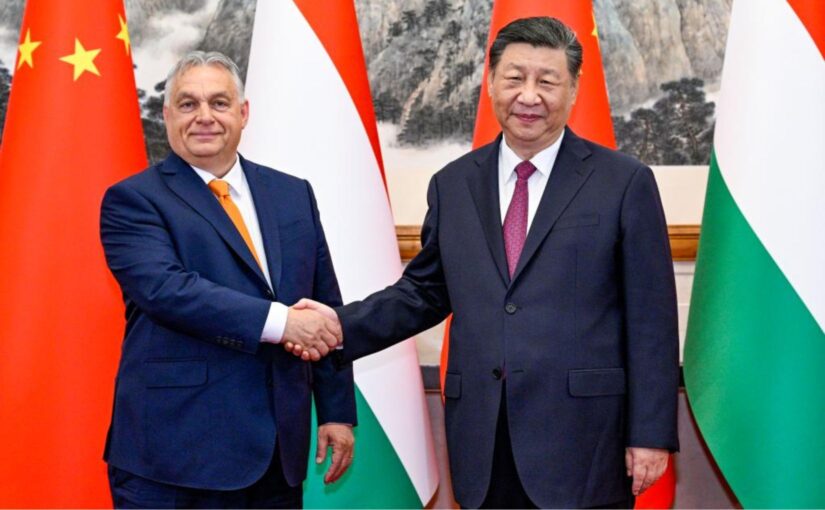
Meeting with Prime Minister Viktor Orbán, China and Hungary decided to elevate bilateral relations to an all-weather comprehensive strategic partnership for the new era.

The two sides should continue to be good friends of mutual trust and assistance, and good partners of win-win cooperation, Xi said, calling on the two countries to take the establishment of the all-weather comprehensive strategic partnership for the new era as an opportunity to inject new and strong impetus into bilateral cooperation and create a better future for the two peoples.

Following their talks, the two sides issued a joint statement. It noted that they, “always respect and treat each other equally, and set a good example of mutually beneficial pragmatic cooperation.”

Hungary respects the great achievements that China has scored in economic and social development, and hopes that the Chinese people, under the leadership of the Communist Party of China, will build China into a great modern socialist country in all respects, achieve the Second Centenary Goal and advance the great rejuvenation of the Chinese nation on all fronts through Chinese modernisation. China commends Hungary’s peaceful, open and pragmatic foreign policy and its positive role in promoting regional stability and common prosperity of Europe.

The Hungarian government remains firm in adhering to the one-China principle, and reaffirms that there is but one China in the world, that the Government of the People’s Republic of China is the sole legal government representing China. Hungary opposes all forms of separatist activities aimed at breaking the unity of China. 

The Hungarian side appreciates the positive role that Chinese enterprises have played in the national development of Hungary, welcomes more Chinese enterprises to invest and do business in Hungary, and is willing to foster a favourable investment and business environment for them. The two sides acknowledge that Hungary has favoirable endowments to provide a meeting point for Eastern and Western economies and technologies. The Hungary-Serbia Railway is a landmark project under Belt and Road cooperation, and also a flagship project of cooperation between China and Central and Eastern European Countries. The two sides are willing to actively promote the construction of the Hungarian section of the Hungary-Serbia Railway, and jointly promote high-level connectivity in Central and Eastern Europe.

The two sides spoke highly of the development of the China-Europe Railway Express between China and Hungary, and agreed to establish an inter-governmental cooperation mechanism on the China-Europe Railway Express, promote infrastructure connectivity, and jointly take practical measures to ensure the security of the transport routes and improve the quality and efficiency of the China-Europe Railway Express, so as to provide important support for deepening economic and trade cooperation between the two countries.

Following this, the two leaders met the press and Xi Jinping noted that: “China values its comprehensive strategic partnership with the European Union (EU), and views Europe as an important pole in a multipolar world and a key partner in China’s bid to advance Chinese modernisation. China supports Hungary in playing a bigger role in the EU and promoting greater progress in China-EU relations.”

On May 10, Prime Minister Orbán and his wife hosted a farewell event for President Xi and his wife Peng Liyuan. Overlooking the city of Budapest, with a view of both sides of the River Danube, Orbán briefed Xi on the history, development, transformation and future plans of the city, noting that Chinese enterprises have made significant contributions to Hungary’s economic development and urban construction, and many Chinese-built projects have become flagship projects of bilateral cooperation and symbols of friendship.

China leads the world in many technological sectors, and Hungary looks forward to more cooperation with China and importing more advanced technologies from China to benefit Hungary’s national development and people’s livelihood.

Xi briefed Orbán on the century-old history of the Communist Party of China (CPC) and the important philosophies of party management and state governance, pointing out that the CPC has grown from a small party with only a few dozen members to a large one with more than 98 million members, and has withstood many severe tests, leading China to achieve today’s achievements.

The CPC is confident in continuing to overcome various risks and challenges on the road ahead and maintain China’s long-term stability and development, Xi said, noting this will not only enable the Chinese people to have better lives but also make a greater contribution to world peace and development.

Analysing the significance of the visit, the Global Times newspaper wrote that: “Both Chinese and Hungarian experts believe mutual respect and a cooperative approach with no ideological strings attached have played decisive roles in bilateral relations.

“On world affairs, China and Hungary often share similar stances. Despite being an EU member state and a NATO member, Hungary has remained committed to not sending any weapons to Ukraine. 

“In recent years, Hungary has become a major logistics hub for China-Europe trade. Hungary is also Europe’s electric vehicle hub ─ Chinese EV maker BYD announced in late 2023 that it will build its first European electric vehicle production base in Hungary and the plant will produce EVs and plug-in hybrids for the Europe market. 

“On several occasions, Hungary has stood aside from or opposed EU positions against China. For instance, in 2021, Hungary blocked an EU statement criticising China’s National Security Law for Hong Kong.”

Sun Keqin, a research fellow at the China Institutes of Contemporary International Relations (CICIR), noted that: “”Hungary is special among the EU. It does not oppose the bloc every time when it comes to China-related issues, but it has played a special role in China-Europe relations. Hungary is a partner China should seriously cooperate with.”

On July 1, Hungary will take over the rotating presidency of the Council of the EU. Foreign Minister Peter Szijjarto believes Hungary can use the opportunity to influence the EU’s policy toward China.

“We will be able to share with our European colleagues in a very credible manner how helpful, how useful and how profitable it can be to work together with China,” Szijjarto told the Global Times in an interview.

Prior to Xi’s visit, Foreign Minister Szijjarto visited China. Meeting his counterpart on April 24, Foreign Minister Wang Yi said that China appreciates Hungary’s determination to deepen cooperation with China despite interference and pressure, adding that the fruitful and mutually beneficial cooperation between China and Hungary in various fields not only benefits the two peoples, but also strongly proves that China is an opportunity rather than a challenge, a partner rather than an opponent to Europe.

Noting that Hungary will take over the rotating presidency of the European Union (EU) in the second half of this year, Wang said it is hoped that Hungary will promote the EU’s rational and friendly view of China’s development, pursue a more active and pragmatic policy towards China, strengthen strategic communication between China and Europe, and promote the sustained, stable and healthy development of China-EU relations.

Hungary is opposed to “decoupling and breaking the chain,” and always believes that viewing China as a threat will only mean missing opportunities, and treating China as a partner is the right choice, Szijjarto said.

Hungary is willing to promote the construction of key projects under the framework of the Belt and Road Initiative, continuously deepen the mutually beneficial cooperation between Hungary and China in various fields, push bilateral relations to a new level and promote the steady and sound development of EU-China relations, he added.

The following articles were originally published on the website of the Chinese Foreign Ministry and by the Xinhua News Agency and Global Times.

Full text of Xi’s signed article in Hungarian media

BUDAPEST, May 8 (Xinhua) — A signed article by Chinese President Xi Jinping titled “Embarking on a Golden Voyage in China-Hungary Relations” was published Wednesday in the Hungarian newspaper Magyar Nemzet.

Continue reading China and Hungary elevate ties to all-weather comprehensive strategic partnership

China urges admitting Palestine as full UN member state

Speaking at the United Nations on May 10, Chinese Ambassador Fu Cong expressed support for the UN Security Council (UNSC) to reconsider Palestine’s application to join the world body.

His comments followed a vote in the UN General Assembly, calling on the world body to admit Palestine as a full member state. Of the 193 members of the UN, 143 voted in favour, just nine countries, including the United States, voted against, while 25 countries abstained. Those who did not participate in the vote included a number whose right to vote has been withdrawn, as US sanctions and theft prevent them from paying their membership dues. These include Venezuela and Afghanistan. Thus, Venezuela, one of the strongest supporters of the Palestinian people, was able to sponsor the resolution but not vote for it.

In his remarks, Ambassador Fu highlighted that the Palestinian-Israeli conflict has been cyclical for decades, causing generations of Palestinians to “lose their home and live in displacement under occupation.” He described the situation as a “wound of the world that is constantly ripped open and bleeding.”

The General Assembly vote followed the United States veto of a similar resolution in the Security Council on April 18. Fu described the US action as “merciless”, adding that it was, “not commensurate with the role of a responsible major country.”

As the General Assembly resolution is not binding in terms of Palestine’s full admission to the UN, due to the US’ Security Council veto, it also includes provisions for Palestine’s participation in UN activities, granting additional rights and privileges. Fu explained that these are “special modalities decided on for a lack of other options as a remedy for the historical injustice long endured by Palestine” and as a correction to the US abuse of its veto power. He further emphasised that these are exceptional and not a precedent, expressing confidence that one day Palestine “will become a full UN member and enjoy full and equal rights in the UN like other member states.”

Details of these provisions, and much more useful information and analysis, can be found in this video from Ben Norton of Geopolitical Economy Report. 

The following article was originally published by the Xinhua News Agency.

China supports UNSC’s early reconsideration of Palestine’s application to join UN

UNITED NATIONS, May 10 (Xinhua) — China on Friday expressed support for the UN Security Council (UNSC) to reconsider Palestine’s application to join the world body.

China’s permanent representative to the UN Fu Cong emphasized the need for Palestine to be granted full UN membership in his address at the Tenth Emergency Special Session of the UN General Assembly.

Fu highlighted that the Palestinian-Israeli conflict has been cyclical for decades, causing generations of Palestinians to “lose their home and live in displacement under occupation.”

He described the situation as a “wound of the world that is constantly ripped open and bleeding.”

Fu stressed that “independent statehood has been a long-cherished aspiration of the Palestinian people” and full UN membership is a crucial step in this historic process.

He insisted that “Palestine should have the same status as Israel,” and it is the international community’s “common responsibility to support and advance the process of Palestine’s independent statehood” to ensure the “implementation of the two-state solution and lasting peace in the Middle East.”

Reflecting on recent developments, Fu expressed regret that “Palestine’s application for full UN membership was mercilessly vetoed by the United States in the Security Council on April 18.”

He criticized the United States for using its veto power to obstruct efforts to correct historical injustice against Palestine, stating that this is “not commensurate with the role of a responsible major country.”

The General Assembly’s emergency special session adopted a resolution by an overwhelming majority, reaffirming the Palestinian people’s right to self-determination, recognizing Palestine’s qualification for full UN membership, and recommending that the Security Council reconsider its application.

“China welcomes this historic resolution, which reflects the will of the international community,” Fu said, noting that China co-sponsored the resolution and hoped that “the relevant country will not create further delays or hurdles.”

The resolution also includes provisions for Palestine’s participation in UN activities, granting additional rights and privileges. Fu explained that these are “special modalities decided on for a lack of other options as a remedy for the historical injustice long endured by Palestine” and as a correction to the U.S. abuse of its veto power.

He said that these modalities, adopted within the limits permitted by the UN Charter, will “enable the international community to listen more adequately to the voice of Palestine” and assist in facilitating dialogue and negotiations with Israel on a relatively equal footing.

Fu emphasized that these arrangements are exceptional and not a precedent, expressing confidence that one day Palestine “will become a full UN member and enjoy full and equal rights in the UN like other member states.”

Fu concluded by addressing the ongoing conflict, identifying the lack of implementation of the two-state solution as the core issue.

He urged Israel to “stop the collective punishment of the Gaza population,” halt its military actions in Rafah, and remove all restrictions on humanitarian goods entering Gaza.

In the West Bank, Fu called for an end to settlement activities and a reduction in settler violence.

He reaffirmed China’s commitment to playing a constructive role in achieving an immediate ceasefire, revitalizing the two-state solution, and promoting peaceful coexistence and lasting stability in the Middle East.

Daniel Ortega: China is contributing to development in Africa, Asia and Latin America

In a recent speech commemorating the anniversary of the death of Nicaraguan freedom fighter and politician Tomás Borge, President Daniel Ortega surveyed the current geopolitical landscape, in particular expressing Nicaragua’s solidarity with the Palestinian people and applauding the student protests in the US and elsewhere: “The Peoples cannot accept, they cannot understand that a genocide is being committed with the participation of the powers of the Empires, headed by the North American Rulers, the Germans, the English, the French.”

Ortega describes the escalating campaign of encirclement and containment against China, asking “what threat is the People’s Republic of China?”

He contrasts China’s foreign policy with that of the Western powers: China “is not installing military bases like so very many military bases the United States has and has installed here in Latin America and the Caribbean alone”; China “is not promoting any war.”

The problem the US and its allies have with China is that “the People’s Republic of China has been growing, developing and has become close with the world’s developing countries… it is contributing to the development of these Peoples, contributing to the fight against poverty among these Peoples, to generating employment”. These are the same countries of the Global South which “the colonialist, imperialist countries used as nothing more than a source of wealth that they could steal.”

The threat to them, the greatest threat to them, to the Europeans, to the United States, is the way in which China has been growing, the threat is that the Chinese economy will grow, when on the other hand history tells us that the economies of the colonialist and imperialist Countries have only grown, using their economies, making them serve so as to dispossess other Peoples, to occupy other Peoples, to exploit other Peoples.

The speech was first published in English on the Tortilla Con Sal website.

Good evening, Nicaraguan Brothers and Sisters, Families of these Blessed Lands. Good evening, Beloved Internationalist Brothers and Sisters. And we are the expression that a New World is possible.

Here we meet as Brothers and Sisters, Compañeros and Compañeras born in the United States of America, born in Switzerland, like that Compañero who died murdered by the bullets of the Empire; Compañeros and Compañeras born in different Countries, Developed and Developing, and we meet, we join each other, in this year of the 45th Anniversary of the Revolution we meet, affirming, assuring, that the day will come when we will all become truly Brothers, Sisters.

That day will come, here is an example, and this has multiplied at different times in history, where Peoples have fought together and continue to fight for Peace; in a World that today more than ever insists on Peace, demands Peace.

And we see youth in North America raising the protest, the condemnation of the genocide that is being committed against the Palestinian People. North American youth protesting, right now, yes, they are protesting, and the protest is multiplying not only in North America, but in every country of our planet.

The Peoples cannot accept, they cannot understand that a genocide is being committed with the participation of the powers of the Empires, headed by the North American Rulers, the Germans, the English, the French.

That is, precisely that World where the Rulers pride themselves on being the most just, the most democratic, the most respectful of Rights, of International Law, they are unmasking themselves. Because they have managed to deceive our Peoples for a long time, thinking that Europe, North America, are Democracies, forgetting or getting us to forget how in a Developed Country, in a democratic Country, Germany, with the support of the great North American capital, Nazism came to Government.

And the war, that great war, that terrible war that caused millions of deaths, originated in a European country, it did not originate in an African country, nor did it originate in a Latin American or Caribbean or Asian country, it originated in Germany… Germany! And then the United States showing off that they own the atomic weapon, because in that war they started looking for how to build atomic weapons, Hitler wanted atomic weapons and the United States also wanted atomic weapons.

The United States had the atomic weapon and it did not take them long to launch it, to drop atomic bombs on Hiroshima and Nagasaki, two cities where there was no Army, two Cities where the victims were the civilian citizens of Japan, and where that horrendous crime caused more than 200,000 deaths as well as the incurable damage, as a result of radiation, in children, who as they were growing up were manifesting multiple diseases as adults and the elderly, finishing them off.

That is to say, they managed to cover up all those crimes over time. There was no condemnation of the use of atomic weapons. And today, well, there are atomic weapons everywhere, and that’s why the world has become more tense, pushing humanity to its limits.

There is a lot of talk about not crossing the red line, because now it is no longer a question of one Country against another, but one where all of humanity is exposed to crimes such as those now being committed against the Palestinian People, and the rulers of Israel insist on that, while as a People, the People of Israel is a People that we respect.

Continue reading Daniel Ortega: China is contributing to development in Africa, Asia and Latin America

Xi Jinping holds talks with President Aleksandar Vučić of Serbia

Chinese President Xi Jinping paid a state visit to Serbia from May 7-8, 2024, as the second leg of his European tour, which also took him first to France and subsequently to Hungary. His last visit to Serbia was in 2016.

Reporting his arrival on the evening of May 7, Xinhua News Agency reported that the “Serbian Air Force sent two fighter jets to escort Xi’s plane after it entered the country’s airspace. The Chinese president was warmly welcomed by Serbian President Aleksandar Vučić and his wife, Tamara Vučić at Belgrade Nikola Tesla Airport. Serbian children presented flowers to Xi and his wife, Peng Liyuan, and waved the national flags of China and Serbia. Serbian people dressed in national costumes sang and danced to welcome them.”

In an arrival statement, President Xi said that China and Serbia enjoy profound traditional friendship.

“Our bilateral relationship has stood the test of the changing international environment and become a fine example of state-to-state relations. Since the establishment of the comprehensive strategic partnership in 2016, the bilateral relationship has realised leapfrog development, and achieved historic results. The two countries are bound by rock-solid political mutual trust and have seen fruitful results in high quality Belt and Road cooperation. 

“Our ironclad friendship has taken deeper roots in the heart of the two peoples. China and Serbia have rendered each other firm support on issues concerning our respective core interests and major concerns. We have jointly upheld international fairness and justice and contributed our share to promoting world peace and development. Cooperation between the two countries is rooted in the principle of equality and mutual benefits.”

The two heads of state held talks on the morning of May 8, in which they announced the decision to deepen and elevate China-Serbia comprehensive strategic partnership and build a China-Serbia community with a shared future in the new era. Prior to this, President Vučić held a grand welcoming ceremony for President Xi, during which some 15,000 Serbian people waved national flags of China and Serbia to express the warmest welcome to the Chinese head of state.

In the talks, President Xi said that the China-Serbia ironclad friendship is characterised by profound historical roots, solid political foundation, extensive common interests and strong popular support.  Actions speak louder than words. China will stand shoulder to shoulder with Serbia, share weal and woe like passengers in the same boat, carry forward the spirit of the ironclad friendship, maintain and grow their friendship, and jointly safeguard fundamental and long-term interests of the two countries.

President Xi stressed that Serbia is China’s first comprehensive strategic partner in Central and Eastern Europe. Under the new circumstances, Serbia has become the first European country to build with China a community with a shared future.  The China-Serbia community with a shared future in the new era is an upgrade of the ironclad friendship between China and Serbia. It also represents their common values and objectives, namely, joint pursuit of development, win-win corporation and mutual success. These are the common aspirations of China, Serbia, and all countries that are committed to independence, peace, and development. 

China supports Serbia in upholding independence and pursuing a development path suited to its national conditions and supports its efforts in safeguarding national sovereignty and territorial integrity. 

With the China-Serbia Free Trade Agreement set to take effect on July 1 this year, the high-standard mutual opening up between China and Serbia will surely enter a new stage. China will continue to import more high-quality agricultural specialties from Serbia. It will invite 300 young Serbians to China on study and exchange programs in the next three years.

China will support 50 young Serbian scientists in taking part in scientific research exchanges in China in the next three years. It is ready to work with Serbia to strengthen cooperation on artificial intelligence (AI) and endeavour to ensure humanity properly develop and utilise AI.

It is important for China and Serbia to jointly reject hegemonism and power politics, and oppose bloc politics or bloc confrontation. The two sides should join hands to uphold the purposes and principles of the UN Charter, practice true multilateralism, and promote international fairness and justice.

President Vučić extended the warmest welcome to President Xi and noted that China is Serbia’s most sincere friend. Although Serbia is a small country, China always fully respects its sovereignty and territorial integrity, and provides valuable support for its economic and social development. President Xi is a great world leader. Under his strong leadership, China has made remarkable achievements. It has become a beacon of development and progress of the world and is playing an increasingly important leading role in international affairs. The Communist Party of China seeks to enhance the well-being of not only the Chinese people, but also people across the world. The Serbian people are full of gratitude and respect for China, especially for President Xi, and feel truly proud to be an ironclad friend to such a great nation. Serbia firmly supports China’s legitimate position on issues concerning its core interests including on Taiwan. There is but one China in the world. Serbia will, without hesitation, continue to unswervingly provide China with firm support.

After the talks, the two Presidents signed the Joint Statement on Deepening and Elevating the Comprehensive Strategic Partnership and Building a China-Serbia Community with a Shared Future in the New Era. They also witnessed the exchange of multiple cooperation documents, including on Belt and Road cooperation, green development, digital economy, e-commerce, infrastructure, economic and technical cooperation, information and communication, agri-food, and the media. 

The detailed joint statement signed by the two presidents commits both countries to the defence of their respective core interests.  

The Serbian side reiterated that the development of friendly relations with the People’s Republic of China is one of the main pillars of Serbia’s foreign policy. It reiterates its firm support for the one-China principle, that there is only one China in the world, that Taiwan is an inalienable part of China’s territory, that the Government of the People’s Republic of China is the sole legitimate government representing the whole of China, that it opposes any form of “Taiwan independence” and that it opposes interference in China’s internal affairs, that it will not engage in any form of official exchanges with the Taiwan authorities, and that it firmly supports all efforts made by the Chinese government to realise national reunification.

Both sides oppose the imposition of any formula on the final status of Kosovo. All parties concerned should reach a mutually acceptable solution through dialogue and consultation within the framework of United Nations Security Council Resolution 1244. In doing so, Serbia’s sovereignty, independence and territorial integrity must be fully respected. China supports the efforts of the Republic of Serbia to find a compromise in a peaceful manner during negotiations with representatives of the Provisional Institutions of Self-Government of Kosovo and calls for the implementation of all agreements reached at the Belgrade-Pristina dialogue and the effective protection of the religious and cultural heritage of the region. (Kosovo occupies a special place in the history of Serbia and in particular of the Serbian Orthodox church.)

Reflecting the global trend towards dedollarisation, the two sides are willing to strengthen financial cooperation, support the opening of the Serbian Renminbi (RMB) Clearing Bank as soon as possible, promote the use of local currency settlement in bilateral trade and investment, and encourage financial institutions of the two countries to provide financing support and financial services for trade and investment cooperation.

The two sides agreed that AI (artificial intelligence) should adhere to the principle of attaching equal importance to development and security, bridge the intelligence gap, jointly do a good job in risk prevention, and explore the formation of an international governance framework for AI with the United Nations as the main channel of communication. The two sides are willing to strengthen policy coordination in the field of artificial intelligence, establish relevant dialogue mechanisms, deepen relevant practical cooperation, and jointly promote artificial intelligence technologies. The Serbian side welcomes the Global AI Governance Initiative announced by President Xi Jinping as well as China’s efforts to strengthen the rights of developing countries in global AI governance.

Both sides agreed to jointly develop new productive forces in the light of local conditions, build high-tech industrial cooperation projects, and encourage and promote investment cooperation to this end. They agreed to deepen cooperation in the field of space science and technology. China welcomes the Serbian side to join the International Lunar Research Station.

They further stressed the importance of continuously deepening cooperation in science and technology innovation and will actively promote more practical results in the exchange of young scientists, poverty alleviation through science and technology, technology transfer, joint research, and joint construction of scientific research platforms, and welcomed the signing of the Memorandum of Understanding on Cooperation in Poverty Alleviation through Science and Technology. China welcomes more young Serbian scientists to engage in short-term scientific research in China.

Both countries believe that the Hungarian-Serbian railway modernisation project is of great significance to strengthening Serbian and regional connectivity and that it opens up new prospects for facilitating the flow of people and expanding commodity circulation and economic exchanges in the region. The two sides spoke highly of the achievements made in the construction of the Serbian section of the railway and will continue to work hard to promote the completion of the construction of the section on schedule and contribute to improving the level of regional connectivity.

Following the signing of the joint statement and the various agreements, the two leaders met the press. 

President Xi noted that in 2016, he paid a state visit to Serbia and experienced the warm hospitality of the Serbian leadership and people. He said that it is a fond memory he still cherishes today, and coming back after eight years, he is heartened to see that, under the leadership of President Vučić, Serbian economic and social development has gained a strong momentum, its national strength and international standing have risen markedly, and the people’s standard of living has kept increasing.

China supports Serbia in upholding its independence and following the development path that suits its own conditions. China also supports Serbia’s efforts to safeguard sovereignty and territorial integrity on the Kosovo issue.

President Xi pointed out that a review of history shows that China-Serbia friendship is, “forged through our extraordinary fight together to promote world peace and development, and with the blood and lives of the two peoples. Looking to the future, the building of a China-Serbia community with a shared future in the new era is a strategic choice made by the two sides. It aims to meet the aspirations of the Chinese and Serbian people for a better life and will be underpinned and sustained by their firm support and extensive participation.”

At the welcoming banquet hosted by President Vučić that followed, Xi Jinping noted that the Chinese people have always cherished a special bond of friendship with Serbia.

“The Yugoslav film The Bridge and the song Bella Ciao, which evoke strong patriotic and anti-fascist sentiments, have been immensely popular in China through the years and became my companion in my youthful days. Other household names in China include athletes Novak Djokovic and Nikola Jokic, and movie director Emir Kusturica.”

(Bella Ciao is originally an Italian song, but such is its popularity and fame in progressive circles that it was chosen as the theme song of The Bridge, a 1969 Yugoslav film depicting the heroic struggle of the communist-led partisans against the Nazi occupation. The film was imported into China, and dubbed into Chinese, in 1977, the year of President Tito’s state visit. Both the film and song became hugely popular in China.)

The following articles were originally published on the website of the Chinese Foreign Ministry and by People’s Daily. The Joint Statement was published in Chinese. It has been machine translated and lightly edited by us.

Arrival Statement by H.E. Xi Jinping at Belgrade Nikola Tesla Airport, Serbia

May 7 (MFA) — It gives me great pleasure to pay a state visit to the Republic of Serbia at the warm invitation of President Aleksandar Vučić. On behalf of the Chinese government and people, I would like to extend heartfelt greetings and best wishes to the friendly government and people of Serbia.

China and Serbia enjoy profound traditional friendship. Our bilateral relationship has stood the test of changing international environment and become a fine example of state-to-state relations. Since the establishment of the comprehensive strategic partnership in 2016, the bilateral relationship has realized leapfrog development, and achieved historic results. The two countries are bound by rock-solid political mutual trust, and have seen fruitful results in high quality Belt and Road cooperation. We have agreed on comprehensive mutual visa exemption, opened direct flights, and signed a free trade agreement. People-to-people exchanges are becoming more robust. Our ironclad friendship has taken deeper roots in the heart of the two peoples. China and Serbia have rendered each other firm support on issues concerning our respective core interests and major concerns. We have jointly upheld international fairness and justice, and contributed our share to promoting world peace and development. Cooperation between the two countries is rooted in the principle of equality and mutual benefits. It serves the fundamental and long-term interests of both countries, provides strong momentum for our respective development and rejuvenation, brings benefits to the two peoples, and contributes to the building of a community with a shared future for mankind.

Standing at a new historical starting point, China will work with Serbia to jointly stay committed to the original aspiration and forge ahead together to open up a new vista in China-Serbia cooperation with stronger momentum, greater scope, and higher quality. I look forward to taking this visit as an opportunity to have in-depth exchange of views with President Vučić on the bilateral relationship and other issues of mutual interest, renew friendship, plan for cooperation, explore development, and draw up a new blueprint for the development of bilateral relations. I am confident that this visit will be a fruitful one and will open up a new chapter in China-Serbia relations.


President Xi Jinping Holds Talks with President Aleksandar Vučić of Serbia

May 8 (MFA) — On the morning of May 8 local time, President Xi Jinping held talks with Serbian President Alexandar Vučić at the Palace of Serbia in Belgrade. The two Presidents announced the decision to deepen and elevate China-Serbia comprehensive strategic partnership and build a China-Serbia community with a shared future in the new era.

The sun shines brightly in Belgrade in May. In front of the Palace of Serbia, the national flags of China and Serbia flutter in the wind, and the guard of honor lined up for the occasion. As President Xi Jinping and Madame Peng Liyuan arrived, they were warmly received by President Aleksandar Vučić and Madame Tamara Vučić.

President Vučić held a grand welcoming ceremony for President Xi. After the two Presidents came to the viewing stand together, the military band played the national anthems of the two countries, and a 10-gun salute was fired. President Xi, accompanied by President Vučić, reviewed the guard of honor. The two Presidents greeted and shook hands with the delegation members of the other side. 

Accompanied by President Vučić, President Xi stepped out onto the platform of the Palace of Serbia. On the square in front of the Palace, 15,000 Serbian people were waving national flags of China and Serbia to express the warmest welcome to President Xi. President Xi waved to the crowd, which burst into jubilant, prolonged applause and cheers. 

After the welcoming ceremony, the two Presidents had a restricted session followed by a plenary meeting. 

President Xi expressed his delight to pay another visit to the beautiful country of Serbia in a span of eight years after the many invitations extended by President Vučić. President Xi said that he was deeply touched when he was greeted at the airport by President Vučić together with many senior government officials who held a grand welcoming ceremony for his visit. He was deeply moved by the genuine friendliness toward China from the Serbian people who are good friends of the Chinese people.

President Xi stressed that the ironclad friendship between China and Serbia has stood the test of the changing international landscape. Such friendship is characterized by profound historical roots, solid political foundation, extensive common interests and strong popular support. Over the past few years, under the leadership of the two Presidents, the bilateral relationship has leapfrogged with historic progress. Since the establishment of a comprehensive strategic partnership in 2016, in particular, the bilateral relationship has been enriched in substance and expanded in scope. It has become an example for China’s friendly relations with other European countries. Actions speak louder than words. China will stand shoulder to shoulder with Serbia, share weal and woe like passengers in the same boat, carry forward the spirit of the ironclad friendship, maintain and grow their friendship, and jointly safeguard fundamental and long-term interests of the two countries. As the two sides pursue their respective national development and revitalization, China will join hands with Serbia to advance the building of a community with a shared future in the new era.

President Xi stressed that Serbia is China’s first comprehensive strategic partner in Central and Eastern Europe. Their bilateral cooperation has injected strong impetus into their respective development and rejuvenation, and brought tangible benefits to the two peoples. Under the new circumstances, Serbia has become the first European country to build with China a community with a shared future. This speaks volumes about the strategic, special and high-level China-Serbia relations. The China-Serbia community with a shared future in the new era is an upgrade of the ironclad friendship between China and Serbia. It also represents their common values and objectives, namely, joint pursuit of development, win-win corporation and mutual success. These are the common aspirations of China, Serbia, and all countries that are committed to independence, peace and development. By building a China-Serbia community with a shared future in the new era, the two sides should keep deepening and expanding high-quality Belt and Road cooperation and collaboration between China and Central and Eastern European countries, thus contributing to their respective modernization.

First, highlighting the strategic nature of the bilateral relationship and keeping to its general direction. China supports Serbia in upholding independence and pursuing a development path suited to its national conditions, and supports its efforts in safeguarding national sovereignty and territorial integrity. The two sides should continue to offer each other firm support, deepen strategic cooperation, and safeguard their respective political security and fundamental interests. 

Second, staying committed to practical cooperation and delivering for the two peoples. High-quality Belt and Road cooperation between China and Serbia has achieved remarkable results. The two sides should steadily advance cooperation in traditional areas such as transportation and energy infrastructure, make sure the entire Serbian section of the Belgrade-Budapest railway go into operation as scheduled, jointly operate well their major cooperation projects, create more small and beautiful livelihood projects, and continue to generate positive economic and social impacts. With the China-Serbia Free Trade Agreement set to take effect on July 1 this year, the high-standard mutual opening up between China and Serbia will surely enter a new stage. China will continue to import more high-quality agricultural specialties from Serbia. It will invite 300 young Serbians to China on study and exchange programs in the next three years. China welcomes the opening of direct flights from Belgrade to Shanghai by Serbia so as to comprehensively deepen people-to-people exchanges. 

Third, opening up new prospects of cooperation with a focus on the innovation dimension in bilateral relations and making innovation cooperation a new growth driver in the relationship. China will support 50 young Serbian scientists in taking part in scientific research exchanges in China in the next three years. It is ready to work with Serbia to strengthen cooperation on artificial intelligence (AI) and endeavor to ensure humanity properly develop and utilize AI. It is important for China and Serbia to jointly reject hegemonism and power politics, and oppose bloc politics or bloc confrontation. The two sides should join hands to uphold the purposes and principles of the U.N. Charter, practice true multilateralism, and promote international fairness and justice.

President Vučić extended the warmest welcome to President Xi and noted that China is Serbia’s most sincere friend. Although Serbia is a small country, China always fully respects its sovereignty and territorial integrity, and provides valuable support for its economic and social development. President Xi is a great world leader. Under his strong leadership, China has made remarkable achievements. It has become a beacon of development and progress of the world and is playing an increasingly important leading role in international affairs. The Communist Party of China seeks to enhance the well-being of not only the Chinese people, but also people across the world. The Serbian people are full of gratitude and respect for China, especially for President Xi, and feel truly proud to be an ironclad friend to such a great nation. Serbia firmly supports China’s legitimate position on issues concerning its core interests including on Taiwan. There is but one China in the world. Serbia will, without hesitation, continue to unswervingly provide China with firm support.

President Vučić noted that China’s investment in and cooperation with Serbia have greatly facilitated the latter’s economic and social development and improved Serbian people’s living standards. Since 2016, in particular, thanks to the personal commitment and support by President Xi, the HBIS Smederevo steel plant has had immensely positive socioeconomic impacts. The transformative changes that had taken place in the steel plant’s development prospects have also boosted the confidence and raised the hope of the people. Serbia’s future is closely linked with China. Serbia looks forward to intensifying exchanges with China in all areas and at all levels, and to strengthening cooperation with China in various fields including infrastructure, new energy, innovation, artificial intelligence and people-to-people and cultural exchanges. Serbia will actively advance high-quality Belt and Road cooperation with China, and work to ensure that the Serbian sector of the Belgrade-Budapest railway will be completed as planned. Serbia welcomes investment cooperation from more Chinese businesses and looks forward to opening more direct flights. Building on the entry-into-force of the bilateral Free Trade Agreement, Serbia is ready to expand economic and trade cooperation with China. The announcement on deepening and elevating the comprehensive strategic partnership and building a China-Serbia community with a shared future in the new era marks a new milestone in the history of this bilateral relationship. Serbia firmly supports and will actively participate in the Global Development Initiative, the Global Security Initiative and the Global Civilization Initiative put forth by President Xi. Serbia will stay in close strategic coordination with China in multilateral fora, jointly oppose hegemonism and power politics, uphold the purposes of the U.N. Charter, and defend international fairness and justice.

After the talks, the two Presidents signed the Joint Statement on Deepening and Elevating the Comprehensive Strategic Partnership and Building a China-Serbia Community with a Shared Future in the New Era. The two Presidents also witnessed the exchange of multiple cooperation documents including on Belt and Road cooperation, green development, digital economy, e-commerce, infrastructure, economic and technical cooperation, information and communication, agri-food, and the media. 

The two Presidents had a joint meeting with the press.

At noon, President Vučić and Madame Tamara Vučić hosted a grand welcoming banquet in honor of President Xi and Madame Peng Liyuan at the Palace of Serbia.

Cai Qi and Wang Yi, among others, were present at these events.


Joint Statement of the People’s Republic of China and the Republic of Serbia on Deepening and Enhancing the Comprehensive Strategic Partnership and Building a China-Serbia Community with a Shared Future in the New Era

At the invitation of President of the Republic of Serbia Aleksandar Vučić, President Xi Jinping of the People’s Republic of China paid a state visit to the Republic of Serbia on May 7-8, 2024.

The two heads of state held talks in a warm and friendly atmosphere and had an in-depth exchange of views on China-Serbia relations, deepening all-round cooperation between the two countries, jointly building the Belt and Road Initiative (BRI), China-CEEC (Central and East European Countries) cooperation, China-EU relations, and international and regional issues of common concern, and reached broad consensus.

The two sides agreed that China and Serbia cherish each other’s solid traditional friendship and close cooperation in specific fields, and that coordination and cooperation in multilateral fields have been fruitful, and that bilateral relations have broad prospects for development. Although the two countries have different histories, cultures, and national conditions, they both uphold the spirit of openness and cooperation, adhere to the principles of fairness and justice, are committed to the happiness of the people and the prosperity of the country, and are committed to the noble cause of peaceful development of humanity. Serbia supports efforts to build a community with a shared future for humanity and stands ready to work with China to implement the Global Development Initiative, the Global Security Initiative, and the Global Civilisation Initiative.

The two sides exchanged views on the results of cooperation achieved so far and held that the relevant achievements have further enhanced the iron-clad friendship between the two peoples. The two sides spoke highly of the further deepening of bilateral relations since the signing of the Joint Statement of the People’s Republic of China and the Republic of Serbia on the Establishment of a Comprehensive Strategic Partnership in 2016, and agreed to deepen and enhance the China-Serbia comprehensive strategic partnership based on the principles of independence, mutual respect and trust, win-win cooperation, common development and mutual support, build a China-Serbia community with a shared future in the new era, and strive to benefit the two peoples and make new contributions to the cause of peace and progress for humanity. The parties hereby declare as follows:

  1. China speaks highly of Serbia’s achievements in overall economic and social development and improving people’s livelihood and is pleased to see that Serbia has smoothly advanced its development plans such as “Serbia 2027 – Leap into the Future”, achieved its goals as scheduled, and promoted Serbia’s development and people’s well-being.

    The Serbian side spoke highly of China’s historic achievements and changes in the new era, and wished the Chinese people to build themselves into a modern socialist power in an all-round way under the leadership of the Communist Party of China and achieve the second centenary goal. The Serbian side supports China in comprehensively advancing the building of a strong country and the great cause of national rejuvenation through Chinese-style modernisation.
  2. The two sides believe that close political dialogue at the highest level of the two countries is of great significance to strengthening Sino-Serbian relations and agree to continue to maintain close exchanges between the two heads of state through meetings, telephone calls and exchanges of letters.

    The two sides are willing to give full play to the role of the China-Serbia Legislature Cooperation Committee, the Joint Economic and Trade Committee, the Joint Committee on Science and Technology Cooperation and other mechanisms, strengthen exchanges and cooperation at all levels and in various fields, and continue to deepen the friendship between the two countries.

    The two sides will continue to deepen cooperation between the foreign affairs departments of the two countries, hold regular meetings and consultations at all levels, exchange views on bilateral relations and international and regional hotspot issues of common concern, and coordinate their positions in a timely manner. The two sides will continue to strengthen exchanges between the political parties of the two countries, deepen the exchange of experience in governance, and promote bilateral cooperation in various fields.
  3. The two sides will firmly support each other on issues concerning each other’s core interests on the basis of respecting national sovereignty and territorial integrity and the principle of non-interference in the internal affairs of other countries.

    The Serbian side reiterated that the development of friendly relations with the People’s Republic of China is one of the main pillars of Serbia’s foreign policy. The Serbian side reiterates its firm support for the one-China principle, that there is only one China in the world, that Taiwan is an inalienable part of China’s territory, that the Government of the People’s Republic of China is the sole legitimate government representing the whole of China, that it opposes any form of “Taiwan independence” and that it opposes interference in China’s internal affairs, that it will not engage in any form of official exchanges with the Taiwan authorities, and that it firmly supports all efforts made by the Chinese Government to realise national reunification.

    Both sides oppose the imposition of any formula on the final status of Kosovo. All parties concerned should reach a mutually acceptable solution through dialogue and consultation within the framework of United Nations Security Council Resolution 1244. In doing so, Serbia’s sovereignty, independence and territorial integrity must be fully respected. China supports the efforts of the Republic of Serbia to find a compromise in a peaceful manner during negotiations with representatives of the Provisional Institutions of Self-Government of Kosovo and calls for the implementation of all agreements reached at the Belgrade-Pristina dialogue and the effective protection of the religious and cultural heritage of the region. The establishment of a coalition of Serbian cities is an important element of the 2013 Brussels Agreement and must be implemented.

    China understands Serbian’s commitment to joining the European Union and welcomes Serbian’s policy of developing friendly relations and promoting regional cooperation with countries in the region.

    The two sides agreed that on the South China Sea issue, territorial issues and maritime disputes should be peacefully resolved through friendly consultations and negotiations between the parties directly concerned in accordance with bilateral agreements and the Declaration on the Conduct of Parties in the South China Sea.
  4. The two sides will take the opportunity of the Belt and Road Initiative to enter a new stage of high-quality development, jointly implement the outcomes of the Third Belt and Road Forum for International Cooperation, deepen and expand cooperation in the fields of economy and trade, investment, science and technology, innovation, digital, information and communication, jointly safeguard the safety of projects and enterprise personnel, and lay the foundation for building a China-Serbia community with a shared future in the new era.

    The two sides will actively implement the Free Trade Agreement between the Government of the People’s Republic of China and the Government of the Republic of Serbia and the Medium-Term Action Plan for the Belt and Road Initiative (2023-2025) signed in Beijing in October 2023.

    The two sides welcomed the positive development of China-Serbia trade and were willing to promote the balanced development of bilateral trade. China is willing to expand imports of Serbian high-quality agricultural products and other products, and speed up the examination and approval of inspection and quarantine permits for specific categories of agricultural products and animal products. The two sides are willing to expand the use of China-Europe trains, and China is happy to see more high-quality products from the Serbian side transported to the Chinese market through the China-Europe trains.

    The two sides spoke highly of the positive results achieved in the cooperation between the two countries in the field of infrastructure construction, and welcomed the upgrading of the Agreement between the Government of the People’s Republic of China and the Government of the Republic of Serbia on Economic and Technical Cooperation in the Field of Infrastructure, which will further strengthen practical cooperation between the two countries in the fields of transportation infrastructure construction, connectivity, clean energy, industrial investment, agriculture, and economic and trade cooperation zones.

    The two sides are willing to strengthen exchanges and cooperation in the fields of geology and mining, jointly carry out scientific research on karst water resources and karst ecology, promote the construction of monitoring stations in key karst zones in Serbia, and continue to strengthen practical cooperation in the field of evaluation of critical mineral resources, and welcome the signing of the Memorandum of Understanding on Cooperation in the Field of Geology and Minerals between China and Serbia.

    The two sides will implement the Memorandum of Understanding on Promoting the Implementation of the Global Development Initiative, jointly promote the implementation of practical cooperation projects in eight major areas, and promote the early harvest of the Global Development Initiative in Serbia.

    The two sides are willing to effectively carry out cooperation in the field of digital economy and green development, and continue to promote the implementation of the Memorandum of Understanding on Promoting Investment Cooperation in the Field of Green Development and the Memorandum of Understanding on Strengthening Investment Cooperation in the Field of Digital Economy signed in 2022 by giving full play to the role of the China-Serbia Investment Cooperation Working Group. We welcome the signing of the Memorandum of Understanding on Green and Sustainable Development Cooperation and the Memorandum of Understanding on Digital Economy Cooperation, and actively promote the implementation of specific cooperation projects. At the same time, as participants in the Framework Initiative for International Economic and Trade Cooperation on Digital Economy and Green Development, the two sides are willing to work with all parties to actively carry out practical economic and trade cooperation in relevant fields.

    The two sides are willing to strengthen financial cooperation, support the opening of the Serbian RMB Clearing Bank as soon as possible, promote the use of local currency settlement in bilateral trade and investment, and encourage financial institutions of the two countries to provide financing support and financial services for trade and investment cooperation.

    The two sides attach great importance to cooperation in the field of e-commerce and welcome the signing of the Memorandum of Understanding on E-commerce Cooperation between China and Serbia.

    The two sides attach great importance to cooperation in the field of information and communication technology, and believe that further strengthening cooperation in the field of information and communication technology is of great significance to strengthening connectivity and deepening the comprehensive strategic partnership between China and Serbia. China is ready to strengthen bilateral cooperation with Serbia in areas such as communication infrastructure, 5G, cloud computing, big data and smart photovoltaics, and promote high-quality development in the field of information and communication.

    The two sides agreed that AI (artificial intelligence) should adhere to the principle of attaching equal importance to development and security, bridge the intelligence gap, jointly do a good job in risk prevention, and explore the formation of an international governance framework for AI with the United Nations as the main channel of communication. The two sides are willing to strengthen policy coordination in the field of artificial intelligence, establish relevant dialogue mechanisms, deepen relevant practical cooperation, and jointly promote artificial intelligence technologies. The Serbian side welcomes the Global AI Governance Initiative announced by President Xi Jinping and China’s efforts to strengthen the rights of developing countries in global AI governance.

    The two sides agreed to jointly develop new productive forces in the light of local conditions, build high-tech industrial cooperation projects, and encourage and promote investment cooperation to this end. The two sides agreed to deepen cooperation in the field of space science and technology. China welcomes the Serbian side to join the International Lunar Research Station.

    The two sides stressed the importance of continuously deepening cooperation in science and technology innovation and will actively promote more practical results in the exchange of young scientists, poverty alleviation through science and technology, technology transfer, joint research, and joint construction of scientific research platforms, and welcomed the signing of the Memorandum of Understanding on Cooperation in Poverty Alleviation through Science and Technology. China welcomes more young Serbian scientists to engage in short-term scientific research in China.

    The two sides are willing to jointly promote the construction of an international cooperation mechanism for natural disaster prevention and emergency management under the Belt and Road Initiative, implement the Memorandum of Understanding on Cooperation in the Field of Natural Disaster Prevention and Emergency Management and the Memorandum of Understanding on Cooperation in the Field of Work Safety, and continue to deepen practical cooperation in disaster management and production safety between the two countries.
  5. The two sides believe that the Hungarian-Serbian railway modernisation project is of great significance to strengthening Serbian and regional connectivity, and opens up new prospects for facilitating the flow of people and expanding commodity circulation and economic exchanges in the region. The two sides spoke highly of the achievements made in the construction of the Serbian section of the railway and will continue to work hard to promote the completion of the construction of the section on schedule and contribute to improving the level of regional connectivity. China is willing to encourage its enterprises to continue to participate in regional connectivity projects in accordance with business and market principles. The two sides are willing to strengthen cooperation to ensure the safety of the railway passing through the Serbian territory.
  6. The two sides attach great importance to cooperation in the fields of health and biotechnology, and China is ready to strengthen bilateral and multilateral cooperation with Serbia in the fields of disease prevention and control, health emergency response, telemedicine and traditional medicine, jointly promote the building of a global community of health for all, and actively participate in the construction of relevant projects in the biotechnology industrial park in Serbia.
  7. The two sides attach great importance to and are willing to strengthen cooperation in the fields of culture, education, sports, tourism, radio and television, journalism and communication, support two-way exchanges between students, support exchanges and cooperation between institutions of higher learning of the two countries, and expand cooperation in the fields of film and television, media, and online audio-visual.

    The two sides spoke highly of the role played by the China-Serbia Agreement on Mutual Exemption of Visas for Holders of Ordinary Passports signed in 2016 in consolidating friendly relations, promoting bilateral cooperation, and promoting people-to-people exchanges and tourism, and are willing to create more convenient conditions for people-to-people exchanges between the two countries. The two sides expressed satisfaction with the operation of direct flights between China and Serbia and encouraged the air transport enterprises of the two countries to add more direct routes according to market principles. They agreed to continue to implement the Agreement between the Government of the People’s Republic of China and the Government of the Republic of Serbia on Reciprocal Recognition and Exchange of Motor Vehicle Driving Licenses, and further facilitate the citizens of the two countries to work and live in each other’s countries.
  8. The two sides spoke highly of the positive role of the China-CEEC cooperation mechanism. The Serbian side highly recognises, fully supports and is willing to continue to actively participate in various areas of cooperation within the framework of the China-CEEC cooperation mechanism. The two sides will work with other CEE countries to promote the sustained and healthy development of cooperation within the mechanism.
  9. The two sides stressed the need to abide by the international order based on international law, including the UN Charter, respect the principles of independence, equality, sovereignty and territorial integrity of all countries, uphold multilateral cooperation with the United Nations at its core, and uphold true multilateralism.

    The two sides advocate an equal and orderly multipolar world and inclusive economic globalisation, uphold the equality of all countries, big or small, and oppose hegemonism and power politics, as well as all forms of unilateralism and protectionism.

    The two sides support the leading role of the United Nations in resolving global issues, safeguarding world peace, and promoting common development, and advocate strengthening the role and authority of the United Nations and its Security Council. The two sides support the reform of the United Nations and its Security Council to increase the representation of developing countries and advocate that Member States should seek a “package” solution and reach consensus through democratic consultations on the basis of broad consensus. The two sides are willing to strengthen coordination and cooperation in the United Nations and other international organisations to jointly promote global and regional peace, stability, development and prosperity.

    The two sides believe that the promotion and protection of human rights is the common cause of all humanity, and that all countries should cooperate in promoting and protecting human rights on the basis of mutual respect and equality, and should not politicise and instrumentalise human rights issues and use them to interfere in the internal affairs of other countries. The two sides will strengthen communication and cooperation in multilateral human rights forums and promote the development of global human rights governance in a more just manner.
  10. The two sides support the efforts of the international community to promote a political settlement of the Ukraine crisis and a ceasefire between Palestine and Israel and call on all parties to prevent further spillover effects and maintain regional peace and stability. The two sides reaffirmed their opposition to bloc confrontation and opposition to any country or bloc that instigates conflicts and undermines the security interests of other countries.
  11. The two sides condemn and oppose terrorism in all its forms and emphasise that the international community should continue to strengthen counter-terrorism cooperation, give full play to the central coordinating role of the United Nations, and use comprehensive means to eradicate both the symptoms and the root causes of terrorism. The two sides oppose the adoption of double standards and the politicisation and instrumentalisation of the issue of counter-terrorism. The two sides will continue to strengthen counter-terrorism cooperation bilaterally and within multilateral frameworks such as the United Nations.

    The two sides believe that expanding cooperation among the judicial, law enforcement, and security departments is of great significance to deepening security cooperation between the two countries and will continue to promote cooperation in combating human trafficking, telecommunications and network fraud, economic crimes, and cross-border corruption.

    The two sides are willing to strengthen inter-departmental contacts and cooperation and deepen practical cooperation in port entry-exit border inspection, facilitation of personnel exchanges, crackdown on illegal immigration activities, and law enforcement capacity building.
  12. The two sides believe that President Xi Jinping’s state visit to the Republic of Serbia and the fruitful talks and exchanges between the two heads of state are of great significance to further promoting the development of China-Serbia friendly relations.

President Xi Jinping expressed his sincere gratitude to President Vučić and the Serbian people for their grand, cordial, and friendly reception, and invited President Vučić to visit China again. President Vučić expressed his gratitude and happily accepted the invitation.

This Declaration was signed in Belgrade on 8 May 2024 in two copies, each in Chinese and Serbian, both texts of which are equally authentic.


President Xi Jinping and President Aleksandar Vučić Jointly Meet the Press

May 8 (MFA) — At noon on May 8 local time, President Xi Jinping and President Aleksandar Vučić of Serbia jointly met the press after their talks at the Palace of Serbia in Belgrade. 

At the outset, on behalf of the Chinese government and people, President Xi extended sincere greetings and best regards to President Vučić and the Serbian government, and to the brotherly people of Serbia.

President Xi noted that in 2016, he paid a state visit to Serbia and experienced the warm hospitality of the Serbian leadership and people. He said that it is a fond memory he still cherishes today, and coming back after eight years, he is heartened to see that under the leadership of President Vučić, the Serbian economic and social development has gained a strong momentum, its national strength and international standing have risen markedly, and the people’s standard of living has kept increasing. As true friends and good partners, China and Serbia enjoy rock-solid political mutual trust, upgraded practical cooperation, close and effective coordination on multilateral affairs, and an ironclad friendship that’s been growing from strength to strength.

President Xi described how touching it was that President Vučić and his wife, the prime minister, former president, speaker of the parliament, foreign minister and others welcomed him and his wife at the airport last night, and arranged special Serbian performances. He was again moved by the genuine friendliness of the Serbian people toward China and the Chinese people when he saw the huge crowds at the grand and heartwarming welcoming ceremony arranged by President Vučić in the morning. Before the press event, President Vučić and he had an in-depth exchange of views, in a cordial and friendly atmosphere, on the China-Serbia relationship and other issues of mutual interest, and they reached new, important and extensive consensus.

—The two leaders announced together to build a China-Serbia community with a shared future in the new era, which will open up a new chapter in the history of China-Serbia relations. Eight years ago, Serbia became China’s first comprehensive strategic partner in Central and Eastern Europe. Today, Serbia becomes the first European country to build a community with a shared future with China. This speaks volumes about the strategic, special and high-level relationship between the two countries.

—The two leaders agreed to enhance strategic communication to guide the building of the China-Serbia community with a shared future in the new era. The two sides will firmly support each other’s core interests and major concerns, and cement the political foundation for building this community. China supports Serbia in upholding its independence and following the development path that suits its own conditions. China supports Serbia’s efforts to safeguard sovereignty and territorial integrity on the Kosovo issue.

—The two leaders witnessed together the signing of multiple cooperation documents which will empower win-win cooperation between the two countries. High-quality Belt and Road cooperation between China and Serbia has produced substantial outcomes. The two sides will continue to advance quality and productive cooperation in a broad range of areas. This will provide a strong impetus to the economic and social development of the two countries. It is also a concrete step to promote universally beneficial and inclusive economic globalization.

—The two leaders agreed to steadily advance cooperation in traditional areas of strength such as transportation and energy infrastructure, and to make innovation cooperation a new growth driver for the bilateral relationship. The two sides will increase people-to-people exchanges in all sectors, fully advance cooperation in culture, education, sports, tourism and at the subnational level, and strengthen inter-party interactions and experience sharing on governance. The two sides will jointly implement the Global Development Initiative, the Global Security Initiative and the Global Civilization Initiative, and advance the building of a community with a shared future for mankind. The two sides will advocate fairness and justice, and jointly oppose hegemonism and power politics.

President Xi announced the first batch of six practical steps China will take to support the building of a China-Serbia community with a shared future in the new era.

First, as a result of the two sides’ joint efforts, the China-Serbia Free Trade Agreement will take effect on July 1 this year. 

Second, China supports Serbia in hosting the Specialized Expo 2027, and will send a delegation to attend the event. Chinese businesses will also be encouraged to take part in relevant construction projects. 

Third, China will import more high-quality agricultural specialties from Serbia. Procedures for the export of dried plums and blueberry to China have already been completed, and the restrictions related to highly pathogenic avian influenza have been lifted. 

Fourth, China will support 50 young Serbian scientists in taking part in scientific research exchange in China in the next three years. 

Fifth, China will invite 300 young Serbians to study in China in the next three years. 

Sixth, China welcomes the opening of direct flights from Belgrade to Shanghai by Serbia, and encourages the two countries’ airlines to open direct flights from Belgrade to Guangzhou.

President Xi pointed out that a review of history shows that China-Serbia friendship is forged through our extraordinary fight together to promote world peace and development, and with the blood and lives of the two peoples. Looking to the future, the building of a China-Serbia community with a shared future in the new era is a strategic choice made by the two sides. It aims to meet the aspirations of the Chinese and Serbian people for a better life, and will be underpinned and sustained by their firm support and extensive participation. China will stand side by side with Serbia to jointly embark on the new journey toward a China-Serbia community with a shared future in the new era.

President Vučić noted that it is of significant importance to Serbia that President Xi pays another visit after eight years. Serbia-China cooperation has produced fruitful outcomes and brought tangible benefits to the Serbian people. He described his talks with President Xi as in-depth, extensive and inspiring. He and President Xi signed a joint statement announcing the building of a China-Serbia community with a shared future in the new era. He thanked President Xi for announcing the many practical measures to boost Serbia-China cooperation. He said Serbia takes proud in having such a great friend as China and in the new characterization of the Serbia-China relationship, and has every confidence in the future of this relationship. Serbia will continue to firmly stand with China on all issues concerning China’s core interests. The ironclad friendship between Serbia and China will not be disrupted or broken by any force.

Cai Qi, Wang Yi, among others, attended the event.


President Xi Jinping Attends the Welcoming Banquet Held by President Aleksandar Vučić of Serbia

May 8 (MFA) — At noon on May 8 local time, President Xi Jinping and his wife Madame Peng Liyuan attended the welcoming banquet held by Serbian President Aleksandar Vučić and his wife at the Palace of Serbia in Belgrade.

Amid warm applause, President Xi delivered a toast.

President Xi pointed out that Serbia, located on “the west of the East, and east of the West,” has long been known as “the gateway to the Balkans.” For centuries, this land has been a meeting place of diverse civilizations on the Eurasian continent, which in many ways shaped the diligent, kind, and unyielding character of the Serbian people. Now, under the leadership of President Vučić, the government and people of Serbia are working hard and making proud achievements in economic and social development and living standards. The Serbian people have great confidence and pride as a nation. Bright and broad prospects lay ahead for Serbia’s development and rejuvenation.

President Xi noted that the Chinese people have always cherished a special bond of friendship with Serbia. The Yugoslav film The Bridge and the song Bella Ciao, which evoke strong patriotic and anti-Fascism sentiments, have been immensely popular in China through the years and became my companion in my youthful days. Other household names in China include athletes Novak Djokovic and Nikola Jokic, and movie director Emir Kusturica. In recent years, the high-quality Belt and Road cooperation between China and Serbia has seen robust growth and fruitful outcomes. Such cooperation is a good example of building a community with a shared future for mankind.

President Xi pointed out that he and President Vučić had just had comprehensive and in-depth talks and reached a lot of important consensus. They signed a joint statement announcing the building of a China-Serbia community with a shared future in the new era. This is a new historic milestone in China-Serbia relations. China-Serbia relations now stand at a brand new historical starting point and enjoy precious opportunities and bright prospects. China will work together with the friendly people of Serbia and make tireless efforts to build a China-Serbia community with a shared future in the new era.

Cai Qi, Wang Yi, among others, attended the event.

Cooperatives in China: current status and prospects for significant growth

The following article by Ali Al-Assam explores the issue of cooperatives in China, drawing on insights from the recent Friends of Socialist China delegation.

Ali – who is Managing Director of the NewsSocial Cooperative, as well as being a lifelong activist in the communist, anti-imperialist and progressive movements in both Britain and Iraq – describes the delegates’ visit to the Lu Wei Agricultural Machinery Farmers’ Professional Cooperative in Jilin, “a voluntary collective that now oversees 667 hectares, commanding 90 percent of the village’s farmable area.” Ali observes that the cooperative has allowed for greater mechanisation of agriculture, and has led to a 20 percent increase in income for participating families. The cooperative runs in a highly democratic manner, with profit-sharing decided collectively and major decisions made at general meetings. Ali observes that the cooperative “embodies a microcosm of efficiency, offering end-to-end services from ploughing to grain processing.”

The Chinese government is encouraging such cooperatives by providing subsidies for the purchase of agricultural machinery. The number of agricultural cooperatives is on the rise in China, and “the Chinese leadership has made exceptional efforts to nurture these cooperatives, advocating for the adoption of cutting-edge technology and sustainable farming practices… President Xi Jinping has underscored the significance of steering small-scale farmers towards modern agriculture to safeguard food security, a move he deems foundational for the nation’s modern socialist aspirations.”

This article was first published in English on NewsSocial and in Arabic on Mushtarek.

During my recent visit to China from April 14th to 24th, 2024, I had the opportunity to engage with seasoned members of the cooperative movement, among whom were British nationals who live in China. A highlight of my trip was spending a substantial part of a day, together with colleagues from ‘Friends of Socialist China’, exploring an agricultural cooperative in the north-eastern Jilin province.

The law on Specialised Farmer Cooperatives was passed by the National People’s Congress, coming into effect on July 1 2007. As stated by Tim Zachernuk In his excellent study of cooperatives in China: “The law acknowledges international cooperative experience as codified in the cooperative principles formulated by the International Cooperative Alliance. The law states that cooperatives are independent and autonomous organisations, should be democratically managed, and that their primary aim is to serve the interests of their members. There are no contradictions between the ICA principles and the Chinese law. A cooperative adhering to ICA principles would be perfectly legitimate under the cooperative law.” Tim Zachernuk pointed to some difficulties in applying the law which seems to have been resolved to some degree since 2015.  

The Chinese government, particularly since 2020, has increasingly championed the cooperative model as an engine for employment enhancement, income growth for workers, and the stabilisation of rural and urban economies. These initiatives often dovetail with broader reforms aimed at reforming both privately owned and  state-owned enterprises and bolstering employee ownership and governance participation.

China’s cooperative landscape is experiencing robust growth and enjoying strong government support. This growth is not only vast but also offers a multitude of learning and partnership opportunities. A notable advancement likely to further solidify democratic practices within cooperatives is the enactment of the Revised Company Law, set to take effect on July 1, 2024. This law is pioneering at the national level in that it establishes the employee representative assembly as the fundamental mechanism of corporate governance. For an in-depth understanding, refer to Dr. Guank Li’s comprehensive analysis of the law.

Insights into China’s Cooperative Landscape

The latest data offers a snapshot of the scope and impact of cooperatives across China:

Continue reading Cooperatives in China: current status and prospects for significant growth

Forging the broadest solidarity against US imperialist intervention in the South China Sea

Communist media in North America have spoken out against the latest moves by US imperialism to strengthen its web of alliances in the Pacific region, targeted principally on the People’s Republic of China. 

On April 19, Otis Grotewohl, reporting on the April 11 meeting of US President Biden with Japanese Prime Minister Fumio Kishima and President of the Philippines, Ferdinand “Bongbong” Marcos Jr. wrote in Workers’ World that:

“While the White House claimed the meeting focused on ‘peace and security,’ Biden’s own ‘tough-talk’ description of the gathering could be perceived as a threatening gesture towards China and the Democratic People’s Republic of Korea, as well as all working-class and indigenous peoples residing near the Indo-Pacific and South China Seas.”

He added:

“The summit was met by a militant protest from a Philippine-led coalition that includes BAYAN USA, Malaya Movement USA and the Tuloy Ang Laban Coalition. Organisers of the event said they were particularly appalled by the showing of Marcos Jr., son of the former right-wing dictator, Ferdinand Marcos Sr.

“The elder Marcos was president from 1965-86 and ruled the Philippine islands under martial law from 1972 until 1981, with the full blessing of US and European imperialists. Many labour unionists and leftists disappeared and were gruesomely slain during Marcos’ ‘ironclad’ rule.”

He also outlined the history of the RIMPAC naval exercises, which have been held since 1971 and are the world’s largest international maritime warfare exercise. A final planning conference for the 2024 exercise was held at the Point Loma Annex Naval Base in San Diego on March 25-28. According to Grotewohl:

“Washington claims it is not using the event as a forum for provocations against the governments of China, DPRK or Russia, but its actions tell a different story. That China, DPRK and Russia are not allowed to attend RIMPAC exercises, but Israel is, exposes the hypocrisy of US leaders.”

Meanwhile, the April edition of TML Monthly, published online by the Communist Party of Canada (Marxist-Leninist) (CPCML) detailed the protests of national democratic organisations in the Philippines against the 39th US-Philippines Balikatan Joint Military Exercise, which began on April 22 and will end on May 18. These are the largest such war games to date, involving more than 17,000 US and Philippines soldiers, almost twice as many as last year.

This year, the Australian Defence Force and French navy are also joining the war games. Eighteen other countries, including Canada, are participating as “observers.”

Bagong Alyansang Makabayan (Bayan), a broad alliance of progressive and patriotic Filipino organisations, called the military war games “a shameful proof of the subservient foreign policy of the administration of Ferdinand Marcos Jr. by allowing the increased presence and intervention of genocide-enabling and imperialist foreign military forces.”

The Philippine human rights organisation Karapatan also condemned Balikatan 2024, pointing out that the heavy presence of US troops on the Philippines islands is a violation of the sovereignty of the Filipino people and a provocation against China which could lead to a military conflict between the two countries with people of the Philippines in the middle. Karapatan pointedly denounced the recent first-time deployment of the US mid-range Typhon missile system which is capable of reaching the Chinese mainland. The missiles were introduced in the context of the Balikatan war games, Karapatan noted, further signalling the US intention “to use Philippine territory as a launching pad for hostile acts against China.”

Kalikasan People’s Network for the Environment also underscored that the US plans to use the Philippines as cannon fodder in confronting China.  “History has also shown that US intervention has always led to war and tragedy – and widespread, long-term environmental destruction, as well. These have been seen in the US-led wars in Korea, Vietnam, Iraq, Afghanistan, Libya, Ukraine, and Palestine,” the organisation said.

Bayan called on the Filipino people to resist the Balikatan war drills, oppose the US provocations in the region and expel US military facilities and other foreign troops in the country. 

For its part, Karapatan called on the freedom-loving people of the Philippines and the world to “forge the broadest solidarity front against US imperialist intervention and war-mongering in the South China Sea and in other areas of the world.”

The following articles were originally published by Workers World and TML Monthly.

U.S.-led ‘Trilateral Summit’ promotes militarism in the Pacific

President Joe Biden met with Japanese Prime Minister Fumio Kishima and the President of the Philippines, Ferdinand “Bongbong” Marcos Jr., on April 11. Dubbed as the “Philippines-U.S.-Japan Trilateral Summit,” the event was held in Washington, D.C.

While the White House claimed the meeting focused on “peace and security,” Biden’s own “tough-talk” description of the gathering could be perceived as a threatening gesture towards China and the Democratic People’s Republic of Korea, as well as all working-class and Indigenous peoples residing near the Indo-Pacific and South China Seas.

Continue reading Forging the broadest solidarity against US imperialist intervention in the South China Sea

Chinese FM holds talks with Central African counterpart

The Central African Republic (CAR) is one of a number of African countries that are increasingly asserting their independence, having long languished under French neo-colonial domination, in particular, decades after achieving formal independence.

It is against this background that CAR Foreign Minister Sylvie Baipo-Temon recently visited China at the invitation of her Chinese counterpart Wang Yi.

Meeting Baipo-Temon on April 15, Wang said that always regards the Central African Republic as a good friend and partner. 

Alluding to the imperialist pressure on the country, he added that China will continue to support the Central African Republic in exploring a development path suited to its national conditions, and speak up for the country at the UN Security Council and on multilateral occasions.

He added that China is willing to enhance cooperation with the Central African Republic in such areas as infrastructure construction, green development, medical and health care, education and training, and security and law enforcement. 

Baipo-Temon expressed appreciation for China’s adherence to the principle of non-interference in other countries’ internal affairs, saying that the Central African Republic abides firmly by the one-China principle and supports China firmly in safeguarding its core interests.

The Central African Republic is also a firm supporter of the global initiatives that China has proposed, and is willing to enhance friendly cooperation with China in various fields to achieve win-win results, she said, adding that the country will participate in the next meeting of the Forum on China-Africa Cooperation, due to be held in Beijing in September, to promote the construction of an Africa-China community with a shared future.

The following article was originally published by the Xinhua News Agency.

BEIJING, April 15 (Xinhua) — Chinese Foreign Minister Wang Yi held talks with Minister for Foreign Affairs of the Central African Republic Sylvie Baipo-Temon in Beijing on Monday, with both sides pledging to enhance cooperation in various fields.

Wang, also a member of the Political Bureau of the Communist Party of China Central Committee, noted that China always regards the Central African Republic as a good friend and partner. He said that China will continue to support the Central African Republic in exploring a development path suited to its national conditions, and speak up for the country at the UN Security Council and on multilateral occasions.

China will work with the Central African Republic to deepen strategic mutual trust and friendly cooperation, and make joint efforts to build a strategic partnership, Wang added.

He said that China is willing to enhance cooperation with the Central African Republic in such areas as infrastructure construction, green development, medical and health care, education and training, and security and law enforcement. China hopes that the Central African Republic will create a safe environment for Chinese enterprises to invest and do business in the country.

Baipo-Temon expressed appreciation for China’s adherence to the principle of non-interference in other countries’ internal affairs, saying that the Central African Republic abides firmly by the one-China principle and supports China firmly in safeguarding its core interests.

The Central African Republic is also a firm supporter of the global initiatives that China has proposed, and it is willing to enhance friendly cooperation with China in various fields to achieve win-win results, she said, adding that the country will participate in the next meeting of the Forum on China-Africa Cooperation to promote the construction of an Africa-China community with a shared future.

After their talks, the two foreign ministries issued a joint statement on promoting the implementation of the three global initiatives.

China-France joint statement on the situation in the Middle East

Chinese President Xi Jinping concluded a three-day state visit to France, the first leg of his European tour, on May 7. 

Considering the present global situation, one of the most significant outcomes of Xi’s visit was the release of a 10-point joint statement by the two countries on the situation in the Middle East.

It states that, as permanent members of the United States Security Council, China and France are working together to find constructive solutions, based on international law, to the challenges and threats to international security and stability.

It adds that they “condemn all violations of international humanitarian law, including all acts of terrorist violence and indiscriminate attacks against civilians. They recall the absolute imperative of protecting civilians in Gaza in accordance with international humanitarian law. The two heads of state expressed their opposition to an Israeli offensive on Rafah, which would lead to a humanitarian disaster on a larger scale, as well as to forced displacement of Palestinian civilians.”

The two presidents also stressed that an immediate and sustainable ceasefire is urgently needed to enable the delivery of large-scale humanitarian aid and the protection of civilians in the Gaza Strip. 

And they called on all parties to “refrain from unilateral measures on the ground that might aggravate tensions, and in this respect condemned Israel’s policy of settlement construction, which violates international law and constitutes a major obstacle to lasting peace as well as to the possibility of establishing a viable and contiguous State of Palestine.” 

Whilst some of the language also indicates a degree of compromise on China’s part, the overall standpoint adopted by France in this joint statement stands in sharp contrast to the fulsome support extended to Israel’s genocidal war of aggression by US and British imperialism. It therefore clearly refutes the naive and dogmatic view of some on the contemporary left who assert, in flights of rhetoric, that contradictions between imperialist powers no longer exist and can therefore not be utilised. 

In clear contrast to such idealist viewpoints, China’s principled and skilful diplomacy proceeds from the Leninist standpoint, clearly articulated by the founder of the Soviet workers’ state in in his famous article ‘Left-Wing’ Communism: an Infantile Disorder

“To carry on a war for the overthrow of the international bourgeoisie, a war which is a hundred times more difficult, protracted and complex than the most stubborn of ordinary wars between states, and to renounce in advance any change of tack, or any utilisation of a conflict of interests (even if temporary) among one’s enemies, or any conciliation or compromise with possible allies (even if they are temporary, unstable, vacillating or conditional allies)—is that not ridiculous in the extreme?”

We reprint below the full text of the China-France joint statement. It was originally published by the Xinhua News Agency.

At the invitation of H.E. Emmanuel Macron, President of the French Republic, H.E. Xi Jinping, President of the People’s Republic of China, paid a state visit to France from May 5 to 7, 2024. The two heads of state had an in-depth exchange of views on the situation in the Middle East:

1. As permanent members of the United Nations Security Council, China and France are working together to find constructive solutions, based on international law, to the challenges and threats to international security and stability.

2. China and France condemn all violations of international humanitarian law, including all acts of terrorist violence and indiscriminate attacks against civilians. They recall the absolute imperative of protecting civilians in Gaza in accordance with international humanitarian law. The two heads of state expressed their opposition to an Israeli offensive on Rafah, which would lead to a humanitarian disaster on a larger scale, as well as to forced displacement of Palestinian civilians.

3. The two heads of state stressed that an immediate and sustainable ceasefire is urgently needed to enable the delivery of large-scale humanitarian aid and the protection of civilians in the Gaza Strip. They called for the immediate and unconditional release of all hostages and the guarantee of humanitarian access to meet their medical and other humanitarian needs, as well as respect for international law with regard to all detainees. They called for the immediate and effective implementation of relevant United Nations resolutions, in particular Security Council resolutions 2712, 2720 and 2728. This is the only credible way to guarantee peace and security for all and to ensure that neither Palestinians nor Israelis will suffer from the horrors they have experienced since the attack on October 7, 2023.

4. The two heads of state called for the effective opening of all necessary corridors and crossing points to enable rapid, safe, sustainable and unhindered delivery of humanitarian aid throughout the Gaza Strip. The two heads of state stressed the importance of strengthening the coordination of international humanitarian efforts.

5. The two heads of state called on all parties to refrain from unilateral measures on the ground that might aggravate tensions, and in this respect condemned Israel’s policy of settlement construction, which violates international law and constitutes a major obstacle to lasting peace as well as to the possibility of establishing a viable and contiguous State of Palestine. The two heads of state reiterated that the future governance of Gaza cannot be dissociated from a comprehensive political settlement of the Palestinian-Israeli conflict based on the two-State solution.

6. The two heads of state called for a decisive and irreversible relaunch of a political process to concretely implement the two-State solution, with Israel and Palestine living side by side in peace and security, both with Jerusalem as their capital, and the establishment of a viable, independent and sovereign State of Palestine based on the 1967 borders. The two heads of state reaffirmed their commitment to this solution, which is the only way to meet the legitimate aspirations of the Israeli and Palestinian people for lasting peace and security.

7. The two heads of state also expressed deep concern over the risk of escalation in the region, and called for the prevention of regional turbulence. China and France are working with their partners to deescalate the situation and call on all parties to exercise restraint.

8. China and France reaffirm their commitment to promoting a political and diplomatic solution to the Iranian nuclear issue. The Joint Comprehensive Plan of Action concluded in 2015 is a major outcome of multilateral diplomacy. The two countries are concerned about the risks of escalation, recall the importance of cooperation with the International Atomic Energy Agency and facilitation of diplomatic efforts, and reaffirm their commitment to safeguarding the international non-proliferation regime and promoting peace and stability in the Middle East.

9. The two heads of state stressed the importance of safeguarding freedom of navigation in the Red Sea and the Gulf of Aden, and called for an immediate cessation of attacks on civilian vessels to safeguard maritime security and global trade and prevent regional tensions and humanitarian and environmental risks.

10. The two heads of state called for the observance of the Olympic Truce during the 2024 Summer Olympic and Paralympic Games. The Olympic Truce calls on all parties to stop hostilities throughout the Games. As conflicts spread and tensions rise, the Truce is an opportunity to work toward a durable resolution of conflicts in full respect of international law. 

Full text of Xi’s signed article in Serbian media

As part of his May 5-10 state visits to three European countries, Chinese President Xi Jinping began a visit to Serbia on May 7, following the conclusion of his visit to France. It is his second state visit to the Balkan country, his previous one being in 2016. 

Coinciding with his arrival, the Serbian daily newspaper Politika published an article by Xi, hailing the “ironclad friendship” between the two countries and peoples. The Chinese President wrote:

“There has always been an affinity between Chinese and Serbian peoples despite the long distance between us. During the bitter Anti-Fascist War and our respective nation-building in the last century, the Chinese and Serbian peoples forged a strong friendship that extends through time and space… Whatever changes in the international landscape, China and Serbia remain true friends and good partners. Our ironclad friendship is ever-growing, setting a model for state-to-state and people-to-people interactions.”

Recalling how the two countries had come together and helped each other during the fight against the COVID-19 pandemic, Xi states: “China provided assistance, prioritised the provision of multiple shipments of protective medical supplies, and sent medical experts to Serbia… Nongovernmental organisations in Serbia voluntarily donated masks and other supplies to the Chinese people. Our mutual support in challenging times testifies to our invaluable brotherly friendship.”

Xi also alluded to the attempts to permanently separate Serbia’s Kosovo region, and the pressures exerted on Serbia by certain powers regarding its external relations in particular, writing:

“We support Serbia’s efforts to uphold its sovereignty and territorial integrity, and oppose any attempt by any forces to interfere in Serbia’s internal affairs.”

What makes Xi’s visit to Serbia particularly significant this time is that May 7, 2024, marks exactly a quarter century since US-led NATO forces bombed the Chinese Embassy in Belgrade, killing three journalists, during their illegal war against the then socialist Yugoslavia. In his article, Xi recalls this as follows:

“Our ironclad friendship has withstood the test of blood and fire, and shines even brighter in the new era… Twenty-five years ago today, NATO flagrantly bombed the Chinese embassy in Yugoslavia, killing three Chinese journalists – Ms. Shao Yunhuan, Mr. Xu Xinghu and his wife Zhu Ying. This we should never forget. The Chinese people cherish peace, but we will never allow such tragic history to repeat itself. The China-Serbia friendship, forged with the blood of our compatriots, will stay in the shared memory of the Chinese and Serbian peoples, and will inspire us to march forward with big strides.”

We reprint below the full text of President Xi’s article in Politika. It was originally published by the Xinhua News Agency.

May the Light of Our Ironclad Friendship Shine on the Path of China-Serbia Cooperation

Xi Jinping, President of the People’s Republic of China

When summer comes, all beings flourish. This is what makes summer the season of hope. I will pay a state visit to the Republic of Serbia at the invitation of President Aleksandar Vučić. This will be my second visit to your country, a land of beauty and legends, as President of the People’s Republic of China. The sweet scenes that prevailed during my last visit eight years ago remain very much alive in my mind. The close cooperation between our two countries over the past eight years has delivered fruitful outcomes. I look forward to meeting with President Aleksandar Vučić and other Serbian leaders and friends to renew our friendship, explore ways of cooperation, and make the ironclad friendship between China and Serbia more dynamic.

There has always been an affinity between Chinese and Serbian peoples despite the long distance between us. During the bitter Anti-Fascist War and our respective nation-building in the last century, the Chinese and Serbian peoples forged a strong friendship that extends through time and space. Amid the ongoing transformations unseen in a century in the world, our mutual support remains as strong as ever, our cooperation is closer, and our exchanges and mutual learning more substantive. Whatever changes in the international landscape, China and Serbia remain true friends and good partners. Our ironclad friendship is ever-growing, setting a model for state-to-state and people-to-people interactions.

Continue reading Full text of Xi’s signed article in Serbian media

Delegates from Britain, Ireland and the US learn about the past, present and future of Socialist China

The first exclusive Friends of Socialist China delegation to the People’s Republic of China took place from 14 to 24 April 2024.

Invited by the China NGO Network for International Exchanges (CNIE), which works under the direction of the International Department of the Central Committee of the Communist Party of China (IDCPC), 14 comrades (11 from Britain, two from the United States and one from Ireland) visited Beijing, Hangzhou and Jiaxing (Zhejiang province), and Changchun and Siping (Jilin province). The packed program featured visits to public service and community facilities, historic revolutionary sites and museums, political, scientific, cultural, industrial, and agricultural organisations, exhibition centres and cooperatives, and famous scenic spots among others.

Serving the people

Our first site visit, on 15 April, was to the Beijing headquarters of the ‘12345’ government service hotline, where 1,500 employees (mostly CPC members) work in shifts to provide a single point of access for any and all problems and queries – for example, rubbish being left on the street, heating not working, or older people not receiving food deliveries. The service aims to provide “a bridge connecting people, party and government”, and is available 24 hours a day, seven days a week, free of charge. We were told that the Beijing HQ typically receives 60,000 calls a day, and 90 percent of these are resolved to the user’s satisfaction. The service in some form has been operating for 30 years, with substantial improvements over that period, including most recently support for more languages allowing visiting tourists and international residents to utilise the hotline.

Thanking our hosts at the 12345 hotline HQ, head of delegation Keith Bennett observed that the service embodies three important characteristics of the Chinese Revolution. Firstly, it represents a modern implementation of the slogan ‘serve the people’. Secondly, it is consistent with the mass line: “take the ideas of the masses (scattered and unsystematic ideas) and concentrate them (through study turn them into concentrated and systematic ideas), then go to the masses and propagate and explain these ideas until the masses embrace them as their own, hold fast to them and translate them into action, and test the correctness of these ideas in such action”. Lastly, the 12345 service is an example of using modern technology in order to carry out social investigation, “investigating the conditions of each social class in real life”. The use of big data allows the local government to notice trends in residents’ enquiries and proactively solve problems and improve services.

At the Beijing headquarters of the ‘12345’ government service hotline

The spirit of serving the people was also evident at the Party-masses Service Centre of Jiaxing, Zhejiang, which we visited on 19 April. Opened in 2021, it’s a hub for training, exhibitions, volunteer services, social organisation incubation, and provision of mental health services. Delegates were amazed to learn that people can register for counselling and get an appointment booked for the next day – free of charge. Also impressive were the meeting spaces and lecture halls that could be hired free of charge for use by the local community. The therapy is framed within a context of public health, and is based on the principle that “only with peace of mind can the people and the country be safe.”

Continue reading Delegates from Britain, Ireland and the US learn about the past, present and future of Socialist China

China, Latin American and Caribbean states deepen their space cooperation

In a significant step to enhance the unity and solidarity of the Global South and to promote economic, scientific and technological cooperation and development, China hosted the first China-Latin American and Caribbean States Space Cooperation Forum in the city of Wuhan, capital of the central province of Hubei, in the last week of April.

Chinese leader Xi Jinping sent a congratulatory letter to the forum in which he said that China and the Latin American and Caribbean countries have achieved fruitful results in space cooperation in recent years, including new progress in the fields of remote sensing satellites, communication satellites and the deep space station network, which have played an important role in promoting scientific and technological progress, strengthening regional connectivity and improving people’s wellbeing.

China is ready to work with the Latin American and Caribbean countries to build a high-level space cooperation partnership, promote space technology to better benefit both peoples, and continue to promote the building of a community of China and the Latin American and Caribbean countries with a shared future.

Chinese Vice Premier Zhang Guoqing read out Xi’s letter at the opening ceremony on April 24. In his own speech, Zhang added that China stands ready to work with the Latin American and Caribbean countries to strengthen the synergy of development strategies in the field of space, deepen scientific and technological innovation cooperation, create more application scenarios, promote industrial complementarity and mutual enhancement, and intensify talent exchanges, so as to push biliteral space cooperation to a higher level and bring tangible benefits to the people of both sides.

Luther Castillo Harry, Minister of Science, Technology and Innovation of Honduras, read out the congratulatory letter from President Xiomara Castro. She said that China has been committed to carrying out space cooperation with developing countries, which can help both sides to overcome common challenges, achieve sustainable development and mitigate climate change and natural disasters. 

Gabriela Jimenez, Venezuelan Minister of Science and Technology, read out the congratulatory letter from Venezuelan President Nicolás Maduro. He said China and Venezuela have close cooperation and profound friendship in the aerospace sector, which is of great significance for promoting space cooperation between China and Latin America.

The forum reviewed and highlighted examples of China’s space cooperation with Argentina, Brazil and Venezuela in particular. 

Yue Yunxia, director of the economic research office of the Institute of Latin American Studies of the Chinese Academy of Social Sciences, said space cooperation between China and Latin American countries is not an empty slogan, but covers a wide range of fields.

“China-Latin America space cooperation has helped Latin American countries build their aerospace systems, train high-quality space technology personnel and achieve new breakthroughs in the aerospace field. China-Latin America cooperation on remote-sensing satellites, communication satellites and in the commercial field has promoted connections among Latin American countries and improved people’s well-being.” 

The following articles were originally published by the Xinhua News Agency.

Xi sends congratulatory letter to forum on space cooperation with LatAm, Caribbean countries

BEIJING, April 24 (Xinhua) — Chinese President Xi Jinping on Wednesday sent a congratulatory letter to the first China-Latin American and Caribbean States Space Cooperation Forum.

Noting that this year marks the 10th anniversary of the establishment of the China-CELAC (Community of Latin American and Caribbean States) Forum jointly announced by the leaders of the two sides, Xi said that China and the Latin American and Caribbean countries have seen prosperous development over the past decade in their cooperation in various fields within the framework of the China-CELAC Forum to usher in a new era featuring equality, mutual benefit, innovation, openness and tangible benefits for the people.

Xi said China and the Latin American and Caribbean countries have yielded fruitful results in space cooperation in recent years, including new progresses in the fields of remote sensing satellites, communication satellites and the deep space station network, which has played an important role in promoting scientific and technological progress, strengthening regional connectivity and improving people’s wellbeing.

China is ready to work with the Latin American and Caribbean countries to build a high-level space cooperation partnership, promote space technology to better benefit both peoples, and continue to promote the building of a community of China and the Latin American and Caribbean countries with a shared future, said Xi.

The space cooperation forum, co-hosted by the China National Space Administration and the Hubei provincial government, started on Wednesday in Wuhan, capital of central China’s Hubei Province.

Continue reading China, Latin American and Caribbean states deepen their space cooperation

Building a Beautiful China: promoting harmony between humanity and nature

The following text is from a speech delivered by Xi Jinping at a national conference on ecological and environmental protection on 17 July 2023. The English translation was published in Qiushi on 11 March 2024.

President Xi reiterates the Chinese leadership’s firm resolve to build an ecological civilisation based on harmony between humanity and nature, “upholding and acting on the principle that lucid waters and lush mountains are invaluable assets.” The speech provides a detailed description of China’s environmental strategy in the areas of tackling air, land and water pollution; transitioning industry to a low-carbon development model; continuing to expand the production and consumption of renewable energy; and protecting biodiversity.

The speech makes it clear that the project of protecting the planet and building a Beautiful China is not for the government alone, but relies on the participation of the masses:

We must promote eco-friendly lifestyles. We will encourage simple, moderate, green, low-carbon, sound, and healthy lifestyles and consumption patterns, making eco-friendly transportation, conservation of water, electricity, and food, as well as garbage sorting our people’s daily practice. Party and government organizations at all levels, state-owned enterprises, and public institutions must be at the forefront of these campaigns. We will continue to launch a series of activities under the theme of ‘I’m a Contributor to a Beautiful China’ and encourage industrial parks, enterprises, communities, schools, families, and individuals to actively participate, with a view to building a society in which everyone pursues ecological progress all the time, everywhere, and in everything they do.

This vision – already becoming reality – is profoundly different to the way the ecological crisis is being handled in the West. In the US, Britain and elsewhere, governments make empty promises around renewable energy and carbon efficiency, whilst taking precious little meaningful action. Indeed they maintain fossil fuel subsidies, expand drilling for oil and gas, impose tariffs and sanctions on Chinese solar panels and EVs, and engage in ecologically ruinous military activities. Meanwhile, the capitalist class attempts to shift responsibility away from itself and on to individual consumers, who are expected to reduce their domestic energy consumption, to avoid flying, to recycle, to take shorter showers, to drive electric cars, to eat less meat and so on. The crisis is thereby, in typical neoliberal fashion, individualised, and the capitalist class is absolved of all responsibility and blame.

China is still a developing country, but it has become the clear global leader in environmental protection. It is the world’s first renewable energy superpower, responsible for over half of all wind and solar investment in 2023. The government is not shifting responsibility to individuals, but promoting coordinated action at all levels of government and society. China’s crucial advantage is its political system: the location of political power in the working people led by the CPC. The government’s goals are the masses’ goals, and hence the pursuit of a Beautiful China and the fight against climate breakdown can be prioritised. As such, Chinese socialism is rendering a profound service for all humanity.

The next five years will be crucial to building a Beautiful China. We should thoroughly implement the thinking on promoting ecological progress with Chinese characteristics for a new era, adhere to the people-centered approach, and uphold and act on the principle that lucid waters and lush mountains are invaluable assets. In our efforts to build a great country and advance national rejuvenation, we will prioritize the Beautiful China Initiative to make notable progress in this regard, and work for substantial improvements in urban and rural living environment. This will enable us to support high-quality development with a high-quality environment.

First, we must intensify the battle against pollution

We must continue to control pollution in a lawful, targeted, and science-based way, and maintain the intensity of our efforts while going deeper and wider in preventing and controlling environmental pollution and improving the quality of the environment.

The blue skies initiative is a priority in the battle against pollution. Focusing on key areas, including the Beijing-Tianjin-Hebei region and its surrounding areas, the Yangtze River Delta, and the Fenhe-Weihe River Plain area, we will optimize the industrial structure, the energy mix, and the composition of the transportation sector, strive for synergy between emissions reduction of pollutants such as volatile organic compounds and nitrogen oxides, and further reduce the concentration of fine particulate matter. We will strengthen efforts to address pollution at its source, use clean energy and centralized heating as alternatives according to local conditions, and further control pollution from bulk coal, coal-fired boilers, and industrial furnaces. We will promote high-standard transformation of the steel, concrete, and coking industries to achieve ultra-low emissions, and continue to cut the discharge of pollutants in key industries. We will strive to bring about a shift in freight transportation from highways to railways and waterways, thus increasing the proportion of railway and waterway transportation in order to reduce energy consumption and pollution from transportation. We will make great efforts to respond to people’s concerns by effectively solving their daily problems and difficulties such as noise, cooking fumes, and stench. We will strengthen coordinated pollution prevention and control across regions and take comprehensive measures to speed up the elimination of serious air pollution and protect our beautiful blue skies.

Continue reading Building a Beautiful China: promoting harmony between humanity and nature

DPRK exposes US military strategy in the Pacific

The Korean Central News Agency (KCNA), the official news agency of the Democratic People’s Republic of Korea (DPRK), published two important commentaries in April concerning US strategy in the Asia-Pacific region, noting that its principal target is China.

Writing on April 12, Jong Min, an international security analyst, focused on the US attempt to deploy intermediate-range missiles in the region.

He said that not long ago, the US army Pacific commander claimed that the Chinese army is taking an irresponsible way in the use of military means, adding that the US forces are planning to deploy new intermediate-range missiles in the Asia-Pacific region later this year to restrain China.

Jong adds: “Not content with persistently escalating the situation and inciting constant war fever through frequent dispatch of strategic assets to the Asia-Pacific region, the US is scheming to deploy even ground-launched intermediate-range missiles capable of directly aiming at specific countries in the region and promptly striking them at any moment. This clearly shows what phase the US ambition for military supremacy has reached.”

He notes that the US started to develop and modernise intermediate-range missiles, as soon as it unilaterally withdraw from the Treaty on the Elimination of Intermediate-Range and Shorter-Range Missiles between Russia and US in August 2019 and completed the development of an intermediate-range missile system by the end of 2022.

“This fact goes to prove that the US attempt to deploy intermediate-range missiles in the Asia-Pacific region is not a defensive step to cope with ‘threat’ from someone but a product of the offensive and hegemonic military strategy which has been steadily pushed forward in a sequential and planned way for a long time.

“The US attempt to deploy intermediate-range missiles is dangerous enough to explosively aggravate the political and military situation in the Asia-Pacific region, trigger off strong rebuff and counteraction of China and other regional countries and spark off a fierce arms race in the region.

“In view of the range of those missiles, their deployment in Guam, Hawaii and other territories of the US has no military significance. Accordingly, they will have to be deployed in such allies of the US in the Asia-Pacific region as Japan and the puppet Republic of Korea (ROK).

“The US arms buildup to check China’s peaceful development and growth and restrain it militarily will inevitably invoke strong countermeasures. And Japan and the puppet ROK or any third country might be well aware of the fact that they would be the first target of military retaliation if the US intermediate-range missiles were deployed in their territories.

“After all, the US deployment of intermediate-range missiles in the Asia-Pacific region is not for protecting its junior allies. On the contrary, it will lead them to the fate of being victims and sacrifices of the US strategy for hegemony.”

Then, on April 25, international affairs analyst Kang Jin Song commented on the US attempt to expand the AUKUS military alliance, presently consisting of Australia, Britain and the United States, to other countries, starting with Japan.

He notes that since its founding, AUKUS has been called a nuclear mine planted in the waters of the Asia-Pacific as ‘the Anglo-Saxon nuclear submarine alliance’ for seeking nuclear supremacy in the Asia-Pacific region by detouring the international nuclear non-proliferation system.

It is the sinister intention of the US to make Japan a crewmember of a confrontation ship called AUKUS and put it at the outpost line of the anti-China pressure and push the nuclear minefield in the Asia-Pacific region closer to China.

He goes on to outline how the Biden administration recently held a tripartite summit of the US, Japan and the Philippines in the wake of a US-Japan summit to call for strengthened security cooperation between Manila and Tokyo, as well as Canberra and Seoul.

“This is mainly aimed at building double and triple infrastructure for implementing the ‘integrated deterrence strategy’ against China by ultimately putting together tools designed for achieving supremacy existing in the Asia-Pacific region in a ‘latticed’ way.

“The reality goes to prove once again that the ‘competition accompanied by dialogue’ with China and the ‘installation of a guard rail’ in bilateral relations, heard from US public officials, are nothing but deceptive slogans and their thinking and practice are oriented to anti-China confrontation from A to Z.

“Owing to the establishment of a ‘small group’ of the US whose arch enemy is China and its ceaseless attempt to expand the group, the Asia-Pacific region, where opportunities and potentials for development are richer than any other region of the world, is turning into a theatre of muscle-flexing and a touch-and-go nuclear minefield.”

The following articles were originally published by KCNA.

Continue reading DPRK exposes US military strategy in the Pacific

China continues to speak out in support of the Palestinian people

China has continued to speak out in support of the struggle of the Palestinian people and to excoriate the hypocritical stand of the United States, which is doing everything in its power to shield and abet the criminal Israeli regime.

Speaking at an April 18 joint press conference with his Indonesian counterpart Retno Marsudi in the capital Jakarta, on the first leg of a regional tour which also took him to Papua New Guinea and Cambodia, Chinese Foreign Minister Wang Yi said that there is no exception nor any privilege for the United States in complying with international law, including United Nations Security Council resolutions.

The UN Security Council, in response to the calls of the international community, has been continuously deliberating on draft resolutions regarding a ceasefire in Gaza, only to be repeatedly vetoed by the United States, Wang said. He added that the Security Council had recently adopted Resolution 2728, demanding an immediate ceasefire. This time, the United States did not dare to continue standing against international moral principles and instead chose to abstain yet claimed that this resolution was “non-binding.”

This statement by the United States has astounded the world, once again exposing the hegemonic mentality of the United States, Wang noted. He criticised the US for employing international law as merely a tool that can be utilised at will or discarded when deemed unnecessary.

Wang further pointed out that every member state of the United Nations is well aware that the resolutions adopted by the Security Council in accordance with the UN Charter are binding and that all countries are obliged to abide by them.

On the same day, Chinese Permanent Representative to the United Nations, Ambassador Fu Cong, addressed a meeting of the Security Council prior to its voting on a resolution that would have admitted the State of Palestine as a full UN member, upgrading its present observer status.

Fu said: “An immediate ceasefire must be promoted with the utmost urgency. Ramadan has already ended, but the people of Gaza still have not seen the long-awaited ceasefire.”

The Ambassador alluded here to the clause in Resolution 2728, which begins:  “Demands an immediate ceasefire for the month of Ramadan respected by all parties leading to a lasting sustainable ceasefire.”

He continued: “Tangible actions must be taken to alleviate the humanitarian disaster in Gaza. Even if the people of Gaza are lucky enough to escape shelling and airstrikes, they still have to face a man-made famine. Such a catastrophe in the 21st century breaches the bottom line of moral conscience… The current round of conflict is an extremely tragic warning to the international community that it can no longer evade the aspiration of the Palestinian people for independence and statehood or perpetuate the historical injustice inflicted upon the Palestinian people.”

Ahead of the vote, he concluded: “Full membership in the UN is an important step for Palestine to establish an independent state. Palestine has requested renewed consideration of its application for full membership in the UN. China calls on all members of the Council to take a responsible attitude in light of history and cast a favourable vote this afternoon to support Palestine in joining the UN family as a full member.”

The United States proceeded to veto the resolution as the sole negative vote. Twelve members of the Security Council, including permanent members China, Russia and France, voted in favour, while Britain and Switzerland abstained.

Reacting to the vote, and the US veto, Fu Cong stated: “Today is a sad day,” because the US veto has ruthlessly dashed “the decades-long dream of the Palestinian people.” 

“The claim that the State of Palestine does not have the capacity to govern does not align with the reality on the ground.” Palestine’s survival space as a state has been constantly squeezed, and the foundation of the two-state solution has been continuously eroded, he added, condemning what he described as “gangster logic that confuses right and wrong.”

 “If it is out of political calculation to oppose Palestine’s full membership of the UN, it would be better to simply say so, instead of making excuses to re-victimise the Palestinian people.” On the broader implications of denying Palestine full membership, Fu argued that this action puts the cart before the horse, especially as “the Israeli side is rejecting the two-state solution more and more clearly.”

On April 24, China’s Deputy Permanent Representative to the UN, Geng Shuang said that Israel’s attacks without solid evidence on the United Nations Relief and Works Agency for Palestine Refugees in the Near East (UNRWA) are unacceptable. Israel, he continued, made serious accusations against UNRWA over links to terrorism for which no evidence has yet been shared.

“At this point, the debate on UNRWA’s neutrality shall come to an end. We urge all countries to resume funding for UNRWA as soon as possible and to refrain from using any pretext to impose additional collective punishment on the population of Gaza.” To guarantee aid delivery by humanitarian agencies is the responsibility of the occupying power. Hunger cannot be used as a weapon and relief cannot be politicized, Geng said.

It has been 200 days since the outbreak of the Gaza conflict. In these 200 days, the world has seen the spread of hunger and famine, the collapse of the health care system, the loss of innocent lives, and the desperate struggle of millions of people on the brink of death. “There is no justification for prolonging this conflict, and there’s no excuse for the killing of civilians.”

Security Council Resolution 2728, which calls for a ceasefire in Gaza, is indisputably binding, and all member states are obligated to implement it. China supports the council in taking further actions to ensure the implementation of Resolution 2728, he added.

Meanwhile, on April 17, the Xinhua News Agency reported that China was sending two further batches of humanitarian aid, including tents, blankets, clothing, medical supplies and flour, to Gaza via the Rafah border crossing.

The following articles were originally published by the Xinhua News Agency and on the website of the Chinese Foreign Ministry.

Continue reading China continues to speak out in support of the Palestinian people

The latest danger from China: too much clean energy?

This brief article by Friends of Socialist China advisory group member Stefania Fusero, originally published in Italian in Futura Società, brings some much-needed clarity to the question of US allegations concerning China’s “over-capacity”, particularly in green technologies such as renewable energy, electric vehicles and lithium-ion batteries.

Stefania rightly points out that, by demanding that China curtail its production of materials that are essential for a global green transition, US Treasury Secretary Janet Yellen “implicitly admits that the priority for the US government is not to join in the global fight against climate breakdown, but instead to sustain the profits of US corporations and financial elites.” This in turn serves to reiterate that “Western governments serve the interests of small oligarchic minorities, not the masses of their populations.”

Stefania notes that the diverging priorities of China and the US are amply evidenced by the fact that, while China directs enormous resources towards development, infrastructure, sustainable energy, and the fight against poverty, the US devotes enormous resources to war, domination, hegemonism, and the pursuit of a ‘rules-based international order’ where the rules are written in Washington and serve the exclusive interests of the US ruling class.

The article concludes by predicting failure for the US’s tactic, citing Radhika Desai’s recent article in CGTN: China “will not roll over and play dead when asked to harm its own economy, its own workers and the possibility of dealing with climate change, all only so that the interests of unproductive inefficient and financialised US corporations may be advanced.”

The article was translated into English by the author.

Giuseppe Masala gave an exhaustive explanation in l’Antidiplomatico of the real reasons which brought US Treasury Secretary Janet Yellen back to China.

Among other things, after quoting from a statement by Yellen – ”we now see the development of excess capacity in ‘new’ industries such as solar panels, lithium-ion batteries and electric vehicles” – Masala rightly states that, translated into simple language, Yellen is saying that the US productive system cannot cope with Chinese competition.

Simplicius the Thinker gets to the same conclusion in his post Yellen Dispatched to Beg China for Face-Saving Slowdown: “The fact of the matter is, China is simply leaping ahead of the decrepit, deteriorating U.S. by every measure and the panicked elites have sent Yellen to beg China to ‘slow down’ and not embarrass them on the world stage.”

There’s more to it, though. When Yellen denounces and laments China’s “overcapacity of clean energy” – specifically mentioning solar panels, electric vehicles and lithium-ion batteries – she gets straight to the issue of the global climate breakdown.

In this context, contrary to incessant Western smearing campaigns, China has acted consistently with the commitment to defend the environment Xi Jinping announced in 2014, and has translated it into a climate strategy the extent of which has never been seen before, as acknowledged by the president of the Environmental Defense Fund: “the world has never before seen a climate program on this scale.”

In solar energy alone, the International Energy Agency noted that China’s PV-focused industrial policies have contributed to more than 80 percent cost reductions, helping the sector become the most cost-effective electricity generation technology in many parts of the world – an important contribution to global decarbonisation.

Complaining about what she calls “clean energy overcapacity”, Yellen implicitly admits that the priority for the US government is not to join in the global fight against climate breakdown, but instead to sustain the profits of US corporations and financial elites. She lays bare the fact that Western governments serve the interests of small oligarchic minorities, not the masses of their populations.

Just take a simple look at the composition of the US public debt, which has reached the stratospheric figure of $34 trillion, of which 14 trillion has gone to military spending since the start of the war in Afghanistan. While the US has been throwing money into the bottomless pit of its endless wars ‘on terror’, China has been investing in the development of its economy, its infrastructure, as well as the fight against poverty, demonstrating that the priority of the PRC is development, whereas the priority of the US is war.

It is thus unsurprising that the foreign policies of the two countries are poles apart, both in the guiding principles and the parlance set out in their respective official documents, and in the posture adopted towards other countries.

China uses the language of diplomacy, rejects the logic of opposing blocs, is not part to any military alliances, and engages with partners for its various international projects, the Belt and Road Initiative first and foremost, in ways which are beneficial both to itself and to them. The US, on the other hand, does not want partners, but vassals from whom it demands exclusive allegiance to the point of agreeing to sacrifice their own interests, and does not hesitate to use the weapons of military and economic threat, in line with a purported ‘international rules based order’, which the US bends to its own will and convenience.

Will China bow to the requests and more-or-less veiled threats coming from the USA and its satellites?

As Radhika Desai writes in a recent article: “Sadly, for Yellen, China is neither Japan nor Europe but a socialist economy whose government is oriented towards advancing egalitarian development for its people. Yellen will find it willing to cooperate for the benefit of people and the planet. But it will not roll over and play dead when asked to harm its own economy, its own workers and the possibility of dealing with climate change, all only so that the interests of unproductive inefficient and financialized US corporations may be advanced.”

China and Bolivia share the same goals of opposing hegemony and upholding justice

Bolivian Foreign Minister Celinda Sosa Lunda visited China at the end of April.

Meeting her Chinese counterpart on April 28, Chinese Foreign Minister Wang Yi noted that China and Bolivia enjoy a traditional friendship featuring mutual understanding and support. 2025 will see the 40th anniversary of their establishment of diplomatic relations. China is willing to work with the Bolivian side to take this opportunity to implement the important consensus reached by the two heads of state and promote China-Bolivia strategic partnership to a new level.

The Hong Kong newspaper South China Morning Post reported the Chinese Foreign Minister as stating that: “China and Bolivia share the same goals of opposing hegemony and bullying by powerful powers and upholding fairness and justice. The two nations should jointly defend the purposes and principles of the United Nations Charter and firmly safeguard the common interests of Global South countries.”

He added that both sides should continue to strengthen political mutual trust; enhance exchanges and cooperation between the governments, legislatures and political parties of the two countries; strengthen exchange of governance experience; synergise development strategies; and tap into the potential for cooperation in new areas such as digital economy, plateau agriculture, information and communication, and green development.

The Bolivian foreign ministry said Sosa would use her visit to address a broad agenda, including cooperation in tourism, technology, energy and others areas of mutual interest. Meeting her Chinese counterpart, she noted that China is an important strategic partner for Bolivia, adding that she hopes to upgrade cooperation in various fields such as economy and trade. Bolivia welcomes Chinese enterprises to invest and do business in the country.

China is currently Bolivia’s second-biggest trading partner. In 2023, trade between the two countries totalled nearly US$2.6 billion.

Sosa also met with Chen Zhou, Vice-Minister of the International Department of the Communist Party of China Central Committee (IDCPC). He said that the CPC is willing to further strengthen friendly exchanges with the Movement towards Socialism (MAS) of Bolivia and promote China-Bolivia relations for sustained and stable development.  

Sosa said that Bolivia admires the great achievements of socialism with Chinese characteristics. Bolivia is currently in a critical period of development and change and is eager to strengthen cooperation with China in various fields. The Movement towards Socialism has long maintained friendly exchanges with the CPC and is willing to continue to deepen exchanges of theories and practices of state governance and administration between the two parties, so as to promote the construction of the respective parties and national development.  

Immediately prior to visiting China, Sosa visited Russia at the invitation of her counterpart Foreign Minister Sergey Lavrov. Russia, which holds the 2024 rotating chair of the BRICS grouping, expressed its support for Bolivia’s application to join the cooperation mechanism.

The Foreign Ministers of Peru and Argentina also visited China in the last week of April.

The following articles were originally published by the Xinhua News Agency and on the website of the IDCPC.

Chinese FM holds talks with Bolivian counterpart

BEIJING, April 28 (Xinhua) — Chinese Foreign Minister Wang Yi held talks with Bolivian Foreign Minister Celinda Sosa Lunda in Beijing on Sunday, and both sides pledged to advance bilateral cooperation and multilateral coordination.

Wang, also a member of the Political Bureau of the Communist Party of China Central Committee, noted that China and Bolivia enjoy a traditional friendship featuring mutual understanding and support. The year 2025 marks the 40th anniversary of the establishment of diplomatic relations between China and Bolivia. China is willing to work with the Bolivian side to take this opportunity to implement the important consensus reached by the two heads of state and promote China-Bolivia strategic partnership to a new level.

Wang said that both sides should continue to strengthen political mutual trust; enhance exchanges and cooperation between the governments, legislatures and political parties of the two countries; strengthen exchange of governance experience; synergize development strategies; and tap into the potential for cooperation in new areas such as digital economy, plateau agriculture, information and communication, and green development.

China and Bolivia should enhance coordination on multilateral strategies, jointly safeguard the purposes and principles of the UN Charter, and firmly safeguard the common interests of the Global South, said Wang, adding that China is willing to work together with Bolivia and other Latin American and Caribbean countries to promote the building of a China-Latin America community with a shared future.

Sosa noted that China is an important strategic partner for Bolivia, saying Bolivia hopes to upgrade cooperation with China in various fields such as economy and trade. Bolivia welcomes Chinese enterprises to invest and do business in the country.

Bolivia firmly supports the one-China principle, and the global initiatives proposed by China. Bolivia is willing to promote Latin America-China relations, Sosa said.

After their talks, the two foreign ministers witnessed the signing of a memorandum of understanding on cooperation between the foreign affairs academies of the two countries.


Chen Zhou Meets with Celinda Sosa Lunda, Foreign Minister of Bolivia

Beijing, April 28th (IDCPC) — Chen Zhou, Vice-minister of the International Department of the CPC Central Committee, met here today on the afternoon with Celinda Sosa Lunda, Foreign Minister of Bolivia and her delegation.  

Chen spoke positively of the relations between the two Parties and the two countries. He said, the Chinese side is willing to work with the Bolivian side to enhance political mutual trust and strategic communication, promote practical cooperation in various fields, better benefit the two peoples, strengthen communication and coordination in international affairs, enhance solidarity and cooperation among developing countries, and jointly promote the building of a community with a shared future for mankind. The CPC is willing to further strengthen friendly exchanges with the Movement Towards Socialism of Bolivia and promote China-Bolivia relations for sustained and stable development.  

Sosa said, Bolivia admires the great achievements of socialism with Chinese characteristics. Bolivia is currently in a critical period of development and change, and is eager to strengthen cooperation with China in various fields. The Movement Towards Socialism has long maintained friendly exchanges with the CPC, and is willing to continue to deepen exchanges of theories and practices of state governance and administration between the two Parties, so as to promote the construction of the respective parties and national development. 

Dien Bien Phu victory through the memory of Chinese Senior Lieutenant General

Vietnam has been staging major commemorations of the 70th anniversary of the country’s victory at the Battle of Dien Bien Phu. This epic confrontation, which has been compared to the Battle of Stalingrad, and which raged for more than 50 days, from 13 March-May 7 1954, saw the Vietnamese liberation forces, led by Ho Chi Minh and Vo Nguyen Giap, comprehensively outwit, outmaneuver and finally crushingly defeat the far more powerful forces of French colonialism.

The victory of the Vietnamese revolutionaries destroyed French colonial rule in the three countries then collectively known as Indochina, namely Vietnam, Laos and Cambodia, which was then codified in the Geneva Accords of July 21, 1954. And, coming less than a year after the Korean people’s victory in the Fatherland Liberation War, the Vietnamese victory at Dien Bien Phu powerfully inspired oppressed peoples and nations throughout the world in their struggles against colonialism and imperialism. Not least, the Algerian people commenced their war of liberation against French colonial rule less than six months later.

The Vietnamese Communist Party’s newspaper Nhân Dân recently summarised the significance of the Dien Bien Phu victory as follows:

The Dien Bien Phu Victory became the sound of thunder that shook the world, tearing through the dark clouds of colonialism and imperialism, bringing a great source of encouragement to oppressed peoples to stand up to regain independence. The three words ‘Vietnam’, ‘Ho Chi Minh’, and ‘Dien Bien Phu’ resounded everywhere, becoming the pride and hope for freedom of progressive forces, a symbol of great bravery, and a shining star of the national liberation movement, signalling the collapse of colonialism.

“The Dien Bien Phu Victory is even greater because it is a victory of a fledgling army of a weak nation which defeated a colonialist giant with outnumbering troops and weapons. During the 56 days and nights of the battle, our army eliminated more than 16,000 enemy troops and demolished a group of strongholds regarded by the West as an invincible fortress. It was also the first time in history that a major expeditionary army of a western imperialist country was exterminated in a colonial country.”

Vietnam’s victory was immeasurably aided by the internationalist support and assistance of the People’s Republic of China and the Soviet Union, particularly the Military Advisory Delegation of China, which was embedded with the Vietnamese command.

It was commanded by Senior Lieutenant General Wei Guoqing (September 2, 1913-June 14, 1989). An outstanding Chinese revolutionary, Wei also served as Vice Chairman of the 4th and 5th National People’s Congress (NPC) Standing Committees; Vice Chairman of the 4th and 5th Chinese People’s Political Consultative Conferences (CPPCC); Alternate Member and Member of the 8th Central Committee of the Communist Party of China (CPC); Member of the 9th Central Committee of the CPC; and member of the 10th, 11th and 12th Political Bureaux of the CPC Central Committee.

Marking the 70th anniversary, Nhân Dân recently interviewed Wei Guoqing’s son, Wei Xiaoyi, and his widow, Xu Qiqian.

Wei Xiaoyi said: “Before leaving for Vietnam, Chairman Mao Zedong met with the delegation’s leaders in Zhongnanhai [the compound where the top Chinese leadership live and work]. He asked the delegation’s members to support the Vietnamese revolution impartially and purely, just like serving the Chinese revolution. My father remembered Chairman Mao Zedong’s notes. After coming to Vietnam, he contributed his opinions to the construction and operations of the Vietnamese army”.

Regarding the significance of the Dien Bien Phu Victory for Vietnam, China and the world, Wei Xiaoyi said that the victory of the Dien Bien Phu Campaign forced the French army to withdraw from Indochina, leading to the success of the cause of national liberation. The growth and maturity of the Vietnamese forces, from a guerrilla army gradually becoming a regular army, created the foundation for the struggle against US imperialists’ invasion and later the national liberation and reunification.

For China, in the 1950s, the maintenance of stability in the situation of Korea bordering north China and Vietnam bordering south China created favourable conditions for the building of socialism. In addition, the Dien Bien Phu Victory also had an impact on the national liberation movement around the world. Vietnam’s struggle to defeat the French colonialists and later, the American imperialists to reunify the country, was a great encouragement for the national liberation movement in the world.

The following article was originally published by Nhân Dân. Additionally, its timeline of the battle can be seen here.

On the occasion of the 70th anniversary of the Dien Bien Phu Victory, Nhan Dan (People) Newspaper’s reporters in China interviewed Wei Xiaoyi, a son of Senior Lieutenant General Wei Guoqing, former Head of the Military Advisory Delegation of China during the Dien Bien Phu Campaign.

Wei Xiaoyi and his mother, Xu Qiqian (over 90), were very moved when they recalled their memories of the Chinese Senior Lieutenant General, who was attached to and devoted much love to Vietnam.

Recalling Senior Lieutenant General Wei Guoqing’s account of the Dien Bien Phu Campaign, Wei Xiaoyi said following the failures in campaigns, such as the Border Campaign and Upper Laos Campaign, France appointed General Henri Navarre as Commander-in-Chief of the French army in Indochina. Navarre developed a military plan named after himself to turn the tide of the Indochina war, with the assumption that by capturing this land, they would be able to control the entire northwest region of Vietnam and cut off communication between the Vietnamese army and people with Laos and China, while making it difficult for the Vietnamese to supply logistics.

In late 1953, the French army began sending garrisons to Dien Bien Phu, including mercenaries and later paratroopers. Faced with that situation, at Vietnam’s request, China sent a military advisory delegation to help the Vietnamese army. Senior Lieutenant General Wei Guoqing was the Head of the Chinese military advisory delegation to the Dien Bien Phu Campaign.

Wei Xiaoyi said: “Before leaving for Vietnam, President Mao Zedong met with the delegation’s leaders in Zhongnanhai. He asked the delegation’s members to support the Vietnamese revolution impartially and purely, just like serving the Chinese revolution. My father remembered President Mao Zedong’s notes. After coming to Vietnam, he contributed his opinions to the construction and operations of the Vietnamese army”.

On the 60th anniversary of the Dien Bien Phu Victory, Wei Xiaoyi visited the ancient Dien Bien Phu battlefield. He said he felt all he heard about Dien Bien Phu through the relic sites such as Dien Bien Phu Campaign Headquarters, where General Vo Nguyen Giap and others of the Dien Bien Phu Campaign Command often worked and rested, or the workplace of the Chinese Military Advisory Delegation.

Just like his father, Wei Xiaoyi greatly admired the spirit of heroic fighting and overcoming difficulties and hardships of the Vietnamese army and people, especially the transportation of weapons, ammunition, and food during the Dien Bien Phu Campaign, relied entirely on human strength amid the scarcity and a large difference in force with the enemy.

Regarding the significance of the Dien Bien Phu Victory for Vietnam, China and the world, Wei Xiaoyi said that the victory of the Dien Bien Phu Campaign forced the French army to withdraw from Indochina, leading to the success of the cause of national liberation. The growth and maturity of the Vietnamese, from a guerrilla army gradually becoming a regular army, created the foundation for the struggle against US imperialists’ invasion and later the national liberation and reunification.

For China, in the 1950s, the maintenance of stability in the situation of Korea in North China and Vietnam in South China created favourable conditions for the building of socialism in China. In addition, the Dien Bien Phu Victory also had an impact on the national liberation movement around the world. Vietnam’s struggle to defeat the French colonialists and later, the American imperialists to reunify the country was a great encouragement for the national liberation movement in the world.

Senior Lieutenant General Wei Guoqing (September 2, 1913 – June 14, 1989) was Head of the Chinese Military Advisory Delegation in Vietnam; Vice Chairman of the National People’s Congress Standing Committee for fourth and fifth tenures; Vice Chairman of the Chinese People’s Political Consultative Conference for fourth and fifth tenures; Alternate Member and Member of the 8th Central Committee of the Communist Party of China (CPC); Member of the 9th Central Committee of the CPC; and member of the 10th, 11th and 12th Politburo of the CPC.

Wei Xiaoyi is the second child of Senior Lieutenant General Wei Guoqing. He joined the army and retired. He is now a researcher on Chinese military and revolutionary history.

Chinese and Iranian defence ministers discuss cooperation

Following an April 26 meeting of the defence ministers of the Shanghai Cooperation Organisation (SCO), held in the Kazakh capital Astana, Iran has expressed appreciation for China’s position and understanding regarding its April 13 missile and drone attack on Israeli military targets, in response to Israel’s April 1 attack on the consular section of Iran’s embassy in the Syrian capital, Damascus.

Meeting with his Chinese counterpart Dong Jun on the sidelines of the conference, Iranian Defence Minister Brigadier General Mohammad Reza Ashtiani hailed China’s stance on the ongoing developments in the region and its condemnation of Israel’s terrorist airstrike against Iran’s diplomatic premises. It is necessary, he said, for Iran and China to boost cooperation and convergence to solve security issues in the region and across the world.

Dong Jun, for his part, slammed Israel’s attack on Iran’s diplomatic premises in Syria, which he said violated international law. China supports Iran’s legitimate right to respond to Israel, he added. He invited his Iranian counterpart to take part in a security conference in Beijing and called for enhanced bilateral cooperation in the defence and military arenas. 

Besides his meeting with Ashtiani, the Xinhua News Agency reported that Dong also held bilateral meetings with his counterparts from Pakistan, Russia, Kyrgyzstan, Belarus, Uzbekistan and Tajikistan, during his stay in Kazakhstan. 

Earlier, on April 15, following the Iranian action, Chinese Foreign Minister Wang Yi held phone talks with his Iranian and Saudi counterparts. Preserving the Saudi-Iranian rapprochement, which was brokered in Beijing last year, is a clear priority for China’s diplomacy and also serves to safeguard the peace process in Yemen, assists in ending conflict in Syria and impedes any American scheme to impose a one-sided deal with Israel that would negatively impact the struggle of the Palestinian people and that of the countries and peoples in the region against imperialism and Zionism. 

Iranian Foreign Minister Hossein Amir-Abdollahian briefed Wang on Iran’s position on the attack on its consulate, saying that the UN Security Council did not make a necessary response and that Iran has the right to self-defence in response to the violation of its sovereignty. The Iranian side calls for an immediate ceasefire in Gaza and supports China’s active efforts to push for this as well as to restore regional peace and strengthen cooperation among regional countries.

Wang Yi said China strongly condemns and firmly opposes the attack on the consular section of the Iranian embassy in Damascus, regarding it as a serious violation of international law and unacceptable.

China has noted Iran’s statement that its action taken was limited and was an act of self-defence in response to the attack. China appreciates Iran’s stress on not targeting regional and neighbouring countries as well as its reiteration on continuously pursuing a good-neighbourly and friendly policy. It is believed that Iran can handle the situation well and spare the region further turmoil while safeguarding its own sovereignty and dignity.

China is willing to maintain communication with the Iranian side and jointly push for a comprehensive, just and lasting settlement of the Palestinian issue, Wang added. China and Iran are comprehensive strategic partners, and China is willing to steadily advance practical cooperation with Iran in various fields for a greater development of bilateral relations.

Wang Yi told his Saudi counterpart Faisal bin Farhan Al Saud that China has noticed Iran’s emphasis that its counterattack does not target any neighbouring country and that it is willing to continuously pursue a good-neighbourly policy.

This round of escalation is the latest manifestation of the spillover of the Gaza conflict, the Chinese Foreign Minister noted, adding that the top priority now is to strictly implement UN Security Council Resolution 2728, immediately realise an unconditional and lasting ceasefire, effectively protect civilians, and ensure humanitarian assistance.

The Palestinian people have long been unable to realise their legitimate national rights, which constitutes the most enduring injustice in modern times, and is the root cause of the Palestinian-Israeli issue, as well as the core of the Middle East issue.

For his part, Faisal said Saudi Arabia and China hold highly consistent positions on the current situation in the Middle East, noting that both countries stand for resolving differences through dialogue and are committed to maintaining peace and stability.

Saudi Arabia fully trusts China and is willing to push for the sustainable development of bilateral cooperation, he added.

The following articles were originally published by Press TV and the Xinhua News Agency.

Iran, China discuss military cooperation; Beijing backs Tehran’s ‘legitimate’ strikes against Israel

26 April (Press TV) — Iran and China’s defense chiefs discussed ways to enhance military cooperation, also conferring on regional issues. 

Iran’s Defense Minister Brigadier General Mohammad Reza Ashtiani met with his Chinese counterpart Dong Jun on the sidelines of the 21st meeting of the Shanghai Cooperation Organization (SCO) Defense Ministers in Astana, Kazakhstan, on Friday.

Ashtiani hailed China’s stance on the ongoing developments in the region and its condemnation of Israel’s terrorist airstrike against Iran’s diplomatic premise in the Syrian capital of Damascus earlier this month.

It is necessary for Iran and China to boost cooperation and convergence to solve security issues in the region and across the world, the Iranian defense chief said.

On April 1, the Israeli regime carried out terrorist airstrikes on the consular section of Iran’s embassy in the Syrian capital, which killed two generals of the Islamic Revolution Guards Corps (IRGC), Brigadier General Mohammad Reza Zahedi and General Mohammad Hadi Haji Rahimi, as well as five of their accompanying officers.

In retaliation, the IRGC targeted the occupied territories on April 13 with a barrage of drones and missiles. The retaliatory strikes, dubbed Operation True Promise, inflicted damage on Israeli military bases across the occupied Palestinian territories.

Following the reprisal, Iran warned Israel against taking any retaliatory actions and also urged the US to try not to involve itself in the conflict and signaled that it viewed the matter as “concluded.”


China supports Iran’s retaliatory airstrikes against Israel: Dong

The Chinese defense minister, for his part, slammed Israel’s attack on Iran’s diplomatic premises in Syria, which he said violated international law.

China supports Iran’s legitimate right to respond to Israel, Dong added.

He invited his Iranian counterpart to take part in a security conference in Beijing and urged for enhanced bilateral cooperation in defense and military arenas. 

The Chinese defense chief called for an immediate ceasefire in the war-stricken Gaza Strip and the delivery of humanitarian aid there.

At least 34,356 Palestinians, mostly children and women, have been killed and 77,368 people wounded in the war that Israel began on October 7 following a retaliatory operation by the Palestinian territory’s resistance movements.

The brutal military onslaught enjoys unreserved military and political support on the part of the Israeli regime’s Western allies, including the United States and France.


Chinese, Iranian FMs hold phone talks on Israel-Iran tensions

BEIJING, April 16 (Xinhua) — Chinese Foreign Minister Wang Yi and his Iranian counterpart, Hossein Amir-Abdollahian, held phone talks on Monday regarding the tensions between Israel and Iran.

Amir-Abdollahian briefed Wang on Iran’s position on the attack on the consular section of the Iranian embassy in Damascus, Syria, saying that the UN Security Council did not make a necessary response to this attack, and that Iran has the right to self-defense in response to the violation of its sovereignty.

Noting that the current regional situation is very sensitive, Amir-Abdollahian said Iran is willing to exercise restraint and has no intention of further escalating the situation.

The Iranian side calls for an immediate ceasefire in Gaza and supports China’s active efforts to push for a ceasefire, restore regional peace and strengthen cooperation among regional countries, Amir-Abdollahian said, adding that Iran is willing to work with China for further development of Iran-China cooperation.

Wang, also a member of the Political Bureau of the Communist Party of China Central Committee, said China strongly condemns and firmly opposes the attack on the consular section of the Iranian embassy in Damascus, regarding it as a serious violation of international law and unacceptable.

China has noted Iran’s statement that its action taken was limited and was an act of self-defense in response to the attack against the Iranian consulate in Syria, Wang said.

China appreciates Iran’s stress on not targeting regional and neighboring countries as well as its reiteration on continuously pursuing a good-neighborly and friendly policy, he said.

It is believed that Iran can handle the situation well and spare the region further turmoil while safeguarding its own sovereignty and dignity, he added.

Wang said that the current situation is a spillover effect of the escalating conflict in Gaza. The pressing task now is to implement Security Council Resolution 2728 as soon as possible, achieve a ceasefire and end the fighting in Gaza, effectively protect civilians and prevent further aggravation of the humanitarian disaster, he said.

China is willing to maintain communication with the Iranian side and jointly push for a comprehensive, just and lasting settlement of the Palestinian issue, Wang said.

China and Iran are comprehensive strategic partners, and China is willing to steadily advance practical cooperation with Iran in various fields for a greater development of bilateral relations, Wang said.


Chinese, Saudi FMs hold phone talks on Middle East’s regional situation, bilateral ties

BEIJING, April 16 (Xinhua) — Chinese Foreign Minister Wang Yi and his Saudi counterpart, Faisal bin Farhan Al Saud, held phone talks on Monday regarding the regional situation in the Middle East as well as China-Saudi Arabia ties.

Wang, also a member of the Political Bureau of the Communist Party of China Central Committee, said China firmly opposes the attack on the Iranian consulate building in Syria’s capital, Damascus, which is a serious violation of international law.

China has noticed Iran’s emphasis that its counterattack does not target any neighboring country and that it is willing to continuously pursue a good-neighborly policy, Wang added.

The current situation entails a choice between deterioration and a return to normalcy, Wang noted.

Wang said China appreciates Saudi Arabia’s emphasis on resolving issues through diplomatic means, adding that China is willing to work together with Saudi Arabia to avoid further escalation of confrontation.

This round of escalation is the latest manifestation of the spillover of the Gaza conflict, Wang noted, adding that the top priority now is to strictly implement UN Security Council Resolution 2728, immediately realize an unconditional and lasting ceasefire, effectively protect civilians, and ensure humanitarian assistance.

The Palestinian people have long been unable to realize their legitimate national rights, which constitutes the most enduring injustice in modern times, and is the root cause of the Palestinian-Israeli issue, as well as the core of the Middle East issue, Wang said.

The issue should be solved by implementing the two-state solution as soon as possible, establishing an independent Palestinian state, restoring the legitimate national rights of the Palestinian people, and realizing the peaceful coexistence of Palestine and Israel, Wang said.

The international community should take more active actions to support Palestine in becoming a full member of the United Nations, promote the convening of a larger-scale, more authoritative, and more effective international peace conference, and develop a timetable and roadmap for the implementation of the two-state solution, Wang said, noting that China is willing to strengthen communication and coordination with Saudi Arabia and make joint efforts to this end.

Saudi Arabia is an important partner of China in the Middle East, said Wang, adding that China stands ready to strengthen communication and coordination with Saudi Arabia, follow through on the important consensus reached by the heads of state of the two countries, continuously deepen political mutual trust, and promote bilateral relations to higher levels.

For his part, Faisal said Saudi Arabia and China hold highly consistent positions on the current situation in the Middle East, noting that both countries stand for resolving differences through dialogue and are committed to maintaining peace and stability in the Middle East.

Faisal said that Saudi Arabia, deeply concerned about the current escalating situation in the Middle East, hopes that the situation will return to the normal track as soon as possible.

Noting that Saudi Arabia highly expects China to play an active and important role in this regard, Faisal said the Saudi side is willing to strengthen communication and coordination with China to promote an immediate and unconditional ceasefire in Gaza, start the implementation of the two-state solution, and help achieve stability in the Middle East at an early date.

Saudi Arabia fully trusts China, and is willing to push for the sustainable development of bilateral cooperation, he added.

Xi Jinping extends May Day greetings to China’s working people

As China celebrated the May Day holiday, marking International Workers’ Day, Chinese leader Xi Jinping extended his greetings and best wishes to the country’s working people.

In his message, Xi called on working people to actively participate in advancing Chinese modernisation with high-quality development and work tirelessly to promote the building of a strong country and the rejuvenation of the Chinese nation on all fronts. He also asked party committees and government bodies at all levels to earnestly realise, safeguard and develop the legitimate rights and interests of workers.

Also, in a significant development, President Xi replied to a letter from Serbian workers at the HBIS Smederevo Steel Plant. Xi said that during his previous state visit to Serbia in 2016, he met with the workers there face-to-face and deeply felt their support for the mutually beneficial cooperation between China and Serbia, and their high expectations for a bright future of the steel plant.

He continued:

“It is a great pleasure to learn that the steel plant has turned losses into gains quickly after the investment of a Chinese-funded enterprise, with the jobs of more than 5,000 employees guaranteed and thousands of families enjoying a peaceful and happy life.

“The development of the plant cannot be achieved without the dedication and hard work of the workers, who have been working diligently for the quick growth of the steel plant and have written a new chapter for the iron-clad friendship between China and Serbia. I give you ‘the thumbs up.’”

Thirty representatives of the HBIS Smederevo Steel Plant workers wrote a letter to Xi, expounding on the latest development of the plant and its important contribution to improving local people’s wellbeing. They also thanked him for showing care for and facilitating the project. In a recent interview with the CGTN Leaders Talk series, Serbian President Aleksandar Vučić also recalled Xi’s 2016 visit to the steel plant and his care for the project.

Xi’s reply was dated April 29 but released on May Day. The Chinese President is scheduled to make another state visit to Serbia next week, as the second leg of a European visit that will also take him to France and Hungary. His visit to Serbia will coincide with the 25th anniversary of US-led NATO’s bombing of the Chinese Embassy in Belgrade, which claimed the lives of three Chinese citizens and wounded others.

Also on May 1st, an article by Xi Jinping on mobilising China’s hundreds of millions of workers to vigorously take part in the great cause of building a strong country and national rejuvenation was published in this year’s ninth issue of Qiushi, the main theoretical journal of the Communist Party of China (CPC).

According to the article, since the 18th CPC National Congress, the working class has been playing a backbone role in the development of the cause of the Party and the country under the leadership of the CPC Central Committee. The Chinese workers’ movement has made historic achievements, and the work of trade unions has made comprehensive progress.

The article says Chinese workers have taken on significant challenges and shouldered responsibilities in such major work as economic development, scientific and technological innovation, poverty alleviation, rural revitalisation, epidemic prevention and control, and disaster relief.

Trade unions should earnestly safeguard the rights of workers and strive to solve practical problems concerning their vital interests, in particular for workers in new forms of employment.

Besides, Party committees at all levels should strengthen leadership over trade unions and their work, and government bodies at all levels should help trade unions solve workers’ difficulties and problems.

The following articles were originally published by the Xinhua News Agency and on the www.cpcnews.cn website. The latter, which is the full text of the Qiushi article, comprising the main part of General Secretary Xi Jinping’s speech on October 23, 2023, when he spoke with the members of the new leadership team of the All-China Federation of Trade Unions (ACFTU), was published in Chinese and has been machine translated.


Xi extends greetings to working people nationwide ahead of Int’l Workers’ Day

BEIJING, April 30 (Xinhua) — Chinese President Xi Jinping on Tuesday extended festive greetings and best wishes to the country’s working people ahead of International Workers’ Day, which falls on May 1.

Xi, also general secretary of the Communist Party of China (CPC) Central Committee and chairman of the Central Military Commission, sent the greetings on behalf of the CPC Central Committee.

This year marks the 75th anniversary of the founding of the People’s Republic of China and a crucial year to fulfill the goals and tasks set in the 14th Five-Year Plan, Xi said, praising the important contributions made by the working people to the cause of the Party and the country.

Xi called on working people to actively participate in advancing Chinese modernization with high-quality development, and work tirelessly to promote the building of a strong country and the rejuvenation of the Chinese nation on all fronts.

Xi asked Party committees and governments at all levels to earnestly realize, safeguard and develop the legitimate rights and interests of workers, and encourage working people to realize dreams through their work. 


Xi replies to letter from Serbian steelworkers

BEIJING, May 1 (Xinhua) — Chinese President Xi Jinping has replied to a letter from Serbian workers in HBIS Smederevo Steel Plant.

In a letter dated Monday, Xi encouraged them to make new contributions to the China-Serbia friendship.

Xi said that during his state visit to Serbia in 2016, he met with the workers face-to-face at the Smederevo Steel Plant and deeply felt their support for the mutually beneficial cooperation between China and Serbia, and their high expectations for a bright future of the steel plant.

From their letter, Xi said he learned that with the joint efforts of the management teams of both sides and the workers themselves, the steel plant has taken on a new look, providing strong support for the development of Smederevo City.

It is a great pleasure to learn that the steel plant has turned losses into gains quickly after the investment of a Chinese-funded enterprise, with the jobs of more than 5,000 employees guaranteed, and thousands of families enjoying a peaceful and happy life, said the Chinese president.

The development of the plant, he said, cannot be achieved without the dedication and hard work of the workers, who have been working diligently for the quick growth of the steel plant and have written a new chapter for the iron-clad friendship between China and Serbia.

I give you “the thumbs up,” Xi said.

The sound development of the plant is a striking epitome of high-quality Belt and Road cooperation between China and Serbia as well as a paradigm of their mutually beneficial cooperation, he said, adding that the steelworkers are participants, witnesses, contributors to and beneficiaries of China-Serbia friendly cooperation.

“I hope you will continue to do your own jobs wholeheartedly and dedicate yourself enthusiastically to the operation and development of the plant, so as to make new and greater contributions to the socio-economic development of Serbia and the consolidation of the China-Serbia friendship,” Xi said.

Thirty representatives of Serbian workers in HBIS Smederevo Steel Plant wrote a letter to Xi, expounding on the latest development of the plant and its important contribution to improving local people’s wellbeing. They also thanked Xi for showing care for and facilitating the project.


Xi’s article on mobilizing workers to participate in building a strong country, national rejuvenation to be published

BEIJING, April 30 (Xinhua) — An article by Xi Jinping, general secretary of the Communist Party of China (CPC) Central Committee, on mobilizing the country’s hundreds of millions of workers to vigorously take part in the great cause of building a strong country and national rejuvenation will be published on Wednesday.

The article by Xi, also Chinese president and chairman of the Central Military Commission, will be published in this year’s ninth issue of the Qiushi Journal, a flagship magazine of the CPC Central Committee.

Since the 18th CPC National Congress, the working class has been playing a backbone role in the development of the cause of the Party and the country under the leadership of the CPC Central Committee. The Chinese workers’ movement has made historic achievements, and the work of trade unions has made comprehensive progress, according to the article.

The article says Chinese workers have taken on significant challenges and shouldered responsibilities in major work such as economic development, scientific and technological innovation, poverty alleviation, rural revitalization, epidemic prevention and control, and disaster relief.

On the work of trade unions, the article stresses the importance of adhering to the overall leadership of the Party over trade unions, and not wavering or deviating from it at any time or under any circumstances.

Efforts must be made to encourage workers to actively take part in the great cause of building China into a strong country and national rejuvenation on all fronts, the article says, noting that it is necessary to promote the spirit of model workers, the working spirit and craftsmanship.

Trade unions should earnestly safeguard the rights of workers and strive to solve practical problems concerning their vital interests, in particular for workers in new forms of employment, according to the article.

Besides, Party committees at all levels should strengthen leadership over trade unions and their work, and governments at all levels should help trade unions solve workers’ difficulties and problems, the article says.


Organize and mobilize hundreds of millions of workers to actively participate in the great cause of building a strong country and national rejuvenation

Xi Jinping

Since the 18th National Congress of the Communist Party of China, under the strong leadership of the CPC Central Committee, China’s working class has played a major role in the development of the cause of the Party and the country. In the past five years, the broad masses of workers have worked with the party and struggled with the party, and have shown the style of the times in major work such as economic construction, scientific and technological innovation, poverty alleviation, rural revitalization, epidemic prevention and control, emergency rescue and disaster relief.

The All-China Federation of Trade Unions and trade unions at all levels have strengthened the ideological and political guidance of employees, promoted the construction and reform of the ranks of industrial workers, protected the rights and interests of workers, maintained political security in the labor field, deepened the reform of the trade union system, and continuously enhanced the political, advanced and mass nature. The CPC Central Committee has fully affirmed the major contributions made by the working class and the new achievements made in the work of the trade unions.

With regard to the work of trade unions in the coming period, the congress made arrangements. Here, I would like to emphasize a few more points.

First, uphold the party’s overall leadership over trade unions. China’s labor movement has developed under the leadership of the party, and trade unions are mass organizations of the working class under the leadership of the party. We must uphold the party’s overall leadership over trade unions, and we must not waver or deviate from them at any time and under any circumstances. Upholding the party’s leadership is not abstract and vague, and cannot be reduced to a mere formality, but must be comprehensively and effectively implemented in the entire process and in all aspects of trade union work. In particular, in establishing trade unions in new economic organizations, new social organizations, and new employment groups, it is necessary to take a clear-cut stand and uphold the party’s leadership from the very beginning. It is necessary to resolutely safeguard the authority of the Party Central Committee and its centralized and unified leadership, always maintain a high degree of unity with the Party Central Committee in ideology, politics, and action, and ensure the correct direction of trade union work. It is necessary to unremittingly use the ideology of socialism with Chinese characteristics in the new era to forge the soul, continue to promote the theoretical arming to go deeper and more practical, and constantly enhance the ideological consciousness and action consciousness of learning and practicing the party’s innovative theories. It is necessary to keep in mind the “great power of the country”, find out the combination point, entry point and focus point of the trade union work and the central task of the party, promote the implementation of the decisions and arrangements of the party Central Committee in the trade union system, and better play the role of trade unions. It is necessary to strengthen ideological and political guidance, do a good job in the ideological and political work of the workers, educate and guide the broad masses of workers to unswervingly listen to the party and follow the party, and ensure that the working class is always the most solid and reliable class foundation of our party.

Second, organize and mobilize hundreds of millions of workers to forge ahead on a new journey and make contributions to a new era. There are thousands of points in the work of trade unions, and the most fundamental one is to unite the broad masses of workers and workers closely around the party and unite and struggle for the realization of the party’s central tasks. It is necessary to adhere to the fundamental principle of wholeheartedly relying on the working class, fully mobilize the enthusiasm, initiative, and creativity of the broad masses of workers and workers, and actively plunge into the great cause of comprehensively promoting the building of a strong country and the rejuvenation of the nation. It is necessary to focus on implementing the new development concept, building a new development pattern, and promoting high-quality development, carry out various forms of labor and skill competitions extensively and in-depth, stimulate the labor enthusiasm and creative potential of the majority of employees, and give full play to the role of the main force in all walks of life and fields. It is necessary to vigorously carry forward the spirit of model workers, the spirit of labor and the spirit of craftsmen, give full play to the exemplary and leading role of model workers and craftsmen, and encourage the majority of employees to achieve their dreams in hard work, honest work and creative labor. It is necessary to focus on the in-depth implementation of the strategy of rejuvenating the country through science and education, the strategy of strengthening the country with talents, and the strategy of innovation-driven development, deepen the reform of the construction of the contingent of industrial workers, accelerate the construction of an army of knowledge-based, skilled, and innovative industrial workers, and train and bring up more craftsmen and high-skilled personnel of major countries.

Third, do a good job of rights protection services with heart and affection. Chinese modernization is the modernization of common prosperity for all people. The working class and the broad masses of laborers are the main creators of social wealth, and the more obvious and substantive progress in promoting the common prosperity of all the people should first be embodied in the hundreds of millions of laborers. As representatives and defenders of the interests of workers, trade unions should conscientiously perform their basic duties of rights protection services, strive to solve practical problems related to the vital interests of the masses of workers, and pay special attention to safeguarding the legitimate rights and interests of workers in new forms of employment. It is necessary to strengthen the democratic management of enterprises and institutions, smooth the channels for the expression of employees’ demands, guide employees to express their interests in a rational and orderly manner in accordance with the law, protect their own rights and interests, and promote the construction of harmonious labor relations.

Trade unions are the homes of workers, and trade union cadres are the “mother’s family” of workers. It is necessary to continue to deepen the reform and construction of trade unions, firmly establish a clear orientation of grasping the grassroots in a big way, consolidate the foundation of the grassroots level, stimulate the vitality of the grassroots level, and continuously enhance the leadership, organization, and service capacity of the grassroots trade unions. It is necessary to improve the existing organizational foundation, continue to promote the establishment and membership of new economic organizations, new social organizations, and new employment groups, and expand the coverage of trade union organizations. It is necessary to innovate the way of working and strive to provide accurate and intimate services for the masses of workers. Trade union cadres should practice the party’s mass line, conduct in-depth investigation and research, keep abreast of what employees are thinking, thinking and expecting, constantly enhance their ability to serve employees, and sincerely speak and do things for employees. As the leading organ of trade unions at all levels, the All-China Federation of Trade Unions should take the lead in strengthening self-building, be a benchmark and set an example, and become a model political organ that reassures the party and satisfies the people.

Party committees (leading party groups) at all levels should strengthen their leadership over trade unions and trade union work, properly select and strengthen trade union leadership groups, show warm concern for and set strict demands on trade union cadres, and attach importance to the training and use of trade union cadres. It is necessary to pay attention to giving play to the role of trade union organizations, promptly study the important problems encountered by the masses of workers and trade unions, and support trade unions in carrying out their work in a creative manner. Governments at all levels should give full play to the role of the joint conference between the government and the trade unions, and actively help the trade unions resolve the practical difficulties and problems of the masses of workers.

This is the main part of General Secretary Xi Jinping’s speech on October 23, 2023, when he spoke with the members of the new leadership team of the All-China Federation of Trade Unions.

China, Tanzania celebrate 60 years of diplomatic relations

China and Tanzania have celebrated the 60th anniversary of their establishment of diplomatic relations. Tanzania has always enjoyed particularly close and friendly relations with China, which were forged by Chairman Mao Zedong, Premier Zhou Enlai and President Julius Nyerere.

Marking the 60th anniversary, on April 26, President Xi Jinping exchanged messages with his Tanzanian counterpart Samia Suluhu Hassan.

Noting that the traditional friendship between China and Tanzania was forged by the elder generations of leaders of the two countries, Xi said that in recent years, political mutual trust between the two countries has been continuously consolidated, and cooperation in various fields has yielded fruitful results, which has become a model of South-South cooperation.

For her part, Hassan said over the past 60 years since the establishment of bilateral diplomatic relations, the two countries have continuously deepened solidarity, friendship and sincere cooperation, adding that both sides respect each other’s sovereignty and territorial integrity, as well as support each other in bilateral and multilateral affairs. Tanzania, she added, admires China’s epoch-making achievements in economic and social development.

Earlier, on April 15, the two countries held a joint celebration of the anniversary in the former Tanzanian capital of Dar es Salaam. 

Speaking there, Chinese Ambassador to Tanzania Chen Mingjian said that in the 1960s, when national liberation movements were in full swing in Africa, China stood firmly with Tanzania and other African countries and forged a profound friendship with them.

The following articles were originally published by the Xinhua News Agency.

Xi exchanges congratulations with Tanzanian president over 60th anniversary of ties

BEIJING, April 26 (Xinhua) — Chinese President Xi Jinping on Friday exchanged congratulations with Tanzanian President Samia Suluhu Hassan over the 60th anniversary of bilateral diplomatic ties.

In his message, Xi pointed out that the traditional friendship between China and Tanzania was forged by the elder generations of leaders of the two countries.

Over the past 60 years since its establishment, the bilateral relationship has withstood the test of international vicissitudes and grown stronger, he added.

In recent years, political mutual trust between the two countries has been continuously consolidated, and cooperation in various fields has yielded fruitful results, which has become a model of South-South cooperation, Xi noted.

Standing at a new historical starting point, Xi said he is ready to work with Hassan to renew bilateral traditional friendship, turn the shared dream of developing and rejuvenating their two countries, as well as the magnificent chapter of bilateral Belt and Road cooperation a reality, continue to enrich the connotation of the comprehensive strategic cooperative partnership between the two countries, and make greater contributions to building a high-level China-Africa community with a shared future.

For her part, Hassan said over the past 60 years since the establishment of bilateral diplomatic relations, the two countries have continuously deepened solidarity, friendship and sincere cooperation, adding that both sides respect each other’s sovereignty and territorial integrity, as well as support each other in bilateral and multilateral affairs.

Tanzania admires China’s epoch-making achievements in economic and social development, deeply appreciates China’s support in the field of development, and will unswervingly support major initiatives such as the Belt and Road Initiative and the Global Development Initiative, so as to strengthen the comprehensive strategic cooperative partnership between the two countries, she said.


China, Tanzania celebrate 60 years of diplomatic relations

DAR ES SALAAM, April 15 (Xinhua) — China and Tanzania held a reception in the Tanzanian port city of Dar es Salaam on Monday to celebrate the 60th anniversary of the establishment of diplomatic relations between the two countries.

The celebrations, braced by Tanzanian Minister for Foreign Affairs and East African Cooperation January Makamba and Chinese Ambassador to Tanzania Chen Mingjian, were also attended by overseas Chinese in Tanzania and Tanzanian government officials.

The reception was highlighted by a photo exhibition, jointly organized by the Chinese embassy and Xinhua News Agency, depicting the practical cooperation between the two countries over the past 60 years.

Makamba said the friendship between the two countries has withstood the test of time and the relationship is much stronger today.

Chen said the past 60 years have marked a period of solidarity and unity between China and Tanzania, characterized by sincere cooperation, common development and shared ideas, as well as mutual support.

She said in the 1960s, when national liberation movements were in full swing in Africa, China stood firmly with Tanzania and other African countries and forged a profound friendship with them.

On April 26, 1964, the People’s Republic of China and the United Republic of Tanzania formally established diplomatic relations.