China aims to establish diplomatic relations with Bhutan soon

Considerable progress has been made towards the establishment of diplomatic relations between China and Bhutan following a visit to Beijing by Bhutanese Foreign Minister Tandi Dorji.

Bhutan is a small Himalayan kingdom bordering both China and India, with a population of a little over 727,000 and a territory of 14,824 square miles. Its border with China is undelineated and the purpose of Dorji’s visit was for boundary talks. This, however, is not the reason for the failure to establish diplomatic relations to date. Despite the unresolved territorial issue, China and Bhutan concluded an agreement in 1998 on border peace and tranquillity, the first bilateral agreement between the two countries. Rather, the issue has been that India long maintained an effective protectorate, or in effect a neo-colonial relationship, with regard to Bhutan’s foreign relations. India, in turn, acquired this jurisdiction from British colonialism on obtaining its own independence. Thus, it was only in 1968 that Bhutan established its first diplomatic relations with any country – with India, followed by Bangladesh in 1973. It only began the process of establishing further diplomatic relations with other countries in 1983 and still does not have formal relations with any of the five permanent members of the United Nations Security Council.

It was only in 2007 that India finally made a move towards formally recognising Bhutan’s right to independently develop its foreign relations.  In February 2007, the “Indo-Bhutan Friendship Treaty” was revised. Whereas the Treaty of 1949, in Article 2 stated: “The Government of India undertakes to exercise no interference in the internal administration of Bhutan. On its part the Government of Bhutan agrees to be guided by the advice of the Government of India in regard to its external relations,” the revised treaty states, “In keeping with the abiding ties of close friendship and cooperation between Bhutan and India, the Government of the Kingdom of Bhutan and the Government of the Republic of India shall cooperate closely with each other on issues relating to their national interests. Neither government shall allow the use of its territory for activities harmful to the national security and interest of the other.”  Given India’s complex regional alignments, this can still function as a pretext for Indian interference and a constraint on Bhutanese independence and sovereignty.

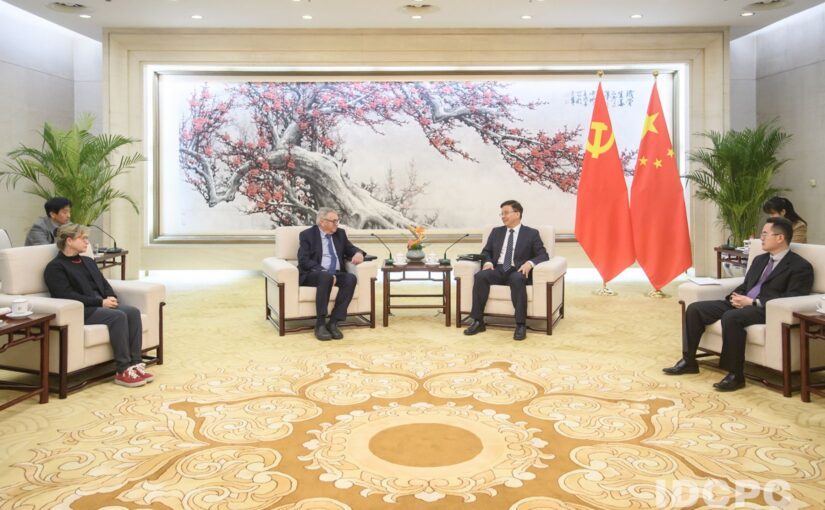
During Foreign Minister Tandi Dorji’s visit, his Chinese counterpart, Wang Yi, in an October 25 meeting, told him that, China is ready to conclude boundary negotiations and establish diplomatic relations with Bhutan as soon as possible. Wang said China and Bhutan are linked by mountains and rivers and enjoy a profound traditional friendship, adding that the conclusion of boundary negotiations and the establishment of diplomatic relations between the two countries fully serves the long-term and fundamental interests of Bhutan.

He also said that China has always placed neighborhood diplomacy at the top of its overall diplomatic architecture, and China respects the sovereignty, independence and territorial integrity of all countries.

Tandi Dorji thanked China for its strong support and assistance to Bhutan, saying that Bhutan firmly upholds the one-China principle.

The following day, Dorji met with Chinese Vice President Han Zheng, who said that although the two countries have not yet established diplomatic relations, they have long maintained friendly exchanges.

“China always respects Bhutan’s independence, sovereignty and territorial integrity, and is willing to strengthen exchanges at all levels and in all fields, expand practical cooperation on the economy, trade, culture and tourism, and accelerate the boundary demarcation process and the establishment of diplomatic relations with Bhutan to bring more benefits to the two countries and the two peoples,” he added.

Tandi Dorji said that both sides have firm determination and a sincere desire to demarcate their boundaries and establish diplomatic relations at an early date. Bhutan is willing to maintain the sound momentum of cooperation with China in all fields and push for the greater development of bilateral ties.

The following articles were originally published by the Xinhua News Agency.

China aims to establish diplomatic relations with Bhutan soon: FM

BEIJING, Oct. 23 (Xinhua) — China is ready to conclude boundary negotiations and establish diplomatic relations with Bhutan as soon as possible, Chinese Foreign Minister Wang Yi said Monday.

Wang, also member of the Political Bureau of the Communist Party of China Central Committee, made the remarks when meeting with Bhutanese Foreign Minister Tandi Dorji who is in China for boundary talks.

Wang said China and Bhutan are linked by mountains and rivers and enjoy a profound traditional friendship, adding that the conclusion of boundary negotiations and the establishment of diplomatic relations between the two countries fully serves the long-term and fundamental interests of Bhutan.

“The two sides should seize historical opportunities, complete the important process as soon as possible, and designate and develop the friendly relations between the two countries in legal form,” said Wang.

Wang also said that China has always placed neighborhood diplomacy at the top of its overall diplomacy architecture, and China respects the sovereignty, independence and territorial integrity of all countries.

Tandi Dorji thanked China for its strong support and assistance to Bhutan, saying that Bhutan firmly upholds the one-China principle.

He said, “Bhutan is willing to work with China to strive for an early settlement of the boundary question and advance the political process of establishing diplomatic ties.”

He said that Bhutan greatly appreciates and supports the China-proposed global initiatives — the Global Development Initiative (GDI), the Global Security Initiative (GSI), and the Global Civilization Initiative (GCI) — which bring benefits to all parties, especially neighboring countries, including Bhutan. 


Chinese vice president meets Bhutan’s foreign minister

BEIJING, Oct. 24 (Xinhua) — Chinese Vice President Han Zheng on Tuesday met with visiting Bhutanese Foreign Minister Tandi Dorji in Beijing. Both sides agreed to accelerate the boundary demarcation process and the establishment of diplomatic relations between the two countries.

Han said that China and Bhutan are friendly neighbors sharing mountains and rivers. He said that although the two countries have not yet established diplomatic relations, they have long maintained friendly exchanges.

He said the two countries have promoted positive progress in bilateral ties in recent years, following the resumption of boundary negotiations. Strengthening that friendship and expanding cooperation are in the fundamental interests of the two countries and in the expectations of the two peoples.

“China always respects Bhutan’s independence, sovereignty and territorial integrity, and is willing to strengthen exchanges at all levels and in all fields, expand practical cooperation on the economy, trade, culture and tourism, and accelerate the boundary demarcation process and the establishment of diplomatic relations with Bhutan to bring more benefits to the two countries and the two peoples,” Han said.

Tandi Dorji said that the Bhutanese government attaches great importance to the development of relations with China and abides firmly by the one-China principle. Both sides have firm determination and a sincere desire to demarcate their boundaries and establish diplomatic relations at an early date. Bhutan is willing to maintain the sound momentum of cooperation with China in all fields and push for the greater development of bilateral ties. 

Senator Mushahid Hussain honoured with Silk Road award at BRI forum

Pakistan Senator Mushahid Hussain was one of three recipients, the others coming from Uganda and Russia, of the inaugural Silk Road News Award. The presentations were made on October 19, during the Media Cooperation Forum of the Third Belt and Road Forum for International Cooperation, held in Beijing. The award was presented in recognition of his work to promote the China Pakistan Economic Corridor (CPEC).

In his acceptance speech, Mushahid, who currently chairs the Defence Committee in the Pakistan Senate, quoted Chairman Mao, that “an idea becomes a material force when it is grasped by millions and millions of people.” He also took the opportunity to refer to the situation in Gaza, which he denounced as genocide, adding that the western powers were complicit in Israel’s crimes.

Senator Mushahid, who also chairs the Pakistan-China Institute and is a member of our advisory group, has devoted his life to the promotion of Pakistan-China friendship, since first visiting the country as a teenager in 1970. He will be a speaker at our forthcoming webinar on ten years of the Belt and Road Initiative on Saturday November 4.

We take this opportunity to congratulate him on this well-deserved recognition and award.

The following article originally appeared in the Pakistani daily newspaper Express Tribune.

Senator Mushahid Hussain on Thursday was awarded the Silk Road Award during the Media Cooperation Forum on the Belt & Road Initiative (BRI) in Beijing. The recognition was for his contributions to the China-Pakistan Economic Corridor (CPEC).

The award ceremony took place on the sidelines of the 3rd Belt and Road Forum and was presented by Information and Communication of the Communist Party of China Chief of Media Li Shulei, who is also a member of the party’s top policymaking political bureau.

In his acceptance speech, Senator Mushahid said he was honoured to receive the first-ever ‘Silk Road News Award.’ He extended the achievement to the people of Pakistan. Two other recipients of this prestigious award were from Uganda and Russia. They were chosen from among 4,485 participants representing 80 countries.

The senator acknowledged China’s enduring support and consistent investment in projects like CPEC. Furthermore, he also highlighted the importance of BRI, stating that it represents a new platform for international economic cooperation and is the most significant development and diplomatic initiative of the 21st century.

The core of such an initiative, he added, is people-to-people connectivity and Pakistan-China relations, especially the role of media, think tanks, academia, youth, and NGOs, working towards a more ‘open, inclusive, and interconnected world’.

Quoting Chairman Mao, Senator Hussain said, “An idea becomes a material force when it is grasped by millions and millions of people,” referring to BRI as a “material force in the world,” bringing benefits and opportunities to a global audience.

Middle East situation

While addressing the international atmosphere in Gaza, the senator expressed his concerns about the Middle East and referred to it as ‘genocide in Gaza,’ where the West’s support of Israel’s crimes is complicit in the ongoing conflict. He criticised the West’s stance on human rights and democracy, calling it ‘double standards’.

Mushahid showed his solidarity with the oppressed Palestinians, terming the situation as a ‘struggle between the oppressed and oppressors’. BRI is a path forward, based on connectivity and cooperation, with CPEC serving as a guarantor for a better future for Pakistan and its people, he added. He encouraged taking ownership of CPEC to ensure its successful conclusion.

Challenge of fake news

Hussain concluded by addressing the challenge of fake news, falsehoods, and fiction, describing them as the most significant threats to the BRI. He called for a collective and cooperative approach among BRI countries on the media front, emphasizing that a “collective voice” would be a potent force multiplier.

The ceremony was attended by Vice Ministers for International Communication from the Publicity and International Departments of the Communist Party of China. It was hosted by ‘People’s Daily’ at its headquarters and attended by the President and Editor-in-Chief of ‘People’s Daily,’ the official organ of the Communist Party of China, along with 200 journalists from over 60 countries.

Xi Jinping bilateral dialogues with leaders from Vietnam, Laos and Brazil

Chinese President Xi Jinping concluded his bilateral dialogues with high-level visitors on the sidelines of the third Belt and Road Forum for International Cooperation (BRF) with three meetings in the morning of October 20.

Meeting with Vietnamese President Võ Văn Thưởng, Xi Jinping pointed out that China and Vietnam have supported each other in their respective struggles for national liberation, forming a deep and enduring comrades-plus-brothers friendship. Both nations are moving ahead with their respective causes of socialist modernisation, seeing each other as a priority in their respective foreign policies and considering each other’s development as an opportunity for their own development. In the face of a changing international landscape and arduous tasks of domestic development, both countries should stay true to the original aspiration of carrying forward traditional friendship, bear in mind the shared ideals and mission, move forward hand in hand along the path of socialism to build a community of a shared future with strategic significance, and ensure that bilateral relations will always stay on the fast track of win-win cooperation and joint development.

For his part, Võ Văn Thưởng said that President Xi’s speech at the opening of the forum was visionary, encompassing both strategic planning and specific measures, showcasing the role of China as a major country and the role of the Communist Party of China (CPC) as a major party. It will have a significant impact in guiding future international cooperation and global development. Vietnam admires the significant achievements of the CPC in theoretical and practical innovation. President Xi’s governance philosophy has been inspiring to the party and government of Vietnam. Vietnam views China’s development as an opportunity and supports socialist China in developing itself and achieving its goal of building a strong China as scheduled. The Vietnamese side believes that China will make a greater contribution to world peace and development.

Meeting with General Secretary of the Lao People’s Revolutionary Party Central Committee and Lao President Thongloun Sisoulith, Xi Jinping pointed out that the past 10 years have seen steady and important progress in building a China-Laos community with a shared future. To build such a community in a world of transformation and turbulence, with accelerated changes unseen in a century, has even greater value and strategic significance for the times, and has an exemplary and guiding role to play.

The Chinese leader emphasised that adhering to the Party leadership and the socialist direction is an essential feature of China-Laos relations. The two parties of China and Laos should continue to deepen political mutual trust, enhance governance capability, and strengthen communication and cooperation in such fields as politics and law enforcement security. The two sides need to tap deep into the potential of the China-Laos Railway, steadily advance the development of the China-Laos Economic Corridor, with a focus on development along the railroad, and actively advance the regional connectivity development outlook, to create a model for Belt and Road cooperation in the region. China will continue to provide assistance for Laos’ economic development to the best of its ability, encourage more Chinese enterprises to invest in the country, import more quality agricultural products from Laos, and expand bilateral cooperation in such fields as energy and mining. Laos will assume the rotating chairmanship of the Association of South East Asian Nations (ASEAN) next year, and China is ready to support Laos in playing a greater role in regional and international affairs.

Thongloun Sisoulith congratulated China on successfully hosting the third BRF, and said that the current cooperation between Laos and China in various fields is being successfully advanced, and Laos sincerely thanks China for providing precious help in its economic and social development over the years. The construction and successful operation of the Laos-China Railway has greatly promoted the economic development of the country and has brought positive changes to the Lao people’s life. A new five-year action plan on building a Laos-China community with a shared future to be signed this time will further consolidate friendly cooperative relations between the two parties and two countries.

Xi Jinping also met with the President of Brazil’s Chamber of Deputies Arthur Lira. He pointed out that during President Lula da Silva’s successful state visit to China this spring, they had a fruitful meeting and reached important common understandings on steering China-Brazil relations into a new era. China and Brazil are respectively the largest developing countries in the eastern and western hemispheres and emerging major countries with global influence. In the face of a world of change and disorder, the two sides should firmly support and echo each other. China supports Brazil’s hosting of the G20 Leaders’ Summit and the Conference of the Parties to the United Nations Framework Convention on Climate Change next year and is ready to strengthen coordination and cooperation with Brazil.

Xi Jinping emphasised that this year marks the 30th anniversary of the establishment of the China-Brazil strategic partnership, and next year the 50th anniversary of diplomatic ties between the two sides. Building on past achievements, China-Brazil relations have much more to accomplish.

Lira noted that Brazil-China relations are in a good shape, and cooperation with China has vigorously promoted Brazil’s economic and social development and increased Brazil’s employment and production capacity. China’s success is of great significance to the world, and China has always been an important partner of Brazil in development. He added that as the rotating president of the G20 next year, Brazil will step up communication and collaboration with China, and play its due role. He looks forward to welcoming President Xi Jinping’s visit to Brazil on that occasion.

The following reports were originally published on the website of the Chinese Foreign Ministry.

Xi Jinping Meets with Vietnamese President Võ Văn Thưởng

On the morning of October 20, 2023, President Xi Jinping met at the Great Hall of the People with Vietnamese President Võ Văn Thưởng who is in China to attend the third Belt and Road Forum for International Cooperation (BRF).

Xi Jinping pointed out that China and Vietnam have supported each other in their respective struggles for national liberation, forming a deep and enduring comrades-plus-brothers friendship. Both nations are moving ahead with their respective causes of socialist modernization, seeing each other as a priority in their respective foreign policies and considering each other’s development as an opportunity for their own development. In the face of a changing international landscape and arduous tasks of domestic development, both countries should stay true to the original aspiration of carrying forward traditional friendship, bear in mind the shared ideals and mission, move forward hand in hand along the path of socialism to build a community of a shared future with strategic significance, and ensure that bilateral relations will always stay on the fast track of win-win cooperation and joint development.

Continue reading Xi Jinping bilateral dialogues with leaders from Vietnam, Laos and Brazil

The Belt and Road Initiative: A Key Pillar of the Global Community of Shared Future

On 10 October 2023, China’s State Council Information Office released an important white paper: The Belt and Road Initiative: A Key Pillar of the Global Community of Shared Future. The document presents the achievements of the Belt and Road Initiative (BRI) since its announcement in September 2013.

A significant number of historic infrastructure projects in the developing world have already been built within the framework of the BRI. For example, the Mombasa-Nairobi Railway is the largest infrastructure project carried out in Kenya since independence. The China-Laos Railway – an electrified railway directly connecting Kunming (in China’s southwestern Yunnan province) to Vientiane, the capital of Laos – was completed in 2021. The white paper notes:

“As an important part of the central section of the pan-Asia railway network, the China-Laos Railway has helped Laos to realize its long-cherished dream of becoming a land-linked country from a landlocked one. It has promoted transport, investment, logistics and tourism, and injected new impetus into the economic development of Laos and areas along the line. By August 31, 2023, the railway had recorded a total of 20.79 million passenger trips and carried 25.22 million tonnes of cargo. It has become a safe and efficient international passageway connecting Laos with its neighbouring countries and regions and generating mutual benefits.”

The Jakarta-Bandung High-speed Railway – the first high-speed rail system in Indonesia – has achieved an operational speed of 350 km per hour, reducing the journey time between these important cities from 3.5 hours to 45 minutes.

A huge number of energy production and distribution projects have been built as part of the BRI, connecting China, Russia, Mongolia, Central Asia, Pakistan and further afield.

The white paper makes it very clear that, while the BRI was launched by China, “it belongs to the world and benefits the whole of humanity”, and that “irrespective of size, strength and wealth, all countries participate on an equal footing.” The aim is not to travel the well-trodden path of imperialist modernisation but rather to build a global community of shared future – “an open, inclusive, clean and beautiful world that enjoys lasting peace, universal security and common prosperity, charting a bright future for human development.”

This is a model of development and international relations that “diverges from the exploitative colonialism of the past, avoids coercive and one-sided transactions, rejects the centre-periphery model of dependency, and refuses to displace crisis onto others or exploit neighbours for self-interest. Instead, it aims to achieve win-win outcomes and shared development and prosperity.”

Rather than competing with other initiatives, the BRI has successfully integrated and cooperated with many other strategies including Russia’s Eurasian Economic Union framework, Kazakhstan’s Bright Road economic policy, Indonesia’s Global Marine Fulcrum initiative, Vietnam’s Two Corridors and One Economic Circle plan, South Africa’s Economic Reconstruction and Recovery Plan, and Egypt’s Suez Canal Corridor Project.

“By June 2023, China had signed more than 200 BRI cooperation agreements with more than 150 countries and 30 international organizations across five continents, yielding a number of signature projects and small-scale yet impactful projects.”

The document notes that the fruits of economic globalisation have hitherto been dominated by a small group of developed countries. Rather than contributing to common prosperity at a global level, globalisation “has widened the wealth gap between rich and poor, between developed and developing countries, and within developed countries. Many developing countries have benefited little from economic globalisation and even lost their capacity for independent development, making it hard for them to access the track of modernisation. Certain countries have practiced unilateralism, protectionism and hegemonism, hampering economic globalisation and threatening a global economic recession.”

The focus of the BRI is precisely on contributing to a form of globalisation that generates common prosperity, that brings benefits particularly to developing countries. As such, “most participants are developing countries, all seeking to leverage collective strengths to address challenges such as inadequate infrastructure, lagging industrial development, limited industrialisation, insufficient capital and technology, and a shortage of skilled workers, to promote their own economic and social development.”

Hence the BRI stands in defence of greater globalisation and economic integration, but in a form that is beneficial to all. It stands against certain concepts that have become popular in the West recently – “decoupling” and “derisking” – which seek to impede global cooperation, exchanges and mutual learning. “In a world full of uncertainties and instabilities, all countries should urgently bridge differences through dialogue, oppose rifts with unity, and promote development through cooperation.”

Especially in the last few years, the BRI has embraced green and low-carbon development, “emphasising respecting and protecting nature and following its laws, and respecting the right of all parties to pursue sustainable and eco-friendly growth.” Hence for example China pledged in 2021 to stop building new coal-fired power stations overseas, and is actively building financing mechanisms to encourage sustainable energy and infrastructure.

The document also discusses progress made under the BRI in numerous fields that are largely overlooked, for example cooperation in public health, digital governance and people-to-people exchanges and tourism.

All in all, “the BRI has become the world’s largest platform for international cooperation” and is providing a springboard for progress and prosperity throughout the world.

We publish the full text of the white paper below. It can also be downloaded as a PDF. It was first published in English on Xinhua.


Note that Friends of Socialist China and the International Manifesto Group are holding a webinar – Building a multipolar world: Ten years of the Belt and Road Initiative – on Saturday 4 November 2023, featuring an array of interesting speakers including Erik Solheim (President, Green Belt and Road Institute), Professor Zhang Weiwei (Director, China Institute, Fudan University), Li Jingjing (Journalist and political commentator, CGTN), Professor Seyed Mohammad Marandi (Political analyst, Iran), Senator Mushahid Hussain (Chair, Pakistan-China Institute), Martin Jacques (Author, When China Rules the World), Fred M’membe (President, Socialist Party Zambia), Camila Escalante (Editor, Kawsachun News), Keith Bennett (Co-editor, Friends of Socialist China) and Radhika Desai (Convenor, International Manifesto Group). Registration is free via Eventbrite.

The Belt and Road Initiative: A Key Pillar of the Global Community of Shared Future

The State Council Information Office of the People’s Republic of China                                                        

Preamble

Over two millennia ago, inspired by a sincere wish for friendship, our ancestors travelled across grasslands and deserts to create a land Silk Road connecting Asia, Europe and Africa, leading the world into an era of extensive cultural exchanges. More than 1,000 years ago, our ancestors set sail and braved the waves to open a maritime Silk Road linking the East and the West, beginning a new phase of closer communication among peoples.

Spanning thousands of miles and years, the ancient silk routes were not only routes for trade but also roads for cultural exchanges. They made a great contribution to human progress. In the 1980s, the United Nations and some countries began to envisage the Eurasian Land Bridge, the Silk Road Initiative, and other plans, reflecting a common wish to engage in communication and cooperation.

In March 2013, President Xi Jinping proposed the vision of a global community of shared future; in September and October that year, he raised the initiatives of joining with others to build a Silk Road Economic Belt and a 21st Century Maritime Silk Road (Belt and Road Initiative, or BRI). The Belt and Road Initiative is a creative development that takes on and carries forward the spirit of the ancient silk routes – two of the great achievements in human history and civilization. It enriches the ancient spirit with the zeitgeist and culture of the new era, and provides a platform for building a global community of shared future.

Continue reading The Belt and Road Initiative: A Key Pillar of the Global Community of Shared Future

Clare Daly: ‘derisking’ from China would be suicidal for European industry

In this episode of the CGTN program Dialogue, Xu Qinduo interviews Clare Daly, the outspoken, anti-imperialist member of the European Parliament (MEP) from Ireland on the EU’s attitude towards the conflicts in Gaza and Ukraine, as well as on China.

Clare notes that the recent resolution on Gaza adopted by the European parliament, which she and her colleague Mick Wallace voted against, did not address the root causes of the conflict or the crimes, including ethnic cleansing and genocide, perpetrated by the Israeli apartheid state. The EU and the United States, she notes, are complicit in Israeli genocide and that makes them equally culpable in international law.

On Ukraine, she is not presently hopeful of prospects for peace. Rather she fears that working class Ukrainian men will continue to be killed in the interests of western arms companies who seek to perpetuate the conflict. 

Asked about the moves to expand NATO to Asia, possibly starting with the establishment of an office in Tokyo, Clare responds that she has said before that the last bite of a dying snake is the most dangerous. US hegemony is in decline and there is no going back on this. But in its lashing out in desperation it is very dangerous. In this regard, she cites President Biden’s recent demand for US$100 bn for not only Israel and Ukraine but Taiwan as well. She feels that the US managed to provoke Russia and now seeks to do the same to China over Taiwan. However, she believes that Chinese diplomacy is more measured and the country will not walk into a similar trap.

Asked what impressed her most on her recent visit to China, she says there is not enough time to recount all the amazing things she saw. China, she notes, has built whole cities, but in Dublin it has not been possible to build even one metro station in 30 years. Ireland does not have a single high-speed train and neither does the US. Unfortunately, the EU has been following the US in seeking to restrict relations with China under the guise of ‘derisking’ and similar terms. Such a policy, she notes, if followed through, would be suicidal for European industry. In the face of these provocations, Clare advises China to continue with its diplomatic overtures and says she can think of nothing that China should be doing differently.

Within this situation, Clare asserts that Ireland has a special role to play. The EU is largely made up of former colonising powers or former socialist countries. Ireland, however, was colonised. It knows what it is like to be oppressed. Therefore, Ireland can be a voice for neutrality, non-alignment, multilateral cooperation and international solidarity.

The full interview with Clare Daly MEP is embedded below.

Ten high-level bilateral meetings on the margins of the Belt and Road Forum

On October 19, Chinese President Xi Jinping held ten high-level bilateral meetings in the margins of the third Belt and Road International Cooperation Forum (BRF).

In the morning, he met with Cambodian Prime Minister Hun Manet, Egyptian Prime Minister Mostafa Madbouly, Sri Lankan President Ranil Wickremesinghe, Mongolian President Ukhnaa Khurelsukh, and Gurbanguly Berdimuhamedov, National Leader of the Turkmen people and Chairman of the Halk Maslahaty of Turkmenistan.

In the afternoon, he met with Prime Minister of Thailand Srettha Thavisin and President of the Republic of Congo Denis Sassou-N’Guesso. And in the evening, he met with Prime Minister of Mozambique Adriano Afonso Maleiane, Prime Minister of Pakistan Anwaar-ul-Haq Kakar, and the former President of Brazil, Dilma Rousseff, who is now the President of the New Development Bank (NDB).

Meeting Prime Minister Hun Manet, Xi Jinping pointed out that since the establishment of diplomatic relations 65 years ago, China and Cambodia have respected, trusted, and supported each other and contributed to each other’s success, setting a fine example of equal treatment and win-win cooperation between countries different in size. Both China and Cambodia are countries that value friendship, and the China-Cambodia ironclad friendship is unbreakable.

He stressed that the Belt and Road cooperation has brought tangible development opportunities to Cambodia. China is ready to uphold the principle of “planning together, building together, and benefiting together”, enhance synergy between the Belt and Road Initiative and Cambodia’s Pentagonal Strategy, flesh out the China-Cambodia “diamond hexagon” cooperation framework at a faster pace, build well the “Industrial Development Corridor” and the “Fish and Rice Corridor”, and push for the implementation of more projects that benefit the people. China supports Cambodia’s projects such as airport construction and cultural relic restoration, welcomes more Cambodian agricultural products to the Chinese market, and encourages more Chinese tourists to visit Cambodia.

Hun Manet thanked China for its valuable support to Cambodia over the years and stressed that his country steadfastly pursues a friendly policy toward China and firmly supports China’s core interests. Cambodia is ready to take the 65th anniversary of the establishment of diplomatic relations between Cambodia and China as an opportunity to strengthen exchanges and cooperation with China, advance cooperation on the “Industrial Development Corridor” and the “Fish and Rice Corridor” and build a Cambodia-China community with a shared future.

In his meeting with the Egyptian Prime Minister, Xi Jinping pointed out that Egypt was the first Arab and African country to establish diplomatic relations with the People’s Republic of China. China and Egypt are good friends with common purposes and mutual trust and good partners for joint development and common prosperity.

He congratulated Egypt on joining the BRICS cooperation mechanism upon invitation, and pointed out that China is ready to strengthen cooperation with Egypt within the China-Arab and China-Africa frameworks, enhance coordination and cooperation at the United Nations, BRICS and other multilateral platforms, uphold true multilateralism and international fairness and justice, and safeguard the common interests of developing countries, so as to inject more certainty and stability into the region and the world.

Mostafa Madbouly said that Egypt sees China as a role model for emerging economies and developing countries. He expressed gratitude for China’s long-term, valuable support to Egypt, and noted that the Belt and Road cooperation has greatly improved Egypt’s transportation and logistics capabilities and given a strong boost to its economic development. Madbouly thanked China for supporting Egypt’s accession to the BRICS cooperation mechanism and expressed his readiness to work closely with China in multilateral cooperation to make the international landscape more balanced and just.

President Xi stated China’s principled position on the current Palestinian-Israeli situation. He stressed that the top priority is to stop the fighting as soon as possible, prevent the conflict from spreading or even getting out of control and causing a severe humanitarian crisis. The fundamental way out of the recurring Palestinian-Israeli conflicts is to implement the two-state solution, establish an independent State of Palestine and achieve peaceful coexistence between Palestine and Israel.

Meeting his Sri Lankan counterpart, Xi Jinping pointed out that the Chinese and Sri Lankan people have enjoyed a time-honoured friendship marked by mutual learning and mutual help, and have been partners for self-reliant development. He emphasised that China firmly supports Sri Lanka in upholding strategic autonomy, and safeguarding national sovereignty, independence, and dignity. China will continue to provide assistance to Sri Lanka with no political strings attached and help the country cope with difficulties affecting social life and people’s livelihood and is happy to see Sri Lanka become a commercial centre of the Indian Ocean. The two sides should step up coordination in international and regional affairs, oppose politicisation of human rights issues and bloc confrontation, and safeguard the common interests of the two countries and fellow developing countries.

Wickremesinghe said that the development of the Belt and Road, especially the Maritime Silk Road, has greatly facilitated Sri Lanka’s economic and social development and is conducive to enhancing Sri Lanka’s unique influence in the region. Sri Lanka hopes to work more closely with China in the future, as China can be an important partner in Sri Lanka’s modernisation. Sri Lanka believes that the Indian Ocean should embrace openness and is ready to strengthen communication with China on regional affairs and support the solidarity and cooperation among developing countries.

At his meeting with the President of Mongolia, Xi Jinping noted that China is ready to work with Mongolia to respect each other’s independence, sovereignty, and territorial integrity, support each other in safeguarding respective core interests, and build a solid foundation for the China-Mongolia community with a shared future. China will continue to help Mongolia revitalise its economy, move ahead with the construction of relevant border ports in an orderly manner, and open up new channels for connectivity between the two countries. The China-Mongolia Desertification Prevention and Control Cooperation Centre has been established. China will continue to support Mongolia’s “Planting One Billion Trees” plan and join hands with Mongolia in carrying out ecological conservation. China would also like to expand trilateral cooperation with Mongolia and Russia, and steadily advance the building of the China-Mongolia-Russia Economic Corridor.

President Khurelsukh noted that the outcomes of the current BRF will contribute to achieving the United Nations Sustainable Development Goals and inject new momentum into global economic growth. Mongolia takes developing relations with China as a key priority in its foreign policy. Next year will mark the 75th anniversary of diplomatic relations between Mongolia and China. It will also mark the 10th anniversary of President Xi Jinping’s visit to Mongolia and the establishment of comprehensive strategic partnership between the two countries. Mongolia is ready to strengthen high-level exchanges with China, respect and support each other and promote cooperation in such areas as trade and economy, connectivity, mining and energy, desertification prevention and control, and green development, as well as enhancing people-to-people exchanges. Mongolia also places a high premium on the Mongolia-China-Russia cooperation and is ready to closely communicate and collaborate with China in multilateral fields.

Meeting with the leader of Turkmenistan, Xi Jinping pointed out that China is a trustworthy friend and partner of the central Asian country. In January this year, he and President Serdar Berdimuhamedov jointly announced the elevation of their bilateral relationship to a comprehensive strategic partnership and the establishment of a community with a shared future at the bilateral level, opening a new chapter in the development of China-Turkmenistan relations. Developing a comprehensive strategic partnership between China and Turkmenistan meets the fundamental interests of both countries and the common aspirations of the two peoples.

China appreciates Turkmenistan’s strong support on issues concerning China’s core interests and major concerns, and will continue to support Turkmenistan in safeguarding its national sovereignty, security, and development interests and in pursuing a development path that suits its national conditions.

Gurbanguly Berdimuhamedov said that the ancient Silk Road has connected the people of Turkmenistan and China and contributed to the progress of world civilisation. Today, close synergy has been forged between Turkmenistan’s strategy of reviving the Great Silk Road and the Belt and Road Initiative, which has greatly facilitated the connectivity, development, and revitalisation of both countries as well as countries in the region.

In his meeting with Srettha Thavisin, Xi Jinping noted that the recently appointed Thai Prime Minister had made China the destination of his first official visit outside ASEAN (the Association of South East Asian Nations), fully demonstrating the great importance the new Thai government attaches to Thailand-China relations. China and Thailand are close neighbours, and their friendship has taken deep roots in the hearts of the two peoples. Xi said he is happy to see that the outcomes of his visit to Thailand last November are being actively and effectively implemented.

Srettha Thavisin said he sincerely admires President Xi Jinping’s vision and China’s achievements in poverty reduction and would like to learn from China’s governance experience. He expressed his hope that the two sides will deepen practical cooperation in various fields, jointly build the Thailand-China Railway, and advance the implementation of the China-Laos-Thailand Connectivity Development Corridor Outlook.

Meeting with President of the Republic of Congo (ROC) Denis Sassou-N’Guesso, Xi Jinping said that the successful implementation of such projects as the No.1 National Highway in the ROC, is exemplary. China and the ROC are true friends and good partners.

Reflecting the long-standing orientation of the Republic of Congo regarding its close relations with China and other socialist countries, Xi Jinping emphasised that shared ideals, mutual trust and mutual support are the key to the sustained and steady growth of China-ROC relations. China appreciates the resolute support given by the ROC on issues related to China’s core interests and major concerns. China supports the ROC in safeguarding national independence, opposing foreign interference, and adhering to a development path that suits its national conditions, and supports the ROC in playing a greater role in international and regional affairs. China also stands ready to coordinate closely with the ROC in multilateral arena to promote the building of a fairer and more equitable international order.

Sassou-N’Guesso said that his country is ready to take the opportunity of celebrating the 60th anniversary of diplomatic relations with China next year to further develop bilateral relations. The ROC firmly adheres to the one-China policy and looks forward to continuing mutual support with China, strengthening pragmatic cooperation in infrastructure, green energy, and other fields, and enhancing communication and collaboration within the framework of the Forum on China-Africa Cooperation (FOCAC).

Similar sentiments animated President Xi’s meeting with the Prime Minister of Mozambique, Adriano Afonso Maleiane. Reflecting the fact that China’s relationship with Mozambique dates to its staunch support for the southern African country’s national liberation struggle, Xi Jinping pointed out that China and Mozambique are true friends and true brothers standing together in adversity and helping each other in difficulty. China is ready to work with Mozambique and other African countries to build the Belt and Road to high standard, and promote the implementation of three cooperative measures, namely, the Initiative on Supporting Africa’s Industrialisation, the Plan for China Supporting Africa’s Agricultural Modernisation, and the Plan for China-Africa Cooperation on Talent Development.

Xi Jinping further emphasised that China is ready to work with Mozambique to further deepen traditional friendship, strengthen strategic coordination, and promote new progress in the China-Mozambique comprehensive strategic cooperative partnership. China supports Mozambique in safeguarding national sovereignty, security, and development interests, and following a development path suited to its own national conditions. The two sides need to deepen cooperation in such fields as energy and agriculture, and promote educational, cultural, sub-national and non-governmental exchanges.

Maleiane remarked that the Belt and Road Initiative, the Global Development Initiative and other important initiatives are conducive to helping other countries eliminate poverty, grow the economy, and improve the people’s livelihood. China’s development and foreign policies are based on peace, equality, respect, and friendship, and are positive energy for world peace and development. Maleiane noted that China has always given Mozambique firm support as a true friend, whether during Mozambique’s struggle for national independence or the fight against the COVID-19 pandemic. Mozambique is firmly committed to the one-China policy and hopes to learn from China’s experience in modernisation to find a better way to realise its own development, and deepen practical cooperation with China across the board to promote the building of a community with a shared future for humanity.

Meeting Prime Minister of Pakistan, Anwaar-ul-Haq Kakar, Xi Jinping pointed out that China and Pakistan are all-weather strategic cooperative partners and ironclad friends. Successive Pakistani governments have actively supported and participated in Belt and Road cooperation. Over the past decade, the China-Pakistan Economic Corridor (CPEC) has achieved fruitful results, giving a strong boost to Pakistan’s economic and social development, and becoming an important signature project of Belt and Road cooperation. He said that the two sides should take the 10th anniversary of the CPEC this year as an opportunity to build an “upgraded version” of the corridor featuring growth, livelihood, innovation, greenness and openness, strengthen cooperation in areas like industrial park, agriculture, mining and new energy, and promote the early implementation of major connectivity projects and the achievement of practical results.

Anwaar-ul-Haq Kakar said that the successful practice of Chinese modernisation has set an example and provided impetus for other developing countries. China’s efforts to build a human community with a shared future have brought confidence and hope to other countries. Pakistan will always be a trustworthy and reliable friend of China, will never allow any force to undermine the friendship between Pakistan and China, and will remain committed to deepening the all-weather strategic cooperative partnership between Pakistan and China. Pakistan is ready to work closely with China to promote the high-quality development of the CPEC. The Pakistani government will make every effort to protect the safety and interests of Chinese citizens and institutions in Pakistan.

Meeting with Dilma Rousseff, Xi Jinping recalled the birth of the New Development Bank which he and President Rousseff jointly witnessed in 2014 in Brazil. He pointed out that the bank has made remarkable achievements and grown from strength to strength in recent years. He noted that the world today is facing intertwined risks and crises. As an important emerging force in the international financial system, the New Development Bank should play its due role, and build itself into a new-type multilateral development institution in the 21st century that works to make the international financial system fairer and more equitable and effectively enhance the representation and say of emerging markets and developing countries.

Dilma Rousseff said that under the current international circumstances, all countries in the world need to take concerted actions to respond to common challenges. Strengthening infrastructure development and connectivity is of crucial importance for developing countries to realise common development. No other initiatives in human history have ever brought more than 150 countries together like the BRI does. She thanked the Chinese government for greatly supporting the New Development Bank’s work, noting that bank has a shared purpose and ideals with the BRI, and is ready to actively participate in the Belt and Road cooperation and make due contributions to a multi-polar world and the reform of the international financial system.

The following reports were originally published on the website of the Chinese Foreign Ministry.

Xi Jinping Meets with Prime Minister of Cambodia Hun Manet

On the morning of October 19, 2023, President Xi Jinping met at the Great Hall of the People with Prime Minister of Cambodia Hun Manet who is in China to attend the third Belt and Road Forum for International Cooperation (BRF).

Xi Jinping pointed out that since the establishment of diplomatic relations 65 years ago, China and Cambodia have respected, trusted and supported each other and contributed to each other’s success, setting a fine example of equal treatment and win-win cooperation between countries different in size. Both China and Cambodia are countries that value friendship, and the China-Cambodia ironclad friendship is unbreakable. The two sides need to visit each other frequently, maintain high-level strategic communication, make good use of the Intergovernmental Coordination Committee mechanism, and implement the action plan for building a China-Cambodia community with a shared future in the new era, to bring the two countries even closer.

Xi Jinping stressed that the Belt and Road cooperation has brought tangible development opportunities to Cambodia. China is ready to uphold the principle of “planning together, building together, and benefiting together”, enhance synergy between the Belt and Road Initiative and Cambodia’s Pentagonal Strategy, flesh out the China-Cambodia “diamond hexagon” cooperation framework at a faster pace, build well the “Industrial Development Corridor” and the “Fish and Rice Corridor”, and push for the implementation of more projects that benefit the people. China supports Cambodia’s projects such as airport construction and cultural relic restoration, welcomes more Cambodian agricultural products to the Chinese market, and encourages more Chinese tourists to visit Cambodia. Xi Jinping expressed his readiness to declare together with Hun Manet the year 2024 the China-Cambodia Year of People-to-People Exchanges.

Continue reading Ten high-level bilateral meetings on the margins of the Belt and Road Forum

Zhang Jun: Without a comprehensive ceasefire, humanitarian assistance will only be a drop in the ocean

After four attempts to pass a resolution in the United Nations Security Council (UNSC) on the conflict in Gaza had already failed, due to the imperialist powers, led by the United States, aiding and abetting Israeli genocide, China, joined by the United Arab Emirates (UAE), currently a non-permanent member, called for an emergency UNSC meeting on October 30.

In his remarks to the meeting, Ambassador Zhang Jun noted that on Friday October 27, an emergency special session of the United Nations General Assembly (UNGA) had, by an overwhelming majority, adopted a resolution calling for an immediate and durable humanitarian truce leading to the cessation of hostilities.

“Regrettably and unacceptably however, Israel, turning a deaf ear to the common concerns of the international community, has chosen to further escalate its military operations in Gaza and formally declared the launch of a ground assault.”

Noting the warning made by UN Secretary-General Guterres that the people of Gaza are facing an “avalanche of human suffering”, the Chinese Ambassador went on:

“Having one of the highest population density in the world, Gaza is a land that has been under siege for 16 years. The 2.3 million innocent people are living in utter fear amidst the indiscriminate bombardment and have been cut off from water, electricity, food, and fuel for 21 days. Just this past weekend, they experienced a communication blackout that lasted for nearly 36 hours. If left unchecked, the situation will spiral further out of control and an even greater humanitarian catastrophe will be inevitable.”

After expressing, “our deep sympathy to the people in Gaza who are struggling on the brink of life and death,” Zhang Jun said:

“China solemnly calls on Israel as the occupying power to fulfil its obligations under international humanitarian law, lift its full siege on Gaza, immediately rescind its emergency evacuation order, and expeditiously restore the supply of basic necessities so as to prevent an even larger humanitarian disaster.”

And clearly addressing himself to the United States, he added:

“China solemnly calls on a certain major country with special influence on the parties concerned to put aside its self-interests and geopolitical considerations and make every effort to stop the war and restore peace.”

He warned of the real dangers of escalation: “There will be no firewall in Gaza… The situation in the West Bank and along the Lebanese-Israeli border has already sounded the alarm.”

Although humanitarian assistance is vital: “Without a comprehensive ceasefire, humanitarian assistance, no matter how much there is, will only be a drop in the ocean. What the people in Gaza need now is more than just the reiteration by the Council of the importance of international humanitarian law and unfulfilled promises of protection. What they need is concrete actions to restore peace, uphold the rule of law, and save lives.”

In solemn words that match the gravity of the situation, and which all countries would do well to heed, Ambassador Zhang Jun concluded:

“At this juncture. silence means acquiescence, and inaction is tantamount to a green light. The eyes of the world are upon us, and history will record our choice.”

The next day, October 31, at the Chinese Foreign Ministry’s regular press conference, in response to a question from Chinese television, Spokesperson Wang Wenbin stated:

“For too long, Palestinian territories have been under illegal occupation. For too long, the Palestinian people’s right to independent statehood has been overlooked. And for too long, their basic rights have received no fundamental guarantee. This is the root cause of the cycle of conflict between Palestine and Israel. Such historical injustice must not continue.”

The following article was originally published on the website of the Permanent Mission of the People’s Republic of China to the United Nations.

Mr. President.

First of all, I would like to thank Brazil for organizing today’s meeting upon the request of the UAE and China. I thank Executive Director Catherine Russell, Commissioner-General Philippe Lazzarini, and Ms. Lisa Doughten for the briefings. Their briefings underscored once again the gravity of the situation in Gaza and the urgency for the Council to act.

Last Friday, the 10th emergency special session of the General Assembly adopted by an overwhelming majority a resolution calling for an immediate and durable humanitarian truce leading to the cessation of hostilities. This reflected the widespread call on the part of the international community. Regrettably and unacceptably however, Israel, turning a deaf ear to the common concerns of the international community, has chosen to further escalate its military operations in Gaza and formally declared the launch of a ground assault.

Secretary-General Guterres has warned that the population in Gaza is facing an “avalanche of human suffering”. Having one of the highest population density in the world, Gaza is a land that has been under siege for 16 years. The 2.3 million innocent people are living in utter fear amidst the indiscriminate bombardment and have been cut off from water, electricity, food, and fuel for 21 days. Just this past weekend, they experienced a communication blackout that lasted for nearly 36 hours. If left unchecked, the situation will spiral further out of control and an even greater humanitarian catastrophe will be inevitable.

We express our deep sympathy to the people in Gaza who are struggling on the brink of life and death. And we are also deeply worried about the Middle East peace process which is on the brink of collapse.

China solemnly calls on the parties to the conflict to cease all hostilities, disengage immediately, put in place a humanitarian truce, and make every effort to prevent the situation from escalating further.

China solemnly calls on Israel as the occupying power to fulfill its obligations under international humanitarian law, lift its full siege on Gaza, immediately rescind its emergency evacuation order, and expeditiously restore the supply of basic necessities so as to prevent an even larger humanitarian disaster.

China solemnly calls for greater diplomatic efforts to facilitate the release of hostages without delay and to work on this basis to open up space for dialogue, so as to return to the track of a political settlement.

China solemnly calls on a certain major country with special influence on the parties concerned to put aside its self interests and geopolitical considerations and make every effort to stop the war and restore peace.

Mr. President,

The decades-long history of the Palestinian-Israeli issue has taught us that military means is not the solution. Absolute security cannot be achieved by imposing collective punishment on civilians, and violence for violence will only exacerbate hatred and confrontation. We call on the parties to the conflict to abandon their blind faith in the use of force and to commit themselves to breaking the cycle of violence and achieving common security.

There will be no firewall in Gaza. It is a dangerous myth to think that a contained war is possible there. Allowing the fighting in Gaza to continue could very well turn it into a military catastrophe that will engulf the entire region. The situation in the West Bank and along the Lebanese-Israeli border has already sounded the alarm. We call on all parties who are concerned about the spillover of the conflict to devote their efforts towards promoting a ceasefire in Gaza.

As long as the war rages on, more violations of international humanitarian law are bound to happen. Without a comprehensive ceasefire, humanitarian assistance, no matter how much there is, will only be a drop in the ocean. What the people in Gaza need now is more than just the reiteration by the Council of the importance of international humanitarian law and unfulfilled promises of protection. What they need is concrete actions to restore peace, uphold the rule of law, and save lives.

The Council has so far held several meetings on the Palestinian-Israeli Situation. It cannot be said that there was no consensus at all. The resolution just adopted by the General Assembly has also pointed the Council in the right direction. In the face of the current critical situation, China once again solemnly calls on the Council to strengthen unity, build consensus, and take responsible and meaningful actions as soon as possible. We believe that so long as we focus on the most pressing issues such as a ceasefire and an end to the fighting, the protection of civilians, and the prevention of a larger humanitarian disaster, it is possible for members of this Council to reach consensus, and indeed this is what we should do. At this juncture. silence means acquiescence, and inaction is tantamount to a green light. The eyes of the world are upon us, and history will record our choice.

Thank you, Mr. President.

Xi meets with leaders of Russia, Nigeria, Kenya, Argentina and United Nations

Chinese President Xi Jinping carried out a second day of bilateral meetings in the margins of the third Belt and Road Forum for International Cooperation (BRF) on October 18.

He met with Russian President Vladimir Putin at noon, Vice President Kashim Shettima of Nigeria in the afternoon, and Kenyan President William Ruto, United Nations Secretary-General Antonio Guterres, and Argentine President Alberto Fernandez in the evening.

President Xi told President Putin that his attendance at the BRF for the third time in a row demonstrates Russia’s support for the Belt and Road cooperation. Russia is an important partner of China in Belt and Road international cooperation. Major infrastructure projects including the China-Russia east-route natural gas pipeline are up and running, delivering tangible benefits to the two peoples. China will work with Russia and other members of the Eurasian Economic Union (EEU) to forge stronger synergy between the Belt and Road cooperation and the EEU, and carry out regional cooperation at a higher level and greater depths. President Xi expressed his hope for early substantive progress in the China-Mongolia-Russia natural gas pipeline, successful Great Tea Way cross-border tourism cooperation, and the building of the China-Mongolia-Russia economic corridor as a road for high-quality interconnected development.

He stressed that developing the China-Russia comprehensive strategic partnership of coordination with ever-lasting good neighbourliness and mutually beneficial cooperation is not a matter of expediency, but a long-term commitment. Next year will mark the 75th anniversary of the establishment of diplomatic relations between China and Russia. China stands ready to work with Russia to continue adding new dimensions to their practical cooperation with a keen grasp of the trend of the times and bearing in mind the fundamental interests of the two peoples. China supports the people of Russia in following their choice of path to national rejuvenation and in safeguarding sovereignty, security and the development interests of the country.

President Xi pointed out that the recent historic expansion of BRICS membership has shown the confidence of developing countries in pursuing a multi-polar world and making international relations more democratic. China supports Russia in hosting the BRICS Summit in Kazan next year. China is ready to work with Russia to step up communication and coordination within the United Nations, the Shanghai Cooperation Organisation, the G20 and other multilateral frameworks, play a greater role in ensuring food security, energy security and stable global industrial and supply chains, and uphold the shared interests of the two countries, the region and the developing world.

President Putin said that Russia is ready to work with China to enhance communication and coordination in BRICS and other multilateral mechanisms, defend the international system based on international law and promote the building of a more just and equitable global governance system.

The two heads of state also had in-depth exchange of views on the Palestinian-Israeli situation.

Meeting Nigerian Vice President Shettima, Xi Jinping pointed out that this year marks the 10th anniversary of his proposal of the Belt and Road Initiative and his proposal of the principle of sincerity, real results, amity and good faith as part of China’s Africa policy. There have been many highlights in the Belt and Road cooperation between China and Nigeria. Many cooperation projects, including railways, ports, power stations and communications backbone networks have been completed in succession, and remarkable achievements have been made in the development of free trade areas. China is ready to continue working with Nigeria to push for more tangible outcomes of China-Nigeria and China-Africa Belt and Road cooperation and help Nigeria and Africa realise industrialisation and agricultural modernisation. China supports Nigeria in playing a greater role in international and regional affairs, and would like to strengthen strategic coordination with Nigeria to promote democracy in international relations and safeguard the common interests of developing countries.

Kashim Shettima noted that Nigeria and China are good friends who have shared weal and woe and supported each other in times of difficulties. China has always treated Nigeria and other African countries with respect and as equals; it has never bossed them around, and has done its best to support the African people in seeking independence and development. He thanked China for proposing a series of important global cooperation initiatives for developing countries, providing valuable assistance for Nigeria’s development, and boosting the industrialisation process of Nigeria and Africa at large.

Continue reading Xi meets with leaders of Russia, Nigeria, Kenya, Argentina and United Nations

Putin: the Belt and Road Initiative is a truly important idea, facilitating a fairer, multipolar world

At the opening ceremony of the Third Belt and Road Forum for International Cooperation, held in Beijing’s Great Hall of the People on October 18, the speech of Chinese President Xi Jinping was immediately followed by that of his Russian counterpart, Vladimir Putin.

Noting that the forum was being held on the tenth anniversary of President Xi proposing the Belt and Road Initiative, President Putin described the BRI, as “a truly important and global idea that is spearheaded into the future, towards creating a fairer multipolar world and system of relations,” adding:

“We pointed out on numerous occasions that Russia and China, just as the majority of other countries, share the striving for equal and mutually beneficial cooperation towards universal, sustainable and lasting economic progress and social welfare based on respect for civilisational diversity and the right of every state to its own development model.”

Putin asserted that BRI is based on these fundamental principles and therefore fits very well with the integration processes underway in many regions:

“It also rhymes with our idea of creating a greater Eurasian partnership as an area of cooperation and interaction among like-minded nations and the alignment of various integration processes, such as the Belt and Road Initiative, the Shanghai Cooperation Organisation (SCO), the Association of Southeast Asian Nations (ASEAN) and the Eurasian Economic Union (EAEU), which Russia is successfully developing with its post-Soviet partners. It is notable that Russia and China have reached a practical agreement on a concurrent and coordinated development of the EAEU and the Belt and Road Initiative.”

President Putin took the opportunity to outline the various projects and plans of the Russian Federation in this regard, such as work to connect Russian ports on the Baltic and Arctic seas to ports in the Persian Gulf and the Indian Ocean, including seamless rail connectivity from Murmansk in the far northwest of Russia to the Iranian port city of Bandar Abbas on the Persian Gulf.

Concluding, President Putin noted that, “when a major project is launched, everybody hopes that it will succeed. However, to be honest, it is difficult to expect that all its elements will be successful, considering the global scale of the initiative advanced by the President of the People’s Republic of China 10 years ago. Our Chinese friends are working successfully. We are happy for them, because this also concerns many of us.”

His speech was followed by those of the Presidents of Kazakhstan, Indonesia and Argentina, the Prime Minister of Ethiopia, and the Secretary-General of the United Nations.

The following is the full text of President Putin’s speech. It was originally published on the official website of the President of Russia.

President Xi, my dear friend,

Ladies and gentlemen,

First of all, I would like to express gratitude to President of China Xi Jinping for inviting me to the Third Belt and Road Forum for International Cooperation.

The forum is being held on the 10th anniversary of the initiative Mr Xi advanced, a truly important and global idea that is spearheaded into the future, towards creating a fairer multipolar world and system of relations. It is a global plan, without a doubt.

I agree with the President of China that the Belt and Road idea ties in logically with multilateral efforts to promote creative and constructive interaction throughout the international community.

We pointed out on numerous occasions that Russia and China, just as the majority of other countries, share the striving for equal and mutually beneficial cooperation towards universal, sustainable and lasting economic progress and social welfare based on respect for the civilisational diversity and the right of every state to its own development model.

The Belt and Road initiative is based on these fundamental principles and fits in very well with the integration processes that are ongoing in many regions. It also corresponds to the Russian ideas of creating an integration contour that will ensure the freedom of trade, investment and employment and will be complemented with interconnected infrastructure.

Continue reading Putin: the Belt and Road Initiative is a truly important idea, facilitating a fairer, multipolar world

Xi meets with leaders of Kazakhstan, Ethiopia, Chile, Hungary, PNG, Serbia, Uzbekistan, Indonesia

Between October 17-20, Chinese President Xi Jinping carried out an extensive program of bilateral diplomatic engagements in the margins of the third Belt and Road Forum for International Cooperation.

His first reported meeting on October 17 was with Kazakh President Kassym-Jomart Tokayev. He also met that morning with Ethiopian Prime Minister Abiy Ahmed Ali, Chilean President Gabriel Boric, Hungarian Prime Minister Viktor Orbán, and James Marape, Prime Minister of Papua New Guinea.

In the afternoon, he met with Serbian President Aleksandar Vučić, Uzbek President Shavkat Mirziyoyev, and Indonesian President Joko Widodo.

Meeting his Kazakh counterpart, President Xi said that China supports Kazakhstan in safeguarding its independence, sovereignty and territorial integrity. No matter how the international situation changes, China and Kazakhstan should stay true to their original aspirations, help and support each other, pass on the belief in good-neighbourliness and friendship from generation to generation, and promote the continued development of the permanent comprehensive strategic partnership between the two countries.

The Chinese President emphasised that ten years ago, it was in Kazakhstan that he first put forward the initiative of jointly building the Silk Road Economic Belt. China firmly opposes interference by external forces in the internal affairs of Central Asian countries, and is ready to continue to strengthen communication and collaboration with Kazakhstan to promote China-Central Asia cooperation. China will also support Kazakhstan’s presidency of the Shanghai Cooperation Organisation (SCO) to help bring SCO cooperation to a new level.

President Tokayev responded that Kazakhstan is the place where President Xi Jinping first proposed the initiative of jointly building the Belt and Road, and Kazakhstan has firmly supported and actively participated in the initiative since day one. He added that Kazakhstan speaks highly of China’s impartial stance and active role in international affairs, including its efforts to promote the settlement of the Ukraine crisis, and is ready to strengthen multilateral communication and collaboration with China.

Meeting Prime Minister Abiy Ahmed Ali, Xi Jinping congratulated Ethiopia on joining the BRICS cooperation mechanism upon invitation, and pointed out that Ethiopia is an important participant in the development of the Belt and Road Initiative (BRI). The two sides, he said, should be friends for common development and win-win cooperation and partners in promoting South-South solidarity and cooperation and safeguarding international fairness and justice. China is ready to work with Ethiopia to strengthen practical cooperation in various fields under such frameworks as the BRI and the Forum on China-Africa Cooperation (FOCAC), support and participate in Ethiopia’s post-war reconstruction and economic revitalisation, strengthen cooperation in green development, and implement the Global Development Initiative, to boost Ethiopia’s development effort.

Abiy Ahmed Ali said that during his current visit to Beijing, he finds the city is still more clean and beautiful and the people live in even greater happiness, which testifies to the tremendous effort and great achievements made by the Chinese government in recent years. Ethiopia’s relations with China are on the right path, and further strengthening bilateral relations is not only of crucial importance for Ethiopia, but also of great significance for South-South solidarity.

The two sides issued a Joint Statement between the People’s Republic of China and the Federal Democratic Republic of Ethiopia on the Establishment of an All-weather Strategic Partnership.

Meeting Chilean President Gabriel Boric, who was also paying a state visit to China, Xi Jinping pointed out that Chile was the first South American country to establish diplomatic relations with the People’s Republic of China. Under the current circumstances, China is ready to work with Chile to carry forward the traditional friendship between the two countries, and constantly enrich the China-Chile comprehensive strategic partnership in the new era. China is ready to strengthen exchanges with Chile on governance experience, and share best practices in such areas as poverty elimination, green transition and environmental protection.

Boric said that Chile highly admires the Chinese civilisation, applauds and congratulates China on its great achievements in such areas as poverty alleviation and anti-corruption, and is grateful for China’s selfless help when the country was faced with the COVID-19 pandemic and other difficulties. Chile thinks of and plans for the development of relations with China from a long-term perspective, and hopes to take this visit as an opportunity to strengthen cooperation in such fields as environmental protection, poverty alleviation, energy, science and technology, and mining, and deepen people-to-people and cultural exchanges. It supports China in joining the Comprehensive and Progressive Agreement for Trans-Pacific Partnership and the Digital Economy Partnership Agreement, speaks highly of China’s commitment to the foreign policy of peace, and stands ready to keep closer communication and coordination with China within such multilateral frameworks as the Asia-Pacific Economic Cooperation (APEC), promote solidarity and cooperation among the Global South countries, and build a human community with a shared future.

After the talks, the two heads of state jointly witnessed the signing of multiple bilateral cooperation documents in such fields as Belt and Road cooperation, development cooperation, industrial investment, digital economy, scientific and technological innovation, customs inspection and quarantine, agriculture, the Antarctic Pole, and cooperation among small- and medium-sized enterprises.

Continue reading Xi meets with leaders of Kazakhstan, Ethiopia, Chile, Hungary, PNG, Serbia, Uzbekistan, Indonesia

Comrade Li Keqiang passes away

Li Keqiang, a member of the Standing Committee of the Political Bureau of the 17th, 18th, and 19th Central Committees of the Communist Party of China (CPC), and who served as Premier of the State Council of the People’s Republic of China for two terms, from March 2013-March 2023, died of a sudden heart attack at 00.10 on Friday October 27 in Shanghai. He was aged 68.

In an official obituary, Comrade Li was extolled as an excellent CPC member, a time-tested and loyal communist soldier and an outstanding proletarian revolutionary, statesman and leader of the Party and state.

The obituary traced his career from serving as an educated youth on a commune in his native Anhui province from March 1974 and becoming a CPC member in May 1976.

Li Keqiang went on to play leading roles in student and youth work, before taking up leading posts in Henan province, where he put forward the goal of realising the rise of central China. Subsequently, while leading the work in Liaoning province, he championed the revitalisation of the old industrial bases in northeast China.

Surveying his leadership of the country’s economic work during the time he served as Premier, the obituary notes that:

“Under the strong leadership of the CPC Central Committee with Comrade Xi Jinping at its core, confronting multiple challenges including fast-changing international situations, the COVID-19 epidemic and downward pressure in the domestic economy, Li followed the general principle of pursuing progress while ensuring stability, fully and faithfully applied the new development philosophy on all fronts, worked to create a new pattern of development, promoted high-quality development, and balanced development and security imperatives.”

It adds:

“While serving as the premier, Li also served as head of the State Council’s leading group for revitalising old industrial bases in the northeast and other regions, head of the State Council’s leading group for the development of the western region, head of the country’s leading group for education, science and technology, and head of the country’s leading group for addressing climate change and energy conservation and emission reduction.

“Following the COVID-19 outbreak, Li assumed the post of head of the central leading group for COVID-19 response and helped secure tremendously encouraging achievements in both epidemic response and economic and social development.

“Always bearing China’s realities in mind, Li had been upholding and improving the country’s basic socialist economic systems, and promoting economic reforms.”
It notes that: “To improve the people’s well-being, Li devoted efforts to address prominent issues in employment, education, housing, healthcare, and elderly care.

“In March 2023, Li no longer served as the premier. After retiring from the leadership post, Li continued to firmly uphold the leadership of the CPC Central Committee with Comrade Xi Jinping at its core, care for advancing the cause of the Party and the country, and firmly uphold the Party’s efforts to improve conduct, build integrity, and combat corruption.

“Li’s life was a revolutionary, hard-working and glorious one, and one that was dedicated to wholeheartedly serving the people and the communist cause, says the obituary notice, adding that his death is a great loss to the Party and the state.”

The following article was originally published by the Xinhua News Agency.

Li Keqiang, member of the Standing Committee of the Political Bureau of the 17th, 18th and 19th Communist Party of China (CPC) central committees and former premier of the State Council, passed away on Friday in Shanghai. He was 68.

Li died of a sudden heart attack at 00:10 on Friday after all-out rescue efforts failed, according to an official obituary notice issued on Friday.

Li was extolled as an excellent CPC member, a time-tested and loyal communist soldier and an outstanding proletarian revolutionist, statesman and leader of the Party and the state.

The obituary notice was jointly issued by the CPC Central Committee, the National People’s Congress (NPC) Standing Committee, the State Council and the National Committee of the Chinese People’s Political Consultative Conference.

Born in July 1955, Li was from Dingyuan, east China’s Anhui Province. In March 1974, he went to Dongling Brigade, Damiao Commune, Fengyang County of Anhui as an educated youth.

He became a CPC member in May 1976.

Between November 1976 and March 1978, Li served as the Party chief of Damiao Brigade.

Li went to study at the Department of Law at Peking University between March 1978 and February 1982. He once served as the head of the Students’ Union of the university.

Since February 1982, Li had successively served as secretary of the Peking University Committee of the Communist Youth League of China (CYLC), a member of the Standing Committee of the CYLC Central Committee, director of the School Department of the CYLC Central Committee and secretary-general of the All-China Students’ Federation, an alternate member of the Secretariat of the CYLC Central Committee, a member of the Secretariat of the CYLC Central Committee and vice chairman of the All-China Youth Federation, and the head of the National Working Committee of the Chinese Young Pioneers.

Continue reading Comrade Li Keqiang passes away

DPRK commemorates 73rd anniversary of Chinese People’s Volunteers entry into the Korean War

The Democratic People’s Republic of Korea (DPRK) commemorated the 73rd anniversary of the entry of the Chinese People’s Volunteer (CPV) Army into the Korean War of 1950-53 on October 25.

Kang Yun Sok, Vice Chairman of the Standing Committee of the DPRK’s Supreme People’s Assembly (SPA), together with Chinese Ambassador to the DPRK Wang Yajun, and other representatives from the two countries, attended the ceremony, which was held at the Friendship Tower. Standing in central Pyongyang, directly overlooking the Chinese Embassy, the tower commemorates the Chinese martyrs who gave their lives in what is known in the DPRK as the Fatherland Liberation War and in China as the War to Resist US Aggression and Aid Korea.

Giving a high appraisal of the historical significance of the entry of the Chinese forces into the Korean front, Kang said that the party, government and people of the DPRK will never forget the heroic feats of the CPV, the outstanding sons and daughters of the Chinese people, who made tremendous sacrifices and an indelible contribution to the victory of the Fatherland Liberation War and in defence of the revolutionary causes of the two countries.

Ambassador Wang said that the traditional friendship between China and the DPRK, built in person and nurtured with special care by the older generations of the Chinese and DPRK leaders, is cemented with the blood shed by the armed forces and the people of the two countries in the arduous war.

The anniversary was also marked by articles in the DPRK press. Rodong Sinmun (Workers’ Daily), the organ of the Workers’ Party of Korea (WPK), wrote that, the precious tradition of Korea-China friendship provided in the flames of the anti-Japanese war was further consolidated into kindred ties sharing blood and destiny in the same trench during the last Fatherland Liberation War, adding:

“The heroic feats of excellent sons and daughters of the Chinese people in the three-year war against US imperialism, common enemy of the DPRK and Chinese peoples, are recorded on the shores of Lake Jangjin and River Chongchon, Height 391, and all other parts of this land.”

Citing three key Chinese martyrs, including Mao Anying, the son of Chairman Mao Zedong, by name, the paper wrote:

“The heroic feats performed by the CPV fighters in the flames of the war were a striking demonstration of the solidity and might of the DPRK-China friendship. The stories about their feats will be handed down to posterity as a brilliant record of the noble revolutionary friendship and militant comradeship between the DPRK and Chinese peoples.”

The following articles were originally published by the Xinhua News Agency and the Korean Central News Agency (KCNA).

Ceremony held in DPRK to commemorate CPV’s participation in War to Resist U.S. Aggression and Aid Korea

BEIJING, Oct. 25 (Xinhua) — A ceremony to commemorate the 73rd anniversary of the Chinese People’s Volunteers (CPV) entering the Democratic People’s Republic of Korea (DPRK) to fight in the War to Resist U.S. Aggression and Aid Korea was held on Wednesday in Pyongyang at the Friendship Tower.

Kang Yun Sok, vice chairman of the Standing Committee of the Supreme People’s Assembly (SPA), and Chinese Ambassador to the DPRK Wang Yajun, together with the representatives from the DPRK and China, attended the ceremony.

After solemnly performing national anthems of China and DPRK, wreaths were placed at the base of the Friendship Tower. Written on the ribbons of the wreaths were letters reading “Martyrs of the Chinese People’s Volunteers will Be Immortal” and “In honor of Martyrs of the Chinese People’s Volunteers”.

Continue reading DPRK commemorates 73rd anniversary of Chinese People’s Volunteers entry into the Korean War

Building an open, inclusive and interconnected world for common development

Chinese President Xi Jinping delivered a keynote speech at the opening ceremony of the Third Belt and Road Forum for International Cooperation (BRF III) at Beijing’s Great Hall of the People on October 18, 2023.

The Chinese leader was joined at the opening ceremony by state leaders from more than 20 countries, including:

  • President of Argentina Alberto Fernández;
  • President of Chile Gabriel Boric;
  • President of the Republic of Congo Denis Sassou-N’Guesso;
  • President of Indonesia Joko Widodo;
  • President of Kazakhstan Kassym-Jomart Tokayev;
  • President of Kenya William Ruto;
  • President of Laos Thongloun Sisoulith;
  • President of Mongolia Khurelsukh Ukhna;
  • President of Russia Vladimir Putin;
  • President of Serbia Aleksandar Vučić;
  • President of Sri Lanka Ranil Wickremesinghe;
  • National Leader of the Turkmen people and Chairman of the Halk Maslahaty of Turkmenistan Gurbanguly Berdimuhamedov;
  • President of Uzbekistan Shavkat Mirziyoyev;
  • President of Vietnam Vo Van Thuong;
  • Prime Minister of Cambodia Hun Manet;
  • Prime Minister of Egypt Mostafa Madbouly;
  • Prime Minister of Ethiopia Abiy Ahmed Ali;
  • Prime Minister of Hungary Viktor Orbán;
  • Prime Minister of Mozambique Adriano Afonso Maleiane;
  • Prime Minister of Pakistan Anwaar-ul-Haq Kakar;
  • Prime Minister of Papua New Guinea James Marape;
  • Prime Minister of Thailand Srettha Thavisin;
  • Vice President of Nigeria Kashim Shettima;
  • Special Representative of the President and Ruler of Ras Al Khaimah (RAK) of the United Arab Emirates (UAE) Sheikh Saud Bin Saqr Al Qasimi;
  • Special Representative of the President and former Prime Minister of France Jean-Pierre Raffarin;
  • and Senior Representative of the Prime Minister and Minister of Development of Greece Kostas Skrekas, as well as heads of international organisations, including United Nations Secretary-General António Guterres and President of the New Development Bank (NDB) Dilma Rousseff.

Presidents Vladimir Putin, Kassym-Jomart Tokayev, Joko Widodo, and Alberto Fernández, Prime Minister Abiy Ahmed Ali, and Secretary-General António Guterres also delivered speeches at the opening ceremony.

Under the title, ‘Building an Open, Inclusive and Interconnected World for Common Development’, and noting that this year marks the tenth anniversary of the Belt and Road Initiative (BRI), President Xi said that it draws, “inspiration from the ancient Silk Road and, focusing on enhancing connectivity, aims to enhance policy, infrastructure, trade, financial and people-to-people connectivity, inject new impetus into the global economy, create new opportunities for global development, and build a new platform for international economic cooperation.

“Belt and Road cooperation has extended from the Eurasian continent to Africa and Latin America. More than 150 countries and over 30 international organisations have signed Belt and Road cooperation documents.”

Belt and Road cooperation, he noted, has progressed from ‘sketching the outline’ to ‘filling in the details’, and blueprints have been turned into real projects. A large number of signature projects and ‘small yet smart’ people-centred programs have been launched.

“Belt and Road cooperation has expanded from physical connectivity to institutional connectivity. Important guiding principles for high-quality Belt and Road cooperation have been laid down, which include the principle of ‘planning together, building together, and benefiting together,’ the philosophy of open, green and clean cooperation, and the goal of pursuing high-standard, people-centred and sustainable cooperation.

Over these 10 years, we have endeavoured to build a global network of connectivity consisting of economic corridors, international transportation routes and information highway, as well as railways, roads, airports, ports, pipelines and power grids. Covering the land, the ocean, the sky and the Internet, this network has boosted the flow of goods, capital, technologies and human resources among countries involved and injected fresh vitality into the millennia-old Silk Road in the new era.

Hydro, wind and solar energy based power plants, oil and gas pipelines, and the increasingly smart and interconnected power transmission networks are removing the development bottleneck caused by energy shortage and fulfilling the dream of developing countries to achieve green and low-carbon development. These energy projects have become the oasis and lighthouse for sustainable development in the new era.”

The Chinese leader went on to note that, “when COVID-19 struck, the Belt and Road became a life-saving road. China provided more than 10 billion masks and 2.3 billion doses of vaccines to other countries and jointly produced vaccines with over 20 countries, making a special contribution to BRI partners’ efforts in fighting COVID-19. And China also received valuable support from more than 70 countries when it was hit hard by the pandemic.

“Belt and Road cooperation is based on the principle of ‘planning together, building together, and benefiting together.’ It transcends differences between civilisations, cultures, social systems, and stages of development. It has opened up a new path for exchanges among countries, and established a new framework for international cooperation. Indeed, the BRI represents humanity’s joint pursuit of development for all.”

He also stressed that:

“We have learned that humankind is a community with a shared future. China can only do well when the world is doing well. When China does well, the world will get even better… We have learned that win-win cooperation is the sure way to success in launching major initiatives that benefit all. When countries embrace cooperation and act in concert, a deep chasm can be turned into a thoroughfare, land-locked countries can become land-linked, and a place of underdevelopment can be transformed into a land of prosperity. Countries taking the lead in economic development should give a hand to their partners who are yet to catch up. We should all treat each other as friends and partners, respect and support each other, and help each other succeed… Viewing others’ development as a threat or taking economic interdependence as a risk will not make one’s own life better or speed up one’s development… Belt and Road cooperation is based on the belief that flame runs high when everyone adds wood to the fire and that mutual support can get us far. Such cooperation seeks to deliver a good life not only to people of just one country, but to people in other countries as well… Ideological confrontation, geopolitical rivalry and bloc politics are not a choice for us. What we stand against are unilateral sanctions, economic coercion and decoupling and supply chain disruption… We need to remain clear-eyed and undisturbed in a volatile world, and we need to be keenly aware of our responsibility for history, for the people and for the world. We should jointly address various global risks and challenges, and deliver a bright future of peace, development, cooperation and mutual benefit for future generations… The modernisation we are pursuing is not for China alone, but for all developing countries through our joint efforts. Global modernisation should be pursued to enhance peaceful development and mutually beneficial cooperation and bring prosperity to all.”

President Xi also outlined eight major steps that China will take to support the joint pursuit of high-quality Belt and Road cooperation.

The following is the full text of President Xi’s speech. It was originally published on the website of the Chinese Foreign Ministry.

Your Excellencies Heads of State and Government,
Heads of International Organizations,
Representatives of Various Countries,
Distinguished Guests,
Ladies and Gentlemen,
Friends,

Today, we are meeting here for the opening ceremony of the Third Belt and Road Forum for International Cooperation (BRF). On behalf of the Chinese government and Chinese people and in my own name, I wish to extend a very warm welcome to you all!

This year marks the 10th anniversary of the Belt and Road Initiative (BRI) I proposed. The BRI, drawing inspiration from the ancient Silk Road and focusing on enhancing connectivity, aims to enhance policy, infrastructure, trade, financial and people-to-people connectivity, inject new impetus into the global economy, create new opportunities for global development, and build a new platform for international economic cooperation.

Continue reading Building an open, inclusive and interconnected world for common development

Review: Creation of the Gods I

Below is a brief review of the recently-released Chinese blockbuster movie, Creation of the Gods I: Kingdom of Storms. We would like to thank Trinity CineAsia for inviting Friends of Socialist China to attend a special showing and Q&A in London with the film’s director of photography.

This review is written by David Peat, an editorial board member of Iskra Books.

Those who have been paying attention to recent Chinese ‘blockbuster’ cinema will have noticed a qualitative shift in terms of the size of productions, the level of visual effects, and the confidence in representing both contemporary and historical Chinese stories. While wuxia (martial arts historical drama) with enormous casts, impressive sets, gravity-defying choreography, and beautiful costumes have for decades been one of the most popular Chinese cultural exports, the Chinese film industry was not typically well-known for its special effects. As recently as 2015, the general consensus with domestic audiences could be summed up by a slang term: 5元特效 “5 cent VFX”. However, with films such as the Wandering Earth series, the PRC’s film industry has shown it can offer a spectacle just as impressive, if not better, than the west. 

That’s not to give the impression that the Chinese film industry is seeking to merely imitate Hollywood (whose ‘blockbuster’ offerings amount to endless sequels/revivals of increasingly exhausted intellectual property) but instead, the recent tranche of highly-polished cinematic works are squarely aimed at consolidating a vibrant domestic filmmaking industry, telling distinctively Chinese stories that will also have global crossover potential. This appears to be working, with China’s cinema market becoming the second-largest in the world in 2016, and the dominance of Hollywood-made films falling from 48% in 2012 to just 12% in 2021.

The latest cinematic ‘event’ in this burgeoning industry is Creation of the Gods I: Kingdom of Storms, a historical fantasy epic based on Chinese mythology. Inevitably referred to as “China’s Lord of the Rings”, this is an adaptation of the 16th-century novel Investiture of the Gods which itself tells a fantastical history of the transition from Shang dynasty (1600–1046 BCE) to Zhou Dynasty (1046 BC – 256 BCE). Released in July domestically, it went on to be the top-grossing film of the season, and likely the year. The production is absolutely enormous, with the trilogy expected to be the most ambitious and expensive in Chinese film history. Wuershan, the Chinese director from Inner Mongolia Autonomous Region, heads up the 2,000-strong crew on this epic project, and in fact did consult with Peter Jackson (the creative force behind the Lord of the Rings series) before getting started on this ambitious trilogy.

The story, which will be well-known to Chinese audiences, features a wide range of characters, with emperors, demons, demi-gods, evil magicians, and army generals, as well as a focus on the Emperor’s Royal Guard (which is composed of the sons of the most powerful regional Lords, to fend off rebellion). In spite of this, the film opens with Prince Yin Shou, as a general of the Emperor’s army, putting down a regional uprising with great violence. In the course of this, inadvertently awakening a fox demon who possesses the body of the daughter of the defeated, rebellious Lord. She talks her way into avoiding becoming another victim and accompanies the prince back to the imperial capital, becoming a concubine for the prince, and going on to encourage his aspiration to become ‘King of All Realms’ (by any means necessary). However, the manner of his ascension, as well as the widespread violence of putting down the earlier rebellion, incurs the wrath of the Gods who bring about ‘The Great Curse’, causing suffering in all corners of the land (and whose effects are shown in blighted crops, fouled water, and illness). The immortals of a spiritual plane known as ‘Kunlun’ send down some of their own to our world with a magical scroll called the ‘Fengshen Bang’, which, if activated by the King of All Realms, can bring about an end to The Great Curse. However, upon arrival at the royal palace, the demi-gods realise the cruel and untrustworthy nature of the current King, and worry that the Fengshan Bang may be used for evil instead of good. As such, they decide to flee and hope that any next king may be a more suitable recipient. The story goes on to chart the adventures of the demi-gods and their allies trying to prevent Yin Shou from gaining possession of the magical artefact, as well as the attempts of would-be usurpers of his throne, including a potential candidate who may be worthy of bringing an end to The Great Curse. 

The set pieces are of an epic scale as would be expected from the Oscar-winning production design of Tim Yip (Crouching Tiger, Hidden Dragon & Red Cliff), with enormous battle scenes, and Tim Yip’s amazing work with costuming is also on display. Since the era depicted is so historically distant, historical accuracy would be difficult to measure, however he was inspired by surviving Shang Dynasty bronze artefacts. The performances tend towards the melodramatic, as befitting the grand mythological stakes, with the egotistical and cruel Yin Shou (played by Fei Xiang, aka Kris Phillips) as well as the fox-demon’s host Su Daji (played by Naran) being particular standouts. The visual effects take centre stage and are (mostly) impressive, with one particularly powerful sequence of a fight with a giant, crumbling stone tiger magically brought to life being reminiscent of the lauded Shadow of the Colossus video game. All in all, the film is an entertaining and well-paced fantasy epic, and a great introduction for western audiences into a new and intriguing mythological tradition.

This film is the first part of a trilogy, and those who were bemused by the ending of Dune’s first film may take warning that this film likewise ends very much looking to the subsequent episodes, and it follows the contemporary tradition of a number of ‘mid-credits’ sequences setting up future events. It is, however, an enjoyable story in its own right and an excellent introduction to a wide range of characters, many of which will presumably play large parts in the forthcoming sequels, which are set to be released in China in 2024 and ‘25 respectively. 

Creation of The Gods is distributed in the UK by Trinity Cine Asia. The film will be released on streaming services next year. 

Chair’s Statement of the Third Belt and Road Forum for International Cooperation

The Third Belt and Road Forum for International Cooperation (BRF III) was convened in the Chinese capital Beijing on October 18, 2023. Marking ten years since President Xi Jinping first advanced the Belt and Road Initiative (BRI) in speeches during visits to Kazakhstan and Indonesia, BRF III was themed on “High-quality Belt and Road Cooperation: Together for Common Development and Prosperity”. Three high-level forums were held under the topics of Connectivity in an Open World Economy, Green Silk Road for Harmony with Nature, and Digital Economy as a New Source of Growth. And six thematic forums, focusing on Trade Connectivity, Maritime Cooperation, Clean Silk Road, Think Tank Exchanges, People-to-People Bonds, and Subnational Cooperation also took place.

President Xi Jinping was joined by 23 national leaders and representatives from 150 countries at the forum.

Speaking at the opening ceremony, held in the Great Hall of the People, President Xi announced eight major steps that China will take to further high-quality Belt and Road cooperation. These entail:

  • Building a multidimensional Belt and Road connectivity network;
  • Supporting an open world economy;
  • Carrying out practical cooperation;
  • Promoting green development;
  • Advancing scientific and technological innovation;
  • Supporting people-to-people exchanges;
  • Promoting integrity-based Belt and Road cooperation; and
  • Strengthening institutional building for Belt and Road international cooperation.

A Chair’s Statement from the forum noted that over the past ten years, the Belt and Road cooperation network has stretched from the Eurasian continent to Africa and Latin America. More than 150 countries and over 30 international organisations have signed Belt and Road cooperation documents with China. China has also conducted more than 3,000 cooperation projects with relevant parties and catalysed investment of nearly USD 1 trillion.

Summarising the discussions, the statement notes that forum participants supported building a green silk road together to realise harmony between humanity and nature. Climate actions should follow the principles of equity and common but differentiated responsibilities and respective capabilities to tackle climate change. The Belt and Road cooperation partners support strengthening cooperation in areas of biodiversity conservation and pollution control, circular economy, green infrastructure, green transport, prevention and control of desertification and sandstorms, and encourage the development of effective green finance instruments.

They also held that bridging the digital gap will facilitate an inclusive digital economy. In this regard, it is necessary to foster an open, fair, just, and non-discriminatory environment for digital development, and build a digital silk road featuring joint contribution and sharing of digital resources, vibrant digital economy, well-targeted and efficient digital governance, better digital security, and mutually beneficial digital cooperation.

Calling for the promotion of unimpeded trade, the participants supported the rules-based, non-discriminatory, open, fair, inclusive, just, and transparent multilateral trading system with the World Trade Organisation (WTO) at its core, and oppose unilateral and protectionist measures. They support necessary WTO reform for multilateral trade rules to keep abreast with the times.

To enhance maritime cooperation, they called for promoting the development, transformation and upgrading of marine industries, and the development of a sustainable, resilient and inclusive blue economy, based on clean production, green technologies and circular economy.

They also called for zero tolerance for corruption in BRI projects.

To promote people-to-people exchanges, the Belt and Road cooperation partners encouraged political parties, parliaments, civil societies, media, think tanks and business communities to play bigger roles in fostering people-to-people bonds, and expect further exchanges and cooperation in areas of art, culture, education, science and technology, tourism, health and sports.

Friends of Socialist China co-editors Keith Bennett and Carlos Martinez attended the forum at the invitation of the International Department of the Communist Party of China (CPC) Central Committee.

The following is the full text of the Chair’s Statement. It was originally published on the website of the Chinese Foreign Ministry.

Preamble

1. The Third Belt and Road Forum for International Cooperation (BRF III) was convened on 18 October 2023, in Beijing. President Xi Jinping of the People’s Republic of China, President Alberto Fernández of the Republic of Argentina, President Gabriel Boric Font of the Republic of Chile, President Denis Sassou-N’Guesso of the Republic of the Congo, President Joko Widodo of the Republic of Indonesia, President Kassym-Jomart Tokayev of the Republic of Kazakhstan, President William Samoei Ruto of the Republic of Kenya, President Thongloun Sisoulith of the Lao People’s Democratic Republic, President Khurelsukh Ukhnaa of Mongolia, President Vladimir Putin of the Russian Federation, President Aleksandar Vučić of the Republic of Serbia, President Ranil Wickremesinghe of the Democratic Socialist Republic of Sri Lanka, National Leader of the Turkmen People and Chairman of the Halk Maslakhaty Gurbanguly Berdimuhamedov of Turkmenistan, President Shavkat Mirziyoyev of the Republic of Uzbekistan, President Vo Van Thuong of the Socialist Republic of Viet Nam, Prime Minister Hun Manet of the Kingdom of Cambodia, Prime Minister Mostafa Madbouly of the Arab Republic of Egypt, Prime Minister Abiy Ahmed Ali of the Federal Democratic Republic of Ethiopia, Prime Minister Viktor Orbán of Hungary, Prime Minister Adriano Afonso Maleiane of the Republic of Mozambique, Prime Minister Anwaar-ul-Haq Kakar of the Islamic Republic of Pakistan, Prime Minister James Marape of the Independent State of Papua New Guinea, Prime Minister Srettha Thavisin of the Kingdom of Thailand, Vice President Kashim Shettima of the Federal Republic of Nigeria, and Secretary General of the United Nations Antόnio Guterres attended the forum. High-level representatives of the leaders of the French Republic, the United Arab Emirates, and the Hellenic Republic as well as representatives from more than 150 countries attended the forum. President Xi Jinping made a keynote speech at the opening ceremony.

2. The BRF III is themed on “High-quality Belt and Road Cooperation: Together for Common Development and Prosperity”. Three high-level forums were held under the topics of Connectivity in an Open World Economy, Green Silk Road for Harmony with Nature, and Digital Economy as a New Source of Growth, respectively. Six thematic forums with focuses on Trade Connectivity, Maritime Cooperation, Clean Silk Road, Think Tank Exchanges, People-to-People Bonds, and Subnational Cooperation were respectively convened. A CEO Conference was held on the eve of the BRF III.

3. This year marks the 10th anniversary of the Belt and Road Initiative (BRI). Over the past ten years, the Belt and Road cooperation network has stretched from the Eurasian continent to Africa and Latin America. More than 150 countries and over 30 international organizations have signed Belt and Road cooperation documents with China. China hosted three BRFs, and launched together with its cooperation partners more than 20 multilateral dialogue and cooperation platforms in sectors of railway, port, finance, taxation, energy, green development, green investment, disaster risk reduction, anti-corruption, think tank, media, culture exchanges, etc.

4. The BRI, focusing on connectivity, has promoted development of the connectivity networks led by economic corridors, with major transportation passages and information highways as backbone, underpinned by railway, ports and pipelines, and encompassing land, sea, air and internet, which facilitated the flow of commodities, capitals, technologies and personnel among partner countries in the past decade. China has conducted more than 3,000 cooperation projects with relevant parties, and catalyzed investment of nearly USD 1 trillion.

5. The participants recognize that the BRI has rejuvenated the Silk Road spirit of peace and cooperation, openness and inclusiveness, mutual learning, and mutual benefit. The Belt and Road cooperation upholds the principle of extensive consultation, joint efforts and shared benefits, the approach of open, green and clean cooperation, and the pursuit of high-standard, people-centered and sustainable development. The BRI, featuring enhanced policy coordination, infrastructure connectivity, unimpeded trade, financial cooperation, and people-to-people bonds, has mobilized driving forces for world economic growth, built platforms for international economic cooperation, opened up vistas for global common development, and become a widely welcomed international public good as well as a practice for building a community with a shared future.

6. The participants expect strengthened efforts to usher in a new stage of high-quality Belt and Road cooperation, aiming to better contribute to promoting international cooperation, boosting global economic growth, accelerating implementation of the 2030 Agenda for Sustainable Development, and shape a bright future of peace, development, and win-win cooperation.

Continue reading Chair’s Statement of the Third Belt and Road Forum for International Cooperation

Life for Angolans is changing for the better with the support of China

The following article, first published in Global Times, is based on an interview with João Baptista Borges, Angolan Minister of Energy and Water.

Borges, who was attending the Third Belt and Road Forum in Beijing, addresses the accusations of “debt trap” that have been leveled against the China-led Belt and Road Initiative (BRI). He calls such claims “untrue and unfair”, noting that the infrastructure projects China is involved in – related to energy systems, water treatment and more – “have benefited millions of Angolans” and that Angola’s cooperation with China “is very important and strategic for us in terms of the great changes it has brought to our lives… If you ask anybody in Angola, they will tell you that our lives have changed with these supports from China.”

Borges insists that Angola’s participation in the BRI is based on mutual respect and mutual benefit, and that Angola makes its own decisions about what projects to pursue. “China has never imposed any projects on us; each project was selected by us.”

Furthermore, while Angola is a major fossil fuel producer, it is developing ambitious plans to carry out a green transition, and considers that Chinese experience and investment will be crucial in this regard. “We are talking in terms of hundreds of millions of dollars to construct solar power plants and hydro transmission systems in order to eliminate gradually the consumption of fossil fuels. Our priority is really to transform our economy in order to provide not only more power but also clean power to the people at affordable prices.”

The China-proposed Belt and Road Initiative (BRI) has generated numerous opportunities for partner countries, including Angola, as noted by João Baptista Borges, the Angolan Minister of Energy and Water, in an exclusive interview with the Global Times, during which he conveyed appreciation for the positive changes that Chinese companies have contributed to his country’s development, notably in sectors including water, energy supply, and green transformation.

The Angolan minister has also refuted the West’s intensified allegations over the so-called “debt trap” issue targeting the initiative, calling it both “untrue and unfair.”

These remarks were made on the sidelines of his visit to China on behalf of Angolan President João Lourenço to attend the third Belt and Road Forum for International Cooperation (BRF), which was held in Beijing from Tuesday to Wednesday.

China’s increased support for Angola can be traced back to the early 2000s when the country was emerging from a decades-long civil war and was in dire need of extensive rebuilding, the minister said.

At that time, there was a pressing need for rebuilding, and the country had already begun receiving substantial financial support from the Chinese government for various critical infrastructure projects, such as water and energy supplies, Borges explained.

The cooperation with China has later increased substantially, with a range of major projects, including water treatment systems and transmission systems, being built to help secure the energy supply of the country and improve the living standards of local people.

Continue reading Life for Angolans is changing for the better with the support of China

The West’s accusations against the Belt and Road are a form of projection and deflection

In the run-up to the Third Belt and Road Forum, which took place in Beijing on 17-18 October, the Beijing Daily subsidiary Capital News carried out an interview with Friends of Socialist China co-editor Carlos Martinez, addressing various questions related to the Belt and Road Initiative (BRI), particularly the reasons for the BRI’s success and the absurd nature of the West’s assorted accusations against it – that it constitutes a “debt trap”, or that it is part of a Chinese hegemonic project.

What follows is a short video clip from the interview, along with a full transcript.

Capital News: According to information from the China Belt and Road Network, as of June 2023, China has signed more than 200 cooperation documents on the Belt and Road Initiative with 152 countries and 32 international organizations. In other words, more than two-thirds of the countries in the world have reached consensus with China on the joint construction of the Belt and Road. Why are more and more countries and regions willing to join the joint construction of the Belt and Road initiative?

Carlos Martinez: The Belt and Road Initiative plays a huge role in global development, and its historical significance lies in providing countries in the Global South with the opportunity to modernize and shake off the shackles of their colonial history.

In essence, the relationship between the United States and the West and the Global South is still predatory: using the cheap labor, land and natural resources provided by the Global South, developed capitalist countries can realize their thirst for profits. The Belt and Road Initiative stands in sharp contrast. By building an extensive infrastructure network, it has greatly improved people’s lives. By creating more jobs, it gives countries of the developing world the opportunity to escape poverty and break their dependence on the West.

Under the BRI framework, Ethiopia has Africa’s first urban light rail, and Indonesia’s Jakarta-Bandung high-speed rail has shortened the travel time from Jakarta to Bandung from three hours to around 40 minutes. What China brings to its partner countries is professional knowledge, resources and experience, as well as development and win-win situations. The joint construction of the Belt and Road is part of China’s vision of building a community with a shared future for humanity.

The Belt and Road Initiative has achieved remarkable results in Africa, Asia and the Pacific, and is now bearing fruit in Latin America and the Caribbean. Countries such as Syria, Nicaragua, Argentina, Cuba, and Zambia have recently joined the Belt and Road Initiative, and many countries in other regions are also taking the initiative to understand and connect. This positive momentum will continue.

Continue reading The West’s accusations against the Belt and Road are a form of projection and deflection

China’s development path, 1949-2022

We are very pleased to republish this important and extremely informative article by Michael Dunford, surveying and explaining China’s development path, 1949-2022. Michael, who is Emeritus Professor at Sussex University in the UK and a Visiting Professor at the Chinese Academy of Sciences, is also a member of our Advisory Group.

In his article, China’s path is conceived as a transition from an economically underdeveloped and semi-colonised country of the Global South into a modern socialist country in a multipolar world, where successive steps were shaped by China’s external environment and a succession of contradictions and crises encountered along the way.

Three phases are examined: a turbulent phase of socialist construction in a context of capital shortage and US embargoes; a phase of reform and opening up in an era of neoliberal globalisation, whose early roots lay in the early 1970s’ rapprochement with the US; and a New Era, dating essentially from Xi Jinping’s election as General Secretary of the CPC Central Committee. In each phase, Michael argues, crises and contradictions saw waves of reform, involving successive joint transformations of economic structures and institutions, while each phase was anticipated in the years that preceded it, so opening up actually started in the early 1970s with the rapprochement with the US, and aspects of the New Era, concerned with innovation, green development, common prosperity and an equitable global order, also started to emerge earlier.

For example, the New Era was anticipated as early as the start of the new millennium, when reform and opening up continued, yet with greater attention to the goal of ‘common prosperity’ and the correction of all kinds of imbalances and contradictions associated with the reform era. In addition, it was shaped by a changing international environment in which the US and its allies sought, and are still seeking, to prevent the return of China and ensure continuing US global dominance and control.

This interpretation challenges the notion that the events set in motion at the very end of 1978 amounted to an ideological change of course, not least as the opening to Western capital and integration into world markets dated from at least the early 1970s and were, in fact, envisaged in the years up to 1949. Second, it challenges common negative assessments of the first 30 years of the New China and, indeed, sees them as laying the foundations for later developments in an overall transition to socialism. Third, it emphasises the significance of successive reforms designed to address internal and external contradictions. Fourth, it suggests that the entire path is connected with earlier phases laying the foundations for later phases and with reforms at each stage addressing contradictions generated at earlier stages.

The article notes that Deng Xiaoping repeatedly argued that:

“Predominance of public ownership and common prosperity are the two fundamental socialist principles that we must adhere to. The aim of socialism is to make all our people prosperous, not to create polarisation. If our policies led to polarisation, it would mean that we had failed; if a new bourgeoisie emerged, it would mean that we had strayed from the right path. In encouraging some regions to become prosperous first, we intend that they should inspire others to follow their example and that all of them should help economically backward regions to develop. The same holds good for some individuals.”

Michael then goes on to argue that in the first three decades of reform and opening up, China achieved sustained high rates of GDP growth, but the priority attached to increases in GDP and letting some get rich first was responsible for a series of negative consequences: serious environmental damage, resource depletion, growing inequalities in income and wealth, growing rural–urban and regional disparities, increasing corruption, and a rapid increase in mass incidents relating to employment, land acquisition, demolitions, pollution and official conduct. Addressing these issues from around the turn of the millennium, in 1998, the party leadership took up issues of greatest concern to farmers and, the next year, China’s western development was set in motion to expand domestic demand and drive economic growth in the aftermath of the Asian Financial Crisis, and to contribute to ‘common prosperity’. Measures to support North-east and Central China followed.

In conclusion, Michael observes that the new China that emerged from a semi-colonial state and civil war in 1949 was one of the poorest countries in the world. As of today, it is an upper-middle-income country that has lifted all of its 1.4 billion people out of extreme poverty. In terms of material production, it is the largest economy in the world, and as a global actor, it envisages a new international order centred on the equality and sovereignty of all nations, and their right to choose their own development paths.

China’s own progress is a result of: a socialist model that is people- rather than capital-centred and in which politics (what is called ‘Chinese whole-process democracy’) rather than capital rules; avoidance of debt-traps that afflict many developing countries; its ability to preserve its sovereignty in an unjust and unequal world; its capacity to effectively mobilise the energy of its people; and its ability to maintain high rates of investment to drive catch-up industrialisation, urbanisation and rural–urban co-evolution.

China emerged from the turbulent Mao era with a core sovereign socialist industrial system, a doubling of life expectancy, an immense young, healthy and educated population, and a high degree of equity. After relations with the US improved, China embarked on reform and opening up under the leadership of Deng Xiaoping to accelerate the development of the productive forces and allowed some people and places to get rich first in the expectation that others would get rich later. Although almost everyone’s livelihood improved overall (though not at certain times and in certain places), a dramatic growth in inequality and serious environmental and social problems, as well as a need to innovate and reduce reliance on low-wage and low-skilled industries, caused China to address more strongly the goals of common prosperity, green development and economic modernisation. Between 2013–20, it successfully completed an extraordinary campaign to end extreme poverty. At the same time, modernisation goals involve a commitment to more measured and higher-quality development, and scientific, technological and industrial upgrading. In the New Era, however, China is also seeking to identify a distinctive Chinese path to modernisation, that is innovative, ecological, spiritually rich and equitable, and that enriches the lives of all of its people.

This thoroughly researched and detailed article deserves to be studied carefully and widely discussed. It was originally published in the journal Global Discourse.

Abstract

China’s path is conceived as a transition of an economically under-developed and semi-colonised  country of the Global South into a modern socialist country in a multipolar world where successive steps (modes of regulation) were shaped by China’s external environment (uneven and combined development) and a succession of contradictions and crises encountered along the way. Three phases are examined: a turbulent phase of socialist construction in a context of capital shortage and United States (US) embargoes, a phase of reform an opening up in an era of neo-liberal globalisation whose early roots lay in early 1970s rapprochement with the US, and a New Era dating from 2017. In each phase crises and contradictions saw waves of reform involving successive joint transformations of economic structures and institutions, while each phase was anticipated in the years that preceded it, so opening-up started in the early 1970s with the rapprochement with the US and aspects of the New Era concern with innovation, green development, common prosperity and an equitable global order started to emerge earlier.

1 Introduction

China is one of the world’s most ancient civilizations marked by the reproduction of recognizable Chinese social, political and cultural characteristics. These characteristics were shaped by several thousand years of dynastic and imperial rule, by earlier socio-political orders made up of an ocean of local rural communities centred around patriarchal families, a single centre of political power and hierarchical administrations occasionally removed as a result of the loss of the Mandate of Heaven (expressing the dependence of the political legitimacy of ruling elites on the consent and wellbeing of the great majority of the Chinese people) and by Confucian, Daoist, Buddhist, Legalist and more recently Marxist values and thought that exercise important influences to this day.

Until the Eighteenth Century, China was a world leader in science and technology. In 1750 it accounted for 32.8% of world manufactures. By 1860, however, its share had declined to just 19.7%, and, by 1913, it was a mere 3.6% (Bairoch 1997: volume 3, p. 860). In the nineteenth and early twentieth centuries neither the crisis-ridden Qing (Manchu) Dynasty nor the post-2011 Nationalist (Guomindang) governments managed to overcome the obstacles to industrial modernization, and the devastating impacts of the military, political and commercial penetration of China by foreign colonial powers and of Japan’s attempt at conquest. In more than one hundred years of humiliation, China was forced to sign unequal treaties, cede sovereignty and territorial rights to nineteen foreign powers and pay huge financial indemnities, while its real GDP per capita declined from 2011 US$ 926 in 1800 to 439 in 1950 (Bolt and van Zanden 2020).

Continue reading China’s development path, 1949-2022

Webinar: Building a multipolar world – Ten years of the Belt and Road Initiative

Date Saturday 4 November
Time2pm Britain / 10am US Eastern / 7am US Pacific / 10pm China

Since the announcement of the Belt and Road Initiative ten years ago, more than 150 countries and international organizations have signed up to the strategy, and upwards of a trillion dollars has been spent on new infrastructure throughout Asia, Africa, Latin America, the Caribbean and the Pacific. The project is actively feeding into global development, modernization and connectedness.

This webinar will analyze the implementation of the BRI so far, seeking to understand its impact and trajectory. In particular we will address accusations that it constitutes a “debt trap”, or that it is part of a hegemonic geopolitical strategy being carried out by China. We will look at how the BRI is improving lives throughout the Global South; the role it has in a global green transition towards renewal energy systems and biodiversity protection; Western global investment projects such as the Build Back Better World; and the role the BRI plays in a changing international order.

Speakers

  • Erik Solheim (President, Green Belt and Road Institute)
  • Professor Zhang Weiwei (Director, China Institute, Fudan University)
  • Li Jingjing (Journalist and political commentator, CGTN)
  • Professor Seyed Mohammad Marandi (Political analyst, Iran)
  • Senator Mushahid Hussain (Chair, Pakistan-China Institute)
  • Martin Jacques (Author, When China Rules the World)
  • Fred M’membe (President, Socialist Party Zambia)
  • Camila Escalante (Editor, Kawsachun News)
  • Moderator: Radhika Desai (Convenor, International Manifesto Group)

Organizers

This webinar is jointly organised by Friends of Socialist China and the International Manifesto Group. It is cosponsored by:

‘Asian NATO’: brought to you by South Korean repression

In this detailed article, which was originally published by The Real News Network, Ju-Hyun Park, the network’s engagement editor, analyses the implications for regional peace, security and economics of the tripartite summit between the United States, Japan and South Korea, that US President Joe Biden hosted at Camp David in August, and relates them to the intensified crackdown on the labour movement and wider sections of civil society since a new conservative administration took office in South Korea.

According to Park, this budding tripartite alliance is a “dream come true for Washington in the New Cold War. And it wouldn’t be happening without South Korean President Yoon’s [Yoon Suk Yeol] war on labour and the opposition.”

Noting that, at Camp David, “for the first time, South Korea, Japan, and the US pledged to share data on North Korean missiles, coordinate joint military responses to threats in the region, and host a new annual trilateral military exercise,” Park explains: “These outcomes indicate a realignment of forces in East Asia that significantly raises the risks of potential major power conflict with China… The Camp David summit is a sure step towards achieving one of Washington’s long-standing goals: establishing an Asian equivalent to NATO as a bulwark to protect US interests in the Pacific.”

Roping South Korea into an alliance with Japan has been an aim of US policymakers since the Korean War (1950-53), but consummating it has proved elusive, both because of the bitter legacy of Japanese colonial rule on the Korean peninsula and latterly South Korea’s burgeoning and mutually beneficial economic relationship with China:

“China overtook the US as South Korea’s primary trade partner almost 20 years ago, and South Korea’s largest corporations depend on China for labour, production, and markets. While South Korea’s capitalists also benefit from the US military occupation of the peninsula, there are few benefits to them in picking sides in a zero-sum conflict between the US and China.”

Biden’s apparent success, therefore, in binding the two powers together in a joint embrace with the United States may been seen as a victory for deft diplomacy, but “there is another cause that deserves significantly more credit: For the past year, current South Korean President Yoon Seok Yeol has waged a ruthless war on the sections of South Korean civil society standing in the way of Washington’s agenda, attacking labour, peace groups, and the general public.”

Yoon’s principal target has been South Korea’s militant labour movement. In January this year, hundreds of police officers raided the offices of multiple progressive organisations, including the Korean Confederation of Trade Unions (KCTU), which represents over two million workers.

Yoon has also overseen a drastic escalation in the frequency and intensity of joint military exercises between South Korea and the US, with more than 20 planned for this year alone.

According to Park:

“Labour repression within South Korea also plays a significant role in facilitating Washington’s aims to technologically and economically isolate China… The war on Chinese tech goes beyond targeting individual Chinese conglomerates. Under Biden, a strategy has slowly taken shape to attempt to bring as much high-tech production back to the US as possible while simultaneously taking measures to exclude China from existing international supply chains that rely heavily on production in Taiwan and South Korea. Two of Biden’s biggest legislative wins, the Inflation Reduction Act and CHIPS and Science Act, contain provisions that effectively force South Korean companies to abandon their investments in China in favour of building electric vehicle and semiconductor factories in the US. South Korean EV battery makers have already committed $13 billion to build new plants and expand existing ones in seven US states.

“This has all come at a steep cost to South Korea. South Korean technology exports to the Chinese market plummeted in the wake of the CHIPS and Inflation Reduction Acts. From 2022 until June 2023, South Korea suffered the most severe trade deficit in its history, haemorrhaging some $47.5 billion in 2022 alone. By far, the leading cause of this deficit was the sudden reversal in trade with China.

“Squeezed between rising inflation and spiralling economic prospects, South Korea’s workers are bearing the brunt of this economic realignment. At the same time, the Yoon government is scrambling to find some way to reverse its poor economic performance without making concessions to workers. Hence, Yoon’s war on trade unions – the only vehicles available for the working class to organise independently and fight back… South Korean labour is one of the only organised obstacles within the US-led bloc to Washington’s economic offensive against China. Crushing the unions means clearing the way for the unhindered reengineering of South Korea’s economy in Washington’s vision.”

Whilst noting that Chinese President Xi Jinping seems determined to maintain cordial relations with South Korea, if at all possible, Park adds that analysts have also warned of the possibility that the trilateral alliance could be used as a mechanism to draw South Korean forces into US wars abroad – including in the Taiwan Strait.

Park also explains that the tightening of a US-led hegemonic bloc in the Pacific inevitably comes up against the law that every action has a reaction, in this case in terms of further consolidating the ties between Pyongyang, Moscow and Beijing:

“North Korea, isolated and encircled for so long, now has a wide and reliable rearguard of support in Moscow and Beijing. As the centre of economic gravity pivots towards China, opportunities for North Korea’s advancement will only proliferate.”

While largely unnoticed by the US public, the trilateral summit between Japan, South Korea, and the US that took place at Camp David this August sent shockwaves throughout East Asia. 

US President Joe Biden, South Korean President Yoon Suk Yeol, and Japanese Prime Minister Kishida Fumio punctuated the end of the three-day summit by releasing a joint declaration rife with the kinds of diplomatic ambiguities and appeals to vague principles typical of this sort of affair. The three leaders pledged their support for a “free and open Indo-Pacific,” for an international “rules-based order,” and for “peace and stability” around the world. But, of course, the historic significance of the summit had less to do with the rhetoric and more to do with the concrete commitments made by the three governments. 

The Pacific today looks a lot like Europe on the eve of the First World War—a hotbed of military powers sharply divided into opposing blocs driven by irreconcilable interests, ready to be pulled into war at a moment’s notice.

For the first time, South Korea, Japan, and the US pledged to share data on North Korean missiles, coordinate joint military responses to threats in the region, and host a new annual trilateral military exercise. 

These outcomes indicate a realignment of forces in East Asia that significantly raises the risks of potential major power conflict with China. Japan and South Korea have been individual allies of the US for decades—but the three have never before been part of a shared military structure. Now, with an agreed-upon “commitment to consult,” tighter military integration and coordination between the three countries than ever before is assured. 

While there is no treaty to bind this budding alliance together yet, the unprecedented “trilateral security cooperation” born from the Camp David summit is a sure step towards achieving one of Washington’s long-standing goals: establishing an Asian equivalent to NATO as a bulwark to protect US interests in the Pacific. The result, which is already manifesting, is a much more divided and hostile region than existed before—where the possibility of great power conflict between nuclear states seems to be more a matter of time than a mere hypothetical.

WRANGLING SOUTH KOREA

Roping South Korea into an alliance with Japan has been an aim of US policymakers since the Korean War, when then-Secretary of State Dean Acheson sought to weld South Korea and Japan together into an economic bloc that could revive Japanese industry post-World War II and ward off communist influence in Asia. In recent years, however, the rise of China as an economic powerhouse, coupled with the nuclearization of North Korea, has brought renewed urgency to this long-sought objective.

For years, Seoul proved to be a slippery fish in Washington’s net. Yoon’s predecessor, Moon Jae-In, delicately navigated support for US military expansion in Korea without making ironclad commitments to insert South Korea into an anti-China bloc. 

The reasons for South Korea’s previous ambiguity lay in a divergence of interests between Seoul and Washington in light of a rapidly changing world. China overtook the US as South Korea’s primary trade partner almost 20 years ago, and South Korea’s largest corporations depend on China for labor, production, and markets. While South Korea’s capitalists also benefit from the US military occupation of the peninsula, there are few benefits to them in picking sides in a zero-sum conflict between the US and China. 

This is all rather inconvenient for those in Washington intent on preserving US hegemony indefinitely. South Korea is not only geostrategically important in a conflict against China—it also has the largest military of any US ally in the region, and is also a crucial producer of advanced technologies which US corporations and the Pentagon depend on. To put it simply, the US needs South Korea to succeed in containing China far more than South Korea needs to participate in this conflict. 

Then there’s the other, far thornier issue of Japan’s 35-year colonization of Korea and the deep imprint it has left—and continues to have—on Korea. Japan has yet to fully acknowledge, apologize for, or offer satisfactory compensation for its many colonial crimes against the Korean people. This matter remains an open wound on the Korean psyche, and a thorn in the side of Tokyo and Washington. 

The litany of Japanese atrocities in Korea are too many to name here, but the most prominent issue at the moment concerns Japan’s forced conscriptions of Koreans during WWII. From 1939 to 1945, Japan forcibly conscripted hundreds of thousands of Koreans to fight its wars, and mobilized more than 3 million Koreans as forced laborers throughout its empire. Among the most heinous and best known of these crimes was the conscription of an estimated 200,000 Korean women into sexual slavery for Japan’s military—a program euphemistically known as the “comfort women” system. 

In 2018, the South Korean Supreme Court ordered Japanese conglomerate Mitsubishi, which profited from wartime forced labor, to pay reparations to their surviving victims. This incident set off a diplomatic row that escalated to the level of a trade dispute that lasted for years.

For Washington, the renewed push to force Japan to address and atone for these historical injustices could not have come at a more inconvenient time. Just a year before, in 2017, India, Australia, Japan, and the US had revived the Quadrilateral Security Dialogue, or the Quad—a military alliance intended to serve as the main axis of a new anti-China bloc. 

The Trump administration was keen to rope South Korea in as a fifth member of the Quad, but this goal never materialized. Entering any kind of explicit alliance with Japan was, and still is, politically toxic in South Korea. Moreover, as the world enters a new era where the US is losing its footing as the globe’s preeminent military and economic power, South Korea, among other nations, was quite sensibly reading the room and attempting to hedge its bets.

Upon entering office, Biden’s administration set achieving a trilateral partnership between the US, Japan, and South Korea as a high priority, seeking to accomplish what its predecessor could not. The Camp David summit represents a major step towards achieving this goal. While the White House and its cheerleaders have already claimed this as a victory for deft diplomacy, there is another cause that deserves significantly more credit: For the past year, current South Korean President Yoon Seok Yeol has waged a ruthless war on the sections of South Korean civil society standing in the way of Washington’s agenda, attacking labor, peace groups, and the general public. 

ENTER YOON SEOK YEOL

Despite less than 18 months in office, Yoon has earned the dubious distinction of being South Korea’s least popular head of state ever—not to mention one of the most maligned leaders in the world. His administration has been pilloried by civil society groups and the main opposition Democratic Party for its corruption and ineptitude, while simultaneously characterized as a “prosecutor’s dictatorship” where escalating abuses of executive power are interpreted by many as signs of backsliding towards South Korea’s days of autocratic rule.

Domestically, the Yoon administration has declared war against its political enemies, particularly against the labor movement. In January of this year, hundreds of police officers raided the offices of multiple progressive organizations, including the Korean Confederation of Trade Unions, which represents over 2 million workers.

Yoon’s domestic crackdown isn’t taking place in a vacuum separate from the formation of the trilateral alliance. These repressive measures are the necessary internal complement to an international agenda primarily determined not in Seoul, but in Washington. 

Wielding trumped-up charges ranging from racketeering to spying on behalf of North Korea, the Yoon administration has weaponized law enforcement to continue its crackdown on labor and progressive organizers throughout this year. Over 1,000 members of the Korean Construction Workers Union alone are currently under federal investigation, and more than 30 are now in jail. One local KCWU leader, Yang Hoe-dong, died by self-immolation in protest of these charges—transforming himself into a martyr for the movement to rally around.

It’s not just labor unions that have found themselves in Yoon’s crosshairs. The 6.15 Committee has also been the target of official persecution. Originally founded in 2000, the 6.15 Committee has chapters on both sides of the Korean peninsula and overseas that work towards building support for Korean peace and reunification through people-to-people exchanges. At the same time that the KCTU’s offices were raided, members of the 6.15 Committee in Jeju province were arrested on espionage charges. The evidence? They had previously hosted a public screening of a North Korean film.

Perhaps most brazenly, the Yoon administration has also escalated attacks on the media. Two news outletsNewstapa and the Joongang Tongyang Broadcasting Company, were raided by prosecutors on Sept. 14, 2023, for publishing a story in 2022 spotlighting Yoon’s alleged participation in an illegal loan scheme. Press freedom has never stood on firm ground in South Korea, even after the supposed era of “democratization” in the 1990s. Ousted former President Park Geun-hye notoriously maintained a blacklist banning thousands of artists considered unfriendly to her government. Yet no other president since the days of military dictatorship ever dared to use state security forces against a media office, until Yoon.

Yoon’s domestic crackdown isn’t taking place in a vacuum separate from the formation of the trilateral alliance. These repressive measures are the necessary internal complement to an international agenda primarily determined not in Seoul, but in Washington. 

OLD AUTOCRACY, NEW COLD WAR

As president, Yoon has overseen several dramatic changes in South Korean foreign policy that benefit US interests and require the repression of internal dissent to achieve: scuttling relations with North Korea, joining US attempts to technologically isolate China, and reconciling with Japan to clear the way for the Camp David summit. 

Since coming into office, Yoon has overseen a drastic escalation in the frequency and intensity of joint military exercises between South Korea and the US. These military exercises began in the 1970s as annual affairs—now, there are more than 20 planned for 2023 alone. These war drills routinely rehearse invasions of North Korea within miles of the DMZ, the de facto border that has divided Korea since the 1953 armistice. 

The KCTU and other labor groups have provided some of the most stalwart opposition to these war games. Last year, in response to the Ulchi Freedom Shield exercises, the KCTU joined hands with the more moderate Federation of Korean Trade Unions to deliver a joint statement denouncing war maneuvers—a statement that was, significantly, also signed by their union umbrella counterpart in North Korea. 

Predictably, Yoon and Biden’s acts of aggression have prompted parallel North Korean shows of force, which then provide the pretext for Washington, Seoul, and, increasingly, Tokyo to escalate in turn. The Biden administration deployed two US nuclear submarines to Korea for the first time in 40 years this summer, and the US and South Korea warned in a joint statement that “Any nuclear attack by North Korea against the United States or its allies is unacceptable and will result in the end of that regime.”

Labor repression within South Korea also plays a significant role in facilitating Washington’s aims to technologically and economically isolate China, a crucial pillar of National Security Advisor Jake Sullivan’s “New Washington Consensus.” Here, the intersection of technological and military power are key. US domination of tech patents is one of the pillars of its premiere position in the global economy—a position it can only hold so long as Chinese attempts to develop domestic tech production capacity are foiled.

Maintaining US dominance of the tech market also has more obvious military implications for Washington, which depends on semiconductors produced in South Korea and Taiwan to operate its weapons of mass destruction. Gregory C. Allen, an analyst with the hawkish Center for Strategic and International Studies think tank, describes Washington’s tech offensive against China as “actively strangling large segments of the Chinese technology industry—strangling with an intent to kill.”

Attempts to “strangle” Chinese tech have escalated sharply under the Trump and Biden administrations. Two of the clearest and highest-profile examples of this have been US attempts to sanction Huawei, going as far as to coordinate the arrest of the company’s CFO during a visit to Canada, as well as the push to ban TikTok, which culminated in a bizarre and ridiculous Senate hearing earlier this year.

But the war on Chinese tech goes beyond targeting individual Chinese conglomerates. Under Biden, a strategy has slowly taken shape to attempt to bring as much high tech production back to the US as possible while simultaneously taking measures to exclude China from existing international supply chains that rely heavily on production in Taiwan and South Korea. Two of Biden’s biggest legislative wins, the Inflation Reduction Act and CHIPS and Science Act, contain provisions that effectively force South Korean companies to abandon their investments in China in favor of building electric vehicle and semiconductor factories in the US. South Korean EV battery makers have already committed $13 billion to build new plants and expand existing ones in seven US states.

This has all come at a steep cost to South Korea. South Korean technology exports to the Chinese market plummeted in the wake of the CHIPS and Inflation Reduction Acts. From 2022 until June 2023, South Korea suffered the most severe trade deficit in its history, hemorrhaging some $47.5 billion in 2022 alone. By far, the leading cause of this deficit was the sudden reversal in trade with China. 

Squeezed between rising inflation and spiraling economic prospects, South Korea’s workers are bearing the brunt of this economic realignment. At the same time, the Yoon government is scrambling to find some way to reverse its poor economic performance without making concessions to workers. Hence, Yoon’s war on trade unions—the only vehicles available for the working class to organize independently and fight back. As President Yoon himself put it, the crackdown on unions is necessary “so that corporate value can rise, capital markets can develop, and many jobs can be created.” South Korean labor is one of the only organized obstacles within the US-led bloc to Washington’s economic offensive against China. Crushing the unions means clearing the way for the unhindered reengineering of South Korea’s economy in Washington’s vision.

Amid this political and economic chaos, Yoon was able to broker a new understanding with Tokyo that put an end to years of diplomatic and economic clashes. In a move many critics described as unconstitutional, the Yoon administration unilaterally modified the 2018 Supreme Court decision ordering restitution from Japanese companies for Korean survivors of wartime forced labor. Instead, the survivors will now be compensated from a fund paid into by South Korean corporations, letting their Japanese counterparts off the hook. Despite being opposed by some 60% of South Koreans, this arrangement allowed for a thaw in Seoul and Tokyo’s relations, which, in turn, set the stage for the summit at Camp David this August. 

Analysts have also warned of the possibility that the trilateral alliance could be used as a mechanism to draw South Korean forces into US wars abroad—including in the Taiwan Strait. 

The specter of North Korean nuclearization was presented as the primary justification for the Camp David summit and the resulting trilateral security cooperation alliance. But the outcomes of Camp David were not exclusively military in nature. Japan and South Korea also pledged to share data on critical supply chains with the US. 

Domestically, Yoon’s participation in the Camp David Summit was widely lambasted as a betrayal of South Korea’s interests. The summit has not only heightened tensions on the Korean peninsula; it has also done significant damage to South Korean relations with Russia and China, although China’s Xi Jinping seems determined to maintain cordial relations. Analysts have also warned of the possibility that the trilateral alliance could be used as a mechanism to draw South Korean forces into US wars abroad—including in the Taiwan Strait. 

The Camp David Summit has only brought more darkness to the political climate in South Korea. Days before he left for the US, Yoon gave a national address for Liberation Day, which marks the anniversary of the end of Japanese colonial rule in Korea. Rather than offer reflections on the human toll of the colonial period or the legacy of the Korean independence movement, Yoon fixated on a different target: “The forces of communist totalitarianism have always disguised themselves as democracy activists, human rights advocates, or progressive activists while engaging in despicable and unethical tactics and false propaganda,” he said. “We must never succumb to the forces of communist totalitarianism.” 

In South Korea, anticommunism and state repression have gone hand-in-hand since the “Republic of Korea” was first established in a widely opposed, US-sponsored election process in 1948. Before the Korean War officially began in 1950, a mass uprising on the island of Jeju against Korea’s division ended in the slaughter of between 30,000 and 60,000 people. In the early days of the Korean War itself, the South Korean government massacred between 100,000 and 200,000 political dissidents that had previously been forced to register in the so-called National Guidance League.

Throughout the long night of South Korea’s military dictatorships, which lasted from the end of WWII to the 1990s, strikes were broken, activists tortured and disappeared, and families of the massacred and vanished were silenced and surveilled in the name of suppressing the communist threat. When the city of Gwangju took up arms in 1980 to demand democracy and appealed to the US to intervene, President Jimmy Carter greenlit the deployment of South Korean paratroopers from the DMZ to butcher as many as 2,000 of the city’s residents. In the aftermath, the Chun Doo Hwan regime blamed the events in Gwangju on North Korean infiltrators and communists. 

For now, the Yoon administration has limited the scale and brutality of its crackdown to incarcerations and prosecutorial witch hunts. But the echoes of Korea’s recent history leave many wondering if, or when, the bloodletting will return. For its part, the Biden administration has followed in the footsteps of every previous administration by refusing to acknowledge the political repression unfolding under Yoon’s South Korea. Corporate media, in turn, has largely ignored the outcry against the Camp David summit by South Koreans themselves.

DIVIDING KOREA, DIVIDING THE PACIFIC

The joint statement delivered at Camp David cast the new US-Japan-South Korean axis in terms of a partnership based on a mutual desire for global peace and prosperity. But the immediate consequences of the summit strongly indicate that things are, in fact, moving in the opposite direction.

Rather than deescalating military tensions and breaking down barriers to international cooperation, the Camp David Summit signals an escalation of military threats coinciding with the tightening of a US-led hegemonic bloc in the Pacific. Every action has a reaction, and the reaction here is coming in the form of a consolidated counter-bloc between Pyongyang, Moscow, and Beijing.

The reestablishment of cooperative relations between North Korea, China, and Russia has been a long time coming. Relations between the three countries turned cold after the destruction of the Soviet Union. For decades, Russia and China acquiesced to UN Security Council sanctions against North Korea—something which they no longer are willing to abide.

In recent years, Beijing and Moscow have increasingly turned to each other, and to Pyongyang, as fellow targets of US sanctions, military encirclement, and propaganda. For all its bombastic proclamations about protecting peace and freedom around the world, Washington has created the conditions for a new unity of interests to emerge among those states it names as its enemies. 

Pyongyang, Beijing, and Moscow were all united in their alarm and rejection of the Camp David Summit—and not without reason. All three countries were explicitly named in the Camp David Principles and Joint Statement as problems to be managed by the self-appointed triumvirate. China and Russia also share borders with Korea, which will be the primary site of military escalation by Washington, Tokyo, and Seoul. Beijing and Pyongyang swiftly denounced the new bloc. Moscow even suggested the start of trilateral naval exercises between the three countries as a counter to US-led military maneuvers.  

On Sept. 12, North Korean leader Kim Jong Un boarded an armored train for the Russian Far East in his first foreign visit as head of state since 2019. In a meeting with Vladimir Putin, Kim expressed his government’s full support for Russia in its conflict against NATO, and received pledges to assist with developing space technologies from Moscow. 

For the time being, the two Korean states have aligned with opposing global interests. The possibility of reunification and reconciliation, which seemed so tantalizingly close just a few years before, now appears to be far out of reach. Yet even as the currents of world politics pull Korea apart once again, opportunities for a different future remain. 

South Korea, which ascended economically for decades on Washington’s coattails, now finds itself on the side of a declining power. Already, Seoul is being forced to choose between its objective interests in closer ties with its neighbors and Washington’s contravening political preferences. The result appears to be a declining trend in South Korea’s fortunes—something key stakeholders in the country may not tolerate forever. 

North Korea, isolated and encircled for so long, now has a wide and reliable rearguard of support in Moscow and Beijing. As the center of economic gravity pivots towards China, opportunities for North Korea’s advancement will only proliferate. The unintended result in the not-too-distant future could well be two Koreas that can stand on truly equal footing and finally become one, ending the division of Korea and the centrality of that division in manufacturing regional conflict.

But perhaps such predictions are too optimistic for the present moment. After all, Korea must survive intact for such a future to be possible. The Pacific today looks a lot like Europe on the eve of the First World War—a hotbed of military powers sharply divided into opposing blocs driven by irreconcilable interests, ready to be pulled into war at a moment’s notice. That war was so cataclysmic that for a generation it could only be remembered as The Great War. The war to come will be even more vicious, and so far, it’s being served to us with a smile.