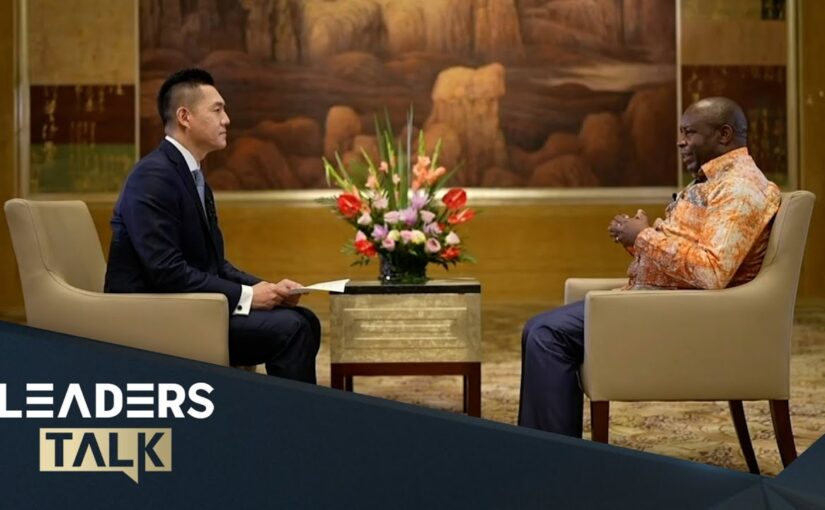
In this episode of the CGTN series Leaders Talk, Wang Guan interviews Évariste Ndayishimiye, the President of Burundi. The interview was filmed in Shanghai during the Burundian leader’s recent state visit to China.
Burundi is a small, landlocked country in east central Africa, sharing land borders with Rwanda, the Democratic Republic of Congo and Tanzania. It was colonised by Germany during the imperialist “scramble for Africa”. Following World War I, it was handed to Belgium under a League of Nations mandate and after World War II was made a so-called United Nations Trust Territory, finally winning national independence in 1962.
Burundi established diplomatic relations with the People’s Republic of China the year after it obtained independence, making this year the 60th anniversary of their bilateral ties.
They have been 60 years of fruitful cooperation, leading President Xi Jinping, in his meeting with his Burundian counterpart, to describe the relationship of one of all-weather friendship. For his part, President Ndayishimiye, who was making his first visit to China as president, but who has previously visited the country on a number of occasions, describes the relationship as one of friendship, solidarity and brotherhood. If there is one country, he says, that always stands with Burundi, whether in good times or bad, it’s China, which is always the first to come to his country’s support in times of difficulty.
Whenever he visits China, Ndayishimiye is keen to delve deeply into the lessons provided by China’s development. His ambition is for Burundi to become an emerging country by 2040 and a developed country by 2060. China, he notes, has become a global power in a very short time, so it is possible. He seeks to learn from China by reorganising his own country to work for the people’s well-being.
Ninety per cent of Burundi’s population currently works in agriculture, so this sector is also the foundation of its collaboration with China. Since 2009, under the auspices of FOCAC (the Forum on China-Africa Cooperation), agricultural experts from China have introduced various hybrid rice strains to Burundi, leading to a huge increase in the country’s food production. President Ndayishimiye praises the role of Chinese experts, who “work with our people shoulder-to-shoulder on the ground.”
However, China’s assistance to Burundi does not stop at agriculture, but also embraces such sectors as healthcare, education and infrastructure, including energy, roads and the expansion of the international airport in the country’s largest city and former capital, Bujumbura.
Burundi’s president is scathing about the record and legacy of European colonialism in his country. “Burundi is like a big family, but the colonisers’ strategy was to divide in order to rule over the resistant people.” He contrasts this to China and utterly refutes any suggestion of “Chinese colonialism” in Africa. He has studied Chinese history and the country was itself once a victim of colonialism. A devout Christian, the president invokes words from the Bible when he insists that China does not believe in doing unto others what has been done unto itself. Interestingly, almost the identical words can be found in the sayings of the Chinese sage Confucius. According to Ndayishimiye, the colonial powers are simply judging China by their own standards.
The full interview with President Évariste Ndayishimiye is embedded below.
Author: Friends of Socialist China
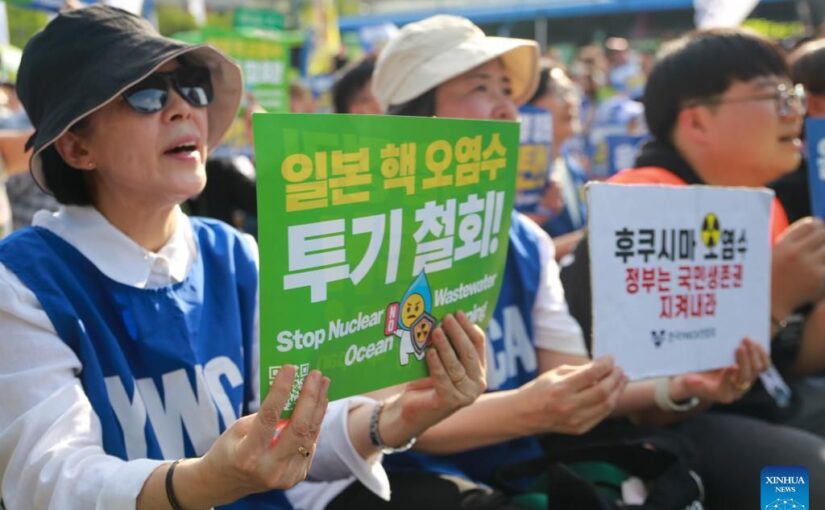
Release of Fukushima wastewater threatens workers
We reprint below an article by Otis Grotewohl, originally published in Workers World, about the Japanese government’s release of wastewater from the Fukushima nuclear disaster into the Pacific Ocean.
Otis notes that, while the government in Tokyo has claimed the process is safe, many people are skeptical, including the Japanese opposition parties, fishermen, local residents and environmental campaigners. Greenpeace Japan states that Tokyo’s decision “disregards scientific evidence, violates the human rights of communities in Japan and the Pacific region, and is non-compliant with international maritime law.”
The Chinese government has announced a ban on imports of Japanese seafood in response to the discharge. Japan, in league with the US and other imperialist powers, is now criticizing China for this ban and for spreading disinformation. “Just as the Japanese government and its Western enablers accuse China of ‘disinformation,’ the capitalist rulers of Washington and Tokyo are waging a major public relations campaign to convince people in the region that seafood from the Pacific Ocean will still be safe to consume after the release of wastewater.”
As Otis points out, the Japanese government’s action is a threat to the health and safety of people in the region, and is being carried out solely in accordance with “the material needs and desires of the employing class.” China meanwhile has taken a clear lead on renewable energy and biodiversity, and is advocating for the interests of ordinary people both in China and throughout the region.
“Anyone concerned with the well-being of humanity and our ecosystem should defend China and stand in solidarity with workers in the Asia-Pacific region who are being threatened with a polluted ocean, poisoned water and contaminated seafood.”
The Japanese government began releasing wastewater from the Fukushima nuclear plant into the Pacific Ocean on Aug. 24. The controversial move has angered workers throughout the region, sparking numerous protests in South Korea, China and Japan.
Following the Tōhoku earthquake and tsunami on March 11, 2011 — which destroyed the Fukushima nuclear plant, resulting in three nuclear meltdowns, three hydrogen explosions and a release of radioactive contaminants — the nuclear company Tepco started pumping in water to cool down the reactors’ fuel rods.
Radioactive wastewater has been added to tanks every day since then, and more than 1,000 tanks have been filled. The government of Tokyo argues the process is “no longer sustainable” to maintain and promises people that “after treatment and dilution the ‘water is safe to release.’” (BBC, Aug. 24) Many people in the area are understandably skeptical.
More than a million metric tonnes of water stored at the nuclear plant is expected to be discharged over the next 30 years, and there are mixed feelings among scientists about this. Among those who are most supportive of Japan’s plan is the United Nations nuclear “watchdog” known as the International Atomic Energy Agency. Many more people oppose the plan, especially environmentalists and workers in the fishing industry who are familiar with the Pacific Ocean.
Continue reading Release of Fukushima wastewater threatens workers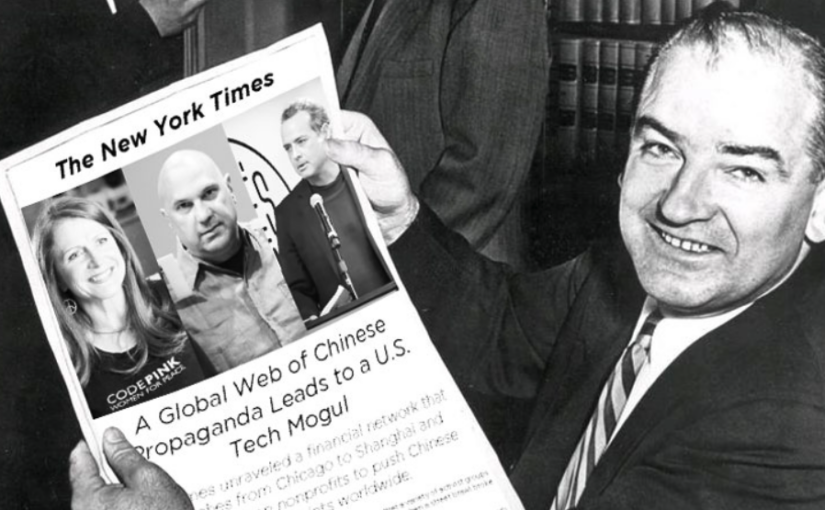
NYT McCarthyite “exposé” carries water for the MAGA right
In an August 11 statement, the Communist Party USA (CPUSA) joined the chorus of solidarity with Roy Singham, a progressive American businessman, and the network of organisations that stand for peace and positive relations with China that he reportedly funds, following the launch of a scurrilous witch-hunting attack, thinly disguised as “investigative journalism”, in the pages of the New York Times on August 5.
Condemning the article as one that, “would have made Joe McCarthy, Roy Cohn, and J. Edgar Hoover green with envy”, the CPUSA states:
“Once again, we see the revival of the notion that challenging US foreign policy is tantamount to acting as an ‘agent of a foreign power,’ a charge drawn straight from the playbook of the old House Un-American Activities Committee.”
It notes that, at the height of the McCarthy period, even a world-renowned scholar like Dr. WEB DuBois, then aged 83, was “handcuffed by the government on such patently false premises.”
According to the CPUSA, the New York Times’ work is not investigative journalism, but rather, “the putrid leftovers of a conspiracy theory that was already rotten the first time around, served up to delegitimise China’s emergence as a global power and discredit critics of US foreign policy.
“If the individuals and organisations targeted in the article were part of the welter of privately-funded NGOs, think tanks, conferences, and media networks used by the US ruling class to promote its foreign policy priorities, there would be no story here.”
We reprint the full text of the CPUSA statement below. It was originally published on the party’s website.
It’s official: The new Cold War is on—and the New York Times “proves” it by warning of a nefarious Chinese plot to influence U.S. public opinion.
In an article that would have made Joe McCarthy, Roy Cohn, and J. Edgar Hoover green with envy, the Times puts a bullseye on the activity of groups like Code Pink, the People’s Forum, and the Tricontinental Institute and the financial support they supposedly rely on from Neville Roy Singham, a wealthy American with a history of donating to left organizations.
The most damning piece of evidence in the prosecution’s arsenal is saved for the hit job’s ending sentence: “Just last month, Mr. Singham attended a Chinese Communist Party propaganda forum. In a photo, taken during a breakout session on how to promote the party abroad, Mr. Singham is seen jotting in a notebook adorned with a red hammer and sickle.” A notebook emblazoned with a red hammer and sickle? Oh no!
The article is replete with such “proof.” According to the Times, Singham also has offices in a building in Shanghai and has been seen in the company of Chinese officials at events where China’s role in the world is presented in a way that does not align with U.S. foreign policy discourse.
Continue reading NYT McCarthyite “exposé” carries water for the MAGA right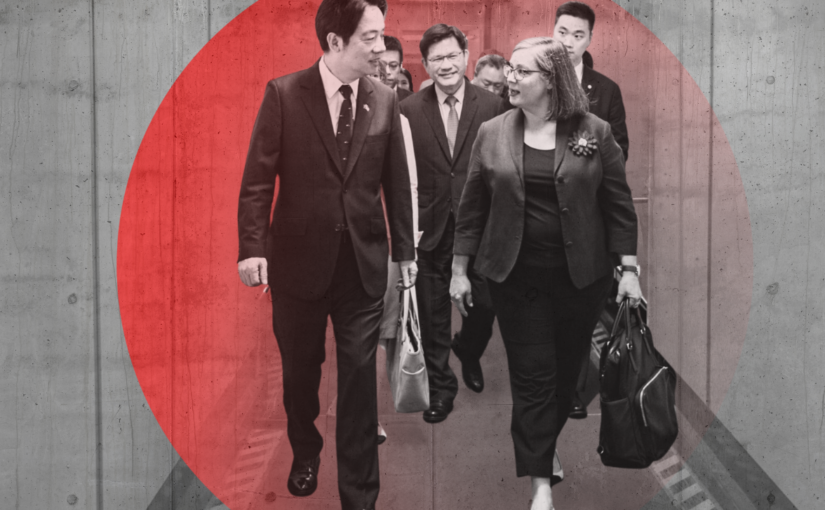
Documents show Taiwan working with FBI to prosecute Chinese Americans and intimidate US politicians
The following report by Alan MacLeod, first published in MintPress News, provides convincing proof that separatists in the Taiwanese administration are working with US intelligence agencies to drum up anti-China hostility, intimidate US politicians, influence US media, and drive a McCarthyite agenda.
The documents reviewed by MintPress reveal that Taiwanese officials are monitoring Chinese Americans and passing intelligence to the FBI with a view to having them prosecuted. Furthermore, Taiwan is spending millions in order to influence US public opinion against China and in favor of Taiwanese independence.
When Chinese American groups protested Tsai-Ing Wen’s visit to the US in early 2023, “it appears that Taiwan attempted to have these groups arrested and prosecuted as foreign agents.” In order to render pro-China or anti-Cold War campaigners liable for prosecution, Taiwanese officials aim to “collect clear and concrete evidence” that such campaigners are “directed by Chinese government”. Clearly this contributes to a broader campaign, led by reactionary US politicians and billionaire media, to stigmatize and criminalize any opposition to the pursuit of a reckless New Cold War.
The article observes that this escalating McCarthyism “has already helped create a culture of fear among Chinese Americans”, with 72 percent of Chinese researchers in the US feeling unsafe, according to a recent survey. Meanwhile, “hate crimes against Asian Americans have skyrocketed.”
With the US dangerously promoting a hegemonist agenda and using economic, diplomatic, propaganda and military means to try and put an end to China’s rise, it’s crucial that progressive and anti-war forces stand up against Cold War, against McCarthyism, and against interference in China’s internal affairs – including the question of Taiwan.
Amid a controversial visit from Vice President William Lai (the front-runner to be his country’s next leader), official documents reviewed by “MintPress News” show that the Taiwanese government is attempting to drum up anti-China hostility, influence and intimidate American politicians and is even working with the FBI and other agencies to spy on and prosecute Chinese American citizens.
Key points of this investigation
• Taiwanese officials are monitoring Chinese Americans and passing intelligence to the FBI in attempts to have them prosecuted.
• Taiwan is working with “friends” in media and politics to create a culture of fear towards China and Chinese people in the US
• Taiwanese officials claim they are “directing” and “guiding” certain US politicians.
• Taiwan is monitoring and helping to intimidate U.S. politicians they deem to be too pro-China.
• The island is spending millions funding US think tanks that inject pro-Taiwan and anti-China talking points into American politics.
Working with the feds to prosecute Chinese Americans
Vice President Lai’s journey to the United States is, officially, only a stopover on his way to Paraguay (the U.S. does not formally recognize Taiwan as an independent state). He is scheduled to make appearances in both New York and San Francisco.
Lai himself is an outspoken leader of the growing movement for Taiwanese independence. Many nationalists see Taiwan as culturally different from the mainland and argue it would be better off as a fully independent state. To achieve this goal, they are attempting to gain American backing and influence American public opinion. China, however, sees the matter as purely internal, and American attempts to wrest Taiwan out of its orbit as a potential trigger for World War Three.
Continue reading Documents show Taiwan working with FBI to prosecute Chinese Americans and intimidate US politicians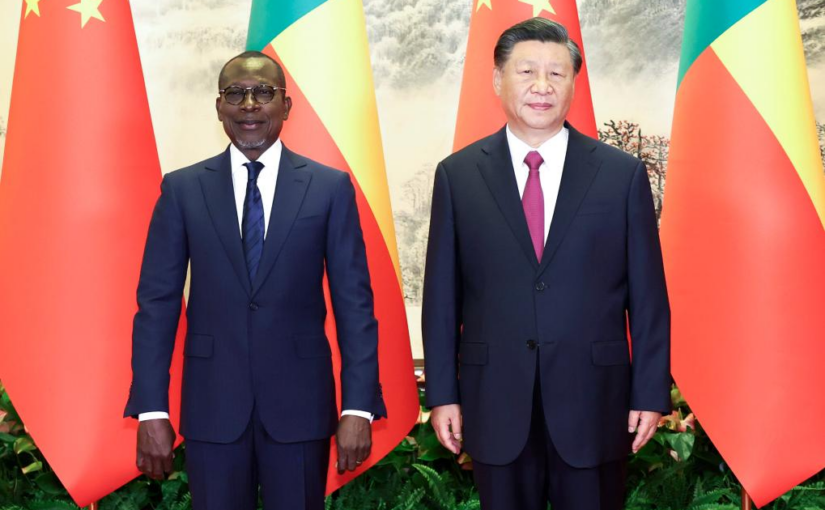
China, Benin establish strategic partnership
Patrice Athanase Guillaume Talon, President of the Republic of Benin, paid a state visit to China at the invitation of his counterpart Xi Jinping at the beginning of September. The West African country has long enjoyed friendly relations with China and the two countries announced the establishment of a strategic partnership during Talon’s visit.
The two heads of state held talks on Friday September 1st. Xi Jinping said that: “China attaches great importance to developing relations with Benin, and is willing to maintain closer exchanges at all levels, deepen friendly and mutually beneficial cooperation in various fields, and push bilateral relations to a new level.”
Expounding on the essential connotations of Chinese modernisation, Xi said that China has embarked on a modernisation path different from that of the West. He noted that the key is always adhering to China’s national conditions and the path of socialism with Chinese characteristics.
China supports Benin in independently exploring a development path suited to its actual conditions, and stands ready to strengthen exchanges of governance experience with Benin, share experience in reform and development, firmly support each other, and achieve common development, Xi said.
He also underlined bilateral cooperation in education, health care, and the construction of the Luban Workshop, a project named after the ancient Chinese craftsman Lu Ban to provide vocational skills training for local people.
Xi called on the two sides to strengthen counterterrorism and security cooperation, work closely to coordinate in international affairs, safeguard the common interests of developing countries and international fairness and justice, and safeguard regional and global peace and development.
He said 2023 marks 10 years since he proposed China’s Africa policy with the principles of sincerity, real results, affinity and good faith. Over the past decade, China has treated its African friends with sincerity and provided sincere support for Africa’s development. China-Africa cooperation has become a model for South-South cooperation and international cooperation with Africa.
Xi added that China supports Africa in becoming an important pole in the world’s political, economic and civilisational development, and stands ready to provide new opportunities for Africa alongside China’s development. China will work with African countries, including Benin, to implement the outcomes of the Forum on China-Africa Cooperation (FOCAC), and facilitate the further alignment of initiatives put forward by the Chinese side, such as the Belt and Road Initiative and the Global Development Initiative, with the African Union (AU) Agenda 2063 and the development strategies of African countries.
Talon said China is a great friend of Benin and the two peoples share a profound and sincere friendship. High-quality, mutually beneficial cooperation between Benin and China will strongly promote Benin’s industrialisation process and help it better achieve national development.
There should be more than one model of democracy, and genuine democracy should benefit all people. In this regard, China has set a good example for other countries, he said.
Benin has benefited significantly from China’s experience in governance, and is willing to build a true strategic partnership with China, deepen mutually beneficial cooperation in various fields, and realise national development and prosperity as China has done, Talon added.
After the talks, the two heads of state witnessed the signing of a number of bilateral cooperation documents on deepening Belt and Road cooperation, green development, the digital economy, agricultural food, health and other fields.
Chinese Premier Li Qiang also met President Talon on the same day. Noting that Benin is an important partner to China in West Africa, Li said the two countries have always maintained sincere and friendly relations, which have become a model of mutual respect and equal treatment among developing countries.
Noting that China is Benin’s long-term friendly partner and the cooperation between the two countries has yielded fruitful results, Talon said China has set an example of development for Benin and other African countries.
He thanked China for the support and assistance it has provided to Benin and other African countries over the years.
Talon added that Benin is willing to learn from China’s development experience and to deepen cooperation in such areas as industry, agriculture, investment and education, promote the continuous development of bilateral relations, and contribute to the construction of a community with a shared future.
The following articles were originally carried by the Xinhua News Agency.
China, Benin establish strategic partnership as heads of state hold talks in Beijing
Xinhua, 2 September 2023
BEIJING, Sept. 1 (Xinhua) — Chinese President Xi Jinping and his Beninese counterpart, Patrice Athanase Guillaume Talon, announced the establishment of a China-Benin strategic partnership on Friday.
The announcement was made when Xi held talks with Talon, who is in China on a state visit, at the Great Hall of the People in Beijing.
During their talks, Xi noted that China-Benin relations have enjoyed a sound development momentum in recent years, with solid progress achieved in practical cooperation.
The two countries have provided support for issues related to each other’s core interests and major concerns, and maintained sound communication and coordination during multilateral events, Xi said.
Continue reading China, Benin establish strategic partnership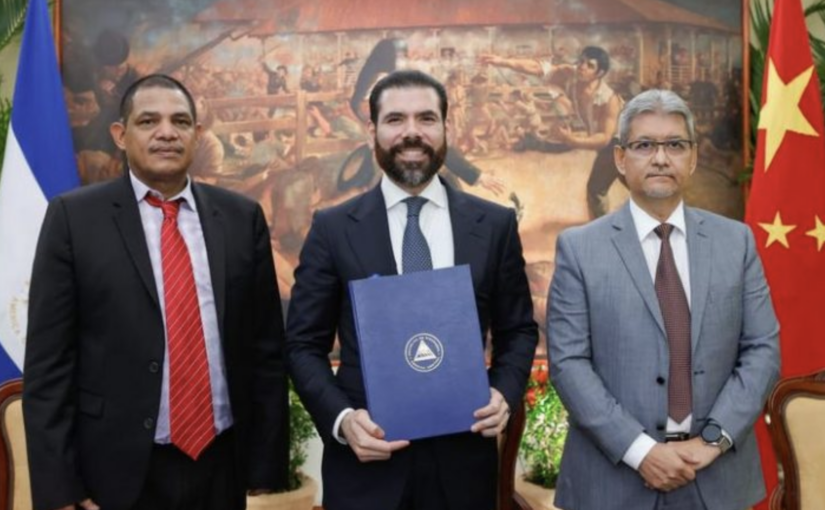
China and Nicaragua sign free trade agreement
China and Nicaragua signed a Free Trade Agreement (FTA) in a virtual ceremony held on August 31st. Nicaragua was represented by Laureano Ortega Murillo, Presidential Advisor for the Promotion of Investments, Trade and International Cooperation, and China by Commerce Minister Wang Wentao.
Laureano Ortega said that it was a historic day, adding that:
“The signing of the Free Trade Agreement between Nicaragua and China will mark a before and after for the Nicaraguan people. It opens the doors to a huge market and will allow us to link up with the companies and businessmen of this sister country.”
“We are convinced that this will generate economic and social benefits for Nicaraguan families, new investments, the creation of more jobs, and the transfer of technologies from China to Nicaragua. It will also provide the opportunity for a greater presence of China in Nicaragua and we reiterate that Nicaragua must be considered by China as a commercial platform for the entire Central American region”.
He pointed out that the relations between the two countries are based on mutual respect and on recognising each other as allies and strategic partners, and this is the only way to explain why they have managed to complete the FTA negotiations in just one year.
This is a significant point as FTA negotiations are generally regarded as one of the most intricate areas of diplomacy and can often take years to negotiate.
Minister Wang Wentao said that the signing of the FTA is the result of the diplomatic relations between China and Nicaragua, which are under the personal attention and leadership of the two presidents, and the mutual trust of the two countries that has been growing through substantial cooperation and has advanced at high speed and at a high level, bringing tangible benefits to the peoples of both countries.
Laureano, at the end of the signing expressed that:
“We reiterate our deep gratitude to the brother government and people of the People’s Republic of China for the signing of the Free Trade Agreement. We promise to carry out the corresponding actions for its entry into force in January 2024. Today in Nicaragua a sun illuminates us and shines brighter in the light of the signing of this agreement that fills us with hope and optimism. We feel strengthened and we are certain that from now on we will see the fruits of this work with the greatest presence of Chinese brothers in our country that will promote economic and social development on the path to prosperity.”
In its report, China Daily noted comments from Dong Jingsheng, deputy director of Peking University’s Latin America Research Centre, who observed that China and Nicaragua are at different phases of development with high economic complementarity in industrial structures and diversity in resources.
He added that the signing of the FTA will foster a more favourable climate for expanding trade and investment partnerships and give both nations’ long-term growth a boost.
China will offer a sizable market for Nicaragua’s high-quality agricultural and aquatic products, and Nicaragua could import goods such as computers, motorcycles and communication equipment, Dong said.
Meanwhile, Chinese enterprises, with their comparative advantages in capital, technology, and managerial experience, could scale up investment and cooperation in sectors including infrastructure, manufacturing, and telecommunications, to increase local employment opportunities, improve public welfare and drive sustainable growth, he added.
The same day, Chinese Foreign Ministry spokesperson Wang Wenbin described the FTA as the most important achievement in the bilateral practical cooperation since the resumption of diplomatic relations.
“Since the two countries resumed diplomatic relations, we have witnessed leapfrog development in bilateral relations, deepening political mutual trust and fruitful practical cooperation. The dividends of resuming diplomatic relations continue to be felt. These have fully proved that the resumption of diplomatic relations between China and Nicaragua is in line with the trend of history and the times and serves the fundamental interests of the two countries and peoples”.
The following articles were originally carried by Kawsachun News, China Daily and Xinhua News Agency.
Nicaragua & China Sign Free Trade Agreement
Kawsachun News, 31 August 2023
In a virtual ceremony, Nicaragua and the People’s Republic of China made history with the signing of the Free Trade Agreement (FTA) that will allow a better and greater commercial and economic exchange between the two nations.
Nicaragua was represented by Laureano Ortega Murillo, Presidential Advisor for the Promotion of Investments, Trade and International Cooperation; the Minister of Finance and Credit, Iván Acosta and the Minister of Public Works, Industry and Commerce, Jesús Bermúdez. The Chinese delegation headed by Mr. Wang Wentao, head of Chinese Commerce.
Laureano Ortega Murillo expressed on behalf of the Government of Reconciliation and National Unity that it was a historic day.
“The signing of the Free Trade Agreement between Nicaragua and China will mark a before and after for the Nicaraguan people. It opens the doors to a huge market and will allow us to link up with the companies and businessmen of this sister country”, indicated Ortega Murillo.
“We are convinced that this will generate economic and social benefits for Nicaraguan families, new investments, the creation of more jobs, the transfer of technologies from China to Nicaragua. It will also provide the opportunity for a greater presence of China in Nicaragua and we reiterate that Nicaragua must be considered by China as a commercial platform for the entire Central American region”, he added.
Continue reading China and Nicaragua sign free trade agreement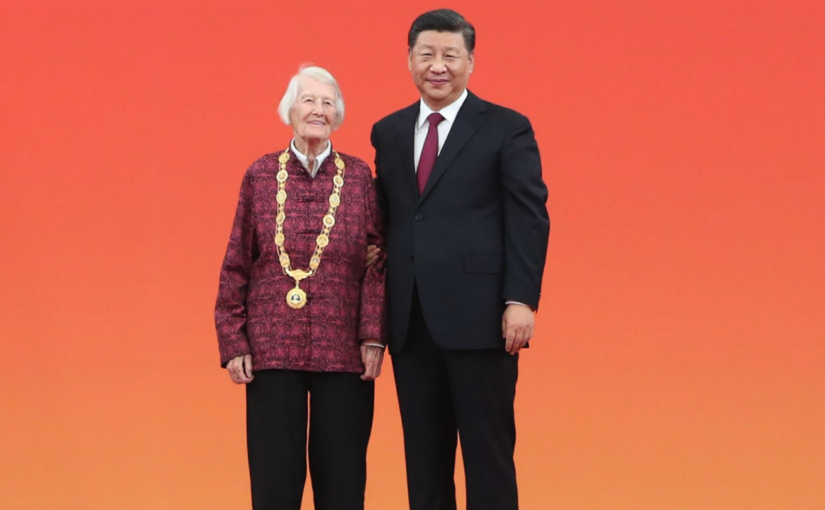
Isabel Crook: An extraordinary life dedicated to the cause of the Chinese people
Following the death of Isabel Crook, veteran communist and staunch friend of China, in Beijing, on August 20, we received the following message from Michael Sheringham.
Michael’s family founded the famous Arthur Probsthain bookshop, which has stood as a family owned and run business specialising in books on Asia, the Middle East and Africa, on London’s Great Russell Street, directly opposite the British Museum, since 1903. He and all his family have been constant and good friends of China.
Michael wrote in part:
“I have seen the obituary for Isabel Crook which you wrote for Friends of Socialist China, which I thought is very good and comprehensive. She did indeed have a remarkably long and full life dedicated to the cause and love of China, where she spent most of her life, with David and her three sons.
“While sad to learn of her passing away, I am gratified to have known her and David and the ‘boys’ since I started living in Beijing in 1972 – or rather since Isabel and David were freed from captivity in early 1973. I, with all the other foreign residents, attended the speech by Premier Zhou Enlai in the Great Hall of the People on March 8th, 1973, when he announced that those foreign friends who had been imprisoned during the Cultural Revolution were all (except Sidney Rittenberg at that time) exonerated and rehabilitated.
“I cherish the times we were able to see Isabel (and David), both in Beijing and London, and we met on many occasions during these years. Isabel came to visit my mother a couple of times in their later years. Isabel and David made great contributions to socialism in China, through their writing, teaching and dedicated work for the revolution.”
Additionally, the Society for Anglo-Chinese Understanding (SACU) wrote on social media:
“SACU is saddened to hear of the passing of Isabel Crook. She died in Beijing in the early hours of Sunday morning, aged 107.
“Hers was an extraordinary life dedicated to the cause of the Chinese people, moved most especially by her compassion for the rural folk. Her experiences and studies spanned from the Chiang Kaishek era to Mao’s revolution and on to ‘reform and opening up’ – she paved the way for many of us from the West to understand the zigs and zags of China’s path. She was a good friend to SACU – as we mourn, we celebrate her life, aspiring to carry on her legacy.”
Many obituaries of Isabel have been published in mainstream newspapers, including in the British newspapers, the Guardian (written by veteran China specialist John Gittings), the Financial Times and the Times; the New York Times; and Canada’s Globe and Mail.
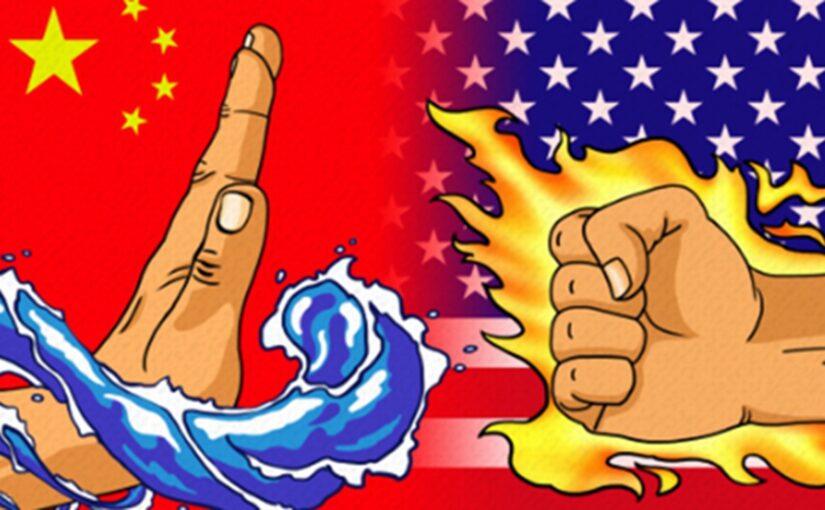
Jeffrey Sachs: The US economic war on China
In this latest article from his syndicated New World Economy column, Professor Jeffrey Sachs (Director of the Center for Sustainable Development at Columbia University) argues convincingly that – despite its protestations to the contrary – the US is waging an economic war on China, and that the US is losing.
Sachs writes that “starting around 2015, US policy-makers came to view China as a threat rather than a trade partner”, following the realization that China was not going to accept a permanent position at the bottom of US-led global value chains, but was in fact advancing “to the cutting edge of robotics, information technology, renewable energy, and other advanced technologies.”
The Trump administration launched a full-scale economic war against China, which the Biden administration has only escalated. One result is a significant decrease in US-China trade: “Between June 2022 and June 2023, US imports from China fell by a whopping 29 percent.” Naturally this has affected China’s economy in the short-term, but the long-term damage will be to the US, since China’s deep economic relations with the countries of Africa, Asia, Latin America, the Middle East, the Caribbean and the Pacific render it relatively less vulnerable to the US’s coercion. “China can substantially increase its exports to the rest of Asia, Africa, and Latin America, through policies such as expanding the Belt and Road Initiative.”
Sachs concludes that “the US attempt to contain China is not only wrongheaded in principle, but destined to fail in practice.”
China’s economy is slowing down. Current forecasts put China’s GDP growth in 2023 at less than 5%, below the forecasts made last year and far below the high growth rates that China enjoyed until the late 2010s. The Western press is filled with China’s supposed misdeeds: a financial crisis in the real-estate market, a general overhang of debt, and other ills. Yet much of the slowdown is the result of US measures that aim to slow China’s growth. Such US policies violate World Trade Organization rules and are a danger to global prosperity. They should be stopped.
The anti-China policies come out of a familiar playbook of US policy-making. The aim is to prevent economic and technological competition from a major rival. The first and most obvious application of this playbook was the technology blockade that the US imposed on the Soviet Union during the Cold War. The Soviet Union was America’s declared enemy and US policy aimed to block Soviet access to advanced technologies.
The second application of the playbook is less obvious, and in fact, is generally overlooked even by knowledgeable observers. At the end of the 1980s and early 1990s, the US deliberately sought to slow Japan’s economic growth. This may seem surprising, as Japan was and is a US ally. Yet Japan was becoming “too successful,” as Japanese firms outcompeted US firms in key sectors, including semiconductors, consumer electronics, and automobiles. Japan’s success was widely hailed in bestsellers such as Japan as Number One by my late, great colleague, Harvard Professor Ezra Vogel.
In the mid-to-late 1980s, US politicians limited US markets to Japan’s exports (via so-called “voluntary” limits agreed with Japan), and pushed Japan to overvalue its currency. The Japanese Yen appreciated from around 240 Yen per dollar in 1985 to 128 Yen per dollar in 1988 and 94 Yen to the dollar in 1995, pricing Japanese goods out of the US market. Japan went into a slump as export growth collapsed. Between 1980 and 1985, Japan’s exports rose annually by
7.9 percent; between 1985 and 1990, export growth fell to 3.5 percent annually; and between 1990 and 1995, to 3.3 percent annually. As growth slowed markedly, many Japanese companies fell into financial distress, leading to a financial bust in the early 1990s.
Continue reading Jeffrey Sachs: The US economic war on China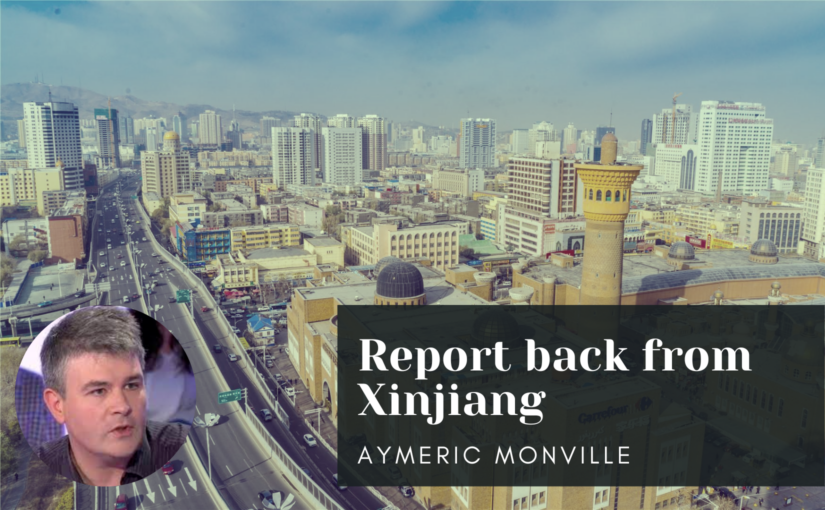
Aymeric Monville: Report back from Xinjiang
We are very pleased to publish below the report by the progressive French academic Aymeric Monville of his recent (August 2023) trip to Xinjiang. The report responds directly to the obscene anti-Chinese propaganda that has been raging for several years in the Western media regarding ostensible human rights abuses against China’s Uyghur population.
Aymeric describes his visits, along with the writer Maxime Vivas, to Kashgar, Urumqi and assorted villages. The picture he paints is dramatically different from the stereotype found in the Western media of a dystopian nightmare characterised by brutal repression and cultural genocide.
Arriving at the Kashgar bazaar in the middle of the night, I found it to be a profusion of light, joy, song and happy people in the streets. In particular, the sight of young women on scooters, their hair blowing in the wind, gave me an impression of great freedom.
He notes that, if the whole thing had been somehow staged for his benefit, it would have been a remarkable feat of organisation: “an absolute record for a Hollywood production involving literally thousands of people”.
Of particular note is the account of a visit to a de-radicalisation centre – what would be described in the Western media as a “concentration camp”:
In fact, it was a school where young people who had not committed any crimes but had been influenced by jihadism were taught not only Mandarin so that they could integrate into Chinese society, but also the constitution and a trade. They can play sport, winning table tennis competitions for example, and can go home at weekends. Recognising the basic characters 图书馆, I realise that this is the school library and ask to enter. I also asked to be shown books in Uyghur as well as Mandarin, which was done. I was also assured that the pupils’ Muslim faith is respected and I have no reason to doubt this.
The report includes an interesting discussion of the Uyghur language – its origins, widespread use, and connection to Uyghur culture – as well as various observations on the everyday activities and living conditions of the Uyghur people. There is no evidence of any “cultural genocide”; indeed massive efforts are made to protect the diverse cultures of the region. Monville points out that, if religious fundamentalist separatists were allowed to succeed in their aims, this cultural diversity would come under serious threat: “We can be sure that Uyghur culture in all its diversity, like that of the other ethnic groups living in the region, would have been very much at risk of eradication.”
The report is highly recommended reading for anyone interested in the truth about Xinjiang. We hope it will be widely disseminated.
Aymeric Monville, born in France in 1977, is the author of several philosophical and political essays. In English, he has just published “Neocapitalism according to Michel Clouscard” (foreword by Gabriel Rockhill). He is deeply involved in the fight against anti-Chinese propaganda, and has published essays in France such as “The Ramblings of the Antichinese in France” and “China without Blinkers”.
I am back from Xinjiang, where I spent several days in the company of the writer Maxime Vivas, some of whose books I have had the honour of publishing. We visited Kashgar, a town close to the Afghan border with a 92 percent Uyghur population; then Urumqi, the capital with a population of over 2 million; and finally the new town of Shihezi, developed in the 1950s by the bingtuan (兵团), peasant-soldiers sent by Mao Zedong to develop pioneer areas so as not to have to compete with the local population for water in this semi-desert region. Not forgetting a diversion to sublime Lake Tianchi, to the east of the Celestial Mountains.
Xinjiang has around 25 million inhabitants in an area three times the size of France, but only 9.7 percent of the territory is inhabitable, so I think that this visit to the major urban centres and the main roads used to reach them gives me a sufficiently representative overview to be able to talk about this region with more authority than many French journalists who have never been there, certainly not recently, and particularly since the slander campaign orchestrated by Mike Pompeo and the CIA from 2019.
It was my first visit, and the third for Maxime Vivas.
Having long understood that the campaign about the alleged “genocide of the Uyghurs”, the “genocide in progress” (according tothe French daily Libération) or the “cultural genocide”, the forced sterilisation of women and so on, which has even been voted on by the French National Assembly, is nothing more than a copy and paste of the same campaign that took place ten or fifteen years earlier on Tibet, I was obviously expecting to meet many Uyghurs living in perfectly decent conditions. Nevertheless, I was struck by the relative prosperity of this remote region of China. Arriving at the Kashgar bazaar in the middle of the night, a few hours late, I found it to be a profusion of light, joy, song and happy people in the streets. In particular, the sight of young women on scooters, their hair blowing in the wind, gave me an impression of great freedom and made me think of what their fate would be on the other side of the Afghan border, where they would lose all their rights. We asked people in the street to pose for photos with us. Everyone, including the women, happily participated.
Continue reading Aymeric Monville: Report back from Xinjiang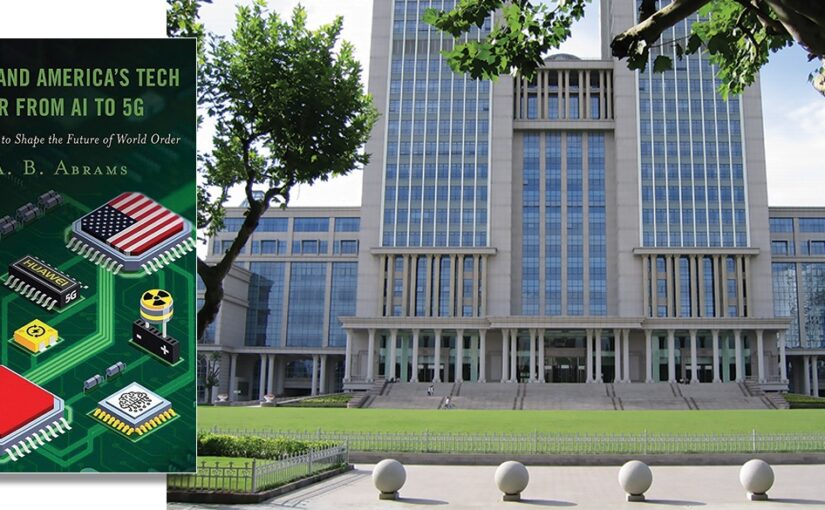
Book review: China and America’s Tech War from AI to 5G
In this review of China and America’s Tech War from AI to 5G: The Struggle to Shape the Future of World War, the new book by AB Abrams, Will Podmore notes that China has major advantages in five crucial areas of strategic and economic significance, namely artificial intelligence, quantum computing, green and nuclear technologies, telecommunications, and semiconductor chips. China is also, he notes, the world’s largest R&D investor and accounts for nearly half of all patent applications lodged worldwide.
Podmore writes that its unaffordability deters many US citizens from university study, but in China the numbers are rising fast. Moreover, the Chinese percentage of STEM graduates among its student cohort is double that of the US. China has also overtaken the US in the number of peer-reviewed papers published in scientific journals.
The US response, Podmore observes, has been to step up its attacks on China’s Huawei. But, as Abrams notes: “By initiating hostilities the US may only have accelerated its own decline by pressing China and its suppliers to phase out reliance on both American inputs such as software as well as on US chips.”
Britain’s decision to strip out Chinese equipment from its 5G network within seven years will cost over £7 billion and delay 5G rollout by at least three years. Podmore evokes a famous aphorism of Mao Zedong when he describes all this as “lifting a rock, only to drop it on your own feet.”
For their part, the editors of the MIT Technology Review write: “It’s becoming increasingly clear in the West that while the venture capital model is good at building things people want, it’s less good at producing things society needs in order to solve hard, long-term problems like pandemics and climate change.”
Abrams’ book is published by Lexington Books. However, at £96, it is beyond the reach of all but a handful of individual readers. A Kindle edition is currently available at a slightly more affordable £38. It may also be possible to order it through your library.
This review was originally published by the Morning Star.
China has major advantages in five key broad areas of technological competition with high strategic and economic significance — artificial intelligence, quantum computing, green and nuclear technologies, telecommunications and semiconductor chips — due to its greater home market scale, flexible regulatory environment and faster product integration loop.
China is the world’s largest overall (public and private) R&D investor. And China is not producing copies, as is commonly alleged: China files nearly half all the patent applications submitted worldwide.
The unaffordability of higher education in the United States means that fewer US citizens are going to university, but in China the numbers receiving higher education are rising fast. In 2013, 40 per cent of Chinese students graduated in STEM subjects, under 20 per cent in the US.
In the period 2016-2018, China overtook the US in the number of peer-reviewed papers published in scientific journals. The 2019 PISA (the OECD Programme for International Student Assessments) found that Chinese students were the best educated in the world.
The US responded not by upping its investments in high tech but by stepping up its attacks on China’s Huawei.
By 2019, 40 per cent of the world’s population used telecoms that passed through Huawei equipment. The US government alleged that Huawei was using its equipment to spy on other countries.
Nevertheless, the US House of Representatives intelligence committee had concluded in 2012 that there was no evidence that the firm was installing back doors in its equipment for espionage purposes.
Germany’s Federal Office for Information Security found no evidence of any security threat or malpractice from Huawei. And, as Abrams points out, “It was the NSA, not a Chinese government agency, which sought to install back doors into Huawei equipment for espionage purposes.”
The NSA made US tech companies like Microsoft, Google, Yahoo, Facebook and Apple assist its surveillance efforts.
Continue reading Book review: China and America’s Tech War from AI to 5G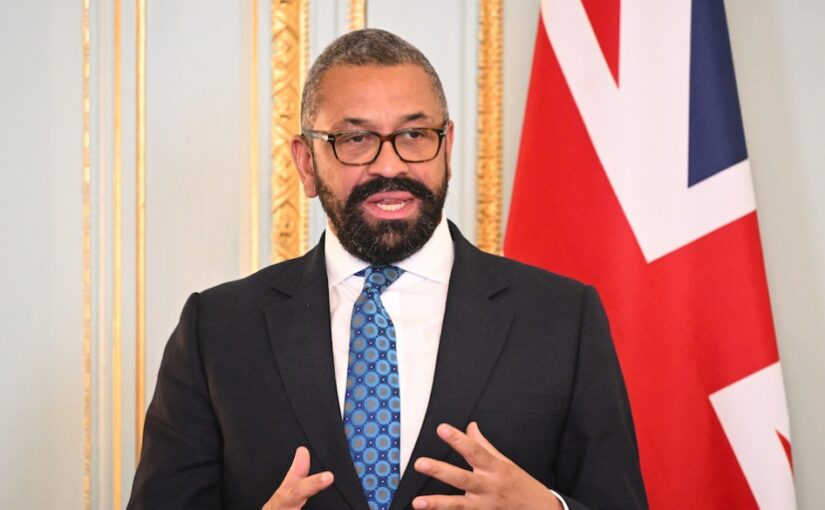
Cleverly’s Beijing mission a welcome contrast to backbench warmongering
The following Morning Star editorial discusses British foreign secretary James Cleverly’s recent visit to Beijing.
Before setting off, Cleverly observed that “no significant global problem – from climate change to pandemic prevention, from economic instability to nuclear proliferation – can be solved without China.” This is certainly true. Furthermore Britain would derive clear economic benefits from improved Britain-China relations.
Unfortunately, as the editorial points out, Cleverly’s relatively balanced position stands in stark contrast to that found elsewhere in parliament, “where the foreign select committee not only urges Aukus expansion but calls for Britain to join another anti-China military bloc, the Quad, a prescription for miring us still deeper in the preparations for a Pacific war that a US general has predicted for the year after next.”
What’s more, the basic political dynamics underlying the deterioration in relations have not meaningfully changed. The US is leading a New Cold War that includes military encirclement (via AUKUS, war games, freedom of navigation assertions and so on), attempting to stoke conflict across the Taiwan Strait, sanctions, tariffs, and a vicious propaganda war. Britain has involved itself in all of this. Prioritising our status as a loyal junior partner to US imperialism has become a consensus position in British politics.
The editorial concludes that a powerful mass peace movement is a necessary force to counter the Cold Warriors in Westminster.
The Foreign Secretary’s visit to Beijing is a welcome attempt to keep communications open with an economic, scientific and technological giant.
James Cleverly is spot on when he says global problems cannot be addressed without China, whether we are talking about climate change, co-operation on pandemics or — the elephant in the room given the feverish warmongering on Tory back benches — avoiding World War III.
The government’s attitude contrasts favourably to that of critics like ex-work and pensions secretary Iain Duncan Smith. For Duncan Smith, for whom “anything to do with China is a security threat,” simply holding talks with Chinese leaders is “appeasement.”
Labour’s David Lammy does not go quite so far, though he calls on Cleverly to secure “tangible diplomatic wins” such as the removal of sanctions on British parliamentarians.
Continue reading Cleverly’s Beijing mission a welcome contrast to backbench warmongering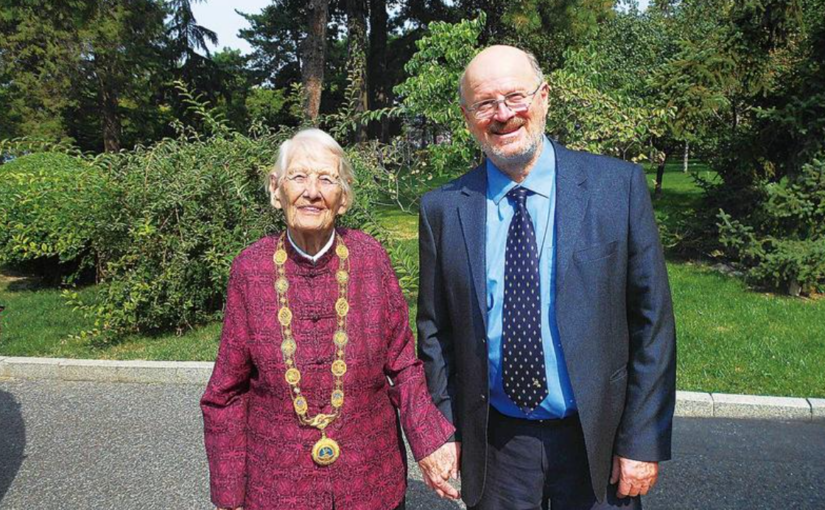
Love China all my life: Isabel Crook’s stories
In this very touching and poignant article, originally published by China Daily on June 1, 2022, Fang Aiqing and Huang Zhiling, assisted by Shen Zaiwang, introduce a biography of Canadian communist Isabel Crook, ‘Love China All My Life: Isabel Crook’s Stories’, published by author Tan Kai that year.
Isabel passed away in Beiing on August 20, 2023, aged 107.
In the book, which took him three years to write, Tan recalls many stories, in particular, of the friendships Isabel maintained over many decades with rural people in Sichuan province, including from the Tibetan, Qiang and Yi nationalities.
China Daily recounts:
“Crook also learned skills from the villagers, but when she saw women spinning wool into yarn by hand, she decided to return to Chengdu, capital of Sichuan province, to buy them a wooden spinning wheel, which they had never seen or heard of before.
“It took Crook at least seven days to travel to Bashinao from her base in Chengdu. Most of the time, she either walked or rode a horse. The route was full of hardships and danger. At one point, Crook and her companions had to traverse a cliff face for several kilometers as the Minjiang River flowed tempestuously below.
“They also relied on a zipline to cross the river. In one photograph in the book, Crook is captured clinging to the line, laughing with great excitement as she carries the spinning wheel.”
It was also in Chengdu that she first met the man who was to become her husband and lifelong companion, David Crook (1910-2000), described as a committed communist from Britain, as well as a friend of the famous Canadian communist and surgeon Norman Bethune.
“David proposed to her on the Luding Bridge, which spans the Dadu River-a revolutionary site he had always wanted to visit after reading about in Edgar Snow’s book Red Star Over China.”
On October 1, 1949, the Crooks were on the viewing stand in Tian’anmen Square for the founding ceremony of the People’s Republic of China, but Isabel had to return home for a short period to feed their eldest son, who was less than two months old.
Symbolising the couple’s deep attachment to China, China Daily writes:
“Even though David Crook was wrongly imprisoned for more than five years and his wife’s freedom of movement was restricted for three years during the ‘cultural revolution’ (1966-76), the couple didn’t leave China and continued their efforts to support the nation’s development.”
Tibetan woman Yangzom, 94, who comes from a rural area of Sichuan province, remembers learning the nursery rhyme Row, Row, Row Your Boat in English more than 80 years ago.
She mastered the words when Canadian expatriate Isabel Crook carried out an anthropological field study of Tibetan households in Yangzom’s home village of Bashinao, Aba Tibet and Qiang autonomous prefecture, Sichuan province, in 1939.
Details of Crook, who was born in 1915, visiting Tibetan and Qiang villages are recorded in Love China All My Life: Isabel Crook’s Stories, a biography recently published by author Tan Kai.
Continue reading Love China all my life: Isabel Crook’s stories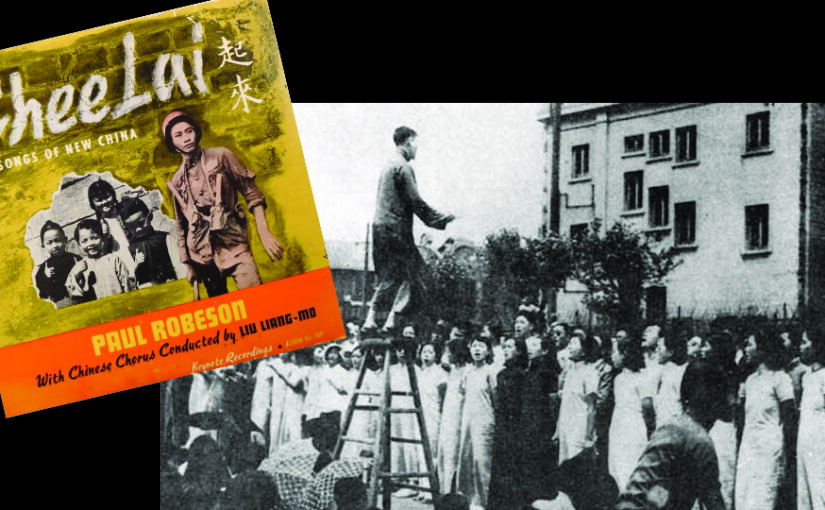
Arise, Africa! Roar, China!: Black and Chinese citizens of the world in the twentieth century
We republish below a review by Joel Wendland-Liu of the important and fascinating 2021 book Arise, Africa! Roar, China! Black and Chinese Citizens of the World in the Twentieth Century, which explores aspects of the historic linkages between progressive African Americans and the Chinese revolution.
As noted in the review, the book “documents the experiences of five individuals – W.E.B. Du Bois, Paul Robeson, Liu Liangmo, Si-lan Chen Leyda, and Langston Hughes – through the lens of their relations to China, with African America, racism, U.S. government persecution, and anti-imperialist working-class struggles for freedom.”
Joel’s review, originally published in People’s World, summarizes some of the key themes in the book, including the extensive work carried out by Liu Liangmo to promote understanding of China in the US; Paul Robeson’s longstanding and consistent support for the Chinese Revolution; the extraordinary life of Afro-Chinese dancer Sylvia Si-lan Chen Leyda; and W.E.B Du Bois and Shirley Graham Du Bois’s eight-week trip around China in 1959, of which W.E.B. Du Bois wrote: “We saw the planning of a nation and a system of work rising over the entrails of a dead empire.”
Also discussed is Langston Hughes’ famous trip to Shanghai in 1933:
Hughes differed from most Western visitors by refusing to stay within the racist cocoon that comprised the international concession zone in the city. He ate street food, enjoyed Chinese theater, and interacted with working-class Chinese people like humans. While these activities may seem normal today, at the time they set him apart from Euro-Americans who spread racist stereotypes about Chinese people, enforced Jim Crow rules, and typically viewed Chinese people as diseased, dangerous, and untrustworthy. Hughes’s experience in China, along with his political support for the revolutionary struggle, impacted his poetry, novels, and short stories over the next decade or so.
Joel observes that the book “gives new insights into the interactions and political relationships of revolutionary Chinese and African-American intellectuals, pointing frequently to new connections across cultures and languages that deserve even more scholarly scrutiny.”
We have previously carried an interview with the author, Gao Yunxiang.
When the slender, affable Chinese man took the podium in Harlem’s posh Golden Gate ballroom on a late autumn afternoon to denounce three recent lynchings in Mississippi, the audience’s FBI informant perked up. Liu Liangmo, a public speaker employed by United China Relief, a non-partisan charity that raised funds to aid China during a brutal Japanese invasion, proceeded to denounce racism as a system: lynchings, poll taxes, and Jim Crow apartheid. He highlighted white supremacy’s links to fascism and imperialism and called for equality and self-determination for all peoples. The bespectacled Liu took his seat to the applause of several hundred at an event sponsored by the Negro Labor Victory Committee, the Negro Quarterly, and the actor Orson Welles. As a professional public speaker, Liu’s task was to promote a deeper understanding of China to American audiences. In the age before television, public speaking events were among the most important ways an organization that couldn’t afford to make a movie or publish a newspaper could share its ideas. In his nine years in the U.S., Liu believed he had traveled 100,000 miles across most of the country.
Historian Gao Yunxiang is a Professor of History at Ryerson University in Toronto. In this original and well-researched book, Arise Africa! Roar, China!: Black and Chinese Citizens of the World in the Twentieth Century, she documents the experiences of five individuals—W.E.B. Du Bois, Paul Robeson, Liu Liangmo, Si-lan Chen Leyda, and Langston Hughes—through the lens of their relations to China, with African America, racism, U.S. government persecution, and anti-imperialist working-class struggles for freedom. Liu, persecuted by the FBI and the immigration regime, left the U.S. in 1949 to serve as a leader of the Chinese Democratic League, one of the several non-communist parties that continues to serve in the country’s National People’s Political Consultative Conference. He also helped to mobilize the Chinese Christian community in support of resistance to Japanese occupation and the ultimate revolutionary transformation of the country.
Continue reading Arise, Africa! Roar, China!: Black and Chinese citizens of the world in the twentieth century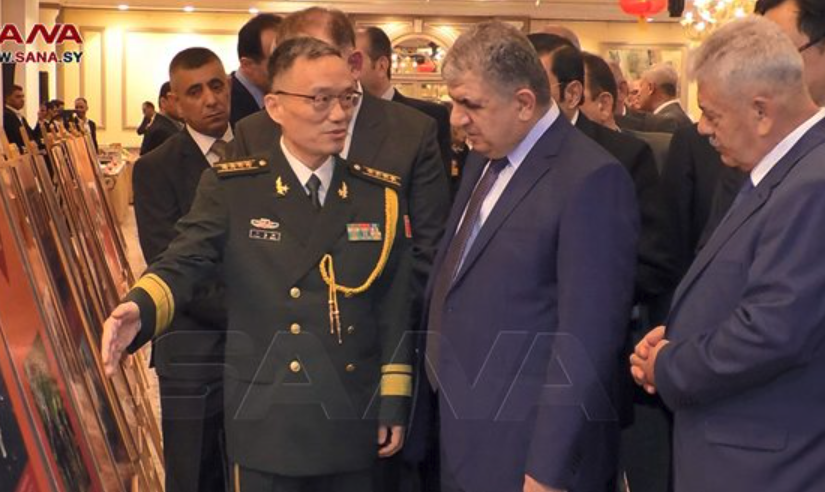
China is a friend and strategic ally of Syria
Chinese embassies around the world organised celebrations for the 96th anniversary of the founding of the People’s Liberation Army (PLA), which fell on August 1st.
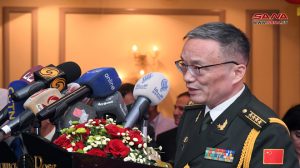
At a reception held in the Syrian capital Damascus on July 25, China’s Defence Attaché said in his speech that the friendship between the two countries has a deep-rooted history, noting that despite the changes in the international and regional situation, they have always supported each other.
Describing Syria as a “loyal friend” of China, he noted that the practical cooperation between the Chinese and Syrian armies has witnessed continuous development in recent years and exchanges in the security and military field have yielded fruitful results.
He confirmed that his country will continue its strong support for the Syrian army’s struggle to preserve national sovereignty, independence and territorial integrity, and for its efforts in combating terrorism and restoring national security and stability.
Responding, Syria’s Defence Minister, Major General Ali Mahmoud Abbas praised China’s stance, army, people, and leadership for its standing by Syria and its just causes during the unjust and aggressive war that was waged against it.
Director of the Diplomatic Institute at the Syrian Foreign and Expatriates Ministry, Dr. Imad Mustafa told reporters that China is a friend and strategic ally of Syria and it serves as the guarantor of a new multipolar world, which puts an end to US hegemony in the international arena.
The following report was originally published by the Syrian Arab News Agency (SANA).
Damascus, SANA- The Embassy of the People’s Republic of China held Tuesday a reception ceremony on the 96th anniversary of founding of the Chinese People’s Liberation Army.
The Defense Attaché at Chinese Embassy in Damascus said in a speech that the friendship between Syria and his country has deep-rooted history, noting that despite the changes in the international and regional situation, the two countries have always supported each other.
The Defense Attaché described Syria as a “loyal friend” of China, and that the relationship between the two countries is a model for friendly relations between countries with different locations, cultures and systems.
He noted that the practical cooperation between the Chinese and Syrian armies has witnessed continuous development in recent years, and exchanges in the security and military field have yielded fruitful results.
He confirmed that his country will continue its strong support for the Syrian army’s struggle to preserve national sovereignty, independence and territorial integrity, and for its efforts in combating terrorism and restoring national security and stability.
He expressed his country’s desire to push forward the practical cooperation between the two armies in various fields.
In turn, Defense Minister, Major Gen. Ali Mahmoud Abbas praised China’s stance, army, people, and leadership for its standing by Syrian and it’s just causes during the unjust and aggressive war that was waged against it.
Minister Abbas stressed that Syria seeks to constantly boost the relationship between the two countries, which extends back decades, in a way that serves the common interest to achieve prosperity for the two peoples and achieve a better future.
The Minister of Defense congratulated China and its people on the anniversary of the establishment of its army, which coincides on 1 August with the 78th anniversary of the founding of the Syrian Arab Army.
He pointed out to the commitment of the two armies since their establishment to a good relationship that reflects the deep-rooted relation binding both countries.
Director of the Diplomatic Institute at the Syrian Foreign and Expatriates Ministry, Dr. Imad Mustafa told the reporters that China is a friend and strategic ally of Syria, and it serves as the guarantor of a new multipolar world in which it puts an end to American hegemony in the international arena.
Remarks by Xi Jinping at China-Africa Leaders’ Dialogue
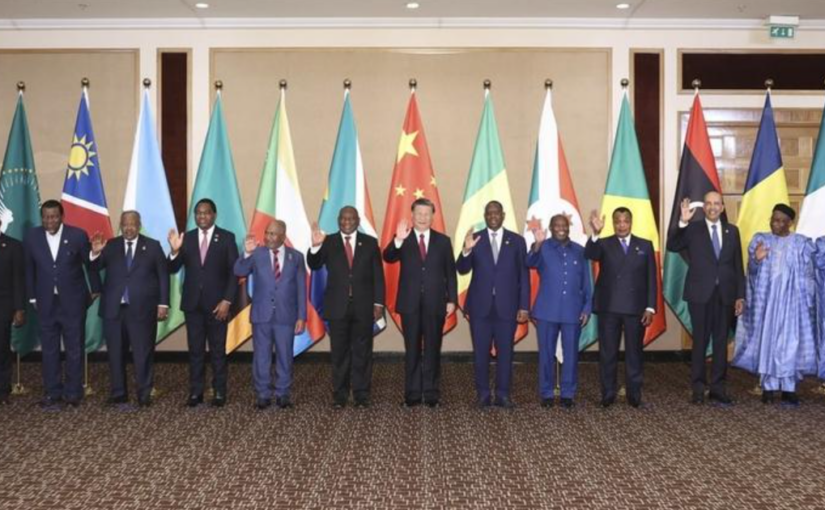
Following the BRICS Summit, held in the South African city of Johannesburg, the host, South African President Cyril Ramaphosa and his Chinese counterpart Xi Jinping jointly convened the China-Africa Leaders’ Dialogue on August 24.
Among those joining them were Comorian President Azali Assoumani, who is currently the Chairperson of the African Union (AU); Senegalese President Macky Sall, who is also the African Co-chair of the Forum on China-Africa Cooperation (FOCAC); presidents of Zambia, Burundi, Djibouti, the Republic of the Congo, and Namibia; and leaders of Chad, Libya, and Nigeria, representing sub-regional organisations.
In his address to the meeting, Xi Jinping noted that this was his tenth visit to the continent, and “each time, I feel the new development and changes in Africa.”
“Over the past 60 years, under the banner of Pan-Africanism, African countries have made big strides on the path of independence, seeking strength through unity and integration. You have demonstrated the strength of Africa in the struggles to uphold multilateralism and the common interests of developing countries.”
Xi went on to say that, after becoming Chinese President in 2013, he visited Africa on his first foreign trip. Over the subsequent decade, “together with our African friends and drawing strength from the spirit of China-Africa friendship and cooperation, we have pressed ahead on the path of solidarity and cooperation, stood for justice amid shifting global dynamics, and looked out for each other in the face of the COVID-19 pandemic.”
He proposed three key areas for China and Africa to intensify their joint work:
- To promote a just and equitable international order. We should carry forward the spirit of sticking together in times of adversity, practice true multilateralism, and unequivocally oppose vestiges of colonialism and hegemonism in all forms.
- To safeguard a peaceful and secure global environment. We should uphold harmonious coexistence between people and nature and protect the security of the global eco-environment.
- To work together to build an open and inclusive world economy.
Xi Jinping said that there are various paths leading to modernisation. “The African people have the most say on which path suits Africa best. Advancing modernisation through integration is the independent choice made by African countries and people. On this path to modernisation, China has all along been a firm supporter, and walking side by side with Africa.”
He also said that China will:
- Launch an initiative on Supporting Africa’s Industrialisation.
- Launch a plan to support Africa’s Agricultural Modernisation.
- Launch a plan for China-Africa Cooperation on Talent Development.
Concluding, President Xi said that China will host the FOCAC meeting next year and declared:
“I am confident that China and Africa will carry forward the traditional friendship, enhance solidarity and coordination, and bolster our cooperation across the board. As we join hands to advance modernisation, we will deliver a better future for the Chinese and African people, and set a fine example in the building of a community with a shared future for humanity.”
The following is the full text of President Xi’s remarks. It was originally published by the Xinhua News Agency.
Your Excellency President Matamela Cyril Ramaphosa,
Your Excellencies Heads of State,
Colleagues,
It is a great pleasure to co-chair with President Ramaphosa the China-Africa Leaders’ Dialogue. I feel a particular warmth seeing my African friends face to face after five years, to celebrate our friendship and chart the way forward for our cooperation. I wish to thank all the colleagues for attending the dialogue, and send sincere greetings to leaders of other African countries who are not with us today.
Africa is a fertile land of hope in the 21st century. This is my 10th visit to the continent. Each time, I feel the new development and changes in Africa. As the Organization of African Unity marks its 60th anniversary this year, I wish to convey heartfelt congratulations to you all and to the African people.
Over the past 60 years, under the banner of Pan-Africanism, African countries have made big strides on the path of independence, seeking strength through unity and integration. You have demonstrated the strength of Africa in the struggles to uphold multilateralism and the common interests of developing countries. With steady progress under Agenda 2063 of the African Union (AU), the official launch of the African Continental Free Trade Area (AfCFTA), and growing coordination among the subregional groups, Africa is becoming an important pole with global influence.
In 2013 after I became Chinese President, I was here in Africa for my first foreign visit and announced the principle of sincerity, real results, amity and good faith for China’s Africa policy. Over the past 10 years, China has stayed committed to this principle. Together with our African friends and drawing strength from the spirit of China-Africa friendship and cooperation, we have pressed ahead on the path of solidarity and cooperation, stood for justice amid shifting global dynamics, and looked out for each other in face of the COVID-19 pandemic. We have taken China-Africa relations to new heights and entered the new stage of jointly building a high-level China-Africa community with a shared future.
Continue reading Remarks by Xi Jinping at China-Africa Leaders’ Dialogue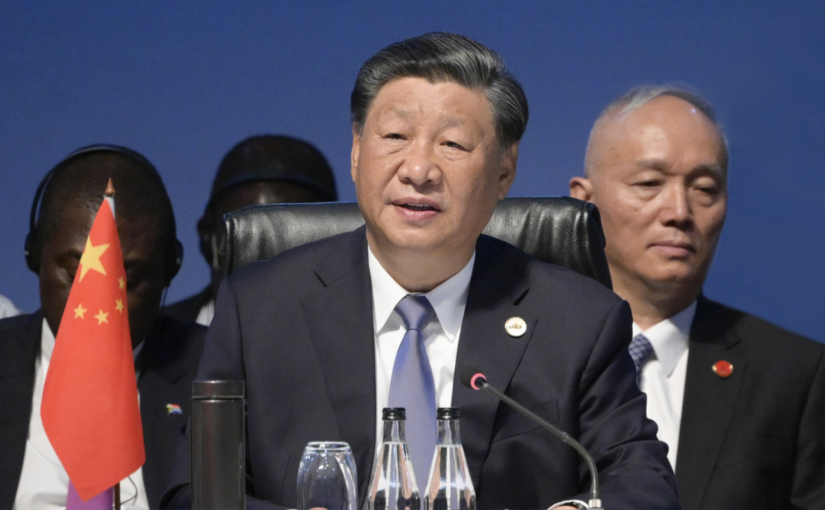
Remarks by Xi Jinping at the BRICS-Africa Outreach and BRICS Plus Dialogue
Alongside the main BRICS Summit, held in the South African city of Johannesburg, a ‘BRICS-Africa Outreach and BRICS Plus Dialogue’ was held on the sidelines on August 24
Hosted by South African President Cyril Ramaphosa, the event was attended by Chinese President Xi Jinping, Brazilian President Luiz Inácio Lula da Silva and Indian Prime Minister Narendra Modi. Russian President Vladimir Putin participated online.
More than 60 leaders and representatives of African countries and other emerging markets and developing countries, as well as United Nations Secretary-General Antonio Guterres, President of the New Development Bank Dilma Rousseff, and leaders of other international and regional organizations, also attended.
Xi Jinping delivered remarks at the dialogue under the title, ‘Hand in Hand Toward a Community of Shared Development’. He began by noting that:
“Development embodies our people’s aspiration for a better life. It is the top priority for developing countries and a timeless theme for humanity. As the UN 2030 Agenda for Sustainable Development is due for a midterm review this year, the delivery of most Sustainable Development Goals remains slow. This is a cause for concern, and the global development endeavour faces formidable challenges.”
Xi pointed out that China has invariably stood in solidarity with fellow developing countries through thick and thin. The country has been and will always remain a member of the developing countries. Since holding the first High-Level Dialogue on Global Development last year, China has set up a Global Development and South-South Cooperation Fund, with a total funding of four billion US dollars, and Chinese financial institutions will soon set up a special fund of 10 billion dollars dedicated to the implementation of the Global Development Initiative (GDI).
Xi added:
“Over the past decade, China has provided a large amount of development assistance to Africa and helped build more than 6,000 km of railway, over 6,000 km of highway, and 80-plus large power facilities on the continent. Going forward, China will carry out more cooperation with African countries to support Africa in enhancing its own capacity for development. Specific measures will be taken, such as providing satellite mapping data products, implementing a Smart Customs cooperation partnership, and launching with UNESCO a ‘GDI for Africa’s Future’ action plan, to support sustainable development in Africa.”
The following is the full text of President Xi’s remarks. It was originally published by the Xinhua News Agency.
Hand in Hand Toward a Community of Shared Development
Remarks by H.E. Xi Jinping, President of the People’s Republic of China
At the BRICS-Africa Outreach and BRICS Plus Dialogue
Johannesburg, August 24, 2023
Your Excellency President Matamela Cyril Ramaphosa,
Colleagues,
Let me begin by thanking President Ramaphosa for preparing the Dialogues. I am delighted to join you all in this discussion on global development.
Development embodies our people’s aspiration for a better life. It is the top priority for developing countries and a timeless theme for humanity. As the UN 2030 Agenda for Sustainable Development is due for a midterm review this year, the delivery of most Sustainable Development Goals remains slow. This is a cause for concern, and the global development endeavor faces formidable challenges.
The international community must pursue the larger interests of all countries, respond to people’s concerns, and restore development to the center of the international agenda. The representation and voice of developing countries in global governance should be increased, and developing countries be supported in realizing better development. It is also important to uphold true multilateralism, forge a global development partnership, and create a secure and stable international environment for shared development.
Continue reading Remarks by Xi Jinping at the BRICS-Africa Outreach and BRICS Plus Dialogue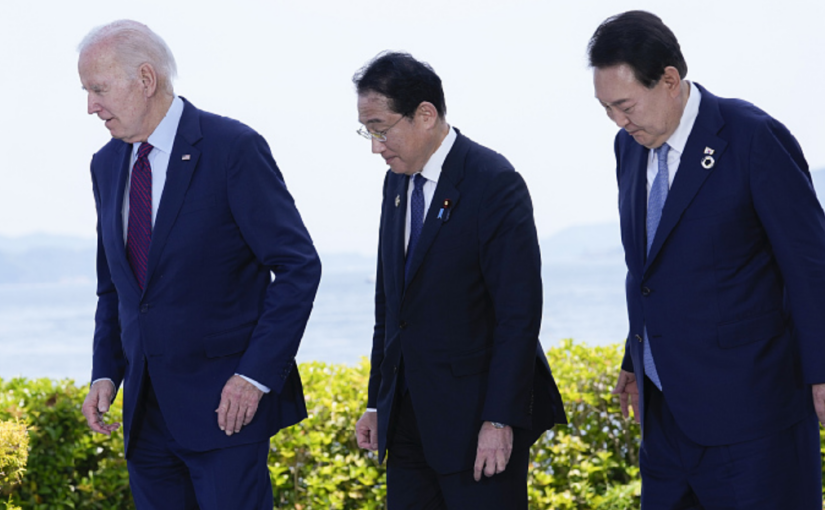
Camp David summit outlines military alliance against China
The following article by Sara Flounders, originally posted on Workers World, provides a critical analysis of US President Joe Biden’s diplomatic “victory” at Camp David, in which he brought together Japan and South Korea to form a security pact with the US. Sara observes that this pact has nothing to do with the maintenance of peace, but is directed towards upgrading the US’s military threat against China and the DPRK, as well as blocking China’s development and regional trade.
The article notes the enormous US military infrastructure which already exists in the region: “US troops have occupied both Japan and South Korea since 1945. There are still 53,700 US troops in Japan on 120 military bases — more bases than in any other country. Some 26,400 US troops are stationed on 73 bases in South Korea, including Fort Humphreys, the largest overseas US military base. This overwhelming US military presence exerts extreme political pressure.” This is on top of the recent creation of AUKUS and the revival and upgrading of the QUAD.
As such, the agreement at Camp David is simply “a further step in Washington’s strategy of inserting tensions, instability and continuing provocations in the region in an attempt to block China’s development and its growing regional trade with its neighbors.”
Sara points out that the US’s anti-China strategy of sanctions and tariffs is actually punishing South Korea and Japan more than China. “By expanding sanctions on China affecting chip technology, software and equipment, Washington disrupts global supply chains and damages the economies of South Korea, Japan and Taiwan.” Indeed the US economy will suffer too. But as far as US strategists are concerned, China’s suffering is a higher priority than US prosperity. Unfortunately for Washington’s cold warriors, however, “though China will feel the impact of sanctions, its economy is larger than those of its Asian neighbors, and its many global trading partners may give it a greater capacity to adjust, including by reinforcing its domestic economy.”
August 22 — U.S. war threats against China heightened this week. On Aug. 18, President Joe Biden framed an aggressive military alliance, with South Korean President Yoon Suk Yeol and Japanese Prime Minister Fumio Kishida dutifully attending, at an ominous summit at Camp David. This trilateral military pact of the United States, South Korea and Japan is directly aimed at China and at the Democratic People’s Republic of Korea (North Korea).
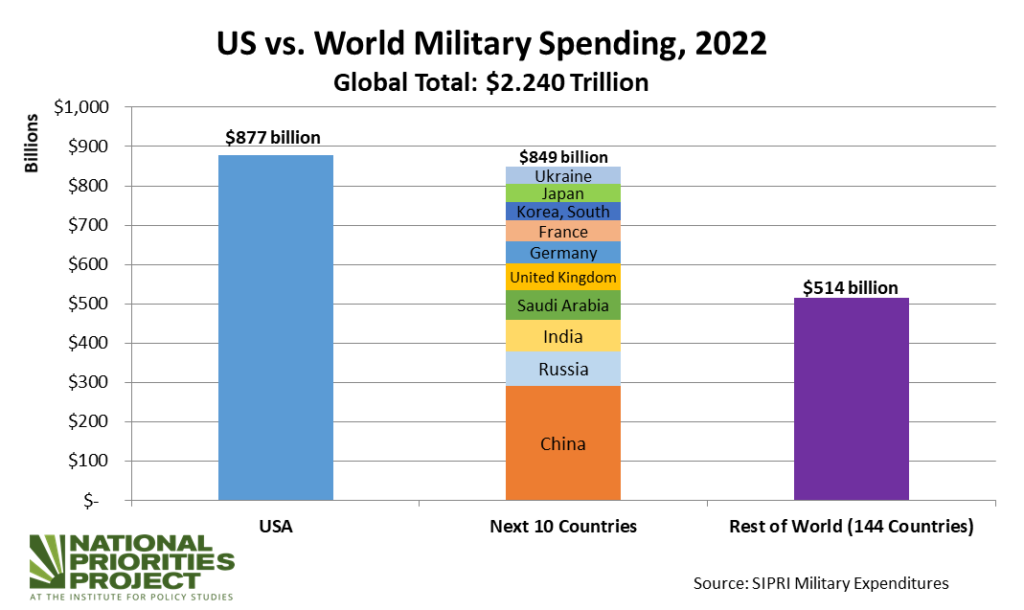
Both U.S. and Chinese, as well as other international media, all described the meeting as a confirmation of a new Cold War against China.
The military pact of South Korea and Japan with the U.S. intentionally damages both the South Korean and Japanese economies, as China has been the major trading partner of both countries. However, right-wing militarists in office in each country seem willing to act against their own people’s interests.
Continue reading Camp David summit outlines military alliance against China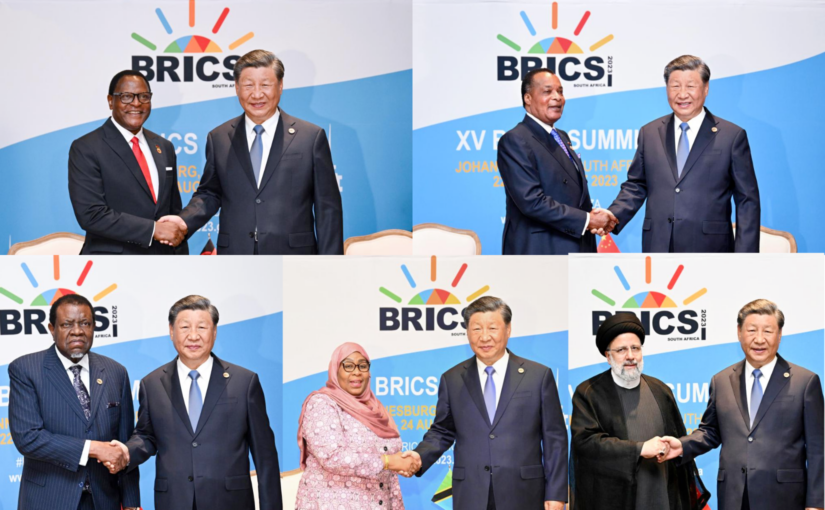
Xi Jinping meets with national leaders of Malawi, Republic of Congo, Namibia, Tanzania and Iran
On the final day, August 24, of his recent visit to South Africa, Chinese President Xi Jinping held a further round of bilateral meetings with other national leaders on the sidelines of the BRICS Summit.
Meeting Malawian President Lazarus Chakwera, Xi said that China supports Malawi in exploring a development path suited to its national conditions, and stands ready to continuously offer whatever help China can to the country in its socio-economic development.
For his part, Chakwera noted that China is always the first to lend a helping hand to Malawi when the latter faces difficulties, adding that during his recent visit to China, he was not only warmly received, but also truly felt that China is Malawi’s true friend, brother and partner.
China will, as always, firmly support the Republic of the Congo in safeguarding its national independence and opposing foreign interference, the Chinese President said, whilst meeting his Congolese counterpart, Denis Sassou Nguesso.
Calling Sassou Nguesso an old friend and good friend of the Chinese people, Xi pointed out that the sound development of bilateral relations is inseparable from the fact that Sassou Nguesso attaches great importance to and sticks to friendship with China.
Noting that next year marks the 60th anniversary of the establishment of diplomatic relations between the two countries, Xi said China is ready to make joint plans and hold grand celebrations with the Congolese side.
Sassou Nguesso said Xi’s successful state visit to the Republic of the Congo in 2013 remains fresh in his memory, adding that Chinese enterprises have undertaken many national construction projects in his country, and friendship and cooperation with China are important factors for the country’s continuous development.
China stands ready to strengthen cooperation with Namibia in various fields, including in clean energy, and will encourage Chinese enterprises to invest in the country, Xi Jinping said, when meeting with his Namibian counterpart, Hage Geingob.
Xi said President Geingob is an old friend of the Chinese people, who has deep affection for China. The Chinese side greatly appreciates the president’s firm support for China’s position on issues of core interests, and his delivering justice and speaking out for righteousness in international affairs.
Xi pointed out that China and Africa share similar historical experiences and hard struggle, adding that China insists on equality and mutual respect between big and small countries.
The Communist Party of China has led the Chinese people to successfully build socialism with Chinese characteristics, while at the same time making efforts to push forward the building of a community with a shared future for humanity, Xi said.
Through proposing a series of initiatives such as the Belt and Road cooperation, Xi added, China offers opportunities to developing countries to realise joint development and prosperity, and fights for more equal rights for developing nations.
For his part, Geingob said Namibia and China enjoy long-term friendship. China is an all-weather friend, and even more so a friend who you can count on when in difficulty. The Namibian side is deeply grateful to China’s firm support in the various causes of fighting for national independence and emancipation as well as national development.
He said as a leader of a global major country, President Xi has led the Chinese people to achieve remarkable accomplishments, and treats African leaders with equality and humility, which is very touching.
The Namibian side has been greatly inspired by the thoughts on socialism with Chinese characteristics, and is exploring a modernization path with Namibian characteristics, Geingob noted.
Geingob is President both of the Republic of Namibia and of the South West African People’s Organisation (SWAPO) of Namibia. At its 2017 Congress, SWAPO formally adopted socialism with Namibian characteristics as its official ideology.
Meeting Tanzanian President Samia Suluhu Hassan, Xi said that stronger China-Africa cooperation under the current international situation is conducive to the unity among developing countries, as well as to safeguarding their legitimate development interests.
He pointed out that Hassan’s successful visit to China in November last year was a highlight moment in China-Tanzania relations. China-Tanzania cooperation has always been at the forefront of China-Africa cooperation, and the Tanzania-Zambia Railway is a beautiful memory shared by the people of China and Tanzania.
Noting that next year marks the 60th anniversary of the establishment of China-Tanzania diplomatic ties, Xi said China is willing to take the opportunity of jointly celebrating this anniversary to continuously work with Tanzania in firmly supporting each other’s core interests and major concerns while deepening strategic cooperation.
Noting that Tanzania and China have maintained close exchanges at all levels and that cooperation projects have progressed smoothly, President Hassan said Tanzania highly appreciates China’s valuable support for and assistance to the development of developing countries. Tanzania and other developing countries have all benefited a lot from the Belt and Road cooperation and other major initiatives proposed by Xi, she said.
Meeting with Iranian President Ebrahim Raisi, Xi said that China stands ready to strengthen cooperation with Iran on BRICS and other multilateral platforms, so as to push for healthy and robust development of multilateralism.
Xi congratulated Iran on becoming a member of BRICS, stressing that it is a historic event that the BRICS summit, with joint efforts of all parties, has made the decision to expand. All the new members are countries with important influence, Xi said, expressing confidence that they will have a major impact on the world.
The BRICS Summit agreed to invite Argentina, Egypt, Ethiopia, Iran, Saudi Arabia, and the United Arab Emirates (UAE) to join the cooperation mechanism from January 2024, in what the host, South African President Cyril Ramaphosa described as, “the first phase of the expansion process.” More than 40 countries have expressed an interest to join, with more than 20 having already submitted formal applications.
Xi said that since Raisi’s successful visit to China in February this year, the two countries have wasted no time to implement the consensus reached between the two leaders, which has achieved positive results. He added that he is glad that with the joint efforts of China, Iran and Saudi Arabia, Iran and Saudi Arabia have achieved reconciliation, which has promoted security and stability in the Middle East.
For his part, Raisi said Iran highly appreciates and thanks China for supporting Iran in becoming a full member of BRICS, which will provide fresh momentum for the development of Iran-China relations.
The Iranian President expressed gratitude for Xi’s important role in promoting dialogue and reconciliation between Iran and Saudi Arabia, adding that the expansion of BRICS shows that unilateralism is going downhill.
The following articles were published by the Xinhua News Agency.
Xi says China supports Malawi in exploring development path suited to its national conditions
JOHANNESBURG, Aug. 24 (Xinhua) — China supports Malawi in exploring a development path suited to its national conditions, and stands ready to continuously offer whatever help China can to the country in its socio-economic development, Chinese President Xi Jinping said here on Thursday.
Xi made the remarks when meeting with his Malawian counterpart, Lazarus Chakwera, on the sidelines of the 15th BRICS Summit.
Xi said he appreciates Chakwera for upholding the one-China principle since taking office.
It is hoped that China and Malawi can continuously support each other on issues concerning their respective core interests and major concerns, push for new results in practical cooperation between the two countries, and promote ever-new development of bilateral relations, he said.
China is willing to strengthen solidarity and cooperation with Malawi and other developing countries, and advance the development of the international order in a more equal and just direction, he said.
For his part, Chakwera noted that China is always the first to lend a helping hand to Malawi when the latter faces difficulties, adding that during his recent visit to China, he was not only warmly received, but also truly felt that China is Malawi’s true friend, brother and partner.
Malawi firmly adheres to the one-China policy, he said, adding that the Belt and Road Initiative proposed by Xi is conducive to the common development of developing countries.
Chakwera added that Malawi is willing to continuously deepen friendship and cooperation with China.
Continue reading Xi Jinping meets with national leaders of Malawi, Republic of Congo, Namibia, Tanzania and Iran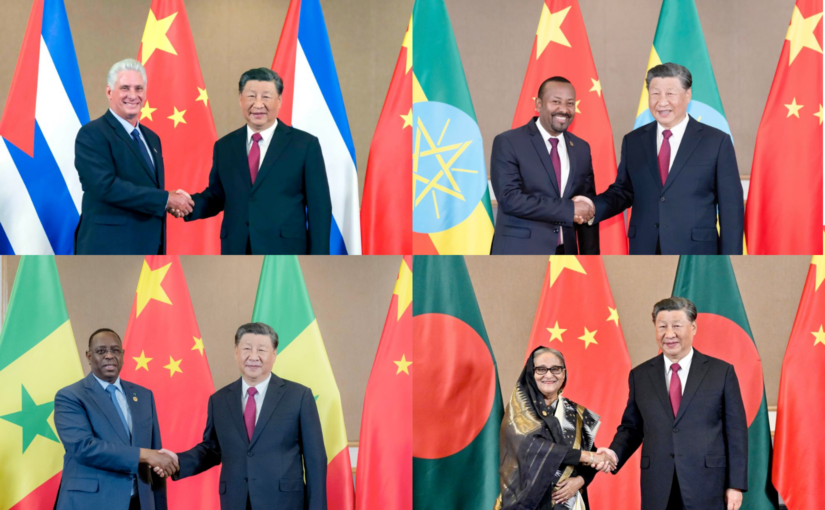
Xi Jinping meets with national leaders of Cuba, Ethiopia, Senegal and Bangladesh
During his recent visit to South Africa, Chinese President Xi Jinping held bilateral meetings on the sidelines of the BRICS Summit with a number of national leaders.
On August 23, he met with Cuban President Miguel Diaz-Canel, Ethiopian Prime Minister Abiy Ahmed, Senegalese President Macky Sall and Bangladeshi Prime Minister Sheikh Hasina.
Meeting his Cuban counterpart, Xi said that China will continue to firmly support Cuba in defending national sovereignty and opposing external interference and blockade. China will also try its best to provide support for Cuba’s economic and social development.
The Chinese President added that his country will work with Cuba to continue deepening political mutual trust, expanding practical cooperation, strengthening strategic coordination, and pushing for progress in the special friendly relationship between the two parties and the two countries. China praises Cuba’s steadfast support for China in issues concerning its core interests.
Xi stressed that the Group of 77 and China is an important platform for cooperation among developing countries, adding that Cuba, as the current chair of the Group of 77 and China, has made positive contributions to strengthening the unity of developing countries.
China attaches great importance to and supports Cuba in successfully holding the Group of 77 and China Summit next month, Xi noted. China is willing to work with Cuba and other members of the Group of 77 to better safeguard the common interests and development rights of developing countries, he added.
For his part, Diaz-Canel spoke of his successful state visit to China last November, saying that both sides are earnestly implementing the important consensus reached by the two leaders.
He said the current Cuba-China relations are at a historical peak, adding that the Cuban people deeply admire President Xi and are grateful for China’s understanding and invaluable support for Cuba’s just cause.
Cuba is ready to work with China to deepen Belt and Road cooperation, build a Cuba-China community with a shared future, and advance on their paths of socialism with their respective characteristics.
Meeting Prime Minister Abiy Ahmad, Xi said that China is a reliable friend and a true partner of Ethiopia.
China attaches great importance to its relations with Ethiopia and supports its domestic peace process, development, and revitalization, he said, adding that China stands ready to work with Ethiopia to promote bilateral exchanges and to expand all-round cooperation, so that bilateral friendship can enjoy greater popular support and the China-Ethiopia comprehensive strategic cooperative partnership can witness further development.
The friendship between Ethiopia and China is profound and the relations between the two countries have maintained good development momentum, said Ahmed, extending his sincere appreciation for the massive and valuable support China has offered for a long time.
Thanks to the help from and cooperation with China, Ethiopia has achieved significant development and transformations in recent years, said the Ethiopian Prime Minister, noting that the two countries share similar experiences and have common stands on many major issues.
Meeting with President Macky Sall, Xi noted that Senegal is an important partner of China in Africa, adding that, with joint efforts in recent years, the two countries have enjoyed ever-deepening political mutual trust and fruitful cooperation in various fields. He said that China supports the African Union in joining the Group of 20 and stands ready to share with African brothers its development experience and opportunities, and push for the joint pursuit of a China-Africa community with a shared future in the new era, by continuously upholding the principles of sincerity, real results, amity and good faith and pursuing the greater good and shared interests.
As co-chairs of the Forum on China-Africa Cooperation (FOCAC), China and Senegal have supported and cooperated with each other and successfully held a series of important events including the Extraordinary China-Africa Summit on Solidarity against COVID-19, he said.
President Sall thanked China for taking the lead in publicly supporting the AU’s G20 membership, saying that his country, as a co-chair of FOCAC, will continue to closely communicate and work with China to promote the further development of Africa-China relations.
Meeting Bangladesh Prime Minister Sheikh Hasina, Xi said that China and Bangladesh enjoy traditional friendship, adding that the two sides upgraded bilateral ties in 2016 to a strategic cooperative partnership, which has indicated the direction for deepening their cooperation.
At present, both China and Bangladesh are at a critical stage of their own development and revitalization, and the Chinese side is willing to strengthen the synergy of development strategies with Bangladesh, deepen practical cooperation in various fields, push the bilateral strategic cooperative partnership to a new level, and better benefit the people of the two countries.
Xi also said that China supports Bangladesh in safeguarding national sovereignty, independence, and territorial integrity, and in opposing external interference, so that the country can maintain domestic unity and stability and achieve development and revitalization.
He extended congratulations to the prime minister on her country’s joining the New Development Bank, saying that China is willing to strengthen coordination and cooperation with Bangladesh in multilateral affairs and to safeguard international equity and justice as well as the shared interests of developing countries.
Hasina noted that Xi’s state visit to Bangladesh in 2016 has become a milestone in bilateral ties. She added that the sound Bangladesh-China relationship is based on mutual respect and non-interference in each other’s internal affairs. Bangladesh, she said, firmly adheres to the one-China policy and appreciates China’s important role in promoting regional peace and stability, adding that her country is ready to deepen ties with China and to strengthen cooperation in multilateral mechanisms such as BRICS.
It is believed that the development of the BRICS mechanism will bring new development opportunities to developing countries, she added.
The following articles were originally carried by the Xinhua News Agency.
Xi pledges China’s continuous support for Cuba in opposing interference
JOHANNESBURG, Aug. 23 (Xinhua) — Chinese President Xi Jinping said here on Wednesday that China will continue to firmly support Cuba in defending national sovereignty and opposing external interference and blockade.
China will also try its best to provide support for Cuba’s economic and social development, said Xi in a meeting with Cuban President Miguel Diaz-Canel on the sidelines of the 15th BRICS Summit.
Xi recalled that President Diaz-Canel paid a successful state visit to China last November, when they reached a broad consensus on further deepening China-Cuba ties in the new era and agreed to work together to build a China-Cuba community with a shared future.
Continue reading Xi Jinping meets with national leaders of Cuba, Ethiopia, Senegal and Bangladesh
China: socialist or capitalist?
This presentation by Friends of Socialist China co-editor Carlos Martinez was given to the Communist Party USA on 20 August 2023 as part of its Marxist Classes series.
Introducing his book, The East is Still Red – Chinese Socialism in the 21st Century, Carlos goes into detail as to the class character of China today.
The book is available in paperback and ePub formats from Praxis Press, and is also available for Kindle. The voucher code ‘Carlos’ provides a site-wide 10 percent discount on Praxis Press.