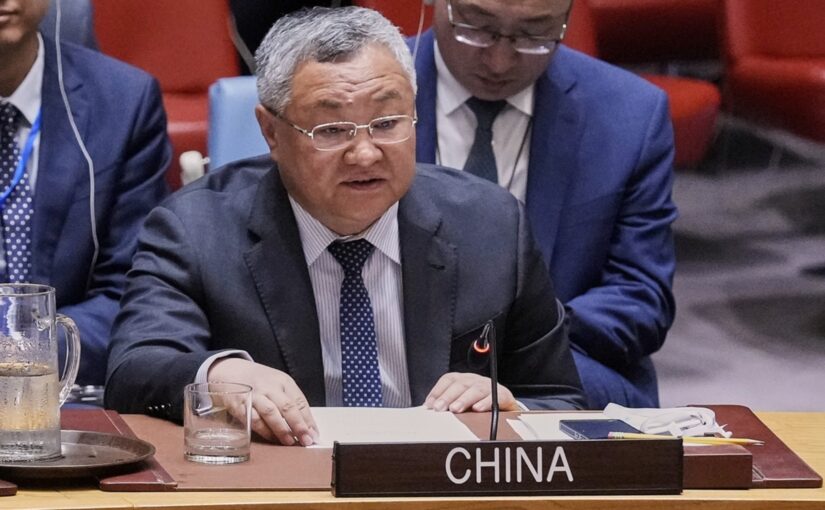
Chinese Ambassador to the UN Fu Cong has reiterated China’s clear positions on the rights of the Palestinian people and on the present situation in the Strait of Hormuz at open debates in the Security Council held on consecutive days.
Speaking on April 28, Fu Cong said:
“The Palestinian question has always been at the heart of the Middle East issue and must not be marginalised under any circumstances. For decades, the Palestinian-Israeli conflict has revolved in cycles. Its fundamental crux is that the two-State solution is only half-realised. The State of Israel was established long ago, while the State of Palestine remains out of reach. Although intense clashes have come to a halt, the Palestinian people are still forced to keep company with death and suffering, the situation in the occupied Palestinian territories continues to worsen, and the foundation of the two-State solution risks being completely hollowed out. Turmoil and war are not the fate of the Palestinian people. The international community must summon the greatest sense of urgency to reverse this negative trajectory and rectify the historic injustice endured by Palestine.”
He went on to make three points:
- Gaza is not a permanent battlefield, and the suffering of its civilians must cease immediately. While efforts by the international community to broker a ceasefire in Gaza are welcome, the most pressing task remains cementing the ceasefire and scaling up aid. Since October last year, Israel has relentlessly mounted attacks and fortified its military presence, resulting in over 800 fatalities and more than 2,000 wounded. The humanitarian crisis in Gaza remains dire, characterised by scarcity of essential supplies, deplorable sanitary conditions, and a medical system teetering on the precipice of total collapse. Israel must fulfill its international humanitarian law obligations, dismantle all barriers to humanitarian access, and guarantee that UNRWA [the United Nations Relief and Works Agency for Palestine Refugees in the Near East] and other humanitarian agencies can carry out their aid work.
- Settlement activities are unacceptable, and tensions in the West Bank must be deescalated. Israel is currently accelerating the expansion of settlements, having recently approved the construction of 34 additional settlements and initiating the rebuilding of the Sanur settlement, which had been shuttered for many years. The escalating violence in the West Bank is equally concerning. Settler violence is intensifying, and the occupying power frequently conducts searches, arrests, and raids, even promulgating death penalty legislation specifically targeting Palestinians. Israel must heed the strong appeals of the international community, immediately halt illegal settlement activities, effectively curb settler violence, and ensure robust accountability for all attacks.
- The two-State solution is non-negotiable, and the independent statehood of Palestine must be supported. It is deeply concerning that voices opposing the two-State solution continue to come from Israel, with some even threatening to strangle the idea of a Palestinian state. The international community must increase support for Palestine to advance the early establishment of a fully sovereign and independent state of Palestine based on the 1967 borders with East Jerusalem as its capital.
The previous day, Fu Cong made remarks on the Safety and Protection of Waterways in the Maritime Domain in which he said:
“The Strait of Hormuz is a vital corridor for the international trade of goods and energy. Maintaining the security, stability, and unimpeded passage in this region is in the common interest of the international community. The root cause of the blockade of the Strait is the illegal military actions launched by the US and Israel against Iran. Despite the recently concluded ceasefire arrangement, the US has stepped up its military deployment and imposed targeted blockades. This is dangerous and irresponsible behaviour.”
He added that: “China commends Pakistan and others for their role as mediators and urges relevant parties to resolve disputes and conflicts by political and diplomatic means.”
Stressing the importance of adhering to the United Nations Convention on the Law of the Sea (UNCLOS – which the United States has not ratified), Fu insisted that: “Everyone should exercise the rights to freedom of navigation granted by international law in good faith, earnestly respect the sovereignty, security, and legitimate rights and interests of coastal states [which in the case of the Strait of Hormuz are Iran and Oman], and ensure the smooth flow of normal maritime trade and navigation.”
Previously, on April 20, Chinese President Xi Jinping accepted a phone call from Saudi Arabia’s Crown Prince and Prime Minister Mohammed bin Salman.
During their conversation, President Xi emphasised that China calls for an immediate and comprehensive ceasefire (in the US-Israeli war of aggression against Iran), supports all efforts conducive to restoring peace, and stands for resolving disputes through political and diplomatic means. The Strait of Hormuz should maintain normal passage, as this serves the common interests of regional countries and the international community. China supports regional countries in building a common home of good-neighbourliness, development, security and cooperation, holding their future in their own hands, and promoting lasting peace and security in the region.
Whether willfully or otherwise, this clear and simple statement by Xi Jinping has been widely misinterpreted and misrepresented in the western media as China somehow criticising, putting pressure on or taking distance from Iran. This despite the fact that it is none other than the United States that is illegally blockading the strait and impeding normal passage at present. In this regard, Fu Cong’s clear statements that, “the root cause of the blockade of the Strait is the illegal military actions launched by the US and Israel against Iran” and his noting that “the US has stepped up its military deployment and imposed targeted blockades”, which have predictably not been reported by the mainstream western media, assume particular importance.
The following articles were originally published on the websites of China’s Permanent Mission to the United Nations and the Chinese Foreign Ministry.
China sets out position on Palestine and Strait of Hormuz at UN
April 30 (China UN Mission) – President,
I welcome Foreign Minister Abdullatif bin Rashid Al-Zayani presiding over today’s meeting. I thank Assistant Secretary-General Khaled Khiari, Foreign Minister Espen Barth Eide, and Mr. Tony Blair for their briefings.
For some time, the Middle East situation has escalated dramatically with widespread consequences, gravely disrupting regional stability and affecting the global economy and energy security. President Xi Jinping has solemnly put forward a four-point proposal on maintaining and promoting peace and stability in the Middle East, including upholding the principles of peaceful coexistence, national sovereignty, international rule of law, and balancing development and security, providing China’s solution for ending conflict and achieving peace. The current situation stands at a critical stage of transition from war to peace. China urges all parties to seize this window of peace, exercise utmost restraint, demonstrate maximum sincerity, and remain steadfast in the direction of a political settlement to prevent any retrogression in the momentum of the ceasefire and negotiations, and strive for the early restoration of stability in the Middle East and the Gulf region.
President,
The Palestinian question has always been at the heart of the Middle East issue, and must not be marginalized under any circumstances. For decades, the Palestinian-Israeli conflict has revolved in cycles. Its fundamental crux is that the two-State solution is only half-realized. The State of Israel was established long ago, while the State of Palestine remains out of reach. Although intense clashes have come to a halt, the Palestinian people are still forced to keep company with death and suffering, the situation in the occupied Palestinian territories continues to worsen, and the foundation of the two-State solution risks being completely hollowed out. Turmoil and war are not the fate of the Palestinian people. The international community must summon the greatest sense of urgency to reverse this negative trajectory and rectify the historic injustice endured by Palestine. I wish to make three points.
First, Gaza is not a permanent battlefield, and the suffering of its civilians must cease immediately. While efforts by the international community to broker a ceasefire in Gaza are welcome, the most pressing task remains cementing the ceasefire and scaling up aid. Since October last year, Israel has relentlessly mounted attacks and fortified its military presence, resulting in over 800 fatalities and more than 2,000 wounded. The humanitarian crisis in Gaza remains dire, characterized by scarcity of essential supplies, deplorable sanitary conditions, and a medical system teetering on the precipice of total collapse. China calls on all concerned parties, especially Israel, to fully abide by the ceasefire agreement to ensure a comprehensive and durable ceasefire throughout Gaza. Israel must fulfill its international humanitarian law obligations, dismantle all barriers to humanitarian access, and guarantee that UNRWA and other humanitarian agencies can carry out their aid work.
Second, settlement activities are unacceptable, and tensions in the West Bank must be deescalated. Israel is currently accelerating the expansion of settlements, having recently approved the construction of 34 additional settlements and initiating the rebuilding of the Sanur settlement, which had been shuttered for many years. The escalating violence in the West Bank is equally concerning. Settler violence is intensifying, and the occupying power frequently conducts searches, arrests, and raids, even promulgating death penalty legislation specifically targeting Palestinians, which dangerously heightens tensions. Settlement activities contravene international law and Security Council resolutions. Prolonging the illegal occupation will not make either party feel safer. Rather, it will intensify a vicious cycle. Israel must heed the strong appeals of the international community, immediately halt illegal settlement activities, effectively curb settler violence, and ensure robust accountability for all attacks.
Third, the two-State solution is non-negotiable, and the independent statehood of Palestine must be supported. It is deeply concerning that voices opposing the two-State solution continue to come from Israel, with some even threatening to strangle the idea of a Palestinian state. The two-State solution remains the only viable pathway to resolving the Palestinian question. Any unilateral action that erodes its foundation must be firmly rejected, and any future arrangements or formation of new mechanisms must adhere to the principle of Palestinians governing Palestine, serving to promote, rather than undermine, the two-State solution. We commend the successful municipal elections held in Palestine last week. The international community must increase support for Palestine to advance the early establishment of a fully sovereign and independent state of Palestine based on the 1967 borders with East Jerusalem as its capital.
China stands ready to continue working alongside the international community to bring an end to the suffering of the Palestinian people, implement the two-State solution, and achieve a comprehensive, just, and lasting solution to the Palestinian question at an early date.
Thank you, President.
Remarks on the Safety and Protection of Waterways in the Maritime Domain by Ambassador Fu Cong at the UN Security Council Open Debate
April 27 (China UN Mission) – President,
At the outset, I welcome His Excellency Foreign Minister Abdullatif bin Rashid Al Zayani of Bahrain presiding over this meeting, and I thank Secretary-General António Guterres, Secretary-General Arsenio Dominguez, and Mr. Nick Childs for their briefings.
Oceans are the cradle of life and connect the world, carrying more than 80% of global trade. They have become the main arteries for the functioning of economies and human society. To guarantee the safety and security of international shipping routes is crucial to the stability of global production and supply chains and to people’s well-being, serving the common interests of all nations. In recent years, due to rising global turmoil, maritime security issues have intensified and have become increasingly intertwined with geopolitical conflicts, traditional and non-traditional security risks, and global governance deficits. Upholding the spirit of unity and cooperation, we need to view maritime security issues in a comprehensive and in-depth manner, and seek solutions that address both the symptoms and root causes. Let me stress the following points.
First, we must find political solutions to hotspot issues. The stability and smooth operation of international shipping routes are closely linked to peace and stability in the surrounding region, especially coastal states. Only through dialogue and consultation can we deescalate hotspot issues and create an enabling environment for the safety of these routes. Excessive use of military means cannot fundamentally resolve risks. Rather, it will exacerbate tensions and confrontation and create even greater security crises.
The Strait of Hormuz is a vital corridor for the international trade of goods and energy. Maintaining the security, stability, and unimpeded passage in this region is in the common interest of the international community. The root cause of the blockade of the Strait is the illegal military actions launched by the US and Israel against Iran. Despite the recently concluded ceasefire arrangement, the US has stepped up its military deployment and imposed targeted blockades. This is dangerous and irresponsible behavior. The solution to ending the blockade of the Strait is to achieve a comprehensive and lasting ceasefire as soon as possible, so as to restore peace and stability in the Gulf region and the Middle East. China commends Pakistan and others for their role as mediators, and urges relevant parties to resolve disputes and conflicts by political and diplomatic means. China opposes any moves that could undermine the ceasefire and lead to escalation and confrontation. China will continue to play a constructive role in promoting regional peace and stability, guided by the spirit of the four propositions on safeguarding and promoting peace and stability in the Middle East proposed by President Xi Jinping, namely, staying committed to the principle of peaceful coexistence, staying committed to the principle of national sovereignty, staying committed to the principle of international rule of law, and staying committed to a balanced approach to development and security.
Second, we must firmly uphold international rule of law. UNCLOS, together with relevant international treaties and customary international law, collectively form the foundation of today’s international maritime order. All countries should interpret and apply the Convention fully, accurately, and in good faith, and refrain from selective application and double standards. Everyone should exercise the rights to freedom of navigation granted by international law in good faith, earnestly respect the sovereignty, security, and legitimate rights and interests of coastal states, and ensure the smooth flow of normal maritime trade and navigation.
Third, we must combat maritime crimes in accordance with law. According to reports from relevant agencies, the world saw 137 incidents of piracy and armed robbery at sea last year, the highest in the past five years. Criminal groups and terrorist forces are increasingly using oceans as their key channels for illicit activities such as the trafficking of drugs, arms, and persons. By observing the framework of international law, all countries should combat maritime crimes in accordance with laws and regulations, while respecting the flag state’s exclusive jurisdiction over vessels flying its flag. At the same time, we need to actively support coastal states’ economic development and improvement of livelihood, thereby eliminating the breeding ground of crimes and turmoil.
Fourth, we must consistently improve global governance. Oceans are the shared home of all humanity. Only by following the principle of extensive consultation, joint contribution, and shared benefits, and by promoting the establishment of a more just and equitable global ocean governance system, can we truly realize the beautiful vision of maritime peace and security and a thriving maritime economy. All countries should support the UN in playing a central role, continue to advance the process of international lawmaking and rule-making, and actively address emerging challenges, including marine ecological conservation and sea-level rise. Upholding the principles of openness, inclusiveness, and win-win cooperation, we need to further boost maritime connectivity and infrastructure development, and promote the sustainable and rational use of marine resources.
President,
As always, China, being a staunch defender of and contributor to the international maritime law, has taken concrete actions to uphold the authority and integrity of UNCLOS, and was among the first to sign and ratify the BBNJ Agreement. China has been playing an active role in such areas as safety of maritime navigation, disaster reduction and prevention, and ecological conservation. China has dispatched 48 naval escort task forces to the Gulf of Aden and Somali waters to carry out routine escort missions. China is also an active participant in the UN Decade of Ocean Science for Sustainable Development. China has issued the Belt and Road Blue Cooperation Initiative, and actively supported developing countries and small-island countries in attaining the SDGs, providing high-quality global maritime public goods to the international community. Together with the international community, we will continue our unremitting efforts to safeguard common maritime security and build a maritime community with a shared future.
Thank you, President.
President Xi Jinping Speaks with Saudi Arabia’s Crown Prince and Prime Minister Mohammed bin Salman bin Abdulaziz Al Saud on the Phone
April 20 (MFA) – On the afternoon of April 20, 2026, President Xi Jinping took a phone call from Saudi Arabia’s Crown Prince and Prime Minister Mohammed bin Salman bin Abdulaziz Al Saud.
President Xi noted that China attaches great importance to growing its relations with Saudi Arabia, and always upholds the principle of mutual respect, equality and mutual benefit. This year marks the 10th anniversary of the establishment of the China-Saudi Arabia comprehensive strategic partnership. Taking it as an opportunity, China stands ready to work with Saudi Arabia to deepen mutual strategic trust, enhance practical cooperation, expand exchanges at all levels, continuously increase the scope and depth of our bilateral relations, and set a fine example for the relations between China and Arab states.
On the current situation in the Middle East and the Gulf region, President Xi emphasized that China calls for an immediate and comprehensive ceasefire, supports all efforts conducive to restoring peace, and stands for resolving disputes through political and diplomatic means. The Strait of Hormuz should maintain normal passage, as this serves the common interests of regional countries and the international community. China supports regional countries in building a common home of good-neighborliness, development, security and cooperation, holding their future in their own hands, and promoting lasting peace and security in the region.
Crown Prince and Prime Minister Mohammed bin Salman noted that the relationship between Saudi Arabia and China is strategic in nature, and growing ties with China is of vital importance to Saudi Arabia. The current warfare in the Middle East undermines the security of the Gulf states and severely disrupts global energy supplies and economic performance. Saudi Arabia is committed to resolving disputes and differences through dialogue and hopes to prevent further escalation. China is a responsible major country that consistently upholds a just position and supports Middle Eastern countries in pursuing good-neighborliness, dialogue and cooperation. Saudi Arabia is ready to strengthen communication and coordination with China to maintain the ceasefire, prevent the resumption of hostilities, ensure the safety and freedom of navigation in the Strait of Hormuz, and work together to find a pathway to lasting peace and stability in the region.





