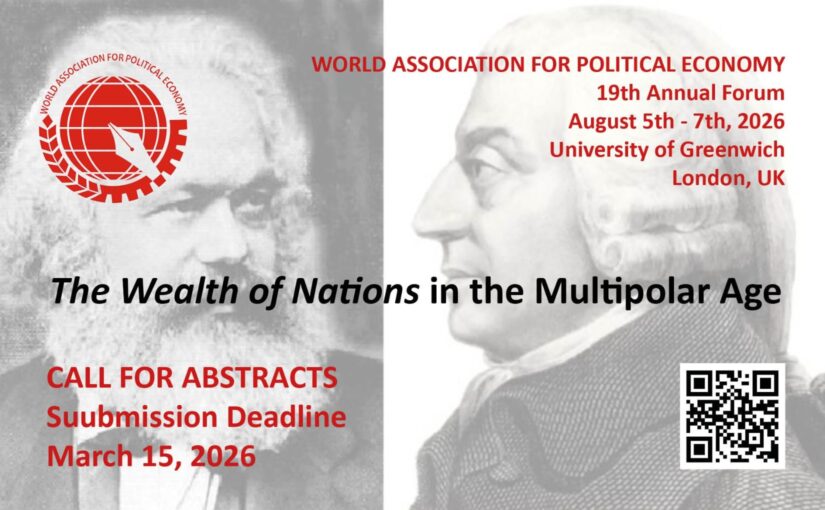
We publish below the Call for Papers for the 19th Annual Forum of the World Association for Political Economy (WAPE), which will be held from August 5-7, 2026, in London on the theme, ‘The Wealth of Nations in the Multipolar Age’.
WAPE is an important initiative to bring together Marxist and socialist scholars worldwide in which the Chinese Academy of Social Sciences plays an important role. Friends of Socialist China co-editors Keith Bennett and Carlos Martinez are participating in the organising committee for the forum.
More detailed information can be found on the conference website.
19th Annual Forum of the World Association for Political Economy: The Wealth of Nations in the Multipolar Age
August 5–7 · University of Greenwich · London UK
Adam Smith’s contradictions are of significance because they contain problems which it is true he does not solve, but which he reveals by contradicting himself. His correct instinct in this connection is best shown by the fact that his successors take opposing stands based on one aspect of his teaching or the other. (Karl Marx, Theories of Surplus Value I, 151)
The World Association for Political Economy (WAPE) is pleased to announce its annual forum on the theme “The Wealth of Nations in the Multipolar Age”, marking the 250th anniversary of the publication of Adam Smith’s The Wealth of Nations. We meet at the Old Royal Naval College in Greenwich, London, where the first Chinese translator of the Smith’s works and first principal of Beijing University, Yan Fu, studied.
We invite scholars, researchers, activists, and practitioners to submit their papers for consideration.
The neoclassical and neoliberal appropriation of Smith is simplistic at best and false at worst. Marx, in contrast, rightly regarded Smith as one of his most important intellectual forbears, whose ideas he both valued and criticized in arriving at his own critique of political economy.
Marx considered Smith to be among those investigating ‘the real internal framework [Zusammenhang] of bourgeois relations of production’ — in particular, through his concept of the division of labour, at once advancing the productive capacities of human labour and stunting the human personality, and his belief that labour was ‘the real measure of the exchangeable value of all commodities’.
Indeed, the centrality of these and other themes of Smith’s work to Marx’s indicates that many of them point beyond capitalism itself.
The Wealth of Nations also addressed, as the curtain rose on the modern capitalist world, the central issue of what makes nations rich or poor. It has formed the running thread of the study of political and geopolitical economy. Today it is central to discussions of the multipolar and pluripolar world, as socialist and other anti-imperialist countries challenge capitalist domination through the increasingly successful pursuit of development, combined with a rejection of the imperial domination that was formative of, and remains fundamental to, capitalism’s very existence.
As in previous years, we will run a geopolitical economy stream to strengthen understanding of what Marx called the ‘relations of producing nations’ of the age of capital, and of the transition away from capitalism.
We commemorate Smith’s The Wealth of Nations this year by inviting submissions that add to existing scholarship on Smith, particularly those that develop the radical and developmental aspects of his thought in the spirit of Marxism, those that investigate his relation to Marx and other critical thinkers since and especially those that which investigate how reconsideration of Smith’s work may contribute to understanding the political and geopolitical economy of the twenty-first century of decaying capitalism, and to advancing socialism in what Marx termed the ‘relations of producing nations’ in the age of multi- and pluripolarity.
Call for Papers
We welcome papers that address theoretical, empirical, or policy-oriented dimensions of the intimately related questions on the themes discussed above and listed below.
Topics
- Adam Smith’s significance for modern thought
- The relation of Marx and his successors with Smith
- The geopolitical economy of the age of capital
- The political economy of development
- Advancing productive powers in a multipolar world
- Modern Forces of Production, Artificial Intelligence, Noonomy, and the Creative Economy
- The negative effects of the dollar as a world currency and of USD-backed stablecoins
- The significance and impact of China’s recent policy initiatives (such as the Global Governance Initiative)
- The role of socialism in the political and geopolitical economy of capitalism
- The emerging role of organisations anddstructures such as BRICS and the Shanghai Cooperation Organisation
- The role of regional blocs and institutions in shaping multipolar governance
- The ecological challenge and resource politics in a multipolar world
- Shifts in labour relations and production systems under multipolarity
- International production networks
- Livelihoods world-wide and the “Death Line” for the American People
- Contemporary forms of Hegemonism, Imperialism, Colonialism, and Racism
- Upholding Integrity and Innovating Marxist Political Economy Through International Cooperation
- Studies on the International Schools of Innovative Marxism
- Macroeconomic modelling
Submission
Abstracts (250–300 words) with keywords. Indicate stream and format (paper, panel, roundtable).
Please include a brief biography (up to 150 words), highlighting your academic affiliation and key research interests.
Papers selected for presentation will be eligible for consideration in WAPE-affiliated journals (World Review of Political Economy, International Critical Thought, World Marxist Review).
Key Dates
- Abstract deadline: March 15
- Decisions: March 30
- Final programme: July 10






I need an email address to submit a paper abstract
Hello. You can submit via the email address WAPE2026@gre.ac.uk
Adam Smith and the Moral Limits of the Market in The Wealth of Nations
Author: Brahim Dinar
Professor of Economics
Hassan II University of Casablanca, Morocco
Email: bh.dinar@gmail.com
Abstract:
Two and a half centuries after the publication of The Wealth of Nations, Adam Smith is still widely regarded as the intellectual father of laissez-faire economics and self-regulating markets. However, this interpretation often overlooks the moral and institutional constraints that Smith considered essential for the proper functioning of economic activity. This paper revisits The Wealth of Nations to examine the moral limits implicit in Smith’s economic analysis and to highlight the enduring relevance of his thought.
The central argument is that markets are not autonomous spheres governed solely by self-interest, but institutions embedded within a broader framework of justice, social trust, and moral norms. To support this thesis, the paper conducts a careful confrontation between The Wealth of Nations and The Theory of Moral Sentiments, demonstrating how Smith’s moral philosophy underpins and constrains his economic prescriptions. This comparative approach illuminates Smith’s attention to justice, his critique of monopolies and rent-seeking behavior, and the indispensable role of institutional frameworks in sustaining social and economic order.
By integrating insights from both works, the study provides a more nuanced understanding of Smith’s legacy, showing that even in The Wealth of Nations, markets are inherently limited by ethical and institutional considerations. This perspective is particularly relevant to contemporary debates on market society, capitalist development, and the moral boundaries of economic behavior, offering a framework for interpreting modern economic challenges in the light of Smithian thought.
Keywords: Adam Smith, Wealth of Nations, Moral Sentiments, Moral Limits of Markets, Market Society
1) Smith, A. (1776). An Inquiry into the Nature and Causes of the Wealth of Nations. London: W. Strahan and T. Cadell.
2) Smith, A. (1759). The Theory of Moral Sentiments. London: A. Millar.
3) Haakonssen, K. (2006). The Science of a Legislator: The Natural Jurisprudence of Adam Smith. Cambridge University Press.
4) Campbell, T. D. (1971). Adam Smith’s Science of Morals. London: Routledge & Kegan Paul.
5) Fleischacker, S. (2004). On Adam Smith’s Wealth of Nations: A Philosophical Companion. Princeton University Press.
6) Riley, P. (2008). Adam Smith and the Ethics of Market Society. Oxford University Press.
7) Skinner, A. S. (1996). Moral Limits of the Market in the Scottish Enlightenment. Cambridge: Cambridge University Press.
Adam Smith and the Moral Limits of the Market in The Wealth of Nations
Author: Brahim Dinar
Professor of Economics
Hassan II University of Casablanca, Morocco
Email: bh.dinar@gmail.com
Abstract:
Two and a half centuries after the publication of The Wealth of Nations, Adam Smith is still widely regarded as the intellectual father of laissez-faire economics and self-regulating markets. However, this interpretation often overlooks the moral and institutional constraints that Smith considered essential for the proper functioning of economic activity. This paper revisits The Wealth of Nations to examine the moral limits implicit in Smith’s economic analysis and to highlight the enduring relevance of his thought.
The central argument is that markets are not autonomous spheres governed solely by self-interest, but institutions embedded within a broader framework of justice, social trust, and moral norms. To support this thesis, the paper conducts a careful confrontation between The Wealth of Nations and The Theory of Moral Sentiments, demonstrating how Smith’s moral philosophy underpins and constrains his economic prescriptions. This comparative approach illuminates Smith’s attention to justice, his critique of monopolies and rent-seeking behavior, and the indispensable role of institutional frameworks in sustaining social and economic order.
By integrating insights from both works, the study provides a more nuanced understanding of Smith’s legacy, showing that even in The Wealth of Nations, markets are inherently limited by ethical and institutional considerations. This perspective is particularly relevant to contemporary debates on market society, capitalist development, and the moral boundaries of economic behavior, offering a framework for interpreting modern economic challenges in the light of Smithian thought.
Keywords: Adam Smith, Wealth of Nations, Moral Sentiments, Moral Limits of Markets, Market Society
1) Smith, A. (1776). An Inquiry into the Nature and Causes of the Wealth of Nations. London: W. Strahan and T. Cadell.
2) Smith, A. (1759). The Theory of Moral Sentiments. London: A. Millar.
3) Haakonssen, K. (2006). The Science of a Legislator: The Natural Jurisprudence of Adam Smith. Cambridge University Press.
4) Campbell, T. D. (1971). Adam Smith’s Science of Morals. London: Routledge & Kegan Paul.
5) Fleischacker, S. (2004). On Adam Smith’s Wealth of Nations: A Philosophical Companion. Princeton University Press.
6) Riley, P. (2008). Adam Smith and the Ethics of Market Society. Oxford University Press.
7) Skinner, A. S. (1996). Moral Limits of the Market in the Scottish Enlightenment. Cambridge: Cambridge University Press.