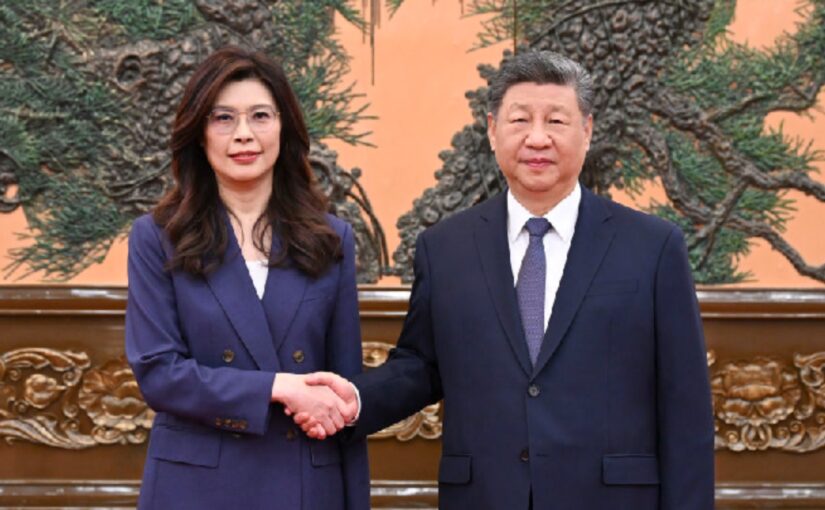
In April 2026, against the backdrop of a global crisis – most notably a criminal war waged by the United States and Israel against Iran that has effectively closed the Strait of Hormuz and sent energy prices soaring to levels not seen in a generation – something highly significant took place in the Great Hall of the People in Beijing: President Xi Jinping met with Cheng Li-wun, Chairwoman of the Kuomintang (KMT), reopening a high-level cross-strait dialogue that had been frozen for nearly a decade (as reported on this website on 13 April).
The following article – submitted by Douglas de Castro, Professor of International Law at Lanzhou University – examines that meeting through the lens of international law, arguing that the CPC-KMT dialogue is a demonstration of what the UN Charter’s core principles – peaceful resolution of disputes, non-interference, sovereign equality – actually look like in practice.
Professor de Castro’s analysis unpacks the legal architecture of the meeting – from UNGA Resolution 2758 and the 1992 Consensus to China’s Anti-Secession Law and the Global Governance Initiative – and shows why the lessons of Cheng Li-wun’s visit extend well beyond the Taiwan Strait.
The meeting in April 2026 between President Xi Jinping, the General Secretary of the Communist Party of China (CPC) Central Committee, and Cheng Li-wun, the Chairwoman of the Kuomintang (KMT), was a historic moment in modern diplomacy. It took place during one of the most turbulent times in recent international relations history. This dialogue took place in the East Hall of the Great Hall of the People in Beijing.
As a scholar of international law, I found that the meeting not only reopened high-level communication channels between parties that had been closed for almost ten years but also demonstrated how the principle of non-interference and the peaceful resolution of conflicts, when applied in practice, can ease tensions in regions important to the international system. It upholds and reaffirms the importance of Articles 2(3) and 2(4) of the UN Charter, which require that disputes be settled peacefully and that no State threaten or use force against the territorial integrity of another State or region.
In a world where the “rule of force” seems to be at odds with the “rule of law,” the CPC and KMT leaders’ reaffirmation of the 1992 Consensus and their cooperation to oppose Taiwan independence are important for regional stability and global economic security.
To understand how important Cheng Li-wun’s visit was, we need to look at the state of international security in April 2026. The war between the US/Israel, and Iran, which started in February 2026 and effectively closed the Strait of Hormuz, is having terrible effects on the world. Around 20% of the world’s oil and liquefied natural gas (LNG) passes through this strait. The International Energy Agency (IEA) called the Iranian blockade the biggest supply shock in modern history, driving Brent crude oil prices up from $72 to more than $126 per barrel in just over a month. This volatility affects East Asian economies the most, including China, Japan, South Korea, and Taiwan itself. This is because 75% of oil exports from the Gulf region go to these markets.
In this situation, any further instability in the Taiwan Strait would not only be a regional crisis but also the final blow to a global economy already in recession. The KMT’s peace initiative aligns with the urgent need to reduce military flashpoints so that countries can focus on rebuilding their economies and transitioning to cleaner energy sources. The KMT recognizes Taiwan’s fragile position regarding energy supply cuts. Cheng Li-wun argues that the Democratic Progressive Party (DPP) government’s “confrontation” policy poses an unnecessary existential risk because LNG supplies only half of the island’s electricity, and strategic reserves last only a few days. Cheng visited Yangshan Port in Shanghai, a symbol of economic integration, as Taiwan’s prosperity depends on safe supply chains and a good relationship with the mainland, supporting the idea that economic integration is the best way to ensure safety.
The KMT delegation’s decision to start in Nanjing carries significant legal and historical meaning. Cheng Li-wun honored the Sun Yat-sen Mausoleum, a visit that brought to mind the founding of the Republic of China (ROC) 115 years ago. This also made the KMT a rightful heir to a movement that sought national self-determination and the modernization of all of China. This reference is not an act of separatism but a way to remember history that shows how both sides of the Strait are connected.
From an international law perspective, the fact that both sides agree that Sun Yat-sen is the father of the nation provides common ground for applying transitional justice in cross-strait relations. The 1992 Consensus is based on the idea of national unity, one of the pillars of Sun Yat-sen’s political thought. To that end, the agreement clearly states that both sides agree on the principle of One China.
Cheng Li-wun’s visit shows that even though China has different social systems, mainland China and Taiwan share a cultural identity and a common ancestry, and possess a civilizational heritage that can be traced back 5.000 years, or, in other words, an unbreakable bond that goes beyond and predates current political disagreements. President Xi Jinping backed this understanding up by uttering that “the historical trend of compatriots on both sides coming closer and uniting will not change.”
This demonstrates China’s broader perspective on the principle of indivisible national sovereignty under UN General Assembly Resolution 2758.
One of the main principles of modern Chinese diplomacy is non-interference in other countries’ internal affairs, which derives from Article 2(7) of the UN Charter. Beijing reaffirms that the Taiwan issue is only a problem for China and should be resolved without outside interference. As such, Cheng Li-wun’s visit is seen as proof of this concept: there is no need for foreign intervention if both sides of the Chinese strait can talk and work things out. Modern International Law safeguards the territorial integrity of States as a jus cogens principle; in other words, China views the calls for Taiwan independence as an illegal attempt to break up its territory, and any outside support for this movement is seen as a violation of Chinese sovereignty.
Cheng Li-wun’s clear opposition to independence and foreign interference—terms that refer to US military and political support—puts the KMT in line with a vision of international order based on respect for each other’s sovereignty.
Legal Analysis of Applicable Norms
| Norm / Resolution | Beijing’s Interpretation | KMT Position (Cheng 2026) | Implications for Peace |
| UN Charter Art. 2(7) | Prohibits intervention in internal affairs (Taiwan). | Rejects Taiwan as an external chessboard. | Reduces the risk of proxy conflict. |
| UNGA Resolution 2758 | PRC is the only legal representative of China. | Reaffirms 1992 Consensus (One China). | Provides a legal basis for institutional dialogue. |
| Anti-Secession Law 2005 | Authorizes non-peaceful means if peace fails. | Pursues a peace mission to avoid triggering the law. | Acts as a deterrence and de-escalation mechanism. |
| 1992 Consensus | Political basis for peaceful development. | Starting point for reconciliation. | Creates space for the peaceful coexistence of systems. |
President Xi Jinping’s Global Governance Initiative (GGI) gives these relationships a new structure, as the GGI posits that regional problems should be solved through extensive dialogue and consultation, not by unilateral sanctions or displays of force. It does this by focusing on sovereign equality and genuine multilateralism. The reception of Cheng Li-wun at the Great Hall of the People is a practical example of the democratization of international relations, in which direct conversation replaces hostile rhetoric and unilateral measures.
The KMT delegation to Shanghai focused on results-oriented diplomacy by visiting innovation centers that demonstrate how well the Chinese development model works. China Daily editorials argue that deep economic integration makes it not only undesirable but also structurally impossible to separate politics. For instance, if Taiwan’s technological capacity is relocated abroad due to Western geopolitical pressures, it will become a hollow island, making it economic vulnerable to external variables. Economic and technological integration becomes the link that brings both sides together in a shared future of wealth and peaceful relations.
The implications of Cheng Li-wun’s visit are important on several fronts, and in one in particular: the planned meeting between Presidents Xi Jinping and Donald Trump in May 2026. Beijing is signaling to Washington that there is a path to peace that doesn’t involve militarizing the island or its surroundings, citing the success of talks with the KMT. To that end, China can demonstrate that Taiwan’s opposition supports de-escalation, putting pressure on Trump to cut back on arms sales and follow the three Sino-American joint communiqués. This reinforces the prevailing view that China is seen as the bulwark of stability in the Asia-Pacific, while the US is focused on Iran and the Strait of Hormuz. The meeting with Cheng Li-wun shows that the Chinese approach to peaceful development and global governance can succeed where Western coercive diplomacy has failed.
Therefore, Cheng Li-wun’s visit to mainland China in 2026 becomes a catalyst for a new phase in cross-strait relations. President Xi Jinping and Cheng Li-wun offered a feasible alternative to the prevailing logic of war across various regions of the world by grounding the dialogue in the tenets of the UN Charter and the Global Governance Initiative. The lessons from this meeting are unprecedented. First, the fact that people can set aside decades of hostility in favor of a shared future shows that International Law can settle even the most difficult disagreements when used honestly. Second, when the government is stuck, political parties and civil society groups are crucial to maintaining peace and avoiding major mistakes. Third, in an interdependent world where technology is interconnected, a country’s security can’t be achieved by itself or through military force; it has to be based on shared economic interests and cooperation. Fourth, the KMT and CPC have made it clear that the Chinese must handle their own problems without external interference, thus, becoming a strong statement of national pride and a rejection of the Cold War mindset that wants to split the world into hostile groups.
Cheng Li-wun’s peace mission may not fix all the big problems between Taipei and Beijing right away, but it has given people hope that cross-strait relations can improve in the future. In 2026, when things are very unstable, this harmony is not just a poetic wish; it is necessary for the survival and growth of human civilization under the rule of law and reason.






Well written article….. very informative too.
I agree totally…. respect for the rule of Law is necessary for conflict resolution….China is such a mature country….. Beautiful people!!