As the US wages a criminal war on Iran and attempts to tighten its grip on Venezuela, the Trump administration is simultaneously mounting an aggressive campaign to drive China out of Latin America.
Writing in CGTN, Oliver Vargas – a British-Bolivian current affairs commentator based in Beijing – provides a sharp and timely analysis of Washington’s latest bid to reassert colonial dominance over its southern neighbours. At the centre of this effort is the so-called “Shield of the Americas” summit – a gathering in early March of handpicked right-wing governments whose stated purpose is to “push China out” of Latin America. But as Oliver notes, the material forces driving China-Latin America cooperation are “far more powerful than any summit communique”.
The coercive tactics on display are extraordinary. Chile has been threatened with the loss of its US visa waiver programme for merely considering a $500 million undersea cable connecting it to China. Panama’s Supreme Court was bullied into ruling against
CK Hutchison’s port concessions – concessions built on $1.8 billion of investment over nearly three decades. These are not the actions of a confident power competing on merit; they are the desperate manoeuvres of a declining hegemon that, as the author puts it, has “only one card to play”.
The contrast with China could not be starker. Since 2000, China-Latin America trade has expanded approximately 35-fold. Peru’s Chancay megaport has cut shipping times to Asia by nearly two weeks. BYD has built a major EV factory in Brazil. Chinese Foreign Minister Wang Yi, speaking at the recent Munich Security Conference, called for all countries to be “equal in terms of rights, opportunities and rules.” US Secretary of State Marco Rubio, from the same platform, lamented the decline of “great Western empires”.
History, Oliver concludes, does not move backward. The Shield of the Americas will prove to have been “nothing more than a footnote in the irreversible story of South-South cooperation”.
As US and Israeli forces continue their war on Iran, in a bid to reshape the whole region by force, US President Donald Trump is still pushing for a similar colonial agenda in Latin America. His Doral resort in Miami is gearing up for the Shield of the Americas Summit, for which only conservative governments in the region are invited and whose stated purpose is to “push China out” of Latin America, an attempt to force the region into reducing trade and cooperation with Beijing, which is today the largest trading partner of many Latin American countries. It will fail.
Unable to compete with China in open markets, the United States is resorting to coercive tactics to maintain dominance over a region through brute force alone. They forget that the material forces driving China-Latin America cooperation are far more powerful than any summit communique, and no amount of threats can reverse the tide of history.
This initiative arrives on the heels of the US military operation to kidnap Venezuelan President Nicolas Maduro in January, an act that violated fundamental principles of international law and sent a chilling message across the hemisphere: Surrender your sovereignty or face the consequences.
The coercive nature of Washington’s campaign in Latin America – beyond Venezuela – is already on full display. In recent weeks, the Trump administration has imposed visa restrictions on three Chilean government officials, including the minister of Transport and Telecommunications, over Santiago’s consideration of a proposed $500 million undersea cable connecting Chile to China. Brandon Judd, the US ambassador to Santiago, went further, warning that Chile could lose its visa waiver privileges entirely if it fails to screen Chinese investments to Washington’s satisfaction.
Consider the audacity of this position: A sovereign nation is being punished for having normal relations with a third country, for merely considering a beneficial infrastructure project.
This pattern of interference extends well beyond Chile. In Panama, the Supreme Court was bullied by the US State Department into ruling that the concession held by the Hong Kong Special Administrative Region-based CK Hutchison to operate ports at both ends of the Panama Canal was unconstitutional. The government has since ordered the occupation of both terminals and handed interim management to European operators, while CK Hutchison, which had invested $1.8 billion over nearly three decades, has launched international arbitration proceedings.
The attack on common prosperity
What makes this campaign particularly absurd is that it’s asking Latin America to commit economic suicide. Since 2000, trade between China and Latin America has experienced a 35-fold increase. This massive expansion in trade volume has occurred at almost the same rate across the region, regardless of the ideological leanings of each government.
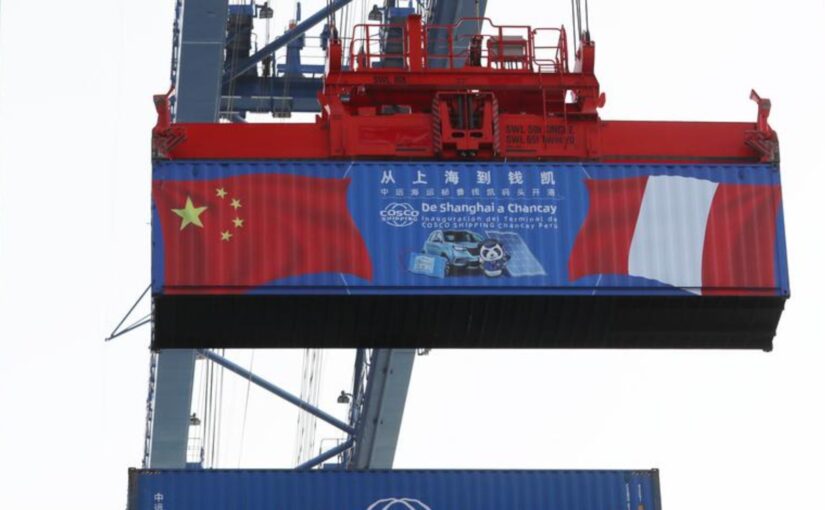
The benefits of this partnership are there for all to see in almost every country. Peru’s Chancay megaport, built with Chinese investment, has reduced shipping times to Asia by nearly two weeks and cut logistics costs by at least 20%, creating a new Pacific gateway for South American exports of manufactured goods, agricultural products and minerals. In Brazil, Chinese companies have invested billions in renewable energy, electric vehicles (EV) manufacturing and port modernization. Ironically, BYD has built a huge EV factory in the Brazilian state of Bahia, on the exact site that Ford abandoned during US industrial retrenchment.
Washington, by contrast, offers Latin America sticks without carrots. They do not offer alternative infrastructure investment, more favorable trade terms, or new development partnerships. They don’t offer this because they do not have the ability to do so. The only card they have to play is to simply demand that Latin American countries sever ties with their most important economic partner and threaten those who refuse with war and sanctions.
It’s important to understand this aggression as a symptom of its decline. As the US loses its ability to compete economically, it is trying to turn the clock back to the era of Western colonialism. At the Munich Security Conference in February, US Secretary of State Marco Rubio delivered a speech that laid bare the ideological foundations of the administration’s foreign policy. He lamented the decline of “great Western empires” in the face of “godless communists.” It was a call for the return of 19th-century imperialism and for the end of sovereignty, self-determination and decolonization. All colonizers have left is to look back on their past glory.
China’s vision for its relationship with Latin America and the Global South could not be more different. At the same Munich conference, Chinese Foreign Minister Wang Yi called for adherence to the purposes and principles of the UN Charter, emphasizing that all countries should be “equal in terms of rights, opportunities and rules.” The UN may not be perfect, but it still represents the sacred principles of peace, sovereignty and self-determination. Surrendering these principles is the path to chaos, war and colonialism.
No going back
The Trump administration’s attempt to turn back the clock of history in Latin America will fail, for the simple reason that it runs against the material interests of the region’s people. China-Latin America cooperation is growing because it is mutually beneficial. Latin America has gained markets for its commodities, secured investment in desperately needed infrastructure and access to affordable technology. It’s this kind of common prosperity that will outlast any one president or political conflict.
The nations of Latin America have endured centuries of foreign intervention, from colonialism to Cold War coups to structural adjustment programs that devastated their economies. What the United States now offers under the “Donroe Doctrine” is more of the same: dependence, instability and underdevelopment dressed up in the language of security. What China offers is something genuinely new: trade without conditions, investment without interference and respect for the sovereign right of every nation to choose its own development path.
History does not move backward. The “Shield of the Americas” will prove to be nothing more than a footnote in the irreversible story of South-South cooperation and Global South solidarity.