In what cannot but be described as a humiliating climbdown and significant defeat for US imperialism, on the evening of April 7, barely minutes before his self-set deadline for unleashing a genocide of unprecedented savagery and barbarism aimed at wiping out the millennia long Iranian civilisation, US President Donald Trump suddenly announced that he had accepted a Pakistani proposal for a two-week ceasefire, with negotiations between the two main protagonists set to begin in the Pakistani capital Islamabad on April 10.
After a month of bestial aggression characterised from the first day by the most egregious war crimes, including the massacre of more than 170 people, the majority of them little girls, in the bombing of a school, along with the murder of the religious and political supreme leader of the Iranian people together with numerous members of his family as well as leading political figures of the country; after a rising crescendo of ever more deranged and psychotic threats of a kind not publicly uttered by a head of state since Adolf Hitler, albeit the nazi leader refrained from using such profane language in public, the US mafia boss performed a volte face and declared that Iran’s 10-point peace proposal, which had been on the table since the start of the aggression, constituted a “workable basis on which to negotiate.”
According to Iran’s Press TV, these ten points are as follows:
- No new aggression against Iran
- Continued Iranian control over the Strait of Hormuz
- Acceptance of (uranium) enrichment
- Removal of all primary sanctions
- Removal of all secondary sanctions
- Termination of all UN Security Council resolutions
- Termination of all (International Atomic Energy Agency – IAEA) Board of Governors resolutions
- Payment of compensation to Iran
- Withdrawal of US combat forces from the region
- Cessation of war on all fronts, including against the heroic Islamic Resistance of Lebanon
Even on the reasonable assumption that any serious negotiation is unlikely to see any side fully realise all its objectives, and irrespective of what the future holds, this climbdown by Trump represents a humiliation for the United States on a scale not seen since the defeats inflicted by the heroic peoples of Vietnam, Laos and Cambodia half a century ago.
A statement from Iran’s National Security Council said:
“On the first day, when the criminal enemies of Iran began this oppressive war, they imagined they would succeed in complete military dominance over Iran in a short time and force Iran to surrender by creating political and social instability. They thought Iran’s missile and drone fire would be quickly extinguished and did not believe that Iran could deliver such a powerful response beyond its borders and across the entire region…
“Iran and the Resistance almost completely destroyed the American military machine in the region; they dealt crushing and profound blows to the vast infrastructure and facilities that the enemy had built and stationed around the region over the years for this war against Iran. In regional dimensions, they imposed extensive casualties on the criminal American army, and within the occupied territories, they delivered heavy and shattering blows to the enemy’s forces, infrastructure, facilities, and assets…
“Now, the honourable Prime Minister of Pakistan has informed Iran that the American side, despite all outward threats, has accepted these principles as the basis for negotiations and has surrendered to the will of the Iranian nation. Accordingly, at the highest level, it has been decided that Iran will engage in negotiations in Islamabad with the American side for a period of two weeks, based solely on these principles. It is emphasised that this does not mean the end of the war; Iran will only accept the termination of the war once the details—given the acceptance of Iran’s preferred principles in the 10-point plan—are finalised in the negotiations…
“If the enemy’s surrender on the battlefield is transformed into a decisive political achievement in the negotiations, we will celebrate this massive historical victory together; otherwise, we will fight side-by-side on the battlefield until all the demands of the Iranian nation are met. Our hands are on the trigger, and the moment the slightest error is committed by the enemy, it will be responded to with full power.”
This sober evaluation is indeed well-founded. Excluded from the discussions, the Israeli regime of Netanyahu has wasted no time in reverting to its invariable tactic of seeking to drown any prospect of peace in blood. Within 10 minutes of the ceasefire being announced, Israel had dropped 160 bombs on Lebanon, killing at least 254 people and wounding more than 1,000 in the capital Beirut.
Israel claimed that the ceasefire did not apply to Lebanon – an assertion in which they were predictably, but shamefacedly, backed by the United States. Vice President JD Vance, who has scarcely bothered to conceal his lack of enthusiasm for his boss’s latest adventure, described the Iranian position as a “legitimate misunderstanding”. Somewhat awkwardly for the United States, it is a “legitimate misunderstanding” strongly shared by the Pakistan Prime Minister who spearheaded the whole process of the agreement. It is significant also that Vance will lead the US team in Islamabad, doubtless keeping a wary eye on Trump’s fellow grifters, the gruesome twosome of Steve Witkoff and son-in-law Jared Kushner.
This has been a war waged on many fronts. In the first place, one must cite the steadfastness and heroism of the Iranian armed forces and people. Imperialism believed, or affected to believe, that the Iranian people just needed a little encouragement, in the form of being bombed “back to the stone age”, for them to rise up, overthrow their supposedly repressive rulers and lay out a red carpet for the son of the late and unlamented Shah. Instead, they closed ranks and united as never before.
In this they were joined by the forces of the axis of resistance in Iraq, Yemen, Lebanon and Palestine in a region-wide anti-imperialist and national democratic struggle.
Also of great importance was the diplomatic front. A lead position was taken here by Pakistan, liaising with other regional states, and in close coordination throughout with China. The two countries jointly put forward a five-point peace initiative.
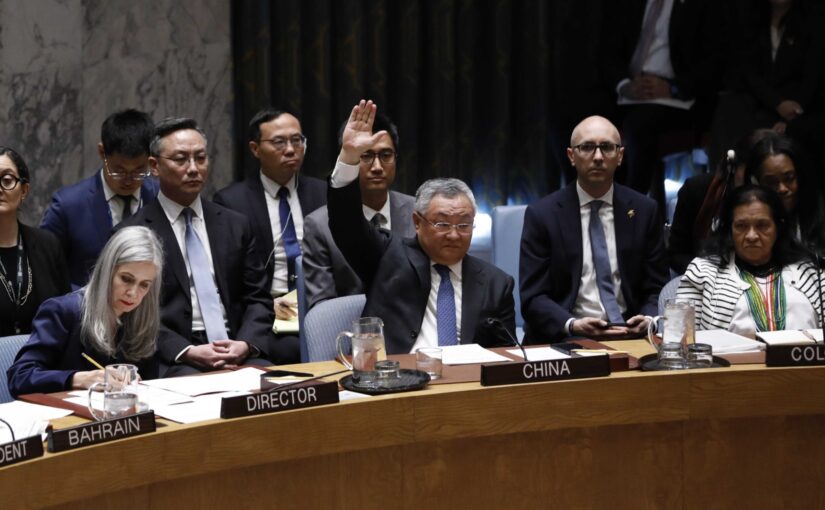
It is almost certainly no coincidence that Trump’s climbdown came immediately following the principled decision by China and Russia to veto a resolution in the United Nations Security Council that was clearly intended to provide a legalistic figleaf for further military action around the question of the Strait of Hormuz.
With Bahrain as the lead sponsor, the resolution was also supported by Kuwait, Qatar, Saudi Arabia, and the United Arab Emirates (UAE) (that is all the members of the Gulf Cooperation Council [GCC] with the exception of Oman), as well as Jordan, with the United States as the clear wire puller in the background.
Chinese Foreign Minister Wang Yi had already made his country’s position clear in an April 2 phone call with his Bahraini counterpart Abdullatif bin Rashid Al Zayani, held at the latter’s request.
According to the Chinese Foreign Ministry’s readout:
“Wang Yi expounded China’s principled position of opposing aggression and advocating peace. He stated that China and Pakistan recently jointly released the Five-Point Initiative of China and Pakistan For Restoring Peace and Stability in the Gulf and Middle East Region, which includes calling for an end to attacks on civilians and nonmilitary targets, ensuring the security of the Strait of Hormuz, and restoring normal passage. A ceasefire and cessation of hostilities is the shared call of the international community. The actions of the UN Security Council should help de-escalate the situation, stop the fighting and resume talks, rather than endorse illegal acts of war or fuel the flames. As a permanent member of the UN Security Council and a responsible major country, China stands ready to work with Bahrain to promote the cessation of hostilities, restore peace, achieve lasting regional stability, and safeguard the legitimate rights and interests of members of the Global South, especially small and medium-sized countries.”
Speaking with his Saudi Arabian counterpart Faisal bin Farhan Al Saud on the same day, Wang added:
“The disruption of navigation in the Strait of Hormuz is a spillover effect of this conflict. As long as the fighting continues, the Strait cannot be secure. The priority now is to achieve an early ceasefire. The actions of the UN Security Council should avoid escalating confrontation and must not legitimise unauthorised military operations, as doing so would lead to serious consequences, with small and medium-sized countries bearing the brunt.”
Speaking to High Representative for Foreign Affairs and Security Policy of the European Commission Kaja Kallas, also on April 2, Wang said that, “the current international situation is unstable, and it is the shared responsibility of China and Europe to strengthen communication and uphold the international system centred on the United Nations and the international order based on international law. Wang Yi elaborated on China’s principled position on the Middle East situation, noting that the China-Pakistan five-point initiative reflects broad international consensus, with the core being cessation of hostilities, an early start to peace talks, protection of non-military targets, security of maritime passages, and upholding the primacy of the UN Charter. A ceasefire is a strong global demand and the fundamental solution to ensuring safe navigation through the Strait of Hormuz. All parties should build greater consensus and create necessary conditions toward this end. The actions of the UN Security Council should aim to ease tensions, not legitimise unauthorised military operations, and must not further intensify conflicts or trigger escalation.”
Speaking with German Foreign Minister Johann Wadephul, he said that “the military strikes by the US and Israel against Iran were not authorised by the UN Security Council and clearly violated international law… China and Germany should uphold an objective and impartial stance, play a constructive role, and promote the swift de-escalation of hostilities to restore peace and stability in the region.”
Following these April 2 conversations, Wang spoke on April 5 with Russian Foreign Minister Sergey Lavrov.
The Chinese Foreign Ministry reported that:
“Lavrov stated that Russia is highly concerned about the continued escalation of the situation in the Middle East. Regarding the current hostilities and the issue of the Strait of Hormuz, Russia maintains that military actions must cease immediately and that a return to the track of politics and diplomacy is essential to address the root causes of the conflict. The UN Security Council should play a constructive role in this regard. Russia stands ready to maintain close communication and coordination with China and continue to make efforts and speak out for a ceasefire and the cessation of hostilities.
“Wang Yi stated that as permanent members of the UN Security Council, China and Russia should uphold justice on major issues of right and wrong, adopt an objective and balanced approach, and strive for greater understanding and support from the international community. China has always maintained that international and regional hotspot issues should be resolved politically through dialogue and negotiation. Currently, the situation in the Middle East is still deteriorating and hostilities are escalating. The fundamental solution to the issue of navigation through the Strait of Hormuz lies in an immediate ceasefire and the cessation of hostilities. China is ready to continue cooperation with Russia in the UN Security Council, maintain timely communication on major issues, and make efforts to deescalate the situation, safeguard regional peace and stability, and uphold common security for the world.”
That is exactly what the two countries did at the UN Security Council meeting on April 7. The resolution fell due to both China and Russia being veto-holding permanent members of the council. Eleven countries voted in favour while Pakistan and Colombia abstained.
Speaking after the vote, Chinese Ambassador Fu Cong said:
“The merits of this conflict are crystal clear. The US and Israel, without authorisation from the Security Council and while negotiations between Iran and the US were underway, launched military strikes against Iran. This is in clear violation of the purposes and principles of the UN Charter and the basic norms of international relations…
“Under the current circumstances, this draft resolution should clearly identify the root causes of this conflict, seek appropriate solutions to address the root causes and ensure the safety and security of shipping lanes, and strive to promote dialogue and achieve peace. It is regrettable, however, that the draft resolution fails to capture the root causes and full picture of the conflict in a comprehensive and balanced manner. It contains one-sided condemnation and pressure, the characterisation of the situation as a threat to international peace and security, as well as the use of armed escorts. Such language is highly susceptible to misinterpretation or even abuse. At a time when the United States is openly threatening the very survival of a civilisation, when the current hostilities imposed on Iran are very likely to further escalate, the draft resolution, should it have been adopted, would send an extremely wrong message and have very serious consequences. The Security Council has lessons to learn from issues such as Libya and the Red Sea. Such past mistakes must not be repeated. [In 2011, China and Russia abstained on, rather than vetoing, a Security Council resolution on Libya, which was promptly misused to wage an all-out war against the country, resulting in the murder of its head of state and the destruction of Libya as a viable state. It was a mistake that neither country has repeated and it is highly significant that Fu Cong should publicly refer to it in this way.] The Security Council’s actions should be aimed at deescalating the situation. They must not provide the legal veneer for unauthorised military operations. The Council’s actions must not grant a license to the use of force, let alone further exacerbate tensions and add fuel to the fire, thereby leading to an escalation of the conflict. The Security Council should not rush to vote on the draft resolution where serious concerns among members have been raised. In light of the above, China had no choice but to vote against the draft resolution.”
Also speaking after the vote, Russian Ambassador Vassily Nebenzia said:
“Our country’s position on the current crisis in the Middle East is principled, consistent, and objective in nature. We condemn the aggression by the United States and Israel against Iran. We respect the sovereignty and territorial integrity of all countries in the region – both of the Islamic Republic of Iran and that of other Gulf States. We view attacks targeting their civilians and civilian infrastructure as unacceptable. Russia has always made every effort, including at the highest level, to put an end to such actions, and we will continue in the same vein. We are striving for the prompt establishment of peace in the Persian Gulf and the Middle East.
“However, the Russian Federation was not able to support a text that would set a dangerous precedent for international law and international maritime law, which is liable to undermine any peace efforts and the credibility of the UN Security Council.”
He proceeded to give a detailed analysis of the resolution and continued:
“The bottom line here is that, even though the authors tried to cloak the draft in generalised wordings, the gist remained unchanged: the draft was designed to grant carte blanche for the continued aggressive acts and further escalation. We understand what this would mean from a legal standpoint, as well as in terms of the implications ‘on the ground.’ Even more so when we hear statements from the US President about his readiness to ‘destroy’ Iran if the Strait of Hormuz is not opened.
“It behooves us to remind the Council members about the distorted Security Council Resolution 1973 on Libya, adopted in 2011, and about what the loose and expansive interpretation thereof resulted in. The limit of trust in States that advanced the use of force hiding behind noble pretexts and vague language was exhausted back then.
“We have already witnessed how the United States attempted to justify its strikes against Iran by invoking the right to self-defence under Article 51 of the UN Charter, interpreting it as having preemptive implications. For all our solidarity with the Arab countries, who were set up by Washington and victimised by the tragedy in the region, we cannot but stress that any attempt to impose such ‘rules of the game’ in the Strait of Hormuz would only play into the hands of those who wish to further undermine security and stability in the Middle East and beyond…
“Adopting such a document disregarding the broader context of the situation would further antagonise Iran, which is already enduring daily strikes by the United States and Israel. A vast number of civilians are being killed on Iranian soil. Nearly two thousand civilians have already died, a quarter of whom are women and children. Among those killed are also the Supreme Leader and many other representatives of the country’s leadership. Civilian infrastructure – schools, hospitals, universities, energy and nuclear facilities, including the Bushehr Nuclear Power Plant – is being attacked, which is fraught with catastrophic humanitarian repercussions for Iran and the entire region. We wish to emphasise that not a single passage was produced by the Security Council to assess these violations of international law.
“Adopting such a one-sided resolution would jeopardise any prospects for resuming the negotiation process to resolve the crisis, and would also obstruct the important and useful peace initiatives that are currently being undertaken by a number of States, including China, Pakistan, and Turkey. If the Security Council were to adopt the position being imposed on it, there would be absolutely no motivation for Tehran to engage in any form of contact with Washington, which has already twice betrayed diplomacy – in June 2025 and this past February – and began launching massive strikes against Iran at the very height of the negotiation process…
“From the very start of work on this document, we and our Chinese colleagues have conveyed our most serious concerns regarding this initiative to the Bahraini authors and other members. We saw no room for amending the text, so we urged our Arab friends to refrain from advancing it. However, our concerns were not heeded, and the draft was put to a vote. Under these circumstances, we had no choice but to vote against it.”
The following articles were originally published by Press TV and Middle East Eye and on the websites of the permanent missions of China and Russia to the United Nations.
Iran declares ‘historic victory’ over US, says enemy forced to accept its proposal
April 7 (Press TV) – Iran has declared a “historic and crushing defeat” of the United States and the Israeli regime after 40 days of war, announcing that Washington has been forced to accept a 10-point Iranian proposal that includes a permanent ceasefire, the lifting of all sanctions, and the withdrawal of US combat forces from the region.
In a statement addressed to the “noble, great, and heroic nation of Iran,” the Supreme National Security Council said the enemy had suffered an undeniable defeat and now saw “no way forward but to submit to the will of the great nation of Iran and the honorable Axis of Resistance.”
The announcement comes on Day 40 of the US-Israeli war of aggression on Iran, which began with the assassination of Leader of the Islamic Revolution Ayatollah Seyyed Ali Khamenei and top-ranking commanders on February 28.
According to the statement, the United States has agreed to a 10-point proposal that fundamentally commits Washington to:
- No new aggression against Iran
- Continued Iranian control over the Strait of Hormuz
- Acceptance of enrichment
- Removal of all primary sanctions
- Removal of all secondary sanctions
- Termination of all UN Security Council resolutions
- Termination of all Board of Governors resolutions
- Payment of compensation to Iran
- Withdrawal of US combat forces from the region
- Cessation of war on all fronts, including against the heroic Islamic Resistance of Lebanon
“Iran has achieved a great victory and has forced criminal America to accept its own 10-point proposal,” the statement read.
The statement by the top security body described the past 40 days as one of the “heaviest combined battles in history,” in which Iran and its allies in Lebanon, Iraq, Yemen, and occupied Palestine inflicted blows that “the historical memory of the world will never forget.”
“Iran and the Resistance have almost completely destroyed the American military machine in the region,” it stated. “They have inflicted crushing and deep blows on the vast infrastructure and capabilities that the enemy had built and deployed around the region over many years for this war against Iran.”
The statement added that within the occupied territories, Resistance forces had dealt “devastating and crushing blows to the enemy’s forces, infrastructure, facilities, and assets.”
It further stated that the United States understood as early as 10 days into the war that it could not win.
“Not only did none of the enemy’s main objectives materialize, but the enemy realized from about 10 days after the start of the war that it would have no ability to win this war,” the statement said. “For this reason, through various channels and methods, the enemy began efforts to establish contact with Iran and request a ceasefire.”
The top security body further said the enemy had initially imagined a quick military victory, believing Iran’s missile and drone capabilities would be “quickly extinguished,” and noted that the “vile global Zionism” had convinced the “ignorant President of the United States” that the war would finish Iran.
While declaring victory, the top security body also urged continued vigilance.
“We congratulate all the people of Iran on this victory,” the statement read, “and emphasize that until the details of this victory are finalized, there remains a need for the resilience and prudence of officials and the preservation of unity and solidarity among the people of Iran.”
The Iranian announcement came hours after Trump said he had agreed to a two-week suspension of bombing and attacks on Iran, subject to Tehran reopening the Strait of Hormuz.
In a post on his Truth Social platform, Trump said he would “suspend the bombing and attack of Iran for a period of two weeks” — a decision he described as a “double-sided CEASEFIRE.”
Trump said the suspension is “subject to the Islamic Republic of Iran agreeing to the COMPLETE, IMMEDIATE, and SAFE OPENING of the Strait of Hormuz.”
Earlier on Tuesday, he had warned that “a whole civilization will die tonight” if Iran failed to meet his demands, an inflammatory war rhetoric that triggered backlash worldwide.
Many condemned the bluster as genocidal and said it amounts to a horrendous war crime.
Pope Leo XIV called the threat “truly unacceptable,” while US lawmakers decried Trump’s rhetoric as “pure evil,” with many of them calling for the invocation of the 25th Amendment to remove Trump from office.
The Strait of Hormuz, which carries approximately one-fifth of the world’s oil, has been effectively blocked by Iran since the US and Israel launched their unprovoked and illegal war of aggression against the Islamic Republic of Iran on February 28.
Iranian officials had categorically stated that the strategic waterway will not be reopened unless its demands are met, which include the permanent cessation of US-Israeli attacks.
In line with the directive of the Leader of the Islamic Revolution, Ayatollah Seyyed Mojtaba Khamenei and the approval of the Supreme National Security Council, and given Iran and the resistance’s upper hand on the battlefield, the enemy’s inability to carry out its threats despite all its claims, and the official acceptance of all the legitimate demands of the Iranian people, it has been decided that negotiations will be held in Islamabad to finalize the details.
This will take place within a maximum of 15 days, so that the details of Iran’s victory on the battlefield may also be solidified in political negotiations.
The negotiations will begin on Friday in Islamabad. Iran will allocate two weeks for these negotiations and the timeframe may be extended by mutual agreement of the two sides.
The top security body said it is essential that during this period, complete national unity is maintained and victory celebrations continue with strength.
These negotiations, it asserted, are a national negotiation and an extension of the battlefield, so all people and political groups must trust and support this process, which is under the supervision of the Leader of the Islamic Revolution.
“If the enemy’s surrender on the battlefield is transformed into a decisive political achievement in the negotiations, we will celebrate this great historic victory together. Otherwise, we will fight side by side on the battlefield until all the demands of the Iranian people are met,” the statement noted.
“Our hands are on the trigger, and the moment the slightest mistake is made by the enemy, it will be answered with full force.”
Full text of Iran’s National Security Council statement on ceasefire
April 8 (Middle East Eye) – The enemy, in its cowardly, illegal, and criminal war against the Iranian nation, has suffered an undeniable, historical, and crushing defeat. By the grace of the pure and holy blood of the Martyred Leader of the Islamic Revolution, His Eminence Grand Ayatollah Imam Khamenei (Peace be upon him), the prudent measures of the Supreme Leader of the Islamic Revolution and Commander-in-Chief, His Eminence Ayatollah Seyyed Mojtaba Khamenei (May God protect him), and the struggle and bravery of the warriors of Islam on the fronts—especially the historical, lasting, and heroic presence of you, the dear nation, on the scene since the very first days of the war—Iran has achieved a massive victory and forced criminal America to accept its 10-point plan.
In this plan, America is fundamentally committed to guaranteeing non-aggression, the continuation of Iran’s control over the Strait of Hormuz, the acceptance of enrichment, the lifting of all primary and secondary sanctions, the termination of all resolutions of the Security Council and the Board of Governors, the payment of Iran’s damages, the withdrawal of U.S. combat forces from the region, and the cessation of war on all fronts, including against the heroic Islamic Resistance of Lebanon.
We congratulate all the people of Iran on this victory and emphasise that until the details of this victory are finalised, there remains a need for the steadfastness and prudence of officials and the maintenance of unity and solidarity among the Iranian people.
Islamic Iran, along with the brave mujahideen of the Resistance in Lebanon, Iraq, Yemen, and occupied Palestine, has dealt blows to the enemy over the past 40 days that the global historical memory will never forget. Iran and the Axis of Resistance, as representatives of honour and humanity against the most savage enemies of mankind, have given them an unforgettable lesson after a historical battle.
They have so crushed their forces, facilities, infrastructure, and all their political, economic, technological, and military assets that the enemy is now plunged into collapse and desperation, seeing no path before it other than surrender to the will of the great nation of Iran and the honourable Axis of Resistance.
On the first day, when the criminal enemies of Iran began this oppressive war, they imagined they would succeed in complete military dominance over Iran in a short time and force Iran to surrender by creating political and social instability. They thought Iran’s missile and drone fire would be quickly extinguished and did not believe that Iran could deliver such a powerful response beyond its borders and across the entire region.
Global evil Zionism had convinced the ignorant President of America that this war would finish Iran, allowing them—after removing this last bastion of humanity and mankind—to comfortably commit any crime against anyone they wished from then on. They dreamed of partitioning dear Iran, plundering its oil and wealth, and ultimately leaving Iranians immersed in chaos, instability, and insecurity for many long years.
The brave warriors of Islam and their courageous allies in the Axis of Resistance, despite their hearts being wounded and torn by the martyrdom of their Imam, decided—relying on Almighty God and following the Lord and Master of Martyrs—to give these enemies a historical lesson once and for all. They chose to take revenge for all previous crimes and create conditions where the enemy would forever cast away the thought of aggression against dear Iran, fully tasting the flavour of humiliation and abasement before the great nation of Iran.
With this strategy and relying on the unprecedented political and social unity established within the country, Iran and the Resistance initiated one of the heaviest hybrid battles in history against America and the Zionist regime, achieving all the objectives designed for this conflict during this period.
Iran and the Resistance almost completely destroyed the American military machine in the region; they dealt crushing and profound blows to the vast infrastructure and facilities that the enemy had built and stationed around the region over the years for this war against Iran. In regional dimensions, they imposed extensive casualties on the criminal American army, and within the occupied territories, they delivered heavy and shattering blows to the enemy’s forces, infrastructure, facilities, and assets.
They so constrained the field on all fronts that not only were none of the enemy’s main objectives realised, but the enemy realised approximately 10 days after the start of the war that it would in no way have the capability to win this war. For this reason, it began attempting to establish contact with Iran and requesting a ceasefire through various channels and methods.
The honourable nation of Iran must know that, by the grace of their children’s struggle and their historic presence on the scene, the enemy has been pleading for over a month for the cessation of the fierce fire of Iran and the Resistance. However, the country’s officials—because it had been decided from the very beginning that the war would continue until objectives were achieved, including the enemy’s regret and desperation and the removal of long-term threats from the country—gave a negative response to all these requests, and the war continued until today, which is the fortieth day.
Furthermore, Iran has so far rejected several deadlines presented by the President of the United States and continues to emphasise that it grants no importance to any type of deadline from the enemy.
We now give tidings to the great nation of Iran that almost all war objectives have been realized and your brave children have driven the enemy to a historic helplessness and a lasting defeat. Iran’s historic decision, backed by the unified support of the entire nation, is to continue this battle for as long as necessary until its massive achievements are consolidated and new security and political equations are created in the region based on the acceptance of the power and sovereignty of Iran and the Resistance.
In this regard, and according to the prudence of the Supreme Leader of the Islamic Revolution, His Eminence Ayatollah Seyyed Mojtaba Khamenei (May God protect him), and the approval of the Supreme National Security Council—and considering Iran and the Resistance’s upper hand in the battlefield, the enemy’s inability to carry out its threats despite all claims, and the formal acceptance of all the rightful demands of the Iranian people—it was decided that negotiations be held in Islamabad to finalise the details. This is so that within a maximum of 15 days, with the finalisation of details, Iran’s victory on the field shall also be consolidated in political negotiations.
To this end, while rejecting all plans presented by the enemy, Iran drafted a 10-point plan and presented it to the American side via the country of Pakistan. It emphasized fundamental points such as controlled passage through the Strait of Hormuz in coordination with Iran’s armed forces (which grants Iran a unique economic and geopolitical position), the necessity of ending the war against all components of the Axis of Resistance (which signifies a historic defeat for the aggression of the child-killing Israeli regime), the withdrawal of U.S. combat forces from all bases and deployment points in the region, the establishment of a secure transit protocol in the Strait of Hormuz such that it guarantees Iranian dominance according to the agreed protocol, the full payment of Iran’s damages according to estimates, the removal of all primary and secondary sanctions and resolutions of the Board of Governors and the Security Council, the release of all blocked Iranian properties and assets abroad, and finally, the approval of all these items in a binding Security Council resolution. It is worth noting that the approval of this resolution will turn all these agreements into binding international law and will create an important diplomatic victory for the nation of Iran.
Now, the honourable Prime Minister of Pakistan has informed Iran that the American side, despite all outward threats, has accepted these principles as the basis for negotiations and has surrendered to the will of the Iranian nation. Accordingly, at the highest level, it has been decided that Iran will engage in negotiations in Islamabad with the American side for a period of two weeks, based solely on these principles. It is emphasised that this does not mean the end of the war; Iran will only accept the termination of the war once the details—given the acceptance of Iran’s preferred principles in the 10-point plan—are finalised in the negotiations.
These negotiations will begin in Islamabad on Friday, April 10 (21 Farvardin), with complete distrust of the American side, and Iran will allocate two weeks for these talks. This timeframe is extendable by mutual agreement. It is essential that during this period, complete national unity be maintained and victory celebrations continue with strength.
The current negotiations are national negotiations and a continuation of the battlefield; it is necessary for all people, elites, and political groups to trust and support this process, which is under the supervision of the Leader of the Revolution and the highest levels of the system, and to strictly avoid any divisive comments.
If the enemy’s surrender on the battlefield is transformed into a decisive political achievement in the negotiations, we will celebrate this massive historical victory together; otherwise, we will fight side-by-side on the battlefield until all the demands of the Iranian nation are met. Our hands are on the trigger, and the moment the slightest error is committed by the enemy, it will be responded to with full power.
Explanation of Vote by Ambassador Fu Cong on the UN Security Council Draft Resolution on the Strait of Hormuz
April 7 (China UN Mission) – President,
The month-long conflict in Iran and its spillover effect continue to deal a heavy blow to regional and global peace and stability. It is hitting the global economy, causing increasingly widespread disruptions. This is not in the common interest of regional countries and beyond. The merits of this conflict are crystal clear. The US and Israel, without authorization from the Security Council and while negotiations between Iran and the US were underway, launched military strikes against Iran. This is in clear violation of the purposes and principles of the UN Charter and the basic norms of international relations.
At the same time, the sovereignty, security, and territorial integrity of Gulf States must be fully respected. Civilians and non-military targets must be given necessary protection. The safety and security of shipping lanes and energy infrastructure must also be safeguarded. China does not go along with Iran’s attacks on Gulf States and the blockade of the Strait of Hormuz. Like all parties, China hopes that peace and stability will be restored to the Strait as soon as possible and navigation will resume.
China attaches great importance to the draft resolution submitted by Bahrain on behalf of Gulf States. We fully understand their serious concerns. We are committed to solving the issue properly, and we have participated constructively in the consultations. Under the current circumstances, this draft resolution should clearly identify the root causes of this conflict, seek appropriate solutions to address the root causes and ensure the safety and security of shipping lanes, and strive to promote dialogue and achieve peace. It is regrettable, however, that the draft resolution fails to capture the root causes and full picture of the conflict in a comprehensive and balanced manner. It contains one-sided condemnation and pressure, the characterization of the situation as threat to international peace and security, as well as the use of armed escorts. Such language is highly susceptible to misinterpretation or even abuse. At a time when the United States is openly threatening the very survival of a civilization, when the current hostilities imposed on Iran are very likely to further escalate, the draft resolution, should it have been adopted, would send an extremely wrong message and have very serious consequences. The Security Council has lessons to learn from issues such as Libya and the Red Sea. Such past mistakes must not be repeated. The Security Council’s actions should be aimed at deescalating the situation. They must not provide the legal veneer for unauthorized military operations. The Council’s actions must not grant a license to the use of force, let alone further exacerbate tensions and add fuel to the fire, thereby leading to an escalation of the conflict. The Security Council should not rush to vote on the draft resolution where serious concerns among members have been raised. In light of the above, China had no choice but to vote against the draft resolution.
President,
This is a war that should never have happened, and as it continues, it will cause immeasurable harm. At present, the situation in the Middle East continues to deteriorate, and hostilities are escalating. The fundamental solution to ensuring safe passage of ships through the Strait of Hormuz is to achieve cessation of hostilities as soon as possible. The US and Israel are the initiators of this conflict. The fundamental reason for the disruption of navigation in the Strait of Hormuz is the illegal military actions taken by the US and Israel against Iran. China strongly calls on the US and Israel to immediately cease their illegal military actions. Having heard what was said by the US representative, we are much more convinced now that China’s position is objective and impartial, reflecting the image of a responsible major country that upholds international fairness and justice. Our vote will stand the test of history.
At the same time, China calls on Iran to stop attacking relevant facilities in the Gulf, address the legitimate concerns of Gulf States, focus on the common interest of the Global South, and take corresponding positive measures to restore normal navigation in the Strait of Hormuz as soon as possible. China applauds the efforts made by Pakistan, Egypt, Türkiye, and Saudi Arabia to promote dialogue and negotiations and restore regional peace. China commends and supports the work carried out by the United Nations in mediation and alleviating the humanitarian situation, and looks forward to these efforts yielding tangible results at an early date.
Recently, China has made tremendous efforts to restore peace and stability in the Gulf and the Middle East. China has engaged in intensive consultations and mediation with relevant parties. China and Pakistan have issued a Five-Point Initiative for Restoring Peace and Stability in the Gulf and Middle East Region, calling for immediate cessation of hostilities, start of peace talks as soon as possible, security of non-military targets, security of shipping lanes, and primacy of the UN Charter. This is an open initiative and welcomes the response and participation by countries and international organizations.
Taking into account the needs of all parties to resolve the relevant issues, Russia and China have jointly submitted a draft Security Council resolution. The text of that draft resolution is objective and fair, aiming at easing tensions, calling for dialogue and negotiations, and upholding navigational rights and freedoms. We hope that it will receive the support of Council members. China is ready to work with all parties to make greater contributions to the early restoration of peace and stability in the region.
Thank you, President.
Explanation of vote by Permanent Representative Vassily Nebenzia after the UNSC Vote on a Draft Resolution on Maritime Security in the Middle East
April 7 (Russia UN Mission) – Mr. President,
The Russian Federation voted against the draft resolution tabled by Bahrain, Jordan, Qatar, Kuwait, the UAE, and Saudi Arabia regarding the situation in the Strait of Hormuz and the adjacent waters.
Our country’s position on the current crisis in the Middle East is principled, consistent, and objective in nature. We condemn the aggression by the United States and Israel against Iran. We respect the sovereignty and territorial integrity of all countries in the region – both of the Islamic Republic of Iran and that of other Gulf States. We view attacks targeting their civilians and civilian infrastructure as unacceptable. Russia has always made every effort, including at the highest level, to put an end to such actions, and we will continue in the same vein. We are striving for the prompt establishment of peace in the Persian Gulf and the Middle East.
However, the Russian Federation was not able to support a text that would set a dangerous precedent for international law and international maritime law, which is liable to undermine any peace efforts and the credibility of the UN Security Council.
Back when negotiating Security Council Resolution 2817, we urged all our Council colleagues to adopt a balanced and objective approach. The UN Secretary-General, too, repeatedly sent similar, equidistant messages, calling on the United States and Israel to halt the war and on Iran to cease attacks targeting its neighbors. It is impossible and unacceptable to overlook the root causes of the crisis in the Middle East, namely the unlawful and reckless actions of the United States and Israel against Iran. Neither Russia nor Mr. Guterres was heeded back then. Nevertheless, we understand the situation of the countries of the Gulf Cooperation Council (GCC) and Jordan, and, therefore, we abstained during the vote on Resolution 2817. That was not an easy decision for us to take.
However, this time our Bahraini partners and their likeminded allies went much further, taking a fundamentally erroneous and dangerous approach to the situation in the region. In essence, virtually every paragraph of the proposed draft abounded with unbalanced, inaccurate, and confrontational elements. I’m going to point only to the main points.
In paragraph 1 of the preamble and paragraph 6 of the operative part, Iran’s actions were presented as the sole source of so-called “destabilizing activities and regional tensions.” And there was not a single word about the true causes of the current crisis in the Middle East, which are actually the unlawful strikes by the US and Israel targeting Iranian territory. And this despite the fact that in paragraph 3 of the preamble, the sponsors themselves highlighted that threats to navigation in the Strait of Hormuz have been observed precisely since February 28, 2026. This, incidentally, flew in the face of their own assertions that the current initiative was designed as a response to certain “decades of threats” to freedom of navigation allegedly emanating from Iran.
In paragraph 6 of the preamble, attempts to interfere with international navigation through the Strait of Hormuz were unequivocally portrayed as a threat to international peace and security. And it was deliberately overlooked that a significant portion of the Strait of Hormuz is within Iran’s territorial waters.
In paragraph 7 of the preamble, threats to merchant and commercial vessels and interference with freedom of navigation were identified as the sole reason for disruption of global energy supplies. Once again, without noting the root causes of the crisis, which the US president himself frankly mentioned when publicly acknowledging that the end of hostilities would result in the opening of the Strait of Hormuz.
In paragraph 9 of the preamble, as well as in paragraphs 1 and 4 of the operative part, there were references to the 1982 UN Convention on the Law of the Sea. This international legal instrument does not apply to situations of armed conflict, which we have repeatedly voiced during the negotiation process.
Paragraph 10 of the preamble alleged that it is Iran that constitutes a threat to international peace and security in the context of the current crisis. The decision to delete references to Chapter VII from this paragraph was not a “panacea” – in essence, such language can in any event be interpreted by bad-faith States as legitimizing the use of force.
Paragraph 2 of the operative part speaks for itself. It proposed that the Security Council give the “green light” to the implementation of certain “defensive” measures – the scope of which is unclear to us – under the pretext of ensuring the safety and security of navigation, without any regard for the sovereignty of littoral States. The reservations regarding the purely defensive nature of these efforts do not change the essence of the matter. Especially given that the sponsors themselves indicated that they were referring precisely to the use of force: this was clearly stated in the language of paragraph 3 of the operative part, which emphasized that States acting according to paragraph 2 must fully comply with international humanitarian law.
Paragraph 7 of the operative part specified that the UN Security Council would be prepared to consider “further measures” against those who undermine navigational rights and freedoms. This is an obvious hint at potential sanctions pressure – regardless of whether it was explicitly stated or not.
Paragraphs 7 and 8 concerned not only the Strait of Hormuz but also the Bab al-Mandab Strait. In other words, the sponsors deliberately expanded the geographical scope of their draft, thereby giving more grounds for expansive interpretations thereof.
Let us turn to paragraph 9 of the operative part. Despite sending a correct message – a call for diplomacy – it only referred to the cessation of hostilities in the Persian and Omani Gulf regions, as well as in the Strait of Hormuz. But as for the need to halt the US-Israeli aggression, this was entirely swept under the rug.
Mr. President,
The bottom line here is that, even though the authors tried to cloak the draft in generalized wordings, the gist remained unchanged: the draft was designed to grant carte blanche for the continued aggressive acts and further escalation. We understand what this would mean from a legal standpoint, as well as in terms of the implications “on the ground.” Even more so when we hear statements from the US President about his readiness to “destroy” Iran if the Strait of Hormuz is not opened.
It behooves us to remind the Council members about the distorted Security Council Resolution 1973 on Libya, adopted in 2011, and about what the loose and expansive interpretation thereof resulted in. The limit of trust in States that advanced the use of force hiding behind noble pretexts and vague language was exhausted back then.
We have already witnessed how the United States attempted to justify its strikes against Iran by invoking the right to self-defense under Article 51 of the UN Charter, interpreting it as having preemptive implications. For all our solidarity with the Arab countries, who were set up by Washington and victimized by the tragedy in the region, we cannot but stress that any attempt to impose such “rules of the game” in the Strait of Hormuz would only play into the hands of those who wish to further undermine security and stability in the Middle East and beyond.
Measures to protect vessels, like any other property of UN member States, do not require Security Council resolutions; it would suffice to have a reference to Article 51 of the UN Charter, which grants the right to self-defense virtually under any circumstances. The expansion of operations for security purposes without the consent of the littoral States is another reason why we were unable to support the Bahraini draft resolution.
Colleagues,
Adopting such a document disregarding the broader context of the situation would further antagonize Iran, which is already enduring daily strikes by the United States and Israel. A vast number of civilians are being killed on Iranian soil. Nearly two thousand civilians have already died, a quarter of whom are women and children. Among those killed are also the Supreme Leader and many other representatives of the country’s leadership. Civilian infrastructure – schools, hospitals, universities, energy and nuclear facilities, including the Bushehr Nuclear Power Plant – is being attacked, which is fraught with catastrophic humanitarian repercussions for Iran and the entire region. We wish to emphasize that not a single passage was produced by the Security Council to assess these violations of international law. And you will hear no excuses from us today, Ambassador Waltz.
I will not dwell in detail on the glaring double standards pertinent to this approach. However, all this is completely illogical even from the standpoint of basic pragmatism. Adopting such a one-sided resolution would jeopardize any prospects for resuming the negotiation process to resolve the crisis, and would also obstruct the important and useful peace initiatives that are currently being undertaken by a number of States, including China, Pakistan, and Turkey. If the Security Council were to adopt the position being imposed on it, there would be absolutely no motivation for Tehran to engage in any form of contact with Washington, which has already twice betrayed diplomacy – in June 2025 and this past February – and began launching massive strikes against Iran at the very height of the negotiation process.
Mr. President,
From the very start of work on this document, we and our Chinese colleagues have conveyed our most serious concerns regarding this initiative to the Bahraini authors and other members. We saw no room for amending the text, so we urged our Arab friends to refrain from advancing it. However, our concerns were not heeded, and the draft was put to a vote. Under these circumstances, we had no choice but to vote against it.
Russia consistently champions ensuring comprehensive security for maritime navigation in all international waterways, opening corridors for Venezuela and Cuba, and ceasing attacks targeting merchant and commercial vessels of any country. Similarly, we advocate unhampered navigation in the Strait of Hormuz. However, this task can only be accomplished with the participation of all littoral States bordering this vital transport corridor. It is not possible to do that without Iran. We call on our Arab and Iranian friends to address the issue of navigation right away. We stand ready to facilitate such contacts.
Mr. President,
We understand the concerns of our Arab partners regarding freedom of navigation; therefore, we, along with China, propose that the Security Council consider an alternative draft resolution on the current situation in the Middle East, including in terms of maritime security. We are confident that providing for genuine freedom of navigation in the Strait, which is of critical importance for the countries of the region and the entire world, can only be achieved through ceasing hostilities and achieving a negotiated solution. Our draft will be concise, impartial and balanced, and in line with the principles of international law and the UN Charter, specifically when it comes to the peaceful settlement of disputes. In this connection, we are immediately submitting this draft in blue. We will provide further information regarding our voting plans shortly. We count on the support of the entire membership of the Security Council.
Thank you.