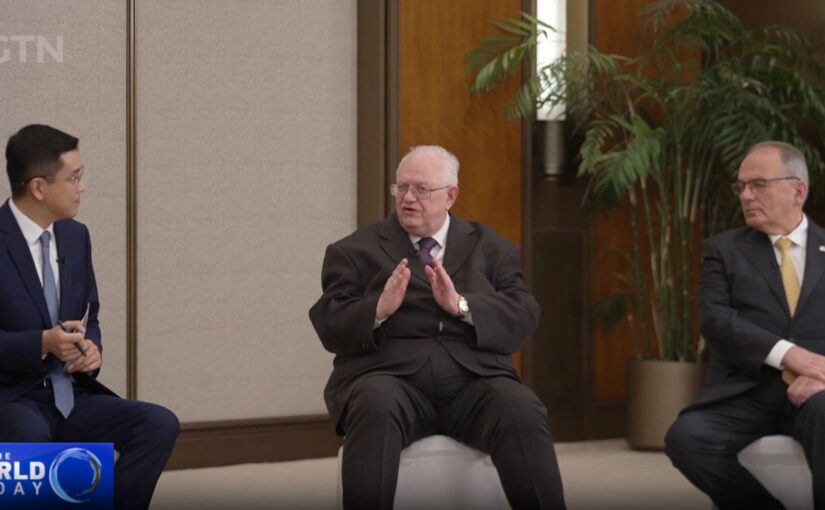
Jean-Luc Mélenchon discusses China with Tariq Ali

The following is an extensive interview with the French left-wing leader Jean-Luc Mélenchon that was conducted by Tariq Ali, the veteran writer and activist, and that was originally published on Sidecar, the blog published by New Left Review.

In their wide-ranging discussion Mélenchon makes a number of important comments about China – to which he has consistently advocated a position of friendship – which are especially significant coming from probably the most important leader of the contemporary European left.

Asked by Ali about the significance of the recent conflict between Iran and Israel, and specifically the role played by the United States, Mélenchon responds:

“We must try to understand the rationale of these Western states. It’s not simply that Trump is crazy or that the Europeans are cowards; maybe they are those things, but what they are doing is nonetheless based on a long-term plan, one that has failed in the past but is now in the process of being realized. The plan is, first, to reorganize the entire Middle East to secure access to oil for the countries of the Global North; and, second, to create the conditions for war with China.”

This theme is further developed in the two men’s conversation, with Tariq Ali positing:

“You mentioned that the second part of America’s plan is conflict with China. A lot of liberals and left-liberals are now finally recoiling from the events in Middle East and saying that our real target should be China. But what they don’t realize is that the real target is China, because, as you say, if the United States controls all the region’s oil – as it would if Iran were to fall – then they would control the flow of this basic commodity. They could force Beijing to beg for it, which would help to keep it in check. So the US strategy in the Middle East might seem completely crazy – and it is crazy on various levels – but there is also a deep logic behind it: that it’s better to fight China in this way than to go to war with it. This has already started to create huge problems across the East. I noticed that the leaders of Japan nor South Korea, two countries that have major US military bases, abruptly cancelled plans to attend the NATO summit in June.”

Mélenchon replies: “The conflict between the US and China is over trade and resource networks, and in some respects the Chinese have already won, because they produce almost everything the world consumes. They have no interest in fighting a war because they are already satisfied with their global influence. Yet this is both a strength and a weakness. When 90% of Iranian oil goes to China, for instance, blocking the Strait of Hormuz would cut off crucial supply chains and bring a large part of Chinese production to a halt. So China is vulnerable on that front. You are right to say that some in the West would prefer a cold war to a hot war, encirclement and containment rather than direct conflict. But these are nuances, and in reality it is easy to move from one to the other. One of [former US President] Biden’s top economic advisors said that there is no ‘commercial solution’ to the problem of competition with China, which means there can only be a military one.

“The point about Japan and Korea is also significant. Not only them, but also many other powers in the region, are now strengthening ties with China. Vietnam was supposed to be in the US bloc, but they’ve signed agreements with the Chinese. So has India, despite the tensions between the two countries. The backdrop here is that, throughout much of Asia, capitalism is still defined by dynamic forces of trade and production, whereas in the US it has assumed a predatory and tributary character.”

He recalls that: “I once had an interesting conversation with a Chinese leader. When I said to him that China was flooding the European market with its overproduction of electric cars, he replied, ‘Mr. Mélenchon, do you think there are too many electric cars in the world?’ Of course I had to answer ‘no’. Then he said: ‘We’re not forcing you to buy our products; it’s up to you whether you want to purchase them.’ Here was a Communist explaining to me the benefits of free trade.

Continue reading Jean-Luc Mélenchon discusses China with Tariq Ali

Inside China: Why they’re opening 1,000 new Schools of Marxism

In this wide-ranging conversation on The Socialist Program, historian and China scholar Professor Ken Hammond discusses recent developments in China following a visit in July 2025. He emphasises both the remarkable economic progress as well as the challenges China faces as it pursues further socialist development and modernisation.

Ken notes the absence of extreme poverty and homelessness in urban China, contrasting it with Western cities. Yet he also highlights discussions that are taking place in China as to how best to restrict the influence of big capital and to maintain the core role of the state in directing the economy.

One significant development mentioned is the establishment of over a thousand Schools of Marxism across Chinese universities, reflecting a reassertion of the importance of Marxist ideology and a renewed public discourse around socialism under Xi Jinping’s leadership.

Ken and host Brian Becker discuss the historical rationale behind China’s use of markets, viewing it as a pragmatic strategy to gain technology, expertise and capital from the advanced capitalist countries. Contrary to US expectations, this has not led to a capitalist counterrevolution. Instead, with a remarkable improvement in their living conditions, Chinese people have considerable confidence in their social system.

Ken and Brian also analyse China’s approach to international relations, based not on exporting its model but promoting multipolarity and cultural respect through initiatives like the Global Civilisation Initiative. As Ken puts it, socialism with Chinese characteristics is still very much a work in progress.

Europe at the crossroads

The following article by Carlos Martinez in Beijing Review explores the 50-year evolution of China–EU relations, highlighting both their historic cooperation and current tensions amid US pressure.

The establishment of diplomatic ties between China and the European Economic Community in 1975 marked a strategic shift for both parties. China viewed Europe as a crucial partner in accessing capital and technology to fuel its Four Modernisations, while Europe gained access to a vast and growing market. Carlos notes that, over the last 50 years, “trade between China and the EU has increased by a factor of 300,” now approaching $800 billion annually. This relationship has extended beyond economics into joint efforts on global issues like climate change.

Geopolitically, China sought ties with Europe as part of Mao Zedong’s strategy of engaging the “intermediate zone”—countries that, like China, sought independence from US hegemony. Mao warned in 1954 that the US aimed “to occupy the countries in this vast intermediate zone, bully them, control their economies.”

However, in recent years, the US-led New Cold War has created pressure on Europe to distance itself from China. The EU has labeled China a “systemic rival” and imposed sanctions over alleged human rights concerns. Under US influence, the EU has delayed ratifying the China–EU Comprehensive Agreement on Investment, excluded Huawei from network infrastructure, and imposed tariffs on Chinese electric vehicles.

Carlos argues that this hostility harms European interests. He cites The Economist to suggest that Chinese green subsidies are in fact a boon: “If China wants to spend taxpayers’ money subsidising global consumers and speeding up the energy transition, the best response is to welcome it.”

A more autonomous European strategy, grounded in cooperation, would better serve its people. Carlos concludes that China remains a force for “peace, progress, stability and sustainability”—a partner Europe should engage with as an equal, rather than as a pawn in US strategic games.

The establishment of bilateral ties between China and the European Economic Community, the precursor of the European Union (EU), on May 6, 1975, was a pivotal moment in modern history. Since that time, the China-Europe relationship has been among the most important in global politics.

From the start, both sides had a huge amount to gain from the relationship. For China, Europe promised to be a valuable partner in facilitating access to Western technology and capital, thereby supporting China’s Four Modernizations (in agriculture, industry, defense and science and technology). As China became increasingly integrated into the global economy, Europe provided much-needed investment as well as being a major export market for Chinese manufactured goods.

Geopolitically, China was keen to diversify its international relationships, and particularly to build strong ties with countries in what Mao Zedong theorized as the “intermediate zone,” recognizing that both the Global South and the advanced countries of Europe had cause to assert their sovereignty and reject domination.

Indeed, Mao’s comments from August 1954, in discussion with a delegation from Britain’s Labour Party, are resonant today: “The objective of the U.S. is to occupy the countries in this vast intermediate zone, bully them, control their economies, establish military bases on their territory, and see to it that they are increasingly weakened.”

Continue reading Europe at the crossroads

The Global Civilizations Dialogue Ministerial Meeting: A liberating vista of a multipolar world

In the following article, Russel Harland (Deputy Branch Secretary and International Relations Officer, Surrey County UNISON, and a member of the Friends of Socialist China Britain Committee) reflects on his participation in the Global Civilizations Dialogue Ministerial Meeting held in Beijing in July 2025, as part of a diverse international delegation.

The conference, attended by over 600 delegates from more than 140 countries, aimed to foster intercivilisational dialogue, mutual understanding, and peace—core principles of President Xi Jinping’s Global Civilisation Initiative (GCI), which, Russel writes, provides a transformative alternative to neoliberal and hegemonic worldviews.

The event’s central theme—Safeguarding Diversity of Human Civilisations for World Peace and Development—was especially resonant amidst current global crises, including the genocide being waged in Gaza. Speeches by senior Chinese officials and international guests praised China’s commitment to peace, multiculturalism, and people-centred development. President Xi’s message underscored values of equality, inclusivity, and cooperation among civilisations.

Participants, including former leaders of Belgium, Japan, and Indonesia, expressed admiration for China’s leadership and global vision. The second day featured smaller roundtables on civilisational exchange, where speakers—from astronauts to poets—stressed the need for empathy, solidarity, and shared progress. Delegates from the Global South highlighted their struggles against colonialism and neoliberalism, echoing a shared history of resistance.

Russel found inspiration in the conference and his pre-conference travels with fellow delegates, seeing China as a hub of cultural diplomacy and hope. He drew parallels with Ireland’s colonial past and stressed the need to break historical constraints through dialogue and understanding. Ultimately, he sees the GCI as a platform for building a just, multipolar world in which, as the Irish poet Seamus Heaney put it, “hope and history rhyme.”

It was an honour to attend the Global Civilisations Dialogue Ministerial Meeting on 10-11 July 2025 in Beijing as an Irish delegate from Friends of Socialist China.This momentous event brought togethermore than six hundred delegates from over 140 countries and regions. Its purpose was to enhance cultural exchanges among civilisations so as to strengthen trust and mutual understanding and transcend differences, recognising the importance of working together for the common aspirationsof humanity.  

The conference came a month after the first United Nations International Day for Dialogue among Civilisations, which followed a China-sponsored resolution calling for June 10th to be recognised as a global day for furthering civil dialogue and promoting peace among nations. It is rooted in President Xi Jinping’s 2023 Global Civilisation Initiative (GCI). Together with the Global Development Initiative, and the Global Security Initiative, also proposed by President Xi, they constitute a framework for global transformation away from such neo-liberal maxims as “there is no alternative” and that relations between nations are a “zero-sum game.”  

Continue reading The Global Civilizations Dialogue Ministerial Meeting: A liberating vista of a multipolar world

Vietnam and China to celebrate key anniversaries

Socialist neighbours China and Vietnam have confirmed that they will exchange high level delegations on the upcoming 80th anniversaries of Vietnam’s August Revolution and National Day along with the Chinese people’s war of resistance against Japanese aggression and the world anti-fascist war.

The pledge came when Vietnamese National Assembly Chairman Tran Thanh Man met with Zhao Leji, Chairman of the Standing Committee of the National People’s Congress (NPC) of China, in Geneva, Switzerland, on July 29, on the sidelines of the Sixth World Conference of Speakers of Parliament (WCSP 6).

Tran Thanh Man affirmed that the Vietnamese Party, State and people highly evaluated Party General Secretary and President Xi Jinping’s recent state visit to Vietnam, calling it a historic milestone and a bright highlight in the bilateral relations in 2025.

The Vietnamese top legislator further noted that the bilateral relations have seen remarkable progress, with growing political trust between the two Parties and States, increasingly comprehensive and effective cooperation mechanisms, and closer legislative ties. He informed his Chinese counterpart that the Vietnamese National Assembly is actively preparing for the first session of the Vietnam–China Inter-Parliamentary Committee and expressed his hope to welcome Chairman Zhao to Vietnam to co-chair this important event.

Both sides shared delight at the upcoming participation of senior leaders from the two countries in the celebrations marking the 80th anniversary of Vietnam’s August Revolution and National Day, as well as the 80th anniversary of the Chinese people’s victory against fascism.

The next day Vietnam’s Nhân Dân newspaper reported that the first joint army training exercise of the Vietnamese and Chinese ground forces had wrapped up at the Jianglong Chongzuo Training Base in China’s Guangxi Zhuang Autonomous Region on July 30.

The exercise, which ran from July 21-30, focused on major military disciplines such as reconnaissance, camouflage, unmanned aerial vehicle (UAV) operations, marksmanship, medical aid, chemical defence, field logistics, and coordinated tactical operations. In particular, the UAV exercises involved six practical combat scenarios in mountainous terrain, enhancing reconnaissance, strike, and rescue capabilities while improving coordination between the two forces. Cultural and sports exchanges within the program, including basketball, table tennis, chess, calligraphy, traditional medicine, and artistic performances, also helped strengthen mutual understanding and trust.

Earlier, on July 7, China Daily reported that a four-day exchange program, held under the theme “Youth Uniting for the Future”, was jointly organised by the Publicity Department of the Communist Party of China (CPC) Guizhou Provincial Committee and China Daily, bringing together Chinese and Vietnamese youth delegates, along with Vietnamese experts.

The event was part of broader efforts to implement agreements reached by the top leaders of China and Vietnam. In April, President Xi Jinping proposed inviting Vietnamese youths to China for “Red Study Tours” over the next three years to strengthen bilateral ties.

Continue reading Vietnam and China to celebrate key anniversaries

Strengthening ties between Irish and Chinese Marxists

A delegation from the Academy of Marxism of the Chinese Academy of Social Sciences recently visited Ireland as part of a European tour that also took them to Britain and Portugal.

In the following article, Gearóid Ó Machail outlines the delegation’s program in Ireland. Gearóid is a member of the National Executive Committee of the Communist Party of Ireland (CPI) as well as of the Advisory Group of Friends of Socialist China.

We previously published a report of the delegation’s time in London. While in Britain, they also visited Cambridge and Manchester.

The Communist Party of Ireland (CPI) recently welcomed a visiting delegation from the Institute of Marxism at the Chinese Academy of Social Sciences (CASS) to Dublin for a series of bilateral engagements and discussions.

The Chinese delegation arrived on the afternoon of Friday July 18 and began their program with discussions at their country’s Dublin embassy.

The next day they engaged with a group of Marxist academics at Trinity College Dublin (TCD). This dialogue brought together academics from three Dublin universities and was facilitated by Assistant Professor Harun Šiljak of the CPI. The Irish delegation also included Emeritus Professor at Dublin City University Helena Sheehan who has recently returned from a teaching post at Peking University.

The Irish hosts engaged with the Chinese comrades to discuss Irish academia and Marxism, perspectives on Chinese modernisation, ecology, the contradictions of capitalism, ‘Socialism with Chinese Characteristics’ and other topics.

The visiting delegation comprised researchers and professors from the Institute of Marxism at the Chinese Academy of Social Sciences (CASS) – a research institution established by the Communist Party of China (CPC) in 2005.

Comrade Professor Chen Zhigang, Vice President of the Institute, led the discussion from the Chinese side, offering valuable insights into the workings of the CPC and its role in China’s development. He addressed the challenges facing rural development in China and elaborated on the concept of socialism with Chinese characteristics, the guiding principles of Xi Jinping Thought and its fundamental opposition to the Western model of globalisation and imperialist agendas. Professor Chen advocated for a model of inclusive globalisation that benefits all nations.

Throughout the discussion, he also reiterated China’s commitment to building an ecological civilisation grounded in world peace and inclusive development.

Comrade Han Dongjun translated Professor Chen’s remarks, while comrades Liu Yan, Fang Tao, and Zhuo Mingliang highlighted various achievements of China under the leadership of the CPC.

Following their meeting with the academics on Saturday morning, the CASS representatives had a bilateral meeting with leading representatives from the Communist Party of Ireland at their Party premises in Temple Bar, Dublin.

Former General Secretary of the CPI and member of the National Executive Committee of the party, Comrade Eugene McCartan was accompanied by Comrade Tommy McKearney of the Betty Sinclair Branch and Dublin Branch Secretary Comrade Harun Šiljak. Both delegations exchanged political experiences and views.

The CPI outlined its class-based, anti-imperialist approach to key political questions. Discussions focussed on ending British rule in Ireland, the defence of Irish neutrality and opposition to the growing threat posed by increased EU militarisation.

The CPI comrades highlighted their strategy to break the “Triple Lock of Imperialism” -the financial, diplomatic and military controls and instruments deployed by the USA, the EU and Britain aimed at restricting and undermining the political and economic sovereignty and destiny of the Irish people.

They also outlined to the visiting Chinese delegation how the Irish nation’s interests are currently subordinated to the needs of imperialism as a result of the political and economic subservience arising from the class interests of the comprador Irish ruling class.

Professor Chen Zhigang provided a detailed presentation on the development of Chinese Marxism, stating that it’s because of Marxism that China has been able to achieve remarkable successes. Comrade Chen discussed the meaning and relevance of Xi Jinping Thought, as the latest development of Marxism in China; a Marxism adapted to the conditions prevailing in the 21st century and the array of new challenges that present themselves.

He further pointed to what should be a well-understood and obvious truth: that as society develops, theory must develop along with it. “If Marxism does not evolve, its vitality will be limited.” He also noted that Socialism with Chinese Characteristics has developed and thrived by combining Marxist ideas with Chinese culture and traditions, hence Chinese people do not think of Marxism as a foreign phenomenon.

Regarding the global applicability of Xi Jinping Thought, Comrade Chen said that China seeks to offer Chinese wisdom towards the solution of problems of global governance. The concept of a Global Community of Shared Future, the Belt and Road Initiative, the Global Development Initiative, the Global Civilisation Initiative and the Global Security Initiative are all based on the principles of mutual learning, exchanges and dialogue, and all seek to promote peace, sustainability, development, cooperation and friendship.

The meeting provided another opportunity to consolidate and strengthen the bonds of friendship between Irish and Chinese communists.

China’s development demonstrates that there is a viable alternative to capitalism and imperialism, and their hegemonic control over people and the planet. Yet, imperialist powers and their capitalist regimes remain determined and are working actively every day to try to undermine China, its people, and their revolutionary achievements.

The comrades from Ireland and China reaffirmed their belief in Marxism’s potential to offer a genuine alternative to capitalism and its warmongering, imperialist hegemony, which undermines peace and disempowers people across the globe. A better world is possible.

Bob Vylan at Glastonbury – A lawyer’s view from Hong Kong

We are pleased to republish the following article, which originally appeared in China Daily, in which Grenville Cross recaps the furore which ensued at the Glastonbury music festival in England after punk rock duo Bob Vylan gave expression to the sentiments shared by the overwhelming majority of the many thousands of people present, who stood as one in solidarity with the Palestinian people and against Israel’s genocidal war of aggression.

Grenville writes: “Although Bob Vylan must have been surprised by the reaction, they were not cowed. In an Instagram statement, they denied they were ‘the number one threat to world peace’. They did not advocate the death of any group, Jewish or otherwise, but were ‘for the dismantling of a violent military machine’ that had ‘destroyed much of Gaza’.”

In the measured terms befitting a senior lawyer, he adds: “If, however, Bob Vylan’s critics had shown some sense of perspective, they might have had more credibility,” before going on to itemise a series of Israeli atrocities and noting:

“Although the Gaza Health Ministry, on June 25, reported 56,200 Palestinian dead since October 2023, the first independent survey of deaths, reported last month by the journal Nature, estimated almost 84,000 Palestinians had died. The study, posted on the preprint server medRxiv on June 27, revealed that over half of the victims were women aged 18 to 64, children, or individuals over 65 years old.”

What this means, he notes, is that Bob Vylan’s critics “treat a chant as far graver than daily killings in Gaza, about which they are silent.”

UK Prime Minister Keir Starmer, he writes, “should focus on bringing Netanyahu to justice. The UK is a signatory to the Rome Statute, which created the ICC [International Criminal Court], and is obliged to execute its arrest warrants… Starmer’s duty is clear, and he must uphold British honour, even if it upsets the US. It is Netanyahu who should be in the dock, not Bob Vylan or the BBC. Global justice must finally prevail.”

Ian Grenville Cross GBS, SBS, SC joined the Attorney General’s Chambers of Hong Kong as Crown Counsel in 1978. He served as the Deputy Director of Public Prosecutions of Hong Kong from 1990 to 1997, and as the Director of Public Prosecutions of the Hong Kong Special Administrative Region from 1997 to 2009. In 1974, he was called to the Bar of England & Wales by the Middle Temple and to the Bar of Hong Kong, in 1981. He was appointed Queen’s Counsel in 1990, becoming Senior Counsel in 1997. He is the Vice Chairman (Senate) of the International Association of Prosecutors.

The Glastonbury Festival of Contemporary Performing Arts is held annually in Somerset, the United Kingdom. Many musicians showcase their talents, although this year the audience got rather more than it expected.

On June 28, when the punk rock duo Bob Vylan performed, the rapper, Pascal Robinson-Foster, deviated from the script. Referring to the Israel Defense Forces’ activities in the Gaza Strip, he chanted “death, death to the IDF”, which the BBC livestreamed. When they chanted “Free! Free!”, the crowd responded: “Palestine!”

BBC’s director-general Tim Davie decided the duo’s set should not be made available to watch on demand, although the chant remained on iPlayer for five hours.

Continue reading Bob Vylan at Glastonbury – A lawyer’s view from Hong Kong

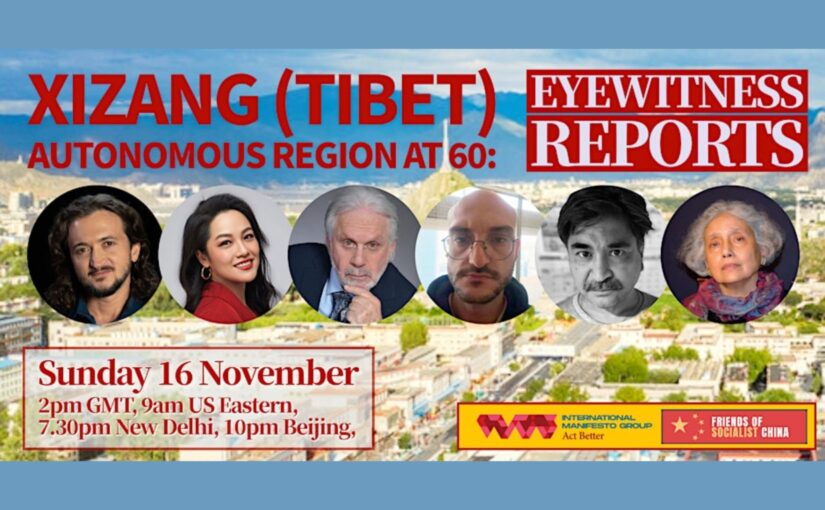
Fact and fiction in Tibet: An eyewitness account

In the following article, which was originally published by Global Times as part of its “Truth Seen in Xizang” series, which draws on the eyewitness accounts by foreigners of their visits to China’s Xizang (Tibet) Autonomous Region, Arnold August, a Montreal-based writer and activist, and a leading member of the International Manifesto Group (IMG), reflects on his 2023 visit and notes:

“I am deeply interested in how China strives to integrate the most dynamic aspects of the religious features of culture into its thinking and actions. This applies locally to Buddhism in Xizang.”

Graphically describing the synthesis between tradition and modernity as an ancient civilisation experiences a period of rapid development, he recalls: “We see most people dressed in traditional garments, witness hundreds of Buddhist monks in their religious garb while walking and/or praying, traditional Buddhist architecture side by side with modern malls, kids rollerblading, others enjoying themselves with their families in an amusement park, or the less timid approaching our group to practice their English and satisfy their curiosity.”

Visiting the Jokhang Temple in the old part of the regional capital Lhasa, which features traditional Tibetan architecture, “what attracted my attention was that it houses the Gelug school monastery (Gelug means ‘virtuous’), the most recent of several vital schools of Tibetan Buddhism. The teaching language, of course, is Tibetan.” And the Potala Palace, which overlooks the city, “contains nearly 700 murals and 10,000 painted scrolls, as well as an impressive collection of important historical documents. If the Western-driven fable of Tibetan ‘suppression’ is true, then how can we explain China’s dedication to the history of the Xizang region?

“To claim that a culture is being ‘eradicated’ while its language is taught, its religion practiced, and its history displayed and studied is a contradiction too glaring to ignore. It raises the uncomfortable question: Who gets to define what cultural survival looks like?”

Arnold writes: “As someone born and raised in Montreal, Quebec, I have a deep appreciation for issues of language, identity and cultural preservation. This personal background made me particularly sensitive to what I observed in Xizang.”

Having described what he’d seen on the visit, he concludes: “In contrast, what is the situation in Quebec, whose distinct cultural heritage goes back to 1618? Unlike the situation for Tibetans, our music, film, journalism, novels and poetry remain just an obscure footnote to Anglo-American cultural and linguistic domination… My main message is to visit Xizang and experience the contrast between fact and fiction.”

Xizang, a region known for its breathtaking landscapes and unique cultural traditions, has long become a target of Western smear campaigns and falsehoods about China. What is the truth? In the “Truth Seen in Xizang” series, the Global Times publishes conversations with and articles from scholars and observers from around the world who have visited the region, sharing their firsthand experience of traveling to Xizang and observing the daily lives of people there. Through their insights and experiences, we aim to present an authentic perspective on the Xizang Autonomous Region. This is the seventh piece of the series.

In 2023, I had the honor of visiting China’s Xizang Autonomous Region as a delegate in the autumn cohort of scholars and journalists, alongside representatives from the Americas, Europe, and Australasia. I am deeply grateful to have been invited to visit Xizang. There are various reports from the ground to share. This is just one.
As someone born and raised in Montreal, Quebec, I have a deep appreciation for issues of language, identity and cultural preservation. This personal background made me particularly sensitive to what I observed in Xizang.

Continue reading Fact and fiction in Tibet: An eyewitness account

China strikes diabetes

The following article by Bhabani Shankar Nayak highlights China’s groundbreaking advances in tackling one of the world’s most devastating illnesses. According to the International Diabetes Federation, 589 million adults currently live with diabetes, a figure projected to reach 853 million by 2050. The disease causes 3.4 million deaths annually and costs over USD 1 trillion in healthcare spending. For Western pharmaceutical corporations, the author argues, this represents a lucrative “business of sickness,” that is focused not on curing diabetes but on managing it – for a profit.

Bhabani writes that China may now be disrupting this model. Scientists at Tianjin First Central Hospital have developed a stem-cell therapy using patients’ own fat cells to generate insulin-producing islet cells. Implanted under the abdomen, these cells restore natural insulin regulation. Clinical trials show extraordinary results: Type-1 patients stopped insulin within 75 days, and Type-2 patients within eleven weeks. The European Medical Journal hailed this as a “milestone,” while China’s National Medical Products Administration is fast-tracking further trials to make the therapy widely available within three years.

This development comes hot on the heels of a recent innovation by Shanghai doctors restoring normal insulin production using pancreatic cells derived from the patient’s own stem cells.

Bhabani stresses that China’s successes in medical science are rooted in the country’s policy-driven investment in public health and medical research, exemplified by the “Shanghai Integration Model” that integrates public initiatives with research-based medicine. Unlike profit-driven Western systems, China’s approach is grounded in the principle of health over profit, producing breakthroughs not only in diabetes but also in AIDS and obesity treatment.

Contrasting China’s people-centred development with Western capitalism, Bhabani concludes that while “imperialism—led by the United States—invests in war,” China invests in life-saving science. Its model, he argues, offers an alternative based on collective welfare, innovation, and human dignity.

In a world shaped by competing models of development, China’s approach stands as a powerful alternative rooted in collective welfare, scientific progress, and the dignity of life.

Bhabani Shankar Nayak is a Professor of Business Management at London Metropolitan University. He is the author or editor of numerous books and articles on China and other issues related to development in the Global South. This article was first published in Countercurrents.

The International Diabetes Federation (IDF)’s Diabetes Atlas reports that 589 million adults (aged 20–79) are currently living with diabetes—equivalent to 1 in 9 adults worldwide. This number is projected to rise to 853 million by 2050. The report also states that diabetes was responsible for 3.4 million deaths in 2024, equating to one death every nine seconds. Additionally, diabetes accounted for at least USD 1 trillion in health expenditures, representing a 338% increase over the past 17 years. The report further predicts that diabetes-related health spending will continue to rise, exceeding USD 1.054 trillion by 2045.

Diabetes is a silent epidemic, causing death and suffering on an unimaginable scale. However, for pharmaceutical corporations, insurance companies, and private healthcare providers, it represents a highly profitable business opportunity. The commercialization of illness lies at the heart of capitalism, particularly in the healthcare models practiced by many large corporations based in the United States and Europe. The pharmaceutical industry manages diabetes through ongoing treatment but rarely invests in a cure—treating the disease as though it were incurable.

Continue reading China strikes diabetes

Communist Party of China joins Liberation Movements Summit in South Africa

The Communist Party of China (CPC) joined the Liberation Movements Summit that was hosted by the African National Congress (ANC) of South Africa in Johannesburg, between July 25-28, under the theme, ‘Defending the Liberation Gains, Advancing Integrated Socio-Economic Development, Strengthening Solidarity for a Better Africa.’

Besides the ANC, the core participants were the five other main liberation movements in the region – the Popular Liberation Movement of Angola (MPLA), the South West Africa People’s Organisation (SWAPO) of Namibia, the Mozambique Liberation Front (FRELIMO), the Zimbabwe African National Union – Patriotic Front (ZANU-PF) and the Chama Cha Mapinduzi (Revolutionary Party of Tanzania – CCM).

In a statement, the ANC said: “This critical gathering reaffirms the ideological foundations of the six Southern African liberation movements… and their historical role in securing independence, dignity and development across the region. It also seeks to reassert the relevance of these movements in a rapidly shifting global order.

“Southern Africa’s liberation movements transformed the region’s political landscape, resisting colonial rule and apartheid, and ushering in people-centred governance. Since independence, these movements have implemented landmark policies on land reform, education, housing, infrastructure and social protection.

“However, these gains now face erosion due to renewed imperial pressures, economic crises, and attempts at neo-colonial interference. The Summit provides a united platform to confront these threats and consolidate progressive regional responses grounded in Pan-Africanism, internationalism and multilateralism.

“The Summit is a strategic intervention in organisational renewal, deepening intra-party solidarity, and realignment of liberation movements with the socio-economic aspirations of a new generation. The ANC believes that the political, economic and cultural survival of Southern Africa’s liberation legacy demands honest introspection, shared learning and actionable unity.

“The Summit will advance frameworks for inter-party collaboration, regional integration, youth engagement, and sovereign resource governance. Through reaffirming shared values and strengthening alliances, the 2025 Liberation Movements Summit will chart a path forward, one that protects the gains of the past while building a just, inclusive and self-determined African future.”

Further details of the conference perspectives may be read here.

Besides these six movements, the POLISARIO Front of the Sahrawi Arab Democratic Republic (SADR) and the Palestinian National Liberation Movement Fatah were also represented at a senior level, along with the South African Communist Party (SACP), Pan-Africanist Congress (PAC) of Azania, the Congress of South African Trade Unions (COSATU) and the South African National Civics Organisation (SANCO).

The Communist Party of China was represented by Liu Jianchao, Minister of the International Department of the Party Central Committee (IDCPC).

Among other parties represented were United Russia, the Communist Party of Cuba, the National Liberation Front (FLN) of Algeria, the Sandinista National Liberation Front (FSLN) of Nicaragua, the Botswana National Front (BNF – the main component of the progressive ruling Umbrella for Democratic Change coalition), and the Botswana Democratic Party, while messages of greetings included that from the Communist Party of the Russian Federation.

In his keynote address, Cyril Ramaphosa, President of the ANC and of the Republic of South Africa, said:

Continue reading Communist Party of China joins Liberation Movements Summit in South Africa

“If the US truly cared about the human rights of Muslims, why does it turn a blind eye to the living hell in Gaza?” – China at UN

Chinese Ambassador Fu Cong addressed a United Nations Security Council briefing on July 24, called on the initiative of Pakistan, to discuss cooperation with the Organisation of Islamic Cooperation (OIC). The OIC is a major international body grouping 57 states. Ambassador Fu described it as “a symbol of unity and autonomy of Islamic countries” and said that China supports the UN in further deepening its cooperation with the OIC.

He added that: “With its religious, historical and cultural advantages when tackling issues that arise in the Islamic world, the OIC has a unique role to play in conflict prevention and mediation… The Palestinian issue lies at the heart of the broader situation in the Middle East and is of the greatest concern to the Islamic world. A pressing priority is to achieve a lasting ceasefire in Gaza, to ease the desperate humanitarian plight there.”

Fu Cong also directly responded to an earlier intervention from the United States, stating:

“China firmly opposes and categorically rejects the groundless accusations made by the US Representative regarding China’s Xinjiang region. Currently, Xinjiang enjoys social stability, [and] economic prosperity, where people live in peace and contentment…. If the US truly cared about the human rights of Muslims, why does it turn a blind eye to the living hell in Gaza? Why has it ignored the historical injustices suffered by the Palestinian people? The United States overlooks its own chronic problems at home, such as gun violence, racial discrimination, the trampling of its citizens’ rights and dignity.”

Speaking on behalf of the OIC, Yousef Al-Dubaie, Assistant Secretary-General for Political Affairs, called on the council to pressure Israel to comply with relevant UN resolutions, including for an immediate and complete cessation of the acts of genocide, massacres, starvation, and displacement of the Palestinian people in the Gaza Strip and the West Bank, including the occupied city of Al Quds [Jerusalem]. He also recalled the Organisation’s positions and efforts regarding Afghanistan, Jammu and Kashmir, Syria, Yemen, Sudan, Somalia, the Sahel countries, Lake Chad, and the issue of the Rohingya Muslim community in Myanmar, and commended the appointment by the UN Secretary-General of a UN Special Envoy to Combat Islamophobia.

The following articles were originally published on the websites of China’s Permanent Mission to the UN and of the OIC.

Remarks on Cooperation between the United Nations and Regional and Sub-regional Organizations (OIC) by Ambassador Fu Cong at the UN Security Council Briefing

President,

I thank the Pakistani presidency to initiate and convene this meeting. Welcome Deputy Prime Minister and Minister for Foreign Affairs Ishaq Dar presiding over this meeting. And thank ASG Khalid Khiari and ASG Yousef M. Al Dobeay for their briefings.

Continue reading “If the US truly cared about the human rights of Muslims, why does it turn a blind eye to the living hell in Gaza?” – China at UN

Black Agenda Report at the Belt and Road Journalism Forum in China

In the following report for Black Agenda Report, Margaret Kimberley reflects on her participation in the 2025 Belt and Road Journalists Forum in Jiangxi, China, representing the only US-based outlet at the event. The forum brought together 100 media professionals from across the globe, fostering cross-cultural understanding and promoting dialogue through journalism.

Margaret highlights how the forum offered historical and cultural context, particularly through Jiangxi’s significance in Chinese revolutionary history, as the site of the founding of the People’s Liberation Army and the starting point of the Long March.

While Western media fixates on bizarre anti-China narratives like the “spy balloon” episode, China continues to grow economically and improve the living conditions of its people.

While the corporate media inundate the public with tall tales of spy balloons and claims that China is making nefarious purchases of U.S. farmland, that nation forges ahead in spite of futile U.S. efforts to diminish its economic prowess.

The forum’s theme—“Promoting Civilisations Dialogue and Global Modernization with Power of Journalists”—underscored the importance of accurate, context-rich reporting, especially in an era when corporate media serves state interests and contributes to public misinformation. Margaret critiques mainstream journalism for failing to investigate or challenge official narratives, instead functioning as “a public relations arm for the state and the ruling class.”

The article concludes that independent outlets like Black Agenda Report play a crucial role in countering imperialist narratives. Exposure to countries like China is essential for journalists who seek truth over propaganda. Participation in the forum affirms the value of BAR’s principled, anti-imperialist perspective.

The 2025 Belt and Road Journalists Forum in China was an opportunity for Black Agenda Report to join an international group of journalists working to promote meaningful dialogue on world issues.

The invitation extended to Black Agenda Report to participate in the 2025 Belt and Road Journalists Forum , held in the cities of Nanchang, Jingdezhen, and Ganzhou in Jiangxi province China, was a testament to our 19 year history of providing “news, commentary, and analysis from a Black left perspective.“ Our work is appreciated nationally and internationally, and this columnist attended the Forum along with 100 media representatives from around the world. The Forum is a venue for journalists from Belt and Road Initiative (BRI) nations, but Black Agenda Report was also included, the only outlet participating from the United States. 

While the people of the U.S. are subjected to an endless stream of dangerous anti-China war propaganda, the Forum provided participants with the historical and cultural context needed to understand China’s history through the lens of the Jiangxi province region. The city Jiangdezhen has been an important center in the creation of ceramics, the porcelain that came to be known as china, for 1,000 years, and from which it was traded internationally on the original Silk Road. The People’s Liberation Army was founded in Jiangxi and in 1934, the Long March of the Communist Party of China (CPC) began in Jiangxi. The Long March was a strategic retreat from the Kuomintang forces and it allowed the CPC to live to fight on for many years, through the War of Resistance Against Japanese Aggression, known in this country as World War II, and to eventually establish the People’s Republic of China in 1949.

While the corporate media inundate the public with tall tales of spy balloons and claims that China is making nefarious purchases of U.S. farmland, that nation forges ahead in spite of futile U.S. efforts to diminish its economic prowess. Donald Trump’s ever changing tariff policies resulted in China imposing tariffs of its own and buying soy beans from Brazil and beef from Australia when those commodities had long been a part of agricultural trade between the two countries. Joe Biden’s attempt to stop China’s access to computer chip production resulted in new innovations like DeepSeek, which created a model for Artificial Intelligence that surpassed ChatGPT at a fraction of the cost.

China’s rise as an economic power has thrown the United States into panic and counterproductive decision making. Artificial Intelligence is not the only example of futile efforts to keep China down. The first Trump administration imposed high tariffs on Chinese electric vehicles, such as BYD, which stands for Build Your Dream. BYD cars are the biggest sellers in China and can be seen alongside U.S. cars on the streets of Beijing and Nanchang. But it was Joe Biden who imposed 100% tariffs on this popular brand and handed off this prohibition to Donald Trump’s second administration. In the meantime, U.S. consumers are deprived of a product they would want, and Detroit automakers have nothing to offer except state protected mediocrity. Trump’s wild indecision on tariffs is an indicator that the U.S. is lost as it tries to do what it cannot, make China a subservient power.

The Forum theme, “Promoting Civilizations Dialogue and Global Modernization with Power of Journalists,” is one that should be of interest to every person calling themselves a journalist. There cannot be information sharing without dialogue but in the U.S., true journalism, providing investigation and analysis, was always at the mercy of the powerful and has now completely devolved into little more than being a public relations arm for the state and for the ruling class. Corporate news gathering at present rarely yields very much that the people need to know, and coverage of China is emblematic of that downward trend. 

In 2023, when a Chinese weather balloon was blown off course, the Biden administration declared it to be a spy balloon and predictably, all of the leading broadcast and print media dutifully followed along and used the same language which emanated from the white house press office. While Joe Biden bragged about shooting the balloon down, there was little follow up reporting on the finding that the balloon was just what China said it was, a weather balloon that went off course. 

Unlike corporate media outlets, Black Agenda Report and other independent media outlets understand that China is, in fact, an ancient civilization, and like all other nations, a sovereign one with rights under international law that ought to be respected. Bullying with tariff threats and a plethora of accusations of wrongdoing should not be taken seriously and must be seen as part of a larger but failed effort to maintain U.S. hegemony. 

The Forum presented a series of seminars and roundtable discussions on topics such as presenting cross cultural narratives, the challenges of authentic news gathering in the age of Artificial Intelligence, and regional focuses on Europe and on Latin America. Discussions were supplemented by tours to historic and cultural sites in Jiangxi. Participants came away with greater appreciation of China as a nation and of their own work, which can be used to benefit the people of the world or which can also be a tool of parties whose goal is to keep the people in a state of misinformation. Unfortunately, this dynamic applies to most U.S. reporting, which is useful only in keeping the public in a state of hostility towards China, viewing it as an “adversary” which must be bested at every turn.

The reality is far different, and even for those who see themselves as living up to journalistic ethics, can become taken in by false narratives when they are repeated often enough. In-person visits are a necessity in preventing the repetition of harmful tropes that are used to manipulate opinion when factual reporting is needed and should be the standard for the profession.

Black Agenda Report has always been dedicated to analyzing the world from an anti-imperialist perspective, an objective that demands not just good information gathering but also exposure to nations like China, whose history requires study and analysis, and whose present day trajectory requires rejection of what most so-called journalists present, the repetition of fake news.

This site strives to be one that is respected nationally and internationally. Participation in the Belt and Road Journalists Forum is an indication that our work is held in high regard. It does not matter if large corporate outlets do not produce the same news that Black Agenda Report presents. In fact, that difference is proof of our standing as journalists.

British Defence Secretary threatens war with China

Britain’s  Defence Minister, the largely and justifiably unknown John Healey, has made an extraordinary threat to go to war with China over the question of Taiwan, an island province that Britain legally recognises – not least according to the bilateral agreement concluded in 1972 between the two countries that elevated their diplomatic relations to ambassadorial level – as part of China.

Speaking on board the HMS Prince of Wales aircraft carrier, after it had docked in the north Australian port of Darwin, where it is to join the United States and other countries in the warmongering Talisman Sabre exercises largely aimed at China, Healey was asked by the right wing Telegraph newspaper, “what the UK is doing to help countries like Taiwan to prepare for potential escalation from China, Mr Healey said: ‘If we have to fight, as we have done in the past, Australia and the UK are nations that will fight together. We exercise together and by exercising together and being more ready to fight, we deter better together.’”

The HMS Prince of Wales is on a nine-month deployment to the Pacific region and is widely expected to sail through the Taiwan Strait around upcoming visits to Japan and South Korea. Already, the Royal Navy provocatively sailed the HMS Spey warship through China’s Taiwan Strait on June 18. It was the first such incident in four years.

Never one to miss out on a free trip, David Lammy, Britain’s equally preposterous Foreign Secretary, accompanied Healey. He has previously said that the UK plans to conduct more so-called “freedom of navigation operations” in the Taiwan Strait.

Further underlining the gravity of the situation, the Labour supporting Mirror newspaper noted:

“In April, Keir Starmer met the crew onboard HMS Prince of Wales during an overnight stay ahead of their voyage. The PM said the mission showed the UK’s ‘leadership on global issues and security and defence’.

“‘We all know that the world is more uncertain than it felt a few months or years before – we’re in a new era,’ Mr Starmer said at the time. ‘We are sending a clear message of strength to our adversaries, and a message of unity and purpose to our allies.’”

As with most, if not all, members of the current British government, it is difficult to fathom whether Healey’s outburst represents blood-curdling bellicosity, strategic myopia, rank ignorance and stupidity, gross irresponsibility, or just plain inexperience. However, the smart money is likely to be on any combination of all of the above.

In an editorial response, the Morning Star noted that: “British troops will be engaged in provocative manoeuvres viewed by Beijing as part of Washington’s bid to encircle it militarily. That is itself part of a wider US strategy to derail China’s rise… That is the overarching war game in which Operation Talisman Sabre takes place. Britain should have no part in it.”

China’s Global Times was more hard-hitting, noting that: “Chinese observers slammed the blatant remarks over China’s internal affair, saying it was a show of residual British colonial mentality.”

It added: “Observers also pointed out that, amid warming China-Australia relations highlighted by the Australian Prime Minister’s successful July visit to China, the British defence official’s remarks attempt to place Canberra in a difficult position. Full alignment with the UK and the US is not a wise choice.”

A spokesperson for the Chinese Embassy in London was direct and to the point:

“If the said report is true, I am sure the UK official will regret having said that. China will never allow anyone to separate Taiwan from China in any way. Nor will China allow any external forces, the UK and Australia included, to undermine our efforts for complete reunification.”

Earlier, on July 25, the spokesperson responded to Foreign Secretary Lammy and Yvette Cooper, the tinpot totalitarian Home Secretary, having issued a joint statement making unwarranted comments on the law enforcement action taken by the Hong Kong SAR police against anti-China disruptors who have fled abroad:

“Hong Kong is China’s Hong Kong, and Hong Kong affairs are purely China’s internal affairs. China urges the UK to abandon its colonial mentality, stop interfering in Hong Kong affairs, cease meddling in China’s internal affairs, stop shielding criminals, and refrain from going further down the wrong path.”

Prior to Healey’s outburst, on 25 July 2025, the Chinese Embassy in the UK held a reception celebrating the 98th anniversary of the founding of the People’s Liberation Army of China. Ambassador Zheng Zeguang pointed out in his speech that this year marks the 80th anniversary of the recovery of Taiwan. Taiwan has been an inalienable part of China’s territory since ancient times. Both the Cairo Declaration and the Potsdam Proclamation, issued by major victorious nations of WWII, including China and the UK, stated in explicit terms that Taiwan is a territory that Japan had stolen from the Chinese, and shall be restored to China. All these instruments have confirmed China’s sovereignty over Taiwan and formed an important part of the post-WWII international order. 

The Ambassador further emphasised that the Chinese people and their armed forces will never allow anyone to separate Taiwan from China in any way. Nor will they allow any external forces to undermine their efforts for complete reunification. All countries having diplomatic ties with China must properly handle Taiwan-related issues, which is key to the smooth development of bilateral relations with China.

Zheng Zeguang also noted that this year marks the 80th anniversary of the victory in the Chinese People’s War of Resistance Against Japanese Aggression and the World Anti-Fascist War. More than 80 years ago, the peoples of China and the UK fought valiantly against fascist aggression on the main Eastern Front and the European battlefield, making enormous contributions to the global victory against fascism. China’s fight was the earliest to begin, and the longest-lasting. The Chinese people suffered the most significant human and material losses before ultimately defeating Japanese aggressors.

Ambassador Zheng emphasised that it should never be forgotten that China and the UK were allies and fought shoulder to shoulder during the war. That part of history has left behind many touching stories of solidarity and mutual support in the flames of war. In 1942, Chinese fishermen from Zhoushan risked their own lives under Japanese gunfire to save 384 British prisoners of war on board Lisbon Maru, which was mistakenly torpedoed by a US submarine. Also in 1942, the Chinese Expeditionary Force successfully rescued British troops besieged by the Japanese army in Myanmar. In 1938, George Hogg, a young Briton, travelled thousands of miles to China, where he established schools, aided orphaned children and gave his life for the Chinese people’s righteous cause. We should remember history, honour those fallen heroes, cherish peace and strive for a better future.

The reception was attended by nearly 300 guests.

In characteristically pugilistic terms, George Galloway responded to Healey in his MOATS (Mother of all Talk Shows) broadcast.

Denouncing his remarks as madness, George noted that Britain, a bankrupt and broken country that has given billions to the ‘thief of Kiev’ and spends millions on reconnaissance flights to facilitate the Gaza genocide, was now threatening China with war. Referring to the 1949 Amethyst Incident, George recalled that the last time Britain had ‘sailed a gunboat up the Yangzi [river]’, the Chinese had sunk it. And China is now a far more powerful country than it was 76 years ago.

Noting the contempt shown for democracy, as highlighted by the fact that Britain’s rubber stamp parliament had not even been consulted or informed, George addressed Healey: “You little runt are threatening China with war.” A man who had never heard a shot fired in anger in his miserable life was threatening a war to be waged at the expense of the British people “and with the blood of your sons and daughters.”

Continue reading British Defence Secretary threatens war with China

DPRK honours Chinese internationalists on war anniversary

The Democratic People’s Republic of Korea (DPRK) celebrated the 72nd anniversary of victory in the Fatherland Liberation War on July 27. This was the date when an armistice agreement was signed ending the fighting that had raged on the Korean peninsula since June 25, 1950.

General Mark Clark, the US commander, admitted that: “In carrying out the instructions of my government, I gained the unenviable distinction of being the first United States commander in history to sign an armistice without victory.”

Malcolm X, the African-American revolutionary leader, said: “Any time Uncle Sam, with all his machinery for warfare, is held to a draw by some rice eaters, he’s lost the battle.” In his ‘The Ballot or the Bullet’ (April 12, 1964), Malcolm noted in his inimitable style:

“Why some rice farmers, some rice farmers, some rice eaters ran him out of Korea. Yes, they ran him out of Korea. Rice eaters with nothing but gym shoes, and a rifle, and a bowl of rice took him and his tanks and his napalm, and all that other action he’s supposed to have and ran him across the Yalu.”

DPRK top leader Kim Jong Un participated in a number of functions to mark this year’s anniversary.

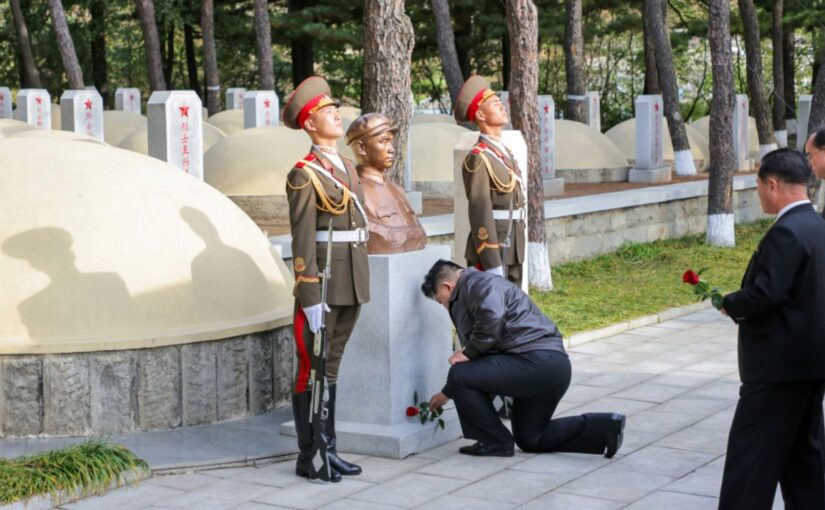
On July 26, he visited the Friendship Tower, which stands in the centre of the capital Pyongyang and honours the martyrs of the Chinese People’s Volunteer Army, who gave their lives in what is known in China as the War to Resist US Aggression and Aid Korea.

Presenting a wreath, Kim Jong Un said that we will never forget the combat feats and merits of the fallen fighters of the Chinese People’s Volunteers recorded in the history of the great victory in the Fatherland Liberation War.

The previous day, Chinese Ambassador Wang Yajun led a large team to visit the Chinese Volunteers Martyrs’ Cemetery in North Pyongan Province.

The administrator of the DPRK cemetery gave a briefing on the restoration and protection of the martyrs’ tombs and said that President Kim Il Sung had instructed that the cemetery should be built in a beautiful place and at a time of commemorative significance. On important holidays, the DPRK people come to pay their respects to the martyrs of the volunteers. As a member of the younger generation, I have been taught by the DPRK Party and government since I was a child that the traditional friendship between the DPRK and China is unbreakable, and I will continue to do my best to maintain and manage the cemetery and contribute to the inheritance of the DPRK-China friendship.

Ambassador Wang thanked the DPRK Party and Government for attaching importance to the restoration and protection of the martyrs’ tombs of the Chinese People’s Volunteers and said that the traditional friendship between China and the DPRK is cemented with blood and is a precious wealth shared by both sides. This year marks the 75th anniversary of the Chinese People’s Volunteers going abroad to fight to resist US aggression and aid Korea, and it is believed that under the strategic guidance of the top leaders of the two parties and two countries, the traditional friendship between China and the DPRK will surely achieve greater development and make greater contributions to safeguarding regional peace and benefiting the two peoples.

The same day, the ambassador visited Pyeoncheon City, South Pyongan Province to pay tribute to the martyrs of the volunteers who died in the Songgu Peak Blockade.

The DPRK personnel gave a detailed account of the situation in the Songgu Peak Blockade Battle, and said that the Chinese People’s Volunteers held high the banner of resisting US aggression and aiding Korea and defending the homeland and the country, united with the DPRK army and people, fought together, and defended the DPRK as if it were their own motherland. It was precisely this spirit that turned into a shield to resist aggression and a sharp sword for launching an attack, and more than 100 officers and men of the Chinese Volunteers were able to resist the repeated attacks of the US military and the wanton and indiscriminate bombardment of aircraft and artillery and fight until the last moment. The Korean people will always remember the great sacrifices of the Chinese People’s Volunteers.

Ambassador Wang said that the Chinese People’s Volunteers fought side by side with the DPRK military and civilians, braved hardships and dangers, made great sacrifices, and made indelible and important contributions to the victory of the War to Resist US Aggression and Aid Korea. We must pass on the spirit of Songgufeng from generation to generation, continue to consolidate and develop the friendship between China and the DPRK, work together to overcome challenges, and contribute to the socialist construction of the two countries and regional peace and stability.

Previously, on July 22, the Chinese Embassy in Pyongyang held a reception to celebrate the 98th anniversary of the founding of the Chinese People’s Liberation Army.

On behalf of all officers and men of the Korean People’s Army, Deputy Director Pak Yong Il warmly congratulated the 98th anniversary of the founding of the Chinese People’s Liberation Army, saying that the DPRK and Chinese armies have joined hands to resist the imperialist invaders in many wars and fought side by side in the same trenches, creating a shining example of friendship and unity. The DPRK is willing to work with China to provide a solid guarantee for the development of friendly relations between them and of the great cause of socialism in the two countries in accordance with the lofty will of the two parties.

On July 18, Ambassador Wang led diplomats from his embassy to visit the Chongsang-ri Cooperative Farm near Nampo City. This is the most famous farm in the DPRK as the country’s founding leader Kim Il Sung visited it a total of 91 times and put forward the basic principles for guiding the development of socialist agriculture and rural development in the DPRK, known as the ‘Chongsan-ri spirit’ and the ‘Chongsang-ri method’.

Continue reading DPRK honours Chinese internationalists on war anniversary

China calls for peace between Cambodia and Thailand

China has called for peace and an end to the fighting between Thailand and Cambodia, saying that the root cause of this problem lies in the historical legacy left by Western colonisers, which now needs to be calmly faced and properly handled.

The call came when Foreign Minister Wang Yi met with Secretary-General of ASEAN (the Association of South East Asian Nations) Kao Kim Hourn in Beijing on July 25.

Wang Yi said that China consistently prioritises ASEAN in its neighbourhood diplomacy and supports it in playing a greater role in international and regional affairs. China will work with ASEAN countries to foster a peaceful, safe and secure, prosperous, beautiful, and amicable home, and build an even closer China-ASEAN community with a shared future.

Under the current circumstances, Wang said, China and ASEAN should focus on cooperation in three key areas:

  • The two sides should work together to uphold free trade and the multilateral trading system. The abuse of tariffs undermines WTO (World Trade Organisation) rules, affects the stability of global industrial and supply chains, and harms other countries’ development and legitimate rights. As major forces in the Global South, China and ASEAN should strengthen solidarity and cooperation to reject unilateralism.
  • They should fully implement the Declaration on the Conduct of Parties in the South China Sea (DOC), complete negotiations on the Code of Conduct in the South China Sea (COC) on schedule, and continue to properly handle South China Sea issues based on the “dual-track approach” to jointly foster a new narrative of peace, friendship, and cooperation.
  • The two sides should work together to maintain regional peace and stability. Looking around the world, conflicts and confrontations are still raging in some places, and the international situation is complex and volatile. The peace and stability in East Asia are hard-won and should be cherished. Recent clashes on the border between Cambodia and Thailand, which caused casualties, are deeply saddening and concerning. The root cause of this problem lies in the historical legacy left by Western colonisers, which now needs to be calmly faced and properly handled. As a common friendly neighbour of Cambodia and Thailand, China is ready to uphold an impartial position and continue playing a constructive role in de-escalating tensions and easing the situation.

Following July 28 talks in the Malaysian capital Kuala Lumpur, chaired by Prime Minister Anwar Ibrahim, in his capacity as the rotating chair of ASEAN, the two countries agreed to an “immediate and unconditional” ceasefire. “This is a vital first step towards de-escalation and the restoration of peace and security,” Anwar said.

The foreign and defence ministers of Malaysia, Cambodia and Thailand have been instructed to “develop a detailed mechanism” to implement and monitor the ceasefire to ensure sustained peace, he added. The Ambassadors of China and the United States also attended the talks.

The following article was originally published on the website of the Chinese Foreign Ministry. An article, produced by Globetrotter, and published on Peoples Dispatch, provides some useful background to and analysis of the dispute.

On July 25, 2025, Member of the Political Bureau of the CPC Central Committee and Foreign Minister Wang Yi met with Secretary-General of ASEAN Kao Kim Hourn in Beijing.

Wang Yi stated that China and ASEAN are friendly neighbors, and their all-round cooperation has increasingly deepened. China consistently prioritizes ASEAN as a priority in its neighborhood diplomacy and supports ASEAN in playing a greater role in international and regional affairs. Guided by the spirit of the Central Conference on Work Related to Neighboring Countries, its commitment to fostering an amicable, secure and prosperous neighborhood, the principle of amity, sincerity, mutual benefit and inclusiveness, and a vision for a shared future, China will work with ASEAN countries to foster a peaceful, safe and secure, prosperous, beautiful, and amicable home, and build an even closer China-ASEAN community with a shared future.

Wang Yi said that under the current circumstances, China and ASEAN should focus on cooperation in three key areas. First, the two sides should work together to uphold free trade and the multilateral trading system. The abuse of tariffs undermines WTO rules, affects the stability of global industrial and supply chains, and harms other countries’ development and legitimate rights. The world must not return to the law of the jungle. As major forces in the Global South, China and ASEAN should strengthen solidarity and cooperation to reject unilateralism, safeguard WTO rules, and ensure the authority and integrity of the China-ASEAN Free Trade Area and the Regional Comprehensive Economic Partnership (RCEP). Second, the two sides should fully implement the Declaration on the Conduct of Parties in the South China Sea (DOC), complete negotiations on the Code of Conduct in the South China Sea (COC) on schedule, promote synergies between the two platforms, and continue to properly handle South China Sea issues based on the “dual-track approach” to jointly foster a new narrative of peace, friendship, and cooperation in the South China Sea. Third, the two sides should work together to maintain regional peace and stability. Looking around the world, conflicts and confrontations are still raging in some places, and the international situation is complex and volatile. The peace and stability in East Asia are hard-won and should be cherished. Recent clashes on the border between Cambodia and Thailand, which caused casualties, are deeply saddening and concerning. The root cause of this problem lies in the historical legacy left by Western colonizers, which now needs to be calmly faced and properly handled. China appreciates and supports ASEAN’s active mediation efforts to promote dialogue, consultation, and political settlement in the “ASEAN way”. As a common friendly neighbor of Cambodia and Thailand, China is ready to uphold an impartial position and continue playing a constructive role in de-escalating tensions and easing the situation.

Kao Kim Hourn gave a positive evaluation of ASEAN-China relations and the achievements of bilateral practical cooperation, and thanked China for firmly supporting ASEAN centrality in regional cooperation and the building of ASEAN community. ASEAN looks forward to taking the 5th anniversary of the establishment of the ASEAN-China comprehensive strategic partnership in 2026 as an opportunity to seek greater strategic synergy with China and deepen practical cooperation across various fields. He said that ASEAN supports accelerating negotiations on the COC and is willing to work with China to jointly maintain regional peace and stability and uphold the multilateral trading system. On the recent border tensions between Cambodia and Thailand, he expressed confidence that the leaders of the countries involved have the political wisdom to resolve this issue. The “ASEAN way” is feasible, and the ASEAN rotating chair is actively engaged in mediation in accordance with the ASEAN Charter. He thanked China for its active efforts to promote talks for peace.

Deputy President’s visit strengthens ties with South Africa

South Africa’s Deputy President Paul Mashatile recently visited China to attend the Third China International Supply Chain Expo (CISCE).

On July 17, he met in Beijing with his Chinese counterpart, Vice President Han Zheng.

Han said that in September last year, China and South Africa upgraded their bilateral relationship to an all-round strategic cooperative partnership in the new era. Han said this opened a new chapter in building a high-level community with a shared future between the two countries. He called on the two sides to further implement the important consensus reached by the two heads of state and to constantly deepen political mutual trust.

On the same day, Liu Jianchao, Minister of the International Department of the Communist Party of China (CPC) Central Committee (IDCPC), also met with Mashatile in his dual capacity of Deputy President of both the Republic of South Africa and of the African National Congress (ANC) of South Africa. 

Liu said, under the leadership and personal promotion of President Xi Jinping and President Cyril Ramaphosa, China-South Africa relations have entered a golden era. China is willing to work with South Africa to implement the important consensus reached by the two heads of state, continue to firmly support each other on issues concerning each other’s core interests and major concerns, deepen practical cooperation in various fields, and enhance friendly exchanges between the two peoples.

He added that the relationship between the two parties is an important foundation for the development of China-South Africa relations. The CPC and the ANC have maintained close communication and dialogue for a long time. The two parties understand and trust each other sincerely and have formed brotherly sentiments. The CPC will continue to stand firmly with the ANC, strengthen strategic communication and political dialogue between the two parties, deepen mutual learning in party building and state governance, and enhance collaboration on international and regional issues to jointly address common challenges.

Mashatile said that more Chinese enterprises are welcome to invest and do business in South Africa. At present, unilateralism and protectionism are on the rise. South Africa is willing to closely cooperate with China within the framework of multilateral mechanisms such as the BRICS, the United Nations and the G20 to practice true multilateralism and safeguard international fairness and justice. The ANC values its friendship with the CPC and hopes to further strengthen exchanges and cooperation between the two parties in areas such as party school building and cadre training to promote even better relations between them.

The following articles were originally published by the Xinhua News Agency and on the website of the IDCPC.

Chinese vice president meets South Africa’s deputy president

BEIJING, July 17 (Xinhua) — Chinese Vice President Han Zheng on Thursday met with South African Deputy President Paul Mashatile in Beijing.

In September last year, China and South Africa upgraded the bilateral relationship to an all-round strategic cooperative partnership in the new era. Han said this opened a new chapter in building a high-level community with a shared future between the two countries.

He called on the two sides to further implement the important consensus reached by the two heads of state, constantly deepen political mutual trust, advance the high-quality development of bilateral cooperation, and serve the modernization endeavors of both countries.

Continue reading Deputy President’s visit strengthens ties with South Africa

Nicaragua celebrates anti-imperialist solidarity and friendship with China on anniversary of victorious Sandinista revolution

July 19 marked the 46th anniversary of the victory of the Sandinista Popular Revolution in Nicaragua, with the centrepiece being a massive nighttime celebration in the capital Managua.

Numerous representatives attended from friendly countries, including China, Russia, Palestine, Vietnam, Venezuela, Cuba, the Democratic People’s Republic of Korea (DPRK), Honduras, Burkina Faso, Algeria, Belarus, Türkiye, and others.

Anti-imperialism was a central theme running through the keynote speech delivered by President Daniel Ortega. The key points were summarised by US anti-imperialist journalist and political analyst Ben Norton in a post on X (Twitter) as follows:

  • Nicaragua offers its full support for Palestine, and unflinching opposition to the US-Israeli genocide in Gaza.
  • Nicaragua strongly supports Iran in its defence against US-Israeli aggression.
  • Fascism has its roots in European colonialism. The West talks about “democracy” and “human rights”, but the crimes committed by European empires – like the transatlantic slave trade of millions of Africans and the French empire’s mass atrocities in Algeria – were very similar to those committed by Nazi Germany. (Ortega praised the Algerian Revolution as an inspiration for Nicaragua.)
  •  Haiti had the first victorious revolution in Latin America and the Caribbean. Haiti inspired Simón Bolívar, and militarily supported him, as he carried out his own anti-colonial revolution in South America. Nicaragua is inspired by Haiti’s example.
  • Immediately after Spanish colonialism was defeated in Latin America, US imperialism replaced it. The US invaded Nicaragua several times, and US imperialism remains the principal threat for Latin America and the world today.
  • Never forget the crimes the US committed in Nicaragua in the 1980s, when the CIA armed and trained the far-right Contra terrorists. Ortega recalled that the US-sponsored Contras also trafficked drugs, many of which ended up in US neighbourhoods.
  • It was the Soviet Union and China that defeated fascism in World War Two. This year is the 80th anniversary of their heroic victory over Nazi Germany and the fascist Japanese empire.
  • “We in the [Sandinista] Front were inspired by the Russian Revolution and the Chinese Revolution”, Ortega said. He praised Mao Zedong as a “great leader who is always in our thoughts.”
  • Today, the People’s Republic of China and Russian Federation are friends of the Global South, helping Nicaragua and other countries to defend their sovereignty against Western imperialism.
  • Capitalist Europe is now remilitarising and massively increasing its military spending on weapons because it, along with the US, wants to prepare for war against Russia and China. 
  • The United Nations has become a tool dominated by the Western imperialist powers, and the US uses its veto power to prevent the UN from taking any significant action (like stopping the genocide in Gaza). The UN needs a “refoundation”.
  • The world desperately wants peace, so countries can economically develop and end poverty, but US imperialism is the main obstacle.

In her address, Co-President Rosario Murillo emphasised:

“Our Nicaragua, a Free Territory, a Glorious Land of Warriors of Peace, greets with Honourable Joy and Certain Hope, all the Peoples who now fighting, without surrendering, for the other World that is now indispensable, and the Delegations that represent them in this formidable Act of Commitment to Liberation, and to Fraternal, Solidarity and Shared Vocation, for the Common Good, which the Planet and Humanity so badly need.”

Continue reading Nicaragua celebrates anti-imperialist solidarity and friendship with China on anniversary of victorious Sandinista revolution

China’s five-year plans democratic, people-centred and grounded in material reality

In a wide-ranging interview with Global Times, Friends of Socialist China co-editor Carlos Martinez describes China’s Five-Year Plans (FYPs) as democratic, people-centred, and grounded in material reality. He emphasises that China’s success in planning stems from its ability to align governance with popular needs and long-term strategy. “China is known globally for its effective governance and for its record of keeping its promises”, he notes, citing the 13th FYP’s targeted poverty alleviation campaign as a key example of practical planning based on extensive grassroots research.

Carlos stresses that these plans are not top-down decrees but involve widespread consultation, making them highly democratic and responsive to the needs of the people.

China’s five-year plans are well-received by the people because they are based on extensive consultation with the people, and are responsive to the needs, wishes and aspirations of the people. Every plan is based on discussions with, and feedback from, the people. In that sense, the plans are highly democratic, and accord with Chinese emphasis that “the people, and the people alone, are the motive force in the making of world history.” The basic methodology of the mass line – from the masses, to the masses – has been well employed by the government and the Party in devising goals and plans.

China’s evolving development strategy, he argues, is responsive to shifting realities. Early plans focused on light industry and technological catch-up; today, priorities include green energy, advanced manufacturing, and digitisation. “Quality, rather than quantity, has become a more important feature of the country’s growth”, he observes.

Carlos credites President Xi Jinping with combining short-, medium-, and long-term planning rooted in the principles of common prosperity and ecological sustainability. Furthermore, Xi’s strategic thinking increasingly has global applicability, as seen in initiatives like the Belt and Road and the Global Development Initiative.

Contrasting China’s approach with the short-termism of Western governments, Carlos points out that, unlike the West’s shareholder-driven model, China’s system prioritises the long-term interests of the people. “Ultimately, the ‘institutional advantage’ is the political power of the working people, and the fact that, in China, people come before profit.”

GT: In China, the scientific formulation and consistent implementation of five-year plans stand as an important piece of experience in the CPC’s approach to governing the country. Why do you think China places significant emphasis on scientific formulation and consistent implementation of five-year plans? 

Martinez:
 China is known globally for its effective governance and for its record of keeping its promises. Its objectives and plans are developed over a long period of time, and are firmly grounded in material reality and the needs and aspirations of the people. 

For example, China’s 13th Five-Year Plan (2016-20) codified the central leadership’s poverty-reduction decision into the state will that is operable in practice. The targeted poverty alleviation campaign included sending officials to the countryside to identify the communities, families and individuals living in extreme poverty. Once the “facts on the ground” were established, a comprehensive plan was developed – at national, provincial, county and village levels – to sustainably lift everyone out of extreme poverty, so that they had a steady income, along with guaranteed housing, food, clothing, education, healthcare, modern energy and running water.

China keeps its promises, and it does so by mobilizing enormous resources toward key projects. In 2020, President Xi announced the country’s commitment to peaking its carbon dioxide emissions before 2030. This goal informed the current (14th) five-year plan, and appropriate targets were set at every level, throughout the country. 

In summary, China develops plans that are realistic and flexible, that meet both the short-term and long-term needs of the people and that contribute to the country’s overall strategy. Once the blueprint is agreed and established, different parts and levels of the government work closely with the central government, with state-owned enterprises, private businesses, educational institutions, as well as community organizations and NGOs to implement the plan. The whole country works together to realize an agenda that aligns with the collective interest. This embodies the spirit of socialism.

Continue reading China’s five-year plans democratic, people-centred and grounded in material reality

Chinese diplomacy: Some countries wage war, others promote peace

In the following article, Sergio Rodríguez Gelfenstein – former director of international relations in Venezuela’s presidential office and former ambassador to Nicaragua – contrasts China’s global diplomacy with the United States’ aggressive foreign policy, arguing that while Washington pursues war, coercion and domination, Beijing advances peace, cooperation, and mutual development.

While the United States plots wars, plans invasions, enacts sanctions, and imposes tariffs on the entire world, China quietly advances its diplomacy of peace. Washington rhetorically spews its plan for planetary destruction, which it carries out in a Machiavellian manner, assuming that this will enable it to maintain its global hegemony. Meanwhile, without much noise, Beijing builds a dynamic of peace and cooperation to make the Earth a livable place for all its inhabitants.

In recent months, amid escalating US and Israeli aggression in West Asia, China has held numerous diplomatic summits promoting stability and multilateralism.

In Latin America, the Fourth China-CELAC Forum in May reaffirmed shared goals in sustainable development and trade, laying the groundwork for the 2025–2027 cooperation plan. In Africa, China convened with 53 countries and the African Union in June, reinforcing the China-Africa Cooperation Vision 2035 and rejecting unilateral sanctions.

China also deepened ties with the EU, seeking compromises on trade disputes, particularly over electric vehicles. Foreign Minister Wang Yi emphasised that China and the EU should be “partners, not rivals”, and urged commitment to multilateralism and peace. Talks with the US, meanwhile, have faltered due to Washington’s unpredictability and hostile actions, particularly around Taiwan and trade measures. Vice Premier He Lifeng insisted that only equal dialogue can resolve trade issues, reiterating: “There are no winners in trade wars”.

China’s active diplomacy extended to Central Asia and West Asia. At the China-Central Asia Summit in June, the heads of state of China, Kazakhstan, Kyrgyzstan, Tajikistan, Turkmenistan, and Uzbekistan signed a treaty of good neighbourliness and permanent friendly cooperation, described by Xi Jinping as “a new milestone in the history of relations between the six countries”.

Meanwhile, China vehemently condemned the US attacks on Iran as “seriously violating the purposes and principles of the United Nations Charter and international law, as well as Iran’s sovereignty, security, and territorial integrity”. China called for a ceasefire, civilian protection, and renewed negotiations—highlighting its consistent orientation towards peace over aggression.

This makes it clear that while some wage war, others advocate for peace and cooperation among all the peoples of the planet.

This article was first published on Sergio Rodríguez Gelfenstein’s blog, and translated from Spanish to English by John Catalinotto for Workers World.

While the United States plots wars, plans invasions, enacts sanctions, and imposes tariffs on the entire world, China quietly advances its diplomacy of peace. Washington rhetorically spews its plan for planetary destruction, which it carries out in a Machiavellian manner, assuming that this will enable it to maintain its global hegemony. Meanwhile, without much noise, Beijing builds a dynamic of peace and cooperation to make the Earth a livable place for all its inhabitants.

Especially in the last two months, simultaneously with the U.S. and Zionist genocidal program to remove the Palestinian people and attacks against Iran, Yemen, Syria, and Lebanon, China has been meeting with representatives from more than half of the world’s countries to discuss a future of harmony, concord, balance, and mutual aid for the improvement, prosperity, and progress of humanity.

Continue reading Chinese diplomacy: Some countries wage war, others promote peace

Wang Yi meets Kazakh, Iranian, Pakistani, Uzbek and Tajik counterparts in Tianjin

Chinese Foreign Minister Wang Yi held a number of bilateral meetings on the sidelines of the foreign ministers’ meeting of the Shanghai Cooperation Organisation (SCO), which was held in Tianjin on July 15.

Meeting on July 15 with Kazakh Deputy Prime Minister and Minister of Foreign Affairs Murat Nurtleu, Wang Yi noted that Kazakhstan successfully hosted the second China-Central Asia Summit last month, during which President Xi Jinping and President Kassym-Jomart Tokayev had in-depth and friendly strategic communication, writing a new chapter of good relations. China and Kazakhstan are good neighbours with a high degree of mutual trust, good friends with mutual assistance in trying times, and good partners for mutual benefit and win-win outcomes. China has always placed Kazakhstan in an important position in its neighbourhood diplomacy and is willing to work with Kazakhstan to firmly support each other, consolidate political mutual trust, create more new highlights of cooperation, and open up new prospects for bilateral relations.

Noting that Kazakhstan is a founding member of the SCO, Wang Yi stated that China looks forward to making joint efforts with Kazakhstan and other member states to ensure the complete success of the Tianjin summit and make plans for the future development of the SCO.

Murat Nurtleu said that China is a friendly neighbour, close friend, and trustworthy partner of Kazakhstan. Under the guidance of the two heads of state, the Kazakhstan-China permanent comprehensive strategic partnership has been elevated to a new level and reached new heights.

On July 16, Wang Yi met with Iranian Foreign Minister Seyed Abbas Araghchi.

Wang said that as a comprehensive strategic partner, China will continue to support Iran in safeguarding its state sovereignty and national dignity, resisting power politics and bullying acts, defending its legitimate rights and interests through political negotiations, and adhering to the principle of good-neighbourliness and friendship to continuously improve and develop relations with its neighbouring countries.

Seyed Abbas Araghchi expressed gratitude for China’s valuable support to Iran and said that Iran is more steadfast than ever in its resolve to develop relations with China. The Iran-China comprehensive strategic partnership enjoys tremendous potential and broad prospects. He reiterated that Iran has explicitly stated that it will not develop nuclear weapons but will not give up its legitimate right to the peaceful use of nuclear energy. Iran is willing to engage in negotiations and consultations as soon as possible with all parties on the premise of equality and respect, to seek a political solution to the Iranian nuclear issue.

Wang Yi said that China consistently opposes the use or threat of force and advocates for resolving differences through dialogue and consultation. China values Iran’s commitment to not developing nuclear weapons, respects Iran’s right to the peaceful use of nuclear energy and appreciates Iran’s efforts to strive for peace through diplomatic means.

Meeting with Pakistani Deputy Prime Minister and Foreign Minister Mohammad Ishaq Dar, Wang Yi said that China supports Pakistan in focusing on handling its own affairs, achieving independent and sustainable development, and continuously enhancing its comprehensive national strength, adding that China is willing to enhance strategic dialogue with Pakistan, jointly build the China-Pakistan Economic Corridor (CPEC) to a high level, and deepen cooperation on agriculture, industry, and mining. He added that China also stands ready to jointly plan the celebration activities for the 75th anniversary of the establishment of diplomatic relations between the two countries next year.

Continue reading Wang Yi meets Kazakh, Iranian, Pakistani, Uzbek and Tajik counterparts in Tianjin