In the following article, the Theoretical Study Group under the Executive Council of the Institute of Party History and Literature of the Communist Party of China (CPC) Central Committee gives a systematic explanation and historical background to General Secretary Xi Jinping’s concept of the “two integrations”, namely of the basic tenets of Marxism with China’s specific realities and traditional culture.
The article quotes Xi Jinping as saying:
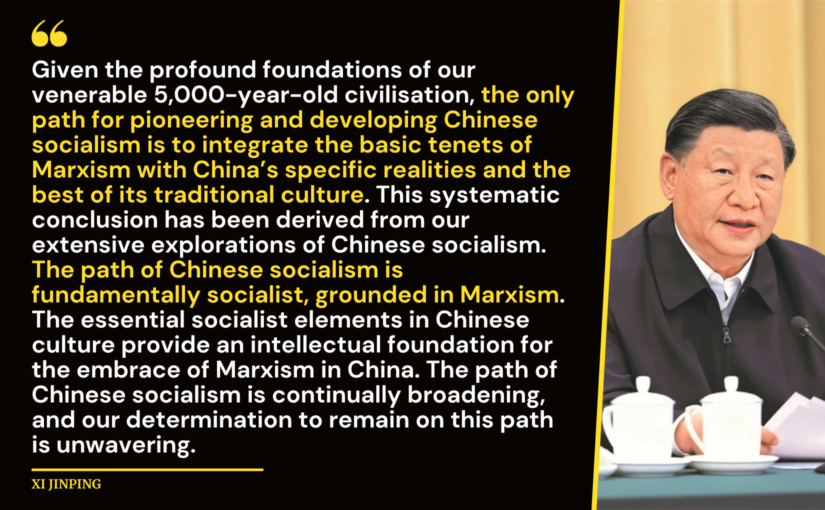
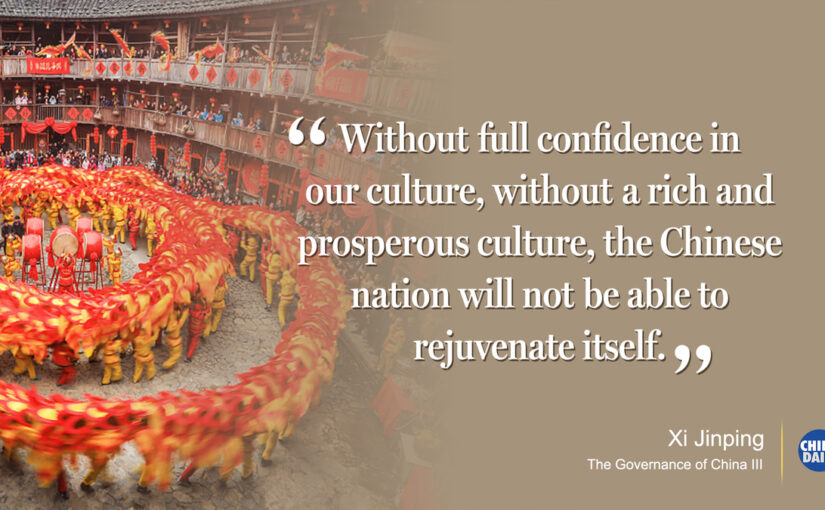
“Given the rich foundations of our more than 5,000-year-old civilisation, the only path for pioneering and developing socialism with Chinese characteristics is to integrate the basic tenets of Marxism with China’s specific realities and with its traditional culture. This systematic conclusion, drawn from our explorations of Chinese socialism, is the strongest assurance for our success.”
It notes that the history of the CPC has been a process of continuously adapting Marxism to the Chinese context and the needs of the times and a process of continually making theoretical innovations.
In the periods of the new-democratic revolution (1921-1949) and of socialist revolution and development (1949-1978), the CPC integrated the basic tenets of Marxism-Leninism with the concrete realities of the Chinese revolution. This enabled it to blaze the correct revolutionary path of encircling the cities from the countryside and seizing state power with military force, secure victory in the new-democratic revolution, complete the socialist revolution, and carry out a highly productive socialist development drive. It was during this process that the CPC established, enriched, and further developed Mao Zedong Thought, which marked the first historic step in adapting Marxism to the Chinese context and the needs of the times.
In his explorations of a path for China’s revolution and development, Mao Zedong placed importance on interpreting and applying Marxism from a national perspective and was particularly adept at drawing nourishment from China’s cultural heritage. Indeed, he once observed that “we should sum up our history from Confucius to Sun Yat-sen and take over this valuable legacy.” Mao advocated making the past serve the present and stressed the need to “extensively and critically make use of China’s cultural heritage,” “to reject its feudal dross and assimilate its democratic essence,” and “to make the things we have inherited our own.” In this way, Mao demonstrated a practical mastery of the best of China’s traditional culture.
The CPC, the article notes, has drawn upon the Chinese concept of the people being the foundation of the state, the idea of universal participation in governance, the tradition of joint and consultative governance, and the political wisdom of being all-inclusive and seeking common ground while setting aside differences. On this basis, it established the system of people’s congresses and the system of CPC-led multiparty cooperation and political consultation.
Deng Xiaoping, it adds, stressed that “the socialist China we are building should have a civilisation with a high cultural and ideological level as well as a high material level; only if we do well on both fronts can we say we are building socialism with Chinese characteristics.” Deng also emphasised the need to carry forward and develop the Chinese nation’s fine cultural traditions and the Party’s fine traditions, oppose lingering feudal influences, and guard against the corrosion of decadent capitalist ideas. He also put forward a fundamental criterion for appraising all the party’s work, namely, whether it is favourable to growing the productive forces in a socialist society, to increasing the overall strength of the socialist state, and to raising the living standards of the people.
Xi Jinping, the article continues, has pointed out that:
“The basic tenets of Marxism must be closely integrated with China’s specific realities. We should adopt the right approaches to our national traditional culture and the cultures of other countries to equip ourselves with all the outstanding intellectual and cultural achievements of humanity.”
Xi Jinping’s Thought upholds the people-centred viewpoint of Marxism and draws extensively on the ancient Chinese governance principles of regarding the people as the foundation of the state and ensuring the people enjoy safety, prosperity, and contentment. It also adheres to Marxist principles regarding the relationship between humans and nature and draws on Chinese wisdom concerning the environment, including the ideas of humanity being an integral part of nature and all things living side by side. Likewise, it adheres to Marxist ideas on world history and carries forward the broad-minded vision advocated in traditional Chinese culture, which includes seeking prosperity for all and harmony between all nations. On this basis, initiatives such as a global community of shared future and the Belt and Road Initiative have been put forward.
The article explains that after Marxism was introduced into China, its propositions were enthusiastically embraced by the Chinese people amid fierce competition between different ideological trends, and they ultimately took root and bore fruit in the land of China. This was far from coincidental. Rather, it was because they were consistent with China’s millennia-old culture and the common values that Chinese people intuitively apply in their everyday lives. It is only with mutual compatibility that genuine integration can be achieved. “This integration is not a master plate from which we simplistically continue our history and culture, nor a pattern through which we mechanically apply the ideas of classic Marxist authors, nor a reprint of the practice of socialism in other countries, nor yet a duplicate of modernisation from any other country. Rather, it is the combining of the basic principles of scientific socialism with China’s specific realities, historical and cultural traditions, and the call of the times. It demands a harmonious blending of communist faith and socialist convictions with the millennia-old ideals of the Chinese nation.”
Integration, it explains, is not about piecing different components together; it is not a simple physical convergence, but instead requires complete fusion. While Marxism has profoundly changed China, China has also greatly enriched Marxism.
The article was originally published in Chinese in issue 13, 2023 of Qiushi Journal, the CPC’s main theoretical organ. This English language version was first published in issue 4, 2023 of Qiushi’s English edition.
In an address at a meeting on cultural inheritance and development, General Secretary Xi Jinping noted, “Given the rich foundations of our more than 5,000-year-old civilization, the only path for pioneering and developing socialism with Chinese characteristics is to integrate the basic tenets of Marxism with China’s specific realities and with its traditional culture. This systematic conclusion, drawn from our explorations of Chinese socialism is the strongest assurance for our success.” In his speech, General Secretary Xi incisively discussed the significance of integrating the basic tenets of Marxism with China’s specific realities and traditional culture (referred to as the “two integrations”) and the rich implications and practical requirements therein.
The CPC’s experience and application of the “two integrations”
The history of the Communist Party of China (CPC) has been a process of continuously adapting Marxism to the Chinese context and the needs of the times and a process of continually making theoretical innovations. The CPC has led the people through arduous quests, setbacks, and pioneering efforts to accomplish enormous tasks that would have been inconceivable for any other political force in China. Essentially, this has been possible because the CPC has remained committed to integrating the basic tenets of Marxism with China’s specific realities and the best of its traditional culture, thus continually adapting Marxism to the Chinese context and the needs of the times.
In the periods of the new-democratic revolution (1921-1949) and socialist revolution and development (1949-1978), the CPC integrated the basic tenets of Marxism-Leninism with the concrete realities of the Chinese revolution. This enabled it to blaze the right revolutionary path of encircling cities from the countryside and seizing state power with military force, secure victory in the new-democratic revolution, complete the socialist revolution, and carry out a highly productive socialist development drive. It was during this process that the CPC established, enriched, and further developed Mao Zedong Thought, which marked the first historic step in adapting Marxism to the Chinese context and the needs of the times. By integrating Marxism’s basic tenets with China’s realities, the CPC developed many original theoretical achievements, put forward a series of important ideas regarding China’s revolution and development, and led the people in securing great successes in the new-democratic revolution and in socialist revolution and development.
In his explorations of a path for China’s revolution and development, Mao Zedong placed importance on interpreting and applying Marxism from a national perspective and was particularly adept at drawing nourishment from China’s cultural heritage. Indeed, he once observed that “We should sum up our history from Confucius to Sun Yat-sen and take over this valuable legacy.” Mao advocated making the past serve the present and stressed the need to “extensively and critically make use of China’s cultural heritage,” “to reject its feudal dross and assimilate its democratic essence,” and “to make the things we have inherited our own.” He fully tapped the contemporary value of China’s traditional culture by infusing classic Chinese idioms such as “seeking truth from facts” and “shooting the arrow at the target” with new meanings. These were used to illustrate the Marxist approach to thinking and working, which grounds all actions in reality. In this way, Mao demonstrated a practical mastery of the best of China’s traditional culture.
Continue reading Integrating the basic tenets of Marxism with China’s specific realities and traditional culture