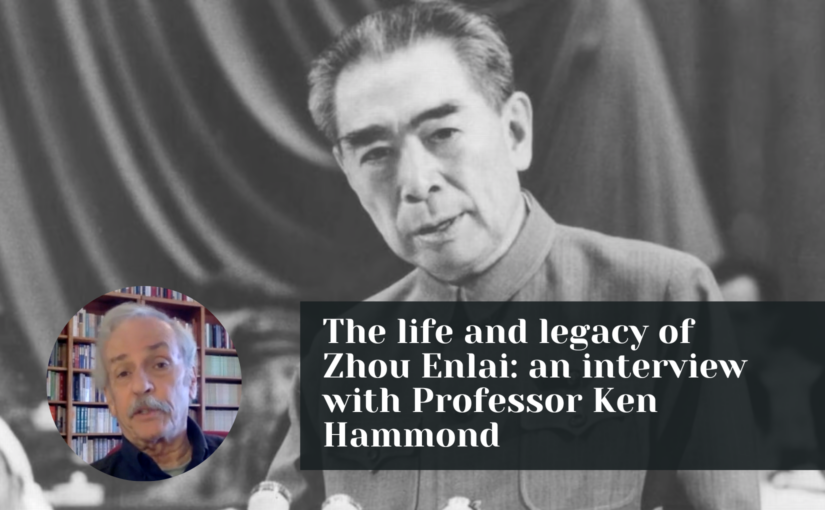
To mark the 125th anniversary of the birth of Zhou Enlai – one of the top leaders of the Chinese Revolution, and Premier of People’s China from 1949 until his death in 1976 – we conducted an extensive interview with Professor Ken Hammond about Zhou’s life and legacy.
The interview covers Zhou Enlai’s formation as a revolutionary; his role in the early years of the Chinese Revolution in the 1920s; his working relationship with Mao Zedong; his contribution to Marxist understanding of socialist foreign policy; his role in establishing links of solidarity between China and Africa; his role in the negotiations with Henry Kissinger and Richard Nixon that brought about the start of a rapprochement between the US and China; his experiences in the Cultural Revolution; and his lasting legacy, both in China and globally.
Ken Hammond is a professor of East Asian and Global History at New Mexico State University, founding director of the Confucius Institute at New Mexico State University, and an activist with Pivot to Peace. He’s also a member of the Friends of Socialist China advisory group, and is working on a biography of Zhou Enlai. He is interviewed by our co-editor Carlos Martinez.
Category: History
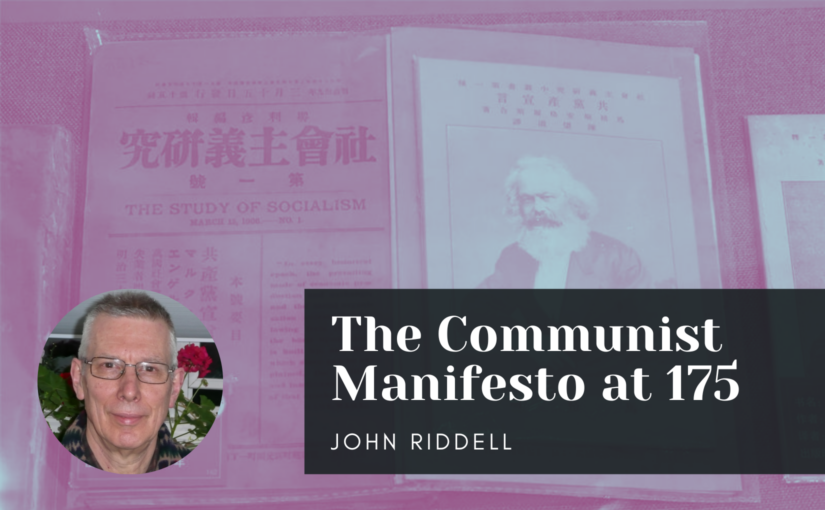
The Communist Manifesto at 175
We are very pleased to publish the below presentation, which was made by the Toronto-based historian John Riddell to a February 26 webinar organised by the International Manifesto Group, with which Friends of Socialist China works closely, marking the 175th anniversary of the publication of the Communist Manifesto by Karl Marx and Friedrich Engels.
In his contribution, John explains that it was the 1917 revolution in Russia and the creation of the Soviet state that truly internationalised the core message of the Manifesto. Taking China as his focus, he notes that some 50,000 Chinese migrant workers in Russia joined the Red Army to defend the revolution from internal and external threats. Eight Chinese delegates joined the Baku Congress of the Peoples of the East, held in 1920, whilst the much smaller and less well-known Congress of the Peoples of the Far East, held two years later, attracted 42 Chinese participants.
These congresses were pivotal in introducing and popularising the programme on the national and colonial questions adopted by the Communist International (Comintern) at its second congress in 1920. This programme, John shows, found practical expression in the work of International Red Aid and the ‘Hands off China’ movement, initiated following a 1925 massacre of workers in Shanghai. Citing the work of Chinese Marxist scholars Cheng Enfu and Wang Jun, John recalls Lenin’s statement that, “the interests of the proletarian struggle in any one country should be subordinated to the interests of that struggle on a world-wide scale, and, second, that a nation which is achieving victory over the bourgeoisie should be able and willing to make the greatest national sacrifices for the overthrow of international capital.” (Draft Theses on National and Colonial Questions for the Second Congress of the Communist International, Collected Works, Volume 31) Despite “missteps and errors”, John concludes, the Comintern made a significant contribution to the Chinese revolution.
John is the founding Director of the Communist International Publishing Project and a member of our advisory group. A lifelong socialist activist, he is one of the world’s foremost scholars of the early Comintern. Joining him on the panel, which was chaired and introduced by Professor Radhika Desai, were:
- Professor Cheng Enfu of the Chinese Academy of Social Sciences;
- Sara Flounders, Contributing Editor of the US communist newspaper Workers’ World and a key anti-war organiser for decades;
- Professor Alexander Buzgalin of Moscow State University;
- Brian Becker, National Coordinator of the ANSWER coalition and a central leader of the Party for Socialism and Liberation in the US;
- Frank Chapman, Executive Director of the National Alliance Against Racist and Political Repression and Central Committee member of the US communist group Freedom Road Socialist Organisation; and
- Xin Yuzhou, a member of the Communist Youth League working in the International Department of the Communist Party of China.
The full event can be viewed on YouTube.
“Workers of the world, unite!” This celebrated call, first voiced by Marx and Engels almost two centuries ago, continues today to resound worldwide in the struggles of working people seeking political and social liberation. To be sure, at first the Communist Manifesto’s appeal was heard only in Europe and European settlements overseas. However, following the Russian revolution of 1917, the Manifesto’s call for universal workers’ unity quickly gained a hearing in every part of the globe.
The principles of the Communist Manifesto found expression in the global struggle to defend the newly established Soviet republic from a host of invading anti-Soviet armies, including a contingent from Canada. The Soviet republic’s defenders included about fifty thousand Chinese workers resident in Russia, who joined in the Red Army to defend the Russian soviet republic.
Two years later, in 1919, the Communist International was launched as a vehicle to unite working people worldwide and carry the message of the Communist Manifesto to every continent.[1]
As our colleague Cheng Enfu has pointed out, the International set its strategic goal as nothing less than “the overthrow of international capital and the establishment of workers’ power throughout the world.”[2]
A year later, in 1920, the Communist International rallied two thousand delegates from Central Asia and the Middle East at a historic congress convened in Baku, Azerbaijan.[3]
The International’s call for the Baku Congress appealed to all victims of colonialism the world over to join in the struggle for “complete equality of all peoples and races, whatever language they may speak, whatever the color of their skin and whatever the religion they profess.” The Baku Congress called for “liberation of all humanity from the yoke of capitalist and imperialist slavery, for the ending of all forms of oppression of one people by another … and of all forms of exploitation.”[4]
The Baku Congress rallied close to two thousand delegates, mostly from the Mideast and central Asia. Significantly, it numbered eight Chinese delegates among its participants. Two years later, a similar congress of delegates from the Far East and Central Asia, convened by the Communist International in 1922, included 42 Chinese delegates.[5]
In 1925, Chinese anti-colonial demonstrators in Shanghai were assaulted by imperialist military forces stationed in the city. Dozens of protesters were killed and many more wounded. Horror at this colonialist atrocity spread not only in China but across Russia, Europe, and beyond. In response, a formidable solidarity movement sprang up on several continents. The resulting “Hands Off China” campaign gathered significant support worldwide. These efforts were coordinated by a solidarity organization called International Red Aid, led by members of the Communist International. Red Aid gathered significant material assistance and funds, which were sent off to the embattled people of China.
The central leader of Red Aid, the German Communist Willi Münzenberg, declared its goal in these words: “We want to form a holy alliance, we, the white, yellow, black, and differently coloured underdogs… for the liberation of all those who suffer.”[6]
Workers’ meetings in Europe were addressed by Chinese socialists. In Beijing a rally of 100,000 Chinese workers greeted a European socialist speaker with passionate enthusiasm. In this manner, the central concept of the Communist Manifesto – Workers of the World Unite! – won an expanded audience on a global scale.
Enfu Cheng and Jun Wang have drawn our attention to the underlying principle of internationalism, namely that “the interests of the proletarian struggle in any one country should be subordinated to the interests of that struggle on a worldwide scale” and that “a nation which is achieving victory over the bourgeoisie should be able and willing to make the greatest national sacrifices for the overthrow of international capital.”[7]
As Enfu Cheng and Jun Wang have pointed out, the application of this internationalist principle by the Communist International was marked by missteps and errors. Nonetheless, they state, the Communist International provided material support in various forms as well as systematic theoretical and strategic guidance to the Chinese revolution.
The ideas of the Communist Manifesto live on today, finding expression in struggles against oppression and for liberation in every country and on every continent. It is thus with joy that we join together today in giving expression to the core ideas of communism’s great Manifesto.
[1] . John Riddell, ed., Founding the Communist International: Proceedings and Documents of the First Congress, March 1919, New York: Pathfinder, 1987.
[2] Enfu Cheng and Jun Yang, “The Chinese Revolution and the Communist International,” Third World Quarterly, vol. 41, no. 8, pp. 1338–1352.
[3] John Riddell, ed., To See the Dawn, Baku 1920, New York: Pathfinder, 1993.
[4] Riddell, ed., To See the Dawn, pp. 231–32.
[5] Riddell, ed., To See the Dawn, p. 242; John Sexton, ed., Alliance of Adversaries: The Congress of the Peoples of the Far East, Chicago: Haymarket, 2018.
[6] Riddell, “International Red Aid,” at johnriddell.com, https://johnriddell.com/2021/07/29/international-red-aid-1922-1937/.
[7] Enfu Cheng and Jun Yang, ibid.
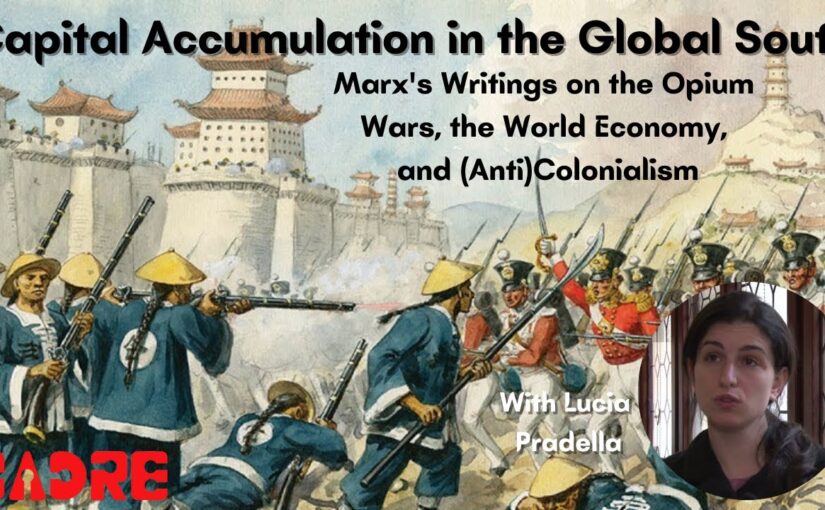
Marx’s writings on the Opium Wars and capital accumulation in the Global South, with Lucia Pradella
In the interview below, Lucia Pradella engages with Joseph Mullen of The Cadre Journal on the subject of Karl Marx’s understanding of colonialism and capital accumulation in the Global South, with particular reference to China.
Dr. Pradella is a Senior Lecturer in International Political Economy at King’s College London and the author of ‘Globalization and the critique of political economy: New insights from Marx’s writings’, published as part of the Routledge Frontiers of Political Economy series. The Cadre Journal is a student-run journal and podcast on anti-imperialism and communism.
Lucia explains how in her study for her master’s and PhD degrees, as well as a period spent working on the major project to publish the Complete Works of Marx and Engels, she acquired greater understanding of the breadth and depth of Marx’s studies of pre-capitalist societies and of the central role played by colonialism, and not least the Opium Wars, in primitive capital accumulation and his value theory. Whilst greater attention has tended to be paid to Marx’s writings on India, it is significant that Marx’s positive attention to, and appraisal of, the first stages of the Taiping Revolution essentially coincides with the defeat suffered by the European revolutions of 1848. Arising from his study of the Taipings, Marx postulated the possibility of a republican revolution in China.
In the Communist Manifesto, she notes, Marx and Engels proceeded from the premise that the industrial proletariat of Europe constituted the agency of the international revolutionary process, but developments post-1848 created two possible paths to revolution, on the part of the industrial proletariat and on the part of the colonised peoples. However, she contends that Marx did not abandon his view that a developed capitalism was necessary for there to be a socialist revolution.
The views and contributions of a range of people, including Rosa Luxemburg, David Harvey, Immanuel Wallerstein, Giovanni Arrighi, Andre Gunder Frank and Samir Amin are touched on, with Lucia arguing that the dependency theorists and proponents of world systems theory overlooked some aspects of Marx’s Capital. Asked for her views on the theory of combined and uneven development, and its applicability, she expresses the view that Trotsky did not understand the centrality of colonialism in Marx’s analysis.
Noting Marx’s acuity with regards to the potential impact of developments in China on the world economy, she says that some of the developments we see today are processes that Marx already analysed at a very abstract level in Capital Volume One.
The full interview is embedded below.

Dorise Nielsen: groundbreaking communist MP in Canada, people’s hero in China
We are pleased to republish this article by Mike Wu, originally carried in People’s Voice, newspaper of the Communist Party of Canada, about the revolutionary life of Dorise Nielsen.
Born in England in 1902, she settled in Canada in 1927. Politicised by the Great Depression, she joined the Communist Party of Canada around the time she met the legendary Norman Bethune, when she was fundraising to help send Canadians to join the International Brigades in Spain. In the 1940 federal election, she was elected as the first communist member of parliament in Canada or indeed North America.
During the McCarthyite conditions of the Cold War, she moved to China in 1957, traveling under the alias Judy Godefroy. She became a Chinese citizen in 1962. She worked in a number of capacities in China, moving to the Foreign Languages Press in the late 1960s.
Dorise died in Beijing on December 9 1980. A speaker at her memorial service, held at the Babaoshan Cemetery for Revolutionaries, said that she “had a deep love of China and the Chinese people, she lived a very simple life and was never extravagant, her feeling for the construction of socialism was profound.”
NB. The article refers to Dorise as the only Canadian in Beijing at the time she moved to China. However, another Canadian citizen, Isabel Crook, was also in Beijing (working at the same institution – the Beijing Foreign Studies University).
Norman Bethune is a well-known figure in the history of Canada–China relations. But there is another legendary figure: Dorise Nielsen, the first Member of Parliament from the Communist Party of Canada, went to China in her later years to support the Chinese people’s socialist construction, until her death in Beijing in 1980.
Dorise was born in London, England in 1902 and settled in Saskatchewan in 1927 to work as a public school teacher. Dorise initially did not concern herself with politics, until the Great Depression broke out in 1929.
During the Depression, Dorise saw with her own eyes how workers, farmers, the ill and the old struggled under capitalism. In 1933, the Co-operative Commonwealth Federation (CCF) held its first convention and approved the Regina Manifesto, which described capitalism as an unjust and inhumane system that concentrated power and wealth in a small elite while leaving most people in poverty.
Continue reading Dorise Nielsen: groundbreaking communist MP in Canada, people’s hero in China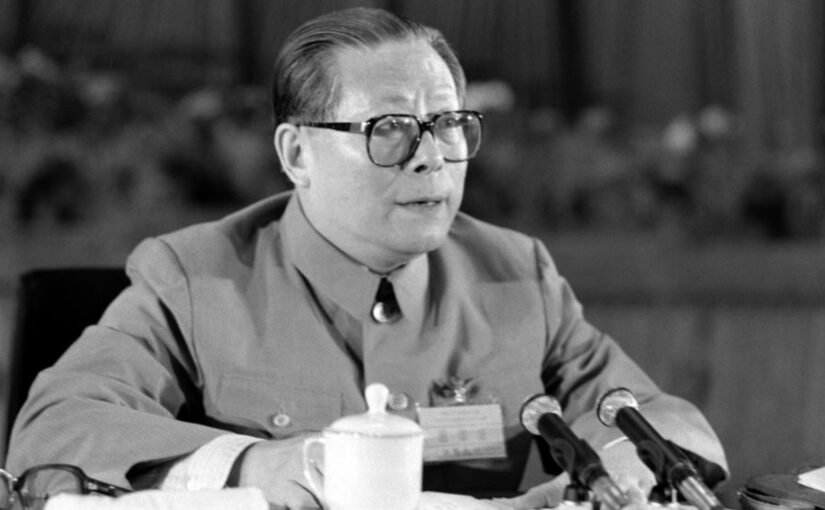
On the revolutionary life of Jiang Zemin
We republish below a profile of the late Chinese leader Comrade Jiang Zemin, originally issued by the Xinhua News Agency, which illustrates and explains the deep respect and affection that the Chinese people hold for this outstanding communist, patriot and internationalist, whose revolutionary career spanned very nearly eight decades.
Much of the information contained here was already covered in the official Chinese letter announcing Comrade Jiang’s passing, which we have already reported. However, there is also much new material, some of which has never appeared in English before.
The article notes a young Jiang Zemin’s contribution to the war to resist US aggression and aid Korea:
“To boost efforts to resist US aggression and aid Korea, Jiang organized the production of canned food specially provided for the Chinese People’s Volunteers. He also oversaw the design of the first homegrown turbo-generator in New China.”
Highlighting his creative application and development of Marxism-Leninism in the evolving situation in China and the world, it states:
“On learning lessons from the demise of the Soviet Union and the drastic changes in Eastern European countries, and the Cultural Revolution in China, Jiang stressed the importance of adhering to socialism, and carrying out socialist reform to explore a path of socialist development that suits China’s actual conditions.”
The now rapidly developing and expanding Shanghai Cooperation Organization (SCO) was to a great extent a creation of Jiang:
“Jiang promoted the establishment of the Shanghai Cooperation Organization (SCO), the first regional cooperation organization set up with China’s participation and named after a Chinese city. The Shanghai Spirit championed by the SCO – mutual trust, mutual benefit, equality, consultation, respect for diverse civilizations and pursuit of common development – has exerted an important influence on contemporary international relations.”
And he stayed true to some of the finest traditions of the Chinese revolution:
“He said the biggest danger for the Party when it becomes the ruling party is its detachment from the masses and that resolutely opposing and preventing corruption is a major political task for the whole Party. Underscoring the importance of adhering to the Party’s mass line, he demanded the Party do everything for the people while relying on the people in every task. He asked officials at all levels to bear in mind the purpose of serving the people wholeheartedly and doing practical and good things for them.”
One thing not covered in this article, which we would like to reference, is Jiang Zemin’s relationship to Ireland and Ireland’s special contribution to China’s development. The Shannon Free Zone, established in 1959, was the world’s first free trade zone. In 1980, Jiang Zemin led a Chinese government delegation to study and learn from its experience and, in many respects, it was used as a model for China’s early development of special economic zones, which have played such a crucial role in the country’s development. Shannon has continued to be visited by senior Chinese delegations over the years.
Jiang Zemin was an outstanding leader enjoying high prestige acknowledged by the whole Communist Party of China (CPC), the entire military and the Chinese people of all ethnic groups.
He was a great Marxist and a great proletarian revolutionary, statesman, military strategist and diplomat. He was a long-tested communist fighter and an outstanding leader of the great cause of socialism with Chinese characteristics. He was the core of the third generation of the Party’s central collective leadership and the principal founder of the Theory of Three Represents.
Jiang’s life was a glorious and fighting one. During his revolutionary career of more than 70 years, he remained unswervingly firm in communist ideals, utterly loyal to the Party and the people, and resolutely committed to the cause of the Party and the people.
After the fourth plenary session of the 13th CPC Central Committee, faced with the complexity of the domestic and international situations and the grave challenges posed by the serious twists and turns world socialism had experienced, Jiang led the Party’s central collective leadership — firmly relying on the whole Party, the entire military and the Chinese people of all ethnic groups — in safeguarding the great cause of socialism with Chinese characteristics and successfully advancing the cause of socialism with Chinese characteristics into the 21st century.
He made indelible achievements and won the heartfelt love of the whole Party, the entire military and the Chinese people of all ethnic groups, as well as the wide acclaim of the international community.
Continue reading On the revolutionary life of Jiang Zemin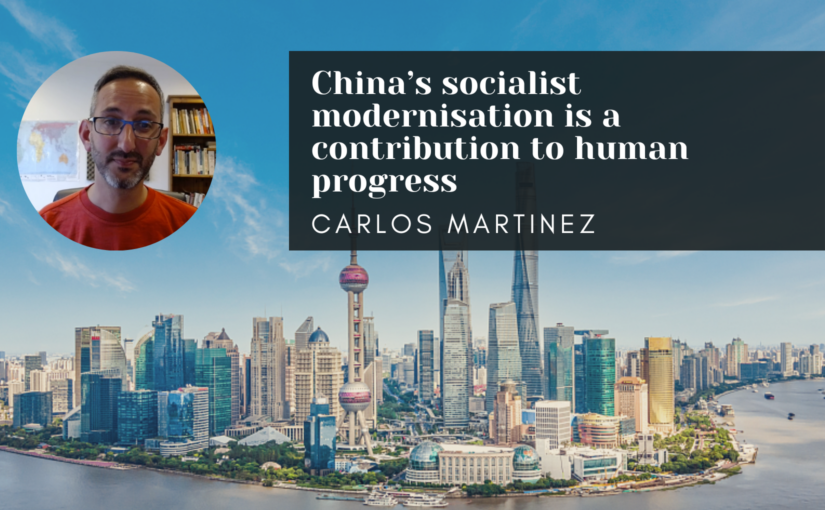
China’s socialist modernisation is a contribution to human progress
Friends of Socialist China co-editor Carlos Martinez was invited by the Chongyang Institute for Financial Studies at Renmin University of China to make a contribution at the thematic symposium on Chinese Governance and Multiple Paths of Modernization at the 5th Hongqiao International Economic Forum, held in Shanghai from 5 to 10 November, 2022.
What follows is the transcript of his remarks, in which he reviews the imperialist countries’ process of modernisation – characterised by colonial violence and plunder – and contrasts this with China’s evolving modernisation path, which is peaceful, sustainable, and based on common prosperity.
All countries have a right to modernisation. Modernisation is a process that enables higher living standards for the masses of the people. It enables common prosperity. With modernised industry, production technique, communication methods, transport systems, energy systems and healthcare methods, humanity has the potential to provide a healthy, meaningful and dignified life to everybody.
A life where each individual has reliable access to a healthy diet, to decent housing, to clothing, to education, to healthcare, to a vibrant cultural, social and intellectual life, to interesting work. In short, modernisation makes it possible to attend to people’s fundamental human rights.
And furthermore, these days it is possible to modernise in a way that doesn’t damage the planet, in a way that doesn’t compromise the sustainability of human existence on Earth.
What China has shown the world is that there is more than one path to modernisation.
For a long time, the predominant ideology – particularly in the West – has affirmed that the only path to modernisation is the one laid down by the imperialist powers.
And what does that path look like? Countries such as the United States and Britain claim that the secret of their success was the combination of free-market capitalism and a system of Western-style parliamentary democracy.
However, there are plenty of countries in the developing world that have attempted to apply that formula and that have achieved little more than chaos.
Indeed, the reality of the West’s path to modernisation looks profoundly different to the picture that has been painted. The industrial revolution, carried out first in Britain, was built to a significant degree on the profits of colonial plunder and the slave trade.
Britain accumulated extraordinary wealth from its colonial ventures in Ireland, India, the Caribbean, the Americas, Africa and elsewhere – not to mention the profits from forcing opium on China, a project so lucrative that Britain went to war multiple times in order to protect it.
It was British, Spanish, Portuguese and French ships that took captured African slaves to the Americas to be worked to death in the plantations, producing sugar, cotton and tobacco for the world market.
Karl Marx famously wrote in Volume 1 of Capital: “The discovery of gold and silver in America, the enslavement and entombment in mines of the aboriginal population, the beginning of the conquest and looting of the East Indies, the turning of Africa into a warren for the commercial hunting of black-skins, signalled the rosy dawn of the era of capitalist production.”
This is the ugly truth of European modernisation. And the story is not so different in the United States. The so-called founding fathers of that country were slave-owners, and they established a slave-owners’ society. They went to war against the indigenous tribes and against Mexico in order to expand their territory.
In the 20th century, having established their domination over the Americas, they constructed a neocolonial global system that is still in place to a significant degree, imposing American hegemony on the world.
A network of 800 foreign military bases. NATO. An enormous nuclear arsenal. Genocidal wars waged on Korea, Vietnam, Yugoslavia, Afghanistan, Iraq, Libya. Systems of economic coercion and unilateral sanctions. Proxy wars, coups, regime change projects, destabilisation.
This is the global system of violence that has facilitated and accompanied imperialist modernisation.
Furthermore, the benefits of this modernisation have been distributed vastly unequally. The wealthy in the US, Britain and elsewhere live an incredibly ‘modern’ life, but there are hundreds of thousands of homeless people; tens of millions that will have to choose between heating and eating this winter; tens of millions that don’t have access to healthcare.
China has also been modernising. China’s modernisation starts in 1949 with the founding of The People’s Republic, the early construction of socialist industry, nationalisation of the land, and the provision of education and healthcare services to the whole population.
In 1963, Premier Zhou Enlai first raised the question of the Four Modernisations: of agriculture, industry, defence, and science and technology. With the launch of reform and opening up in 1978, China accelerated its pursuit of those goals, and ushered in an era of rapid development of the productive forces and improvement in the people’s living standards.
China’s journey of modernisation has evolved again in recent years with the pursuit of the second centenary goal: of building a great modern socialist country that is prosperous, strong, democratic, culturally advanced, harmonious and beautiful by 2049.
China’s modernisation, however, is a socialist modernisation. It’s distinct from the capitalist model of in several important ways:
- It is built on the efforts of the Chinese people rather than on war, colonialism and slavery.
- Its fruits are to be shared by everybody, not dominated by the wealthy. As General Secretary Xi Jinping said in his work report to the 20th National Congress of the Communist Party of China, China’s modernisation is “the modernisation of common prosperity for all.”
- It is becoming a green modernisation, fuelled by clean energy, careful not to destroy the planet that sustains us. Again quoting Xi Jinping’s work report, “it is the modernisation of harmony between humanity and nature.”
This evolving, peaceful, sustainable and fair modernisation constitutes a valuable contribution to our collective human understanding, and shows that there is more than one path to modernisation.
But this did not come about by accident.
China’s achievements, its commitment to common prosperity, its commitment to ending poverty and underdevelopment, its commitment to preventing climate collapse and its commitment to peace are a function of China’s political system, its revolutionary history, and the leadership of the CPC.
While democracy turns out not to have been the essential ingredient in the West’s modernisation, socialist democracy is certainly an essential ingredient of China’s modernisation. Because of China’s revolution and the party’s adherence to the Four Cardinal Principles, power in China is exercised by, and on behalf of, the people – not a small group of wealthy people that own and deploy capital. As such, China’s modernisation serves the people.
China’s ongoing process of socialist modernisation is therefore an inspiration and a valuable lesson to progressive and peace-loving people the world over.
Xi Jinping urges efforts to carry forward the founding spirit of the CPC
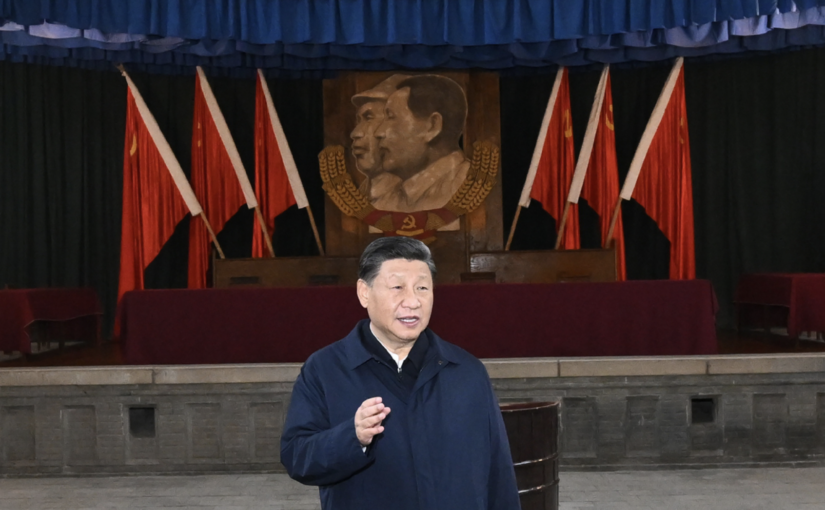
Shortly after the conclusion of the 20th National Congress of the CPC, General Secretary Xi Jinping led a visit of all seven members of the newly elected Politburo Standing Committee to Yan’an, in Shaanxi, a very important location in China’s revolutionary history. Yan’an is where the Chinese Red Army set up its base at the conclusion of the Long March, in late 1935 – a base that served as the centre of the Chinese Revolution for over a decade. It was in Yan’an that several of the key building blocks of Chinese socialism – including the ‘barefoot doctor’ system of basic healthcare provision – were first developed. It is also where some of the classic musical and literary works of the Chinese Revolution were composed, including the famous song ‘The East is Red’, the melody of which was based on a local folk song.
This is the third time that Xi has led a post-Congress visit of the newly elected Standing Committee to an important revolutionary site (the first was in 2012, to The Road to Renewal exhibition in Beijing; the second was in 2017, to the site of the CPC’s First Congress in Shanghai), stating that “the revolutionary sites are like a book that is worth reading all the time” in order to feel inspired by the heroic feats of the Chinese Revolution and to continuously deepen the leadership’s connection to the CPC’s founding principles and objectives. To uphold the legacy of the Yan’an period, “all Party members must stand firmly with the people, act on the Party’s purpose, put into practice the mass line, maintain close ties with the people, take the initiative to apply the people-centered development philosophy to all work, and achieve solid progress in promoting common prosperity, so that the people share more fully and fairly in the gains of modernization.”
We reproduce two articles below reporting on the trip, one from China Daily and one from Xinhua.
Xi urges efforts to carry forward great founding spirit of CPC and Yan’an Spirit
Less than a week after the conclusion of the 20th National Congress of the Communist Party of China (CPC), Xi Jinping, general secretary of the CPC Central Committee, president of the People’s Republic of China, and chairman of the Central Military Commission, led the members of the Standing Committee of the CPC Central Committee Political Bureau to visit Yan’an, an old revolutionary base in Northwest China’s Shaanxi province. The members are Li Qiang, Zhao Leji, Wang Huning, Cai Qi, Ding Xuexiang and Li Xi. They were there to pay tribute to this sacred land of the Chinese revolution, review the eventful days of the Party Central Committee in Yan’an in the years of the revolutionary war, commemorate the great achievements made by revolutionaries of the older generation, and manifest the conviction of the new central leadership to carry forward the Party’s revolutionary legacy and fighting spirit and present an excellent answer sheet to the people and posterity with new achievements on the road ahead. Xi stressed that we will carry forward the great founding spirit of the Party, the Yan’an Spirit, and our fighting spirit, remain confident in our history, and exhibit greater historical initiative to strive in unity for the fulfillment of the objectives and tasks set forth at the 20th CPC National Congress.
On the morning of October 27, Xi Jinping and the others arrived at the revolutionary site of Yangjialing in northwest Yan’an. In November of 1938, all departments of the CPC Central Committee moved from Fenghuang Hill to Yangjialing, where the CPC held its Seventh National Congress, launched the Yan’an Rectification Movement, and led the Chinese people in the War of Resistance Against Japanese Aggression.
Continue reading Xi Jinping urges efforts to carry forward the founding spirit of the CPC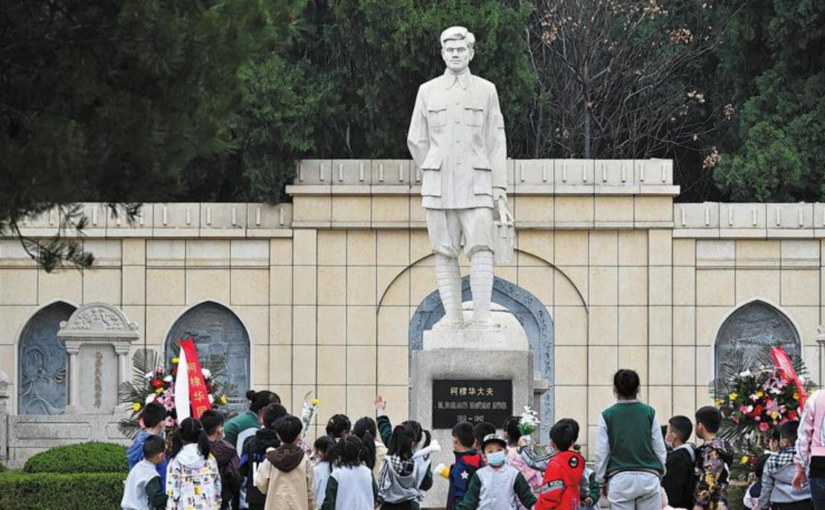
Red Salute to Dr DS Kotnis on the 110th anniversary of his birth
October 10 sees the 110th birthday of Dr. Dwarkanath Shantaram Kotnis, Indian surgeon, internationalist fighter, and member of the Communist Party of China.
Dr. Kotnis was one of a team of five Indian doctors, one of whom had previously served with the International Brigades in Spain, who were sent to help the Chinese people in their war of resistance against Japan by India’s Congress party, then led by Jawaharlal Nehru and Subhas Chandra Bose, after China’s Red Army leader Zhu De had written a request to Nehru on the suggestion of Agnes Smedley, the American internationalist who maintained deep ties with the freedom movements in both countries.
The team were seen off from Calcutta (today’s Kolkata) by Congress leaders Bose and Sarojini Naidu, who, at the conclusion of a mass meeting in Jinnah Hall, said: “You are sent to the war-stricken people of China as messengers of goodwill and sympathy. One or some of you may not return home.” Dr. Kotnis is the one who did not return.
In the spirit of the great Canadian communist, Dr. Norman Bethune, who the team had gone to replace following his death from sepsis incurred while operating behind enemy lines, Dr. Kotnis worked tirelessly, sometimes for 72 hours without sleep. He refused any special treatment, taught himself fluent Chinese, and passed on his knowledge by writing two textbooks on surgery (one uncompleted, he was actually struck by a fatal seizure as he was writing), and becoming a teacher and then the head of the Bethune Medical School.
It was while teaching at the school that he met, fell in love with and married Guo Qinglan, a nurse and nursing teacher. Their son, Yinhua, whose name means India-China was born just four months before Dr. Kotnis’s death.
Participation in the Chinese revolution had a profound effect on Dr. Kotnis. In an April 1, 1942 letter to his fellow team member, Dr. BK Basu, he wrote: “You know very well how backward I was before reaching Yan’an, my brain full of bourgeois ideas, and though full of national sentiments, hazy ideas of revolutionary methods. During over one year’s stay here, living the life of an Eighth Route Army man, ever receiving criticism from comrades, both during meetings and personal talks, I have myself been experiencing a good deal of transformation in my character, ideas etc.”
In July that year, Dr. Kotnis was admitted to membership of the Communist Party of China. When a student graduated from the Bethune School, Kotnis would write them the following words of encouragement: “Study hard for the sake of the liberation of the oppressed mankind” in English, and “Victory in the war of resistance against Japan” in Chinese.
In Shijiazhuang, the capital of Hebei province, the Ke Dihua (Kotnis’s Chinese name) Medical Science Secondary Specialized School, was founded in 1992. More than 45,000 medical professionals have graduated from it. Each of the new students and staff must swear in front of a statue of Kotnis that they will work like him.
Continue reading Red Salute to Dr DS Kotnis on the 110th anniversary of his birth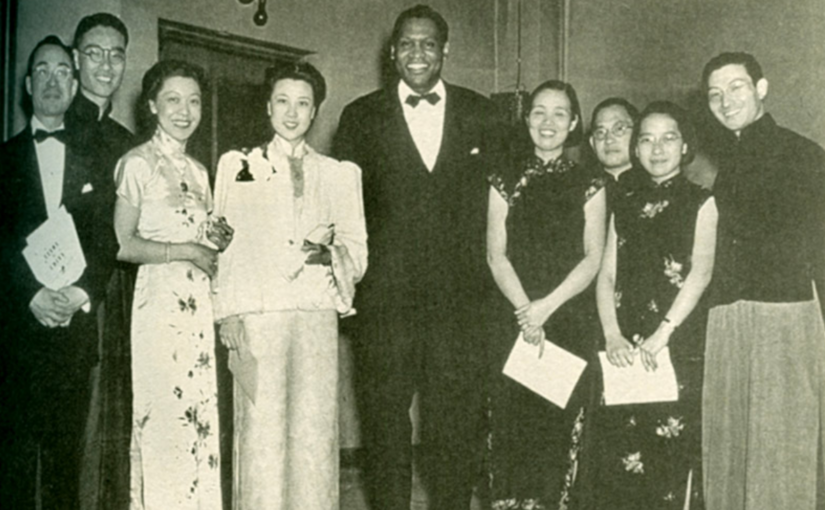
Why the People’s Republic of China embraced Paul Robeson
The below article by Gao Yunxiang (Professor of History at Toronto Metropolitan University in Canada and author of the critically acclaimed Arise, Africa! Roar, China! Black and Chinese Citizens of the World in the Twentieth Century, published last year) is a fascinating and detailed account of the special relations between the Chinese revolution and the great African-American singer, actor and Marxist Paul Robeson (1898-1976), which date from the 1930s and which still resonate today. Professor Gao describes this as “part of the history that connects Black internationalism with the experiences of Chinese and Chinese American people.”
She explains that the Chinese love for Robeson “derives most of all from his role in globalising the future national anthem of the People’s Republic of China.” Introduced to it in November 1940, for Robeson, its lyrics “expressed the determination of the world’s oppressed, in their struggle for liberation.” In November 1941, he recorded it in an album together with the Chinese People’s Chorus, which had been organised by members of the Chinese Hand Laundry Alliance, an important working-class organisation in New York City’s Chinatown. Soong Qingling, widow of China’s first president Dr. Sun Yat-sen, and later Honorary President of the People’s Republic of China, described Robeson as the “voice of the people of all lands.”
However, Robeson’s connections to the struggles and aspirations of the Chinese people date back to at least 1935, when he met in London with Mei Lanfang, considered the father of modern Peking Opera, who was returning from three weeks of successful appearances in the Soviet Union.
On October 1 1949, when Chairman Mao proclaimed the founding of the People’s Republic of China, Robeson sang the national anthem on the streets of Harlem and cabled his congratulations to the Chinese leader. Despite vicious persecution, he stood firm when Chinese forces entered the Korean war. Mutual support between the People’s Republic of China and the Democratic People’s Republic of Korea would, he insisted, be the “great truth” in their shared journey to freedom. It was only logical for Chinese volunteers to come to “the aid of the heroic Korean people.”
The article also highlights how the 1940 film ‘The Proud Valley’, starring Robeson and set in the mining communities of South Wales, was shown in China in the 1950s as well as his participation in mass China friendship activities in Britain after the US authorities were forced to restore his passport.
Whilst this article contains a couple of assertions towards its conclusion with which the editors of this website do not agree, we republish it because the fascinating and moving historical material it presents needs to be made known to the widest possible audience.
The article was originally carried by Australia’s Aeon Newsletter.
Several times in recent years, Chinese broadcasters have aired shows that feature Paul Robeson (1898-1976), one of the most popular African American singers and actors of his era and a well-known civil rights activist. China National Radio and various channels of the widely influential China Central TV showcased Robeson on programmes in 2009, 2012 and 2021 narrating China’s resistance to foreign military aggressions. This is a remarkable amount of coverage in Chinese media for an American who died decades ago. Though not widely known in the United States, the relationship between Robeson and China continues to resonate in China today. It’s part of the history that connects Black internationalism with the experiences of Chinese and Chinese American people. Robeson was one of the most important figures in an alliance between Maoist China and politically radical African Americans.
Continue reading Why the People’s Republic of China embraced Paul Robeson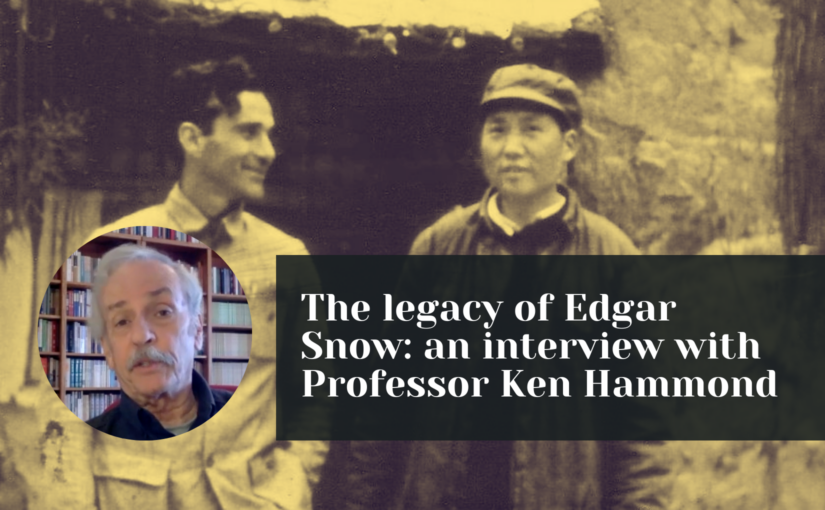
The legacy of Edgar Snow: an interview with Professor Ken Hammond
Edgar Snow, a lifelong friend of the Chinese people and proponent of US-China friendship, died 50 years ago, on 15 February 1972. His pioneering book Red Star Over China, written in 1937, was the first introduction to the Chinese Revolution for millions in the English-speaking world. It remains essential reading today, and Snow’s life continues to inspire those that live by the principles of solidarity, international friendship and peace.
Interviewed by Friends of Socialist China co-editor Carlos Martinez, Ken Hammond – professor of history at New Mexico State University and an expert in Chinese history, politics and language – discusses Edgar Snow’s early life, his political development, his relationship with the leadership of the Communist Party of China, the impact that ‘Red Star Over China’ had in the West, the relationship between US progressive circles and China over the decades, and the importance of getting US-China relations back on track.
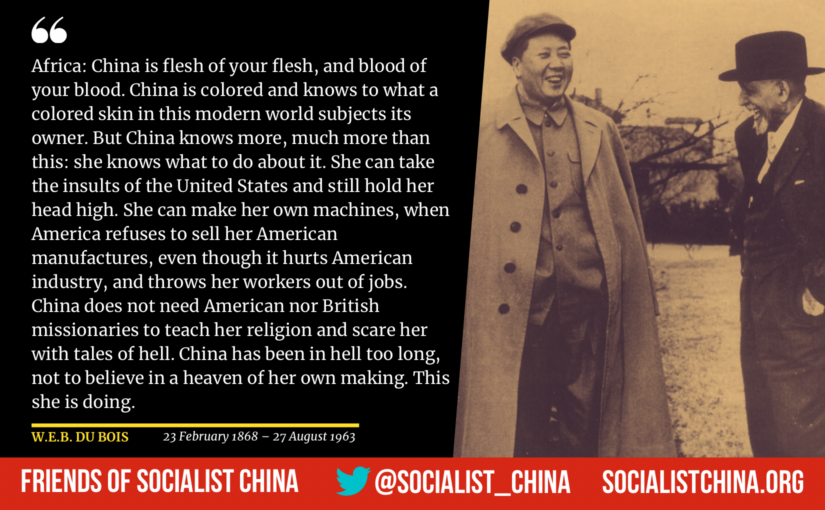
Speech of W.E.B. Du Bois in Beijing University in 1959
On the 154th anniversary of his birth, we are pleased to republish this speech given in Beijing by the great African-American communist, Pan-Africanist, scholar and freedom fighter W.E.B. Du Bois on the occasion of his 91st birthday.
By courtesy of the government of the 600 million people of the Chinese Republic, I am permitted on my 91st birthday to speak to the people of China and Africa and through them to the world. Hail, then, and farewell, dwelling places of the yellow and black races. Hail human kind!
I speak with no authority; no assumption of age nor rank; I hold no position, I have no wealth. One thing alone I own and that is my own soul. Ownership of that I have even while in my own country for near a century I have been nothing but a “nigger.” On this basis and this alone I dare speak, I dare advise.
China after long centuries has arisen to her feet and leapt forward. Africa, arise, and stand straight, speak and think! Act! Turn from the West and your slavery and humiliation for the last 500 years and face the rising sun.
Continue reading Speech of W.E.B. Du Bois in Beijing University in 1959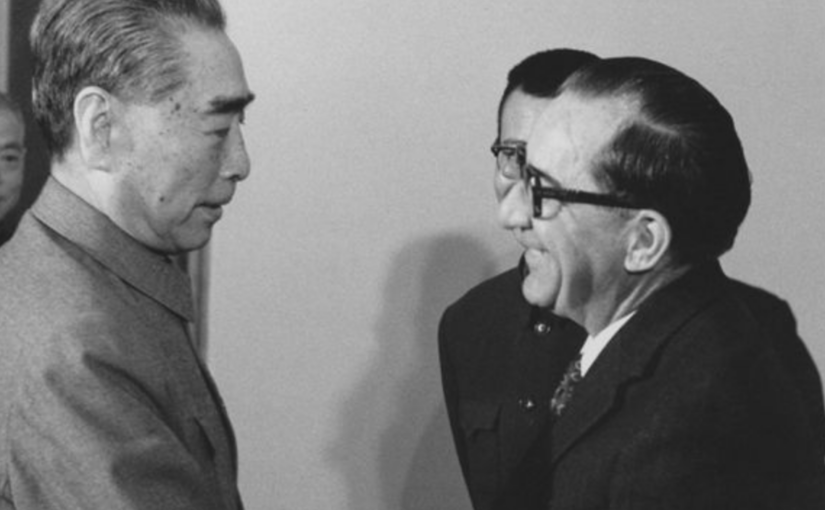
China’s loans and projects transformed Malta’s economy
This year sees the 50th anniversary of the establishment of diplomatic relations between China and Malta. China is a large country in East Asia with a population of some 1.4 billion people. Malta is a small European country in the Mediterranean with a population of less than half a million. Yet the two countries share a deep and profound friendship.
With the Golden Jubilee of diplomatic relations approaching, on January 10, President Xi Jinping had a telephone conversation with his Maltese counterpart George Vella. According to the official read out from the Chinese Foreign Ministry:
“Xi Jinping pointed out, China and Malta are old and good friends that have withstood the test of time. Half a century ago, the elder generation of Chinese and Maltese leaders, with great vision and foresight, jointly forged friendly relations between China and Malta. Over the past 50 years, no matter how the international situation changes, China-Malta relations have been developing in a sound and steady manner, with deepening friendship and fruitful cooperation in various fields. In the face of challenges such as the international financial crisis and the COVID-19 pandemic, the two sides have always helped and supported each other.”
For his part, President Vella responded: “Bilateral relations have become more mature and made remarkable achievements, setting a good example of state-to-state relations. Malta is firmly committed to further developing its friendly relations with China and is ready to strengthen high-level exchanges and deepen practical cooperation with China in various fields. Malta cherishes the precious opportunities brought by Belt and Road cooperation and is ready to continue to advance relevant cooperation with China. I hope that Malta-China relations will develop even better in the next 50 years and bring more benefits to the two peoples. Malta firmly adheres to the one-China principle and firmly supports multilateralism. Malta is ready to play a positive role in promoting the development of EU-China relations. Malta highly appreciates China’s vaccine aid for the international community’s fight against the COVID-19 pandemic and its positive contribution to the global response to climate change, and looks forward to closer cooperation with China.”
Although Malta won its independence from a century and a half of British colonial rule in 1964, it remained a neo-colony under the military and economic domination of British imperialism. All that was set to change with the election of a Labour government under the Prime Ministership of Dom Mintoff in 1971. Under his visionary leadership, Malta was transformed from a British neo-colony into a bastion of anti-imperialism and a mainstay of the Non-Aligned Movement. He also expanded the state and public sector of the economy, with extensive nationalisation, established a comprehensive welfare state, and enacted key social reforms, including equal pay for men and women and the decriminalisation of homosexuality. All this required the forging of international alliances and Mintoff assiduously developed close friendships with such outstanding revolutionary leaders of the developing world as Mao Zedong, Kim Il Sung, Muammar Gadaffi and Nicolae Ceausescu, among others. Above all, it was Mintoff’s deep and genuine friendship with Socialist China that enabled Malta to expel the British military bases and to stand up in the world. This writer vividly remembers the consternation of the British TV newsreader reporting Mintoff’s crossing back into the then British colony of Hong Kong, sporting a large badge of Chairman Mao on his suit jacket lapel following a meeting in Beijing with the Chinese leader.
Naturally all this earned Mintoff the undying hatred of the British ruling class. Particular and sustained vitriol was poured by the Daily Mail, a right wing British daily which had supported the British Union of Fascists in the 1930s, who dubbed him “desperate Dom”. Their hatred became positively apoplectic when his daughter Yana, then a student in London, and a key activist in the Troops Out Movement (TOM), campaigning for Irish independence and reunification, hurled horse dung on MPs from the public gallery of the House of Commons in solidarity with the ‘dirty protest’ waged by Irish Republican prisoners in the north of Ireland. (The ‘dirty protest’ was to culminate in the 1981 hunger strike in which 10 young Volunteers from the Irish Republican Army and the Irish National Liberation Army were to heroically lay down their lives.)
Without the British military bases, Malta would have faced economic ruin. That is why, in 1975, China built Dock Number Six in the harbour of the Maltese capital Valetta. Far better known as the Red China Dock, this engineering feat remains the largest dry dock in the Mediterranean. At that time, China was still a poor country and its economy was reeling from the turmoil of the Cultural Revolution. On a per capita basis, Malta was clearly a more prosperous country. But Chairman Mao and Premier Zhou Enlai saw it as their solemn internationalist duty to help Malta take the road of independence and the building of a new society.
Visiting the Red China Dock on 7th September 2021, China’s Ambassador to Malta Yu Dunhai noted that it is, “a significant symbol of China-Malta friendship and remains as a monument in the heart of the people devoting themselves to China-Malta friendship. More than 40 years ago, China overcame its economic and technological limits, provided 100 million RMB interest-free loan and sent about 800 technicians to Malta to construct the dry dock, which showcases the sincere friendship between our two countries. Two Chinese engineers, Mr. Xu Huizhong and Mr. Gu Zhaoyan, lost their lives during the construction. Their great effort and sacrifice laid solid foundation for China-Malta ongoing friendship.”
We are therefore very pleased to reproduce from Shine News, the online platform of the prestigious Shanghai Daily, the following interview with Dr Alex Sceberras Trigona, Foreign Minister of Malta from 1981-87. In this period, Dr Trigona worked closely with Deng Xiaoping to carry forward and develop the friendship established with the preceding generation of Chinese leaders.
(Introduction by Friends of Socialist China co-editor Keith Bennett).
Dr Alex Sceberras Trigona recalls the big moment when he had to arrange a meeting between Malta Prime Minister Dom Mintoff and Chinese leader Deng Xiaoping in 1982 when he served as Malta’s minister for foreign affairs.
China and Malta established diplomatic ties in 1972, and Sceberras Trigona was instrumental in strengthening the relationship between the two countries during his tenure as foreign minister from 1981 to 1987. He has lost track of the number of times he has visited China but thinks “it could be 30 to 40 times” at least.
He has experienced the “hospitality and big heart” of China and was involved in the documentation and negotiations of projects that China helped build in Malta. He had negotiated and concluded Malta’s Neutrality Agreements in the worst years of the Cold War and has met generations of the Chinese people, from leaders to young students. He opened Malta’s embassy in Beijing.
Continue reading China’s loans and projects transformed Malta’s economy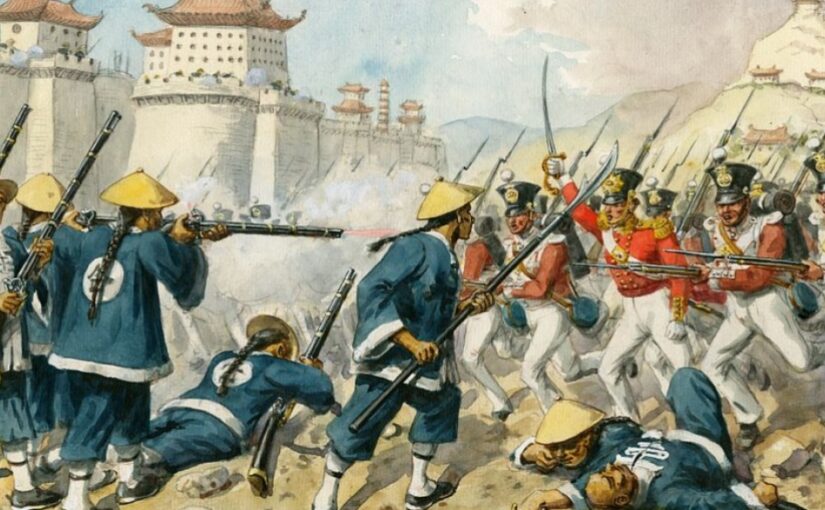
Damning imperialism: Marx’s writing on China
We are pleased to republish this article by Nick Matthews highlighting Karl Marx’s writings on China, originally published in the Morning Star.
Although not as well-known as his writings on Ireland and India, Marx paid a great deal of attention to China and not least to its relations with Western powers, Britain in particular. Much of his writing on the subject originally appeared in the form of articles for the New York Daily Tribune. As a passionate opponent of colonialism, Marx was outraged at Britain’s predatory Opium Wars against China and he supported the Chinese people’s resistance to foreign aggression without any equivocation.
Matthews’ article also contains useful background information on the New York Daily Tribune as well as on the work of Donna Torr, a foundation member of the Communist Party of Great Britain, whose work in Moscow included translating the works of Marx and Engels and who edited the definitive collection of Marx’s journalistic work on China, first published in 1951.
China and Marxism have been much discussed lately. Hearing these voices reminded me that Karl Marx himself had written extensively about China. How his views have come down to us is quite a tale.
In the late 1840s, Charles Anderson Dana, like many well-to-do Americans, took a trip to Europe.
In Paris he came across an uncompromising German radical who seemed to understand everything that was going on in those revolutionary times. This was of course Karl Marx.
Continue reading Damning imperialism: Marx’s writing on China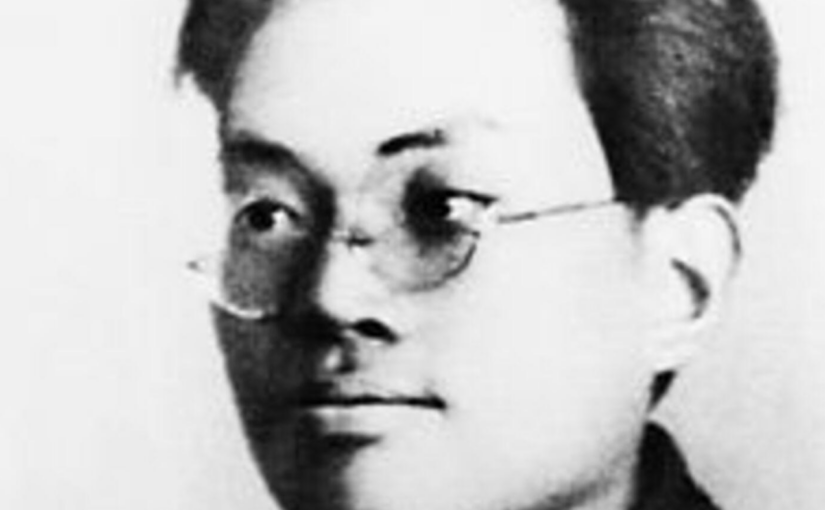
Zhang Tailei: ‘Thunderstorm’ of China’s revolution
In this paper, presented at the Fifteenth Forum of the World Association for Political Economy (WAPE), held 18-19 December 2021 at the Shanghai International Studies University and online, John Riddell introduces the life of an early pioneer and martyr of the Chinese revolution, honoured in his own country, but who deserves to be better known internationally. John, a lifelong socialist activist, is the founding editor of the Comintern Publishing Project and probably the foremost contemporary scholar of the early Communist International (Comintern) working in the English language. He has translated and edited numerous volumes of Comintern proceedings. We are grateful to him for making his paper available to us.
To understand the rise of China, it is helpful to get acquainted with the life and work of lesser-known figures who contributed to the liberation struggle. Such an activist is Zhang Tailei (1898–1927), whom I learned of while translating the proceedings of a global Communist congress held in 1921.[1] Little documentation on Zhang is available in the West. This brief sketch aims to highlight his main achievements; I hope it may help lead us to an account based on fuller access to Chinese sources.
Among the early leaders of the Communist Party of China (CPC), Zhang Tailei was one of the first to propose unity in action of diverse political forces to defend China against aggression by the imperialist powers. Zhang was a respected leader not only of his party but also of a world revolutionary association, the Communist International.[2]
Continue reading Zhang Tailei: ‘Thunderstorm’ of China’s revolution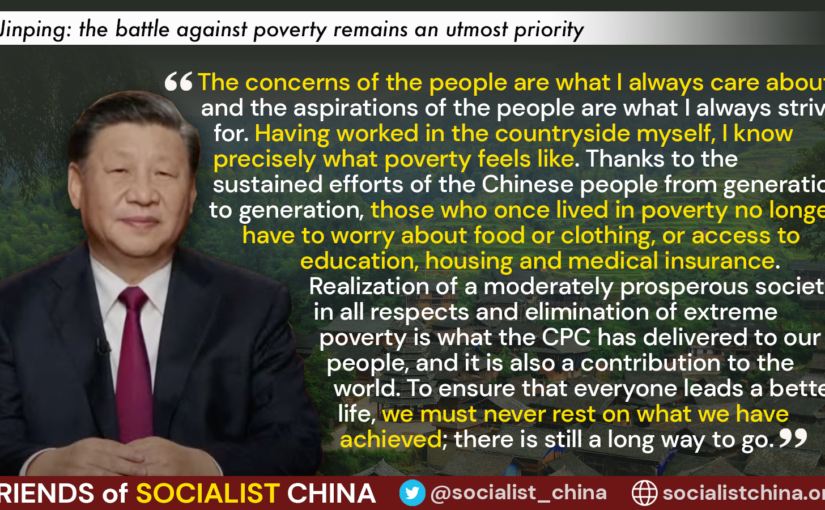
New Year address by President Xi Jinping
We reprint here President Xi Jinping’s New Year Address for 2022 delivered from Beijing on New Year’s Eve. In direct and vivid language, the Chinese President succinctly covers a broad canvas ranging from nature to sports to space exploration. He reflects on the great achievements of an extraordinary year that saw the centenary of the founding of the Communist Party of China and the adoption of a major resolution on party history:
Standing on the Tian’anmen Rostrum, one could only marvel at the extraordinary journey traveled by this major Party, a journey of Chinese Communists leading the Chinese people, in their hundreds of millions, in an unyielding struggle against all obstacles and challenges, and scoring spectacular, epoch-making achievements over the past century.
China’s historic victory over extreme poverty was naturally another major theme. As a seasoned Marxist, in his Address, Comrade Xi integrated the general with the particular on the basis of the mass line:
The myriad of things we attend to all boil down to matters concerning every household… The concerns of the people are what I always care about, and the aspirations of the people are what I always strive for.
Reviewing his country’s signal contribution to the global battle against Covid-19, the Chinese President noted:
Only through unity, solidarity and cooperation can countries around the world write a new chapter in building a community with a shared future for mankind.
Embedded below the text is CGTN’s video version of the speech, with English subtitles.
My greetings to you all. The year 2022 is approaching. From Beijing, I extend New Year wishes to all of you!
The past year has been a year of exceptional significance. We have lived through landmark events in the history of our Party and our country. At the historical convergence of the Two Centenary Goals, we have set out on a new journey of building a modern socialist country in all respects and are making confident strides on the path toward the great rejuvenation of the Chinese nation.
Continue reading New Year address by President Xi Jinping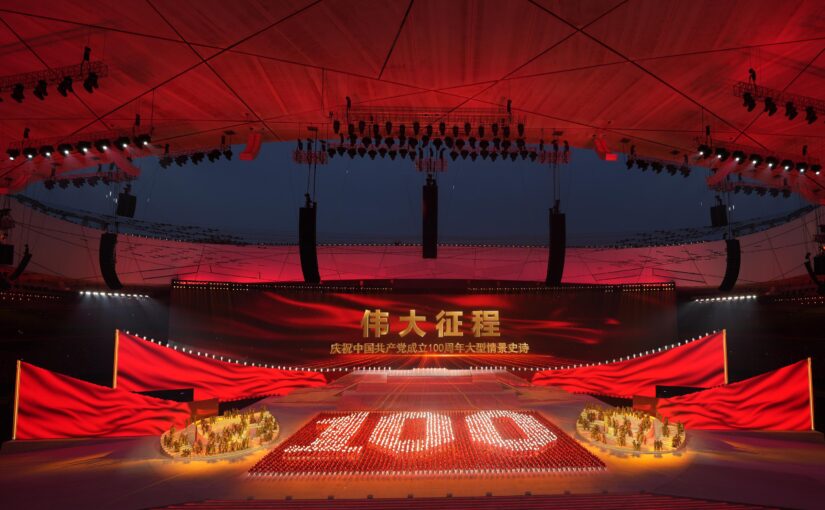
The CPC at 100 – An exemplar in the innovation and adaptation of Marxism
The 12th World Socialism Forum was held on December 21st 2021, hosted by the Chinese Academy of Social Sciences (CASS) and organised by the World Socialism Research Centre, the Academy of Marxism and the Research Centre of Xi Jinping Thought on Socialism with Chinese Characteristics for a New Era of CASS. It was held in the Chinese Academy of History of CASS, with both offline and online participation.
The theme of the event was the Preservation and Innovation of Marxism in the 21st Century, with a key focus on:
- The Major Achievements and Inspiring Experience of the Communist Party of China over the Past Century
- The Contribution of the Path of Socialist Political Development with Chinese Characteristics to Political Civilisations of Humanity
- Lessons and Insights from the Downfall of the Soviet Communist Party and the Dissolution of the Soviet Union
- Upholding and Developing Marxism in the 21st Century
The Forum heard a total of 23 presentations, including 13 from leading Chinese Marxist thinkers and theoreticians as well as from the Cuban Ambassador to China; Egon Krenz, former leader of the German Democratic Republic (GDR); two speakers from Russia, including the Vice Chair of the Communist Party of the Russian Federation (CPRF); Keith Bennett, Co-Editor of Friends of Socialist China; and speakers from Argentina, Italy, Cameroon, Venezuela and Vietnam.
We print below Keith Bennett’s speech to the Forum.
Dear Comrades and Friends
On behalf of Friends of Socialist China, a platform established earlier this year to support the People’s Republic of China and spread understanding of Chinese socialism on the basis of Marxism, I’d like to extend our thanks to the World Socialism Forum for inviting us to attend this important meeting and to submit a paper. We also extend warm greetings to everyone participating and hope that we can find concrete ways of working together in the future.
Continue reading The CPC at 100 – An exemplar in the innovation and adaptation of Marxism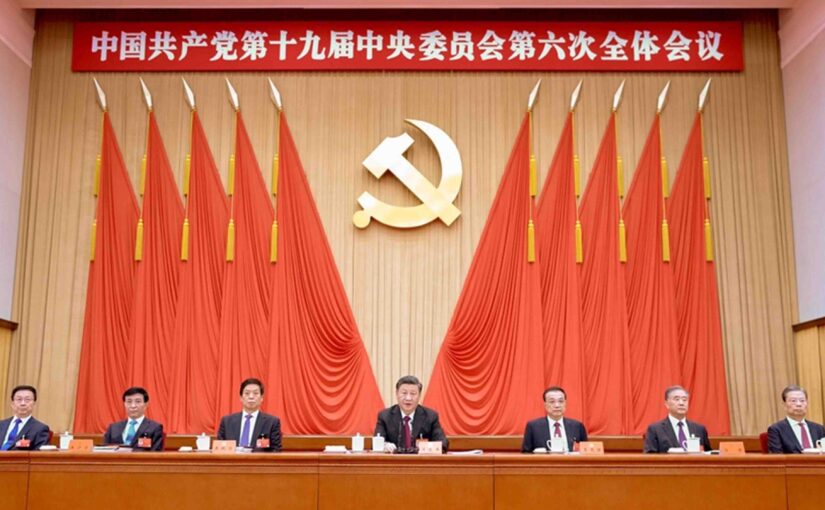
John Ross: The international and historical significance of the resolution on the history of the CPC
In his latest article, which we are pleased to republish from Learning from China, John Ross provides a useful summary of the three key resolutions on party history adopted by the Communist Party of China in its century of struggle. Against this background, John further outlines how generations of Chinese communists, and especially Mao Zedong, Deng Xiaoping and Xi Jinping, have defended, applied, enriched and developed Marxism-Leninism and in so doing have not only immeasurably improved the lives of the Chinese people but also contributed significantly to the progress of humanity, especially to the liberation struggles of the countries and peoples of Asia, Africa and Latin America.
The following article was originally published in Chinese by Guancha.cn.
The “Resolution on the Major Achievements and Historical Experience of the Party over the Past Century”, adopted by the Sixth Session of the 19th Central Committee of the Communist Party of China (CPC) in November 2021, is, rightly, regarded as in the first place an issue for China itself. As the Resolution notes in its first sentence: “Since its founding in 1921, the Communist Party of China (CPC) has remained true to its original aspiration and mission of seeking happiness for the Chinese people and rejuvenation for the Chinese nation.”
It is obviously correct to start with the position of China itself. But the second sentence of the Resolution starts by noting the connection of China’s national struggle with international developments – in particular in regard to socialism: “Staying committed to communist ideals and socialist convictions, it [the CPC] has united and led Chinese people of all ethnic groups in working tirelessly to achieve national independence and liberation.” Indeed, for reasons that will be analysed, this resolution on the history of the CPC is of very great international and historical importance for all countries as well as for China itself. Therefore, while in no way wishing to deflect from the correctly China focussed nature of discussion on the Resolution, it is also hoped here it may cast some light on the discussion if international aspects of the significance of the Resolution are also considered.
Continue reading John Ross: The international and historical significance of the resolution on the history of the CPC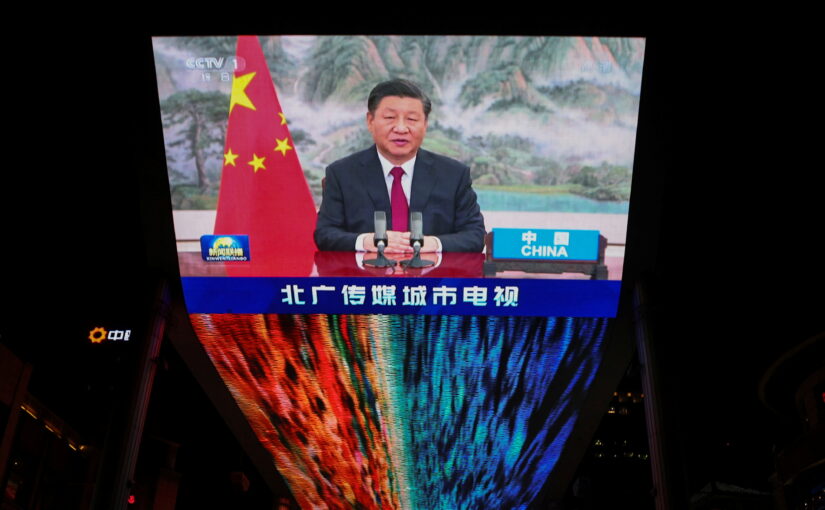
Xi’s explanation of resolution on major achievements and historical experience of CPC over past century
The following address was given by Xi Jinping, General Secretary of the Communist Party of China, to the plenary meeting of the Party’s Central Committee, held in Beijing from 8 to 11 November 2021. It provides a detailed explanation of the contents of the Resolution on the Major Achievements and Historical Experience of the Party over the Past Century that was adopted by the meeting as well as outlining how the document was drafted and revised. It provides an excellent introduction to and summary of the Resolution and deserves careful study.
On behalf of the Political Bureau of the 19th Central Committee of the Communist Party of China (CPC), I will now brief you on the Resolution of the CPC Central Committee on the Major Achievements and Historical Experience of the Party over the Past Century and related issues.
I. Considerations on the Agenda of the Sixth Plenary Session of the 19th CPC Central Committee
Our Party has always attached great importance to reviewing its historical experience. As early as in the Yan’an period, Comrade Mao Zedong pointed out, “We will not be able to achieve greater success unless we have a clear understanding of our history and of the roads we have traveled.”
In 1945, at the critical juncture for securing final victory in the War of Resistance against Japanese Aggression, the Sixth CPC Central Committee convened its seventh plenary session and adopted the Resolution on Certain Questions in the History of Our Party. The resolution reviewed the history of the Party and the experience it had gained and lessons it had learned since its founding in 1921, especially those in the period between the fourth plenary session of the Sixth Central Committee in January 1931 and the Zunyi Meeting in January 1935. It drew conclusions on major historical issues of the Party, leading to a broad consensus among all Party members, particularly high-ranking officials, on fundamental questions pertaining to the Chinese revolution. It served to strengthen the solidarity of the Party, paved the way for the convocation of the Seventh CPC National Congress, and helped advance the Chinese revolution significantly.
Continue reading Xi’s explanation of resolution on major achievements and historical experience of CPC over past century
From poverty to prosperity, China’s century
This very interesting article by University of Glasgow professors Asit K Biswas and Cecilia Tortajada provides an overview of the extraordinary economic, political and scientific progress China has made since liberation – with a particular focus on the strategy of Reform and Opening Up – and analyses how this progress provides the foundations for achieving the country’s ambitious goals around sustainable development. The article was originally published in China Daily on 12 November 2021.
The speed, scale and span of the economic and social transformation of China during the past 40-odd years have been unprecedented in human history.
One hundred years ago, times were not good for China. Its 400 million people lived mainly in rural areas, mired in poverty. It was a nation ravaged by imperial mismanagement, foreign colonialism and civil wars.
On July 23 1921, 13 disillusioned Chinese young men and two representatives from the Communist International, met secretly in an inconspicuous house, 106 Rue Wantz, in Shanghai’s French Concession, which began the first national congress of the Communist Party of China (CPC). The police interrupted the meeting on July 30, and the Chinese members shifted their discussions to a tourist boat on the South Lake in Jiaxing, Zhejiang province, to continue the first National Congress. The first congress marked the founding of the CPC.
Continue reading From poverty to prosperity, China’s century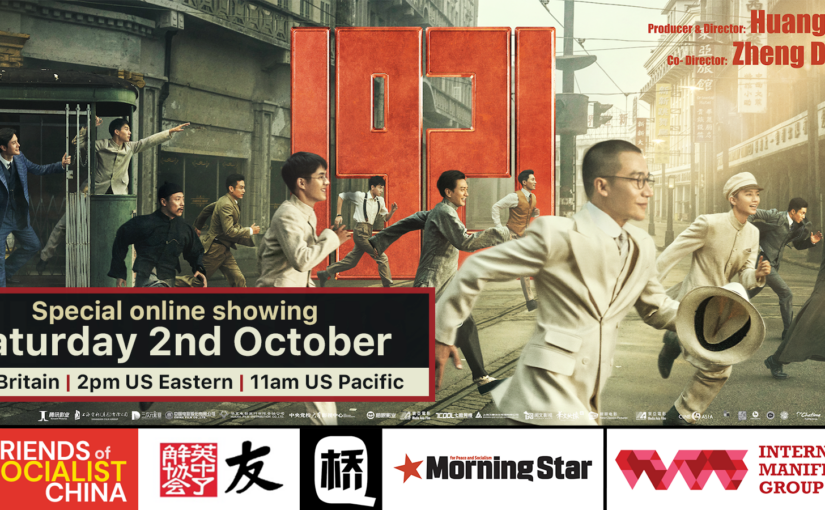
Reminder: Special online showing of ‘1921’ (2 October)
Friends of Socialist China are pleased to offer a rare opportunity to watch the film 1921.
- Date: Saturday 2 October 2021
- Time: 7pm Britain / 2pm US Eastern / 11am US Pacific
- Registration: Eventbrite
About ‘1921’
‘1921’ is a full length feature film produced to mark this year’s centenary of the Communist Party of China. It is set against the background of the intense class struggle waged by the young Chinese working class in Shanghai in particular. The action also takes us to Moscow, Paris and elsewhere. Key early Chinese communists like Li Dazhao, Chen Duxiu, Mao Zedong and Deng Xiaoping all feature in this not to be missed film. As gripping as any Hollywood blockbuster, it is also an education and an inspiration.
A review by Friends of Socialist China co-editor Keith Bennett can be read online.
Please note the film is in Mandarin Chinese with English subtitles.
Who is organising the screening?
This event is organised by Friends of Socialist China, in coordination with Trinity Cine Asia. It is co-sponsored by the Society for Anglo-Chinese Understanding, the Morning Star, the Geopolitical Economy Research Group, the International Manifesto Group, and Qiao Collective.
How does the online screening work?
At the start time (7pm Britain, 2pm US Eastern, 11am US Pacific), registered users will receive (by email) a link to stream the film. They will then have a three-hour window in which to watch it.
Why are we charging for this event?
Please note that Friends of Socialist China are not making any money from the showing; our purpose in arranging it is to ensure that its important political and cultural content reaches a wider audience. However, Trinity Cine Asia, with whom we are partnering to organise the screening, have paid the costs of distribution and marketing; therefore all proceeds go to them.