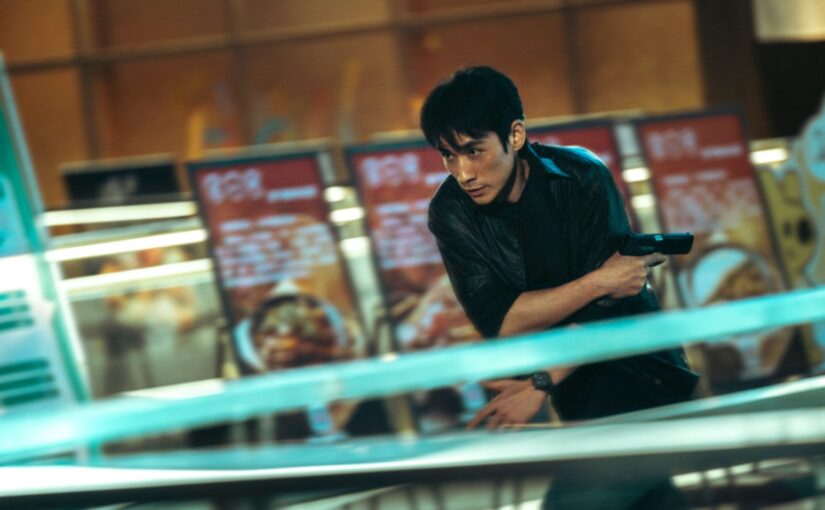
David Peat, secretary of the Friends of Socialist China Britain committee and editor at Iskra Books, reviews the latest film by the “grandmaster” of Fifth Generation Chinese cinema, Zhang Yimou. A contemporary espionage thriller, made with assistance from China’s Ministry of State Security, which, in a first of its kind, advised actors on surveillance techniques, the film is based on some real life counterespionage cases.
This article contains no spoilers for Scare Out.
Scare Out is the latest film by one of China’s greatest cinematic legends, Zhang Yimou. Best known in the West for his epic, gravity-defying martial arts and historical epics such as Hero (2002), and stories exploring China’s 20th Century history such as To Live (1991), less well-known is the fact that Zhang Yimou was also behind what many consider modern China’s greatest (and largest-scale) statement of cultural soft power to date — the Opening Ceremony of the 2008 Beijing Olympics, co-directed with choreographer, and Lieutenant General of the People’s Liberation Army, Zhang Jigang. Zhang Yimou also directed the closing ceremony in 2008, as well as the opening and closing ceremonies of the 2022 Winter Olympics and 2022 Winter Paralympics.
His latest film, Scare Out, is a high-tech espionage thriller, its contemporary setting unusual for the Chinese market, which has typically focussed on spy stories in historical settings, including Zhang Yimou’s own 2021 film Cliff Walkers, set in Japanese-occupied Manchuria during the 1930s. Based on details of some real-life counterespionage cases in China, Scare Out tells the story of an Internal Security team putting everything on the line to defeat threats both foreign and domestic, and stars boy band member turned movie star Jackson Yee, noted especially for his parts in The Battle at Lake Changjin (2021) and its sequel the following year, set during the War to Resist US Aggression and Aid Korea (1950-53), as Yan Di, a security officer, second-in-command to Colonel Huang Kai (Zhu Yilong). The story kicks off with a bungled apprehension of a suspect who was attempting to smuggle secrets of China’s sixth generation fighter jet stealth systems to an unspecified but heavily-hinted at foreign nation, after which it is revealed that the leadership suspects the presence of a mole within the counter-espionage department. The story escalates with many twists and turns, and the atmosphere of suspicion and paranoia continues to grow as all members of the team, but particularly our two lead characters, are placed under suspicion. The intrigue is sustained and heightened by the hyper-kinetic editing which combines CCTV overlays with dizzying and cutting-edge drone cinematography of Shenzhen, showcasing China’s by-now signature nightscapes: dazzling forests of LED-adorned skyscrapers. This innovative and modern film-making shows that, even at 75, Zhang Yimou is continuing to experiment and innovate.
The film is also notable as the first contemporary instance in which China’s Ministry of State Security has explicitly contributed to the production. Director Zhang Yimou highlighted in interviews their contributions to realism in terms of how surveillance is carried out, real-life details of some counterespionage cases, and even providing insights into officers’ emotional responses, to aid the actors’ performances. No doubt the idea of such cooperation will raise some eyebrows with Western audiences, but they should perhaps direct their attention instead to the role that US military and security services play in Hollywood – a 2025 paper from Brown University estimated that “since the inception of the Hollywood entertainment industry… over 2,500 war-themed movies and TV programs have been made with Pentagon assistance.”[1] It should also be noted that, given the US’ waning but still overwhelming cultural hegemony, these films, which the Pentagon has tweaked to ensure they serve imperialism’s interests, overwhelmingly dominate at cinemas around the world, almost always without acknowledgement of the security services’ interference.
Internal Security and (counter)espionage in socialist and/or sovereignty-building states serve different functions from those services in imperialist countries. In the former, their primary function is ensuring the hard-earned successes of the revolutionary process are not undermined, whereas in the latter case they primarily focus on oppressing their own populations and seeking to destabilise the sovereignty of countries not under imperialist domination (which, in turn, necessitates more stringency from those countries’ defences).
The long revolutionary journey of the Communist Party of China (CPC) saw them facing against undermining efforts from Nationalist (Guomindang) forces, including outright betrayals during the periods of temporary alliance. Moreover, the CPC had to deal with Japanese spies and their collaborators. As such, the Party, upon the establishment of the People’s Republic, recognised the enormous importance of Internal Security, with Premier Zhou Enlai holding an important role in the development of these services. Premier Zhou also emphasised the importance of National Security being embedded within the wider project of socialist construction, and followed the approach of “combining specialised work with the mass line” [结合专门工作与群众路线], throughout his tenure as Premier, further elaborating on this concept in a 1975 speech, stating the need to “ensure that the task of consolidating the dictatorship of the proletariat is fulfilled right through to the grass-roots level. We should rely on the broad masses to deal steady, accurate and hard blows at the handful of class enemies, with the emphasis on accuracy.”[2]
This film focuses on those undertaking the aforementioned “specialised work”, and therefore functions also as a statement of intent on the part of China’s internal security services: they will endure extreme sacrifices and exhibit endless vigilance in order to ensure and protect the achievements of the People’s Republic of China. Zhang Yimou stressed the message of the film: “We may never know who they are, but it is these countless unsung individuals who safeguard the peace and reunions we enjoy today.”[3] As hinted at in the director’s comment, the film was released during the Chinese New Year period, the most important window for the Chinese box office, and it is clear therefore that its message is intended to be heard far and wide.
Chinese president Xi Jinping, in his speech at the first session of 14th National People’s Congress in 2023, recalled China’s century of humiliation “when bullying by foreign powers and frequent wars tore the country apart and plunged the Chinese people into an abyss of great suffering.” Only through the strength and unity brought about by the Communist Party of China was it possible to end this tragedy, thanks to “the Chinese people of all ethnic groups…working hard for a century.”[4] Zhang Yimou’s latest film tells the story of some of those working hard at the most extreme edge of ensuring this tragic history is not repeated.
Scare Out is distributed by Trinity CineAsia, the trailer for the film can be viewed here. The film is currently showing at various venues across Britain and Ireland – see details here.
[1] ‘The Militarization of Movies and Television, Tanner Mirrlees, February 25, 2025. https://costsofwar.watson.brown.edu/sites/default/files/papers/Mirrlees-Militarization-of-Movies-and-TV.pdf
[2] Zhou Enlai, ‘Report on the Work of the Government’, https://www.marxists.org/reference/archive/zhou-enlai/1975/01/13.htm.
[3] Zhang Yimou, Renowned Chinese director Zhang Yimou on his latest national-security thriller ‘Scare out’: Hear the thunderclap in the silence, Global Times, https://www.globaltimes.cn/page/202602/1355539.shtml
[4] Xi Jinping, ‘Full text of Xi Jinping’s speech at first session of 14th NPC’, http://eng.mod.gov.cn/xb/News_213114/TopStories/16209361.html