The following article by Lee Siu Hin, originally published in Workers World, documents the scale and substance of China’s support for Cuba under the intensified pressure of Trump’s second term.
While the Trump regime tightens the screws on Cuba, China has been demonstrating its solidarity with the Cuban people in myriad ways, including sending food aid, restoring buses to the streets of Havana, and building solar power infrastructure designed to free Cuba from the energy stranglehold that forms the sharpest edge of the US blockade.
Since Trump returned to the White House last year, the embargo on Cuba has reached its most punishing levels. The US invasion of Venezuela in January, which severed Cuba’s oil supply lifeline, has compounded the crisis. Cuba faces food shortages, an energy emergency, and the continued denial of basic medical supplies – not through political or economic mismanagement (as the Western media would have you believe) but as a deliberate policy of economic warfare conducted by the US empire.
China’s response has been concrete and strategic. Ninety thousand tons of rice; emergency financial assistance of $80 million; medical equipment that Cuba cannot source elsewhere due to the embargo. The solar energy program being developed by the two countries is designed not merely to plug gaps but to structurally transform Cuba’s energy system so that it can enjoy energy sovereignty.
The economic aid provided by China constitutes a comprehensive, multi-pronged strategy, encompassing not only firm and robust political backing but also extensive, substantive assistance across vital sectors such as energy, food security and public welfare.
This is what solidarity looks like when it is not a gesture. Siu Hin concludes:
Everyone has a vital role to play in international solidarity. Western activists can also learn a great deal from the positive experience of the Global South, notably from China.
China has supported Cuba since its revolution in 1959. Shortly after, Che Guevara visited China in 1960 to secure comprehensive support for the newly born socialist island nation.
China played a critical role as a true friend in times of U.S. threat
For the past year, since Donald Trump returned to the White House in 2025, he has continued the imperialist policy of all-out blockade against Cuba — first during his initial term (2017–2021) and then under Biden (2021–2025). In response, China has offered timely and critical assistance to Cuba when it was needed most. The Chinese Foreign Ministry spokesperson declared on Jan. 27 that China “calls for immediate lifting of blockade and sanctions on Cuba. We will continue to support and assist Cuba.” (Spokesperson of Ministry of Foreign Affairs of China on X)
According to the Cuban government’s 2025 report to the United Nations, the ongoing U.S. economic blockade and sanctions caused an estimated over $7.6 billion in damages from March 2024 to February 2025. (cubaminrex.cu, May 2025)
Since Jan. 3, when the U.S. invaded Venezuela — killing over 100 people and kidnapping President Nicolás Maduro and First Combatant Cilia Flores to New York — President Trump has increased sanctions and threatened to invade Cuba. Losing oil imports from Venezuela and facing food shortages due to the U.S. blockade, Cuba received immediate humanitarian aid from China (food) and Russia (oil).
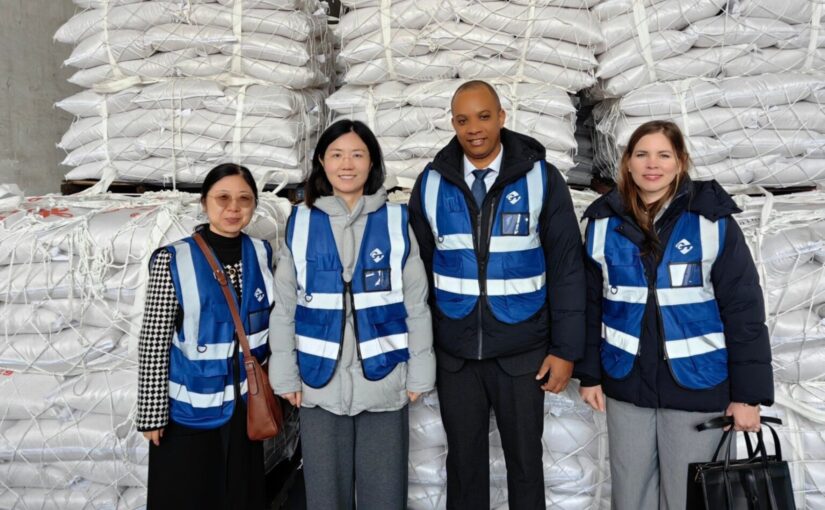
As of April, China has delivered 30,000 tons of rice; furthermore, an additional 60,000 tons have been pledged, bringing the total volume of food aid to 90,000 tons — enough to feed one million people for one year. (Embassy of the Republic of Cuba in the People’s Republic of China on X, March 19)
This is in addition to other Chinese humanitarian aid delivered last year. On Nov. 17, 2025, China sent aid to Cuba following Hurricane Melissa. The shipment included food, solar lighting and roofing materials totaling 30 tons and completed in six flights. (en.cibercuba.com, Nov. 17, 2025)
In 2025, Chinese medical donations included over 44,000 three-way stopcocks destined for Cuban hospitals treating critical patients — an item Cuba cannot obtain internationally due to the U.S. economic embargo. China is also collaborating with Cuba to install 5,000 solar systems in hospitals, polyclinics and maternal homes, aimed at stabilizing the electrical supply to the health care network facing an energy crisis created by the U.S. blockade. (KPL/Prensa Latina, March 11, 2025)
China is not just ‘giving’ but also helping Cuba upgrade its infrastructure
The economic aid provided by China constitutes a comprehensive, multi-pronged strategy, encompassing not only firm and robust political backing but also extensive, substantive assistance across vital sectors such as energy, food security and public welfare.
First, finance and infrastructure: In January 2026, Chinese emergency financial aid totaling $80 million was approved (cubasi.cu, Jan. 21). Then, in early April 2026, the two nations signed another 29 cooperation agreements, covering a wide spectrum of fields, including credit financing, port infrastructure development, technology transfer and biotechnology.
One good example is the public transportation project: In 2025, China provided spare parts for buses, including engines, tires and batteries, to rehabilitate the Chinese Yutong bus fleet in Cuba. Over 100 previously sidelined buses in Havana were restored to service.
Another project is energy structure transition: China’s export of solar photovoltaic (PV) equipment to Cuba skyrocketed from approximately $5 million in 2023 to $117 million in 2025. Plans are currently in place to assist in the construction of over 92 solar power stations by 2028. (discoveryalert.com.au, March 29)
With Trump 2.0’s full-scale oil blockade against Cuba, Chinese solar technology will provide the opportunity for the country to break away from a petroleum-only energy structure. Confronted with the U.S. strategy of severing Cuba’s energy supply chains, China has chosen to address the issue at its root by assisting Cuba in constructing an independent and sustainable economic system.
Specific projects include aid for a 35-megawatt PV power plant (projected to save 18,000 tons of fuel annually), a 120-megawatt PV project and the donation of 5,000 sets of residential solar power systems.
What Chinese and Russian aid to Cuba can teach Western activists
Western, mainly white-run activist groups, always have their unrealistic fantasies. They believe that a few sit-ins, letter-writing campaigns or small-scale aid missions can change the world. They never consider — even discredit — the efforts of the people, organizations and governments of the Global South.
Everyone has a vital role to play in international solidarity. Western activists can also learn a great deal from the positive experience of the Global South, notably from China.






Excellent article!
How are the Chinese solar panels, parts, rice, etc getting to Cuba? Has China sent a freighter?
Activists in the West can also assist by popularising the work China is doing, and educate people. This also serves to break through the encirclement and suppression of China being perpetrated by the US led old world using its propaganda war against China i.e lies about China.
The white racism in the u.s. is waking up the world. Making enemies worldwide. We’re on the brink of WWIII thanks to “trump america” and this war they will not win.