The article below by Duncan McFarland and Liu Xuegang argues that US foreign policy – particularly its increasingly hostile stance toward China – has direct and harmful consequences for Chinese and Asian communities in the US.
The authors trace a long history of anti-Asian sentiment linked to US imperialist strategy, from the Chinese Exclusion Act of 1882 to the McCarthyite Cold War propaganda of the 1940s and 50s. In recent years, tensions have escalated sharply under both Republican and Democratic administrations. Trump’s team has declared China a top strategic threat, launched a tariff war, and escalated the state’s attack on Chinese scientists, researchers and students in the US.
The article concludes that US imperialism fosters division and racism at home as it pursues global dominance. It calls for resistance to the New Cold War and urges solidarity with global movements for peace and cooperation.
The international working class does not want war. It is imperative to oppose Cold War 2.0, work for peace, and support initiatives, especially in the Global South and China, for cooperation on global issues such as climate change, pandemics, war, and poverty.
U.S. imperialism divides the world into hostile camps; this is the wrong approach. The people of the world want peace, prosperity, and cooperation. The U.S. policy of hegemony abroad promotes racism at home; the struggle for justice and freedom at home is also a struggle for peace abroad.
This article originally appeared in People’s World. The authors are members of the Asia-Pacific Subcommittee, Peace and Solidarity Commission, CPUSA.
U.S. foreign policy can have a great impact on people’s daily lives here at home, and U.S. policy toward China is a prime example. When the U.S. conducts a hostile, anti-China foreign policy, there is increased racism and repression in the Asian and Chinese American communities in the U.S.
On the other hand, when relations with China are good, such as during World War II or the 1980s, mainstream media depicted Chinese Americans as friendly, patriotic, and the “model minority.”
As U.S. imperialism’s new Cold War against China heats up, familiar patterns are repeating themselves under new conditions.
Historical background
The Central Pacific Railroad employed large numbers of Chinese immigrants to build the western half of the Transcontinental Railway, completed in 1869. However, no Chinese workers were invited to the golden spike ceremony at the completion of the project. Especially with the overthrow of Reconstruction, racist attitudes prevailed, and the Chinese Exclusion Act was signed in 1882. This blocked Chinese workers from entering the U.S.; it was the first anti-immigration legislation targeting a specific ethnic group or country of origin.
In 1913, the novel The Insidious Fu Manchu was a hit and became a cultural icon full of racist stereotypes about the ever-lurking, insidious Dr. Fu. But during the 1930s, the U.S. and China became important allies in the Pacific War against Japanese imperialism and aggression.
The following article, written by Betsey Piette for Workers World, highlights socialist China’s growing role in challenging US-led imperialist domination and argues that defending China is essential to the global struggle against capitalism.
Betsey stresses the need to foster internationalist consciousness among workers and young activists, linking domestic struggles with global anti-imperialist movements. She critiques the propaganda that falsely equates China and the US as being equivalent capitalist ‘superpowers’, arguing that this narrative obscures the exploitative and chaotic nature of US capitalism while ignoring China’s remarkable achievements under socialism.
Betsey observes that, despite the US’s escalating campaign of military encirclement and economic warfare, China’s economy continues to expand, living standards continue to improve, and its international cooperation continues to deepen, including with the US’s “traditional allies”.
Betsey asserts that China’s planned economy and state-led development – which have resulted not only in vastly increased living standards for the Chinese people but also in China becoming a science and technology powerhouse – offer an inspiring alternative model to capitalist neoliberalism.
The article concludes by calling for systematic defence of China’s socialist system against US threats of war, warning that economic aggression may escalate into military conflict. China’s is a revolution in motion that must be defended by the global working class.
Despite decades of wars and occupations of countries abroad, the U.S. faces a global challenge it is unable to contain. This challenge is multifaceted, but three things stand out:
One is the relentless resistance of the people of Palestine and West Asia in elevating their struggle for a free Palestine.
A second is the challenge from socialist China’s resistance to U.S. capitalist domination of the global economy.
The third is a growing awareness among young people that they have no future under capitalism, with its unchecked environmental catastrophes and its ready acceptance of fascist politicians.
A key challenge for the party and the movements we are part of is how to encourage young activists and workers to develop a more global outlook when it comes to capitalism and imperialism and to see why socialism offers the solution.
Demands are important
“From the river to the sea, Palestine will be free” is the most popular demand for Palestine and one that gets the most pushback from the Zionists. This demand doesn’t just raise opposition to the ongoing genocide in Gaza — it supports the future goal for Palestinians. Demands are important.
As we oppose the threat of imperialist war against China, we need to raise awareness about transformation and resulting gains made by socialism in China.
Imperialist propaganda puts an equal sign between the U.S. and China as “superpowers” — as if they are both capitalist countries. Corporate media pundits and politicians promote the lies that “China is repressive, that their economy is failing, that there is widespread unemployment, no opportunities for young people, etc.” It’s like they are looking in a mirror where what is reflected back are the conditions in the U.S., not China.
In the following article, Friends of Socialist China co-editor Carlos Martinez argues that the US-led New Cold War against China is failing. Despite extensive efforts to contain China’s rise – through tariffs, sanctions, and attempts at economic decoupling – China continues to grow economically and technologically. It now leads globally in multiple areas including renewable energy, electric vehicles, and advanced manufacturing. Its global reach is expanding, as evidenced by its central role in BRICS, the Belt and Road Initiative, and its status as the top trading partner for three-quarters of the world’s countries.
The West’s tariffs and sanctions have clearly backfired, invigorating China’s domestic industries rather than weakening them.
However, Carlos warns that the failure of “cold” methods could well provoke a shift toward direct military confrontation. The article identifies Taiwan as the most likely flashpoint, with the US escalating arms sales to the island and increasing its military deployments in the region. In the last two decades, successive US administrations, Democratic and Republican alike, have undermined the One China policy and fanned separatist sentiment, in defiance of international law.
Military preparations, including AUKUS, the rearmament of Japan, and new US bases in the Philippines, reflect a growing bipartisan consensus in Washington in favour of war planning.
This all adds up to accelerating preparations for war with China – a war with the objective of dismantling Chinese socialism, establishing a comprador regime (or set of regimes), privatising China’s economy, rolling back the extraordinary advances of the Chinese working class and peasantry, and replacing common prosperity with common destitution. Needless to say, this would be disastrous not just for the Chinese people but for the entire global working class.
Carlos calls for resolute opposition to this dangerous escalation.
The New Cold War is not working
The US-led ‘cold’ war against China is manifestly failing in its objectives of suppressing China’s rise and weakening its global influence.
China’s economy continues to grow steadily. In purchasing power parity (PPP) terms, it is by now the largest in the world. Its mobilisation of extraordinary resources to break out of underdevelopment and become a science and technology superpower appears to be paying substantial dividends, with the country establishing a clear lead globally in renewable energy, electric vehicles, telecommunications, advanced manufacturing, infrastructure construction and more. It is by far the global leader in poverty alleviation and sustainable development. Sanctions on semiconductor exports have not slowed down China’s progress in computing, and indeed have had an enzymatic effect on its domestic chip industry. The spectacular success of DeepSeek’s open-source R1 large language model indicates that the US can no longer take its leadership in the digital realm for granted.
Meanwhile, the West’s attempts to ‘decouple’ from China have yielded precious little fruit. While a handful of imperialist countries have promised to remove Huawei from their network infrastructure, and while sanctions on Chinese electric vehicles mean that consumers in the West have to pay obscene sums for inferior quality cars, China’s integration and mutually-beneficial cooperation with the world has continued to expand. China is the largest trading partner of approximately two-thirds of the world’s countries. Over 150 states are signed up to the Belt and Road Initiative. China lies at the core of BRICS and the Shanghai Cooperation Organisation.
Trump’s tariffs were meant to coerce China into accepting the US’s trade terms and to force other countries to unambiguously join Washington’s economic and geopolitical ‘camp’, thereby alienating China. Nothing of the sort has taken place. Even the normally supine European Union has denounced the tariffs and signalled its intention to expand trade with China.
In summary, the Project for a New American Century is not going well. Zbigniew Brzezinski famously wrote in his The Grand Chessboard: American Primacy and its Geostrategic Imperatives (1997) that “the most dangerous scenario would be a grand coalition of China, Russia, and perhaps Iran, an ‘anti-hegemonic’ coalition united not by ideology but by complementary grievances.” Precisely such an anti-hegemonic coalition exists, and is uniting the countries of Asia, Africa, Latin America, the Caribbean and the Pacific in a project of building a multipolar future, thereby posing an existential challenge to the so-called ‘rules-based international order’ based on the principles of unilateralism, war, destabilisation, coercion and unequal exchange.
The following article by W. T. Whitney Jr, originally published in People’s World, connects the Trump administration’s hostility towards China back to the US-led campaign of containment and encirclement starting in 1949 with the proclamation of the People’s Republic.
While the current state of relations between the two countries is often described as a New Cold War, Whitney points out that it has a significant military component, with 400 US bases surrounding China with ships, missiles and troops. Furthermore, “US allies in the Western Pacific—Japan and South Korea in the North, Australia and Indonesia in the South, and The Philippines and various islands in between—have long hosted U.S. military installations and/or troop deployments. Nuclear-capable planes and vessels are at the ready. US Navy and Air Force units regularly carry out joint training exercises with the militaries of other nations.”
Vast investment is being ploughed into weapons development in the US, and Trump-supporting producers of advanced modern weaponry (such as Peter Thiel) “exert sufficient influence over government decision-making to ensure happy times for the new breed of weapon producers”.
The article concludes with a call for the anti-war movement in the West to step up in its opposition to war on China, and its efforts to build stronger people-to-people links between the West and China:
Will resistance to war against China end up stronger and more effective than earlier anti-war mobilizations in the post-Vietnam War era? A first step toward resisting would be to build awareness of the reality that war with China may come soon. General knowledge of relevant history should be broadened, with emphasis on how U.S. imperialism works and on its capitalist origins. Anyone standing up for peace and no war ought to be reaching out in solidarity with socialist China.
Despite all the hype about a possible “breakthrough” in the U.S.’ trade war with China due to Trump’s tariff retreats, the reality is that the movement toward an actual war with China accelerates.
The public, focused on troubles currently upending U.S. politics, does not pay much attention to a war that has actually been on the way for decades.
The watershed moment of course came all the way back in 1949 with the victory of China’s socialist revolution. Amid resurgent anti-communism in the United States, accusations flourished of “who ‘lost’ China.”
Loss in U.S. eyes happened in China with the dawning of national independence and promise of social change. In 1946, a year after the Japanese war ended, U.S. Marines, allied with Chinese Nationalist forces, the Kuomintang, were fighting the People’s Liberation Army in Northeast China.
The U.S. government that year was delaying the return home of troops who fought against Japan. Soldier Erwin Marquit, participant in “mutinies” opposing the delay, explained that the U.S. wanted to “keep open the option of intervention by U.S. troops … [to support] the determination of imperialist powers to hold on to their colonies and neocolonies,” China being one of these.
The article below is based on a speech by Friends of Socialist China co-editor Carlos Martinez to a webinar held by the Black Liberation Alliance on the subject of ‘Trump’s Tariff Wars on the Global South and the New Cold War’, held on 8 May 2025.
Carlos positions the tariff war within the broader US-led New Cold War on China. The tariffs are essentially “a continuation and a deepening of Obama’s so-called Pivot to Asia, designed by Hillary Clinton and first announced in 2011”.
The Trump administration’s justifications for its tariff war – that it will result in re-industrialisation of the US and increase in income – are patent nonsense. “In fact, US treasury secretary Scott Bessent stated openly last month that the objective for the tariffs is to persuade Japan, South Korea and India to participate in a ‘grand encirclement’ strategy to isolate and weaken China.”
Carlos writes that “the US is seeking to punish China for its success in building a modern economy, for developing its sovereignty, and for its refusal to bow down to US hegemony… China’s rise disrupts the whole imperialist system. It gets in the way of the relationship the US wants to have with the rest of the world, whereby it can design the global economic and financial system in its own interests.”
The article observes that the tariff war has no chance of being successful: “The US ruling class wants to isolate China, but actually it will end up isolating itself.” However, with the failure of the tariff war comes the possibility of further dangerous developments:
The obvious concern following on from that is that US imperialism’s next weapon against China may be not be a metaphorical one; that the New Cold War will turn hot. Anti-war movements in the West need to be highly vigilant on that score.
The first thing to say about the Trump administration’s tariff war is that it is primarily designed to weaken, undermine and isolate the People’s Republic of China.
It’s part of a broader program of “decoupling” from China and a broader New Cold War on China – a system of hybrid warfare incorporating economic measures, diplomatic measures and propaganda measures, along with a significant military component: the deployment of hundreds of thousands of troops to the Pacific region; the US military bases in the Philippines, Guam, Okinawa, Japan, South Korea, Australia; the deployment of sophisticated weapons systems to the region; and the various attempts to create some sort of Asian NATO.
The following article by Paul Atkin, originally published in Socialist Economic Bulletin, analyses the response by British politicians and journalists to the announcement by Jingye – the Chinese company that acquired British Steel in 2019 – that it would be closing the blast furnaces at its Scunthorpe plant on account of making losses of £255 million per year. This response has been characterised by thinly-veiled Sinophobia and anti-China propaganda, with British politicians accusing Jingye of attempting to sabotage the country’s steel industry, and demanding that Chinese companies be prevented from future investment in British infrastructure.
Paul contrasts this hysteria with the relatively muted response to a very similar crisis at the Port Talbot steel works in 2024. “Both plants owned by companies based overseas. Both seeking a way out of unprofitable production. Both in negotiation for subsidy from successive governments for outcomes that would lead to massive job losses. Both looking to close aging blast furnaces earlier than originally planned because they have been making significant losses.” However, “Indian based Tata Steel’s ownership of Port Talbot was certainly mentioned in news coverage, but not on the blanket, verging on obsessive scale that British Steel’s Chinese ownership has… After Port Talbot, there has been no denunciation of Indian investment into the UK, nor any calls in the media or Parliament for any ‘urgent review’ into India’s role in the UK, or paranoid accusations … that the attempted closure is part of a dastardly plot to sabotage a strategic British industry”.
The article points out that the narrative on British Steel serves two purposes for the British ruling class. First, it feeds into building popular support for the US-led New Cold War on China. Second, it contributes to the fossil fuel industry’s resistance to meaningful action on climate change, given China’s global leadership in renewable energy and electric transport.
Paul notes that Spain is taking a considerably more far-sighted and progressive approach, “both encouraging inward Chinese investment – like the joint venture between CATL and Stellantis to build a battery factory in northern Spain – and deals signed last year between Spain and Chinese companies Envision and Hygreen Energy to build green hydrogen infrastructure in the country.”
It is crucial that environmental activists in the West do not fall into the Sinophobic trap being laid for them by the Cold War hawks in Washington and London.
The contrast between the way the crises in steel production at Scunthorpe and Port Talbot has been stark. Both plants owned by companies based overseas. Both seeking a way out of unprofitable production. Both in negotiation for subsidy from successive governments for outcomes that would lead to massive job losses. Both looking to close aging blast furnaces earlier than originally planned because they have been making significant losses.
In the case of Port Talbot, this led to a deal to convert to Electric Arc Furnaces to secure sustainable steel production at the site, but with the loss of 2,500 jobs and only 300 retained. This was dependent on a subsidy from the government of £500 million. A similar deal was not clinched at Scunthorpe, as the crisis was brought forward by Trump’s imposition of a 25% tariff on UK manufactured steel – which led to an announcement of imminent closure from the company the following morning. A closure would mean 2,700 jobs lost – on the same scale as Port Talbot.
In Port Talbot, in the absence of a serious just transition process involving the unions, which were excluded from the discussions by the company and the then Tory government, the job losses are being dealt with by the same sort of offers of retraining as have been proposed for the Grangemouth oil refinery in Scotland. In the case of Scunthorpe, also with no just transition process, the government has rightly stepped in to take charge of the plant to keep the blast furnaces running in the short term; which means that the losses previously borne by the company will now be borne by the Exchequer. With the company losing £255 million a year, the governments £2.5 billion steel transformation fund can absorb this in the short term. Workers at Port Talbot have expressed some bitterness that this was not considered for them.
What has been different is the mobilisation of Sinophobia around British Steel’s ownership by a Chinese company, Jingye. Indian based Tata Steel’s ownership of Port Talbot was certainly mentioned in news coverage, but not on the blanket, verging on obsessive scale that British Steel’s Chinese ownership has. Tata’s brinkmanship in negotiations was also mentioned, but they were not accused of “negotiating in bad faith” in the way that Jingye have. Both companies have behaved as you’d expect a capitalist company to behave, though if you read Jingye’s Group Introduction you can see how their operations inside China are turned to more positive social objectives – from a high wages policy to greening their workplaces – from being based in a country run by a Communist Party, not by their own class. But here, both Tata and Jingye are in it for the money. Their UK operations have only been viable as a tiny loss making fragment of a much larger business, as part of an attempt to implant themselves in a variety of global markets in the hope of profitability in the medium to long term. Steel production at Port Talbot in 2022, for example, was just 10% of Tata’s global production of 35 million tonnes.
After Port Talbot, there have been no denunciation of Indian investment into the UK, nor any calls in the media or Parliament for any “urgent review” into India’s role in the UK, or paranoid accusations made explicitly by Farage but echoed by “senior Labour figures” as well as Tories in the media but not in the recent Saturday debate in Parliament, that the attempted closure in Scunthorpe is part of a dastardly plot by the Chinese government to sabotage a strategic British industry, not a commercial decision in which a company is seeking to cut its losses in all the ways British capitalist company law allows them to; including cancelling orders for the raw materials they’d need to keep running the blast furnaces they want to close. Instead, there has been serious negotiations with the Indian government to set up a trade deal, which was reported last week as “90% done”.
No decoupling there.
The attack on commercial engagement with China fulfills two objectives. One is a straightforward attempt to mobilise popular sentiment in defence of steel workers jobs behind a Cold War sentiment in a wider context in which the Trump administrations policies have shaken up popular faith in deference to the US. An anti Chinese attack distracts from that and pushes people back towards habitual hostilities.
The other opens another front in the resistance to any serious action on climate change that could threaten the profits of the fossil fuel sector. Accusations from the Right have been:
The blast furnaces could have been kept running with locally sourced coking coal from the cancelled Whitehaven mine. This misses the point that the coke from this mine – had it been developed – would have had such a heavy sulphur content that it was too poor quality to be used at Scunthorpe, so this is a consciously mendacious and fundamentally unserious talking point.
High energy prices in the UK are because of “Net Zero”. This, as they know, is the opposite of the truth. The UK has high energy costs because they are tied to the price of gas far more than any other country in the G7. See Figure 1. We should also note that the oft repeated “solution” to this problem from Reform or the Tories is massive investment in nuclear power instead. The problem with this is that the cost per Kilowatt hour of energy generated by nuclear power is higher than gas, which is higher than renewables. See figure 2. So their way forward would actually compound the problem. Paradoxically, their attack on Chinese investment in UK nuclear power development, and the withdrawal of Chinese investment from Sizewell C in Suffolk and Bradwell in Essex, is making the financing of these projects almost impossible. So, in this case, the contradictions of their politics means they will neither have their cake, nor eat it.
These themes came together in a front page broadside from the Times on 15th April directed at Ed Miliband’s recent trip to China aiming to improve relations and develop better sharing of expertise on the climate transition. Miliband’s is the head that the right wing press is keenest to have on its trophy wall of sacked ministers, hence quite limited and inadequate targets being described as “swivel eyed” and “eye watering” in a constant hammering of lead articles from the Sun to the Telegraph and all the low points in between. Attacks on solar panel installations are increasingly taking the form of accusations of “forced labour” in China, which are untrue, but because it is almost universally believed at Westminster, this threatens a reactionary result on the basis of an apparently progressive concern – as China is the source of 80% of the world’s solar panel supply. However, even if the UK sabotages its green transition by impeding imports of Chinese solar panels this will have little effect globally, as China is increasingly exporting them to the Global South. See Figure 3 Miliband is nevertheless the most popular government minister among Labour members in Labour List’s survey – in which he has a positive rating of 68, compared to Keir Starmer’s 13 – because he is seen as getting on with something positive and progressive, while Liz Kendall and Rachel Reeves are in negative territory.
The call from Dame Helena Kennedy for “an urgent security review of all those Chinese companies operating within our infrastructure which could pose a threat to our national interests – and maybe not just confined to China” threatens to compound the damage already done by the UKs removal of Huewei’s investment in the 5G network, ensuring that the version the country has is slower and more expensive, and the financial difficulty set for Nuclear power station projects by the removal of Chinese investment on the basis of “national security” paranoia. Applied more widely, this neatly lines the UK up with Trump’s trade war against China and sets the UK up for a potential trade deal in which US capital is looking hungrily at the NHS, wants to sell chlorinated chicken and other additive saturated and nutrition less food from their agricultural industrial complex and open up a tax and regulation free for all for their abusive big tech companies, while their President is actively sabotaging global progress towards sustainability by doubling down on fossil fuels. China is doing none of these things. A more positive approach is that being taken by the PSOE government in Spain, which is both encouraging inward Chinese investment – like the joint venture between CATL and Stellantis to build a battery factory in northern Spain and deals signed last year between Spain and Chinese companies Envision and Hygreen Energy to build green hydrogen infrastructure in the country.
Farage, and others on the Right are arguing for nationalisation as a temporary measure just in order for the company to be “sold on” – treating nationalisation as an emergency life support process for private capital -is that there is not exactly a huge queue of companies waiting to buy, and any that did would most likely to be looking at asset stripping. Jingye was the only company interested in 2019, when previous owner Graybull capital gave up on it.
This would also be the government’s preferred approach, because they are nervous of the capital costs involved in making the plant viable. There are three intertwined problems with this.
Attracting a viable private company prepared to put serious money into reviving the plant means attracting overseas capital. Given that more than 50% of global steel production is made by Chinese companies (see figure 4 below) Jonathan Reynolds has changed his tune since the weekend debate in Parliament. That Saturday he was decrying allowing Jingye into UK steel manufacturing as a national security issue, but by mid-week, a few days later, he was prepared to be more pragmatic about it.
Making the plant viable cannot mean investing in new blast furnaces. These would become stranded assets before they had reached the end of their design life. Despite the determined rearguard action from Trump and others, trying to carry on as though the world isn’t changing makes no business sense. In 2024, for example, all new steel plants developed in China were Electric Arc Furnaces, designed to use scrap steel as raw material. As yet, production of virgin steel has been dependent on coking coal, but the first production using (green) hydrogen and electricity looks like coming on stream in Sweden by next year; so if virgin steel production is considered an imperative for the Scunthorpe site, that model will have to be looked at and emulated as a matter of urgency.
New investment in different production on the site – like almost all capital investment – replaces labour with capital. As with Port Talbot, far fewer workers would be needed for EAFs. Reynolds has talked about “a different employment footprint” for the plant; which is one way to put it. So, the issue of how the transition can be made in a way that opens up alternative employment with decent terms and conditions has to be negotiated with the workers themselves through their unions.
What’s needed is a clear industrial plan that consolidates the nationalisation as a precedent for other sectors and builds on the Scunthorpe plant’s strengths in producing, for example, 90% of railway tracks used in the UK, as part of a strategic plan for green transition. This has hitherto been focussed on a transition to Electric Arc Furnaces, but linking the production of green hydrogen to new generation furnaces capable of producing the tougher virgin steel needed for a full range of industrial applications should also be part of the process; because blast furnaces can’t be kept open indefinitely if we are to stop the climate running away out of a safe zone capable of sustaining human civilisation by mid century.
Appendix
UK steel production is the 35th largest in the world, comparable to Sweden, Slovakia, Argentina and the UAE. Its 4 million tonnes in 2024 is just over a tenth of the production of Germany, a twentieth of the United States, a thirty seventh that of India and a 250th that of China.
The niche, almost token, position of UK based steel manufacturing reflects a wider process in which UK based capital is no longer primarily engaged with manufacture.
The last time the steel industry in the UK was nationalised in 1967 it had 268,500 workers from more than 14 previous UK based privately owned companies with 200 wholly or partly-owned subsidiaries. These companies were considered increasingly unviable because they had failed to invest and modernise, so were increasingly uncompetitive. This is part of a wider story about how the UK capitalist class has transformed itself since the 1960s. While the quantity of manufactured goods has increased since then, the proportion of manufacturing in the economy has shrunk from 30.1% in 1970 to 8.6% in 2024. The service sector has grown from 56% to more than 80%. UK based capital primarily makes money from selling services, mostly financial, to manufacturing capitalists at home and abroad. They are spectacularly bad at large scale manufacturing start ups, as the debacle of British Volt (whose approach of setting themselves up a luxurious executive office suite before they’d secured funding to even build their factory might be described as cashing in on your chickens before you’ve sold any).
What that means is that most of “British Industry” is owned by firms based overseas, so might be better described as “manufacturing that happens to take place in Britain”. Consider the automotive sector. While there are locally based SMEs in the supply chain, all the big manufacturers depend on overseas investment. Nissan, Stellantis, BMW, VW, Geely, Tata (again). As with locally based steel production, firms like Morris, Austin, even Rover, are long gone for the same reasons as BSA – once the world’s biggest motorcycle company – now only builds retro classic designs as a niche luxury product and Guest Keen and Nettlefold had to be nationalised to save its assets.
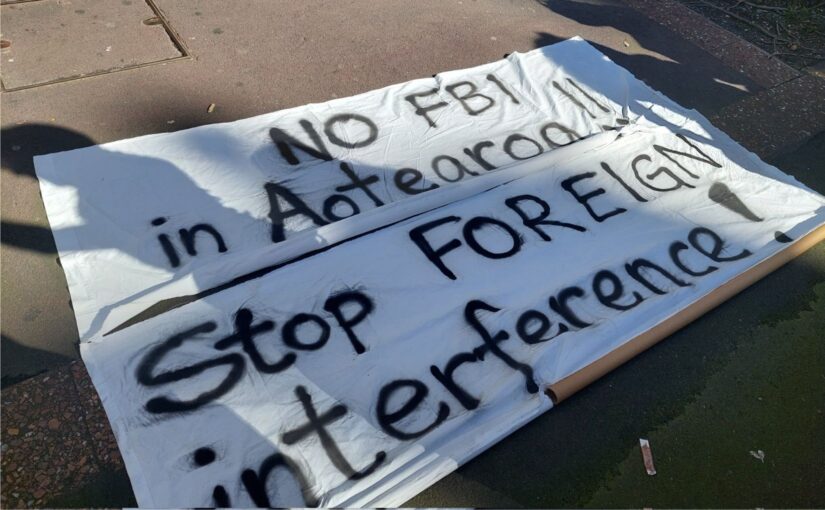
On 25 March 2025, at a US Senate Intelligence Committee hearing on global threats, CODEPINK activist Tighe Barry stood up and called on the US government to stop funding Israel’s genocide in Gaza. Fanatical China hawk Senator Tom Cotton responded by labelling Barry as a “CODEPINK lunatic that was funded by the Communist Party of China”. Retired Colonel Ann Wright stood up and shouted “I’m a retired Army Colonel and former diplomat. I work with CODEPINK and it is not funded by Communist China.”
Both activists were ejected from the room and arrested. Cotton meanwhile proceeded with his McCarthyite diatribe: “The fact that Communist China funds CODEPINK, which interrupts a hearing about Israel illustrates Director Gabbard’s point that China, Russia, Iran and North Korea are working together in greater concert than they ever had before.”
The purpose of this narrative is to portray any opposition to US hegemonism and imperialism as being funded and fomented by foreign powers – just as in the 1950s and 60s, working class, progressive and anti-war activists were portrayed as Soviet agents.
Senate Intelligence Committee Hearing Turns Ugly with McCarthy-Style Lies About CODEPINK: Women for Peace
On March 25, at the U.S. Senate Intelligence Committee hearing on global threats with the five heads of intelligence agencies of the U.S. government, Senator Tom Cotton, accused on national TV a group I have worked with for over 20 years, CODEPINK: Women for Peace, of being funded by the Communist Party of China.
During the hearing CODEPINK activist Tighe Barry stood up following the presentation of the Director of National Security Tulsi Gabbard’s lengthy statement about global threats to U.S. national security and yelled “Stop Funding Israel.”
This was because neither Intelligence Committee Chair Tom Cotton and Vice Chair Mark Warner had mentioned Israel in their opening statement nor had Gabbard mentioned the Israeli genocide of Palestinians in Gaza in her statement either.
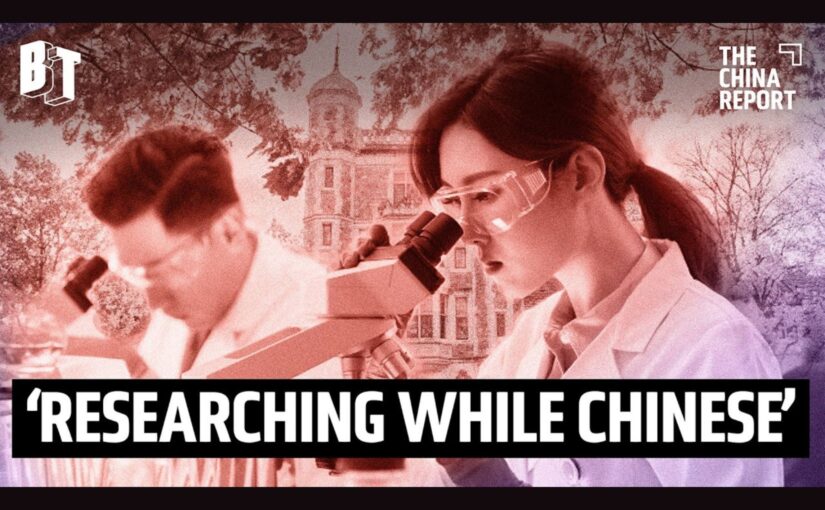
The following article by Tasfia Jahangir and Miles Wetherington, originally published in Liberation News, describes the rising McCarthyism in the US, in particular the red-scare narrative around Chinese students and scientists.
The authors note that John Moolenaar, a Michigan Republican who chairs the House Select Committee on the CPC, has sent letters to six US universities, including Stanford, demanding that they provide detailed information about their entire Chinese student populations, saying that the student visa system has become a “Trojan horse” and implying that “any Chinese national studying in a STEM field — especially those working in key research areas like AI, semiconductors, or aerospace — is potentially a spy”. At the same time, lawmakers have introduced a “Stop Chinese Communist Visas Act”, seeking to block visas for Chinese students studying in the US, on supposed national security grounds.
Hostility towards Chinese students and scientists is bipartisan, and has been trending upwards for years, under both the Trump and Biden administrations. The authors note that this escalation “also fits into a broader pattern of repression targeting international students. Indian students — the largest international group — have been told to ‘self-deport’ for campus activism, while students like Mahmoud Khalil, Rumeysa Ozturk and Momodou Taal have faced repression for opposing the genocide in Palestine.”
The focus on Chinese academics in particular is “part of the US strategy of containment, encirclement and suppression on China”. The US ruling class seeks to win public support for the New Cold War, painting China as a threat to the US and the world. Such a portrayal is becoming increasing untenable:
US officials try to demonise China as if it is on the warpath, but it is the United States that poses the greatest threat to world peace. In the last 30 years alone, the United States has launched 251 military interventions across the globe. In stark contrast, China has eradicated extreme poverty for more than 850 million people, and managed to overcome the legacy of colonialism and underdevelopment by reaching a level of moderate prosperity all while upholding the Five Principles of Peaceful Coexistence.
Ultimately this revival of reds-under-the-bed hysteria will only serve to fuel racism and xenophobia, and to further poison US-China relations. What’s more, it “actively sabotages the kind of international cooperation needed to confront global crises”. Ironically, it will also provide a boost for China’s domestic innovation, as top Chinese students will opt to study at home rather than face an increasingly hostile and dangerous environment in the US.
The authors conclude:
Collaboration between the US and China — two of the largest research and innovation hubs in the world — could offer humanity an opportunity to solve the pressing crises of our time: pandemics, climate change, AI ethics and more. But to those in power, shared progress is a threat. It undermines the need for endless militarisation, sanctions and rivalry. It challenges the US ruling class’ worldview based on zero-sum competition and global hegemony.
On March 19, U.S. Representative John Moolenaar, Chairman of the House Select Committee on the Chinese Communist Party, sent a letter to six American universities demanding that they provide detailed personal, academic, and financial information about Chinese international students in STEM fields. Disguised as a routine inquiry into national security, the letter levies sweeping accusations. It claims that Chinese students “jeopardize” U.S. technological leadership, and labels the American student visa system as a “Trojan horse” for these students to steal intellectual property on behalf of the Chinese government. On top of this, the House also recently introduced the STOP CCP VISAs Act, a bill that, if passed, would ban student visas for all Chinese national students.
We must oppose this vilification of Chinese students and recognize it for what it is — an attack on global science.
The war on Chinese students is a war on global science
The Select Committee on the CCP letter and STOP CCP VISAs Act are part of a decade-long bipartisan campaign to surveil, vilify and push out Chinese researchers and students from American institutions. Under both Trump and Biden administrations, we’ve witnessed countless attacks on Chinese scholars and scientists based solely on their national origin — federal investigations with no evidence, layoffs, cancelled visas, and partnerships dismantled under political pressure.
Moolenaar’s letter escalates this campaign by implying that any Chinese national studying in a STEM field — especially those working in key research areas like AI, semiconductors, or aerospace — is potentially a spy. It makes absurd and xenophobic claims, such as the idea that the mere act of returning to China after graduation should be treated with suspicion. This logic dehumanizes thousands of students as geopolitical pawns rather than what they are: workers, researchers and colleagues striving to build a better future.
On 10 March 2025, the CODEPINK China Is Not Our Enemy book club hosted Friends of Socialist China co-editor Carlos Martinez for a discussion about The East is Still Red, which was the first book the group read together. The video of the session is embedded below.
The video starts with a 10 minute introduction by Carlos, explaining the key motivations for writing the book: to challenge the New Cold War propaganda against China; and to build understanding of Chinese socialism and counter the notion that China has “gone capitalist”.
The presentation is followed by a wide-ranging discussion about common prosperity, China’s foreign relations, China’s democratic processes, its management of the Covid-19 pandemic, and its actions around preventing climate breakdown.
In the following article, that was originally published on his Substack, Geopolitical Economy, Ben Norton draws attention to a recent speech by US Vice President JD Vance on globalisation that made it clear that Washington’s goal is to keep formerly colonised countries in the Global South trapped at the bottom of the global value chain.
Ben outlines how Vance acknowledged that the US-led West wants to maintain a strict international division of labour, in which poor countries in the periphery produce low value-added goods while the rich nations in the core extract exorbitant monopoly rents. Vance made these remarks at a gathering, called the American Dynamism Summit, that was organised by the Silicon Valley venture capital firm Andreessen Horowitz.
Ben goes on to note that Vance is a China hawk who has scapegoated Beijing for the many economic problems in the US, demonising it as “the biggest threat to our country”. After Donald Trump selected Vance to be his running mate in the 2024 presidential election campaign, Vance pledged that they would end the war in Ukraine, not because they wanted peace for peace’s sake, but rather to prioritise containing China.
In his speech at the American Dynamism Summit, Vance said that: “The idea of globalisation was that rich countries would move further up the value chain, while the poor countries made the simpler things.”
Having referenced the Chinese city of Shenzhen, he continued: “But I think we got it wrong. It turns out that the geographies that do the manufacturing get awfully good at the designing of things.
As Ben notes, in these comments, the US vice president inadvertently acknowledged that the fundamental thesis of the dependency theorists in the 1960s was indeed correct. “The rich countries in the core of the world-system (mostly in the Global North) seek to trap the poor, formerly colonised nations in the periphery (mostly in the Global South) in a cycle of dependency on the core’s high value-added products, through monopolistic control of advanced technologies.”
US Vice President JD Vance gave a speech about globalization that made it clear that Washington’s goal is to keep formerly colonized countries in the Global South trapped at the bottom of the global value chain.
Vance acknowledged that the US-led West wants to maintain a strict international division of labor, in which poor countries in the periphery produce low value-added goods (with lots of competition and therefore low profits), whereas the rich nations in the core extract exorbitant monopoly rents through their control over high value-added technologies (with little to no competition, reinforced by strict intellectual property rights).
Silicon Valley prepares for war with China
The US vice president made these remarks at a summit that was organized by the Silicon Valley venture capital firm Andreessen Horowitz. This annual meeting in Washington, DC is called the American Dynamism Summit, and it brings together corporate executives and US government officials to facilitate contracts.
One of their main priorities is preparing for war with China. Andreessen Horowitz promotes 50 US companies that it says are “shaping the fight of the future”, outlining a scenario of a hypothetical 2027 war with China over Taiwan.
Vance is a China hawk who has scapegoated Beijing for the many economic problems in the US, demonizing it as “the biggest threat to our country”.
After Donald Trump selected Vance to be his running mate in the 2024 campaign, Vance pledged that they would end the war in Ukraine, not because they wanted peace for peace’s sake, but rather to prioritize containing China. The US will “bring this thing to a rapid close so America can focus on the real issue, which is China”, Vance told Fox News, claiming, “That’s the biggest threat to our country and we are completely distracted from it”.
In the following article on Geopolitical Economy, Ben Norton exposes the extreme anti-China views of US Defense Secretary Pete Hegseth.
Ben notes that, in his 2020 book American Crusade: Our Fight to Stay Free, Hegseth describes the Chinese as “literally the villains of our generation” and warns: “If we don’t stand up to communist China now, we will be standing for the Chinese anthem someday”.
This anti-China sentiment is not restricted to the past. “As defense secretary, Pete Hegseth has pushed for extremely aggressive policies against Beijing”, commenting just this month on Fox News that the United States is prepared to go to war with China. He calls for the US to stop trading with China and to do everything within its power to stop China’s rise.
These alarming views are combined with flagrant islamophobia, misogyny and homophobia.
Hegseth is not the only China hawk in Trump’s cabinet. As we have noted previously, “Marco Rubio is an anti-China fanatic, who stands for more tariffs, more sanctions, more slander, more support for Taiwanese separatism, more provocations in the South China Sea, and more destabilisation in Hong Kong and Xinjiang. Mike Waltz has long pushed for closer military cooperation with India, Japan, Australia and other countries in the region in preparation for war against China.”

Increasingly, there is consensus within US policy circles in favour of an escalation of the campaign to encircle and contain China. Progressive and anti-war movements in the West must resist this dangerous trajectory.
US Defense Secretary Pete Hegseth is a self-declared “crusader” who believes the United States is in a “holy war” against the left, China, and Islam.
In his 2020 book American Crusade: Our Fight to Stay Free, Hegseth vowed that, if Trump could return to the White House and Republicans could take power, “Communist China will fall—and lick its wounds for another two hundred years”.
Hegseth declared that the Chinese “are literally the villains of our generation”, and warned, “If we don’t stand up to communist China now, we will be standing for the Chinese anthem someday”.
In Hegseth’s conspiratorial worldview, Chinese communists and the international left are conspiring with Islamists against the United States and Israel, which are sacred countries blessed by God.
Under Trump’s leadership, Hegseth promised, “Israel and America will form an even tighter bond, fighting the scourge of Islamism and international leftism that will never fully abate”.
“Islamists will never get a nuclear weapon but will be preemptively bombed back to the 700s when they try”, he added.
In the book, Hegseth heaped praise upon the medieval Crusaders, and he argued that Western conservatives in the 21st century should continue the holy war they started a millennium ago.
One of his chapters is titled “Make the Crusade Great Again”.
On the first page of the book, Hegseth proudly said his “American crusade” is a “holy war”, and he insisted that leftists are not “mere political opponents. We are foes. Either we win, or they win—we agree on nothing else”.
Hegseth also stated with certainty that there will soon be a civil war in the United States, between the right and left.
The following article by Carlos Martinez responds to a recent article in The Times complaining about TikTok users not being sufficiently anti-China. The only explanation the Times journalist can muster is that TikTok’s algorithms must be weighted to promote pro-CPC content.
Carlos observes that TikTok users are predominantly young, and posits that young people are less vulnerable to anti-China hysteria than older generations – at least in part due to China’s leading role in the battle against climate breakdown; its concerted efforts to reduce poverty and improve living standards; and its orientation towards peace, which contrasts starkly with the West’s orientation towards war.
Carlos concludes that imperialist cultural hegemony is under threat:
Throughout the Western world, people are learning to question and reject the crass propaganda pumped out by the mainstream media’s State Department stenographers in relation to Palestine, China, Russia, Cuba, Venezuela, Nicaragua, Iran, the DPRK and more. This is an entirely welcome development.
A recent article in The Times, entitled Why TikTok ‘makes people more eager to visit China’, worries that “people who spend hours scrolling on TikTok are more likely to want to visit China — possibly because the platform censors material that portrays the country in a negative light”. The article’s author is particularly concerned that TikTok users might “see an airbrushed view of China and its human rights record”.
Researchers found that, horrifyingly, users searching on TikTok for terms such as “Tiananmen” or “Tibet” were exposed to a significant number of results that failed to denounce the Communist Party of China. Indeed, it seems that heavy TikTok users typically rate China’s human rights record as “medium”, whereas non-TikTok users rate it as “poor”.
Lee Jussim, a co-author of the research on which the Times article is based, said: “We did the studies because there was ample reason long before our studies to suspect CCP manipulation of TikTok. It’s one thing to suspect, it’s quite another to find it empirically.” He concludes: “Social media companies should be required to publicly disclose how their algorithms determine what content users can access.”
Imperialist propaganda losing its impact?
Edward Herman and Noam Chomsky’s classic 1988 work Manufacturing Consent: The Political Economy of the Mass Media explores the connection between the economic interests of the ruling class and the ideas that are communicated via mass media: “The media serve, and propagandise on behalf of, the powerful societal interests that control and finance them. The representatives of these interests have important agendas and principles that they want to advance, and they are well positioned to shape and constrain media policy.”
Western media hostility to China has reached fever pitch in recent years. The accusation that China is committing a genocide (or “cultural genocide”) in Xinjiang has been repeated so often as to acquire the force of truth, in spite of the notable absence of any meaningful evidence in its support. Rioters in Hong Kong are presented as saintly defenders of democratic principles. Chinese weather balloons, kettles and smart TVs are all spying on us, and inscrutable Chinese scientists are sending our secrets directly to the People’s Liberation Army.
Fu Manchu is back, and this time he wants to take our freedoms away.
In Britain as in the US, the bourgeoisie is divided on many issues, but there is a clear consensus when it comes to waging a propaganda war on China. And yet it seems that anti-China propaganda is losing its impact, particularly among young people.
The statistical categories presented by the authors of the research are “those who don’t use TikTok” and “those who spent more than three hours a day on the platform”. Age is fairly obviously a confounding variable here: a significant majority of TikTok users are under 30, and only 27 percent are over the age of 45. Young adults (18-24 years) make up over half of TikTok content creators.
So inasmuch as we can derive anything useful from the research, it’s that younger generations are less invested than their grandparents in idiotic Cold War narratives. That may be partly a reflection of the fact that TikTok’s algorithms – in flagrant violation of the well-known and universal rules of social media – don’t actively boost anti-China content and suppress pro-China content. But it also speaks to the genuine concerns and interests of young people.
For example, surveys consistently show that young people are more worried about the prospect of climate breakdown and are more likely to consider the environmental crisis as an existential threat to humanity. As such, they might be expected to welcome the news that China will account for 60 percent of all renewable energy capacity installed worldwide between now and 2030 (according to the International Energy Agency); that China has likely already reached its 2030 goal of peaking carbon emissions; that China is fast phasing out fossil fuel vehicles; that China leads the world in afforestation and biodiversity protection; and that China’s investment in renewables has led to a 80 percent reduction in the cost of solar and wind energy globally.
Furthermore, young people are notorious for having a curious predilection for peace, and perhaps many of them are impressed by the fact that China hasn’t been to war in over four decades; that it has one overseas military base, compared to the US’s 800; that it has a consistent policy of no first use of nuclear weapons, while the US has a consistent policy of nuclear bullying; that it has worked diligently towards peace in Gaza and Ukraine, while the US has been financing, arming and promoting genocide and war.
While TikTok doesn’t actively suppress negative stories about China, what makes it unique among major social media apps is that it also doesn’t suppress positive stories about China. Users are exposed to a variety of voices, including those who highlight China’s extraordinary development, its contributions to climate change solutions, its successes tackling poverty, and its appeal as a travel destination.
The following statement has been issued by the Friends of Socialist China US Committee in response to the Trump administration’s announcement of new tariffs on Chinese imports.
The Trump administration’s decision to slap additional tariffs on the People’s Republic of China is something that should be condemned by every person who cares about peace and progress. These moves are making the world a more dangerous place and are part of a larger anti-China policy being pursued by the Trump administration – a policy begun under the Obama administration and deepened during the Biden administration.
These tariffs are in effect a tax on working people here in the United States and will result in rising prices for our necessities and wants. They will have no impact whatsoever on the lifestyles of the billionaires. Indeed, the money raised from increased prices will be used to fund the Trump regime’s tax cuts for the super-rich. Furthermore, these tariffs will harm the U.S. economy more than China’s. People’s China has a more diversified economy, more trading partners, and a greater share of world trade.
To quote Mao Zedong, “Lifting a rock only to drop it on one’s own feet is a Chinese folk saying to describe the behavior of certain fools.” This certainly applies to Trump and his wealthy backers.
The tariffs against China exist in a larger context. The U.S. empire is in a state of stagnation and decline, while People’s China is developing at an incredible speed. Wall Street and the Pentagon are working to “contain” and encircle China. They are increasing the spending for war preparations, attempting to draw countries in the region into hostile alliances aimed at China, and encouraging separatist forces in Taiwan, Tibet and Xinjiang. The tariffs supplement the hundreds of U.S. sanctions against China in textiles, solar energy, computers and more.
For the past decade, U.S. policy makers have talked about “decoupling” the U.S. economy from that of China. Washington DC’s trade war is a part of that process, and it cannot be separated from preparations for other kinds of war in the Pacific, including those fought by military means.
Socialist China has made incredible achievements. China has waged a real war on poverty, while the U.S. government is waging a war on working people. China is by far the world leader in renewable energy production, electric transport, biodiversity protection and afforestation. China takes public health seriously. That’s why its life expectancy consistently goes up. Here in the U.S., we have measles outbreaks, and vaccine “skeptics” running the show. China wants peace. No serious person can say that about the U.S. today.
We demand that the tariffs directed at China be rolled back. We oppose the Trump administration’s anti-China policy, including any and all preparations for war. And we stand in solidarity with socialist China as it heads into a bright future.
Embedded below is the video of a recent live panel discussion, hosted by Friends of Socialist China co-founder Danny Haiphong, exploring the geopolitical tensions between China and the United States, particularly in the context of Trump’s trade policies, military escalation, and hostile media narratives. The panel features journalists and analysts Carl Zha (host of the Silk & Steel Podcast), Li Jingjing (CGTN), and KJ Noh (peace activist and co-host of The China Report), each offering insights into China’s March 2025 “Two Sessions” and the ongoing developments in US-China relations.
A key theme was China’s foreign ministry taking a more assertive position in response to US aggression. While China still seeks friendship and mutually beneficial cooperation, and maintains a clear orientation towards peace, its leadership is making clear that China will not simply buckle in the face of bullying and that China is prepared to defend itself from any kind of attack.
Carl Zha emphasised how China has been preparing for US tariffs since Trump’s first term, diversifying its economy and reducing reliance on the US market. He further noted that China’s economy is not heavily dependent on exports to, or investment from, the US.
Li Jingjing, reporting from the National People’s Congress, highlighted that China’s priority is domestic economic development, technological advancement and improving rural livelihoods. Military spending is a small part of the agenda compared to investments in infrastructure, rural wellbeing and AI.
KJ Noh analysed the US’s military strategy, pointing to its war games in the Asia-Pacific, its consolidation of the First Island Chain, and its overall strategy to weaken China. He argued that the US military-industrial complex fuels war rhetoric, even as China prioritises peace and economic growth.
The discussion also addressed Western media misrepresentations of China and the rising anti-China hysteria based on the US ruling class’s fear of China’s challenge to Western dominance and hegemonism.
The following text is based on a speech given by Friends of Socialist China co-editor Carlos Martinez at the Stop the War Cymru AGM, held on Saturday 8 March 2025. Carlos participated in the panel Imperialism’s Drive to War: Middle East, Ukraine, Russia, China, Cuba, alongside Andrew Murray (Deputy President of Stop the War Coalition), Bethan Sayed (former Member of the Senedd [Welsh parliament] for Plaid Cymru) and Ismara Mercedes Vargas Walter (Cuban Ambassador to the UK). The session was chaired by David McKnight (co-chair of Stop the War Cymru).
The speech takes up the questions of the Trump administration’s strategic orientation towards confrontation with China; whether the global working class should take sides in a conflict between the US and China; and what the tasks of the British anti-war movement are in relation to the US-led New Cold War on China.
Likelihood of a further escalation of the New Cold War
What can we expect in terms of the US-China relationship in the coming months and years?
First, we need to consider the Trump administration’s moves towards extricating itself from the quagmire in Ukraine. Presumably most people understand that Trump and his cabinet are not motivated by any abstract love of peace; they’re not attempting to recreate the spirit of Woodstock and “make love not war”. Rather, they are carrying out a strategic reorientation to fight a New Cold War on one main front instead of two. This means reducing conflict with Russia in order to focus their efforts and resources on the project of containing and encircling China.
A number of commentators have pointed to the parallels with Henry Kissinger’s “triangular diplomacy” of the early 1970s, in which the US sought to befriend China in order to concentrate on attacking their number one strategic enemy at the time: the Soviet Union.
Half a century later, the People’s Republic of China is considered the greatest threat to the long-term interests of US imperialism. China is the world’s largest economy in purchasing power parity (PPP) terms. It’s the major trading partner of over two-thirds of the world’s countries. It’s catching up with – and indeed surpassing – the US in a number of crucial areas of technology and science. Furthermore, China is at the core of the trajectory towards a multipolar world.
In a recent article, Ben Norton cites various statements from Trump and his team indicating that a strategic reorientation towards aggression against China is precisely what they are planning. For example, in an interview with Tucker Carlson last year, Trump stated that “you never want Russia and China uniting… I’m going to have to un-unite them, and I think I can do that, too. I have to un-unite them.” Similarly, Marco Rubio, the secretary of state, said in his Senate hearing last year: “The Chinese see great benefit in Ukraine because they view it as: the more time and money we spend there, the less time, and money, and focus we have on them.”
Trump’s cabinet is packed with China hawks. Marco Rubio is an anti-China fanatic who stands for increased tariffs, more sanctions, more slander, more support for Taiwanese separatism, more provocations in the South China Sea, and more destabilisation in Hong Kong and Xinjiang. Mike Waltz (national security advisor) has long pushed for closer military cooperation with India, Japan, Australia and other countries in the region in preparation for war against China. Pete Hegseth, defence secretary, says that the US is “prepared to go to war with China”.
In this eyewitness account, Tan Wah Piow reports on the mood in Panama, along with the background to the issue, following US President Donald Trump’s brazen threats to “take back” the canal that connects the Atlantic and Pacific oceans.
Referring to Trump’s “audacity”, Wah Piow notes that: “This is a thriving sovereign nation, a regional financial powerhouse, and, as of January 2025, a newly elected [non-permanent] member of the UN Security Council.”
Citing a vast field of Panamanian flags he saw from his taxi, he notes: “His [the taxi driver’s] words brought back memories of the Museo Canal exhibit on the 1964 Martyrs Day incident when US troops killed 21 Panamanian students for asserting their right to raise the national flag in the US-controlled Canal Zone. The 1964 incident remains deeply ingrained in Panamanian consciousness, symbolising the people’s struggle for independence and control of the Canal.
“That incident was a rallying cry for international solidarity against US imperialism in Latin America. Even Chairman Mao of China issued a statement on January 12, 1964, published in Hong Qi, the Chinese Communist Party’s official organ, supporting the ‘great patriotic struggle’ of the Panamanian people. Back then, China had no diplomatic ties in the region beyond Cuba, and there was no Chinese shipping through the Canal.
“The 1964 Martyrs Day protests ultimately led to the 1977 Torrijos-Carter Treaties, which ceded sovereignty of the Canal to Panama. Under these agreements, Panama gained full control of the Canal in perpetuity.”
Trump’s remarks, he explains, were not merely a one-off provocation or a bargaining tactic, followed as they were by a threatening visit by Secretary of State Marco Rubio.
“Today,” Wah Piow notes, “the Panama Canal sees 14,000 vessels annually, handling 5 per cent of global shipping. China-US trade accounts for about 20 per cent of its traffic, while China-Latin American trade represents another 15-20 per cent. Studies suggest this volume is set to rise, with China already having surpassed the US as the primary trading partner of countries such as Brazil, Chile, and Peru. Trump’s renewed interest in the Canal appears driven by the fear that China is outpacing the US in Latin America.”
He calls on the international community to defend Panamanian sovereignty, “otherwise, a US power play to uphold its imperialist interests could threaten not just Panama but the economic stability of an entire region long hindered by dependence on Washington.”
Tan Wah Piow, a retired London lawyer, has been in exile from Singapore since 1976. He was imprisoned as a student leader for his activism and is Singapore’s most well-known exile. He is also a member of the Friends of Socialist China Advisory Group. He visited Panama in February 2025. This article was originally published in the Morning Star.
Leaving the Museo Canal at Panama Viejo, a Unesco World Heritage Site, I made my way to the Miraflores visitor centre — now a popular spot to witness US imperialism’s refocus on its Central and South American backyard.
It was a pleasant drive along a well-landscaped avenue lined with modern office buildings, banks, and shopping centres that reflect Panama’s booming economy. The ride quickly transitions from the historic ruins of the first European city on the Pacific coast to the sleek skyline of Costa del Este, a planned urban district filled with glass skyscrapers, luxury condos, and multinational corporate headquarters.
The Pacific Ocean stretches toward the horizon, and on the right, high-rise buildings tower in the distance. Downtown Panama City, with its unmistakable F&F Tower’s twisting glass structure, the gleaming towers of global banks, upscale malls, and five-star hotels — symbol of Panama’s role as an international trade hub.
Panama City stands as a testament to the country’s modernity; some may say it is a trophy of neoliberalism. Home to about 55 per cent of Panama’s 4.5 million people, this is hardly the image of a forgotten backwater.
As I took in the urban skyline, I wondered how US President Donald Trump could have the audacity to utter his “take back the Canal” rhetoric as though Panama was some insignificant, godforsaken failed state. This is a thriving sovereign nation, a regional financial powerhouse, and, as of January 2025, a newly elected member of the UN security council.
Approaching Miraflores, my Uber driver pointed out a striking sight — a vast field of Panamanian flags planted on the lawn. At first, I thought it was a modernist art installation. “Planting flags very popular — after Trump’s ‘Recuperar el Canal’ and ‘tomar el Canal de nuevo,’” he explained in broken English. Even without full knowledge of Spanish, I got the gist.
His words brought back memories of the Museo Canal exhibit on the 1964 Martyrs Day incident when US troops killed 21 Panamanian students for asserting their right to raise the national flag in the US-controlled Canal Zone. The 1964 incident remains deeply ingrained in Panamanian consciousness, symbolising the people’s struggle for independence and control of the Canal.
Martyrs Day is still a public holiday, commemorating the sacrifices made to reclaim national sovereignty. The flag-raising dispute even made the cover of Newsweek on January 24, 1964.
That incident was a rallying cry for international solidarity against US imperialism in Latin America. Even Chairman Mao of China issued a statement on January 12, 1964, published in HongQi, the Chinese Communist Party’s official organ, supporting the “great patriotic struggle” of the Panamanian people. Back then, China had no diplomatic ties in the region beyond Cuba, and there was no Chinese shipping through the Canal.
The 1964 Martyrs Day protests ultimately led to the 1977 Torrijos-Carter Treaties, which ceded sovereignty of the Canal to Panama. Under these agreements, Panama gained full control of the Canal in perpetuity, nullifying any lingering US claims of unilateral intervention. At the formal handover ceremony on December 14, 1999, former US president Jimmy Carter told Panama’s President Mireya Moscoso, “It’s yours.”
For Panamanians, the 50-mile-long Panama Canal is a powerful symbol of national sovereignty and identity, serving as the foundation of their nation’s role as a vital link between the Pacific and Atlantic Oceans. Hence, when Trump in January 2025 described the Canal’s transfer as a “disgrace” and alleged that it had fallen under Chinese influence, it reignited painful memories of the 1964 massacre.
The Chinese embassy in Panama swiftly rejected the accusation, as did Hong Kong-based Hutchison, which manages two Panamanian ports. Notably, Hutchison, a publicly traded company, does not control the Panama Canal’s operations.
At the Miraflores Locks, as a massive vessel passed through, a taped announcement reassured visitors that the Panama Canal was under the sole control of the Panama Canal Authority, an independent Panamanian entity. The message emphasised that all vessels transiting the Canal must be piloted by Panamanian captains, who know “every inch” of the waterway. The repetition of this assurance suggested it was directed at US tourists, encouraging them to counter misinformation back home.
Unfortunately, Trump’s remarks were not merely a one-off provocation or a bargaining tactic for free US shipping passage. He complained about transit fees despite all nations paying the same rates. More alarmingly, he dispatched Secretary of State Marco Rubio to Panama with a message that Washington wanted to reclaim control of the Canal, citing alleged Chinese influence. Rubio warned that unless there were “immediate changes,” the US would take necessary steps to “safeguard its rights.”
Even before Rubio’s arrival, protests erupted. The Tico Times reported that demonstrators “categorically reject the US attempts to turn Panama into a protectorate and a colony again.” Teachers’ union leader Diogenes Sanchez declared, “We are going to fight to defend our national sovereignty.”
Meanwhile, Senator Ted Cruz spearheaded a parallel attack from the Senate Foreign Relations Committee. A veteran anti-China hawk, Cruz made unsubstantiated claims about China’s threat to the neutrality of the Canal, stating, “The Panama Canal is too important to be left vulnerable to Chinese influence. The US has a responsibility to ensure that the Canal remains neutral and secure, even if that means taking decisive action.”
Panamanian President Jose Raul Mulino firmly asserted that the Canal’s sovereignty is “non-negotiable,” yet some domestic critics accused him of yielding to US pressure. Mulino denied claims that US government vessels were exempted from transit fees, calling such reports “lies and falsehoods” propagated by the US State Department. Although Rubio did not repeat the “free transit” claim, he protested that the fees were “absurd.”
Up to 15 per cent of Panama’s GDP is derived from the Canal and its related industries, and with the country’s dollarised economy making the US its largest trading partner, Washington has leverage to exert economic blackmail. Newsweek reported in January 2025 that Panama had abruptly decided not to renew a trade and development agreement with China — a decision President Mulino attributed to “external pressures.”
Had a non-Western nation applied such coercion, the US and European capitals would have responded with deafening condemnations. Yet, Western champions of the “rules-based international order” remain conspicuous in their silence.
Today, the Panama Canal sees 14,000 vessels annually, handling 5 per cent of global shipping. China-US trade accounts for about 20 per cent of its traffic, while China-Latin American trade represents another 15-20 per cent. Studies suggest this volume is set to rise, with China already having surpassed the US as the primary trading partner of countries such as Brazil, Chile, and Peru.
Trump’s renewed interest in the Canal appears driven by the fear that China is outpacing the US in Latin America. The global community, especially the EU and Britain — which claim to uphold international law — must act decisively to protect the Canal’s neutrality and, most importantly, Panama’s sovereignty.
Otherwise, a US power play to uphold its imperialist interests could threaten not just Panama but the economic stability of an entire region long hindered by dependence on Washington.
In the following article, Vijay Prashad analyses what is being referred to as Donald Trump’s ‘Reverse Kissinger Strategy’, namely an apparent attempt to end the conflict in Ukraine and improve relations with Russia to a certain extent, with a view to concentrating US firepower on China.
Vijay first outlines Trump’s moves regarding Ukraine and NATO and towards the arms industry at home and continues:
There is a fundamental misreading of these moves by the Trump administration. They are sometimes seen as the idiosyncratic flailing of a far-right president who is committed to putting ‘America First’ and so is unwilling to pursue expensive wars that are not in its interest. But this is a short-sighted and erroneous assessment of Trump’s phone call with Putin on Ukraine and approach to the US military. Rather than see this as an isolationist manoeuvre, it is important to understand that Trump is attempting to pursue a ‘Reverse Kissinger Strategy’, namely, to befriend Russia to isolate China.
According to Vijay, Trump understands that Russia is not an existential threat to the United States. “However, China’s rapid development of technology and science as well as of the new productive forces genuinely poses a threat to US domination of the key sectors of the global economy. It is the US perceived ‘threat’ from China that motivates Trump’s approach to alliances and enemies.”
He notes that both US President Richard Nixon and his Secretary of State Henry Kissinger closely followed the steadily worsening split between the Soviet Union and China: “When Nixon became president, the USSR-PRC border dispute around Zhenbao Island almost escalated with a potential Soviet nuclear strike against Beijing.” It was this tragic division that provided the opening for the United States. “Nixon’s epochal visit to China was entirely driven by US interests to divide Russia and China so that the US could establish its power around the Asian continent.”
Vijay concludes that what the United States is now doing is to attempt to break the relation established between China and Russia since 2007, but:
It is worth remembering Kissinger’s assessment of the Chinese leadership in 1971: ‘Their interest is 100 percent political… Remember, these are men of ideological purity. Zhou Enlai joined the Communist Party in France in 1920… before there was a Chinese Communist Party. This generation didn’t fight for 50 years and go on the Long March for trade’. This view captures not only Zhou Enlai and Mao Zedong, but also Vladimir Putin and Xi Jinping. They too have been steeled in a struggle against the United States over the course of the past decade. It is unlikely that a few baubles will attract Putin to adopt Trump’s ‘Reverse Kissinger Strategy’.
The article was originally published by No Cold War.
US President Donald Trump called Russia’s President Vladimir Putin and told him that his government is committed to a peace process in Ukraine. As part of the deal, Trump’s administration made it clear that sections of eastern Ukraine and the Crimea would remain in Russian hands. Speaking at the headquarters of the North Atlantic Treaty Organisation (NATO), Trump’s Defence Secretary Pete Hegseth said that it was ‘unrealistic’ to assume that Ukraine would return to its pre-2014 borders, which means that Crimea would not be part of any negotiations with Russia. NATO membership for Ukraine, he said, was not going to be possible as far as the United States was concerned. The United States, Hegseth told NATO, was not ‘primarily focused’ on European security, but on putting its own national interests first and foremost. The best that the European leaders at NATO could do was to demand that Ukraine have a seat at the talks, but there was very little said against the US pressure that Russia be given concessions to come to the table. Ukraine and Europe can have their say, Hegseth said, but Trump would set the agenda. ‘What he decides to allow and not allow is at the purview of the leader of the free world, of President Trump’, Hegseth said with characteristic midwestern swagger. The cowboys, he said with his body language, are back in charge.
While Hegseth was in Brussels, Trump was in Washington, DC with his close ally Elon Musk. Both are on a rampage to cut government spending. Over the past five decades, the US government has already shrunk, particularly when it comes to social welfare provision. What remains are areas that have been jealously guarded by the large corporations, such as the arms industry. It had always seemed as if this industry was inviolate and that cuts in military spending in the United States would be impossible to sustain. But the arms industry can rest easy (except Lockheed Martin, which might lose its subsidy for the F-35 fighter jet); Musk and his team are not going to cut military contracts but go after the military and civilian employees. During his confirmation hearing, Hegseth told the Senators that during World War II the United States had seven four-star generals and now it has forty-four of them. ‘There is an inverse relationship between the size of staffs and victory on the battlefield. We do not need more bureaucracy at the top. We need more war fighters empowered at the bottom’. He said that the ‘fat can be cut, so [the US military] can go toward lethality’.
The following article by C.J. Atkins, published first in People’s World, analyses the apparently drastic differences between the Trump and Biden administrations’ foreign policy agendas, explaining the underlying strategic and ideological agenda behind Trump’s pivot on Ukraine, and debunking the assorted “simplistic hot takes centered on Trump’s admiration for strongmen or conspiratorial allegations that hinge on Russian blackmail and compromising material”.
Atkins gets to the heart of the issue by pointing out that the differences between Republicans and Democrats over Ukraine are “evidence of a split within the US ruling class which has exploded into the open. At the heart of that split are differences over how to resolve the long-term crisis of US capitalism and confront China’s rise to prominence in the world economy.” He explains that the Washington foreign policy establishment has spent years attempting to weaken Russia, seeing “the further extension of US power in Europe as an important milestone along the road to dealing with China”. Trump on the other hand aims to “take confrontation with Russia off the table”, considering it an “expensive distraction”.
The author further opines that Trump’s tariffs and coercive measures against Canada, Mexico, and Latin America are aimed at bringing those parts of the world “into a tighter embrace with the US economy”, consolidating a trade bloc that excludes and attempts to isolate China. That is, they extend the “decoupling” agenda pursued during Trump 1.0 as well as by the Biden administration.
With US monopoly capital increasingly feeling the competition from China, “the foreign policy being pursued by the Trump administration is an expression of the fears of a large section of the capitalist class, and those fears are why we have witnessed a rush toward the Trump camp by industrial sectors which had previously been skeptical of or neutral toward him.”
If the war in Ukraine can be swiftly ended, this is undoubtedly positive. But people should not think Trump’s overtures to Russia reflect some overarching orientation towards peace. Aggression against Russia is set to be replaced with “a new Cold War against China, the carving up of the world into blocs on behalf of big corporations, more destruction in the Middle East, and the ditching of democracy at home—along with all the things that entails, like labor laws, women’s rights, racial equality, and more.”
Trump labeled President Volodymyr Zelensky a “dictator” and called him out for not holding elections earlier this week. He said the Ukrainian leader only wants to “keep the gravy train” of U.S. money rolling in, and blamed him for starting the war with Russia.
Vladimir Putin, meanwhile, was said to be committed to “common sense.” The White House declared him to be someone Trump can “work together” with “very closely.”
What a world of difference from just a few months ago when a different U.S. president called Zelensky a “courageous and determined” defender of democracy and denounced Putin as a “war criminal.”
This dramatic turnaround is just the latest example of the about-face that’s happened in U.S. foreign policy over the last several weeks—a change that’s sparked confusion and bewilderment as 80 years of U.S. imperial strategy is seemingly being thrown overboard.
In Europe, Vice President J.D. Vance recently trashed political leaders there for not working together with fascists and initiated what one commentator called “the opening salvo in a trans-Atlantic divorce proceeding.” Snubbing German Chancellor Olaf Scholz, Trump’s V.P. met with Alice Weidel, leader of the neo-Nazi Alternative for Germany party, instead.
The following article by Hugo East, originally published in Workers World, describes the rapid rise of DeepSeek’s R1 model, the corresponding stock devaluation of the US tech giants, and the role played by China’s socialist market economy in fostering innovation.
Hugo writes that “DeepSeek owes its efficacy to the socialist character of the People’s Republic of China… Socialist planning has enabled the PRC’s meteoric rise as a world power rivaling the US, as evidenced by the success of DeepSeek.” He relates the emergence of DeepSeek to the inauguration ten years ago of the Made in China 2025 initiative, which sought to transform China from an exporter of relatively low-cost manufactured goods into a global leader in innovation.
Citing the Critical Technology Tracker (published by the think tank Australian Strategic Policy Institute (ASPI)) the article notes that in the period from 2017 to 2023, China was the leading country in 57 of 64 critical technologies. The author writes that Made in China 2025 “fits squarely within China’s socialist economic development as first initiated by the Communist Party of China (CPC) in 1949 under the leadership of its then-leader Chairman Mao Zedong”.
The article also points out that DeepSeek’s success proves the ineffectiveness of US sanctions against China, which have only served to accelerate China’s technological development. “Just like the PRC’s recent ascendency in automotive manufacturing, DeepSeek has found success despite the U.S.’s attempts to starve China’s AI industry of supposedly vital resources through a targeted trade embargo.”
With computing power limited by the US government’s semiconductor war, Chinese researchers have had to rely on “algorithmic innovation” – which has also “had the effect of making DeepSeek much less expensive, both in direct financial cost and in energy consumption”.
Hugo concludes:
DeepSeek is just one of several technological and scientific innovations developed under a socialist economy that challenges capitalist profits while benefiting the whole world.
The Chinese company DeepSeek released its artificial intelligence (AI) chatbot to the U.S. market on Jan. 20. By the following week, it was the most downloaded app on the iOS App Store, surpassing Open AI’s ChatGPT.
The rapid rise of DeepSeek caused an unprecedented crash in the valuation of multiple U.S. tech companies, wiping out close to $1 trillion in combined market value from chip giant Nvidia Corp. and other peers. The loss to Nvidia was by far the largest, fastest devaluation of a U.S. company in history.
DeepSeek owes its efficacy to the socialist character of the People’s Republic of China (PRC), in which it was developed. The PRC’s economic central planning, through which it seeks to combine the advantages of strictly regulated capitalistic markets with state-owned enterprises designed for the benefit of the Chinese people, conforms to socialist methods of planning initiated by its first leader Mao Zedong. Socialist planning has enabled the PRC’s meteoric rise as a world power rivaling the U.S., as evidenced by the success of DeepSeek.
The latest iteration of that socialist planning is a ten-year initiative that began in 2015 called “Made in China 2025” (MIC 2025). In a report issued in 2017, the U.S. Chamber of Commerce said of MIC 2025: “Contrary to key elements of the Third Plenum Decision [PRC’s previous central economic plan], in which the Chinese leadership called for markets to play a decisive role in the allocation of resources across the economy, MIC 2025 instead appears to reaffirm the government’s central role in economic planning.”
Amidst the tsunami of proto-fascist measures unleashed by the Trump-Vance-Musk regime’s ‘carnival of reaction’, a central place is taken by the threats to deport millions of migrant workers and their families – a threat that has already become grim reality for thousands arrested, terrorised, humiliated, and flown, shackled and handcuffed, in military planes to their countries of origin. This obscene spectacle of performative sadism has also already been aped in Britain by the Starmer ‘Labour’ government.
Trailing this policy during the election campaign, Trump claimed that tens of thousands of undocumented Chinese migrants had recently entered the US, warning his audience that “they’re all military age and they are mostly men.” Trump accused these immigrants of “trying to build a little army in our country.”
In a historical essay, published by the World Socialist Website eight days before Trump’s inauguration, and which we reprint below, Paul Montgomery notes:
“In portraying Chinese immigrants as an invading army, Trump and [his ‘border czar’ Tom] Homan echo the worst rhetoric of the Yellow Peril and Chinese Exclusion era of the late nineteenth and early twentieth centuries. It is an escalation of the anti-Chinese rhetoric Trump used throughout the COVID-19 pandemic, and it seeks to place the US ever more openly on a war footing against China.”
Drawing critically, in the first instance, on recent material produced by the National Public Radio (NPR), the author outlines the history of the Chinese Exclusion era, which lasted from the passage of the Chinese Exclusion Act in 1882 to its repeal in 1943. During this period, federal law prevented Chinese immigrants from entering the United States.
However, he correctly points out that: “To understand Chinese Exclusion, it must be placed in the context of the development of capitalism in the United States and the early development of US imperialism in the Pacific and East Asia.” And goes on to quote Karl Marx writing to Friedrich Engels in 1858:
“The real task of bourgeois society is the creation, at least in outline, of a world market, and of a type of production resting on this basis. Since the world is round, this task seems to have been brought to a conclusion with the colonisation of California and Australia and the inclusion of China and Japan.”
Montgomery quotes the late Asian-American historian Ronald Takaki: “Capital used Chinese laborers as a transnational industrial reserve army to weigh down white workers during periods of economic expansion and to hold white labor in check during periods of overproduction.” By recruiting Chinese laborers, employers could “boost the supply of labor and drive down the wages of both Chinese and white workers. The resulting racial antagonism generated between the two groups helped to ensure a divided working class and a dominant employer class.”
And most important of all! Every industrial and commercial centre in England now possesses a working class divided into two hostile camps, English proletarians and Irish proletarians. The ordinary English worker hates the Irish worker as a competitor who lowers his standard of life. In relation to the Irish worker, he regards himself as a member of the ruling nation and consequently he becomes a tool of the English aristocrats and capitalists against Ireland, thus strengthening their domination over himself. He cherishes religious, social, and national prejudices against the Irish worker. His attitude towards him is much the same as that of the ‘poor whites’ to the Negroes in the former slave states of the USA. The Irishman pays him back with interest in his own money. He sees in the English worker both the accomplice and the stupid tool of the English rulers in Ireland.
This antagonism is artificially kept alive and intensified by the press, the pulpit, the comic papers, in short, by all the means at the disposal of the ruling classes. This antagonism is the secret of the impotence of the English working class, despite its organisation. It is the secret by which the capitalist class maintains its power. And the latter is quite aware of this.
In this regard, the article highlights the reactionary role of the early labour aristocratic trade union movement in fuelling and perpetuating anti-Chinese racism:
“Leading labor organizations of this period, formed by craft unions and claiming hundreds of thousands of members, also directed workers toward the anti-Chinese position. The American Federation of Labor (AFL) and the Knights of Labor both called for the exclusion of Chinese workers. At its founding conference in Pittsburgh in 1881, the AFL, then known as the Federation of Organized Trades and Labor Unions, adopted a resolution that declared ‘the presence of Chinese, and their competition with free white labor’ to be ‘one of the greatest evils with which any country can be afflicted.’ The AFL pledged to use its ‘best efforts to get rid of this monstrous evil.’”
One important criticism made by Montgomery of the NPR material is its ignoring of the anti-Chinese and racist positions taken by the Democratic Party in California in the period under review.
He writes: “Absent from NPR’s analysis is the Democratic Party, which championed anti-Chinese policies from the moment California became a state. Portraying the apparent cowardice of the Republican Party before anti-Chinese mobs while ignoring the reactionary politics of the Democratic Party is more convenient for the political aims and assumptions of NPR writers and podcasters. But the Republican Party of the 1870s and 1880s was only adapting itself to positions held by the Democratic Party since the 1850s.”
Drawing on the work of a respected Chinese American historian, he continues: “The Chinese Question, writes historian Mae Ngai, ‘became a bedrock principle of the Democratic Party in California.’ Among the major early advocates for exclusion was Democrat John Bigler, an attorney whose political ambitions led him to become California’s third governor. In an 1852 address to the California legislature, Bigler called for ‘measures to be adopted’ that would halt the ‘tide of Asiatic immigration.’ Insisting that the ‘Chinese Question’ required a national solution, Bigler called on the United States Congress to use its power to ‘entirely exclude this class of Asiatic immigrants.’”
The article concludes:
The anti-Chinese positions now expressed by Donald Trump and Tom Homan, like those of the exclusion era, are clearly racist and xenophobic. But that is not all they are. They come in the midst of growing class struggles and in the context of escalating conflict between US imperialism and the Chinese state. That Trump now claims a Chinese threat lurks behind the Panama Canal, which he proposes to annex by force, if necessary, is enough to demonstrate that the anti-Chinese rhetoric of his past and future administration, just as in the exclusion era, is significant for reasons that extend far beyond the question of racism in the United States. The attempt to portray Chinese immigrants, once again, as an invading army is the domestic expression of the Trump administration’s drive to reassert US global hegemony through a direct confrontation with China.
The incoming Trump administration is preparing to initiate a program of mass deportations and attacks against the rights of immigrants. There are growing indications that Chinese immigrants will be among the first targeted.