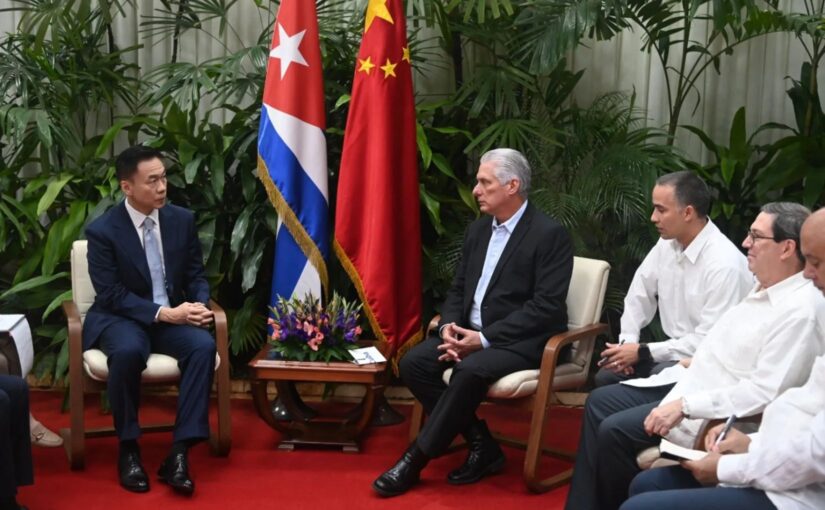
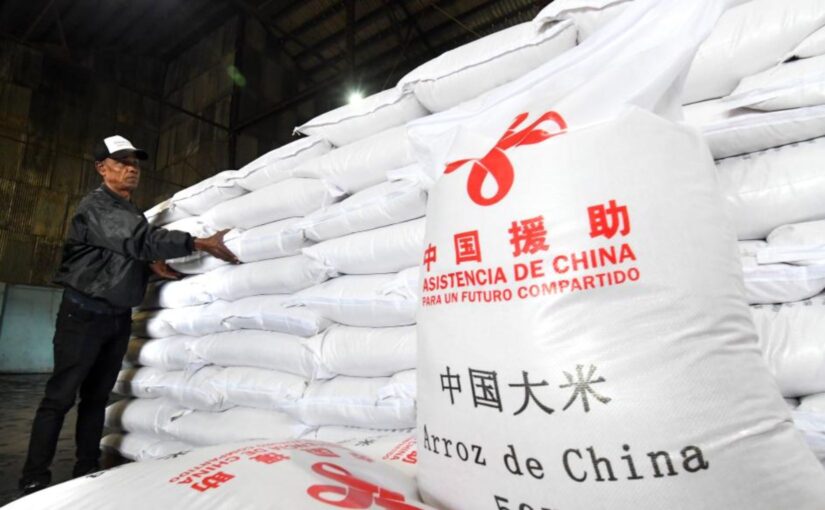
Following on from reports earlier this week about a new Chinese emergency aid program delivering 30,000 tons of rice to Cuba, China’s ambassador in Havana, Hua Xin, has announced a further set of assistance measures agreed by the Chinese government.
We republish below a report from the Cuban Communist Party (translated by The Left Chapter), which notes that the newly-announced aid package includes US$80 million in financial assistance and a donation of 60,000 tons of rice. The financial assistance is aimed specifically at helping Cuba to resolve its energy crisis – caused by the US’s illegal blockade on the island, and exacerbated by the reduced flow of oil from Venezuela following the US’s flagrantly illegal attack on that country.
The report is followed by an article in Brasil de Fato providing further information and noting that, while most of Cuba’s electricity is still generated from fossil fuels, “Chinese investment in renewables seeks to reduce dependence on imported fuels and strengthen the stability of the country’s electricity supply”.
Xi Jinping approves new round of aid from the People’s Republic of China to Cuba
January 21 (The Left Chapter) – The President of the People’s Republic of China and General Secretary of the Communist Party of China (CPC), Xi Jinping, approved a new round of aid to Cuba that includes emergency financial assistance valued at 80 million dollars for the acquisition of electrical equipment and other urgent needs that the country has, as well as a donation of 60,000 tons of rice.
The Chinese ambassador to Cuba, Hua Xin, reported this to Miguel Díaz-Canel Bermúdez, the First Secretary of the Central Committee of the Communist Party of Cuba (PCC) and President of the Republic, during a meeting on Tuesday afternoon at the Palace of the Revolution.
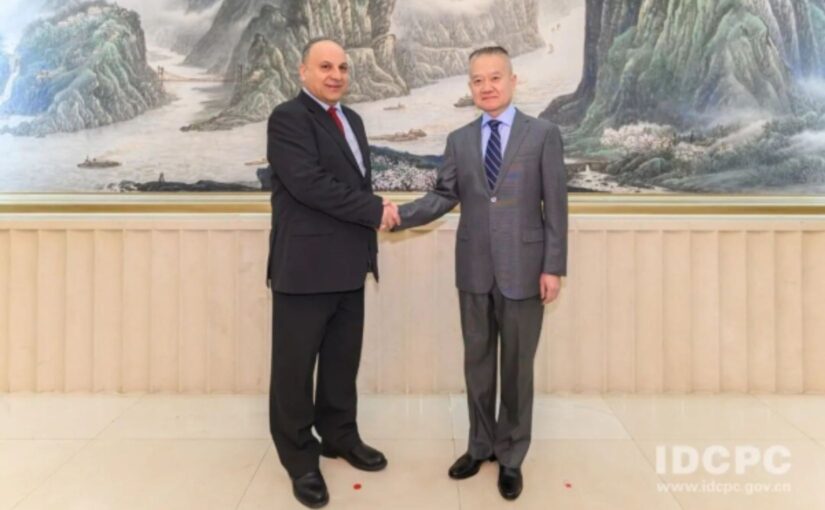
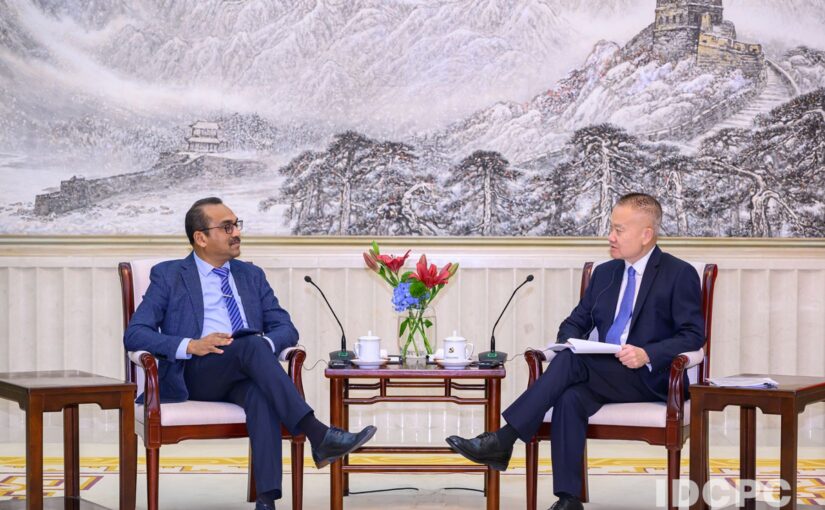
Liu Haixing, Minister of the International Department of the Communist Party of China (CPC) Central Committee (IDCPC), met in Beijing on January 16 with a visiting delegation of the Palestinian National Liberation Movement Fatah led by Bassam Zakarneh, Member of Fatah’s Revolutionary Council of Palestine and Fatah’s Deputy Minister of Arab Relations and Chinese Affairs.
Liu said that the CPC is willing to work with Fatah to implement the important consensus reached by the two heads of state, strengthen high-level exchanges, deepen political mutual trust, firmly support each other on issues involving respective core interests and major concerns, enhance experience exchange in state governance and administration and cooperation in areas such as youth and women, strengthen coordination and cooperation in international and regional affairs, and promote greater development of China-Palestine strategic partnership through inter-party channels.
Zakarneh said, Palestine spoke highly of the profound and enduring friendship between Palestine and China and sincerely thanks China for the long-term strong support and selfless assistance to the Palestinian people. Palestine will, as always, firmly support China’s core concerns and the cause of reunification.
The following article was originally published on the IDCPC website.
Liu Haixing Meets with a Fatah Delegation of Palestine
Beijing, January 16th (IDCPC) — Liu Haixing, Minister of the International Department of the CPC Central Committee (IDCPC), met here today with a delegation led by Bassam Zakarneh, Member of Fatah’s Revolutionary Council of Palestine and Fatah’s Deputy Minister of Arab Relations and Chinese Affairs.
Liu said, under the strategic guidance of President Xi Jinping and President Mahmoud Abbas, China-Palestine relations have maintained good momentum of development. The CPC is willing to work with Fatah to implement the important consensus reached by the two heads of state, strengthen high-level exchanges, deepen political mutual trust, firmly support each other on issues involving respective core interests and major concerns, enhance experience exchange in state governance and administration and cooperation in areas such as youth and women, strengthen coordination and cooperation in international and regional affairs, and promote greater development of China-Palestine strategic partnership through inter-party channels. Liu also introduced the main achievements of the fourth plenary session of the 20th CPC Central Committee and the fifth plenary session of the 20th CPC Central Commission for Discipline Inspection.
Zakarneh said, Palestine highly spoke of the profound and enduring friendship between Palestine and China and sincerely thanks China for the long-term strong support and selfless assistance to the Palestinian people. Palestine will, as always, firmly support China’s core concerns and the cause of reunification. Fatah pays close attention to the Recommendations of the Central Committee of the Communist Party of China (CPC) for Formulating the 15th Five-Year Plan for National Economic and Social Development adopted at the fourth plenary session of the 20th CPC Central Committee, and is willing to further deepen exchanges and cooperation with the CPC, learn from China’s successful experiences in aspects such as comprehensively exercising rigorous governance over the Party, cultivation of cadres and economic development.
The two sides also exchanged views on international and regional issues of common concern.
Jin Xin, Assistant-minister of the IDCPC, Firas Shomaly, Member of Fatah’s Revolutionary Council of Palestine, and Jawad Mohammed Qutish Awad, Palestinian Ambassador to China, and others, were present.
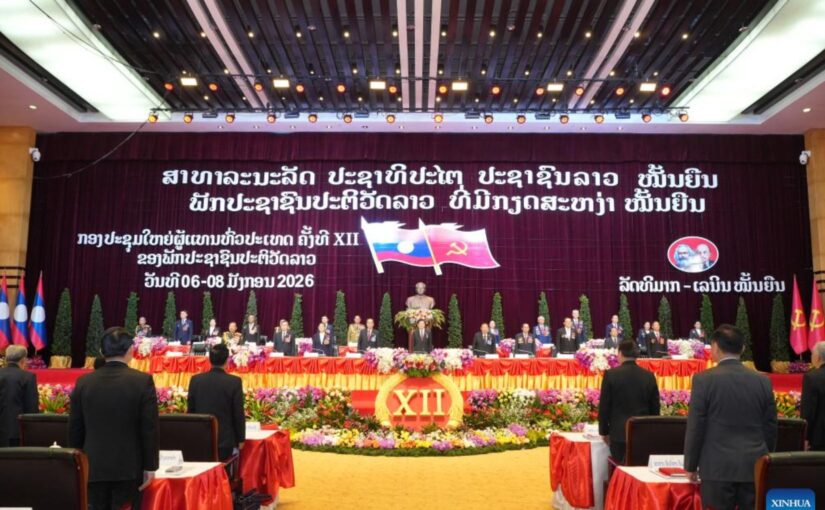
The successful conclusion of the 12th National Congress of the Lao People’s Revolutionary Party (LPRP) on January 8 has served as a spur to the further development of the socialist country’s fraternal relationship with neighbouring China.
A January 11 report published by the Xinhua News Agency noted that the congress had summarised Laos’ achievements over the past five years, charting the future direction of the country’s socialist development, and injecting new impetus into the advancement of China-Laos relations.
It added that: “The congress reviewed and adopted a series of key political documents, including the political report of the 11th Central Committee and the 10th Five-Year Plan for Socio-Economic Development (2026-2030). Under the plan, Laos aims to achieve an average annual economic growth rate of six percent during the 2026-2030 period.
“A key highlight of the congress was the adoption of the Party’s third political program, which clearly sets the goal of transforming the country into an upper-middle-income developing nation by 2055, the 100th anniversary of the founding of the LPRP.”
In this regard, the China-Laos Railway was frequently cited as a key driver of national development. However, besides transport infrastructure, “cooperation between the two countries has expanded across a wide range of sectors under the strategic guidance of senior leaders from both sides. Substantial progress has been made in energy, healthcare, poverty alleviation, and other key areas, further consolidating the China-Laos community with a shared future.”
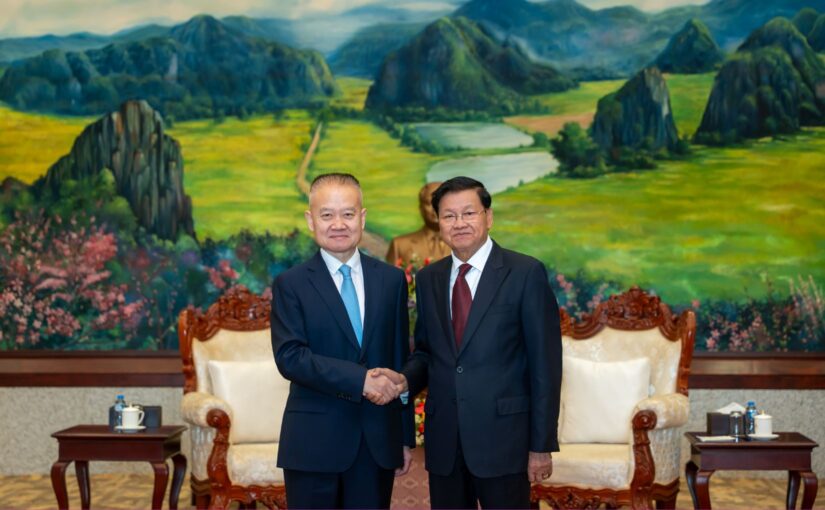
Noting that the successful conclusion of the congress opens a new chapter in Laos’ socialist development and heralds fresh historical opportunities for advancing the China-Laos community with a shared future, the article said that Thongloun Sisoulith, General Secretary of the LPRP Central Committee and Lao President, stated that Laos stands ready to work with China to fully implement the action plan for building the China-Laos community with a shared future, strengthen unity and cooperation, jointly address risks and challenges arising from changes in the international and regional landscape, and safeguard the shared interests of both parties and countries.
And Chinese Ambassador to Laos Fang Hong reaffirmed China’s commitment to working closely with Laos to implement the important consensus reached by the top leaders of the two countries. She noted that the 65th anniversary of the establishment of diplomatic relations between China and Laos presents an opportunity to deepen exchanges on governance experience, advance high-quality Belt and Road cooperation, and promote the development of both countries’ socialist causes.
On January 13, Thongloun Sisoulith met in the Lao capital Vientiane with Liu Haixing, Special Envoy of General Secretary Xi Jinping and Minister of the International Department of the Communist Party of China (CPC) Central Committee (IDCPC).
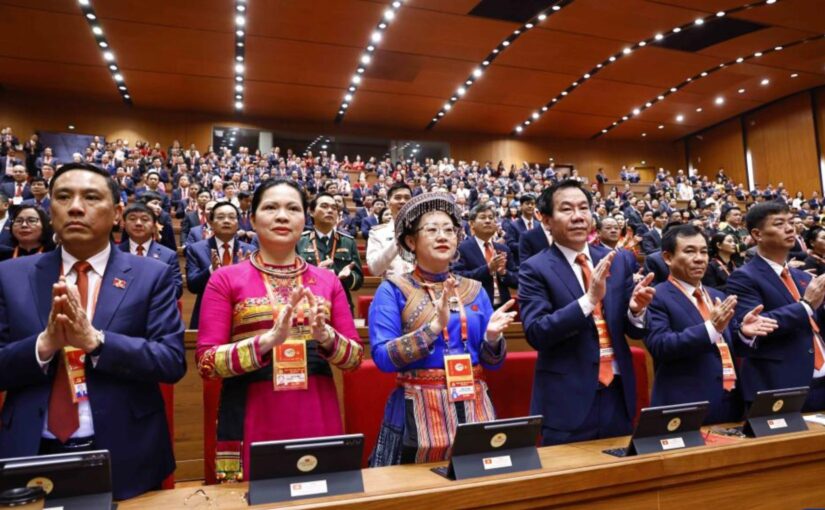
The Communist Party of Vietnam (CPV) opened its 14th National Congress in Hanoi on January 20.
In a message of greetings sent the same day, the Central Committee of the Communist Party of China (CPC) said that the CPV is the strong leadership core of the Vietnamese people and the cause of socialism in Vietnam. Since the 13th National Congress of the CPV, the Central Committee of the CPV has united and led the Vietnamese people in making remarkable achievements in advancing socialist construction and reform.
It added that amid complex international situations, Vietnam has maintained political and social stability, experienced rapid and sustainable economic development, and seen its international status rise steadily. These accomplishments have demonstrated the advantages of the communist party leadership and the socialist system, and have made positive contributions to peace, stability, development and prosperity in the region and the world.
The message further emphasised that the CPC and the government of China attach great importance to developing the relations between the two parties and countries, and are willing to work together with the Vietnamese side to adhere to the principles of “long-term stability, future orientation, good-neighbourly friendship and all-round cooperation,” and the spirit of “good neighbours, good friends, good comrades, good partners,” to implement the important consensus reached by the top leaders of the two parties and countries.
The following article was originally published by the Xinhua News Agency.
The Central Committee of the Communist Party of China (CPC) on Tuesday sent a congratulatory message on the convening of the 14th National Congress of the Communist Party of Vietnam (CPV).
The CPV is the strong leadership core of the Vietnamese people and the cause of socialism in Vietnam. Since the 13th National Congress of the CPV, the Central Committee of the CPV has united and led the Vietnamese people in making remarkable achievements in advancing socialist construction and reform, read the message.
Amid complex international situations, Vietnam has maintained political and social stability, experienced rapid and sustainable economic development, and seen its international status rise steadily. These accomplishments have demonstrated the advantages of the communist party leadership and the socialist system, and have made positive contributions to peace, stability, development and prosperity in the region and the world, it said.
A Chinese emergency aid program has delivered its first shipment of rice to Cuba, which is facing shortages as a result of the tightening US blockade on the island.
Under the new program, China will send 30,000 tons of rice. The first shipment was handed over on Monday 19 January.
At the handover ceremony – attended by Vice Prime Minister Oscar Perez-Oliva Fraga, Minister of Domestic Trade Betsy Díaz Velázquez, Deputy Minister of Foreign Trade and Foreign Investment, Déborah Rivas Saavedra and Chinese Ambassador to Cuba Hua Xin, among others – Ambassador Hua stated that “each grain of rice represents the unbreakable commitment of the Chinese people” to the island.
He continued:
We’re convinced that, with the joint effort of Cuba and China, no blockade will be able to turn off the light of hope, no difficulty will be able to block the path of progress.
Hua Xin added that China’s solidarity with Cuba “not only embodies the deep bonds of special friendship between both nations, but also demonstrates the unwavering commitment to remain united even in difficult times”.
Cuban Foreign Minister Bruno Rodríguez commented on X that the aid “is a sign of the close brotherhood and historical ties of friendship and solidarity that unite both nations”.
Daniel Lambert, manager of the Irish hip-hop group Kneecap, made an apposite comment on social media: “Due to crippling sanctions the USA has illegally placed on Cuba for 64 years its population struggles to now survive. Yesterday China sent 30,000 tons of rice to assist the Cuban people. As the US starves its neighbour a nation across the world tries to assist.”
We publish below reports from Xinhua Spanish and Prensa Latina. The Xinhua report has been translated by us.
China delivers first batch of emergency food aid to Cuba
HAVANA, Jan 19 (Xinhua) — On Monday, Cuba officially received the first batch of a donation of 30,000 tons of rice from China, sent as emergency aid to support efforts aimed at guaranteeing the food supply of the population of the Caribbean island.
At the handover ceremony, held at the Ministry of Domestic Trade in Havana, Cuban Deputy Prime Minister and Head of Foreign Trade and Foreign Investment, Óscar Pérez-Oliva, thanked China for the donation, describing it as “a concrete expression of China’s exemplary, unconditional and selfless cooperation with Cuba”.
In the following article, which was originally published on the Indian website Scroll, Ajay Kamalakaran shares fascinating details regarding the five Indian doctors, particularly Dr. BK Basu, who served on the frontlines during the Chinese people’s war of resistance against Japanese aggression, providing critically needed medical care.
Prior to their August 1938 departure from Bombay (now Mumbai) they were cautioned by Indian independence movement leader Sarojini Naidu: “You are undertaking a dangerous task…some, or one of you, may not return.”
They were all aware of the risks, but as the 28-year-old Dr. Basu wrote, their anxieties were outweighed by the pride they felt in taking part in an act of “internationalism and anti-imperialism”.
Throughout a long voyage, the Indian doctors received an impressive welcome at each port of call.
In Colombo [Ceylon now Sri Lanka], an enthusiastic Chinese store owner took a photo with the group in front of his shop. In Penang [Malaya], a “welcoming mass of people”, predominantly overseas Chinese and Indians, garlanded the doctors.
“Singapore was much the same, with large crowds at the pier waving Indian and Chinese flags… In Hong Kong, too, they were greeted with cheers and applause.”
Reaching Guangzhou, then known as Canton, they were feted by Soong Ching-ling, the widow of Dr. Sun Yat Sen and later a Vice-President and finally the Honorary President of the People’s Republic of China.
Reaching Changsha, in Hunan province, “the spirit of international support was palpable… Volunteers from the United States, Europe, Russia and even Java joined a banquet hosted for the Indians by Ye Jianying, the chief of the Eight Route Army, the larger of the two communist forces that fought the Japanese. Among those at the banquet was the writer-journalist Agnes Smedley, an ardent supporter of Indian independence.” [An account of Smedley’s role in the fight for Indian independence may be read here.]
Basu developed a particularly close relationship with Dr. DK Kotnis, who was admitted to membership of the Communist Party of China and died of illness in 1942, aged just 32. “Together their efforts extended beyond treating the wounded. When crossing enemy lines, they would actively sabotage infrastructure used by the Japanese, including railway tracks.”
The 12th National Congress of the Lao People’s Revolutionary Party (LPRP) opened on January 6 in the capital Vientiane.
The congress is being held under the theme “Enhancing the Party’s Strong Leadership, Proactively Building an Independent and Self-Reliant Economy, Continuing to Consolidate the People’s Democratic Regime, and Advancing towards Socialism.”
In a congratulatory message, the Central Committee of the Communist Party of China (CPC) writes:
“As the strong leadership core of the Lao people and the socialist cause of Laos, since the 11th national congress of the party, the Central Committee of the LPRP, led by General Secretary Thongloun Sisoulith, has been committed to promoting the party’s self-building, consolidated its leadership position, united and led the people of all ethnic groups in Laos, actively explored a socialist development path that suits the country’s national conditions, and achieved a series of important progress and results in the party and the country’s various undertakings.”
It adds that both China and Laos are socialist countries led by communist parties and the CPC and the Chinese government have always viewed and handled the relationship between the two parties and countries from a strategic and long-term perspective.
The following article was originally published by the Xinhua News Agency.
BEIJING, Jan. 6 (Xinhua) — The Central Committee of the Communist Party of China (CPC) on Tuesday sent a congratulatory message to the Lao People’s Revolutionary Party (LPRP) on the opening of its 12th National Congress.
As the strong leadership core of the Lao people and the socialist cause of Laos, the message said, since the 11th national congress of the party, the Central Committee of the LPRP, led by General Secretary Thongloun Sisoulith, has been committed to promoting the party’s self-building, consolidated its leadership position, united and led the people of all ethnic groups in Laos, actively explored a socialist development path that suits the country’s national conditions, and achieved a series of important progress and results in the party and the country’s various undertakings.
In the message, the CPC Central Committee said it is sincerely pleased with these achievements and highly evaluates them.
The 12th congress is a milestone in the development process of Laos’ socialist cause, said the message, adding that it will review and approve the party’s third Political Programme and other important political documents, as well as make strategic plans and specific arrangements for the development of the party and the country’s various undertakings in the coming period.
It is believed that under the strong leadership of the LPRP, the Lao people will successfully achieve the goals and tasks set by the congress and advance Laos’ socialist cause to a new stage of development, it said.
Both China and Laos are socialist countries led by communist parties, it noted, adding that the CPC and the Chinese government have always viewed and handled the relationship between the two parties and countries from a strategic and long-term perspective.
In the current new situation, China is willing to work with Laos, following the important consensus of the highest leaders of both parties and countries as the fundamental guide, to strengthen strategic communication, deepen exchanges and cooperation, and steadily promote the building of a China-Laos community with a shared future, it said.
This will help push forward the continuous, sound and stable development of the China-Laos comprehensive strategic cooperative partnership, benefit both countries and peoples, and make new positive contributions to world peace, development and progress, it said.
China and Vietnam have successfully seen out 2025, designated as their Year of People-to-People Exchanges marking the 75th anniversary of their diplomatic relations, with a varied series of activities.
Chinese and Vietnamese troops conducted a joint border patrol on December 25. Under the rotational mechanism, this joint patrol was chaired by the Chinese side. Both sides agreed to continue strengthening coordination mechanisms, jointly combating cross-border violations, promoting rapid handover mechanisms, ensuring a safe border environment, facilitating customs clearance at border gates, and enhancing friendship exchanges and cooperation.
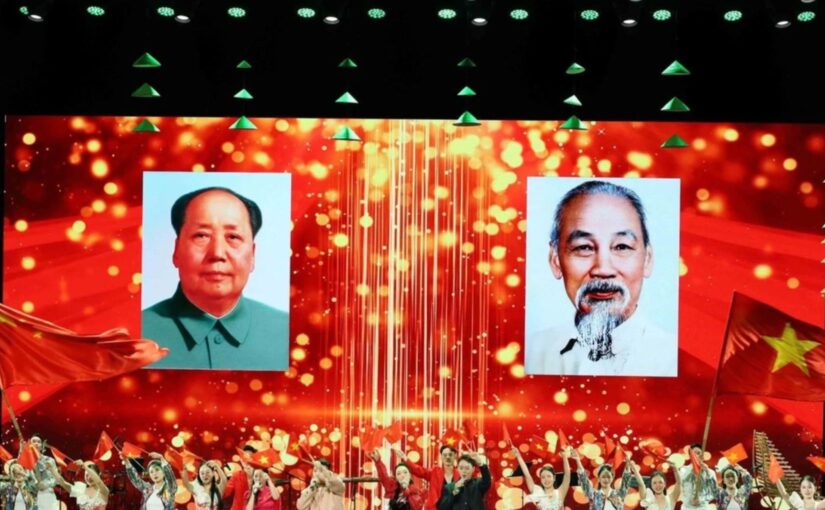
On December 23, a special exhibition on President Ho Chi Minh in China opened at the Hongyan Revolutionary History Museum in Chongqing.
Held under the theme “The Revolutionary Path,” the exhibition is structured into four sections focusing on organisational building, the shared struggle against a common enemy and foreign aggression, mutual support, and the joint creation of a glorious chapter in history.
Featuring more than 230 historical photographs and valuable archival images, the exhibition vividly retraces President Ho Chi Minh’s revolutionary life while reflecting a special and memorable period in Vietnam-China relations. During his revolutionary career, President Ho Chi Minh made many visits and spent much time in China, including an important period in Hongyan village in Chongqing, which housed the Southern Bureau of the Central Committee of the Communist Party of China and the representative office of the Eighth Route Army in Chongqing.
Speaking at the event, Vietnamese Consul General in Chongqing Bui Nguyen Long underlined the exhibition’s special significance as it coincides with the 135th birth anniversary of President Ho Chi Minh and the 75th anniversary of the establishment of Vietnam-China diplomatic relations.
The exhibition, he said, will help the two peoples, particularly the younger generation, gain a deeper understanding of the heroic and illustrious chapters of Vietnam-China traditional friendship.
On the sidelines of the exhibition, the Hongyan Revolutionary History Museum, in coordination with the Vietnamese Consulate General in Chongqing, introduced a coffee product named “Comrades and Brothers.” Made from Vietnamese Robusta coffee beans sourced from Buon Ma Thuot and buffalo milk from China’s Guangxi region, the product aims to further spread the positive values of Vietnam-China relations among communities in western China.
In an interview published on December 24, Professor Wang Yong, Director of the Centre for International Political Economy at Peking University, said that Vietnam-China relations are maintaining strong and comprehensive momentum and have reached an “unprecedented height” while entering a new phase of development with prospects for broader and deeper cooperation.
Speaking to the Vietnam News Agency correspondent in China, Wang said that since the start of 2025, the two countries have carried out a wide range of activities to mark the 75th anniversary of their diplomatic relations, including the high-level visits and exchanges, as well as cooperation initiatives between the two sides’ ministries, sectors and localities. He noted that the high frequency of contacts at various levels reflects the strong impetus behind bilateral ties and demonstrates that overall relations are being promoted in a highly positive and substantive manner.
Looking ahead, Wang affirmed that Vietnam-China relations are entering what he described as a “golden period” of cooperation. He predicted that the two sides will continue to maintain high-level exchanges, expand partnerships in infrastructure, energy, innovation, and science and technology, while further promoting people-to-people exchanges and cooperation between localities.
On December 21, in Beijing, in an atmosphere imbued with warm friendship, the program, “Vietnam Culture Day in China” was held at the China National Opera House. This was the concluding event of a series of exchange activities marking the 75th anniversary of the establishment of Vietnam-China diplomatic relations and the Vietnam-China People-to-People Exchange Year 2025. More than 1,000 people attended.
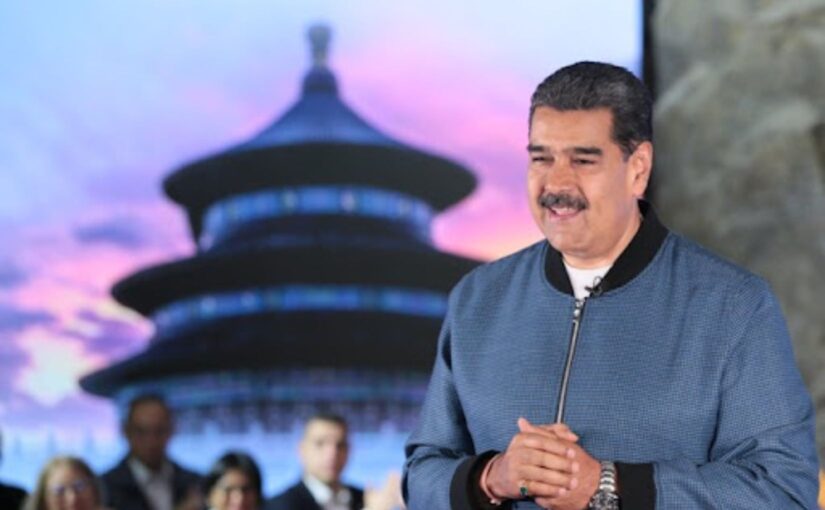
On Friday 26 December, Venezuelan President Nicolás Maduro marked the birth anniversary of Chairman Mao with a message on his official Telegram channel.
Attached to the message is a video in which President Maduro elaborates on the historic importance of the Chinese Revolution and China’s role in the world. The video transcript (translated to English by us) reads as follows:
Our tribute to the Great Helmsman Mao Zedong, founder of the People’s Republic of China, who, through his example, his ideas, and the revolutionary struggle he led, undoubtedly shaped the 20th century worldwide and marked the future of China. The 21st century is the century in which the destiny of humanity, as President Xi Jinping says, must be characterised by the common destiny of humanity.
Only the great republic founded by the great Mao Zedong, the great Helmsman, was able to bring China and the entire Chinese people together, enabling them to establish a political model that has allowed for the development and expansion of productive forces, and has managed to transform China in just 50 or 60 years from a semi-feudal country to a country with the highest level of scientific, technological, cultural, economic, financial and commercial development in the world.
A powerful culture and a powerful revolution, the revolution of the Great Helmsman, who founded the People’s Republic of China on 1 October 1949.
One must study the epic journey of the Chinese people and how the Great Helmsman, Mao Zedong, together with the Communist Party of China and the People’s Liberation Army, managed to forge the greatest national alliance in Chinese history.
We share the same values, the historic values of the great Mao Zedong and Xi Jinping, Simón Bolívar and Hugo Chávez. So we are united in soul, spirit and values.
Below you will find the text of the Telegram message (translated to English by us) and the associated video.
We celebrate the birthday of Mao Zedong, one of the giants of the 20th century. His genius in strategy and the formation of a revolutionary army of workers and peasants demonstrated that peoples can defeat empires. His legacy taught us that: “Weapons are an important factor in war, but not the decisive one; the decisive factor is man and not things”. This strategic vision was the cornerstone for the victory and liberation of the Chinese people.
Thanks to leaderships like that of Mao, China has regained its power, transforming itself into a superpower of knowledge, education and technology, and restoring dignity to a nation. Mao’s figure represents rebellion and the construction of a sovereign project, elements that inspire our homeland in the defence of its own sovereignty and independence.
For the last nearly six months, a landmark exhibition at the National Museum of Australia in the capital Canberra has been reminding visitors that Indigenous-Chinese bonds helped forge the links between the two peoples long before the two countries established diplomatic relations in 1972.
Our Story: Aboriginal–Chinese People in Australia, is the fruit of a five-year research project led and curated by Chinese-Australian artist Zhou Xiaoping and shows how mixed heritage communities wove ties of survival and solidarity on nineteenth century goldfields and in pearling camps. Drawing on historical records and oral histories, Our Story challenges monolithic accounts of Australian history.
During the gold rushes and in industries such as pearling, railways, and agriculture (1850s–1900), Chinese labourers settled across northern Australia and many formed relationships with Aboriginal women, in the face of the White Australia policy and other racist legislation that targeted both peoples.
These families blended Chinese traditions – language, cuisine, festivals – with Aboriginal kinship and cultural practices. “I’m Aboriginal, but I’m also proud of my Chinese heritage,” says Peter Yu, whose family photographs in the exhibition tell the story of how his Hakka father and Yawuru mother raised nine children under restrictive cohabitation laws, similar to those of apartheid South Africa.
Survival often demanded ingenuity. In the 1930s, Wen Liqun registered her Larrakia stepson – her Chinese husband’s son with a Larrakia woman – as “Chinese” to shield him from the Stolen Generations. (According to Wikipedia: “The Stolen Generations [also known as Stolen Children] were the children of Australian Aboriginal and Torres Strait Islander descent who were removed from their families by the Australian federal and state government agencies and church missions, under acts of their respective parliaments. The removals of those referred to as ‘half-caste’ children were conducted in the period between approximately 1905 and 1967, although in some places mixed-race children were still being taken into the 1970s. Official government estimates are that in certain regions between one in ten and one in three Indigenous Australian children were forcibly taken from their families and communities between 1910 and 1970. The Bringing Them Home Royal Commission report [1997] described the Australian policies of removing Aboriginal children as genocide.”)
In the article published below, which was originally published on the website of the Australian Institute of International Affairs, Dr. Marina Yue Zhang, an associate professor at the Australia-China Relations Institute, University of Technology Sydney (UTS: ACRI), writes:
“As the exhibition prepares to tour China in 2026, it forces a reckoning: how does a nation reconcile its suppressed histories with its multicultural present? By reconnecting with these hidden roots – embodied in everyday objects and intimate stories – Australia may yet forge its most resilient, relational partnership with China and its people.
“‘In an age of tariff wars and tech sanctions,’ says Dr. Jilda Andrews, curator of the museum, ‘Our Story isn’t just an exhibition. It’s a milestone in putting First Nations voices at the centre – creating a space for truth-telling, listening and honest conversation.’”
As the exhibition prepares to move on to China next year, readers in Australia still have until 27 January 2026 to see it at Canberra’s National Museum of Australia.
As Australia marked Reconciliation Week (27 May – 3June ), a landmark exhibition at the National Museum of Australia reminds us that Indigenous–Chinese bonds helped forge the links between the two peoples long before Canberra and Beijing formalised diplomacy in 1972.
Our Story: Aboriginal–Chinese People in Australia, a five-year research project led and curated by Chinese-Australian artist Zhou Xiaoping, uncovers a legacy of resilience and cultural fusion. Mixed-heritage communities—unwitting pioneers of people-to-people diplomacy—wove ties of survival and solidarity on 19th-century goldfields and in pearling camps. Drawing on historical records and oral histories, their stories—Our Story, the untold narratives of the nation—challenge monolithic accounts of Australian history and reveal a premodern form of “soft power.”
Through videos, installations, and embedded texts in family trees and photographs, the exhibition invites contemporary Aboriginal artists to interpret these “our stories.” Together, they illuminate the accidental diplomacy of Chinese men and Aboriginal women who built communities against the odds.
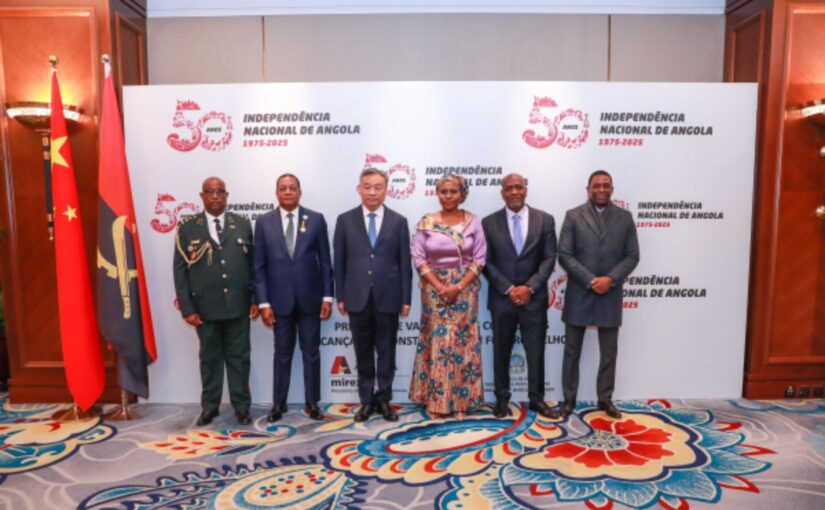
China last month marked the 50th anniversary of Angolan independence (November 11th 1975), which followed a protracted armed struggle for liberation against Portuguese colonialism and the overthrow of the fascist regime in Lisbon.
On November 28, Vice Foreign Minister Miao Deyu attended and spoke at the reception hosted by the Angolan Embassy in Beijing.
He stated that the friendship between China and Angola has a long history and enjoys a solid foundation. In recent years, under the strategic guidance of President Xi Jinping and President João Manuel Gonçalves Lourenço, practical cooperation in various fields between China and Angola has yielded fruitful results, benefiting the peoples of both countries. China is willing to work with Angola to carry forward the traditional friendship, join hands in seeking common development, and make greater contributions to building an all-weather China-Africa community with a shared future for the new era.
Ambassador of Angola Dalva Maurĺcia Calombo Ringote Allen stated that Angola and China share a deep traditional friendship, and that bilateral relations are rooted in the values of friendship, peace, solidarity, respect, and mutual benefit. The Angolan side sincerely thanks the Chinese side for the valuable support it has long provided for Angola’s national independence, reconstruction and development.
Earlier, from November 10 to 11, Special Representative of the Chinese Government on African Affairs Liu Yuxi visited Angola. Angolan President João Manuel Gonçalves Lourenço met with him, and they exchanged views on bilateral relations and issues of common concern.
Liu Yuxi handed over President Xi Jinping’s congratulatory message on the 50th anniversary of Angola’s independence and stated that under the strategic guidance of the leaders of both countries, the bilateral relationship between China and Angola has gained in-depth development, and mutually beneficial cooperation has yielded fruitful results.
President João Manuel Gonçalves Lourenço thanked President Xi Jinping for his congratulatory message, and expressed that Angola admires the historic achievements China has made under the leadership of President Xi Jinping, regards China as the most important partner for development cooperation, and is willing to strengthen coordination and cooperation with China to safeguard the interests of the vast number of developing countries, including those in Africa.
During the visit, Liu Yuxi also held working exchanges with Foreign Minister Téte António and attended the celebration of the 50th anniversary of Angola’s independence on behalf of the Chinese side.
In all, some 45 foreign delegations, including more than a dozen heads of state or government, along with a number of former African Presidents, attended the celebrations in the capital Luanda, which included both civilian and military parades. Among them were the Presidents of Namibia, Zimbabwe, the Republic of Congo, São Tomé and Príncipe, Cape Verde, Comoros, the Sahrawi Arab Democratic Republic (SADR), and Portugal, the Prime Minister of the Democratic Republic of Congo, the President of the Assembly of Mozambique, and the President of the Council of the Nation of Algeria. An especially warm welcome was given to Esteban Lazo Hernández, member of the Political Bureau of the Communist Party of Cuba Central Committee and President of the National Assembly of People’s Power and the Council of State.
Granma, the newspaper of the PCC, reported: “Our country’s internationalist epic, especially during the heroic Operation Carlota, was an enduring page of altruism and solidarity, whose contribution was decisive in preserving and consolidating Angola’s independence and achieving that of Namibia, as well as making a significant contribution to the demise of the apartheid regime.
The Communist Party of Australia (CPA) has said that it can learn from the Communist Party of China’s efforts to uproot corruption and bureaucracy and retain a good style of work based on the mass line.
In a recent interview with the Global Times newspaper, Vinnie Molina, National President of the CPA, was asked what lessons China’s “eight-point decision” provides for Marxist parties worldwide.
The eight-point decision is a set of rules first adopted by the CPC leadership in December 2012 to address chronic bureaucratic issues, including official privileges.
Spelled out in just over 600 words, it established rules for Party leaders governing research tours, meetings, documentation, and other official duties. It later expanded into a Party-wide initiative for all members to adopt its principles to improve governance conduct. After more than a decade of implementation, the decision has been hailed as a “game changer” in China’s governance.
In March 2025, the CPC launched a further Party-wide education campaign to implement the program.
Asked what provisions made the deepest impressions on him, Molina replied:
“To be a good Communist requires dedication and humility. I really admire the leadership style of Chinese President Xi Jinping, especially how he leads by example… The first regulation is crucial: ‘leaders must keep in close contact with the grassroots.’ Those who are in positions of responsibility must work hard to earn the people’s trust and never separate themselves from the people. Local knowledge and experience are vital for leadership on the national level.”
As the president of a Marxist-Leninist party, Molina sees the decision as inheriting and developing Marxist party-building doctrine:
“Friedrich Engels, in his ‘Rules of the Communist League (1847),’ recognised that if the working masses were to overcome capitalism, they would need to be highly organised. He also stressed the importance of responsibility to the community and having safeguards against the misuse of funds. It is easy to deviate from party discipline if we are not closely linked to the people. It is with the people that the Communist Parties test their leadership and policies.”
He added: “The CPC uses the method of criticism and self-criticism in party-building at all levels from the leadership to the rank and file to strengthen the unity of the organisation and its place in Chinese society. As Marxist-Leninist parties, we must reflect on the principles and methods of work and establish strict requirements to ensure both centralism and democracy are adhered to. We can only grow and thrive if we have cadres who are disciplined and understand the need for democratic centralism, self-discipline and leading by example.”
On the relations between Marxist parties worldwide, including between the CPA and CPC, Molina concludes:
“The exchanges between Communist Parties are vital to upholding our commitment to proletarian internationalism. By learning how each party applies universal principles to its specific context, we gain invaluable insights. The CPC’s decision of engaging with Marxist parties worldwide is not only correct but essential. We deeply value this dialogue and hope to see in-depth information sharing. ‘Workers of the world, unite’ is a phrase that rings true throughout history. To isolate ourselves from the world can lead to the withering of our movement – as seen in parts of the Western left, which have at times fallen prey to the imperialist propaganda. That is why we support greater opportunities for Marxist education exchanges, which can help smaller parties like the CPA train cadres capable of building a stronger communist presence.”
The Communist Party of China (CPC) has reiterated its solidarity with the United Socialist Party of Venezuela (PSUV) and with the revolutionary government of President Maduro.
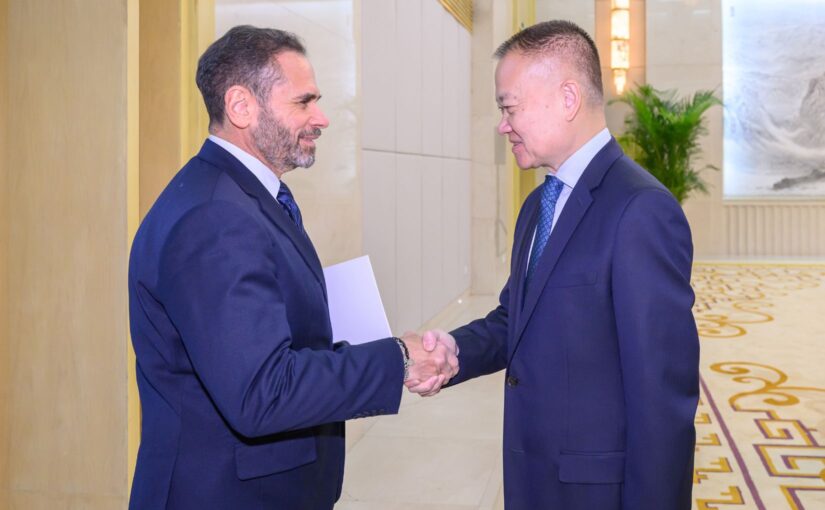
Liu Haixing, Minister of the International Department of the CPC Central Committee (IDCPC), met on November 26 with Remigio Ceballos, the Venezuelan Ambassador to China.
Liu said, in recent years, under the strategic guidance of President Xi Jinping and President Nicolas Maduro, China-Venezuela relations have continuously reached new heights. China will, as always, firmly support Venezuela in safeguarding its sovereignty and independence, oppose external interference and support Venezuela in independently choosing its development path. The CPC and the PSUV share similar ideals and goals.
The Chinese side is willing to jointly implement the important consensus reached by the two heads of state, continuously deepen exchanges and mutual learning of experience in party building and state governance, enhance exchanges at all levels, promote cooperation in areas such as cadre training, and increase coordination and cooperation in international and regional affairs, so as to advance the all-weather strategic partnership between China and Venezuela through inter-party channels.
Ceballos said, the governments, political parties and people of Venezuela and China maintain a brotherly friendship. Venezuela firmly supports China’s position on the Taiwan question and the concept of a community with a shared future for humanity and the Belt and Road cooperation proposed by President Xi Jinping. No matter how the international situation changes, Venezuela will continue to uphold and fulfill its firm commitment to developing friendly relations with China and is willing to deepen practical cooperation with China in areas such as economy, trade, energy and education. The Embassy of Venezuela in China is willing to actively promote exchanges and cooperation between the ruling parties of the two countries.
The following article was first published on the website of the IDCPC.
Beijing, November 26th—Liu Haixing, Minister of the International Department of the CPC Central Committee (IDCPC), met here today with Remigio Ceballos, Venezuelan Ambassador to China.
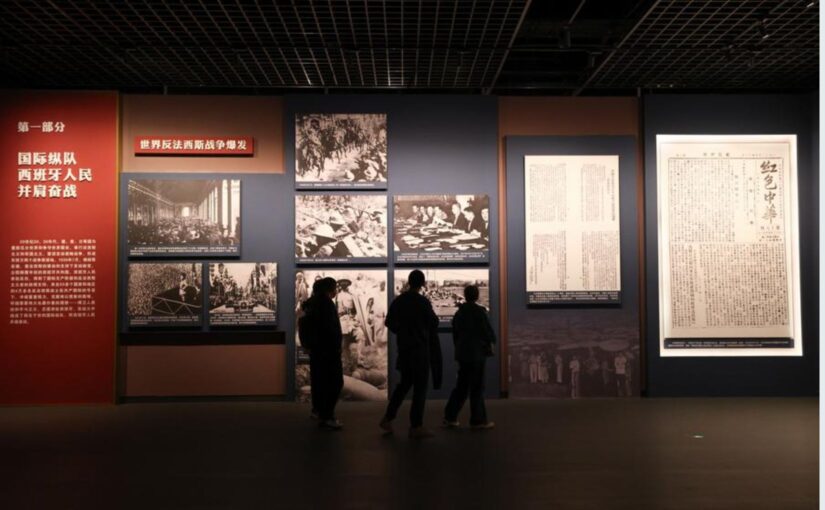
“For a Common Cause: From the Spanish Battlefield to China’s War of Resistance Against Japanese Aggression,” is the title of a major exhibition which opened in August at Beijing’s Museum of the Communist Party of China (CPC), marking the 80th anniversary of victory in the Chinese People’s War of Resistance Against Japanese Aggression and the World Anti-Fascist War. It will run till the end of 2025.
Through more than 260 photographs, 150 cultural relics and historical footage, the exhibition shows how anti-fascist volunteers of the International Brigades fought bravely on both the Spanish and Chinese battlefronts – unfolding an inspiring chapter of mutual aid in the global struggle against fascism.
A feature article published by the Xinhua News Agency on November 27 notes that: “The International Brigades mobilised over 40,000 volunteers from more than 50 countries to defend the Spanish Republic against forces including those sent from fascist Italy and Nazi Germany during its civil war (1936-1939). They fought in brutal battles such as the Defence of Madrid and the Battle of Jarama, where an estimated 10,000 lives were lost.”
It adds that less widely recognised is the Chinese contribution to this history. Among the International Brigades’ volunteers were more than 100 Chinese, many of whom were CPC members.
One prominent figure was Xie Weijin, who fought under the alias Lin Jishi. He fought in pivotal engagements, sustained two battle wounds, and narrowly avoided amputation. Beyond the frontline, Xie established an orphanage for over 100 children.
In a 1938 speech, Xie crystallised the shared struggle: “The Spanish and Chinese peoples are in a very tense phase of struggle… They are waging a revolutionary war for the national and social liberation of their respective countries, leading the fight against fascism…”
After the International Brigades were withdrawn from Spain that year, a number of internationalist fighters made their way to China, which was the main anti-fascist battlefield in the east. Among them was the Canadian surgeon Norman Bethune. After pioneering a mobile blood-transfusion service in Spain, he arrived in north China in 1938. There, he famously worked 40-hour shifts and championed setting up operating tables near the front lines. Alongside other international medical workers, Bethune saved countless lives and revolutionised battlefield medicine in China.
The following article was originally published by the Xinhua News Agency.
“There’s a valley in Spain called Jarama. It’s a place that we all know so well. It was there that we gave of our manhood, where so many of our brave comrades fell.”
These plaintive strains of the folk ballad “Jarama Valley” are more than a memorial — they are a portal to the stories of the International Brigades. This diverse group of anti-fascist fighters, drawn from across continents, now takes center stage in a touching exhibition in Beijing.
Titled “For a Common Cause: From the Spanish Battlefield to China’s War of Resistance Against Japanese Aggression,” the ongoing exhibition opened in August at the Museum of the Communist Party of China (CPC), marking the 80th anniversary of victory in the Chinese People’s War of Resistance Against Japanese Aggression and the World Anti-Fascist War.
Through more than 260 photographs, 150 cultural relics and historical footage, the exhibition shows how anti-fascist volunteers of the International Brigades fought bravely on both the Spanish and Chinese battlefronts — unfolding an inspiring chapter of mutual aid in the global struggle against fascism.
“This marks the first time China has contextualized the two battlefields within a single exhibition space, underscoring the united anti-fascist spirit of people across the world,” said Zhao Jiaojian, planner of the exhibition, which will run through the end of 2025.
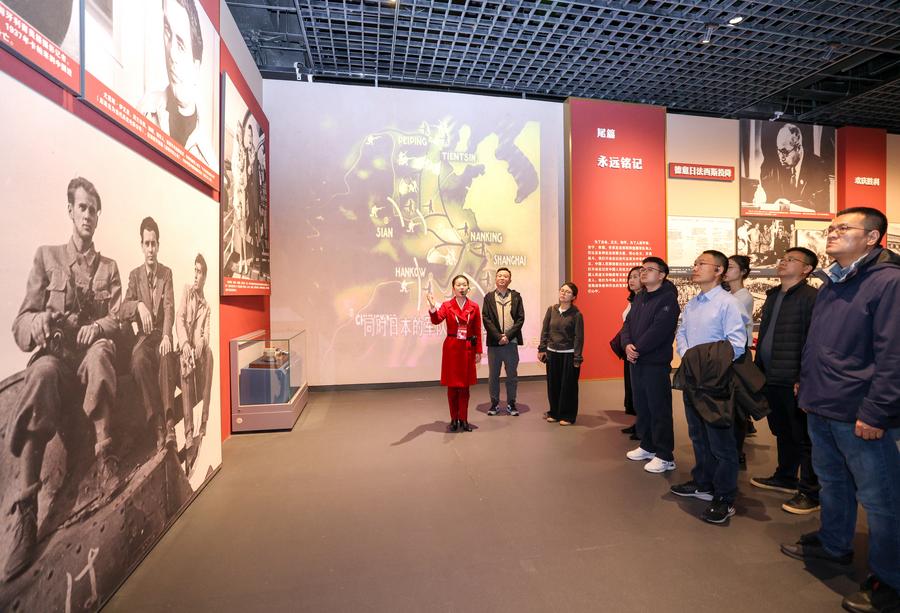
A staff member introduces exhibits to visitors at the exhibition titled “For a Common Cause: From the Spanish Battlefield to China’s War of Resistance Against Japanese Aggression” held at the Museum of the Communist Party of China (CPC) in Beijing, capital of China, Nov. 14, 2025. (Xinhua/Yin Gang)
BATTLES IN SPAIN
Organized by the Comintern — an international communist alliance — the International Brigades mobilized over 40,000 volunteers from more than 50 countries to defend the Spanish Republic against forces including those sent from fascist Italy and Nazi Germany during its civil war (1936-1939). They fought in brutal battles such as the Defense of Madrid and the Battle of Jarama, where an estimated 10,000 lives were lost.
Less widely recognized is the Chinese dimension of this chapter. Among the International Brigades’ volunteers were more than 100 Chinese, many of whom were CPC members.
One prominent figure was Xie Weijin, who fought under the alias Lin Jishi. A multilingual individual with military training, Xie rose to lead the Chinese volunteers and serve as the political commissar of an artillery brigade.
He fought in pivotal engagements, sustained two battle wounds, and narrowly avoided amputation. Beyond the frontline, Xie established an orphanage for war-orphaned children, which provided shelter for over 100 children by 1938.
In a speech delivered that year, Xie crystallized the shared struggle: “The Spanish and Chinese peoples are in a very tense phase of struggle… They are waging a revolutionary war for the national and social liberation of their respective countries, leading the fight against fascism…”
Their contributions were acknowledged back in China. A replica of the red banner sent by then CPC leaders to the volunteers in Spain is now displayed at the Beijing exhibition, bearing the inscription: “Unite the peoples of Spain and China! Down with the common foe of mankind — the Fascists!”
The heroic deeds of the volunteers, exemplified by figures like Xie, demonstrated “a commitment to justice that crossed national borders, and constituted an indelible chapter in the global fight against fascism that should never be forgotten,” said Jiang Ying, researcher of the Academy of Military Sciences.
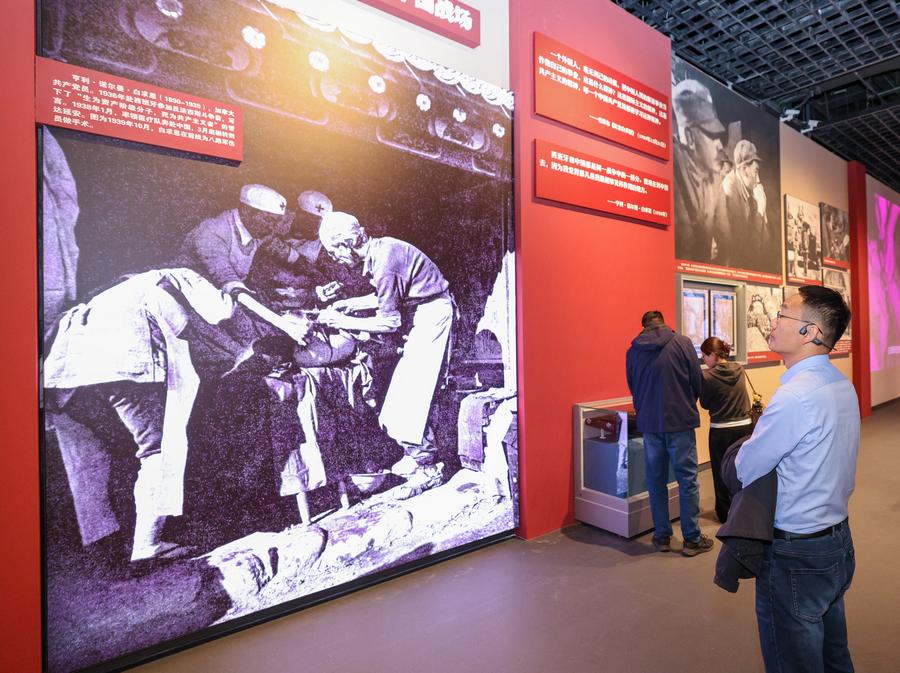
A visitor views a photo of Canadian surgeon Norman Bethune at the exhibition titled “For a Common Cause: From the Spanish Battlefield to China’s War of Resistance Against Japanese Aggression” held at the Museum of the Communist Party of China (CPC) in Beijing, capital of China, Nov. 14, 2025. (Xinhua/Yin Gang)
THE EASTERN FRONT
As the Spanish Civil War drew to a close in 1938, the International Brigades were officially withdrawn. Following a period of internment in France, the Chinese volunteers returned home to join in China’s nationwide resistance against Japanese aggression.
Yet the tide of internationalism did not recede — it flowed eastward. Foreign fighters redirected their focus from Spain to China, which had become the main theater of the World Anti-Fascist War in the East.
Among these volunteers, the most renowned was Canadian surgeon Norman Bethune, a household name in China. After pioneering a mobile blood-transfusion service in Spain, he arrived in north China in 1938. There, he famously worked 40-hour shifts and championed setting up operating tables near the front lines. Alongside other international medical workers, Bethune saved countless lives and revolutionized battlefield medicine in China.
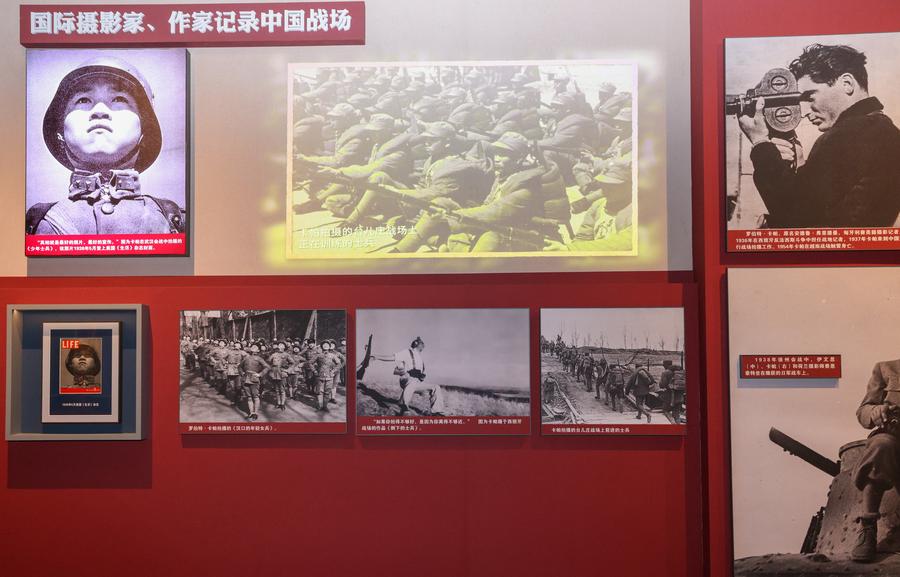
They were joined by journalists and artists who documented the Chinese people’s arduous struggle for the rest of the world. Among them, Hungarian-American photographer Robert Capa captured the war’s brutal reality in 1937, while Dutch filmmaker Joris Ivens arrived in 1938 to produce “The 400 Million” — the first Western documentary to portray China’s resistance in a positive light, galvanizing global support.
“In this exhibition, I can clearly see how the Chinese people assisted foreign revolutionaries and how foreign revolutionaries assisted the Chinese people,” said Lin Tao, a doctoral student at Hunan Normal University, while visiting the exhibition.
This photo taken on Nov. 14, 2025 shows photographic works by Hungarian-American photographer Robert Capa displayed at the exhibition titled “For a Common Cause: From the Spanish Battlefield to China’s War of Resistance Against Japanese Aggression” at the Museum of the Communist Party of China (CPC) in Beijing, capital of China. (Xinhua/Yin Gang)
Many young Chinese visitors like Lin have been profoundly moved by the exhibition, which also highlights the pivotal contributions of International Brigades anti-fascist fighters on the Chinese battlefield.
Decades later, China continues to honor this international solidarity. On the occasion of marking the 80th anniversary of its victory in World War II on Sept. 3 this year, the nation expressed sincere gratitude to the foreign governments and individuals who aided its people.
China was the first country to rise against fascist aggression with the longest-lasting resistance that began in 1931. The country tied down and struck over half of Japan’s overseas forces, at the cost of 35 million military and civilian casualties — accounting for approximately one-third of all WWII casualties worldwide.
“The exhibition aims to deepen the understanding that the Chinese people, at a tremendous national cost, made significant contributions to the victory of the World Anti-Fascist War,” Zhao told Xinhua.
“Meanwhile, the Chinese People’s War of Resistance Against Japanese Aggression received extensive support from the international community, and the Chinese people will forever cherish these contributions. China will continue to work hand in hand with the rest of the world — and strive tirelessly to build a brighter future for humanity,” Zhao added.
The following article is a chapter by Friends of Socialist China co-founder Danny Haiphong from the forthcoming compilation China Changes Everything, put together by the FoSC US Committee and featuring chapters by Ken Hammond, Gerald Horne, Paweł Wargan, Kyle Ferrana, Jacquie Luqman, KJ Noh, Margaret Kimberley, Radhika Desai, Dee Knight, Keith Bennett, Carlos Martinez and others.
Danny argues that widespread Western claims about China’s foreign policy – from “debt trap diplomacy” to imperial ambitions – are unfounded and rooted in projection.
The article debunks the “debt trap” narrative, using research by scholars such as Deborah Brautigam showing that most Global South debt is owed to Western lenders, the IMF, and the World Bank rather than China. Cases often cited as examples of Chinese asset seizures, such as Sri Lanka’s Hambantota port or Uganda’s airport, are shown to be fabrications. Meanwhile, the China-proposed Belt and Road Initiative (BRI) focuses on infrastructure development and mutual benefit – building railways, ports, metros, energy systems, communications pathways, schools and hospitals in countries long exploited by colonial powers. These projects create jobs, raise living standards, promote development, and expand global connectivity.
Taking up the complex issue of whether China is “doing enough” in relation to Israel’s genocide in Gaza, Danny rejects the accusation that China is passive. He cites China’s resolute stand at the UN demanding comprehensive ceasefire and withdrawal, its mediation efforts among Palestinian factions, and its support for the principal regional backers of Palestinian self-determination, most notably Iran. Demands that China “do more,” he says, misplace responsibility: the genocide is enabled by US military, financial, and diplomatic support. The real task for people in the West is not to pressure China, but to confront their own governments and the US-led imperial system that causes these crises.
There isn’t a single statement from the Palestinian resistance organizations or from the entire Axis of Resistance demanding that China do more. In fact, these forces are building closer ties to China with the aim of strengthening their stability and therefore their effectiveness in resisting imperialism and colonialism. China’s relations with Iran have grown tremendously, helping the biggest supporter of Palestine to survive and to even make military and industrial advances despite U.S. and EU sanctions.
Furthermore, Danny notes that China is operating under significant constraints while working systematically to oppose imperialism and enable a multipolar world order. He concludes:
It is clear that China is operating within the contradictions of a decaying US-led unipolar order, and by doing so can offer many tangible benefits to humanity. The real question we in the West should be asking is, how can we collectively strengthen our movements to put real pressure on the root cause of the genocide in Gaza: the U.S. empire. Once we do, new and ample opportunities will emerge, to end not only the horrors in Gaza, but also the entire system of empire from which they sprang.
The question in the title may seem hyperbolic, but it is one that comes up in one form or another across the U.S. political spectrum.
U.S. elites slam China’s foreign policy as riddled with “debt traps” for poorer countries in the Global South. The Western corporate media asserts that China is pursuing its own kind of empire and has a target on its own province of Taiwan as well as its neighbors in the South China Sea.
For the US ruling circle and its European vassals, China is an imperial competitor seeking to destroy the West’s “rules-based” international order (actually a euphemism for U.S. imperialism).
There are also plenty on the political “left”, even some communists, who view China in the exact same light. They consider China to be “state-capitalist” and therefore pursuing profits at the expense of humanity. And then there are those who, even if they rebuke this criticism and uphold China’s socialist foundation, are profoundly disappointed in China’s foreign policy. To these critics, China falls short of the global solidarity required in this historical moment and is not aggressive enough in the pursuit of justice.
The Democratic People’s Republic of Korea (DPRK) held solemn commemorations to mark the 75th anniversary of the entry of the Chinese People’s Volunteers (CPV) into the war known in China as the War to Resist US Aggression and Aid Korea and in the DPRK as the Fatherland Liberation War.
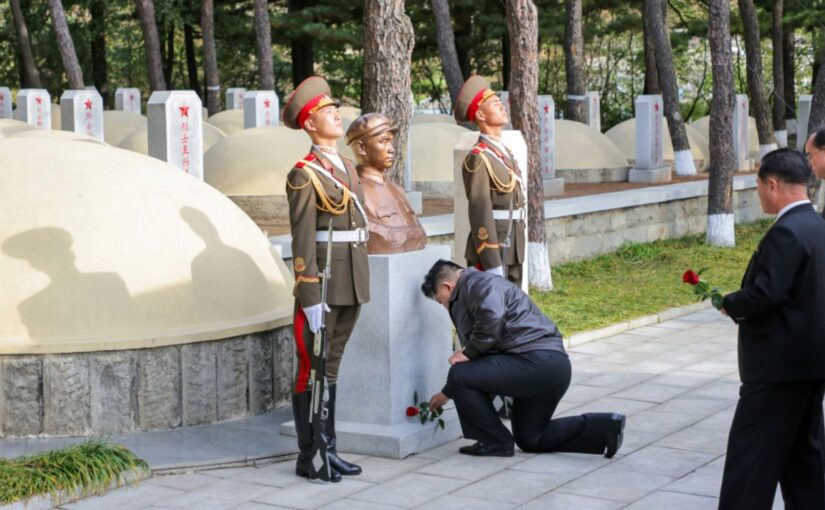
On October 24, Kim Jong Un, General Secretary of the Workers’ Party of Korea and President of the State Affairs of the Democratic People’s Republic of Korea, visited the Cemetery of the Fallen Soldiers of the Chinese People’s Volunteers in Hoechang County, South Phyongan Province and paid a high tribute to them.
Following the main ceremony, Kim Jong Un visited the grave of Mao Anying, the son of Comrade Mao Zedong, where he placed a flower and paid homage.
The Korean Central News Agency (KCNA) commented: “The faces of the CPV fallen soldiers, who assisted the revolutionary war of our people at the cost of their blood with the spirit of internationalism and the feeling of fraternal friendship, remain deep in the hearts of the peoples of the two countries as a symbol of valuable DPRK-China friendship.
“Our people will never forget the blood shed by the excellent sons and daughters of the Chinese people and their immortal feats even after a lapse of many years and the shift of generations.
“The DPRK-China friendship forged at the cost of blood would powerfully demonstrate its inexhaustible vitality in the sacred struggle to realise the cause of independence against imperialism, the socialist cause, in the future, too.”
The following day a further ceremony was held at the Friendship Tower in downtown Pyongyang, which honours the CPV martyrs.
Earlier, on October 22, a ceremony for remodeling the cemetery of fallen fighters of the Chinese People’s Volunteers was held in Sinphyong County, North Hwanghae Province. Among those present were DPRK Vice-Minister of Urban Management Kang Chol Ho, joined by Wang Yajun, Chinese Ambassador to the DPRK, staff members of his embassy, the delegation of the veterans and families of martyrs of the CPV on a visit to the DPRK, Chinese guests staying in the DPRK, and Chinese students and residents in the DPRK.
A delegation of the Chinese People’s Liberation Army led by Xia Zhihe, Political Commissar of the National Defence University of the PLA also visited the DPRK from October 25 to October 28 to take part in commemorative functions.
Functions were also held at the Chinese Embassy in Pyongyang and the DPRK Embassy in Beijing on October 25.
At the reception hosted in Pyongyang by Chinese Ambassador Wang Yajun, speakers referred to the historic significance of the CPV’s entry into the Korean front 75 years ago and the feats of the martyrs of the volunteers who devoted their precious lives to the revolutionary war of the Korean people.
They expressed the will to carry forward the glorious tradition and the great friendship under the strategic guidance of the top leaders of the two parties and two countries and thus open up a more beautiful future of the socialist cause of the two countries and the DPRK-China relations.
At the DPRK embassy in Beijing, speakers paid high tribute to the martyrs and veterans of the Chinese People’s Volunteers who entered the Korean front and fought shoulder to shoulder with the Korean people. They said that looking back on the history of 75 years ago is of great significance in remembering the forerunners and inheriting their spirit.
They expressed the will to promote the traditional DPRK-China friendship on the road of accomplishing the socialist cause, opposing the imperialists’ aggression and hegemony and defending regional peace and security, international fairness and justice.
Korean diplomatic staff also paid tribute at the cemeteries of CPV martyrs in the cities of Shenyang and Dandong, in China’s Liaoning Province.
The following articles were originally published on the website of KCNA. China’s People’s Daily also reported the commemorations.
Respected Comrade Kim Jong Un Visits Cemetery of CPV Fallen Soldiers on Occasion of 75th Anniversary of Entry of CPV into Korean Front
Pyongyang, October 25 (KCNA) — Kim Jong Un, general secretary of the Workers’ Party of Korea and president of the State Affairs of the Democratic People’s Republic of Korea, visited the Cemetery of the Fallen Soldiers of the Chinese People’s Volunteers in Hoechang County, South Phyongan Province and paid a high tribute to them on Oct. 24 on the occasion of the 75th anniversary of the entry of the CPV into the Korean front.
The respected Comrade Kim Jong Un was accompanied by Jo Yong Won, Pak Jong Chon and Kim Tok Hun, secretaries of the Central Committee of the WPK, and Choe Son Hui, foreign minister of the DPRK.
The guard of honor of the Korean People’s Army lined up at the cemetery.
The national anthems of the People’s Republic of China and the Democratic People’s Republic of Korea were played.
A flower basket in the name of Kim Jong Un and the flower baskets in the names of the Central Committee of the WPK and the State Affairs Commission of the DPRK were laid before the cemetery.
Kim Jong Un paid a silent tribute in memory of the CPV fallen soldiers.
Then, he visited the grave of Mao Anying at the cemetery.
He placed a flower before the grave and paid homage.
The faces of the CPV fallen soldiers, who assisted the revolutionary war of our people at the cost of their blood with the spirit of internationalism and the feeling of fraternal friendship, remain deep in the hearts of the peoples of the two countries as a symbol of valuable DPRK-China friendship.
Our people will never forget the blood shed by the excellent sons and daughters of the Chinese people and their immortal feats even after a lapse of many years and the shift of generations.
The DPRK-China friendship forged at the cost of blood would powerfully demonstrate its inexhaustible vitality in the sacred struggle to realize the cause of independence against imperialism, the socialist cause, in the future, too.
On Sunday 26 October, the Irish community in London, together with friends, gathered outside Brixton Prison for the annual Terence MacSwiney Commemoration. This year’s gathering marked 105 years since the death of the Lord Mayor of Cork, after 74 days on hunger-strike, and was once again organised by the Terence MacSwiney Committee [London].
Committee Chair Frank Glynn welcomed the approximately 60 people gathered outside the south London prison. The day’s keynote speaker was Thomas Gould, Sinn Féin TD (member of the Irish parliament) for Cork North-Central, who delivered a powerful address that appealed to the solidarity and internationalism of those living in London to support the campaign to build a new and united Ireland.
Drawing inspiration from the example of Terence MacSwiney, Gould extended solidarity to the suffering people of Palestine amidst the ongoing occupation of their land and Israel’s genocidal war. He appealed for class unity at this time, noting that the establishment and those in power are desperately seeking to turn poor people against one another. He equally paid tribute to those Irishmen and women who were forced to leave their country over the past decades, assuring them that their sacrifice is not forgotten back home.
The commemoration also heard from Pat Reynolds of the Irish in Britain Representation Group (IBRG); Pam Blakelock, who spoke about her husband’s descendance from Muriel MacSwiney (Terence MacSwiney’s widow); and the Palestinian activist, Samar Maquishi, who spoke about the unwavering support of the Irish people for the cause of Palestine. As Samar observed, “Even if the whole world was quiet, the Irish won’t be silenced!”
Longstanding London-based Irish republican Denis Grace read the Proclamation of Easter Week 1916 on behalf of the Commemoration Committee. Music was provided by the stalwart London-Irish balladeer Seán Brady and Achill Island’s own Tom Lynch on the Uilleann Pipes. Special mention was also made of the election of Catherine Connolly as the next President of Ireland. There was overwhelming support expressed for Ms Connolly, whose campaign was supported by a broad range of left-wing and progressive forces in Ireland, particularly as a candidate who placed voting rights for Irish citizens outside of the twenty-six-county state and the ongoing struggle for Irish reunification at the centre of her election platform.
(The above is an edited version of the press statement issued by the Terence MacSwiney Committee [London].)
McSwiney’s 1920 death on hunger strike, during the 1919-1921 Irish war of independence, had a profound international impact, including on such leaders of the Indian freedom movement as Jawaharlal Nehru and Mahatma Gandhi. A young Ho Chi Minh, who was working in London at the time, was profoundly moved, saying: “He died for his country. How courageous! How heroic ! A nation which has such citizens will never surrender.”
But whilst Ho Chi Minh could see for himself the very public outpouring of grief on the part of London’s Irish community, another young progressive, who was later to become an important Asian communist leader, was following the news from Japan, where he was studying at the time.
That student was Guo Moro, who was to become a senior leader of the People’s Republic of China and a close comrade of Mao Zedong. He served as Chairman of both the Chinese Academy of Sciences and the China Federation of Literary and Art Circles from their inception after liberation in 1949 to his death in 1978.
In a 2020 article written for Raidió Teilifís Éireann (RTÉ, the Irish broadcasting service), Francis Kane, a lecturer at Ulster University, explains:
“In 1920, China was in chaos, a divided country dominated by foreigners and warlords, its ancient empire having finally collapsed in 1911. In his idealistic youth, the poet Guo Moruo cannot have known that one day he would become a man of enormous power and prestige… He died not long after his comrade and friend Chairman Mao, whom he praised relentlessly.”
Kane writes that Guo penned “an astonishing poem, an emotional ‘in real time’ commemoration of fellow writer MacSwiney in 1920, usually translated as ‘Victorious in Death’.”
Vice-minister of the International Department of the Communist Party of China (CPC) Central Committee (IDCPC) Ma Hui recently met with visitors from Guyana and Mexico.
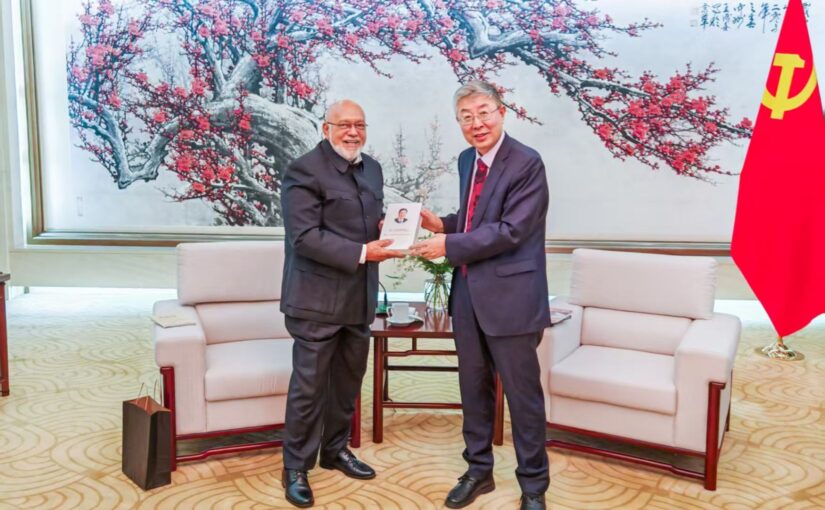
On October 15, he met with Donald Ramotar, Member of the Executive Committee of the People’s Progressive Party / Civic (PPP/C) and former President of Guyana, along with Clement Rohee, former Foreign Minister of Guyana.
Ma said that the CPC is willing to strengthen experience exchange in state governance and administration with the PPP/C and jointly build a new type of inter-party relationship featuring seeking common ground while reserving differences, mutual respect and mutual learning.
Ramotar thanked China for its valuable support for Guyana’s economic and social development and highly praised Xi Jinping Thought on Socialism with Chinese Characteristics in the New Era — the latest achievements of the adaptation of Marxism to the Chinese context and the needs of our times, and its global significance.
The Guyanese friends were visiting at the invitation of the Chinese People’s Institute of Foreign Affairs (CPIFA).
Two days previously, Ma had met with Alberto Anaya, President of the Labour Party (PT) of Mexico.
Ma said, China and Mexico are both important countries in the Global South. The CPC attaches great importance to friendly relations with all Mexican political parties, including the Labour Party, and is willing to strengthen inter-party exchanges and cooperation to promote the healthy development of the comprehensive strategic partnership between China and Mexico.
Anaya said, China’s development is rapid and its achievements are obvious to all. The rich experience of the CPC in party building and state governance is worth learning from. The Labour Party values its traditional friendship with the CPC and is willing to deepen exchanges and cooperation between the two parties to contribute to the development of Mexico-China relations and the building of a community with a shared future for humanity.
The PT is part of the progressive ruling coalition in Mexico. Anaya was in Beijing on his way home from the Democratic People’s Republic of Korea (DPRK) where he had participated in the 80th anniversary celebrations of the founding of the Workers’ Party of Korea (WPK).
The following articles were originally published on the website of the IDCPC.
Ma Hui Meets with Donald Ramotar, Member of the Executive Committee of the People’s Progressive Party / Civic (PPP/C) and Former President of Guyana
Beijing, October 15th (IDCPC) – Ma Hui, Vice-minister of the International Department of the CPC Central Committee, met here today Donald Ramotar, Member of the Executive Committee of the People’s Progressive Party / Civic (PPP/C) and former President of Guyana, who was visiting China at the invitation of the Chinese People’s Institute of Foreign Affairs.
Speaking highly of the PPP/C and Ramotar for their positive contributions to promoting China-Guyana relations and inter-party exchanges between the two countries, Ma said, China is willing to work with Guyana to implement the important consensus reached by the two heads of state and promote the continuous development of China-Guyana relations. The CPC is willing to strengthen experience exchange in state governance and administration with the PPP/C and jointly build a new type of inter-party relationship featuring seeking common ground while reserving differences, mutual respect and mutual learning.
Ramotar thanked China for its valuable support for Guyana’s economic and social development and highly praised Xi Jinping Thought on Socialism with Chinese Characteristics in the New Era—the latest achievements of the adaptation of Marxism to the Chinese context and the needs of our times, and its global significance. He said, the PPP/C is willing to strengthen exchanges of ideas and experience with the CPC and jointly promote the development of the global cause of justice.
Clement Rohee, former Foreign Minister of Guyana, was present.
Ma Hui Meets with Alberto Anaya, President of the Labor Party of Mexico
Beijing, October 13th (IDCPC) – Ma Hui, Vice-minister of the International Department of the CPC Central Committee, met here today with Alberto Anaya, President of the Labor Party of Mexico.
Ma said, China and Mexico are both important countries in the Global South. Win-win cooperation is in line with the fundamental interests of the two countries and the two peoples. The CPC attaches great importance to friendly relations with all Mexican political parties, including the Labor Party, and is willing to strengthen inter-party exchanges and cooperation to promote the healthy development of the comprehensive strategic partnership between China and Mexico.
Anaya said, China’s development is rapid and its achievements are obvious to all. The rich experience of the CPC in party building and state governance is worth learning from. The Labor Party values its traditional friendship with the CPC and is willing to deepen exchanges and cooperation between the two parties to contribute to the development of Mexico-China relations and the building of a community with a shared future for mankind.
A delegation of senior cadres from the Janatha Vimukthi Peramuna (JVP – People’s Liberation Front of Sri Lanka) recently visited China. The JVP is Sri Lanka’s largest Marxist party and currently the core party in its governing coalition. The delegation was led by Bimal Rathnayake, Member of the Political Bureau of the JVP and Minister of Transport, Highways, Ports and Civil Aviation of Sri Lanka.
The Sri Lankan visitors met with Liu Haixing, Minister of the International Department of the Communist Party of China (CPC) Central Committee (IDCPC), on October 17.
Liu said, in January this year, President Xi Jinping held talks with visiting President Anura Kumara Dissanayake and reached important consensus on building a China-Sri Lanka community with a shared future and deepening exchanges of governance experience between the two countries’ ruling parties, charting the course for the development of the relations between the two countries and the two Parties. The CPC is willing to continue to strengthen high-level exchanges with the JVP and assist practical cooperation between the two countries and promote people-to-people bonds through the inter-party channel.
Rathnayake said, the JVP values the friendly exchanges with the CPC and thanks China for its valuable support for Sri Lanka’s economic and social development. Under the leadership of General Secretary Xi Jinping, China has achieved remarkable accomplishments in economic development, anti-corruption and other areas. The successful practice of the CPC has convinced Sri Lanka that strong party leadership is the key to a country’s development and progress. The JVP is committed to maintaining close high-level exchanges with the CPC, learning from its experience and practices in strengthening party building and promoting national development, and conducting in-depth exchanges and cooperation in areas such as cadre training, smart city construction, poverty reduction, and promoting ethnic unity, in order to enhance the JVP’s own governance capacities and work hand in hand with China to advance the modernisation process of the two countries.
The following article was first published on the website of the IDCPC.
Beijing, October 17th (IDCPC) – Liu Haixing, Minister of the International Department of the CPC Central Committee (IDCPC), met here today with a delegation of senior cadres of the Janatha Vimukthi Peramuna (JVP) from Sri Lanka led by Bimal Rathnayake, Member of the Political Bureau of the JVP and Minister of Transport, Highways, Ports and Civil Aviation of Sri Lanka.
Liu said, in January this year, President Xi Jinping held talks with visiting President Anura Kumara Dissanayake, and reached important consensus on building a China-Sri Lanka community with a shared future and deepening exchanges of governance experience between the two countries’ ruling parties, charting the course for the development of the relations between the two countries and the two Parties. The CPC is willing to continue to strengthen high-level exchanges with the JVP, and assist practical cooperation between the two countries and promote people-to-people bonds through the inter-party channel. Liu shared the great process and successful experience of the CPC in leading the advancement of Chinese modernization, and introduced the main agenda of the fourth plenary session of the 20th CPC Central Committee. He said, formulating and implementing national development plans is an important piece of governance experience of the CPC. The political parties of China and Sri Lanka can have in-depth exchanges on formulating medium-and long-term development plans and promoting national modernization, so as to promote better alignment of the two countries’ strategies and plans.
Rathnayake said, the JVP values the friendly exchanges with the CPC and thanks China for its valuable support for Sri Lanka’s economic and social development. Under the leadership of General Secretary Xi Jinping, China has achieved remarkable accomplishments in economic development, anti-corruption and other areas. The successful practice of the CPC has convinced Sri Lanka that strong party leadership is the key to a country’s development and progress. The JVP is committed to maintaining close high-level exchanges with the CPC, learning from its experience and practices in strengthening party building and promoting national development, and conducting in-depth exchanges and cooperation in areas such as cadre training, smart city construction, poverty reduction, and promoting ethnic unity, in order to enhance JVP’s own governance capacities and work hand in hand with China to advance the modernization process of the two countries.
Sun Haiyan, Vice-minister of the IDCPC, was present.
Between September 23-30, a six-person delegation from the Communist Party of India (Marxist) (CPIM), India’s biggest communist party, led by General Secretary MA Baby, visited China. Besides Beijing, the delegation visited the provinces of Hubei and Zhejiang.
Baby first visited China in 1985, but this was his first visit since he assumed the leadership of the party following the untimely death of Sitaram Yechury. He recounted the visit in two articles for People’s Democracy, the CPI(M)’s English language weekly. Indicating a key lesson that Indian communists have learned from their Chinese comrades, he writes:
“China lifted 800 million people above the poverty line as defined by the World Bank. Incidentally, it needs to be mentioned that taking inspiration from this example, and in an effort to address the material circumstances of the state, the CPI(M)-led Left Democratic Front government in Kerala has taken up a progressive initiative to eradicate extreme poverty. By November, Kerala will become the first Indian state to do so.”
He also marvelled at the Museum of the History of the Communist Party of China (CPC), opened in July 2021 to mark the party’s centenary:
“The museum is a prime example of how a nation’s and a party’s history can be presented using cutting-edge science and technology. In the museum, the story of the CPC’s century-long journey, from its formation to modern-day achievements, is presented with the help of digital and immersive tools.”
On the substantive business of the visit, Baby reports:
“Several bilateral discussions were held during the visit. The most prominent among them was the discussion with a delegation of the CPC leadership, led by their Polit Bureau member Li Shulei. That meeting reaffirmed the deep and long-standing ties between the CPC and the CPI(M). Both parties recognise that the US State, under President Donald Trump, is trying to impose a unipolar world under its dominance. ‘Countries of the South’ — developing nations — need to stand together to resist this. In this context, the Indian Prime Minister Narendra Modi’s participation in the Shanghai Cooperation Organisation’s (SCO) 2025 Summit in Tianjin was particularly taken note of.
“This year marks the 75th anniversary of the establishment of diplomatic ties between India and China. Beyond cooperation within the SCO, both countries are playing their roles within BRICS as well. In the coming years, India and China are both set to hold the BRICS chairmanship, taking turns. The discussions stressed that India and China must resolve the issues between them through dialogue. Improving India-China relations would not only benefit both countries but also contribute to global peace and progress. Therefore, both sides must make patient and focused efforts toward de-escalating tensions along the border. It is serendipitous that during our visit certain significant developments were taking place towards this, such as the resumption of direct flights between India and China.”