As Donald Trump tightens his energy stranglehold on Cuba – severing oil supplies, threatening countries that dare to help, and following the Kissinger playbook of “making the economy scream” – a remarkable story of socialist solidarity is unfolding.
Writing in the Morning Star, Carlos Martinez documents how China has stepped into the breach, assisting Cuba with its energy sovereignty and its green transition. Chinese solar exports to Cuba have rocketed from $5 million in 2023 to $117 million in 2025. Beijing has committed to building 92 solar parks on the island by 2028, with a combined capacity equivalent to Cuba’s entire current fossil fuel generation. Already, Cuba’s share of solar power has risen from 5.8 percent to over 20 percent in a single year – a pace of transition that energy analysts describe as one of the fastest ever achieved by a developing nation.
But as this article shows, China’s solidarity extends far beyond megawatts and megaprojects. Ten thousand photovoltaic systems have been donated for rural homes, maternity wards and health clinics. Five thousand solar kits installed across 168 municipalities are keeping medicines refrigerated and families powered through the blackouts. President Xi Jinping personally approved $80 million in emergency aid for electrical equipment. Chinese Ambassador Hua Xin has pledged “firm support under all circumstances.”
This, Carlos argues, is what South-South cooperation looks like in practice: technology, financing and humanitarian assistance with no conditionalities, no structural adjustment, no strings attached. Fidel Castro said in 2004 that China had become “the most promising hope and the best example for all Third World countries.” Cuba’s solar revolution
suggests his assessment has only become more prescient.
When the lights go out in Havana — as they have done for up to 20 hours a day in the worst months of Cuba’s current energy crisis — the causes are not difficult to identify.
The United States’ economic blockade, in place since 1962 and systematically tightened under successive administrations, has cost Cuba an estimated $160 billion ($2 trillion in current prices, which is equivalent to around 20 years of Cuba’s annual GDP).
The latest escalation of this cruel and illegal blockade has involved a full-scale energy embargo, with the US attempting to completely cut off Cuba’s access to oil.
The kidnapping of Venezuelan President Nicolas Maduro three months ago resulted in the severing of by far Cuba’s most important energy supplier.
Trump’s tariff threats then forced Mexico to cancel emergency oil shipments.
The result has been blackouts, fuel shortages and severe disruption to daily life across the island. The Trump regime is following the Kissinger playbook of “making the economy scream” in order to force regime change.
And life is unquestionably being made difficult. As a Cuban hairdresser told Medea Benjamin of CodePink in February: “You can’t imagine how it touches every part of our lives. With no gasoline, buses don’t run, so we can’t get to work. We have electricity only three to six hours a day. There’s no gas for cooking, so we’re burning wood and charcoal in our apartments. It’s like going back 100 years.”
Thankfully, at the end of March, a Russian tanker carrying an estimated 730,000 barrels of crude oil docked in Havana, providing some urgently needed relief. But Cuba’s energy import situation continues to be highly precarious and uncertain.
Nobody can blockade the sun
The Cuban people’s response to this siege has not been surrender. It has been transformation — and at the heart of that transformation is a remarkable programme of solar energy development, driven by one of the most significant acts of international solidarity in the history of the global green transition.
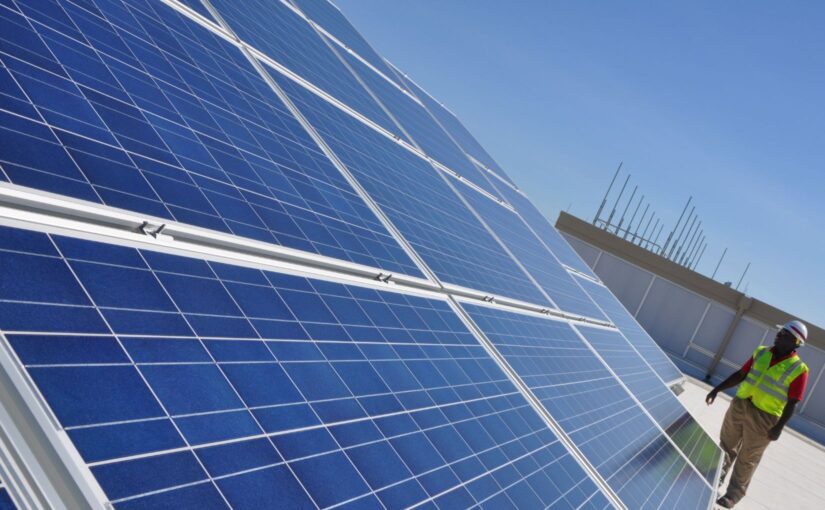
China’s support for the Cuban renewable energy programme has accelerated dramatically in recent years. Chinese solar exports to Cuba rose from $5 million in 2023 to $117m in 2025. A report in the Financial Times on April 6 notes that “thanks to Chinese technology, the Caribbean island has 34 solar parks in operation with a capacity of almost 1.2 gigawatts (GW), a 350 per cent increase on 2024, enabling Cuba to more than quadruple its proportion of solar-powered generation by the end of last year.”
Beijing has committed to building 92 solar parks in Cuba by 2028, with a combined capacity of approximately 2GW — equivalent to Cuba’s entire current fossil fuel generation capacity. The solar parks already connected to the grid are contributing 1GW. As a result, Cuba’s share of solar in total electricity generation has risen from 5.8 per cent a year ago to over 20 per cent today.
Energy analysts have described this as one of the most rapid solar transitions ever achieved by a developing nation.
Cuba has set official targets of generating 24 per cent of its electricity from renewables by 2030, rising to 40 per cent by 2035 and 100 per cent by 2050. At the current pace of buildout, the 2030 target looks well within reach — and may be exceeded considerably sooner.
Battery storage — currently in place at only four of Cuba’s 55 solar parks — will need to be expanded significantly to address the evening peak demand. Wind energy will also make a growing contribution, with 19 wind farms totaling 415 MW currently being built, again with Chinese support. But the pace of the solar buildout, measured against where Cuba was just months ago, is already extraordinary.
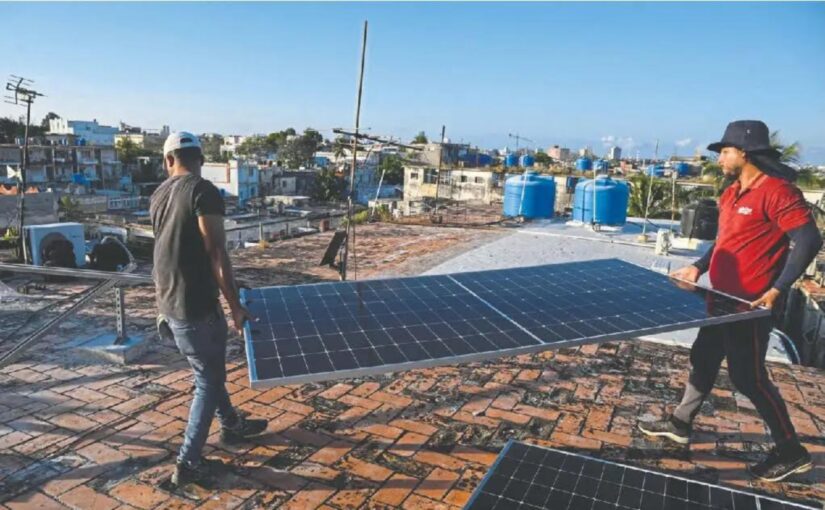
Chinese support at all levels China’s contribution extends beyond large-scale infrastructure. Beijing has also donated 10,000 photovoltaic systems for deployment in isolated rural homes and critical facilities — including maternity wards and health clinics — ensuring that medical equipment can continue to function and medicines can be refrigerated even during power cuts.
A further 5,000 solar kits have been installed in health centres across 168 municipalities, each comprising panels, inverters and storage batteries. The head of Cuba’s Electric Union described the household-level systems as life-changing: enabling families to run a refrigerator, a fan and a television, and reducing the rural-to-urban migration that energy poverty drives.
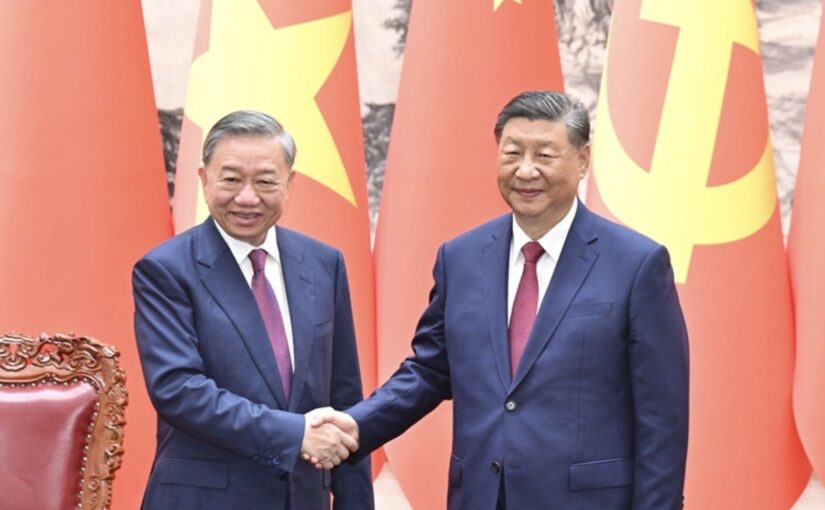
Furthermore, in January 2026, President Xi Jinping personally approved $80 million in emergency financial aid for electrical equipment, alongside a donation of 60,000 tons of emergency rice aid.
China has been involved in Cuba’s energy sector for many years — supplying wind turbines since 2018, providing electric buses through Yutong since 2005, and supporting the assembly of Chinese electric cars, scooters and bicycles in Cuba through the Caribbean Electric Vehicles (VEDCA) programme.
In 2021, Cuba joined the Belt and Road Energy Partnership, the Chinese-led international framework for clean energy investment. But the current programme represents a qualitative leap, driven in large part by the urgency of Cuba’s situation and the depth of the bilateral relationship.
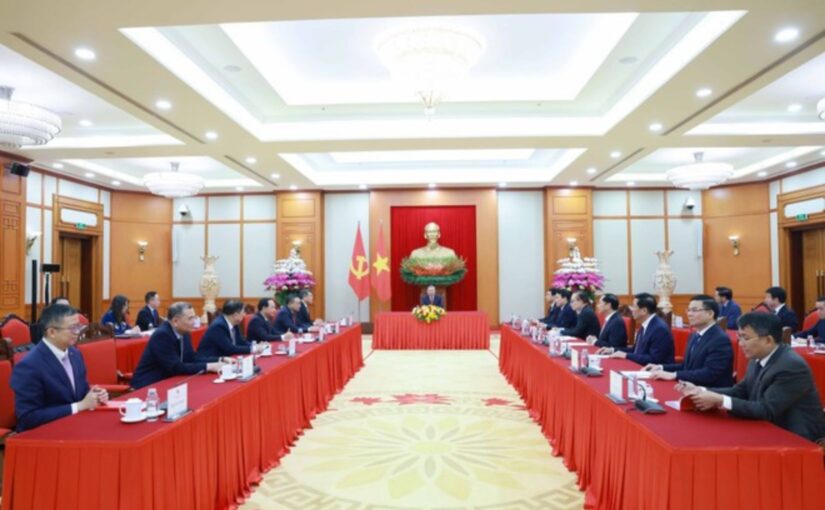
As Chinese ambassador Hua Xin stated at the handover ceremony for a recent tranche of solar parks: China stands with Cuba in “firm support under all circumstances.” Cuban Energy Minister Vicente de la O Levy stated that the co-operation between the two socialist countries represents “a joint commitment to energy sovereignty.”
Socialist solidarity
What is taking shape in Cuba is a demonstration, in the most concrete terms, of what South-South co-operation and socialist solidarity look like in practice: China is providing technology, financing, expertise, training and humanitarian assistance to a country under siege, with no conditionalities, no structural adjustment requirements, no demand for market access.
Hugo Chavez one described the flourishing ties between progressive Latin America and China as a “Great Wall against US hegemonism.” Cuba’s solar revolution is a powerful example of that wall in action.
Fidel Castro said in 2004 that China had become “the most promising hope and the best example for all Third World countries.” Two decades later, the US is raining bombs on Iranian civilian infrastructure, tightening its cruel blockade on Cuba, kidnapping Venezuela’s elected president, and supporting an ongoing genocide in Gaza.
China meanwhile is emerging as the major trading partner of the vast majority of global South nations; has become the world’s only renewable energy superpower; and consistently demonstrates its commitment to peace, international law and global prosperity.
Fidel’s assessment looks more prescient than ever.