Socialist countries greet China’s National Day

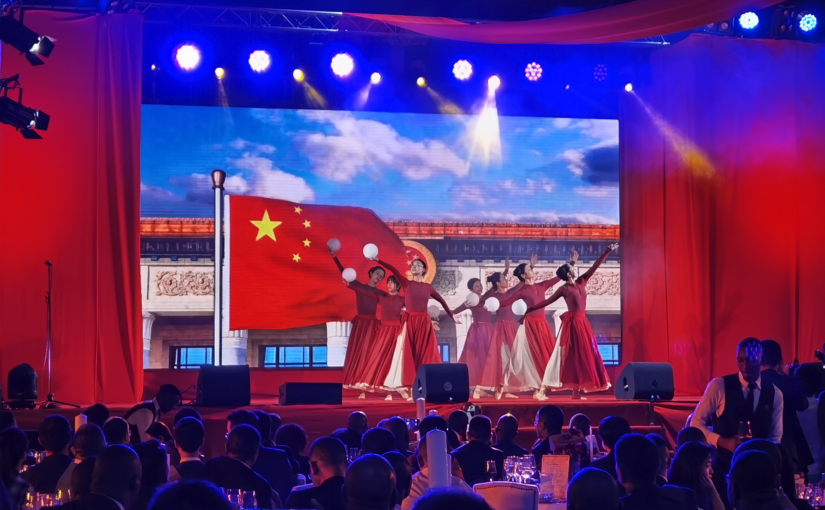
Marking the 73rd anniversary of the founding of the People’s Republic of China on October 1, leaders of numerous countries sent greetings to President Xi Jinping and other Chinese leaders.

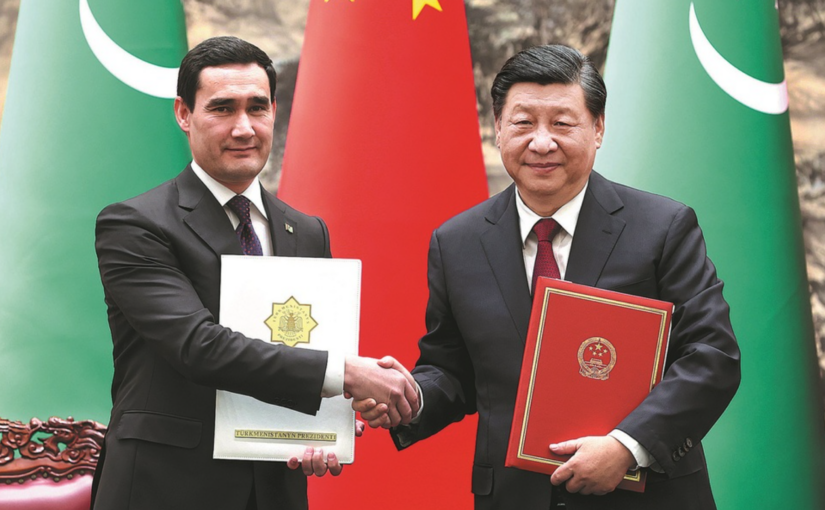
Reporting the messages of greetings, the Xinhua News Agency and other Chinese media gave notable pride of place to the greetings sent by China’s fraternal socialist countries, the Democratic People’s Republic of Korea (DPRK), Socialist Republic of Vietnam, Lao People’s Democratic Republic, and Republic of Cuba. 

DPRK leader Kim Jong Un noted that, over the past 73 years, China has made “remarkable successes in accomplishing the socialist cause, braving all sorts of challenges and trials of history” and had entered the new stage of comprehensively building a modern socialist country since the 18th Party Congress. 

The Korean leader also expressed solidarity with China’s struggle to defend the country’s sovereignty and territorial integrity and realize national reunification. He further noted that the two parties and two countries are supporting and encouraging each other in the common socialist cause.

Vietnamese Party leader Nguyen Phu Trong and state President Nguyen Xuan Phuc expressed their firm belief that under the leadership of the CPC Central Committee with Comrade Xi Jinping at its core, the Chinese people will certainly achieve the national development tasks and goals set forth by the CPC and forge ahead on the road of building China into a great modern socialist country that is prosperous, strong, democratic, culturally advanced, harmonious, and beautiful.

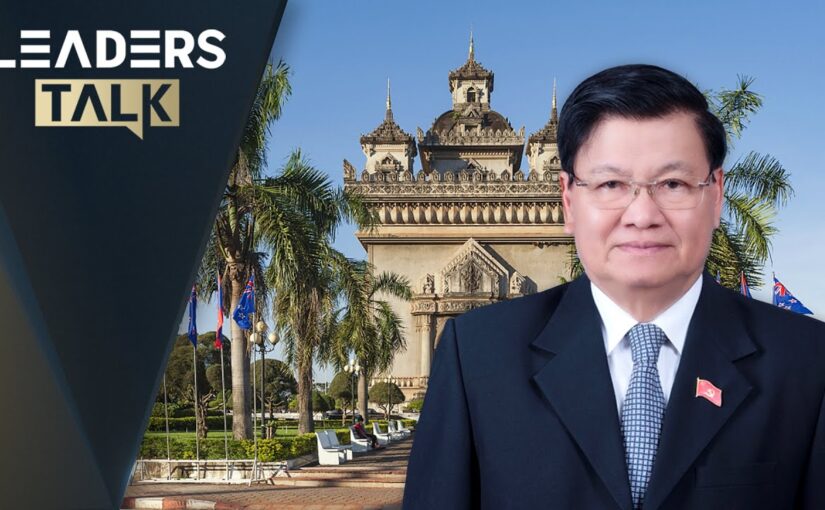
Lao leader Thongloun Sisoulith expressed his belief that the brotherly Chinese people will make new and greater achievements in the new journey toward China’s second centenary goal of building a great modern socialist country in all respects, and successfully realize the great rejuvenation of the Chinese nation.

Cuban President Miguel Diaz-Canel and Prime Minister Manuel Marrero conveyed their conviction that the socialist cause in China will be strengthened after the successful holding of the Congress of the Communist Party this month.

The following articles were originally carried by the Xinhua News Agency, the Korean Central News Agency (KCNA), the Vietnamese Communist Party newspaper Nhan Dan, and the Cuban news agency Prensa Latina.

Foreign leaders congratulate the People’s Republic of China on 73rd founding anniversary

Leaders of many countries and international organizations have recently telephoned or sent letters to Xi Jinping, general secretary of the Communist Party of China (CPC) Central Committee and president of the People’s Republic of China (PRC), to warmly congratulate on the 73rd anniversary of the founding of the PRC and wish the upcoming 20th National Congress of the CPC a full success.

Kim Jong Un, general secretary of the Workers’ Party of Korea (WPK) and chairman of the State Affairs Commission of the Democratic People’s Republic of Korea (DPRK), on behalf of the WPK, the government of the DPRK and the people of the DPRK, extended warm congratulations to Comrade General Secretary Xi Jinping, the CPC, the government of the PRC and the brotherly Chinese people.

Continue reading Socialist countries greet China’s National Day

China set to open world’s largest hybrid energy plant in 2023

The following article, originally published in CGTN on 1 October 2022, details an important renewable energy project that will combine the output from the Kela Solar Power Station in Sichuan with that of the nearby Lianghekou Hydropower Station. The Kela solar plant will send its electricity output to the hydropower plant, which is already connected to the national grid. In combination, the two will be able to mitigate the problems of fluctuation and intermittency associated with both photovoltaic and hydropower technology.

When it opens in 2023, this will be the world’s largest hybrid energy plant, and will make an important contribution to China’s historic goals of peaking carbon emissions by 2030 and achieving carbon neutrality before 2060.

A nice detail from the article is that the solar panels at the Kela plant are being elevated to a height of 1.8 meters in order to allow local herdsmen to continue to feed their cows and sheep in the area.

China is upgrading a major hydro power plant as part of the world’s largest hybrid energy project, generating electricity from hydro and photovoltaic powers.

Kela Solar Power Station will be built in southwest China’s Sichuan Province, close to Lianghekou Hydropower Station, located on the Yalong River, with generating capacity of 1 million kW. The solar panels will be installed on the mountains at an altitude of up to 4,600 meters, with extra 1 million kW in capacity. The project is expected to operate for 1,735 hours in a year with an average annual power capacity of 2 billion kilowatt-hours when completed in 2023.

China is ushering in clean energy practices as it aims to peak carbon emissions in 2030 and achieve carbon neutrality before 2060.

Kela Station will help cut carbon dioxide emissions by over 1.6 million tonnes, an equivalent of burning 600,000 tonnes of coal, according to Qi Ningchun, chairman of the Yalong River Hydropower Development Co. Ltd., operator of the project.

Kela Station will be a complementary power source for the hydropower station as the two plants’ outputs change distinctively throughout the year.

Continue reading China set to open world’s largest hybrid energy plant in 2023

China’s 73 years of moving forward

We are pleased to reproduce this article by Stephen Millies, originally carried by our US comrades of Struggle/La Lucha greeting the 73rd anniversary of the founding of the People’s Republic of China and celebrating the struggles and achievements of the Chinese revolution.

Since Mao Zedong declared that “the Chinese people have stood up”, Stephen notes, life expectancy has more than doubled, surpassing that in the US. Illiteracy, which stood at some 80% at the time of liberation, has been virtually eliminated. Thirty-seven million people attend university. 52% of them are women. 

Noting the centuries-long confrontation between China and imperialism, the author notes that imperialist hatred has only increased in the face of the socialist country’s achievements. The terrible wars in Korea and Indochina were a key part of US imperialism’s response to the Chinese revolution, as was McCarthyism at home. Refuting some of the key anti-China smears used to confuse working and oppressed people in the United States, Stephen concludes: “Our enemy is high rents, police brutality and mass incarceration. We need what China has: a socialist revolution.”

When the People’s Republic of China was born on Oct. 1, 1949, the country was devastated by years of war. At least 20 million Chinese people were killed. Starvation stalked the land. 

The Chinese Revolution swept that misery away. Seventy-three years after Mao Zedong declared that “China has stood up,” look at what socialism has accomplished:

  • Life expectancy has more than doubled to reach 77.3 years. That’s a longer lifespan than in the U.S.
  • Women moved forward with unbound feet. Chinese scientist Tu Youyou won the Nobel Prize in medicine in 2015. She discovered artemisinin and dihydroartemisinin, which are used to combat malaria.
  • While 80% of China’s people couldn’t read or write in 1949, illiteracy has been virtually abolished. Thirty-seven million people attend universities compared with 117,000 before the revolution. More than 52% of college students were women
  • China has become the workshop of the world. The People’s Republic makes more than a billion tons of steel annually. China has built more miles of high-speed rail than the rest of the world combined.
  • Even greater advances have been made by China’s national minorities, whose languages and cultures flourish. One of the great victories of human rights was the abolition of serfdom in Tibet by the People’s Liberation Army. The Chinese Revolution inspired oppressed people around the world, including Malcolm X.
Continue reading China’s 73 years of moving forward

Wang Yi: Making every effort for peace and development and shouldering the responsibility for solidarity and progress

China’s State Councilor and Foreign Minister Comrade Wang Yi attended the 77th Session of the United Nations General Assembly in New York last month.

Besides delivering his address to the assembly on September 24, Wang Yi had a packed programme, which saw him:

  • Hold tens of bilateral meetings with other national leaders, both from countries friendly to China as well as those not so friendly, along with senior UN officials and leaders of international organizations
  • Meet with former US Secretary of State Henry Kissinger
  • Meet jointly with representatives of the National Committee on US-China Relations, US-China Business Council and US Chamber of Commerce
  • Chair the Ministerial Meeting of the Group of Friends of the Global Development Initiative (GDI), attended by senior leaders from more than 40 countries
  • Address the Informal Leaders’ Roundtable on Climate Action
  • Attend the Security Council Foreign Ministers’ meeting on the Ukraine issue
  • Deliver a major speech on the prospects for China-US relations to the Asia Society
  • Participate in the meeting of BRICS Foreign Ministers

Delivering his September 24 speech, Wang began by noting that humanity was facing various challenges, including the continued resurfacing of the Covid-19 pandemic, uncertain global security, and fragile and unsteady global recovery. “The world has entered a new phase of turbulence and transformation…But we are also at a time full of hope. The world continues to move towards multipolarity…Around the world, the people’s call for progress and cooperation is getting louder than ever before.”

Posing the question of how to “ride on the trend of history to build a community with a shared future for mankind”, he explained that “China’s answer is firm and clear”:

  • We must uphold peace and oppose war and turbulence. “Turbulence and war can only open Pandora’s box, and he who instigates a proxy war can easily burn his own hands.”
  • We must pursue development and eliminate poverty, upholding all countries’ legitimate right to development.
  • We must remain open and oppose exclusion – “decoupling and supply chain disruption will hurt both those who practice them and others.”
  • We must stay engaged in cooperation and oppose confrontation. “Our biggest strength will come from solidarity; our best strategy is to stick together through thick and thin; and the brightest prospect is win-win cooperation.”
  • We must strengthen solidarity and oppose division. “Peace, development, fairness, justice, democracy and freedom are common values of humanity.”
  • We must uphold equity and oppose bullying.  “International rules should be drawn up by all countries together. No country is above others, and no country should abuse its power to bully other sovereign countries.”

Affirming that China will “pursue the shared interests of the vast majority of countries”, Wang went on to note that:

  • China has been a builder of world peace and is “the only one among the five Nuclear-Weapon States that is committed to no-first-use of nuclear weapons.” (Note: Wang Yi refers here to the five recognised nuclear powers under the Non-Proliferation Treaty. The DPRK, India, Pakistan and Israel also possess nuclear weapons.)
  • China has been a contributor to global development. “Contributing about 30 percent of annual global growth, China is the biggest engine driving the global economy. China is a pacesetter in implementing the UN 2030 Agenda for Sustainable Development. It has met the poverty reduction goal ten years ahead of the envisioned timeframe and accounts for 70 percent of the gains in global poverty reduction… It has provided development aid to more than 160 countries in need and extended more debt-service payments owed by developing countries than any other G20 member state.”
  • China has been a defender of the international order. By this, Wang refers to “the international system with the UN at its core and the international order based on international law”, which, it should be noted, is very different from the so-called ‘rules based international order’, constantly touted by a handful of countries, principally the United States and Great Britain, which is nothing but a flimsy cover for the attempted maintenance of imperial diktat. “As a member of the developing world, China will forever stand together with other developing countries. We are heartened to see the rapid progress achieved by the developing world in recent years, and we will continue to speak up for other developing countries…Developing countries are no longer the ‘silent majority’ in international and multilateral processes. With stronger solidarity among ourselves, we China and other developing countries have spoken out for justice, and we have become a pillar of promoting development cooperation and safeguarding equity and justice.”
  • China has been a provider of public goods. “We have done our best to provide anti-pandemic supplies and shared our practices on combating the virus. China is among the first to promise making COVID-19 vaccines a global public good and to support waiving intellectual property rights on the vaccines. China has provided over 2.2 billion doses of vaccines to more than 120 countries and international organizations…In response to climate change, China is committed to pursuing a development path that puts ecological conservation first, one of green and low-carbon growth…China accounts for one-fourth of all the trees planted globally. We have been making unremitting efforts to foster a community of life for man and Nature… This year, we have provided over 15,000 tons of emergency humanitarian food assistance to other developing countries in need.”
  • China has been a mediator of hotspot issues. “While adhering to the principle of non-interference in others’ domestic affairs and respecting the will and needs of the countries concerned, China has endeavoured to help settle hotspot issues in a constructive way…China supports all efforts conducive to the peaceful resolution of the Ukraine crisis…The Palestinian question is at the heart of the Middle East issue. Justice is already late in coming, but it must not be absent… China firmly supports the Cuban people in their just struggle to defend their sovereignty and oppose external interference and blockade.”

Turning to the Taiwan issue, Wang Yi noted that: “Fifty-one years ago, right in this august hall, the UN General Assembly adopted Resolution 2758 with an overwhelming majority, which decided to restore the lawful seat of the People’s Republic of China in the UN and to expel the ‘representatives’ of the Taiwan authorities from the place which they had unlawfully occupied. The so-called ‘dual representation’ proposal put forth by the United States and a few other countries to keep Taiwan’s seat in the UN became a piece of waste paper…When entering into diplomatic relations with China, 181 countries all recognized and accepted that there is but one China in the world and Taiwan is a part of China, and that the Government of the People’s Republic of China is the sole legal government representing the whole of China. By firmly upholding the one-China principle, China is not only upholding its sovereignty and territorial integrity, but also truly safeguarding peace and stability across the Taiwan Strait, and non-interference in others’ internal affairs, a basic norm of international relations that is of vital importance to the large number of developing countries.”

Coming to the conclusion of his speech, Wang Yi declared: “As China has one-fifth of the global population, its march toward modernization has important, far-reaching significance for the world. The path that China pursues is one of peace and development, not one of plunder and colonialism; it is a path of win-win cooperation, not one of zero-sum game; and it is one of harmony between man and Nature, not one of destructive exploitation of resources.”

We reprint below the full text of Comrade Wang Yi’s speech, which was originally carried on the website of the Chinese Foreign Ministry. In a subsequent post, we will present some highlights from the minister’s New York meetings with the representatives of a number of friendly, progressive and developing countries.

Mr. President, 
Dear Colleagues,

We are at a time fraught with challenges. The COVID-19 pandemic has kept resurfacing. Global security faces uncertainty. Global economic recovery is fragile and unsteady, and various risks and crises are emerging. The world has entered a new phase of turbulence and transformation. Changes unseen in a century are accelerating. 

Continue reading Wang Yi: Making every effort for peace and development and shouldering the responsibility for solidarity and progress

Videos: China encirclement and the imperialist build-up in the Pacific

On Saturday 24 September 2022, we hosted a webinar on the rising aggression of the US and its allies in the Pacific region. There were a number of excellent contributions dealing with issues including the Biden administration’s increased support for Taiwanese separatism; Western power projection in the South China Sea and the Taiwan Straits; the hysteria surrounding China’s security agreement with the Solomon Islands; the AUKUS nuclear pact; and developments in Korea and Japan. The event stream and the individual speeches are embedded below, and can be viewed directly on our YouTube channel.

Event stream: China encirclement and the imperialist build-up in the Pacific
Ken Hammond: Fearing the loss of their global hegemony, US elites are responding with desperation
Ju-Hyun Park: China encirclement not possible without imperialist national oppression of China’s neighbors
Lilian Sing: US geopolitical hostility to China is trickling down and fomenting anti-Asian hate
Sara Flounders: There’s US ruling class consensus around derailing China’s socialist development
Li Peng: The US plays the Taiwan card to undermine China’s development and obstruct reunification
Charles Xu: A “free and open Indo-Pacific” is exactly what imperialist forces have always subverted
Ben Norton: The US is developing plans to overthrow the Chinese government by military means
KJ Noh: The US is already engaged in a multi-faceted hybrid war on China
Zhong Xiangyu: Taiwanese separatism is being leveraged towards the West’s China containment strategy
Keith Bennett: A major conflict between China and the US would be a catastrophe for humanity

Seminar: China in the World Today

Britain’s General Federation of Trade Unions (GFTU) initiated an autumn series of online seminars, under the theme The Bigger Picture, on September 15, by inviting Friends of Socialist China co-editors Carlos Martinez and Keith Bennett to introduce on the theme ‘China in the World Today’. Chaired by GFTU General Secretary Doug Nicholls, Carlos kicked off with a look at China’s domestic situation, focusing on poverty elimination and preventing climate catastrophe. Keith followed, addressing the questions of Taiwan and the relations between China, Britain, and the US. A lively discussion ensued, which could certainly have gone on for much longer.

Next events in the series will feature Dr. Francisco Dominguez, academic, activist and member of our advisory group, who will speak on the Decline of US imperialism on October 20; and our friend Dr. Kate Hudson, General Secretary of the Campaign for Nuclear Disarmament (CND), who will speak on NATO Friend or Foe on November 17. You can register for these events at The Bigger Picture: Autumn Series of Online Seminars – GFTU.

The GFTU is pleased to facilitate informed debate and critical thinking about many subjects in its education programme and the views of speakers and participants do not necessarily reflect those of the GFTU.

The US gets ready for war in Taiwan

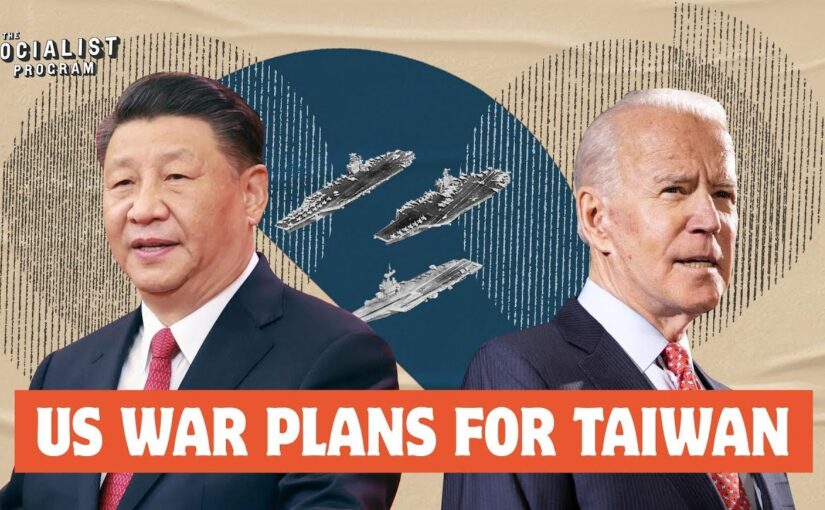
In the following article, first carried in the Morning Star, Kenny Coyle details the “major reversal in US-China relations”, most recently highlighted by Biden’s unequivocal declaration that the US would commit its forces in the event of a military conflict between China and its renegade island province of Taiwan. This, Kenny explains, is “viewed with alarm in Beijing”, as it “increases the possibilities of a US-China war.”

The article outlines the key points of the three Sino-US joint communiques, noting how the second was swiftly undermined by the ‘Taiwan Relations Act’, and drawing attention to the ‘Taiwan Policy Act’, currently making its way through the US legislature. This would allow for an “enduring rotational US military presence” on Taiwan, something that the US has not maintained since 1979 when it established diplomatic relations with the People’s Republic. As Kenny rightly concludes, this “suggests dark days lie ahead.”

On Sunday 18 September, US President Joe Biden told the US news programme 60 Minutes that the US military would go to war in Taiwan should Chinese forces land on the island chain to enforce its sovereignty.

While China has never ruled out the last-resort use of military force, it has always insisted on its preference for peaceful reunification. Biden’s most recent comments repeat previous statements, including one made in Japan, Taiwan’s former colonial occupying power, in May. They are, however, the first since US house speaker Nancy Pelosi’s journey to Taipei in August which resulted in China holding major military exercises after her visit.

Pelosi’s meeting with the political leadership of Taiwan certainly enraged China and inflamed tension in the area. This was no diplomatic faux pas; it was the whole point of her trip.

An official visit by the third most senior politician in the US on a US Air Force special air mission Boeing C40 military jet emblazoned with US livery to a territory in which Washington does not have an embassy or a consulate was a deliberate provocation.

China got the message. Once Pelosi’s jet departed Taiwan’s self-declared air space, rejoined by her US Air Force escort, China announced a series of live-fire military drills around the main island of Taiwan and reaffirmed its declaration of sovereignty over the territories administered by the Taipei authorities.

Continue reading The US gets ready for war in Taiwan

Xi Jinping: Consistently develop and uphold Socialism with Chinese characteristics

With the Twentieth National Congress of the Communist Party of China scheduled to open on October 16, the party’s leading theoretical journal, Qiushi, has recently published an extract from an extremely important speech made by General Secretary Xi Jinping on January 5, 2018, at a seminar for new central committee members and other leading cadres. 

Echoing the opening of Comrade Mao Zedong’s famous article, ‘Where do correct ideas come from?’, Comrade Xi asserts that, “Socialism with Chinese characteristics did not fall from the sky”, but rather is deeply rooted not simply in the four decades of ‘reform and opening up’, but in the whole history of the Chinese revolution and in the inheritance of 5,000 years of Chinese civilization. 

He goes on to explain that the socialist revolution constituted, “the most extensive and profound social transformation in the history of the Chinese nation.” After the establishment of the basic socialist system, the Party has, “made a long-term exploration of how to build socialism in China and has made important achievements as well as experienced serious twists and turns. The main problem here is that building socialism in a semi-colonial and semi-feudal society like ours is an unprecedented undertaking, and there is no ready-made model to follow.”

Engels, he points out, noted that “‘the so-called ‘socialist society’ is not something that is set in stone, but should be seen, like any other social system, as a society that changes and reforms frequently.'” Socialism with Chinese characteristics has to be grasped, “in the course of the evolution of socialism in the world,” from Marx and Engels who turned socialism from an ideal into a science, to the October Revolution, which saw scientific socialism develop from theory to practice. Furthermore: “After the end of the Second World War, a number of socialist countries were born, especially our Party led the people to establish New China and the socialist system, which led scientific socialism from practice in one country to development in many countries. At that time, the socialist camp was flourishing, and together with the anti-imperialist and anti-colonialist struggles of Asian, African and Latin American countries, it formed a basically evenly matched pattern with the capitalist world, which is why Comrade Mao Zedong said that ‘the east wind overwhelmed the west wind.'”

However, historical development is full of twists and turns. Events in the late 1980s and early 1990s not only led to the collapse of the Soviet Union and the East European socialist countries, they also, “brought a serious impact on the vast number of developing countries that aspired to socialism, and many of them were forced to take the path of copying the Western system.”

Noting that the previous year had seen the 100th anniversary of the October Revolution, Comrade Xi explained, “I mentioned this major historical event at the beginning of the second part of the 19th Party Congress report in order to declare the historical impact of the October Revolution on the birth and development of the Chinese Communist Party. As Lenin profoundly pointed out in commemorating the fourth anniversary of the October Revolution, ‘this first victory is not yet final,’ but ‘we have already begun this enterprise. It does not matter when and for what period the proletarians of which country will carry this cause to its conclusion. What is important is that the ice has been broken, the voyage has been opened, the way has been shown.'”

Therefore, Xi notes, “The success of scientific socialism in China is of great significance to Marxism and scientific socialism, and to socialism in the world.” It is conceivable, he continues, that if the leadership of the CPC and China’s socialist system had also collapsed, then the cause of socialism as a whole could have been plunged into darkness. As it is, “Socialism with Chinese characteristics is becoming the banner for the development of scientific socialism in the 21st century and the mainstay for the revitalization of socialism in the world.”

The Chinese leader also addresses the question of the CPC being both a “ruling party” and a “revolutionary party”. He explains that those who assert that the party has transitioned from a revolutionary party to a ruling party are mistaken. They are not two distinct things. “We are communists and revolutionaries and should not lose our revolutionary spirit,” Comrade Xi notes, and continues: “Our Party is a Marxist ruling party, but at the same time it is a Marxist revolutionary party, and we must maintain the same vigor, revolutionary enthusiasm, and desperate spirit as in the past during the revolutionary war and carry out the revolutionary work to the end.”

This document has yet to be officially published in English translation. What follows is a machine translation from the Chinese original, received from the Dongsheng news group. As a result, it may contain some minor inaccuracies and should not be considered definitive. However, we are reprinting it on account of its great importance, rich content and timeliness.

When I met with Chinese and foreign journalists after the First Plenary Session of the 19th CPC Central Committee, I said that practice has proved that our Party is able to lead the people not only in a great social revolution, but also in a great self-revolution of the whole Party. Let me first make some comments from the perspective of social revolution.

Socialism with Chinese characteristics in the new era is the fruit of the great social revolution led by our Party and the continuation of the great social revolution led by our Party, and must be carried out consistently.

Both history and reality tell us that a social revolution often requires a long historical process to achieve ultimate victory. Only by looking back at the road taken, comparing the road of others, looking far ahead of the road, to figure out where we came from, where to go, many issues to see deep, accurate.

Continue reading Xi Jinping: Consistently develop and uphold Socialism with Chinese characteristics

Why the US wants to destroy China and Russia: Nicaraguan President Daniel Ortega explains

We are very pleased to reproduce this key extract from an important speech by Daniel Ortega, President of revolutionary Nicaragua, with thanks to our friends at Multipolarista. As a multipolar world emerges, Comrade Ortega explains, the US is trying desperately to maintain its hegemony by attempting to destroy the Russian Federation, the People’s Republic of China and the economies of the European countries. 

What harm, Ortega asks, has People’s China done to the United States or to the peoples of the world – to the peoples of Latin America, the Caribbean, Africa or Asia. What worries them rather is that China is providing benefits to these peoples, so the United States is losing its power to keep them enslaved. 

Speaking on the day that US House Speaker Pelosi arrived in Taiwan, Ortega said that he was sure that the Chinese people, under the leadership of President Xi Jinping, have the strength, intelligence and experience to formulate the correct response that will further strengthen the People’s Republic and weaken US hegemony.

Amidst all these tumultuous events, the veteran Nicaraguan revolutionary leader points out, a new world is being born, something to which Nicaragua and its people are contributing their little grain of sand every day.

PM Roosevelt Skerrit at launch of Dominica-China Friendship Association

The following video, which we reproduce with thanks to our friends at Kawsachun News, features a warm and important speech by Prime Minister Roosevelt Skerrit of the Commonwealth of Dominica at the September 10 launch of the Dominica-China Friendship Association, attended by a galaxy of the country’s VIPs, including President Charles Savarin.

Prime Minister Skerrit hails the formation of the Friendship Association as a “most progressive move towards a deepening of already strong ties” between the two governments and peoples.

Roosevelt Skerrit is the third successive Prime Minister from the Dominica Labour Party. The first, Rosie Douglas, was a long-standing and good friend of the People’s Republic and Communist Party of China. Unfortunately, he tragically died on October 1 2000, from a heart attack, after just a few months in office, and before he could complete the work he had initiated of breaking the ties that the previous right-wing government had established with the Taiwan authorities. It fell to his close comrade Skerrit to take this step on March 23 2004. 

In his speech, Skerrit notes that this decision has enhanced the lives of Dominica’s people – including in education, human resources, health care, agriculture and sports. China has also extended invaluable help in the face of two tropical storms and the global pandemic. He drew particular attention to the word friendship in the new association’s name.  Friendship, the Prime Minister explained, means that you stand with your friends, especially in difficult times. He encouraged the association to issue statements of solidarity with China whenever the country is unjustly attacked.

China has proved itself to be key partner for African development

We are pleased to reprint the below article by Michael Olugbode, a journalist with the Nigerian newspaper, This Day, originally carried by People’s Daily Online.

Situating his argument in the context of the contributions of the great Pan-African and socialist revolutionaries Walter Rodney and Frantz Fanon, respectively from Guyana and Martinique, and their most famous works, How Europe Underdeveloped Africa and The Wretched of the Earth, Michael goes on to assert:

“It has been many decades since colonization ‘ended’ on the African continent, but the continent has not fully healed from this past trauma and continues to search for a path to continue from where its development was disrupted. Perhaps this search may have at last come to an end with the support of a country that had also once witnessed a dose of colonization and whose people has since healed from this inhumane history, having emerged from the ruins of colonization and wars to become the fastest growing economy on the planet. That country is none other than the People’s Republic of China.”

Outlining details of the multifaceted cooperation between China and Africa, he notes that the 10 plans that President Xi Jinping outlined at the 2015 FOCAC (Forum on China-Africa Cooperation) Summit in Johannesburg have been implemented in full, with the construction of numerous railways, highways, airports, ports and other infrastructure projects, and concludes:

“The facts are there for everyone to see that Africa has finally and gradually started moving towards a promising mode of development thanks to the fellow brother that China has proven itself to be.”

Modern science, and especially the latest archeological discoveries, has shown that the African continent is the cradle of humankind. Its people were developing slowly and steadily at their own pace until some external forces invaded the continent and carted away its able bodied men and women to strange lands where they were forced to toil for generations building the emerging economies of another continent.

Some have referred to this process as an exchange or perhaps a kind of trade, but could it be described as such when humans, treated like nothing but property, were exchanged for goods such as guns and gin. No wonder Walter Rodney, in reference to his book How Europe Underdeveloped Africa, argued that it was a combination of power politics and economic exploitation of Africa by Europeans that eventually led to the poor state of African political and economic development as became evident in the late 20th century. Although the author did not state his intention “to remove the ultimate responsibility for development from the shoulders of Africans… [He believes that] every African has a responsibility to understand the [capitalist] system and work for its overthrow.”

Similarly, Frantz Fanon’s The Wretched of the Earth provides insights into how the developmental strides of Africa were distorted. The psychiatrist provided a psychological and psychiatric analysis of the dehumanizing effects of colonization upon the individuals and the nations of Africa, and discussed the broader social, cultural, and political implications of establishing a social movement for the decolonization of a person and of a people.

It has been many decades since colonization “ended” on the African continent, but the continent has not fully healed from this past trauma and continues to search for a path to continue from where its development was disrupted. Perhaps this search may have at last come to an end with the support of a country that had also once witnessed a dose of colonization and whose people has since healed from this inhumane history, having emerged from the ruins of colonization and wars to become the fastest growing economy on the planet. That country is none other than the People’s Republic of China.

China has presented Africa with a way out of its constant state of underdevelopment by offering a friendly win-win international development springboard in the form of the Forum on China-Africa Cooperation (FOCAC). At the opening ceremony of the 2018 FOCAC Beijing Summit, Chinese President Xi Jinping quoted the observations of an ancient Chinese scholar, who stated that: “Only with deep roots can a tree yield rich fruit; only filled with oil can a lamp burn brightly.” Xi noted that history follows its own rules and logic, and that with a similar fate in the past and a common mission, China and Africa have extended sympathy to and helped each other throughout all the past years. He said: “Together, we have embarked on a distinctive path of win-win cooperation.”

“Marching on this path, China has followed the principle of sincerity, real results, amity and good faith and the principle of pursuing the greater good and shared interests. China has stood with African countries. Together, we have worked in unity and forged ahead,” said Xi.

The words of President Xi is the moving spirit behind the FOCAC. Since the 2015 FOCAC Johannesburg Summit, China has fully implemented the 10 cooperation plans adopted at the Summit. A large number of railways, highways, airports, ports and other infrastructure projects as well as a number of economic and trade cooperation zones have been built or are under construction. Mutual cooperation on peace and security, science and technology, education, culture, health, poverty reduction, and people-to-people exchanges has been deepened. The massive financing pledged by China has been either delivered or arranged to be delivered. These 10 cooperation plans have brought huge benefits to the African and Chinese peoples. They have fully demonstrated the creativity, rallying power and efficiency of China-Africa cooperation, and have lifted the China-Africa comprehensive strategic and cooperative partnership to new heights.

China has meanwhile promised to build an even closer-knit China-Africa community with a shared future in the new era. It has even gone a step further to launch an industrial promotion initiative and a China-Africa economic and trade expo in China to encourage Chinese companies to increase their investment in Africa, in addition to building and upgrading a number of economic and trade cooperation zones in Africa. China also has a plan to support Africa in achieving general food security by 2030, working with Africa to formulate and implement a program of action to promote China-Africa cooperation on agricultural modernization. China has continued to strengthen cooperation with African countries in local currency settlement and has made good use of the China-Africa Development Fund, the China-Africa Fund for Industrial Cooperation, and the Special Loan for the Development of African SMEs.

The list is endless. Every series of important cooperation plans proposed by China during each FOCAC Summit has been effectively implemented, which has provided a great boost to the economic and social development of Africa and which has been highly praised by the African people and the international community.

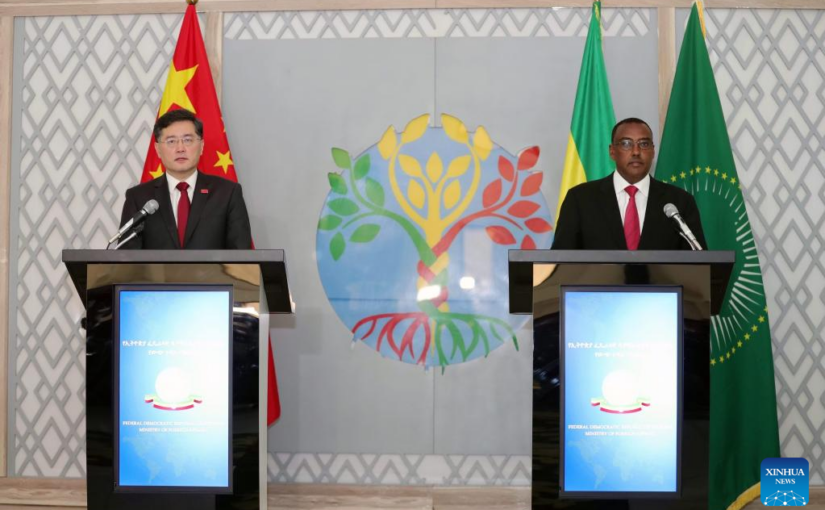
China-Africa trade and cooperation have both blossomed. A number of major Chinese-assisted infrastructure projects have been completed, including the Ethiopia-Djibouti railway, Kenya’s standard gauge railway from Mombasa to Nairobi, and Cote d’Ivoire’s Soubre hydropower plant. These projects provide much needed transport and energy infrastructure to help further develop local industries.

The facts are there for everyone to see that Africa has finally and gradually started moving towards a promising mode of development thanks to the fellow brother that China has proven itself to be.

Syrian Ambassador: Muslims in Xinjiang experience greater freedom than Muslims in the West

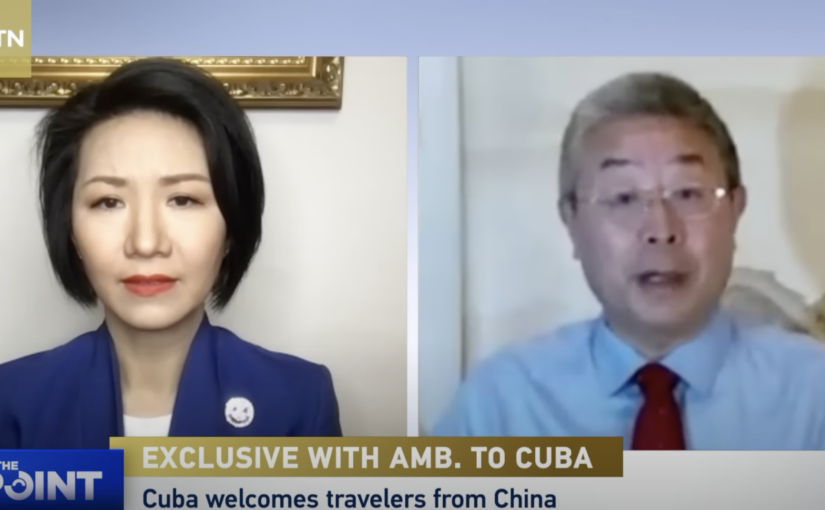
The below extract from CGTN’s popular The Point features an interview with Syria’s Ambassador to China, HE Muhammad Hasanein Khaddam. 

Although relatively new in his ambassadorial role, this is his second posting to China. Broadcast on September 7, the ambassador was one of a group of diplomats from 30 Muslim majority countries who had recently paid a visit to Xinjiang. Describing the region as an oasis, Ambassador Khaddam said the gap between what they saw with their own eyes and what is presented in the west is unbridgeable.

However, this did not surprise him, as the same lies had been told about his own country during 12 years of war waged by terrorist groups and the western powers. Muslim people in Xinjiang, he pointed out, enjoy freedoms that can’t be enjoyed by their co-religionists in many western countries that criticise China. 

Turning to the situation in Syria, the Ambassador notes that the Belt and Road Initiative (BRI), that Syria formally joined at the beginning of this year, brings hope of a new modality of ‘win win’, without dictation or disrespect. Companies from friendly nations that stood with Syria, he explains, will enjoy numerous opportunities in the reconstruction of the country, such as in the building of ports, roads, bridges and a railway to Iraq.

Why China isn’t capitalist

The below article by Stephen Millies was originally published by the US socialist journal Struggle/La Lucha. It is an interesting and provocative response to those comrades on the left who contend that capitalism has been restored in the People’s Republic of China.

Noting that China’s economy may already be larger than that of the United States, Stephen asserts that: “This tremendous economic growth is the result of China’s socialist revolution… You can’t explain China’s fantastic economic growth except by admitting there’s some other social system than capitalism in charge.”

An interesting aspect of the article is its presentation of how the Soviet Union, even in the late 1980s, played a major part in the liberation of southern Africa. It also notes that: “Sometimes retreats are absolutely necessary. For example, the Long March was a glorious retreat that saved the Communist Party of China from being destroyed.” In this context, Stephen also references Lenin’s New Economic Policy (NEP), along with an observation from Karl Marx that, following a socialist revolution, the working class might have to “buy off the band” of the wealthy.

Wall Street and the Pentagon view the People’s Republic of China as their number one enemy. China is the target of U.S. imperialism’s “Pivot to Asia.” 

China’s economy may already be larger than the United States. The American Enterprise Institute―one of the best-known capitalist think tanks ― admits China surpassed the U.S. as the world’s biggest manufacturer back in 2010. 

That’s historically significant. Factories in the United States exceeded Britain’s production in the 1890s.

China is now the “workshop of the world.” In 2021, China built nearly 17 million more motor vehicles than the U.S.

This tremendous economic growth is the result of China’s socialist revolution. It’s not just a matter of China making more than a billion tons of steel a year or having more miles of high-speed rail than the rest of the world.

When Mao Zedong declared “China has stood up” in 1949 and the People’s Republic of China was born, Chinese people lived to be, on average, just 36 years old. 

By 2022 life expectancy had more than doubled to reach 77.3 years. That’s a longer lifespan than in the United States.

Despite these tremendous gains, some communists and revolutionaries contend that capitalism has been restored in the People’s Republic of China. They point to the 606 billionaires in China, including 67 in Hong Kong. 

Continue reading Why China isn’t capitalist

How China escaped shock therapy in the 1980s: interview with Isabella M. Weber

The process of economic reform in China in the 1980s is not always well known or understood. ‘How China Escaped Shock Therapy: The Market Reform Debate’, published last year, is an important contribution to both understanding and debate. The first book by Isabella M. Weber, Assistant Professor of Economics at the USA’s University of Massachusetts Amherst, it won the 2021 Joan Robinson Prize, named for the renowned Cambridge economics professor and friend of socialist Asia.

The book details the complex debate that took place in China in the 1980s, which involved veteran Chinese leaders from the first generation of the revolution, young Chinese economists, Eastern European economists, and mainstream western economists from international financial institutions and elsewhere.

With the exception of the veteran revolutionary leaders, many of the participants in these debates were pushing a strategy which was to later become known elsewere as shock therapy. Their view did not prevail. Rather, what emerged was an “experimental and radical gradualist economic reform”, that drew from traditional Chinese economic statecraft, the leaders’ experience of hyperinflation before liberation, and the early results of the initial economic reforms in the countryside.

In this interview, originally published in the Czech language on Alarm, and then in English translation on the online East European socialist magazine LeftEast, Isabella expands on some of her book’s key themes. She notes that: “We have to remember that at that time China was unlike Czechoslovakia, Poland, or East Germany in that it was a very poor country. Mao’s reign laid important foundations for the economic reform, like basic healthcare system, public infrastructure, and industrialization, but nevertheless China was still a very poor country with a GDP lower than Sudan or Haiti. Of course, that doesn’t represent the whole level of development of the country, but it gives you a sense of what we’re talking about.”

Making a comparison to the economic reforms carried out in Russia from the end of the decade, Isabella describes this as an example of what was at stake for the Chinese. She draws a clear and very important distinction between the Chinese and Russian leaders and situations of the time:

“In the Chinese case in the 1980s the most powerful people in the leadership were first generation revolutionaries, so they approached the economic reforms with a very different perspective than Gorbachev or Boris Yeltsin. Another difference is that China started the reform coming out of the Cultural Revolution, which meant that at the beginning of the reforms the bureaucratic system was being re-established, whilst in the Russian case the bureaucratic system was very rigid.”

When today’s historiography refers to the debate about economic reforms in Eastern European countries during late communism, it often uses the term the “long transition”. It shows that the economic transformation from state socialism into neoliberalism was a process that took off in some of the countries in Eastern Europe in reaction to the oil crisis in 1973. Their debt was getting out of the control and it forced them to work more closely with Western financial institutions, but it also meant much deeper transformation of the world’s economic system with the end of the gold standard and Bretton-Woods economic system. Cooperation between Eastern European economists and Western financial institutions helped to shape the debate about the need for further economic transformation of state socialist economies. The most radical supporters of the neoliberal economic reform, later known as „shock therapy“, were influenced by Pinochet’s Chile or the military regime in South Korea. But at the same time, very similar debates over economic reform were taking place in China. Political economist Isabella M. Weber‘s astonishing new book How China Escaped Shock Therapy details the complex debate over economic reform in China in the 1980s between, on one side, young Chinese economists, Eastern European economists, and people from Western financial institutions that tried to push through “package reform“ (which would later be known as shock therapy), and, on the other, the old guard of the Chinese leadership who had first cut their teeth in the country. In the end, the latter group decided on their own experimental and radical gradualist economic reform that emerged from traditional Chinese economic statecraft, their experience of hyperinflation among during the Second World War, and the successful agrarian reforms of the 1980s. Why did the Chinese leadership decide that the neoliberal approach to economic reform was not an option for their country? We spoke with Isabella M. Weber,  a political economist and assistant professor of economics at the University of Massachusetts Amherst and the Research Leader for China at the Political Economy Research Institute.

When did the debate about the need for economic reform start to appear in China and what was the driving force behind this push for economic reform?

The debate started after Mao Zedong’s death, but even in the last years of Mao’s reign there were already less official initiatives to rethink the communist project. It also coincided with China’s reapproachment with the USA, which marked a radical shift in China’s foreign relationships. I think that the year of Mao’s death was crucial. The transition period between Mao’s reign and Deng Xiaoping is often overlooked in the historiography of China’s reforms. To my mind this period marks a radical break with the ideas of Cultural Revolution. It was a shift from mass mobilization and revolutionary forms of social organization to a more developmentalist and economistic agenda, but initially this agenda was in the spirit of the “Big Push,“ a ten-year plan that involved importing foreign technologies and capital goods in exchange for Chinese oil, which was predicted to be discovered in larger quantities back then. The problem was that these projected findings of petroleum turned out to be inaccurate, so this plan imploded within the span of two years. So when Deng Xiaoping came into power it was clear that a new economic model was needed.

Continue reading How China escaped shock therapy in the 1980s: interview with Isabella M. Weber

The flaws in the “Assessment” report of the Office of the High Commissioner for Human Rights on China

In this important article, originally carried on Counterpunch, Alfred de Zayas, a former long-term United Nations employee, dissects the recent report of the Office of the (UN) High Commissioner for Human Rights on China’s Xinjiang region, which he believes, “should be discarded as propagandistic, biased, and methodologically flawed.” The report, he notes, was not mandated by the UN Human Rights Council, comes in response to pressures from Washington and Brussels, and forms part of their geopolitical hybrid war against China.

De Zayas draws a comparison with his own mission to Venezuela, prior to which he read all the relevant reports from the OHCHR, Amnesty International and Human Rights Watch. But when he fact-checked these on the ground, he saw a fundamentally different picture from that contained in reports by ideologues who had not been to Venezuela. 

The author therefore writes that, “the questions must be raised whether and to what extent the Office of the High Commissioner for Human Rights and the Human Rights Council are operating in the service of Western interests, to what extent the human rights concerns of the rest of humanity are taken on board.”

On 31 August 2022, the last day of Michelle Bachelet’s 4-year tenure as UN High Commissioner for Human Rights, the Office released a 46-page document, which I believe should be discarded as propagandistic, biased, and methodologically flawed.  This document, which was not mandated by the Human Rights Council and responds to pressures on OHCHR by Washington and Brussels, bears the superficially neutral title “ Assessment of human rights concerns in the Xinjiang Uyghur Autonomous Region”[1].

Already in June 2022, at the beginning of the 50th session of the Human Rights Council, China’s ambassador Chen Xu deplored the increase in “politicization” of the Council, reminding the members that “disinformation has become rampant, which seriously runs counter to the original purpose of the Human Rights Council.”

High Commissioner Bachelet did well in delaying publication of the Xinjiang “assessment” and returning to Chile before the unappetizing and destructive debates start during the forthcoming 51st session of the Council (12 September-7 October 2022).  Already the Chinese mission has rejected[2] the “assessment” as unprofessional and incompatible with the end-of-mission statement issued by Michelle Bachelet after her successful mission to China and Xinjiang in May 2022, a statement, which I consider balanced, detailed and constructive[3].  Alas, Bachelet’s statement after her well-prepared visit did not succeed in silencing the Washington and Brussels critics that have been systematically misrepresenting the situation in Xinjiang and misusing it for purposes of their geopolitical hybrid war against China.  Bachelet’s sedate statement was met by hostility, media mobbing and calls for her resignation.

Continue reading The flaws in the “Assessment” report of the Office of the High Commissioner for Human Rights on China

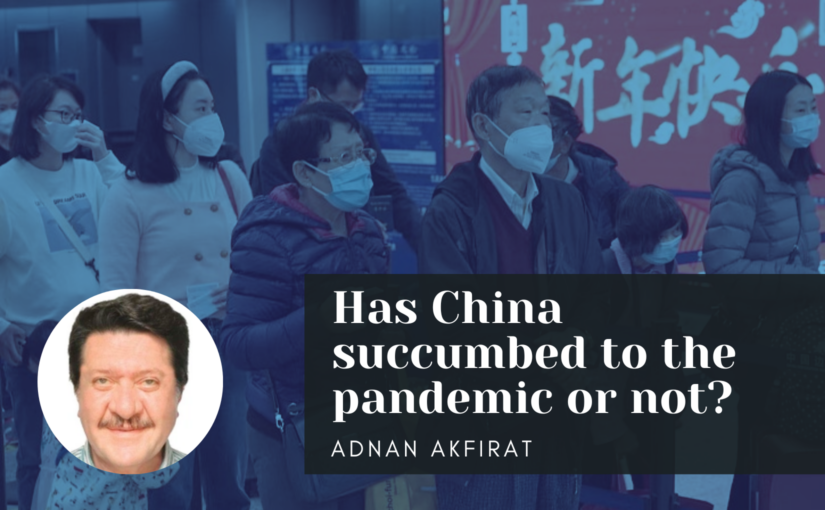
NYT scolds China for not ‘learning to live’ – or die – with Covid

In the below article, originally published by FAIR (Fairness & Accuracy in Reporting), Jim Naureckas takes the New York Times to task for yet another of its regular attacks on China’s highly effective Zero Covid policy. He notes that if the Chinese government had followed the same policies as its US counterpart regarding the pandemic, and got the same results, then four and a half million people would have died. As China did not follow the US example, the country has experienced 15,000 deaths – the majority from a spring 2022 outbreak in Hong Kong, which has a different medical and social system to the mainland. Meanwhile, the US has suffered more than a million Covid deaths – and with a current fatality rate of around 450 per day is set to lose around 160,000 more people this year if present trends continue.

Jim notes that nowhere in the New York Times article under review is there any comparison of the respective national death tolls or any hint that the USA’s life expectancy has now dropped below that of China. And whilst the article (like many others of its type in the western media) claims that China’s determination to suppress the virus has triggered an economic crisis, the author notes that in 2020, the first year of the pandemic, China’s economy grew by 2.4% while the USA’s shrank by 3.4%. The USA’s economy is projected to grow by 1.3% this year. However, Goldman Sachs projects 3.0% growth for China.

Four and a half million people.

That’s how many Chinese people would have died from Covid-19 had its government taken the same approach to the pandemic that the United States has taken, and gotten the same results.

Instead, China has had 15,000 deaths from Covid—most of these from an outbreak in the spring of 2022 in Hong Kong, which has its own healthcare system.

Meanwhile, the United States has lost more than a million people to Covid since the pandemic began. Deaths currently continue at the rate of about 450 a day, which would add up to roughly 160,000 a year if present trends continue.

Continue reading NYT scolds China for not ‘learning to live’ – or die – with Covid

Xi Jinping: Steadfastly following the Chinese path to promote further progress in human rights

We are very pleased to publish below the full text of Comrade Xi Jinping’s important speech on human rights. Comrade Xi delivered this speech to a group study session of the Communist Party of China’s Political Bureau, held on February 25 this year, which took as its theme the Chinese path of advancing human rights.

In his comprehensive exposition, the Chinese communist leader notes how the concept of respect and caring for others is deeply rooted in Chinese history and culture and that during the Western bourgeois revolution, Enlightenment thinkers advanced the concept of “natural rights”. Marx and Engels, he goes on to note, endorsed the historical value of such bourgeois theories, but “firmly refuted the theory’s denial of the social, historical, and class-based nature of human rights. ‘The individual,’ Marx pointed out, ‘is a social being.’… They envisioned that ‘In place of the old bourgeois society, with its classes and class antagonisms, we shall have an association, in which the free development of each is the condition for the free development of all.’”

Throughout its century of struggle, therefore, the CPC has always fought for the genuine human rights of the Chinese people. As a result, absolute poverty has been eliminated and a system of whole-process people’s democracy gradually developed, along with the world’s largest education, social security and health care systems. Human rights, Xi observes, “are not special privileges bestowed on some people or a small minority but universal rights to be enjoyed by all the people.” Moreover, “The advancement of human rights is a common undertaking of all humanity. In protecting human rights, all of us can always do better.”

In this context, he calls out the hypocrisy of the major capitalist countries, noting that, “Political polarization, wealth disparities, and racial tensions have all intensified, while racism, populism, and xenophobia have become rife, thus bringing human rights issues to the fore. Yet, these countries still use slogans like ‘universal human rights’ and ‘human rights over sovereignty’ as a pretext for forcing Western conceptions and systems of democracy and human rights on others and for meddling in the internal affairs of other countries. This has only served to cause recurrent military conflict, ongoing unrest, and the displacement of many from their homes in a number of countries.”

The speech was originally published in Chinese in issue 12 (2022) of Qiushi Journal, the CPC’s main theoretical organ. We reproduce it from issue 4 (2022) of Qiushi Journal’s English language edition.

Today, the Political Bureau of the CPC Central Committee is holding its 37th group study session, the focus of which is the Chinese path of advancing human rights. The goals of this session are to review our country’s human rights achievements, both theoretical and practical, in the new era, assess the international struggle in the sphere of human rights, and maintain steadfast commitment to the Chinese path to promote further progress in human rights.

It is the pursuit of all societies to protect the life, value, and dignity of every person and ensure their entitlement to human rights. Chinese culture has always stressed the importance of respecting and caring for others. From Confucius who declared that “benevolence has been the greatest priority of governance since ancient times” to Mencius who said, “Finding talents for the country is what benevolence is all about,” to Xunzi who believed that people were “most valuable” and Mozi who called on us to “love others as we do ourselves regardless of social status or wealth”—each of these great thinkers stressed the intrinsic value of the person. Our forebears also put forward other similar axioms: “Of all things in the world, people are most precious”; “To accomplish great feats, one must put the people first”; “In the matters of governance, the people should come first.” During the Western bourgeois revolution, the thinkers of the Enlightenment put forward the concept of “natural rights,” which holds that all men are created equal and possess inalienable rights, a concept that helped propel forward revolutions in Britain, America, France and other countries.

Karl Marx and Friedrich Engels endorsed the historical value of the bourgeois theory of human rights, meanwhile they firmly refuted the theory’s denial of the social, historical, and class-based nature of human rights. “The individual,” Marx pointed out, “is a social being.” He also argued that “Right can never be higher than the economic structure of society and its cultural development conditioned thereby.” Marx and Engels made the point that in a capitalist society “man has ceased to be the slave of men and has become the slave of things.” They envisioned that “In place of the old bourgeois society, with its classes and class antagonisms, we shall have an association, in which the free development of each is the condition for the free development of all.” 

Continue reading Xi Jinping: Steadfastly following the Chinese path to promote further progress in human rights

Liu Xin interviews former Kuomintang leader

The below video features an extremely interesting and comprehensive interview with Ms. Hung Hsiu-chu, former Chair of the Chinese Kuomintang (KMT) party and current Chair of the Chinese Cyan Geese Peace Education Foundation, conducted by Liu Xin for her popular CGTN programme, The Point. 

Speaking from Taipei in the aftermath of the visit by US House Speaker Pelosi, Ms. Hung presents a point of view that is almost never heard in the West – that of a Taiwan-born Chinese patriot. She makes clear that, in the wake of the visit and other western provocations, China will have to move from “fighting independence [of Taiwan] to boosting reunification in an enhanced manner.”

She slams the anti-China statement by the leaders of the G-7 countries and the EU High Representative following China’s response to the Pelosi visit, pointing out that this is simply a US-led bloc, all of whose members, with the exception of Japan, are members of NATO. She further notes that the G-7 did not reflect on the eastward expansion of NATO, which is the root cause of the Ukraine conflict. All Chinese, she explains, must join together to defend national sovereignty when the One China Principle is attacked, and the West should get over its centuries-old sense of superiority and treat others equally.

Ms. Hung speaks frankly about the decline in national sentiment among many young people in Taiwan but reiterates her absolute confidence in China’s eventual reunification.

The interviewer, Liu Xin is among the speakers at our webinar this Saturday, September 24, on China encirclement and the imperialist build-up in the Pacific – for which you can register using Eventbrite.

This is why the Arab world stands firmly with China

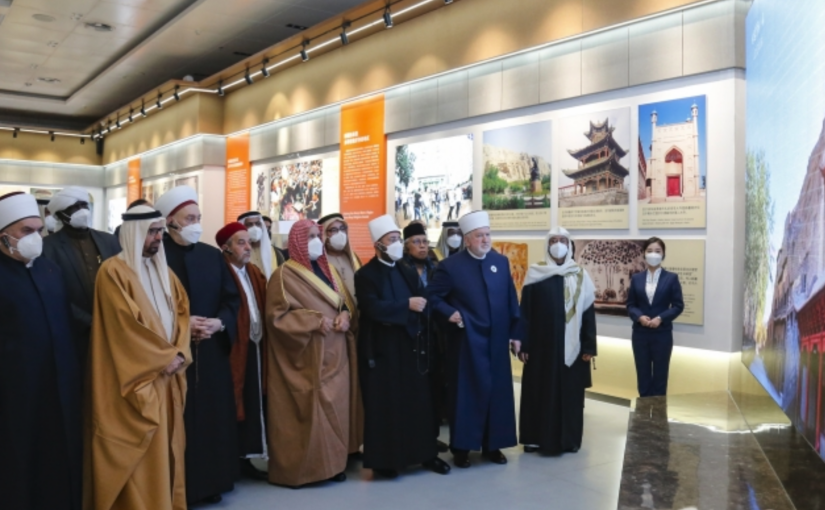
This article by Keith Lamb, first published in CGTN on 14 September 2022, describes the friendly relations between China and the Arab world, noting in particular that the Arab states have refused to support the West’s slanderous accusations in relation to human rights in Xinjiang. Indeed, numerous envoys from the League of Arab States have visited Xinjiang and spoken enthusiastically about the development of human rights in the region.

The author notes that imperialist apologists explain the above away on the basis that Arab states are somehow afraid of China; but surely it’s the countries which “committed carnage against the Arab world” that should be feared, not China, which “has not invaded a single Arab state and doesn’t maintain a myriad of military bases.”

Far from carrying out military aggression against the region, China is involved in extensive cooperation, trade and aid. “Where others have bombed, China builds.” The author observes that, last year, Iraq was the number one recipient of Belt and Road financing, receiving $10.5 billion; this sort of engagement compares favorably with the US-led genocidal war on Iraq. Meanwhile China is cooperating extensively with the countries of the region on cutting-edge technology, including in green energy, telecoms and AI. As Keith says, “this is not a new imperialism but a rejection of it.”

Those blinded by the “free” press believe China’s Xinjiang Uygur Autonomous Region is the location of a “genocide” against Chinese Muslims who are simultaneously “enslaved.” In contrast, envoys from the League of Arab States (LAS), who have been to Xinjiang, talk about China’s social and human rights achievements.

Those who screamed for violence against Arab states, including Libya, Iraq, and Syria, in the name of human rights, solve this cognitive dissonance by claiming that the Arab world is afraid of China. However, their delusion is only carried one step further to absurdity as clearly those who committed the carnage against the Arab world are the ones who should be feared.

In contrast, China has not invaded a single Arab state and it doesn’t maintain a myriad of military bases, which blurs the line between cooperation and occupation. If anything, considering the vast military power accumulated in the Middle East, the LAS support for China shows that they, despite lurking threats, will bravely stand up for truth so that “Weapons of Mass Destruction” lies can no longer be leveraged for the tyrants of war.

Instead, a new page of history is turning, which seeks to constrain the unilateral whims of a hegemonic bully. It is China’s peaceful rise and developmental philosophy contrasted with a fading unilateral order of violence, lies, and uneven development that leads the Arab world to stand with China today.

Continue reading This is why the Arab world stands firmly with China

Video: Whose democracy? Beijing, New York show vast contrast

The video embedded below is the last in a three-part series on democracy made by China Daily, based on an interview with Friends of Socialist China co-editor Carlos Martinez. In this segment, Carlos talks about visiting both New York City and Beijing for the first time in 2019, and the stark contrast between the two cities. New York, in spite of being a major centre of wealth, contains terrible levels of poverty, inequality, homelessness and discrimination, and its infrastructure is collapsing. Beijing on the other hand is modern, efficient, clean and well-organised, and the fundamental human rights of all its citizens are guaranteed. What this small example reflects is the difference between Western democracy – a democracy for the elite – and Chinese socialist democracy, which works for the masses of the people.

You can also see part 1 and part 2 of the series.