Four Criteria of Democracy: The Superiority of China’s Full Process Socialist Democracy over the Democracy in the United States


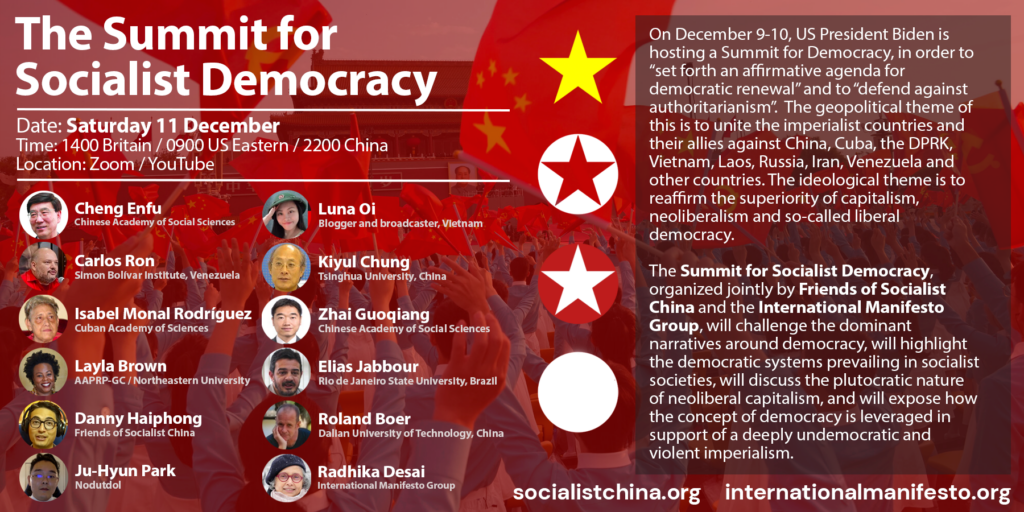
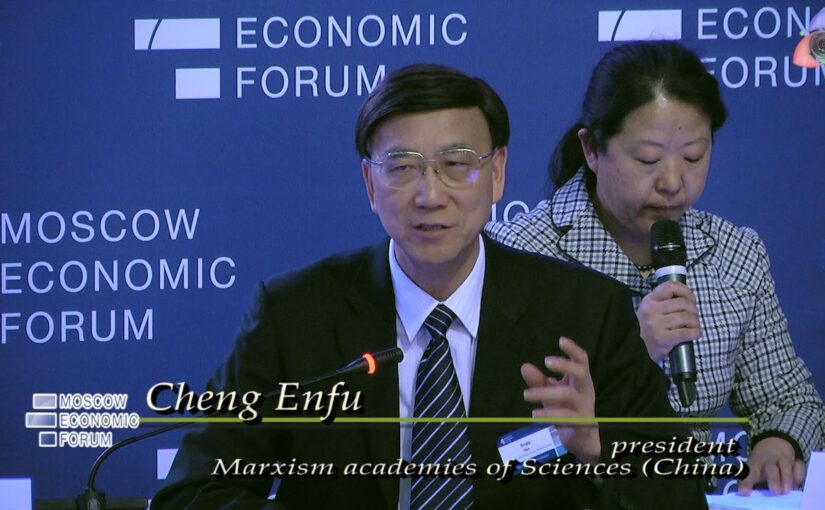
We are very pleased to publish the text of this important speech made by Cheng Enfu (Principal Professor, University of the Chinese Academy of Social Sciences, and President, World Association of Political Economy) to our Summit for Socialist Democracy held on 11 December 2021. The full event can be viewed on YouTube.

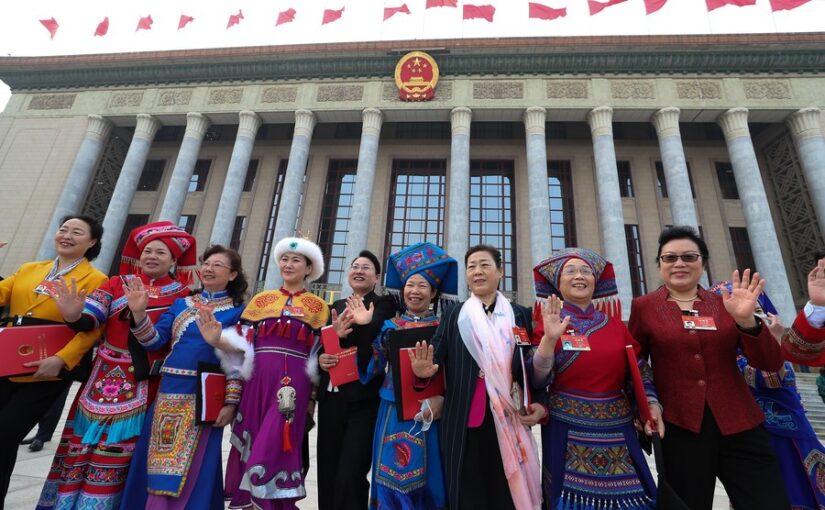
The key to a country’s democracy is whether the people are the masters of their own country. To that end, four important criteria must be considered in determining whether a country’s political system is democratic.

1. The right to vote is important, but more important is people’s wide participation

When people have the right to vote, they can freely express their personal will, but this is far from enough, because the equality in the political right of “one person, one vote” does not necessarily remove other inequalities in economic and social terms. To solve this problem, people must have the right to participate in an all-around manner. The right to participation is the kernel of democratic politics. A democracy in which the people have only the right to vote but not the right to broad participation, i.e., they are awakened only at the time of voting and then go dormant afterwards, is formalistic. Evidently, it is of equal importance to ensure and support the people’s position as masters and to allow them to participate deeply in the management of both national and social life, through elections in accordance with the law as well as through systems and means other than election.

Continue reading Four Criteria of Democracy: The Superiority of China’s Full Process Socialist Democracy over the Democracy in the United States
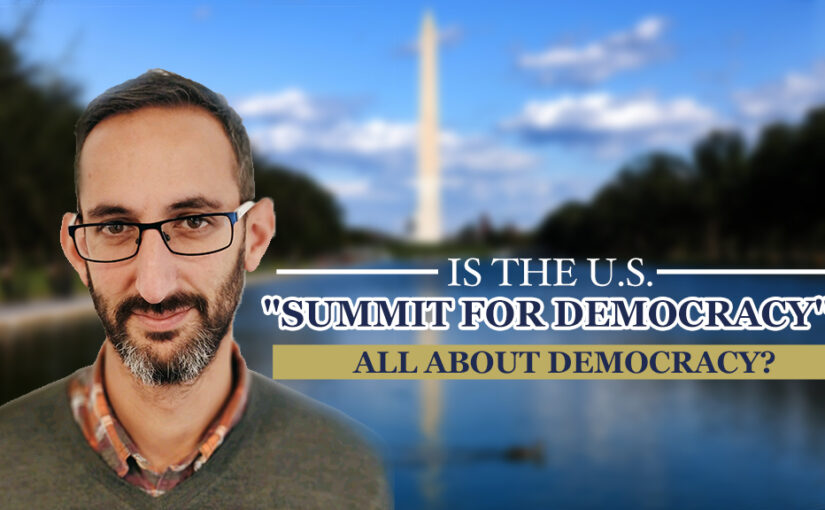
Li Jingjing: Does China have democracy?

CGTN reporter Li Jingjing recently posted a presentation on YouTube explaining China’s political system and countering the standard narrative in the West that China is ‘authoritarian’ and ‘undemocratic’. The video is embedded below, along with the text, which Li Jingjing has kindly provided us with.

China has… democracy?

Yes, guys. I know a lot of you probably are very shocked right now, especially if you are from the West.

“No, there’s no way China is a democracy, it’s an authoritarian government that oppresses its people! As we were told by our governments and media!”

Ok ok, if it really oppresses its people, then how do you explain this:

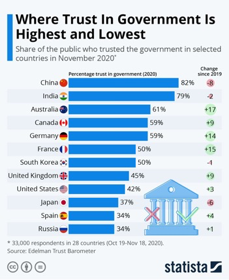
According to the Edelman Trust Barometer in 2020, 82% of Chinese trust their government, ranked No.1 in the world, followed by India, Australia, Canada and Germany. And you see, this research was done in 2020, after China went through lockdowns and hit hard by COVID 19 pandemic in the first half of that year, the trust in government is still higher than any other countries. I’m sure that number got even higher after the economy and wellbeing of people got better in 2021.

Continue reading Li Jingjing: Does China have democracy?

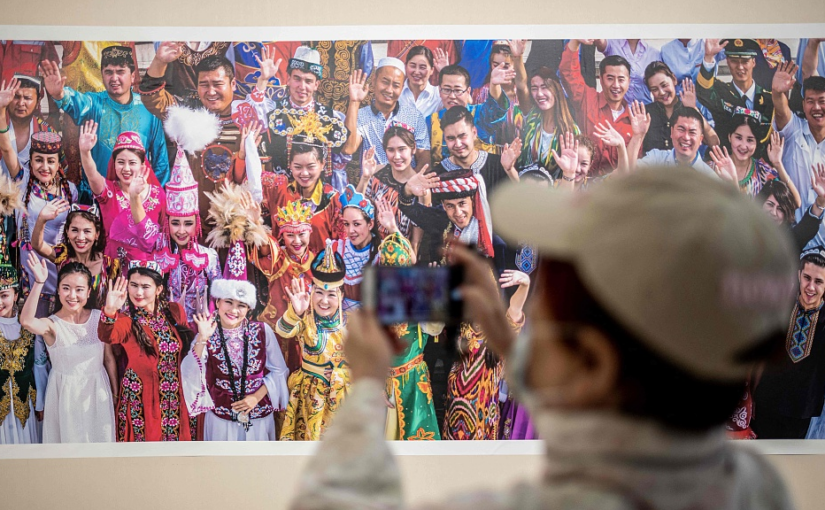
Danny Haiphong: ‘Uygur Tribunal’ is a misinformation arm of the US’s anti-China agenda

The following article by Friends of Socialist China co-editor Danny Haiphong, originally published on CGTN, exposes the so-called ‘Uygur Tribunal’ as being totally lacking in credibility and existing for the singular purpose of contributing to the US-led New Cold War against China.

On the same day that the U.S. hosted the first day of its “Summit for Democracy,” the U.K.-based “Uygur Tribunal” released a report alleging that China had committed “crimes against humanity” toward the Uygur ethnic group in China’s Xinjiang Uygur Autonomous Region. Findings in the report repeated the same allegations against China that have become commonplace in the West over the past several years. The so-called “Uygur Tribunal Chair” Geoffrey Nice presented the report and said that China is both detaining Uygurs in the millions and engaging in “genocide” through the control of births.

Of course, the “Uygur Tribunal” is not an impartial source. The campaign is a project of a U.S. consortium of anti-China think-tanks in charge of spreading propaganda in the name of human rights. In fact, the “Uygur Tribunal” website explains that the World Uygur Congress formally requested Geoffrey Nice to launch the project. The World Uygur Congress received $400,000 in 2020 alone from the National Endowment for Democracy (NED), a regime change-arm funded by the U.S. Congress and inheritor of the CIA’s numerous campaigns of political interference around the world.

Continue reading Danny Haiphong: ‘Uygur Tribunal’ is a misinformation arm of the US’s anti-China agenda

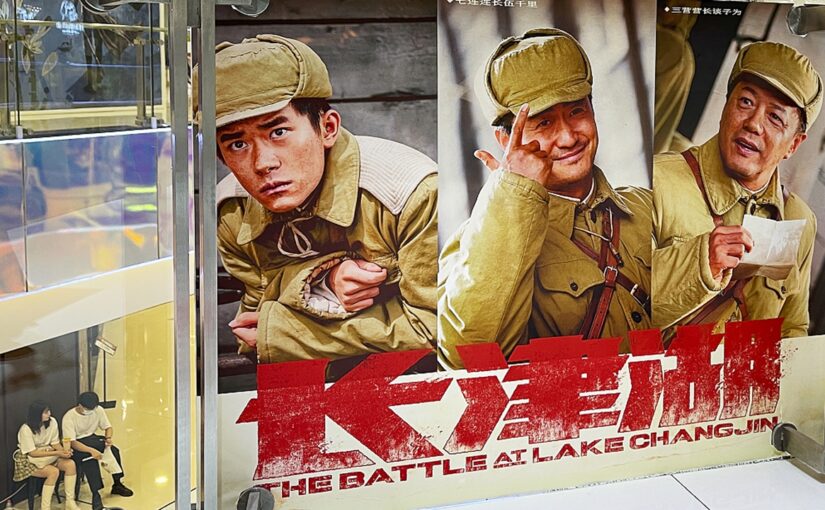
Film review: The Battle at Lake Changjin

The following review was written by Friends of Socialist China co-editor Keith Bennett.

The Battle at Lake Changjin, directed by Chen Kaige, Tsui Hark and Dante Lam, premiered at the Beijing International Film Festival on 21 September 2021 and was released in China on 30 September. As part of its international distribution, it has been showing at selected cinemas in Britain, Ireland, the USA and Canada since 19 November and in Australia since 2 December. With a budget of some US$200 million, it is the most expensive Chinese film ever made. However, the acclaim with which it has been received has also made it the highest grossing film of 2021, the highest grossing film in Chinese history and the highest grossing non-English language film.

At just two minutes under three hours in length, the film is a revolutionary epic, with the main action centred around the Changjin Lake area of the Democratic People’s Republic of Korea (DPRK) in the bitterly cold winter of 1950, shortly after the Chinese People’s Volunteer Army (CPVA) had entered the War to Resist US Aggression and Aid Korea. Confronted with the harshest natural and climatic conditions, forced to survive on starvation rations, and faced with an enemy that was better trained, better equipped, better fed, better armed and with complete mastery of the skies, the Chinese troops “fearing neither hardship nor death”, to use the well-known Chinese expression, continue to forge ahead in the most courageous and ingenious of ways. Armed with the element of surprise, and although making the ultimate sacrifice, by successfully blowing up the Shuimen Bridge, they score the most decisive victory ultimately ensuring the achievement of China’s objectives in the war.

Continue reading Film review: The Battle at Lake Changjin

Joint statement on democracy and common development

We are very pleased to republish this statement, coordinated by the International Department of the Communist Party of China, promoting a pluralistic approach to the issue of democracy and calling on the world’s countries to develop mutual understanding and cooperation rather than attempting to pursue hegemony and unilateralism.

The statement has been endorsed by 351 political parties, social organisations and think tanks from 140 countries and regions. Friends of Socialist China is proud to be among the signatories.

Joint Statement of World Political Parties, Social Organisations and Think Tanks on making Independent Efforts to Explore the Path Toward Democracy and Working Together to Promote Common Development

Democracy represents an important achievement of humanity in the advancement of political civilisation, and development an eternal pursuit throughout human history. People of different countries and regions, through their unremitting explorations, have brought about distinctively varied forms of democracy and development paths, presenting a magnificent spectacle of flourishing human civilisations. Political parties, as they are in a position to build, preserve and develop democracy, have been charged with the important mission to realise democracy and promote development. In view of the above, we, the 351 political parties, social organisations and think tanks from 140 countries and regions, issue a joint statement to the whole world as follows:

Continue reading Joint statement on democracy and common development

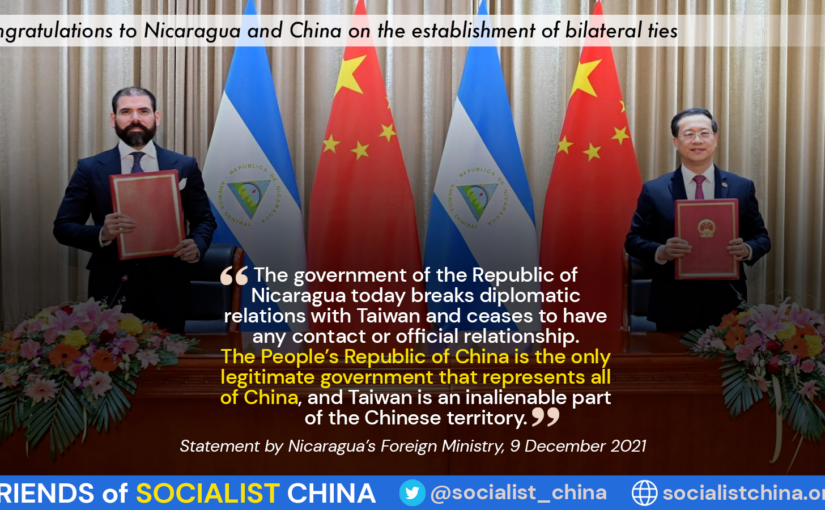
The resumption of diplomatic relations between China and Nicaragua is a blow to imperialism

By Friends of Socialist China co-editor Keith Bennett

On 9 December 2021, Nicaragua’s Foreign Minister Denis Moncada announced the resumption of diplomatic relations between the People’s Republic of China and the Republic of Nicaragua. This was followed the next day by a meeting in the northern Chinese city of Tianjin between Chinese Vice Foreign Minister Ma Zhaoxu and Laureano Ortega, the representative of the Nicaraguan government and a son of President Daniel Ortega, at which the two countries issued a joint communique announcing the re-establishment of their diplomatic relations.

This development is welcome and inspiring news for all those committed to anti-imperialism and especially for all those who care about the prospects for the development of socialism in Central and South America.

Continue reading The resumption of diplomatic relations between China and Nicaragua is a blow to imperialism

US Peace Council statement against the Cold War on China

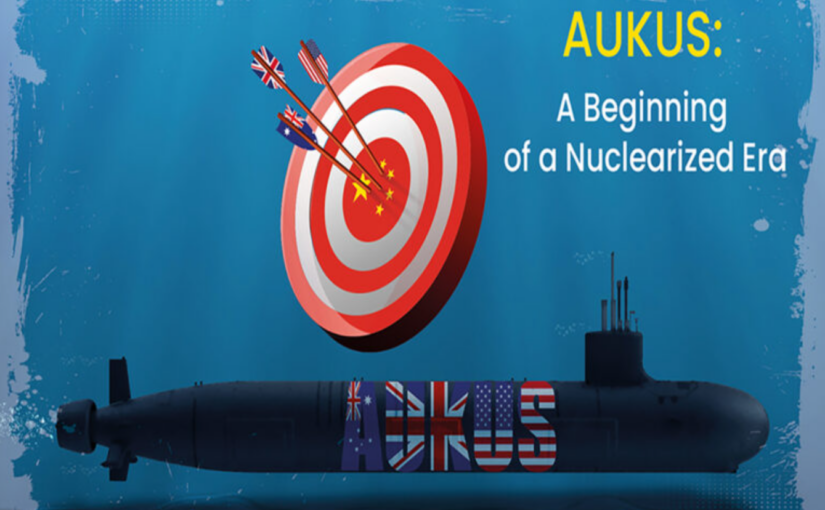
We’re pleased to republish this statement by the US Peace Council, issued on 9 December 2021, against the US-led New Cold War on China and against the AUKUS military alliance between the US, Britain and Australia.

The signs of the new cold war with China are everywhere. The political signal comes from the top. President Biden’s Interim National Security Strategic Guidance, tellingly called Renewing America’s Advantages, states: “We must also contend with the reality that the distribution of power across the world is changing, creating new threats. China, in particular, has rapidly become more assertive. It is the only competitor potentially capable of combining its economic, diplomatic, military, and technological power to mount a sustained challenge to a stable and open international system.”

Competition with China has worked its way into almost every aspect of Biden Administration policy. Biden often justifies his big domestic spending plans for infrastructure, physical and social, by the “need to compete more effectively with China.”

Not yet a year old, the Biden Administration has been mounting provocation after provocation toward People’s China: fresh military aid and political support to Taiwan, intense naval and submarine activity in the South China Sea, the Taiwan Straits, and the Straits of Malacca through which much of China’s oil imports pass; a new U.S. military base on the northwest coast of Australia facing the South China Sea; bogus claims of “Uyghur genocide” in Xinjiang province; ongoing support for separatism and the Dalai Lama in Tibet; not to mention last year’s American NGO-funded “democracy” disruptions in Hong Kong.

Continue reading US Peace Council statement against the Cold War on China

China is more meaningfully democratic than the Western capitalist states

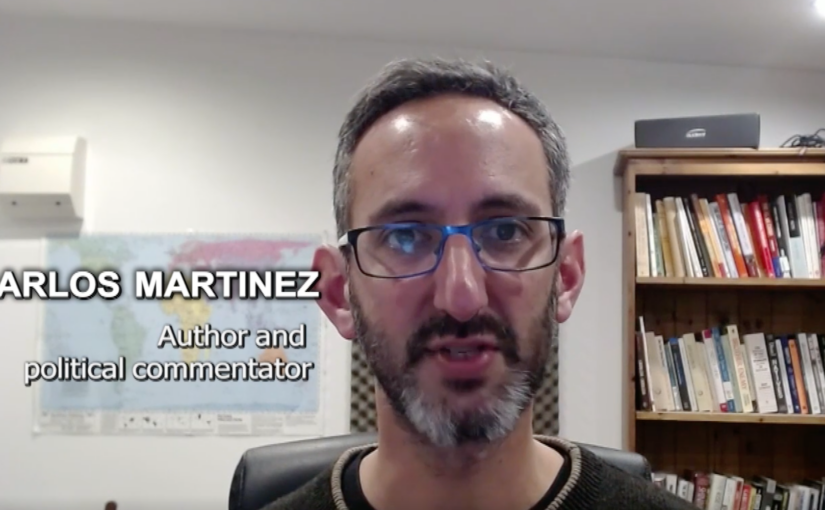
In this brief interview with Xinhua, Carlos Martinez explains how China’s whole process people’s democracy is in fact much more meaningfully democratic – in terms of being accountable to the people – than is the West’s ‘liberal’ capitalist democracy. The video is embedded below, followed by the report, which originally appeared in Xinhua on 9 December 2021.

China’s whole-process people’s democracy is far more meaningfully democratic than the Western liberal democracy, Carlos Martinez, a British author and political commentator, told Xinhua in a recent interview.

Ordinary Chinese people are much more engaged in running their communities and society, said Martinez, adding that “the basic interests of ordinary people in China are represented in government to a far greater degree than the case in the West.”

Noting that the shaping of democracy in China has its own background, he said there was no template available for the type of democracy the Chinese people needed when the People’s Republic of China was founded in 1949.

Continue reading China is more meaningfully democratic than the Western capitalist states

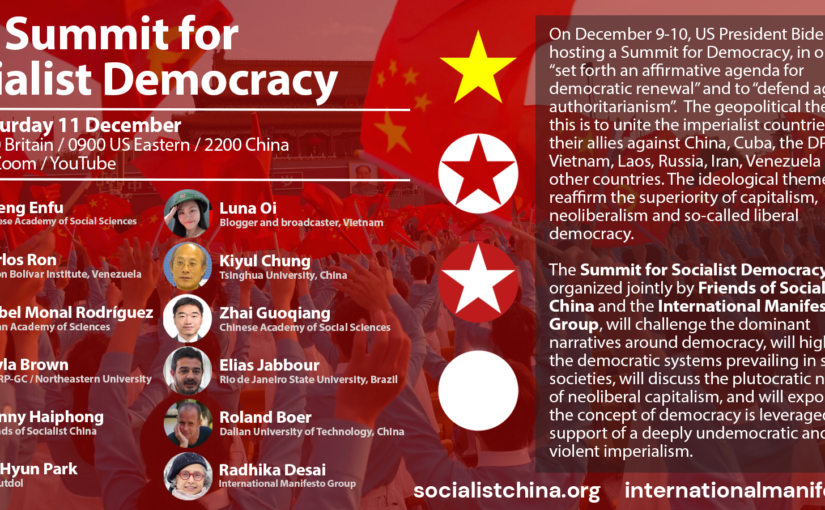
Reminder: The Summit for Socialist Democracy (11 December)

A reminder that our Summit for Socialist Democracy webinar takes place on Saturday 11 December, 9am US Eastern / 2pm Britain / 10pm China.

Details

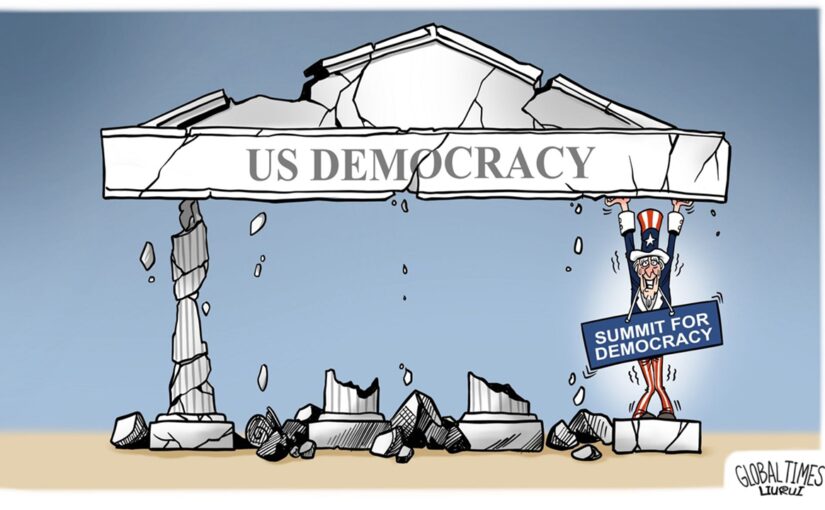
On December 9-10, Biden is hosting a ‘Summit  for Democracy’, “bring together leaders from government, civil society, and the private sector to set forth an affirmative agenda for democratic renewal” and to “defend against authoritarianism”. The geopolitical theme of this is, of course, to close ranks in the capitalist world against China, Russia, Cuba, DPRK, Venezuela and other countries. The ideological theme is to reaffirm the superiority of capitalism and so-called liberal democracy.

Our event will challenge the dominant narratives around democracy, will highlight the democratic systems prevailing in socialist societies, will discuss the plutocratic nature of neoliberal capitalism, and will expose how the concept of democracy is leveraged in support of a deeply undemocratic and violent imperialism.

The event is organised jointly by Friends of Socialist China and the International Manifesto Group, and is co-sponsored by the Morning Star, the International Action CenterNodutdol and Qiao Collective.

Speakers

  • Cheng Enfu (Principal Professor, University of the Chinese Academy of Social Sciences)
  • Carlos Ron (Deputy Minister of Foreign Affairs for North America, Venezuela)
  • Isabel Monal Rodríguez (Director of the Department of Marxist Studies, Academy of Sciences of Cuba)
  • Luna Oi (Vietnamese blogger and broadcaster)
  • Kiyul Chung (Professor, Tsinghua University, China; Korea University, Tokyo, Japan)
  • Layla Brown (Assistant Professor, Northeastern University, US)
  • Zhai Guoqiang (Deputy Director of the Institute of International Law, Chinese Academy of Social Sciences)
  • Elias Jabbour (Professor, Rio de Janeiro State University, Brazil)
  • Roland Boer (Professor, Dalian University of Technology, China)
  • Danny Haiphong (Co-editor, Friends of Socialist China; Contributing editor, Black Agenda Report)
  • Ju-Hyun Park (Writer and organizer, Nodutdol)
  • Moderator: Radhika Desai (Professor, University of Manitoba, Canada)

China and the 1948 Convention on the Prevention and Punishment of the Crime of Genocide

This important article in CGTN by Alfred de Zayas, professor of international law at the Geneva School of Diplomacy and former United Nations Independent Expert on Promotion of a Democratic and Equitable International Order, discusses the wilful and dangerous weaponization of the word ‘genocide’ and its utterly inappropriate application to the treatment of the Uyghur population of Xinjiang.

When the UN Charter was adopted 76 years ago, the drafters wanted to add an international bill of rights, but no draft had been negotiated. In the light of the atrocities of World War II, it seemed more important to lay down principles of international criminal law in the Nuremberg and Tokyo Trials. It was three years later that the General Assembly turned to the scholarly work of the Polish jurist Raphael Lemkin on the “ultimate crime” and, after much debate, adopted the Convention on the Prevention and Punishment of the Crime of Genocide on December 9, 1948.

“Homo homini lupus” – a man is a wolf to another man. History records many atrocities and massacres including the Armenian genocide from 1915 to 1923, the Nanking Massacre in 1937, the Holocaust from 1941 to 1945, the genocide of the Igbos, the genocide of the Tamils in Sri Lanka…

Continue reading China and the 1948 Convention on the Prevention and Punishment of the Crime of Genocide

Ian Goodrum: The ‘Summit for Democracy’ is a master class in hypocrisy

We are pleased to republish below this important article by Ian Goodrum in People’s World exposing the profound hypocrisy lying just beneath the surface of Biden’s ‘Summit for Democracy’, and discussing the realities of China’s socialist democracy.

The image above shows US soldiers holding three Grenadians prisoner during the October 1983 US invasion.

If you thought discourse in the United States couldn’t get more childish, think again: This week, the White House is convening the geopolitical equivalent of the He-Man Woman-Haters’ Club from Our Gang.
The club has an official name, of course; the Summit for Democracy, wherein U.S. President Joe Biden and 110 of his closest friends have a super-secret special meeting in their treehouse to talk about how great they are. But however hard they try to gussy it up, this affair is no different from what Spanky, Alfalfa, and Buckwheat got up to in those Hal Roach short films decades ago.

Continue reading Ian Goodrum: The ‘Summit for Democracy’ is a master class in hypocrisy

Carlos Martinez: the Summit for Democracy is just another excuse for China-bashing

Friends of Socialist China co-editor Carlos Martinez was recently interviewed by CGTN in relation to Biden’s upcoming Summit for Democracy, which is in reality an attempt to consolidate pro-imperialist forces globally against China and other socialist and progressive countries. This is the second part of the interview (the first part can be found here). The video segment of the interview is embedded below, followed by the text of the report, which is republished from CGTN.

These issues will be explored in detail at our Summit for Socialist Democracy, to be held on Saturday 11 December.

I think to some extent, the political context in the West is that anti-China propaganda, particularly in the U.S., has reached a stage where politicians seem like they are forced to engage in China-bashing. It’s become like a form of populism. The media and politicians have been blaming China for everything- for COVID-19, for unemployment, for declining or slow economic growth.

So Biden feels that he has to prove to people that he’s not going to be soft on China. He made it clear from the start that he planned to continue Trump’s basic policy of hostility towards China. But at the same time, Biden wants to put some kind of distance in people’s minds between himself and Trump. And he’s doing that in two key ways, and both of them sort of feed into the summit.

Continue reading Carlos Martinez: the Summit for Democracy is just another excuse for China-bashing

There is greater democracy in China than in many self-proclaimed democratic countries

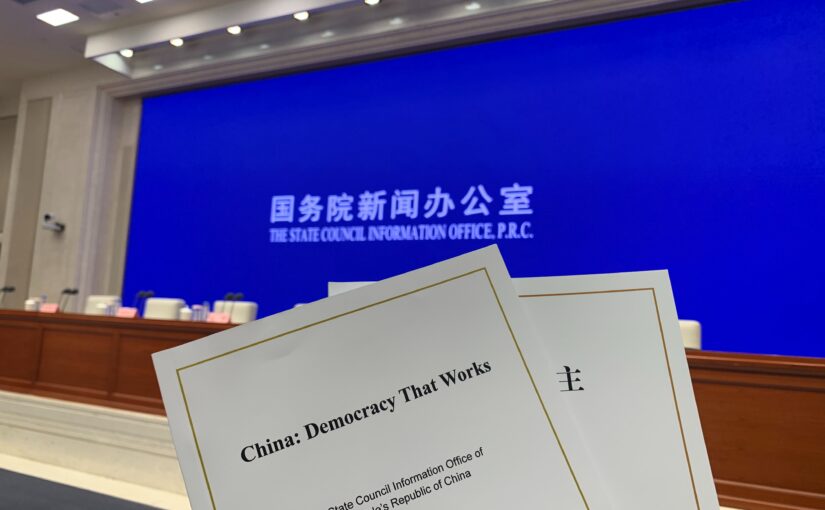
We are pleased to republish this article from China Daily featuring a selection of opinions about the China: Democracy That Works white paper released at the beginning of December 2021.

Dispelling a universal type of democracy, China’s latest white paper on the issue presents Chinese whole-process people’s democracy as a true and most suitable form in the country’s context, political analysts say.

The document, titled “China: Democracy That Works”, was released by the State Council Information Office on Saturday. Democracy is a common value of humanity and an ideal pursued by ancient civilizations including China and cherished by the Communist Party of China and the Chinese people, it said.

Carlos Martinez, co-editor of Friends of Socialist China, said that the white paper provides a detailed insight into China’s own democratic system at a time when the United States and its allies are making a big push to promote Western capitalist democracy as the only legitimate form of governance.
Continue reading There is greater democracy in China than in many self-proclaimed democratic countries

Carlos Martinez: The Summit for Democracy won’t succeed in propping up US hegemony

Friends of Socialist China co-editor Carlos Martinez was recently interviewed by CGTN in relation to Biden’s upcoming Summit for Democracy, which is in reality an attempt to consolidate pro-imperialist forces globally against China and other socialist and progressive countries. A video segment of the interview is embedded below, followed by the text of the report, which is republished from CGTN.

These issues will be explored in detail at our Summit for Socialist Democracy, to be held on Saturday 11 December.

I think the international context is quite sensitive (and) quite fragile. The main reason behind this being the emerging “new cold war,” which is led by the United States and is directed primarily against China. It’s also directed against Russia, Iran, Cuba, Venezuela (and) the Democratic People’s Republic of Korea.

Essentially, all those countries that you can say, they’re unwilling to accept the U.S. vision of international relations, the so-called liberal international order in which the U.S. enjoys more or less unchallenged hegemony. And U.S.-China relations have really deteriorated in recent years, particularly since 2018.

Continue reading Carlos Martinez: The Summit for Democracy won’t succeed in propping up US hegemony

‘The country that bombed you is your friend. The one that built your new railway is your enemy’

We are pleased to republish this article by Tom Fowdy, originally carried by RT. The author calls out the grotesque hypocrisy of imperialist criticism of China for having built a high speed railway to Vientiane, the capital of Socialist Laos – a small country on which the United States dropped more bombs than were dropped in the whole of World War II, killing some 10% of the population and making it the most bombed country in history. 

This is the Western media’s bizarre messaging to the people of Laos, a nation that was carpet bombed by America, and which is now being vilified for accepting a new $9 billion railway line paid for by China.

Thursday was National Day in Laos, a celebration marking 46 years since the landlocked Southeast Asian nation deposed its monarchy and became a revolutionary communist state, an effort which was supported by Vietnam.

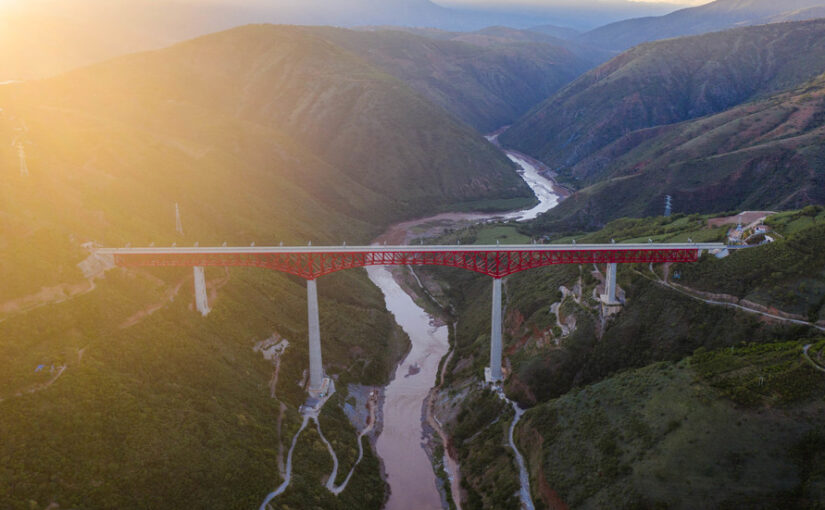
This year, the anniversary had added significance, as it saw the opening of a major new project, an electrified high-speed and freight railway system connecting the capital city, Vientiane with its northern neighbour, China. 

Continue reading ‘The country that bombed you is your friend. The one that built your new railway is your enemy’

Dee Knight: the ‘Summit for Democracy’ is the apex of hypocrisy

In this timely article, Dee Knight of the Anti-War Subcommittee of the Democratic Socialists of America’s (DSA) International Committee dissects and exposes the true nature of President Biden’s ‘Summit for Democracy’. He particularly notes that the invitation to the Taiwan authorities is a direct attack on the ‘one China policy’, established as the basis of China-US relations since the time of the 1972 Shanghai Communique.  He further outlines the hypocrisy of the US position with regard to such countries as Venezuela, Nicaragua and Honduras.  These and other themes will be further elaborated in our Summit for Socialist Democracy on Saturday 11th December. 

President Biden’s December 9–10 “Summit for Democracy” has already stirred up a storm. The White House says the summit will have “three principal themes: defending against authoritarianism, fighting corruption, and promoting respect for human rights” — clearly targeting Washington’s chosen “autocratic states,” China, Russia, Iran, Venezuela, Cuba, and Nicaragua.

The government of Taiwan is among the 100-plus invitees, prompting suspicions that a key goal is de facto recognition of the island as a sovereign state. This continues the systematic gutting of the 1972 Shanghai Communiqué, signed by Richard Nixon and Henry Kissinger, in which the United States acknowledged the One-China policy and agreed to cut back military installations on Taiwan. Now Taiwan is bristling with military installations of all kinds, and has trainers from the U.S. on site — also in violation of the Shanghai Communiqué. It’s a pressure campaign against China, threatening world peace, despite recent friendly talk between Biden and Xi.

Continue reading Dee Knight: the ‘Summit for Democracy’ is the apex of hypocrisy

China plays a crucial role supporting progress and sovereignty in Latin America

This article by Carlos Martinez, which first appeared in the Morning Star of 4 December 2021, discusses China’s economic engagement with Latin America in recent decades; debunks claims that this engagement is a form of neocolonialism; and concludes that China’s solidarity with Latin America is an important support for sovereign development in the region.

In the last two decades, economic links between Latin America and the People’s Republic of China have been expanding at a dizzying rate. Bilateral trade in 2000 was just 12 billion USD (1 percent of Latin American’s total trade); now it stands at 315 billion USD. In the same time period, China’s foreign direct investment in Latin America has increased by a factor of five.

Since the launch of the Belt and Road Initiative in 2013, 19 of the 33 countries in the Latin American and Caribbean region have signed up to the China-led global infrastructure development strategy. Infrastructure projects have been a particular focus for Chinese firms. Writing in Foreign Policy in 2018, Max Nathanson observed that “Latin American governments have long lamented their countries’ patchy infrastructure.” China has “stepped in with a solution: roughly $150 billion loaned to Latin American countries since 2005.”

Continue reading China plays a crucial role supporting progress and sovereignty in Latin America

On democracy in China: state power serves the people rather than capital

We’re pleased to republish below the full text of China: Democracy That Works, an important white paper released by China’s State Council Information Office on 4 December 2021.

At a time when the US and its allies are making a big push to promote Western capitalist democracy as the only legitimate form of governance (for example by holding a so-called Summit for Democracy this week), the document ‘China: Democracy That Works’ provides a detailed insight into China’s own democratic system. Many in the West, having been told for so long that China is ‘undemocratic’ and ‘authoritarian’, will be surprised to find out that China has an extensive system of electoral representation at every level of society. Unlike in the West, China’s electoral democracy is not manipulated by financial interests; electoral campaigns are not high-budget marketing exercises; and people get elected on the basis of their record of serving the people.

As the document states, “state power serves the people, rather than capital.” This is the fundamental difference between China’s socialist democracy and the West’s capitalist democracy. This basic fact explains how China, in spite of being a developing country, is able to so effectively prioritise meeting the needs of the masses of the people – eradicating absolute poverty, suppressing the Covid-19 pandemic, tackling homelessness, stamping out corruption, constructing the world’s biggest social welfare system, and transitioning to a low-carbon economy.

The document notes that different countries have different histories and national conditions and that there is no one-size-fits-all approach to democracy. It therefore does not attempt to universalise China’s democratic model, but it does forcefully reject the attempts by the Western capitalist countries to universalise their model.

Note that Friends of Socialist China and the International Manifesto Group are holding a Summit for Socialist Democracy on 11 December 2021 that will explore some of these ideas in detail.

Preamble

Democracy is a common value of humanity and an ideal that has always been cherished by the Communist Party of China (CPC) and the Chinese people.

This year marks the centenary of the CPC. Since its founding in 1921, the Party has taken wellbeing for the Chinese people and the rejuvenation of the Chinese nation as its abiding goals, and has made continuous efforts to ensure the people’s status as masters of the country. China is a country with a feudal history dating back several thousand years that descended into a semi-feudal and semi-colonial society after the Opium War of 1840. Over the past hundred years, the Party has led the people in realizing people’s democracy in China. The Chinese people now truly hold in their hands their own future and that of society and the country.

Continue reading On democracy in China: state power serves the people rather than capital

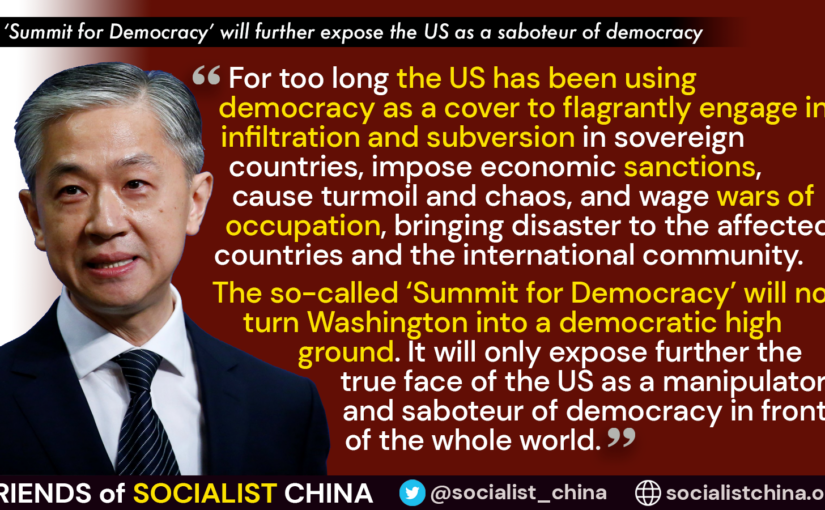
Quote: Wang Wenbin on the US’s brazen misuse of the word ‘democracy’

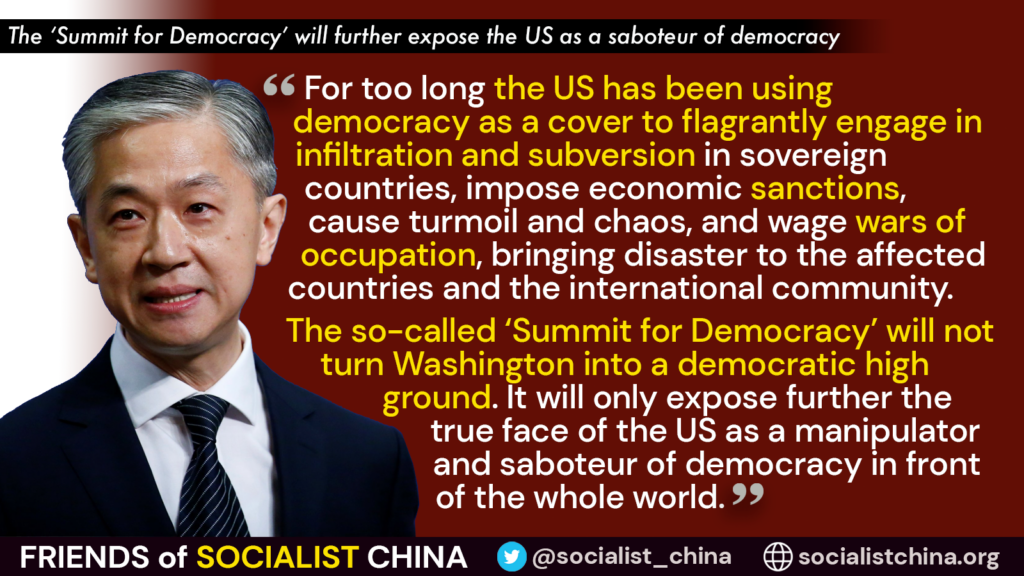
For too long the US has been using democracy as a cover to flagrantly engage in infiltration and subversion in sovereign countries, impose economic sanctions, cause turmoil and chaos, and wage wars of occupation, bringing disaster to the affected countries and the international community.

The so-called ‘Summit for Democracy’ will not turn Washington into a democratic high ground. It will only expose further the true face of the US as a manipulator and saboteur of democracy in front of the whole world.

Foreign Ministry Spokesperson Wang Wenbin’s Regular Press Conference on December 1, 2021

Danny Haiphong exposes the rank hypocrisy of the so-called Summit for Democracy

Co-editor of Friends of Socialist China Danny Haiphong appeared on By Any Means Necessary with Sean Blackmon and Jacquie Luqman to discuss the upcoming Summit for Democracy led by the Biden Administration. The conversation included an in-depth analysis of the differences between socialist democracy and capitalist democracy in preparation for FoSC’s upcoming Summit for Socialist Democracy. You can register for that here.