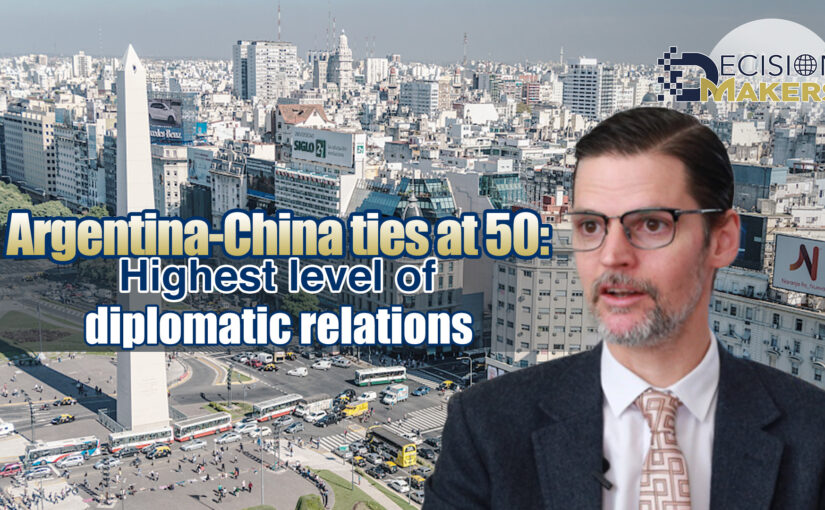
In this article for CGTN marking 50 years of diplomatic relations between China and Argentina, ambassador Sabino Vaca Narvaja details the deepening of the relationship over the last two decades in particular, starting with the Strategic Partnership announced by Hu Jintao and Néstor Kirchner in 2004. Most recently, Argentina has joined the Belt and Road Initiative, and the two countries are cooperating closely in an array of areas, including renewable energy, transport, housing and telecommunications. Vaca particularly notes China’s indispensable support during the Covid-19 pandemic: China supplied vast quantities of medical supplies, and has to date provided over 30 million vaccine doses. Sinopharm is now working with Sinergium Biotech to produce vaccines in Argentina.
Argentina and China are “comprehensive strategic partners,” the highest level of diplomatic relations, and this year we celebrate 50 years of diplomatic relations. Here I invite you to join me in a brief review of the evolution of this relationship.
Since the beginning of the new century, the bilateral relationship has deepened. It was precisely in 2004 that the government of Néstor Kirchner signed the “Strategic Partnership between Argentina and China” with the then Chinese President Hu Jintao. An important figure in this event was the then chief of the cabinet of ministers and now president of the nation, Dr. Alberto Fernández. In 2014, the relationship was raised even higher to the level of Comprehensive Strategic Partnership, with Cristina Fernández de Kirchner and Xi Jinping being presidents at that moment. Now the vice president is Cristina Fernández de Kirchner and the president is Alberto Fernández, who has just concluded a successful official visit to Beijing and signed the accession to the Belt and Road Initiative (BRI), deepening bilateral relations even more.
The nature of the comprehensive strategic partnership subscribed in 2014 by both governments implies a mandate to deepen cooperation in all areas, identifying and implementing projects that best meet the interests of both peoples. The potentialities of cooperation are incalculable since all areas are open to cooperation. In this aspect, we are working hard to consolidate and expand bilateral cooperation. An example of this is the Strategic Dialogue for Economic Coordination and Cooperation (DECCE). This mechanism is also in charge of implementing the Integrated Five-Year Plan which lists priority projects between both countries, such as photovoltaic parks, wind farms, gas pipelines, thermal power plants, transmission lines, dams and so on. There are also important projects related to strengthening our railway network, both in cargo and passenger transport and strengthening the connectivity of the Pacific through bi-oceanic corridors from east to west and the border crossings with Chile. Likewise, bridges, aqueducts, water treatment plants and residential buildings are being planned.
Continue reading Argentina’s ambassador to China reflects on 50 years of China-Argentina relations